Space Sunday: FRAM2, private missions, asteroids

Crew Dragon Resilience splashes down of the coast of California at the end of the 4-day FRAM2 mission. Credit: SpaceX

Previewed in my previous Space Sunday update, the FRAM2 mission lifted-off almost precisely on time from Kennedy Space Centre’s Launch Complex 39A at 01:46:50 UTC on April 1st, carrying the first humans to ever orbit the Earth in a low-Earth polar orbit.

The ascent to orbit, travelling south from the space centre, proceeded smoothly, the SpaceX Crew Dragon capsule and service module (“Trunk” in SpaceX parlance) entering a low Earth orbit with an apogee of 413 km and a perigee of 202 km some eight minutes after launch. The orbit, referred to as a polar retrograde, due to the fact the vehicle travelled first over the South Pole then around and over the North Pole, lay at an inclination of 90.01°, breaking the previous high inclination orbit record for a crewed space vehicle set by Vostok 6 in 1963.

Aboard the vehicle were Chinese-born, but Maltese citizen and crypto currency entrepreneur Chung Wang, who will be the mission’s commander and is a co-bankroller of the flight; Jannicke Mikkelsen, a Scottish-born Norwegian cinematographer and a pioneer of VR cinematography, 3D animation and augmented reality, who is the other co-bankroller for the flight; Eric Philips, a 62-year-old noted Australian polar explorer, who will be the first “fully” Australian national to fly in space, and Rabea Rogge, a German electrical engineer and robotic expert.

The 4-day mission comprised an extensive science programme, focusing on human health in space, growing food supplements on-orbit (oyster mushrooms) and investigating the Phenomena known as STEVE (see my last Space Sunday update) from orbit. The mission also included educational broadcasts to schools and a lot of social media-posted videos.

A video of Antarctica recorded by the FRAM2 crew. Seen in the footage is videographer Jannicke Mikkelsen, and the voice-over is from Eric Philips

To assist in observations and measurements, Resilience was fitted with the transparent Copula to replace the outer  airlock hatch and docking mechanism within the forward end of the capsule, affording the crew near-360º views of Earth once the vehicle’s protective nose cone had been opened.

The launch itself required a complete update of the Crew Dragon navigation software, originally written for lower 51º inclination orbits. This included a complete overhaul of the launch abort software for both capsule and launch vehicle. The latter was made necessary by the fact the ascent to orbit carried the vehicle over parts of South America, so any abort situation had to ensure that both booster and capsule would not return to Earth over land, and the capsule would be able to splashdown safely with the crew.

What really marked this mission, however, was the sheer transparency of operations; nothing in the video logs was pre-scripted or rehearsed; camera were rolling with conversations going on in the background – including conversations between crew members and SpaceX mission control about “known issue” with the space vehicle (not sure how significant – but being told that there is a “known issue” with a vehicle when you’re sitting in it in space might not be the most comforting thing to hear!), informal chit-chat during observations and an introduction to the fifth “crew member”, Tyler.

A compilation video of the mission, including shot through the inner hatch of the airlock showing Earth beyond the Copula. Note the inner hatch could also be opened to allow crew to enter the forward are and look out of the Cupola

While the mission had a lot of science goals – including testing a portable MRI unit, carrying out x-rays of the human body, studies into blood and bone health and glucose regulation in the body in micro-gravity – it has not stopped criticism being levelled at it, with some scientists stating the period spent in space being too short to yield practical results in some areas, and other aspects of the mission being labelled “a notch above a gimmick”.

For Chung, Mikkelsen and Philips in particular, however, the mission was as much personal as scientific: they have spent fair portions of their adult lives exploring the Polar regions, carrying out studies and research (the four all actually met during an expedition to Svalbard (leading them to nickname the mission “Svalbard 1”).

The first ever x-ray of a human hand taken in space (right) during tests of a small x-ray unit aboard the FRAM2 mission. The hand (with ring) was used in homage to the first ever x-ray of a human, captured by Wilhelm Conrad Röntgen (of his wife’s hand) in 1895 (l). Credits: Wilhelm Conrad Röntgen; FRAM2 / SpaceX

FRAM2 came to an end on April 4th, 2025, when, following an extended de-orbit, the combined vehicle re-entered the atmosphere and headed for a splashdown off the California coast where the SpaceX recovery ship was waiting for the vehicle. This marked the first splashdown for Crew Dragon off the west coast of the USA – although more will be following.

SpaceX has been criticised for the fact that during several missions returning crews from the International Space Station, the “Trunk” service module has in part survived re-entry, with elements coming down very close to populated areas. To avoid this, the company is moving crewed splashdowns to the west coast of the USA in order to ensure that should any parts of the Trunk survive re-entry they will splashdown in the Pacific Ocean.

As a test of this, the module used by Resilience remained attached to the vehicle for longer during the initial re-entry operations, in order to ensure that if any part of it did survive the heat of re-entry, the debris would fall to Earth over Point Nemo – the remotest part of the Pacific Ocean relative to human habitation, and referred to as the “spacecraft graveyard”.
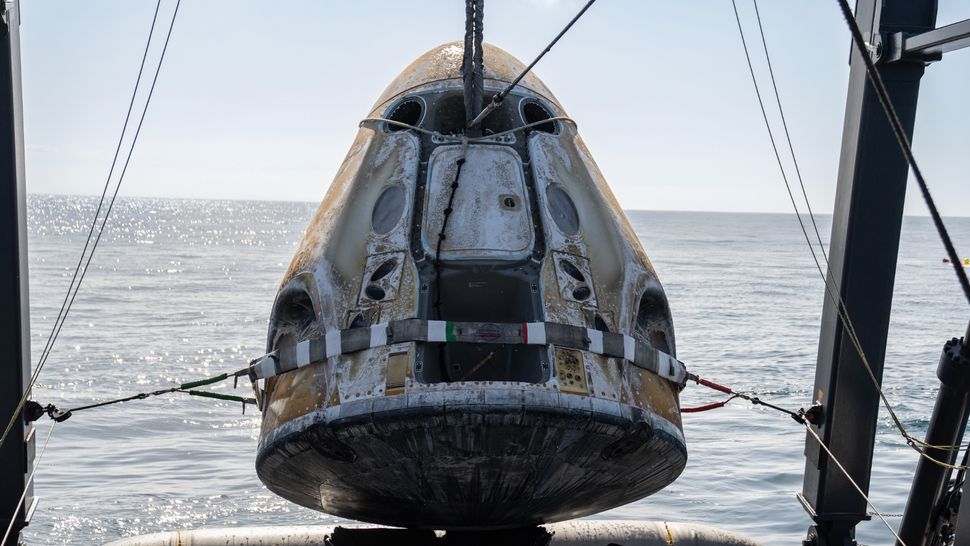
A re-entry seared Resilience is lifted aboard the SpaceX recovery vessel in preparation for crew egress. Credit: SpaceX

Splashdown occurred at 19:28 UTC on April 4th, with the capsule and crew safely recovered to the SpaceX recovery vehicle for transport to the port of Los Angeles.

NASA Opens-Out Requirements for Private Missions to the ISS

NASA has announced it is seeking proposal for two further private astronaut missions (PAMs) to be conducted to the ISS – and for the first time, the requirement that such missions must be commanded by former NASA astronaut has been removed.

The agency is planning to pivot away from the International Space Station (ISS) operations as it nears its end-of-life (some of the Russian elements of the station are already well outside their “warranty” – that is, their intended lifespan), with the hope that the private sector will take over low-Earth orbit research and station operations. Currently, there are a number of proposals for doing so – perhaps most notably Axiom Space and the orbital Reef consortium led by Blue Origin and Sierra Space.

Axiom Space already has a contract with NASA to add its own modules to the ISS, starting in 2027 with the launch of the PPTM – Power, Propulsion and Transfer Module. This will then be joined by at least a second module, Hab-1, prior to the decommissioning of the ISS. These modules will then be detached from the ISS to become a free-floating hub to which Axiom will add further modules.
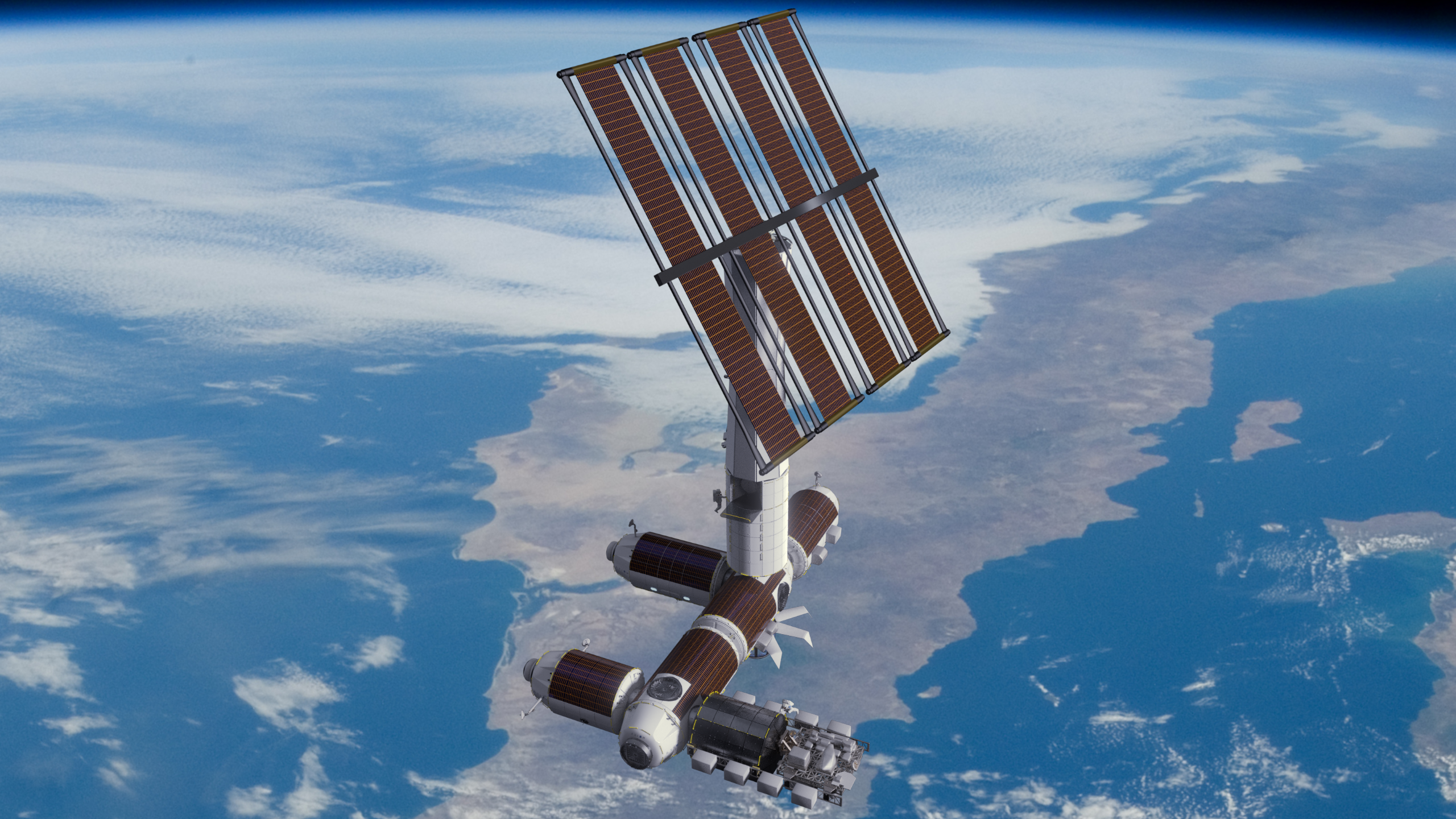
An artist’s impression of the Axiom space station as it will look when completed and free-flying. Credit: Axiom Space

To prepare for this, Axiom signed an agreement with NASA to fly four missions to the ISS between 2022 and 2025, with the option on a fifth. Three of these form the only fully private missions yet flown to the ISS, and all have been commanded by former NASA astronauts – Michael López-Alegría (Axiom AX-1 and Ax-3) and Peggy Whitson (Ax-2), with Whitson also set to command AX-4, currently targeting a May 2025 launch.

Under the new NASA PAM requirements, private missions are now required to be commanded by any astronaut who has served as a long-duration ISS crewmember (defined as 30 days or more in the ISS) and who has been involved in ISS operations in the last five years or else shows evidence of “current, active participation in similar, relevant spaceflight operations”. This therefore opens the door for missions to be commanded by Canadian, French, German, English, Japanese, etc., astronauts meeting the requirements to command missions by commercial providers.

The move to relax the requirements is to help remove the reliance on purely NASA-based experience to lead private sector missions into orbit and allow companies like Axiom, Blue Origin and – most notably, perhaps – Vast Space, who have a MOU with SpaceX to fly two PAM missions to the ISS but have yet to meet NASA’s requirements to do so, to start formulating their own requirements, gain expertise and build partnership and processes to assist in their efforts to establish on-orbit facilities.
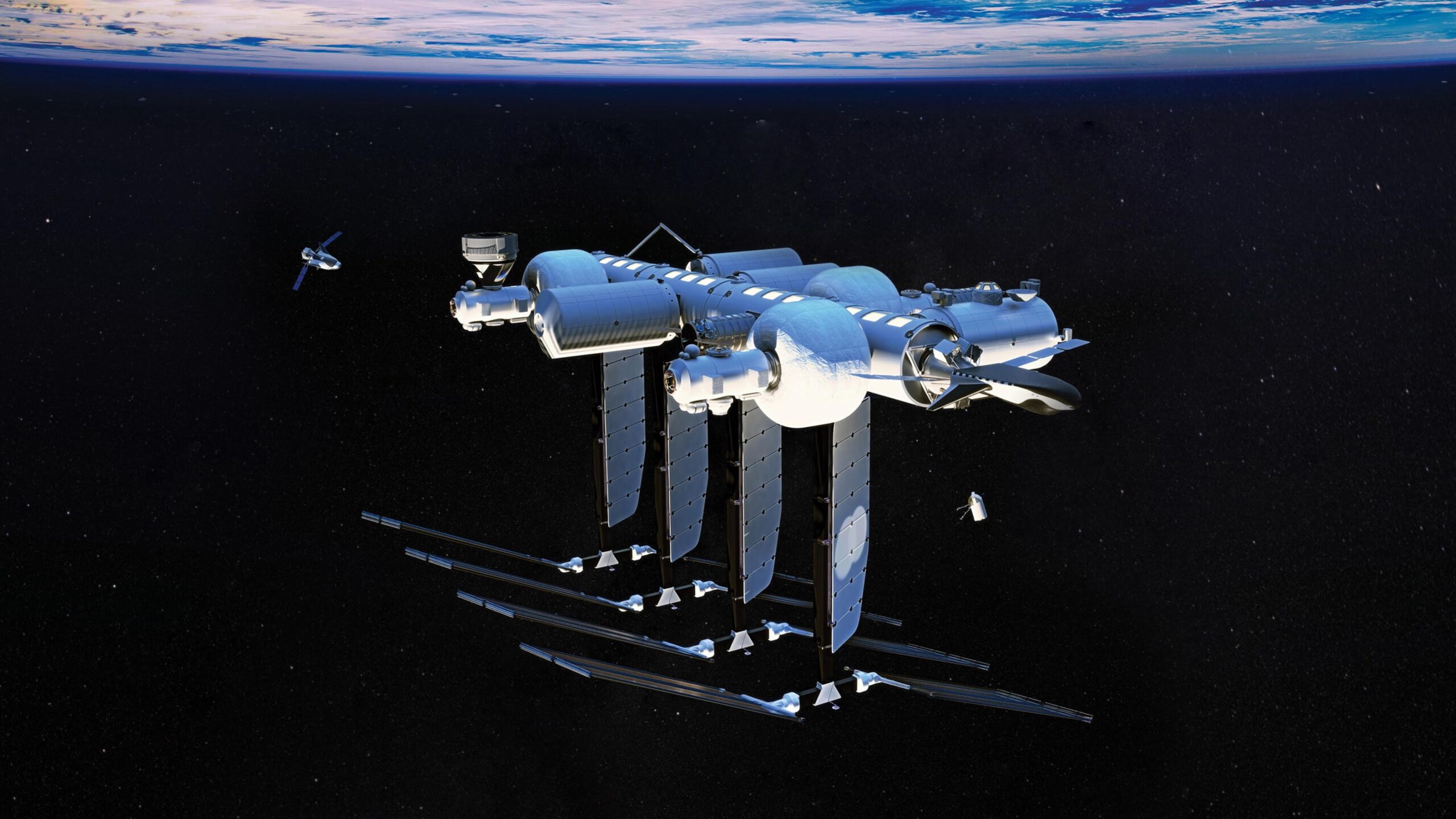
The Blue Origin / Sierra Space-led Orbital Reef space station design, which will utilise the Boeing CST-100 Starliner for crew transfers, and the Sierra Space Dreamer Chaser spaceplane for cargo transfers. Credit: Blue Origin / Sierra Space / Boeing

The announcement by NASA is of potential import to the UK: Axiom have an agreement in place with SpaceX to fly a total of five Ax missions to the ISS. However, the fifth – provisionally aiming for 2026 – has yet to be crewed, and there have been discussion between Axiom and UK officials about the mission being an “all British” crew, comprising Tim Peake as mission commander, who flew the Expedition 46/47 rotations on the ISS, together with fellow UK European Astronaut Corps members  Meganne ChristianRosemary Coogan and Paralympic sprinter (and surgeon)  John McFall.

New Glenn Mishap Investigation Completed

The Federal Aviation Administration announced March 31st, 2025 that it has accepted the findings of an investigation led by Blue Origin following the loss of the first stage of the company’s New Glenn heavy lift launch vehicle during its maiden flight on January 16th, 2025 (see: Space Sunday: NG-1 and IFT-7).

While the overall goals of that mission were met, a secondary goal – recovering the rocket’s large first stage by landing it at sea board a landing vessel – failed, the booster stage falling back into the Atlantic Ocean. Whilst no debris was strewn across flight corridors or fell on populated areas (unlike recent SpaceX Starship launch attempts), the failure of the planned booster recovery, whilst always rated by Blue Origin as having a minimal chance of success on the very first flight of the rocket, meant the vehicle’s launch license was correctly suspended by the Federal Aviation Authority (FAA) until a full Mishap Investigation into the cause of the loss had been carried out by Blue Origin and the FAA had accepted the findings and remedial actions taken.

The investigation report was duly supplied in March 2025, and identified the booster’s inability to re-ignite its motors during descent as the cause of the loss. Whilst no precise cause(s) for this failure have been openly published, Blue Origin has indicated seven areas where remedial work has been undertaken on the vehicle’s flight systems, and the FAA now consider the investigation closed. As a result – subject to a final inspection of the changes made – the license suspension should be lifted before the end of April. In the meantime, Blue Origin has been given the all-clear to resume preparations for the next New Glenn launch.

The maiden flight of Blue Origin’s New Glenn rocket lifts-off from Launch Complex 36 at Cape Canaveral Space Force Station on January 16th, 2025. Credit: Blue Origin / USSF

All of this is in stark contrast to the handling of the last two SpaceX Starship launches (IFT-7 and IFT-8). Both resulted in the complete loss of the Starship upper stages well within Earth’s atmosphere, resulting in debris falling over the Greater Antilles (and some of it striking close to populated areas on the Turks and Caicos islands) together with a degree of disruption to commercial flights in the region. However, in the case of IFT-7, the FAA cleared the launch of IFT-8 before the Mishap Investigation was closed, and appears to be on course to do so in the case of IFT-8, with SpaceX already ramping-up for the next test article flight.

In the meantime, assuming the New Glenn license is renewed in April, the next launch for the vehicle could come as soon as “late spring 2025” (end of May). However, no payload for the flight has been specified, only that it will include a further attempt to return the first stage to an at-sea landing aboard Landing Platform Vessel 1 Jacklyn.

Some reports had suggested this next launch could comprise the Blue Moon Mark 1 lander – an automated vehicle capable of delivering up to 3 tonnes of payload to the surface of the Moon and intended to demonstrate / test technologies to be used in the company’s much larger Blue Moon Mark 2 lander, designed to deliver crews to the surface of the Moon. However, in discussing the launch path for New Glenn, Blue Origin CEO David Limp indicated that a launch of Blue Moon Mark 1 is unlikely to occur before late summer 2025 at the earliest.

2024 YR4 Seen At Last

As I noted in February 2025, 2024 YR4 is an Earth-crossing Apollo-type asteroid discovered on December 27th, 2024. It caused a bit of stir at the time, as there was a non-zero chance that as it pursued its own orbit around the Sun, in 2032 it could end up trying to occupy the space volume of space as taken-up by or own planet, with potentially disastrous and deadly results for anyone and anything caught directly under / within the air blast that would likely result from its destruction as it tore into our atmosphere.

Fortunately, continued observations of the asteroid – which passes across Earth’s orbit roughly once every 4 years – have shown the threat of any impact in 2032 are now very close to zero (although it does still exist on the tiniest of scales, together with a smaller chance of it hitting the Moon).

At the time of its discovery, 2024 YR4 was classified as a stony S-type or L-type asteroid, somewhere in the region of 50-60 metres across (roughly the same size as the fragment which caused the 1908 Tunguska event). That size estimate has now been confirmed, and what’s more, we now have our first (and admittedly fuzzy) images of the fragment, courtesy of the James Webb Space Telescope (JWST), and they reveal it to be a strange little bugger.

2024 YR4 imaged by JWST’s NIRCam on 8 March 2025. Credit: NASA/ESA

Imaged and scanned by the US Near-InfraRed Camera (NIRCam) and British-led European Mid-InfraRed Instrument (MIRI), 2024 YR4 is indeed some 60 metres across at its widest. It is also somewhat unlike similar asteroids in its spectral type, in that it has a high spin rate as it tumbles around the Sun and appears to be more a conglomeration rocks banded together, rather than a single chunk of rock.

Observations are continuing to ensure the 2032 rick of impact is completely eliminated and also to provide data to calculate impact risks beyond 2032, whilst the data obtained by JWST – which mark 2024 YR4 as the smallest object the observatory has every imaged from its L2 HALO orbit – are being used to help scientists to better characterise NEOs of a similar size and spectral type and more fully understand how they might react were one to strike our atmosphere.
Space Sunday: A landing, a topple, a return and another failure

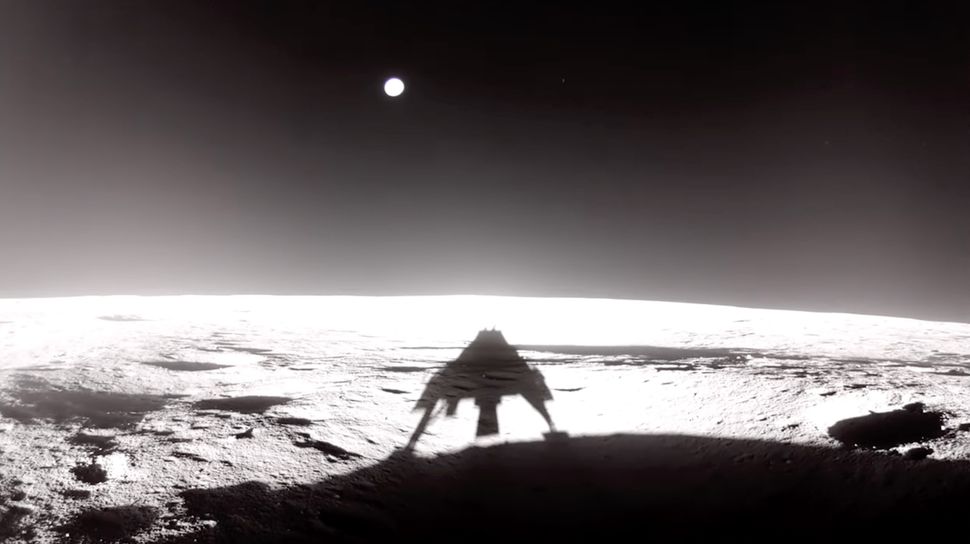
The Earth, brightly reflecting sunlight, sits above the horizon over Mare Crisium, the shadow of Firefly Aerospace’s Blue Ghost capturing the fact the lander was on the Moon. Credit: Firefly Aerospace

I’ve covered the US-led Project Artemis quite a lot in recent Space Sunday pieces, largely as a result of all the speculation about NASA’s Space Launch System (SLS) and Orion vehicle facing potential cancellation (for the tl;dr folk, whilst SLS is perceived as being “too expensive” the practicalities are that, like it or not, there is no launch capability available which could be easily “slotted-in” to Artemis to replace it any time soon). However, another reason for doing so, is the support work and missions related to Artemis are busily ramping up.

Back in January, Firefly Aerospace saw the launch of their Blue Ghost lunar lander on a shared ride to the Moon atop a SpaceX Falcon 9 rocket, its companion being the Japanese private-venture Hakuto-R Mission 2 lander Resilience. Whilst built and operated by Firefly Aerospace, Blue Ghost Mission 1 – which also has the mission title Ghost Riders in the Sky, named for the 1948 song of the same name – has been developed under NASA’s Commercial Lunar Payload Services (CLPS) programme, and thus has the official NASA designation (just to confuse things further) of CLPS TO 19D.

After a gentle cruise out to the Moon by steadily increasing its orbit distance from Earth until it could transfer to a distant lunar orbit and then slowly close on the Moon from there – thus requiring minimal propellant payload – the Blue Ghost vehicle touched-down on the Moon on March 2nd, 2025, becoming the first commercial lunar lander to reach the surface of the Moon and commence operations.

Another image from the Blue Ghose Lander, again showing the Earth above the horizon and reflected in the surface of one of the lander’s solar arrays. Credit: Blue Ghost

The vehicle is intended to have an operational lifespan of 14 days (one lunar day), and carries 10 experiments which utilise the lander’s solar power generation system. Roughly the size of a small car, the vehicle landed not in the southern polar regions of the Moon – the target area for Artemis missions – but within Mare Crisium, a 556 km basin to the north-east of Mare Tranquillitatis, the region in which Apollo 11 landed in 1969.

Despite this more northerly landing location, the mission’s objectives remain in line with Artemis, being intended to gather additional data on the properties of lunar regolith, together with its geophysical characteristics, as well as measuring the interactions between Earth magnetic field and the solar wind – all of which will help in the preparations for the long-term human exploration of the Moon and “routine” travel between Earth and cislunar space.

The location of Mare Crisium on the Moon, to the north-east of Mare Tranquillitatis where Apollo 11 landed in 1969. Credit: NASA

And if you’re wondering about Blue Ghost’s companion during the launch for Earth, Japan’s Resilience, which also carries a lunar rover, is taking the “scenic” route to the Moon, arriving there in early June 2025, at which point I’ll hopefully have an update on that mission.

However, Blue Ghost was not intended to be the only US lander reaching the Moon in early 2025. Also a part of NASA’s CLPS programme, the Athena lander, built and operated by Intuitive Machines, had been slated to arrive on the Moon and commence operations on March 6th, having also been launched on its way to the Moon atop a SpaceX Falcon 9 on February 27th, 2025.

Officially designated IM-2 / CLPS-3, the lander – christened Athena and classified by the company as a Nova-C lander – was the second lunar lander mission undertaken within the CLPS programme by Intuitive Machines, their first having been launched to, and reaching, the Moon in February 2024. However, that lander, called Odysseus, toppled over on landing (see: Space Sunday: Lunar topples, space drugs and wooden satellites), effectively ending that mission.

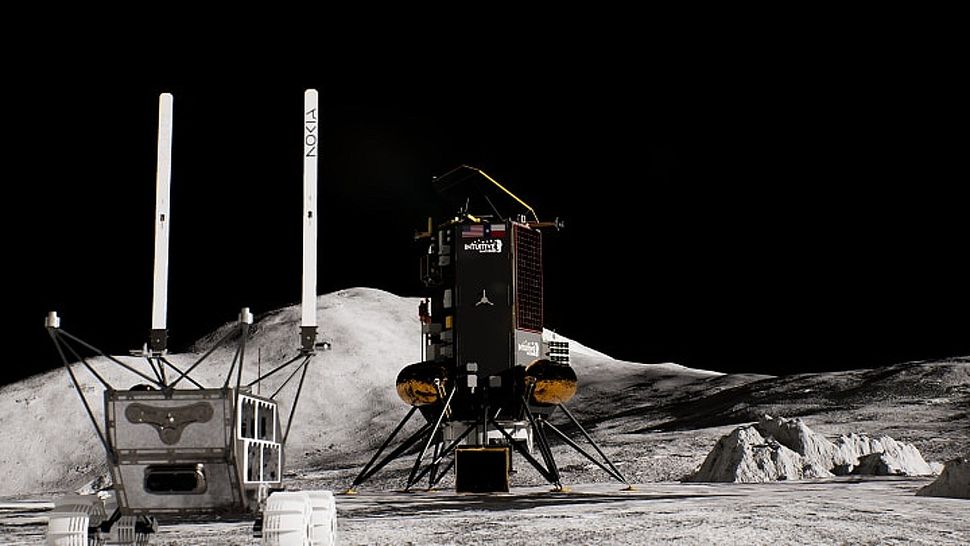
A artist’s impression of the MAPP rover driving away from the Athena lander. Credit: Intuitive Machines / Lunar Outpost

Like Odysseus, the IM-2 mission was targeting the Lunar South Polar Region for a landing, in this case the tallest mountain on the Moon to be given its own name (in 2022): Mons Mouton, named for Melba Roy Mouton, a pioneering African-American mathematician at NASA during the 1960s, the peak having previously been regarded as part of the broader Leibnitz plateau. In addition to its own science mission, the lander also carried a trio on small-scale landers – Grace, a hopper-style mini-rover also made by Intuitive Machines and massing just 1 kg; the Mobile Autonomous Prospecting Platform (MAPP), a 5-10 kg rover with a 15 kg payload built and operated by a consortium; and AstroAnt, a matchbox-size micro rover from MIT, which would have trundled around the back of MAPP using magnetic wheels taking measurements on the amount of heat absorption and heat radiation to help determine the thermal regulation requirements on future rovers operating within the temperature regimes of the lunar South Polar Region.

Both Athena and Odysseus share the same overall design, being very tall, slim vehicles with elevated centres of mass.  With Odysseus, this appeared to combine with a horizontal drift of the vehicle during its landing attempt (the vehicle’s telemetry indicated it was crabbing sideways at around 3.2 km/h at touch-down, rather than descending vertically), to cause it to topple over.

An AstroAnt “swarm rover” as developed by MIT. Credit: MIT

On March 6th, 2025, Athena appeared to suffer a similar fate: as the vehicle neared the surface of Mons Mouton, its motors kicked-up a plume of dust which prevented the vehicle’s lasers and rangefinders from guiding the spacecraft. While data was received to indicate Athena had landed, it also indicated the loss of one of the lander’s two communications antennas and that power was being generated by the vehicle’s solar arrays well below nominal levels.

Subsequent to the landing, the mission team placed Athena into a “safe” mode to conserve power. However, images taken by both the lander and from NASA’s Lunar Reconnaissance Orbiter (LRO) as it passed over the landing site confirmed Athena had toppled over on touch-down and to be laying in a small, shallow crater, either as a result of sideways drift in the final phase of landing or as a result of one of more landing legs overhanging the edge of the crater at touch-down.

An image returned by Intuitive Machine’s Athena lander, showing it lying on its side on the Moon following its March 6th, 2025 attempted landing. Credit: Intuitive Machines

Despite the fall, Intuitive Machines regard the mission as a “success” inasmuch as the vehicle returned data all the way up to the point of landing, and was able to briefly power-up some of the on-board instruments despite falling into the crater. However, given this is the second incident wherein a tall, slim lander with a high centre of mass has toppled over when landing in what is acknowledged to be one of the toughest and mostly unknown regions of the Moon to reach, it could  call into question the suitability of the SpaceX 50-metre tall human landing system (HLS) to successfully make similar landings within the environment.

X-37B Returns Home

Released in February 2025, this image from the USSF’s X-37B spaceplane was captured in October 2024, during the 7th mission of the OTV programme. Credit: United States Space Force

The US Space Force’s highly-secretive X-37B space plane returned to Earth on Friday, March 7th (UTC), marking the end of a 434-day mission in orbit. The 9-metre long automated vehicle – one of two currently operated by the USSF – originally lifted-off from Kennedy Space Centre’s Lunch Complex 39A (LC-39A) atop a SpaceX Falcon Heavy booster in December 2023, on the seventh overall flight of the Orbital Test Vehicle mission (OTV-7).

As with the previous six missions in the programme, much of OTV-7 was completed in a blanket of secrecy; however, unlike them, the mission did not continue to push the envelope of flight duration. Whereas the 2nd through 6th OTV flights repeatedly increased the number of days one of the vehicles could spend in orbit (from 224 days in the case of the first mission to just under 3 hours shy of 909 days in the case of OTV-6), this seventh flight was the second shortest to date.

Which is not so say it was without precedent; whilst the previous missions had been confined to the sphere of low-Earth orbit operations, OTV-7 saw the spacecraft placed into a highly elliptical orbit (HEO0, with a perigee of just 323 km, and an apogee of 38,838 km. This orbit not only illustrated the vehicle’s ability to operate at significant distances from Earth, but also allowed it to demonstrate its ability to using aerobraking – dipping into the upper reaches of Earth’s denser atmosphere as a means to both decelerate a space vehicle and / or to alter its orbit. Whilst often used by robotic missions to Mars and Venus, the aerobraking by OTV-7 marked a first for a US winged space vehicle, giving the X-37B an additional operational capability, such as detection avoidance by altering both orbital inclination and altitude during such a manoeuvre, a capability which could be extended to future generations of US military satellites.

In another departure from previous missions, in February 2025, the US Department of Defense (DoD) released images taken from the X-37B while in space – the first time any such pictures of the vehicle on-orbit have entered the public domain.

Following a de-orbit burn of its main propulsion system, the X-37B vehicle successfully re-entered the Earth’s atmosphere and glided to a landing on Vandenberg Runway 12, wheels touching down at 07:22 UTVC on Friday, March 7th, 2025. There is obviously no word on when one of the vehicles might next be placed into orbit.

Starship Blows It – Again

On March 6th, 2025, and less than two months after their previous attempt, SpaceX tried to deliver one of their Starship vehicles onto a sub-orbital flight. Called Integrated Flight Test 8 (IFT-8), the flight was intended to be something of a repeat of January’s IFT-7 – and it turned to be almost a direct carbon copy of that flight in more ways than intended.

The primary goals of the mission were to:

  • Launch the combined vehicle and recover the booster at the launch site.
  • Deliver a Starship “block 2” vehicle incorporating numerous design changes into a sub-orbital track and deploy a series of dummy Starlink satellites & carry out an on-orbit re-light of some of the vehicle’s engines to simulate a de-orbit burn.
  • Starship re-entry and possible splashdown, testing new thermal projection system tiles and the function of the redesigned forward aerodynamic flaps.

What was not on the cards was an almost to-the-minute loss of the Starship vehicle in what appears to have been very similar circumstances to the last flight – and with an initially similar aftermath.

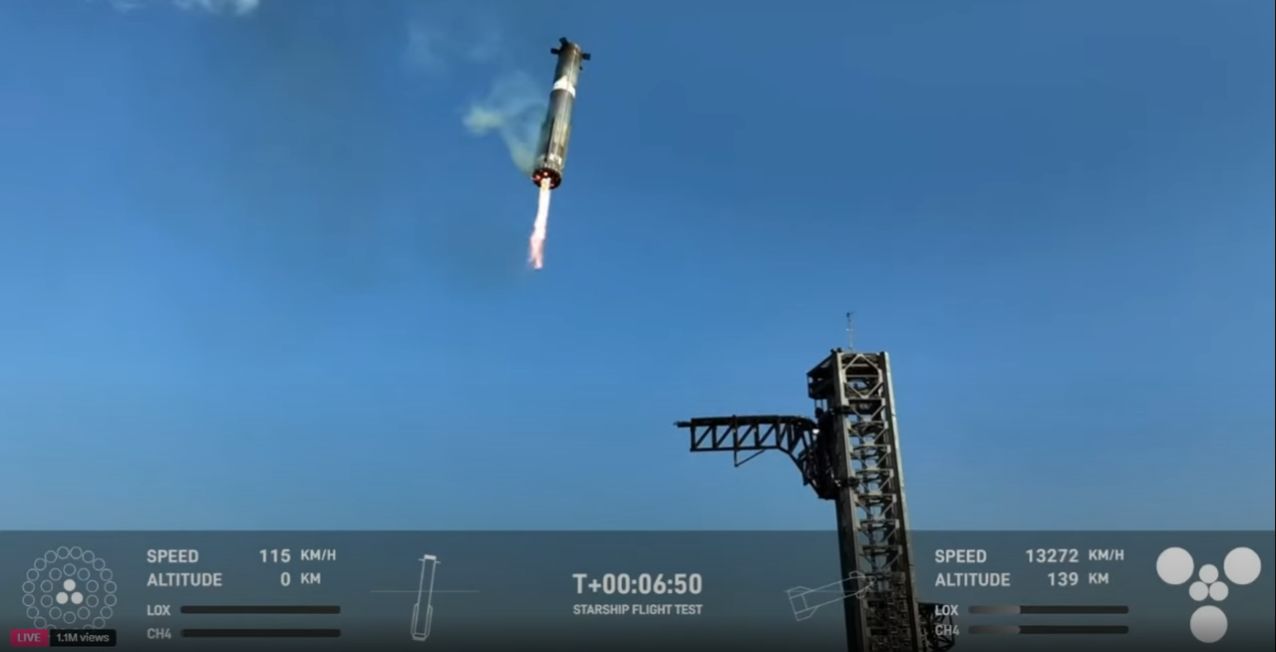
The catcher is ready: the Super Heavy booster used in IFT-8 decelerates on three engines as it closes on the launch tower at Boca Chica in readiness for a perfect “catch”. Credit: SpaceX

The first goal of the mission was carried out successfully: the 123-metre tall stack of Super Heavy vehicle and Starship vehicle departed the launch facility at Boca Chica, Texas, at 23:30 UTC, with the booster pushing the Starship up to the assigned “hot staging” altitude. At this point, the vehicles separated, and the booster completed the necessary “boost back” operations to return to the launch site and be “caught” by the “chopstick” arms on the launch tower 7 minutes and one second after its initial departure.

However, and echoing the events of January’s IFT-7, the Starship vehicle encountered what appear to again be engine / engine bay related issues. At 7 minutes 45 seconds into the flight, images from inside the vehicle’s engine skirt showed both clouds of propellant gases streaming around the exhaust bells of the inner three sea-level Raptor engines, together with signs of some form of burn-through on the engine bell of one of the outer large vacuum Raptor engines (referred to as “Rvacs”). The images were followed at 8:04 into the flight by the premature shut-down of an Rvac motor, followed in rapid succession by all three sea-level engines.

First indications: on the left, signs of a fire burning through part of an Rvac exhaust bell can be seen circled, while right-of centre, a plume of propellant gas can be seen passing over one of the three sea-level engine bells prior to entering the exhaust flow. Credit: SpaceX

With just two fixed Rvac motors running, the vehicle entered an uncontrolled tumble and likely started to break-up somewhere between 9:19 and 9:30 into the flight. Shortly after this, observers in parts of the Caribbean, from the Dominican Republic to the Bahamas, and as far north as Florida’s Space Coast, reported seeing the vehicle explode and debris falling. As a result, and as with IFT-7, the FAA implemented a number of debris response areas along the vehicle’s flight path over the Greater Antilles, closing off airspace. This resulted in some flights either being placed in holding patterns outside the threat areas, or being diverted to other airports or being held on the ground.

Following the loss of the vehicle, the FAA once again suspended the Starship launch license and announced a mishap investigation to be led by SpaceX. This is common practice – the operator leading the investigation into the loss of their vehicle, with FAA having oversight and a final say in allowing the resumption of flights. However, what is far from usual is that the launch operator takes it upon itself to unilaterally declare the issues surrounding the vehicle loss had been investigated and resolved, and launches would therefore be resuming. However, this is precisely what happened in the case of IFT-7 on February 24th, 2025, with the FAA (now very much under the thumb of the SpaceX CEO in his “special appointment” role within the Trump administration) releasing the license to allow Starship operations to resume whilst leaving their investigation open.

As such, there are significant question to be asked in relation to both what actually happened following IFT-7 in terms of issue rectification, whether the loss of IFT-8 might indicate a significant design flaw in the Starship “block 2” vehicle, and whether or not the FAA’s ability to properly manage oversight of commercial space companies – or at least SpaceX – may have been compromised given the SpaceX CEO’s new position of authority within the Trump administration (although getting an answer to this question is highly unlikely).

Space Sunday: NG-1 and IFT-7

New Glenn NG-1 rises from SLC-36, Canaveral Space Force Station, Florida, on the morning of January 16th, marking the start of the vehicle’s maiden flight. Credit: Blue Origin

This past week marked several space launch events and announcements, including India’s first successful on-orbit rendezvous and docking between two of its satellites, However, for this edition of Space Sunday, I’m focusing on the two “biggies” of the week.

New Glenn NG-1: Primary Goal Met, even with Booster Lost

On Thursday, January 16th, 2025, Blue Origin’s New Glenn rocket finally lifted off on its maiden flight after multiple delays over a 4-year period.

Originally targeting 2020/21 for a first launch, New Glenn was delayed numerous times both as a result of changes to the vehicle’s overall design (some coming as late at 2018), technical issues in development, external forces such as the COVID-2 pandemic, and as one Blue Origin executive put it in 2018, “we study a little too much and do too little.”

Such was the delay that the company lost the chance to debut New Glenn with a high-profile launch – that of NASA’s EscaPADE mission to Mars. In late summer of 2024, the US space agency became concerned enough over Blue Origin’s ability to meet the required November 2024 launch window for the mission, the decision was made to push back EscaPADE to a spring 2025 launch date. Instead, the first New Glenn flight – NG-1 – took place with a prototype / demonstrator payload of another of the company’s vehicles, Blue Ring. This is a spacecraft platform designed to support spacecraft operation, under development by Blue Origin. The platform is to be capable of refuelling, transporting, and hosting satellites.

An artist’s impression of a Blue Ring vehicle in Earth orbit with its pair of 22-metre solar arrays deployed to provide electrical power and propulsion. Credit: Blue Origin

With a payload capacity of up to three tonnes and fully able to be refuelled itself, Blue Ring is capable of performing the role of a space tug, moving payload between orbits and itself capable operating in geostationary orbit, lunar orbit, cislunar space and within the Earth-Moon Lagrange points. This makes it a highly flexible vehicle, something added to by its mix of electric and chemical propulsion systems and its ability to be carried by a range of launch vehicles as well as New Glenn.

This first flight on Blue Ring did not see the vehicle detach from the rocket’s upper stage; instead, the launch was to test of whether New Glenn could accurately deliver it to an assigned orbit with a high level of accuracy and whether the vehicle’s own flight and data-gathering systems operated correctly. Both of these are key to both New Glenn and Blue Ring gaining certification to carry out US National Security Space Launch (NSSL) operations.

New Glenn on the launch stand at SLC-36, as seen from the just off the Florida coast. Note the large black object alongside the rocket is the Launch Table, a platform used to hold the rocket in both its horizontal orientation when being rolled-out from the integration building to the pad, and provide launch-tower like support when the vehicle is upright. Credit: Blue Origin

Lift-off for NG-1 came at 07:03 UTC on January 16th, the 98 metre tall two-stage vehicle rising from Space Launch Complex 36 at Canaveral Space Force Station. All seven BE-4 liquid oxygen / liquid methane engines on the first stage worked flawlessly, successfully pushing the vehicle up to a stage separation some 21 km above the Earth. The upper stage then lifted the Blue Ring pathfinder into an elliptical medium Earth orbit (MEO) with an apogee of 19,300 km and a perigee of 2,400 km at a 30-degree inclination (and not a “low Earth orbit” as some outlets reported) some 13 minutes after launch.

While the payload did not separate from the New Glenn upper stage, its on-board systems did power-up, allowing it to provide detailed telemetry as to its position and orbit – confirming it had deviated less than 1% from its optimal orbital track. Over a 6-hour period the pathfinder vehicle completed all assigned tasks, and the New Glenn was “safed” (all remaining propellants and any potentially hazardous elements such as batteries, vented / jettisoned).

All of this marked a highly successful maiden flight for New Glenn – which already has a fairly full launch manifest. However, there was one hiccup: Like SpaceX’s Falcon family, New Glenn’s first stage is designed to be recovered and re-used; and while ambitious, Blue Origin hoped to achieve what it admitted was “secondary goal” on the flight, and one unlikely to happen, a successful recovery of the NG-1 first stage aboard the Landing Platform Vessel Jacklyn, station-keeping some 1,000 km off the Florida coast.

However, following second stage separation, the first stage of the booster entered into a re-entry burn using three of its main engines, and at T+ 7:55, telemetry froze at the planned end of that burn, indicating the stage had been lost at an attitude of approximately 26.5 km while travelling at some 6,900 km/h.

Exactly what happened is unclear – the stage loss is now subject to a Federal Aviation Administration (FAA) Mishap Investigation which, following standard FAA practice, will be led by Blue Origin as the launch vehicle operator, and subject to FAA oversight. It is not clear at present in this investigation will impact on upcoming New Glenn launches; that will depend on what is identified as the cause of the loss.

Starship IFT-7: Booster Caught, but Exposed the Risks

Almost on January 16th, 2025, SpaceX attempted the seventh integrated flight teat (IFT) of their Starship / Super Heavy (S/SH) launch system. The launch featured Booster 14 (a Block 1 – i.e. “original version”- vehicle) and a Ship 33, a Block 2 craft said to feature multiple updates and improvements to increase “reliability, capability and safety”.

Chief among the changes to the Block 2 series of Starship vehicles and their predecessors are:

  • An increase in hull length by 3.1 metres.
  • Redesigned forward aeroflaps, which are smaller and thinner than Block 1, thinner, and positioned both further forward and more leeward (further “up” the hull relative to the heat shield in an attempt to reduce their exposure to plasma flow heating during re-entry).
  • A 25% increase in overall propellant load.
  • Redesigned flight avionics, improvements to the interstage venting.

Additionally, Block 2 vehicles are specifically designed to fly with the upcoming Raptor 3 engine, which is an even lighter variant of the motor (1.525 tonnes), wither greater maximum thrust (280-300 tonne-force (tf) at sea level compared to Raptor 2’s 230 tf). However, Ship 33 flew with Raptor 2 motors. The Block 2 vehicle is also the first variant of Starship reportedly designed to lift 100 tonnes of payload to LEO.

IFT-7 was to be a further proving flight for S/SH, with a number of core milestones:

  • Vehicle launch with booster recovery.
  • Starship sub-orbital insertion & on-orbit re-light of engines.
  • Starship deployment of a dummy Starlink payload via a “pez dispenser” hatch.
  • Starship re-entry test and possible splashdown.

It’s important to note that whether or not Ship 33 survived re-entry was to be questionable. Ship 33 had a reduction in the area of its hull covered by thermal protection system tiles in an attempt to reduce vehicle mass and complexity, and intentionally had a number of tiles removed from various points to test the ability of the steel used in the vehicle to withstand heating (the areas devoid of tiles will eventually mount the “catch pins” required during launch tower recovery operations.). Therefore, the loss of this vehicle during re-entry was considered likely, even if everything else went smoothly.

Ship 33 and Booster 14 lift-off from Boca Chica, Texas at the start of IFT-7, January 16th, 2025

IFT-7 launched from the SpaceX facilities at Boca Chica, Texas, at 22:37 UTC, and the initial ascent proceeded smoothly. At 2:32 into the flight and at around 60 km altitude, the booster shut down all but its central three directional motors ready for “hot staging” – the ignition of Ship 33’s six motors and its separation from the booster. This took place at T+ 2:46, the booster immediately re-lighting all but one of its inner ring of 10 fixed motors at the start of the boost-back manoeuvre designed to stop its ascent and push it back towards the launch point.

Boost-back lasted some 42 seconds before the inner ring of motors on the booster shut down again, immediately followed by the jettisoning of the hot stage (the ring mounted between the booster and the starship and used to deflect the latter’s exhaust flames away from the former during the hot staging sequence. At this point the booster was in an aerodynamic fall / glide back towards Boca Chica, the fall becoming increasingly vertical as it closed on the launch point.

Just over 3 minutes after shutting-down from boost-back, all 10 motors on the booster’s inner ring re-lit at approximately 1.2 km altitude, slowing its decent, before shutting down a final time 8 seconds later, allowing the three directional motors to both continue to slow the boosters descent to a hover and guide it between the “chopstick” arms of the launch tower’s “Mechazilla” mechanism for a successful “catch”, marking a successful conclusion to the initial two milestones for the flight.

Meanwhile, Ship 33 continued its ascent towards a sub-orbital trajectory. Then, at 7:39 into the flight and at an altitude of 141 km, telemetry indicated one of Ship 33’s inner three inner sea-level Raptor motors prematurely shut down. Fourteen seconds later, livestream camera footage appeared to show flames from an internal fire passing over the exposed hinge mechanism of an aft flap. This is followed by telemetry indicating the loss of a second sea-level Raptor, together with one of the outer three vacuum-optimised Raptors, likely resulting in an off-centre thrust from the three remaining motors (only one of which – the central sea-level motor – could be gimballed to provide directional thrust to counter the thrust bias from the two fixed outer motors.

At 8:19 into the flight, and at altitude of 145 km, telemetry indicates the last of the remaining central motors and one of the two outer motors were no longer functioning. Seven seconds later, telemetry freezes, suggesting at this point the vehicle was breaking up. As has been seen from numerous videos released over social media, it appears the vehicle exploded (euphemistically called “a rapid unscheduled disassembly” by SpaceX, a term making light of the potential harm such an event can cause).

A close-up of a still from the IFT-1 livestream showing one of the hinge mechanisms on a aft flap of Ship 33 – flames are just visible passing through the aperture. Credit: SpaceX

SpaceX founder Elon Musk made light of the event, stating SpaceX had already likely identified the cause – a propellant leak resulting in a fire within the aft section of Ship 33 – and the next flight, planned for February will not be affected.

Whether this is the case or not remains to be seen; like it or not, the FAA have called for a mishap investigation; there’s also the fact the break-up of Ship 33 highlights the potential risk of flights out of Boca Chica. These carry ascending vehicles directly over over the Caribbean and close to many of the islands and archipelagos forming the Greater Antilles (including the Bahamas, Cuba, the Turks and Caicos, Hispaniola, Puerto Rico and the Virgin islands) – thus presenting a high risk of debris falling on populated areas.

As it is, debris from this flight has been reported as striking the Turks and Caicos Islands (fortunately without injury), and the spread of debris required the delay and diversion of numerous flights from and into the region (whilst passengers in some already in the area witness the aftermath of the vehicle’s destruction). These points alone warrant a review of the risks involved in launches out of Boca Chica.

Space Sunday: big rockets and (possible) ISS troubles

A shot from the “flap cam” on Starship, showing the Super Heavy immediately after separation during IFT6. Note the residual gases burning within the hot staging ring. Credit: SpaceX

The sixth integrated flight test (IFT-6) of the SpaceX Starship / Super Heavy behemoth took place on Tuesday, November 19th, 2024, and proved to be perhaps the most successful test yet of the system, even though the core aspect of the first part of the flight didn’t occur.

The vehicle lifted-off from the SpaceX Starbase facility at Boca Chica, Texas at 22:00 UTC. All 33 Raptor-2 engines on the Super Heavy booster ignited, and the massive vehicle lifted-off smoothly. All continued to run, and the initial phases of the flight passed without incident: the vehicle passed through Max-Q, reached Most Engines Cut-Off (MECO) at 2 minutes 35 seconds, leaving it with just three motors running.  Seven second later, hot staging occurred, Starship firing all 6 of its engines and then separating from the booster.

Starship IFT6 rising from the launch facilities, November 19th, 2024. Credit: Redline Helicopter Tours

This was followed by the booster flipping itself onto a divergent trajectory to Starship and re-igniting the ring of 10 inner fixed motors to commence its “boost back”: gradually killing it ascent velocity and bringing it to a point where it could commence a controlled fall back to Earth, and then a powered final descent into being caught b the Mechazilla system on the launch tower, as seen during the October flight.

However, during the boost-back, the call was made to abort the attempt at capture, and to instead direct the booster to splashdown in the Gulf of Mexico. The booster then went through a nominal descent, dropping engines first (and causing them to glow red-hot during the compression of air inside their nozzles, despite the fact none were firing).

Booster in the water: seconds after splashdown, a single motor still running, the Super Heavy booster sits in the Gulf of Mexico. Credit: SpaceX

At just over 1 km altitude, the 13 inner motors did right, all of them firing for some 7 seconds and reducing the rocket’s descent from 1,278 km/h to just 205 km/h. At this point nine of the ten motors on the inner fixed ring shut down, with one appearing to run a second or so longer. When it shut down, there was a belch of flame of the base of the booster, which might indicate an issue.

Nevertheless, the three central motors continued to operate, gimballing to bring the booster to a vertical position and a brief hover right above the water before cutting off and allowing the rocket to drop end-first into the sea. Remaining upright for a moment, the booster then started to topple over. However, as the live stream cut away at that point, it was down to other camera to capture the subsequent explosion due to water ingress around the super-hot engines, etc., which destroyed the rocket.

“There’s the kaboom!” Shots from onlookers demonstrating that 13 super-heated engines and their plumbing and residual gases in propellant tanks don’t play nice with cold sea water, as the Super Heavy booster explodes

The Starship vehicle, meanwhile, made it to orbit and continued on over the Atlantic and Africa to  the Indian Ocean, where it went through its de-orbit manoeuvres.

Whilst in the coast phase of the flight, the vehicle had been due to re-ignite one of its vacuum engines to demonstrate this could be done in space. This occurred at 37 minutes 46 seconds into the flight, the motor running for about 4 seconds. Although brief, the re-light was a milestone – Starship will need the capability while on orbit in the future.

A camera in Starship’s engine bay captures the steady firing of one of its vacuum Raptor-2 motors during the flight’s orbital coast phase. Credit: SpaceX

The Starship’s return to Earth was anticipated as being potentially “whackadoodle”, and subject to possible vehicle loss. This was because SpaceX had removed elements of the thermal protection system designed to protect the vehicle from burning-up during atmospheric re-entry.

The purpose in removing tiles from the vehicle was to expose parts of the hull where, if Starship is also to be “caught” by the Mechazilla system on its return to Earth, it will need exposed elements on the side bearing the brunt of the heat generated by re-entry into the atmosphere, and SpaceX wanted data on how the metal of the vehicle held-up to being exposed to plasma heat, particularly given the previous two flights had seen plasma burn-through of at least one of the exposes hinges on the vehicle’s aerodynamic flaps.

The leading edge of a flap show clear signs of impending burn-through during re-entry – but the damage is a lot less than previous flights. Credit: SpaceX

As it turned out, the vehicle managed very well during re-entry; there was a significant amount of very visible over-heating on the leading edge of a flap, but even this was less than seen in IFT4 and IFT 5. It’s not clear as to how much damage the exposed areas of the vehicle suffered were TPS tiles had been removed, but given the vehicle survived, any damage caused was clearly not sufficient to compromise its overall integrity.

The drop through the atmosphere was visually impressive, the flight so accurate that as the vehicle flips itself upright at less than 1 km above the ocean, the landing zone camera buoy anchored ready to record the splashdown can clearly be seen. Immediately after entering the water, the Starship toppled, bursting into flame – but this time not immediately exploding.

After fling half-way around the world, the Starship vehicle is about to splashdown just a handful of metres from the camera buoy (arrowed, top right)at the landing zone. Credit: SpaceX

Whilst a booster catch might not have been achieved, IFT6 can be classified a success. All criteria but the catch of the booster was achieved, and even though the later was lost as a result of a forced splashdown, the successful diversion of the booster to do so demonstrates an ability for SpaceX to divert a vehicle away from a landing tower in the event of an issues with the tower – providing said issues are spotted earl enough.

The flip side of this is that it exposes an inherent weakness in the system; the reason for the abort was that the actual launch of the vehicle had caused damage to the launch tower and its communications systems, calling into question its ability to make the catch. Tower / launch stand damage has been a recurring theme with Super Heavy launches, although the degree of damage caused has been dramatically reduced.

The moment before splashdown, as seen from the Starship flap cam (l) and the remote camera buoy (r). Credit: SpaceX

Even so, the fact that comms systems could be KO’d reveals how vulnerable the system is to a potential loss of vehicle (and the knock-on impact in terms of “rapid reusability”), particularly if there is no close-at-hand and available launch / catch tower available to take over the role. And while this abort was called when the vehicle was still 87 km altitude, with lots of time to bring it safely into a splashdown, can the same be said if an issue occurs when the vehicle is just 13 km above ground? Or ten? Or two? Or if the malfunction occurs in the final engine burn?

ISS Reports “Toxic Smell” and Atmosphere Scrubbed

Update: Several hours after this article was published, NASA issued a statement on the event described below.

Reports are surfacing of possible toxic contamination board a resupply vehicle at the International Space Station (ISS). Initial news on the situation was broken by the highly-reliable Russian Space Web, operated by respected space journalist and author, Anatoly Zak, but that the time of writing this piece, western outlets had not reported the story, which is still breaking.

On November 21st Russia launched the automated Progress MS-29 resupply vehicle to the International Space Station (ISS), carrying some 2.487 tonnes of supplies, including 1.155 tonnes of pressurised supplies, 869 Kg of propellants; 420 kg of water and 43 kg of nitrogen gas.

Cosmonauts Ivan Vagner and Alexei Ovchinin monitor the automated approach and docking of Progress MS-29 at the Poisk module of the Russian section of the ISS. The majority of Progress dockings are automated, but members of the crew are on hand to manually intervene if required. Credit: Roscosmos / NASA

After being placed in an initial parking orbit, the vehicle rendezvoused with the ISS on November 23rd, manoeuvring to dock with the zenith port of the Poisk module (mini research module – MSM 2), attached to the Zvezda main module of the Russian section of the station. Following docking, the vehicle was secured and the pressure between the module and Progress vehicle pressurised to allow the hatches between the two to be opened.

However, the hatch to the Progress has to be immediately closed due to a “toxic smell” and a potential contamination hazard in the form of free-floating droplets. Following the securing of the hatches, NASA’s flight controllers apparently ordered the activation of the Trace Contaminant Control Sub-assembly (TCCS) in the International section of the ISS, a system designed to remove traces of potential airborne contaminants, effectively scrubbing the atmosphere in the ISS, with the Russian crew activating a similar system within the Russian section for around 30 minutes, with the cosmonauts themselves donning protective equipment (as reported last week, the main hatch between the two sections of the station is now kept shut due to a continuous leak of air through the Russian Zvezda module).

Progress MS-29 approaching the ISS, November 23rd, 2024. Credit: Roscosmos

The cause of the smell and the overall status of the MS-29 vehicle have yet to be determined; this is a developing story.

New Glenn Gets Ready

Blue Origin is approaching a readiness to launch their new heavy lift launch vehicle (HLLV), the New Glen rocket.

Earlier in November I reported on the new rocket’s first stage being rolled from the Blue Origin manufacturing facilities at Kennedy Space Centre to the launch preparation facilities at Space Launch Complex 36 (SLC-36), Cape Canaveral Space Force Station. These facilities already held the rocket’s upper stage, which had undergone a series of static fire tests of its motors whilst on a test stand at the pad earlier in the year.

Integrating the first and upper stages of the first New Glenn rocket to fly. Credit: Blue Origin

Since the arrival of the 57.5 metre long first stage at the integration facility at SLC-36, Blue Origin engineers have been preparing the vehicle for launch. By November 14th, the first and second stages of the rocket has been integrated with each other, and worked moved to integrating the payload and its protective fairings to the rocket.

Originally, the inaugural flight for the massive rocket – capable of lifting up to 45 tonnes to low Earth orbit (LEO) – was to have been the NASA EscaPADE mission to Mars. However, due to complications, the flight will now be the first of two planned launches designed to certify the system for the United States Space Force’s National Security Space Launch (NSSL) programme. The payload for the flight will be a prototype of Blue Origin’s Blue Ring satellite platform, a vehicle capable of delivering satellites to orbit, moving them to different orbits and refuelling them.

The fully assemble rocket, two stages plus the payload and its protective fairings, backs towards launch pad SLC-36, Cape Canaveral Space Force Station, November 21st, 2024. Credit: Blue Origin

On November 21st, the completed rocket – over 80 metres in length – rolled out of the integration facility and delivered to SLC-36, where it was raised to a vertical position, mounted on the 476-tonne launch table designed to support it and keep it clamped to the pad.

The actual launch date for the mission has yet to be confirmed, but it will see the company both launch the rocket and attempt to recover the reusable first stage, called So You Think There’s a Chance? Following separation from  the upper stage of the rocket, the first stage will attempted to make and controlled / power decent to and landing on the Blue Origin’s Landing Platform Vessel 1 (LPV-1) Jacklyn.

The New Glenn rocket mounted on its 476-tonne launch table at SLC-26, November 21st, 2024. Credit: Blue Origin

Artemis 2 Vehicle Progress

Even as NASA’s Space Launch System (SLS) continues to face a potentially uncertain future due to its per-launch cost, the second fully flight-ready vehicle continues to come together at NASA’s Kenned Space Centre in readiness for the Artemis II mission.

The mission, which is targeting a launch in late 2025, is due to carry a crew of four – Reid Wiseman (Commander); Victor Glover Pilot; Christina Koch, flight engineer and Jeremy Hansen (Canada), mission specialist – on an extended flight of up to 21 days, commencing with the crew aboard their Orion Multi-Purpose Crew Vehicle (MPCV), being placed in low Earth orbit, prior to transiting to a high Earth orbit with a period of 24 hours.

The Artemis II mission profile – click for full size, if required. Credit: NASA

Once there, they will carry out a series of system checks on the Orion and its European Service Module (ESM), as well as performing rendezvous and proximity flight tests with the rocket’s Interim Cryogenic Propulsion Stage (ICPS), simulating the kind of rendezvous operations future crews will have to do in order to dock with the vehicles that will actually carry them down to the surface of the Moon and back. After this, the crew will make a trip out and around the Moon and back to Earth.

The Orion capsule for the mission is nearing completion, with core assembly completed and the internal fixtures, fittings and systems on-going. Earlier in November 2024, and sans its outer protection shell and heat shield, it was subjected to a series of pressure tests to simulate both the upper atmosphere and space to ensure it had no structural integrity issues.

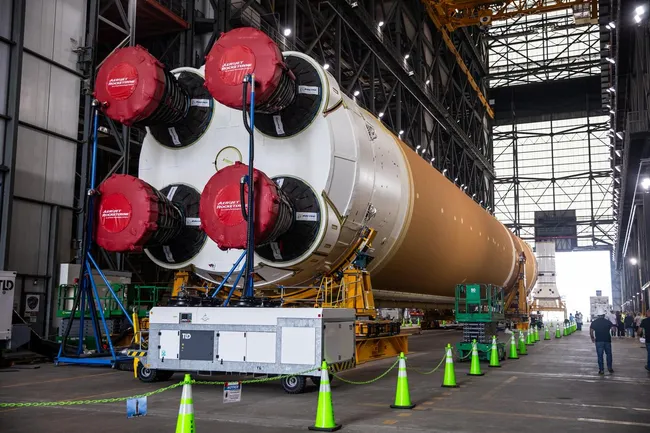
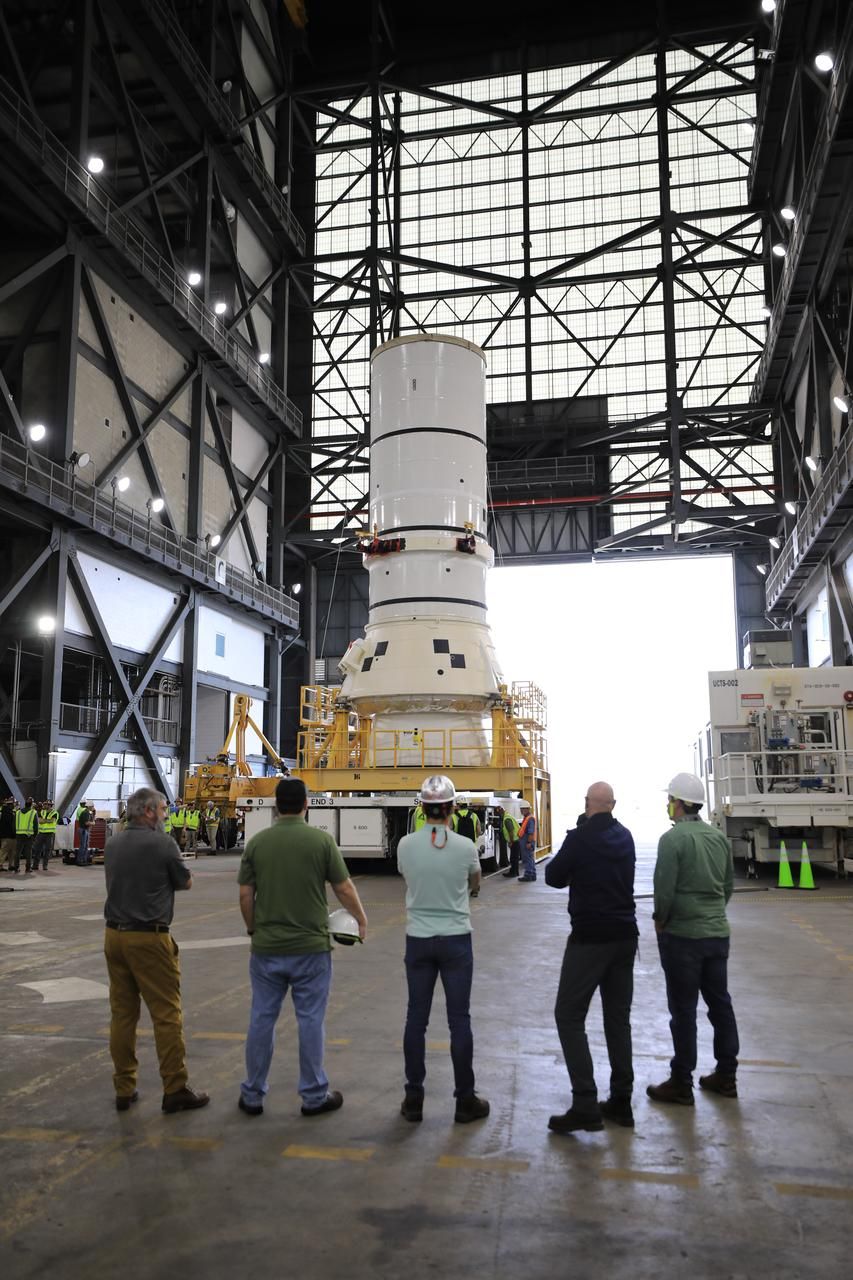
The core stage of the Artemis II SLS rocket, complete with its four main engines, inside NASA’s gigantic Vehicle Assembly Building (VAB). One of the base segments of a solid rocket booster (SRB) can be seen in the background. Credit: NASA

Meanwhile, the SLS vehicle itself has commenced stacking. The core stage, with is massive propellant tanks and four RS-25 “shuttle” engines, arrived at the Vehicle Assembly Building (VAB), Kennedy Space Centre, in July 2024, and since this has been undergoing much work whilst still lying on its side.

More recently, work on stacking the two solid rocket boosters (SRBs) developed from those used with the space shuttle, that will help power it up through the atmosphere has also commenced.

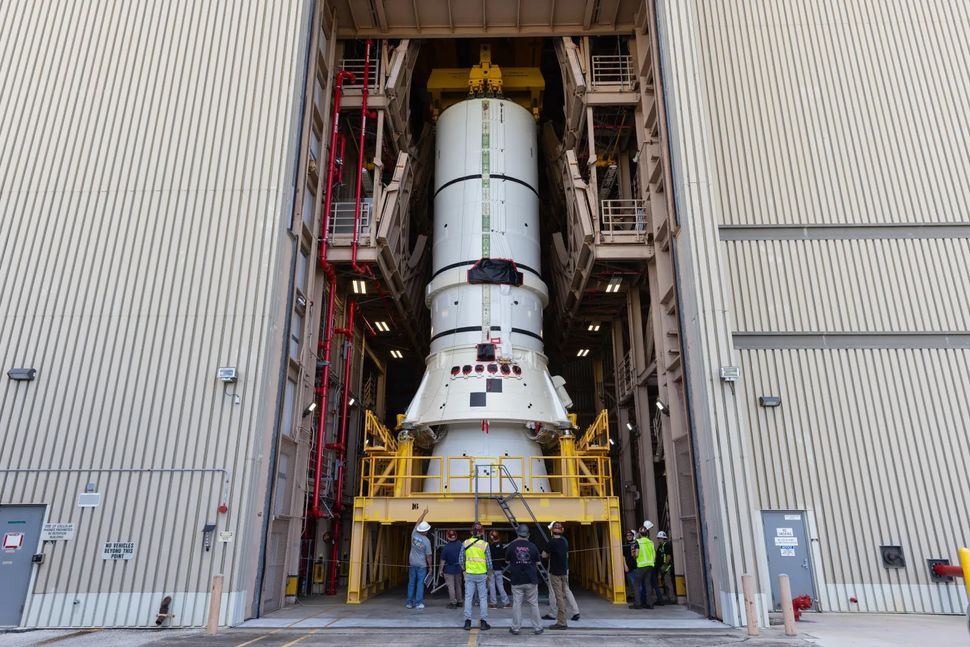
A crane inside the VAB prepares to lift one of the SRB motor sections and its assembly gantry, ready to place it on the back of a transport vehicle. November 13th, 2024. Credit: NASA

The SRBs comprise 5 individual segments which need to be manufactured and then bolted together, prior to being filled with their wet cement-like solid propellant mix. The base segments of these boosters include the rocket motor and guidance controls, and on November 13th, these were rolled into the Vehicle Assembly Building on special transport / stacking gantries. Over the next several months, the two SRBs will be assembled vertically in one of the bays within the VAB, and then loaded with their propellant and capped off.

Once the SRBs are ready and their avionics, etc., checked out, the core stage of the SLS will be hoisted up into one of the VAB’s high bays, moving to a vertical orientation as it does so. It will then be lowered between the two SRBs so that they can all be joined together. After this the ICPS will be moved up into position and mated to the top of the core stage of the rocket, and then work can commence stacking the Orion and its ESM and their launch fairings.

The SRB motor and its mounting gantry on the transporter, ready to be moved to the VAB bay where stacking can commence, November 13th, 2024. Credit: NASA

Whether or not Artemis II makes its planned late 2025 launch (no earlier than September) is open to question; currently, NASA has yet to fully complete the work on ensuring the already manufactured heat shield for the mission’s Orion vehicle is fit for purpose, per my previous report on heat shield issues.

Space Sunday: ESA’s Hera and catching a rocket in mid-air

Seconds from capture: Super Heavy Booster 12 descends between the “chopsticks” of the Mechazilla lifting system of the tower from which it and Ship 30 launched less than 8 minutes previously, as the arms close around it in readiness for a safe capture during the fifth integrated flight test of SpaceX’s starship / super heavy launch system. Story below. Credit: SpaceX via the NSF.com livestream.

Hera: Return to Didymos

On November 24th, 2021, NASA launched the Double Asteroid Redirection Test (DART) mission, a vehicle aimed at testing a method of planetary defence against near-Earth objects (NEOs) that pose a real risk of impact, by smashing an object into them and using kinetic energy  to deflect them from their existing trajectory.

To achieve this, the spacecraft was both a science probe and impact device, and it was launched to rendezvous with the binary asteroid 65803 Didymos (Greek for “twin”), comprising a primary asteroid approximately 780 metres across, and a smaller companion called Dimorphos (Greek: “two forms”). These sit within a heliocentric orbit which periodically cross that of Earth whilst also reaching out beyond Mars , which occupy a heliocentric orbit that periodically crosses that of Earth. On reaching the pair, DART smashed into Dimorphos, successfully altering its orbit around Didymos.

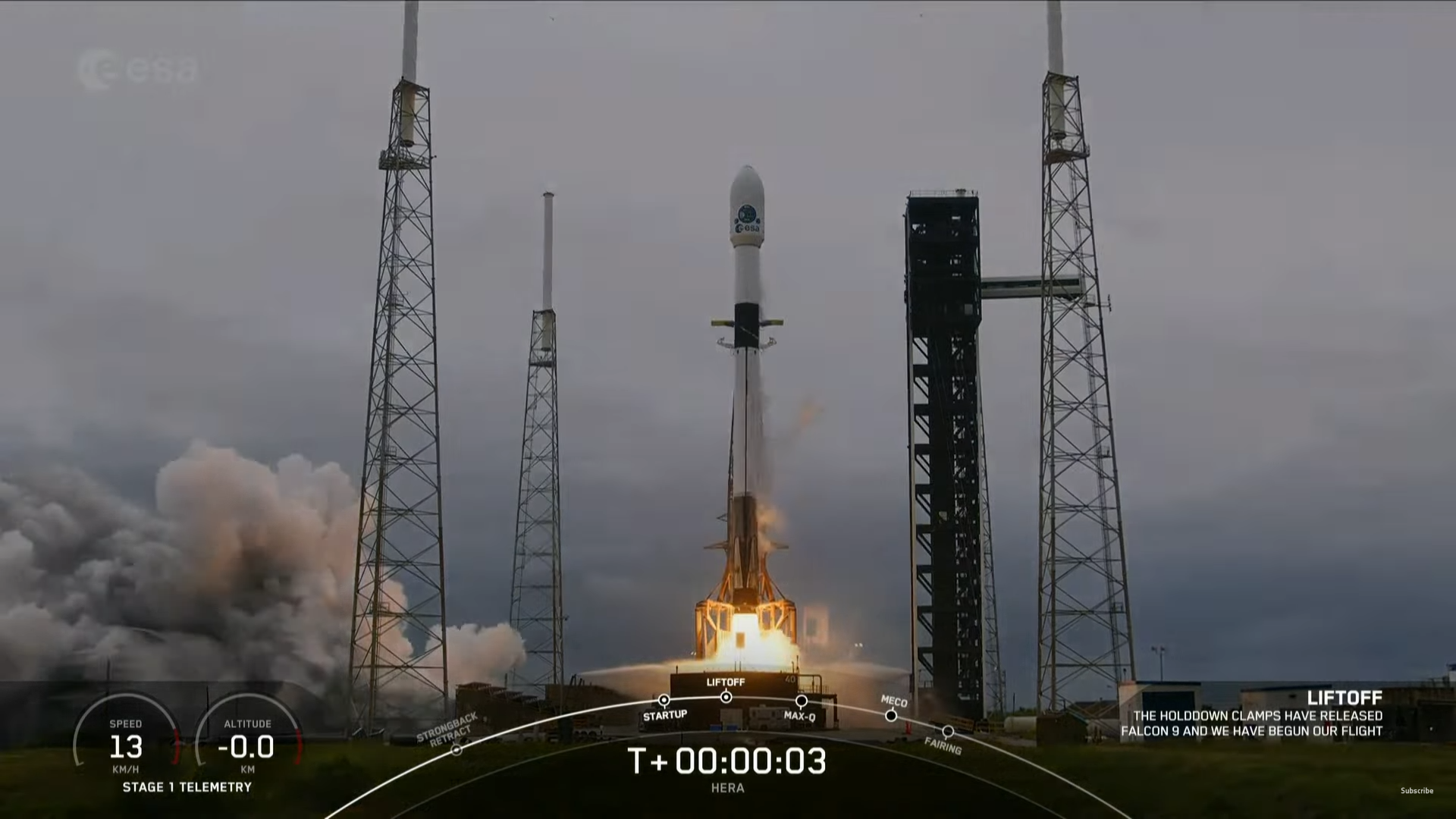
A SpaceX Falcon 9 lifts-off from Cape Canaveral Space force station’s SLC-41 on Monday, October 7th, 2024, carrying the European Space Agency’s Hera asteroid mission to the binary asteroids Didymos and Dimorphos. Credit: ESA/SpaceX

I covered the launch of the mission in Space Sunday: a DART plus JWST and TRAPPIST-1 updates, and the aftermath of the impact two years ago in Space Sunday: collisions, gamma bursts and rockets. Since then there has been much reported on what has happened to Dimorphos in the wake of the impact, but scientists have been awaiting a planned follow-up mission to the Didymos pairing which could survey the outcome up close. And that mission is now underway, courtesy of the European Space Agency (ESA).

Launched at 14:52:11 UTC on Monday, October 7th from Canaveral Space Force Station, Florida atop a SpaceX Falcon 9 rocket, ESA’s Hera mission made it away from Earth just ahead of the arrival of Hurricane Milton. Lift-off marked the start of a two-year journey for the 1.1 tonne solar-powered spacecraft – also called Hera, after the mythological Greek goddess, rather than the name being an acronym –, as it heads first for Mars, which it will pass in March 2025 at a distance of between 5,000 and 8,000km. Taking the opportunity to test its science instruments in studying the tiny outermost Martian moon, Deimos as it does so, Hera will use the Martian gravity well to swing itself onto a trajectory so it can rendezvous with Didymos in December 2026.

Hera spacecraft design. The locations of the different payload elements are indicated (AFC = Asteroid Framing Cameras; TIRI = Thermal InfraRed Imager; PALT = Planetary ALTimeter; SMC = Small Monitoring Cameras. Credit: Michael, Kuppers, et al, ESA

The cube-shaped vehicle will have a primary mission of six months orbiting the Didymos pair, split into 5 phases:

  • Initial characterisation (6 weeks): determine the global shape and mass/gravity together with the thermal and dynamical properties of both asteroids.
  • Payload deployment (4 weeks): release two small cubesats, Juventas and Milani. The former will attempt to land on Didymos to conduct direct surface and sub-surface science, the latter will gather spectral data on the two asteroids and the surrounding dust cloud resulting from the DART impact.
  • Detailed characterisation (6 weeks): metre-scale mapping of the asteroids and determination of thermal, spectral, and interior properties.
  • Dimorphos observations (6 weeks): High-resolution investigations of a large fraction of the surface area of Dimorphos, including the DART impact crater.
  • Experimental (6 weeks): study the morphological, spectral, and thermal properties of Dimorphos.

Overall, the mission is designed to accuracy access the overall success of the DART mission if deflecting Dimorphos in its orbit around Didymos (and thus the effectiveness of using kinetic impact to deflect NEOs threatening Earth with an impact) and to characterise both asteroids to help us better understand the composition, etc., of typical NEOs, so that the data obtained might help further refine plans for potential future asteroid redirect missions.

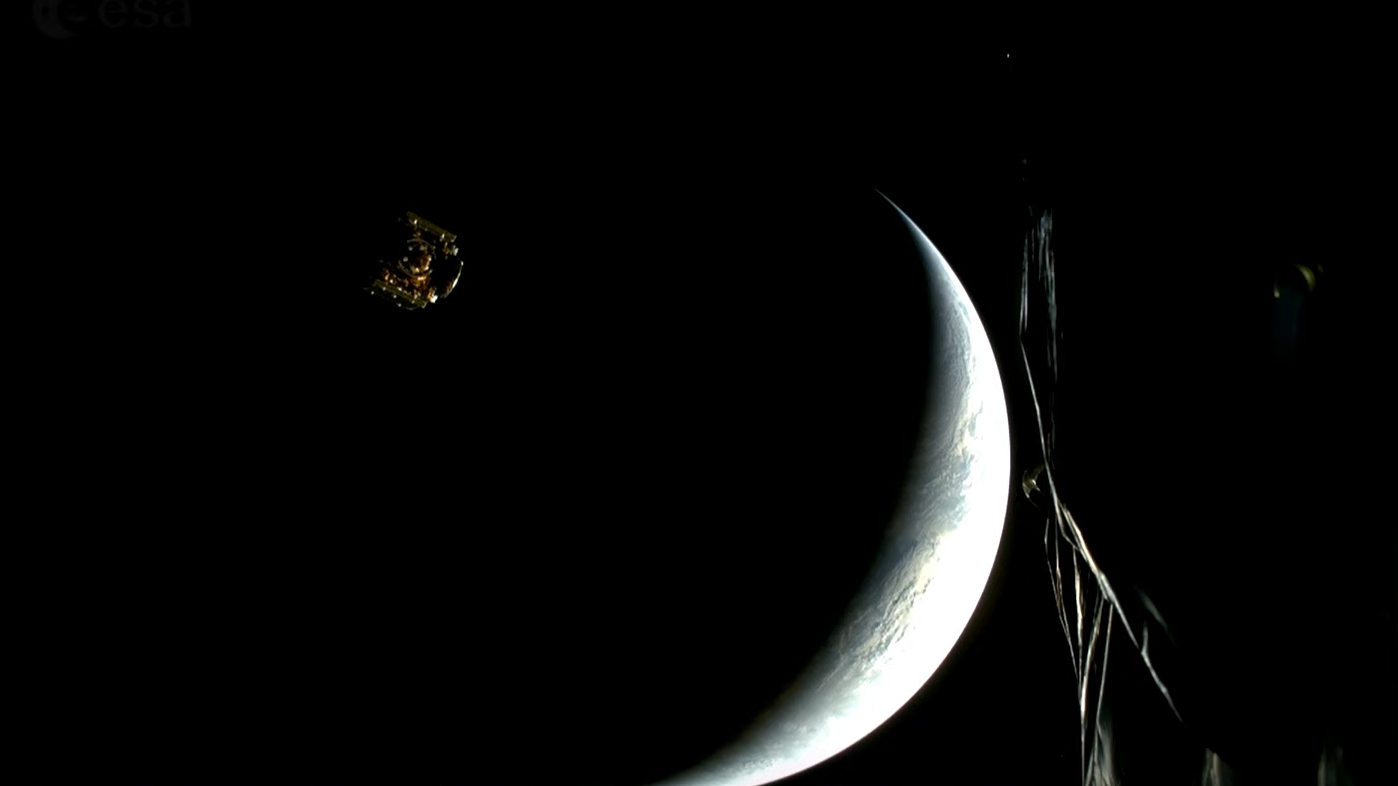
Hera, with the crescent Earth to one side, seen from the SpaceX Falcon 9 upper stage following vehicle separation and prior to solar array deployment. October 7th, 2024. Credit: SpaceX/ESA

One of the major elements of the mission has been the development of sophisticated guidance and mapping software which will allow Hera, using a series of compact sensor systems, to autonomously construct a map of the Didymos system and the space around it. It will then use this map to determine for itself the safest orbital trajectories around the asteroids to avoid impacts with any remaining rock and dust debris remaining in orbit around both bodies from the DART impact, and of a sufficient size to damage it in a collision.

Following launch, Hera successfully separated from the upper stage of the Falcon 9 launch vehicle and called ESA’s mission control to confirm it was operating correctly and ready to start crucial operations such as deploying its solar panels. In November 2024, the vehicle will perform a “mid-flight” adjustment to better align its trajectory to Mars.

Starship Flight 5

October 13th saw the launch of the fifth Starship / Super Heavy combination from the SpaceX facilities at Boca Chica – and the first attempt to bring a booster back to the launch pad and catch it using the “chopsticks” of the Mechazilla mechanism on the launch tower.

A lot of people – myself included – severely doubt(ed) the ability of both the long-term viability of the idea of catching boosters and launch vehicles out of the air, or whether this flight could prove the concept. Credit falls where due, and for this flight we were proven wrong.

A drones-eye via of the starship / super heavy launch facility, Boca Chica, Texas as IFT-5 propellant loading is underway. Note the clouds of liquid oxygen forming as a result of venting from the propellant feeds and vehicle tank vents. Credit: SpaceX livestream

The launch came at 13:25 UTC, with the ignition of the 33 Raptor 2 motors lifting the roughly 5,000 tonne mass of the combined Ship 30 and Booster 12 into the morning skies above south Texas. All 33 motors had a good clean burn, and the stack quickly gained altitude. At 2m 40s after launch, and approximately 50km altitude, the majority of the engines on the booster shut down and the six motors on Ship 30 ignited in the “hot staging” burn ahead of separation. Following separation, the booster immediately commenced a manoeuvre to steer away from the starship, in readiness to commence a flight back towards the launch pad.

This started the critical phase of Booster 12’s flight. Initially it continued to gain height ballistically, reaching an altitude of approximately 100 km whilst performing a “boost back” engine burn to slow its ascent and then start a fall back towards the launch site. The manoeuvre was completed with a level of accuracy such that SpaceX confirmed they would proceed with the “return to base” and attempted booster capture. Had the boost-back been off, the capture phase would have been abandoned and the booster allow to make a controlled splashdown in the Gulf of Mexico.

Boost back: with the hot staging ring a bright dot at the bottom of the image, Booster 12 fall back towards Earth heading towards the launch site. Credit: SpaceX livestream

There followed a series of visible pulses from the booster as it purged excess vapour from this primary propellant tanks while the three central motors gimballed to direct their thrust and steer it away from the jettisoned hot staging ring falling below it. Canting over to being close to horizontal, the booster descended to some 10 km altitude, racing back towards the launch facilities with a speed of 2,860 km/h, before the inner ring of 10 motors fired committing it to an initial braking manoeuvre.

At this point, and abort and splashdown was still possible, but the guidance system on the launch tower was working perfectly, allowing the booster to home into it. At 5km and still travelling at over 1750 km/h the 13 motors that have been firing all shut down, the booster gradually righting itself and decelerating through 1200 km/h before all thirteen re-fired in a final deceleration move before the inner ring of ten engines shut down and the three centre engines took over at at 1 km altitude to steer the booster in for capture.

With propellant vapours also burning form the mid-point vents, Booster 12 approaches the launch tower in readiness for capture. Credit: SpaceX livestream

The final part of the descent witnessed flames rising along two sides of the booster. The first, and larger of the two appeared to originate at the Quick Disconnect ports at the bottom of the booster (the connectors for loading propellants into the booster). The second appears part-way up the booster, possibly at vent ports for the main propellant tanks. This may have been ignited by flames from the lower fire reaching around the vehicle and setting vapours from the vents alight. Neither fire affected the vehicle’s performance as it slowed rapidly and descend precisely between the Mechazilla “chopsticks”, although it did actually come quite close to striking the tower in the process.

At precisely the same time, the “chopsticks” started to close on either side of the booster such that once it was vertical, the arms were close enough for it to gently lower itself onto them using four hard points around its hull (called “pins”, and specifically designed to allow the “chopsticks” take the booster’s unladen weight when raising / lowering it), which came to rest precisely on “shock absorbers” running along the length of the arms, designed to dissipate the weight of the booster as it dropped onto them. At this point, the Raptor engines shut down, and because of the fire, the onboard fire suppression system appeared to activate.

Even so, the fire rocket continued for several minutes, giving rise to fears of a possible post-capture explosion, but vent valves at the top of the booster were opened, allowing any remaining propellant vapours in the header tanks (smaller propellant tanks used for the final decent and capture) to be released away from the vehicle, greatly reducing the rick of explosion, and the vehicle remained intact on the launch tower.

In all, a remarkable achievement for a first attempt. Kudos to SpaceX.

However, the booster’s successful capture just under 8 minutes after launch wasn’t the end of the flight. As Booster was making its return, Ship 30 continued on its way to orbit, reaching a peak altitude of some 211 km as it cruised half-way around the world.

As it passed across Africa, the vehicle started a slow decent back into the atmosphere, passing over the tip of southern Madagascar as it gently dropped from 119 km to 115km. At around 100m altitude, it started to show the first indications of plasma built-up due the frictions created as it pushed the air molecules around it against their neighbours in the increasing atmospheric density, signs which quickly grew in intensity.

Plasma flow around the side of the starship as it passes through the re-entry interface and enters into the period of maximum dynamic stress during descent. Thanks to Starlink, transmissions from the vehicle were largely uninterrupted during the re-entry phase. Credit: SpaceX livestream

At around 75 km altitude, the vehicle entered the period of peak heating – the roughly 10 minute period when the plasma generated around the vehicle reaches its highest temperatures. It was during the period during IFT-4 in June 24, that the starship started to suffer significant burn-through issues and structure loss with one it its aft aerodynamic flaps, and which continued through its decent, destroying pretty much all of the flap in the process. Not of this was evident at this point with Ship 30.

As re-entry progressed, propellant from the header tanks in the vehicle started to be pumped through the three motors that would be used during the final phase of the flight in a “chill down” process to get them down to the desired temperature for full ignition.

At 47 km altitude, and slightly lower than the previous flight, one of the aft flaps on Ship 30 (top left) shows evidence of burn-through along the hinge mechanism. Whilst showing there is is still an issue with the hinges, this time the burn-through did not result in the partial loss of the entire flap. Credit: SpaceX livestream

It was after the period of peak re-entry heating, as the vehicle entered the period of maximum  dynamic stress on its structure that the first hints of plasma burn-through began to make their presence visible on one of the two aft flaps (at roughly 48 km altitude), although there was no visible sign of large pieces of the flaps disintegrating, as had been the case in June.  Transmissions did break up at this point, resuming as the vehicle entered aerodynamic fee-fall (the “bellyflop”), which showed all four flaps functioning despite the burn-through damage to one.

With less than a kilometre to fall, the three Raptors ignited, and the vehicle tipped upright, and 1 hour 5 minutes after launch, it splashed-down at night, precisely on target in the Indian Ocean. There was around a 20-second period where the vehicle appeared to settle in the water prior to it exploding, the event caught via a remote camera on a buoy positioned a short distance from the target splashdown zone.

20 seconds after splashing down in the Indian Ocean and precisely on target, Ship 30 exploded, the moment caught by a remote camera mounted on a buoy anchored close the the landing zone. Even so, IFT-5 can be counted as nothing short of a successful flight. Credit: SpaceX livestream

The cause of the explosion has yet to be determined – but given that Starship isn’t actually designed to land on water, and the mix of super-heated engine elements and cold sea water isn’t a particularly good one, the explosion shouldn’t be surprising, and doesn’t negate the overall success of the flight.

There is still much more to do in testing this system – such as demonstrating these kinds of “return to base” flights and captures can be achieved consistently. There is also much that is questionable about the starship  / super heavy launch system as a whole, particularly in terms of crewed missions to Mars and even in supporting NASA’s Project Artemis lunar aspirations. However, none of this negates what is a remarkable first time achievement for SpaceX with IFT-5.

And here’s another view of the Booster 12 capture – from a camera mounted on the launch tower:

 Europa Clipper  Update

Previewed in my previous Space Sunday update (see: Space Sunday: Europa Clipper, Vulcan Centaur and Voyager 2), Europa Clipper, NASA’s mission to study the Jovian moon Europa, which had been due to lift-off on Thursday, October 10th, suffered a launch postponement courtesy of Hurricane Milton. The launch is now targeted for 16:06 UTC on Monday, October 14th for launch from Launch Complex 39A at Kennedy Space Centre, Florida.

Space Sunday: lunar delays and planetary dances

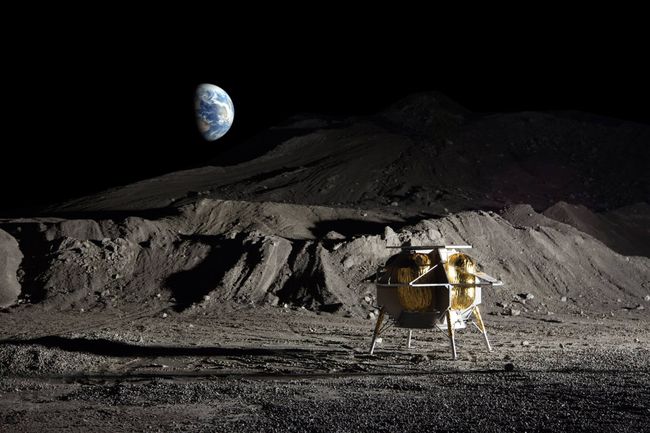
The Peregrine Mission One lander on the surface of the Moon, as imaged by Astrobotic Technology, the company responsible for the lander’s design and construction. Credit: Astrobotic Technology

America’s return to the surface Moon as a part of government-funded activities will start in earnest over Christmas 2023, with the launch of the NASA-supported Peregrine Mission One and the Peregrine lander, built by Astrobotic Technology, which will take to the sky on December 24th, 2023 atop a Vulcan Centaur rocket out of Cape Canaveral Space Force Base, Florida.

Originally a private mission, Mission One qualified for NASA funding under the agency’s Commercial Lunar Payload Services (CLPS) in 2018, effectively making it the first lander programme funded by NASA under the broader umbrella of the Artemis programme. In this capacity, the mission will fly 14 NASA-funded science payloads in addition to the original 14 private payloads planned for the mission.

The mission will be the inaugural payload carrying flight for the Vulcan Centaur, with the lander arriving in lunar orbit after just a few days flight – but will not land until January 25th, 2024, the delay due to the need to await the having to wait for the right lighting conditions at the landing site.

I’ll have more on this mission closer to the launch date, but in the meantime, as the Peregrine Mission One launch date is getting closer, the date for America’s return to the Moon with a crewed mission is slipping further away.

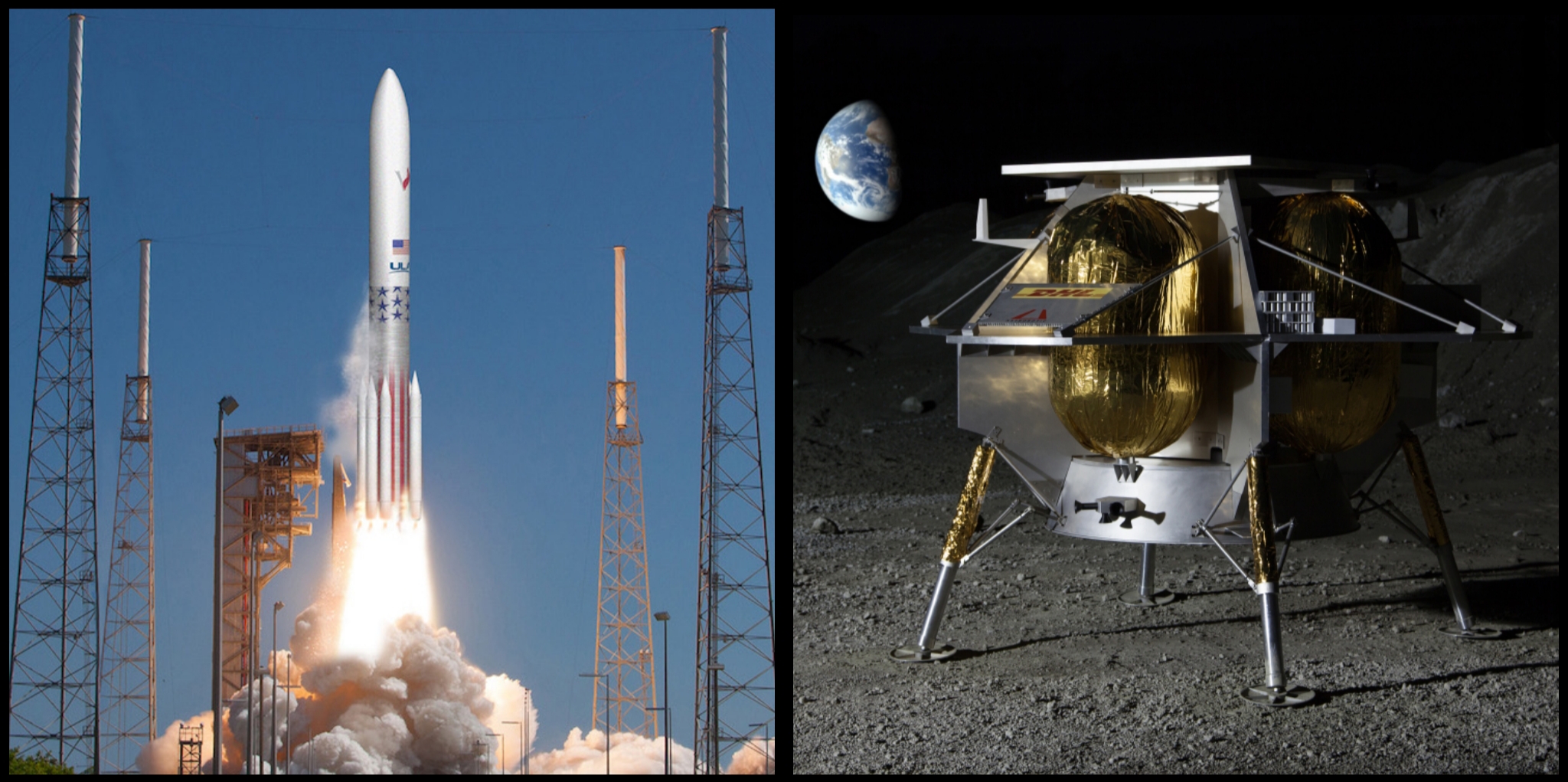
The Peregrine Lander (r) will mark the first flight of United Launch Alliance’s (ULA) new Vulcan Centaur launch vehicle (l). Credits: ULA and Astrobotic Technology

In terms of the Artemis crewed programmed, there have been a number of flags raised around the stated time-frame for Artemis 3, the mission slated to deliver the first such crew to the surface of the Moon in 2025, over the past few years. These have notably come from NASA’s own Office of Inspector General (OIG), but similar concerns have also started to be more openly voiced from within NASA.

These concerns largely focus on whether or not SpaceX can provide NASA with its promised lunar lander and its supporting infrastructure in anything like a timely manner, given that SpaceX has yet to actually successfully fly a Starship vehicle. In this, the awarding of the lander vehicle – called the Human Landing System (HLS) in NASA parlance – to SpaceX, who propose using a specialised version of the Starship vehicle, was always controversial. For one thing, Starship HLS will be incapable of being launched directly to lunar orbit. Instead, it will have to initially go to low Earth orbit and reload itself with propellants – which will also have to be carried to orbit by other Starship vehicles.

Infographic produced by Blue Origin highlighting the likely launch requirements for a Starship HLS. Credit: Blue Origin

At the time the contract for HLS was awarded (2021), competing bidders Blue Origin noted that according to SpaceX’s own data for Starship, a HLS variant of the vehicle would require the launch of fifteen other starship vehicles just to get it to the Moon. The first of these would be another modified Starship designed to be an “orbiting fuel depot”. It would then be followed by 14 further “tanker” Starship flights, which would transfer up to 100 tonnes of propellant per flight for transfer to the “fuel depot”. Only after these flights had been performed, would the Starship HLS be launched – and it would have to rendezvous with the “fuel depot” and transfer the majority of propellants (approx. 1,200 tonnes) from the depot to its own tanks in order to be able to boost itself to the Moon and then brake itself into lunar orbit.

Despite such claims being made on the basis of SpaceX’s own figures, SpaceX CEO Elon Musk pooh-poohed  them, claiming all such refuelling could be done in around 4-8 flights, not 16. Despite their own OIG and the US Government Accountability Office (GOA) agreeing with the 16-flight estimation, NASA nevertheless opted to accept Musk’s claim of 4-8 launches, going so far is to use it in their own mission graphics.

A NASA infographic showing the Artemis 3 mission infrastructure. Note the (optimistic)  6 Starship launches required to get the SpaceX Starship HLS to lunar orbit. Credit: NASA/SpaceX

However, the agency appeared to step back from this on November 17th, 2023, when Lakiesha Hawkins, assistant deputy associate administrator in NASA’s Moon to Mars Programme Office, confirmed that SpaceX will need “almost 20” Starship launches in order to get their HLS vehicle to the Moon, with launches at a relatively high cadence to avoid issues of boil-off occurring when storing propellant in orbit.

Now the US Government Accountability Office (GOA) has re-joined the debate, underlining the belief that SpaceX is far from being in any position to make good on its promises regarding the available of HLS. In particular the report highlights SpaceX is still a good way from demonstrating it can successfully orbit (and re-fly) a Starship vehicle, and it has not even started to demonstrate it has the means to store upwards of 1,000 tonnes of propellants in orbit, or the means by which volumes of propellants well above what has thus far been achieved can be safely and efficiently be transferred between space vehicles, and it has yet to produce a even a prototype design for the vehicle.

Nor does the report end there; it is also highly critical of the manner in which NASA has managed the equally important element of space suit design, firstly in awarding the initial contract for the Artemis lunar space suits to Axiom Space – a company with no practical experience in spacesuit design and development –  rather than a company like ILC Dover, which has produced all of NASA’s space suits since Apollo; then secondly in failing to provide Axiom with all the criteria for the suits, necessitating Axiom redesigning various elements of their suit to meet safety / emergency life support needs.

As a result, the GAO concludes that it is likely Artemis 3 will be in a position to go ahead much before 2027; there is just too much to do and too much to successfully develop for the mission to go ahead any sooner. In this, there is a certain irony. When Artemis was originally roadmapped, it was for a first crewed landing in 2028; however, the entire programme was unduly accelerated in 2019 by the Trump Administration, which wanted the first crewed mission to take place no later than December 2024, so as to fall within what they believed would be their second term in office. Had NASA been able to stick with the original plan of 2028, there is a good chance that right now, it would be considered as being “on target”, rather than being seen as “failing” to meet time frames.

Hubble Hits Further Gyro Issues

On November 29th, 2023, NASA announced that the ageing Hubble Space Telescope (HST) had entered a “safe” mode for an indefinite period due to further troubles with the system of gyroscopes used to point the observatory and hold it steady during imaging.

In all, HST has six gyroscopes (comprising 3 pairs – a primary and a back-up),with one of each pair required for normal operations. To help increase the telescope’s operational life, all three pairs of gyros were replaced in the last shuttle mission to service Hubble in 2009, and software was uploaded to the observatory to allow it to function on two gyros – or even one (with greatly reduced science capacity)  should it become necessary.

Today, only 3 of those gyros remain operational, the other three having simply worn out, and on November 19th, one of those remaining 3 started producing incorrect data, causing the telescope to enter a safe mode, stopping all science operations. Engineers investigating the issue were able to get the gyro operating correctly in short order, allowing Hubble to resume operations – only for the gyro to glitch again on November 21st and again on November 23rd, leading to the decision to leave the telescope in its safe mode until the issue can be more fully assessed.

The Hubble Space Telescope. Credit: NASA

The news of the problems immediately led to renewed calls for either a crewed servicing mission to Hubble or some form of automated servicing mission – either of which might also be used to boost HST’s declining orbit. However, such missions are far more easily said than done: currently, there isn’t any robotic craft capable of servicing Hubble (not the hardware or software to make one possible). When it comes to crewed missions, it needs to be remembered that Hubble was designed to be serviced by the space shuttle, which could carry a special adaptor in its cargo bay to which Hubble could be attached, providing a stable platform from which work could be conducted, with the shuttle’s robot arm also making a range of tasks possible, whilst the bulk of the shuttle itself made raising Hubble’s orbit much more straightforward.

Currently, the only US crewed vehicle capable of servicing HST is the SpaceX Crew Dragon – and it is far from ideal, having none of the advantages or capabilities offered by the space shuttle, despite the gung-ho attitude of many Space X supporters. In fact, it is not unfair to say that having such a vehicle free-flying in such close proximity to Hubble, together with astronauts floating around on tethers could do more harm than good.

A further issue with any servicing mission is that of financing. Right now, the money isn’t in the pot in terms of any funding NASA might make available for a servicing mission – and its science budget is liable to get a lot tighter in 2024, which could see Hubble’s overall budget cut.

Continue reading “Space Sunday: lunar delays and planetary dances”