Space Sunday: ESA’s Hera and catching a rocket in mid-air

Seconds from capture: Super Heavy Booster 12 descends between the “chopsticks” of the Mechazilla lifting system of the tower from which it and Ship 30 launched less than 8 minutes previously, as the arms close around it in readiness for a safe capture during the fifth integrated flight test of SpaceX’s starship / super heavy launch system. Story below. Credit: SpaceX via the NSF.com livestream.

Hera: Return to Didymos

On November 24th, 2021, NASA launched the Double Asteroid Redirection Test (DART) mission, a vehicle aimed at testing a method of planetary defence against near-Earth objects (NEOs) that pose a real risk of impact, by smashing an object into them and using kinetic energy  to deflect them from their existing trajectory.

To achieve this, the spacecraft was both a science probe and impact device, and it was launched to rendezvous with the binary asteroid 65803 Didymos (Greek for “twin”), comprising a primary asteroid approximately 780 metres across, and a smaller companion called Dimorphos (Greek: “two forms”). These sit within a heliocentric orbit which periodically cross that of Earth whilst also reaching out beyond Mars , which occupy a heliocentric orbit that periodically crosses that of Earth. On reaching the pair, DART smashed into Dimorphos, successfully altering its orbit around Didymos.
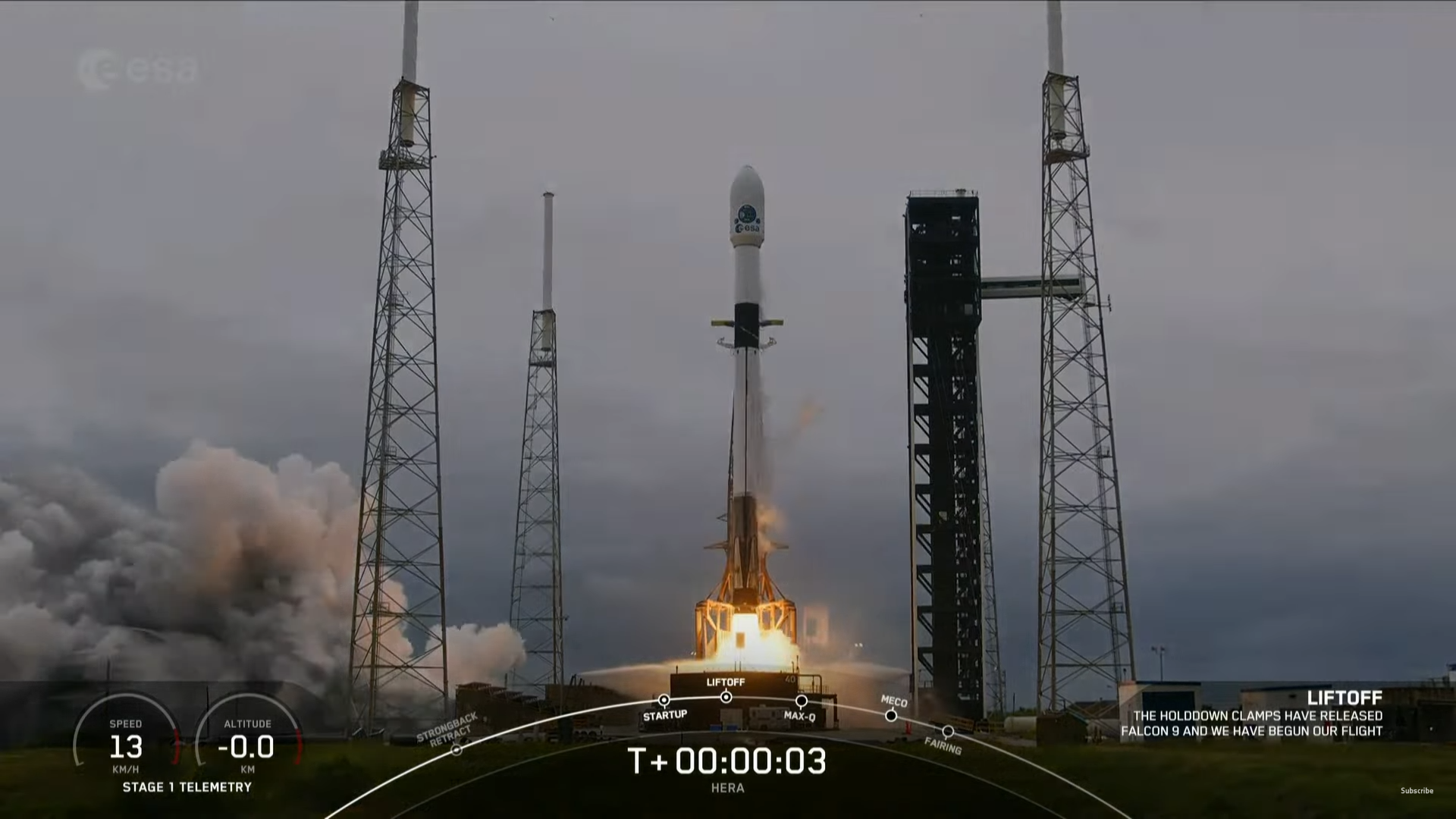
A SpaceX Falcon 9 lifts-off from Cape Canaveral Space force station’s SLC-41 on Monday, October 7th, 2024, carrying the European Space Agency’s Hera asteroid mission to the binary asteroids Didymos and Dimorphos. Credit: ESA/SpaceX

I covered the launch of the mission in Space Sunday: a DART plus JWST and TRAPPIST-1 updates, and the aftermath of the impact two years ago in Space Sunday: collisions, gamma bursts and rockets. Since then there has been much reported on what has happened to Dimorphos in the wake of the impact, but scientists have been awaiting a planned follow-up mission to the Didymos pairing which could survey the outcome up close. And that mission is now underway, courtesy of the European Space Agency (ESA).

Launched at 14:52:11 UTC on Monday, October 7th from Canaveral Space Force Station, Florida atop a SpaceX Falcon 9 rocket, ESA’s Hera mission made it away from Earth just ahead of the arrival of Hurricane Milton. Lift-off marked the start of a two-year journey for the 1.1 tonne solar-powered spacecraft – also called Hera, after the mythological Greek goddess, rather than the name being an acronym –, as it heads first for Mars, which it will pass in March 2025 at a distance of between 5,000 and 8,000km. Taking the opportunity to test its science instruments in studying the tiny outermost Martian moon, Deimos as it does so, Hera will use the Martian gravity well to swing itself onto a trajectory so it can rendezvous with Didymos in December 2026.

Hera spacecraft design. The locations of the different payload elements are indicated (AFC = Asteroid Framing Cameras; TIRI = Thermal InfraRed Imager; PALT = Planetary ALTimeter; SMC = Small Monitoring Cameras. Credit: Michael, Kuppers, et al, ESA

The cube-shaped vehicle will have a primary mission of six months orbiting the Didymos pair, split into 5 phases:

  • Initial characterisation (6 weeks): determine the global shape and mass/gravity together with the thermal and dynamical properties of both asteroids.
  • Payload deployment (4 weeks): release two small cubesats, Juventas and Milani. The former will attempt to land on Didymos to conduct direct surface and sub-surface science, the latter will gather spectral data on the two asteroids and the surrounding dust cloud resulting from the DART impact.
  • Detailed characterisation (6 weeks): metre-scale mapping of the asteroids and determination of thermal, spectral, and interior properties.
  • Dimorphos observations (6 weeks): High-resolution investigations of a large fraction of the surface area of Dimorphos, including the DART impact crater.
  • Experimental (6 weeks): study the morphological, spectral, and thermal properties of Dimorphos.

Overall, the mission is designed to accuracy access the overall success of the DART mission if deflecting Dimorphos in its orbit around Didymos (and thus the effectiveness of using kinetic impact to deflect NEOs threatening Earth with an impact) and to characterise both asteroids to help us better understand the composition, etc., of typical NEOs, so that the data obtained might help further refine plans for potential future asteroid redirect missions.
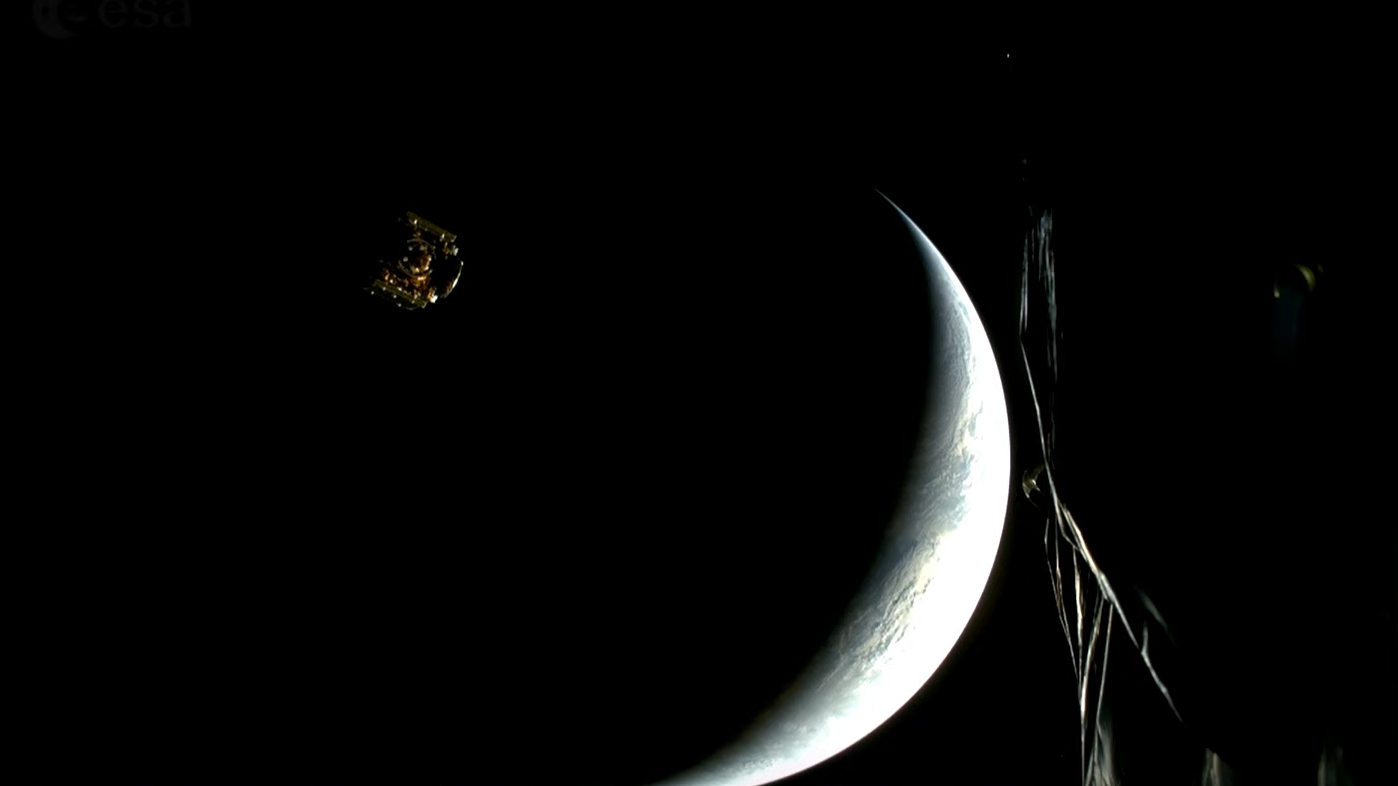
Hera, with the crescent Earth to one side, seen from the SpaceX Falcon 9 upper stage following vehicle separation and prior to solar array deployment. October 7th, 2024. Credit: SpaceX/ESA

One of the major elements of the mission has been the development of sophisticated guidance and mapping software which will allow Hera, using a series of compact sensor systems, to autonomously construct a map of the Didymos system and the space around it. It will then use this map to determine for itself the safest orbital trajectories around the asteroids to avoid impacts with any remaining rock and dust debris remaining in orbit around both bodies from the DART impact, and of a sufficient size to damage it in a collision.

Following launch, Hera successfully separated from the upper stage of the Falcon 9 launch vehicle and called ESA’s mission control to confirm it was operating correctly and ready to start crucial operations such as deploying its solar panels. In November 2024, the vehicle will perform a “mid-flight” adjustment to better align its trajectory to Mars.

Starship Flight 5

October 13th saw the launch of the fifth Starship / Super Heavy combination from the SpaceX facilities at Boca Chica – and the first attempt to bring a booster back to the launch pad and catch it using the “chopsticks” of the Mechazilla mechanism on the launch tower.

A lot of people – myself included – severely doubt(ed) the ability of both the long-term viability of the idea of catching boosters and launch vehicles out of the air, or whether this flight could prove the concept. Credit falls where due, and for this flight we were proven wrong.

A drones-eye via of the starship / super heavy launch facility, Boca Chica, Texas as IFT-5 propellant loading is underway. Note the clouds of liquid oxygen forming as a result of venting from the propellant feeds and vehicle tank vents. Credit: SpaceX livestream

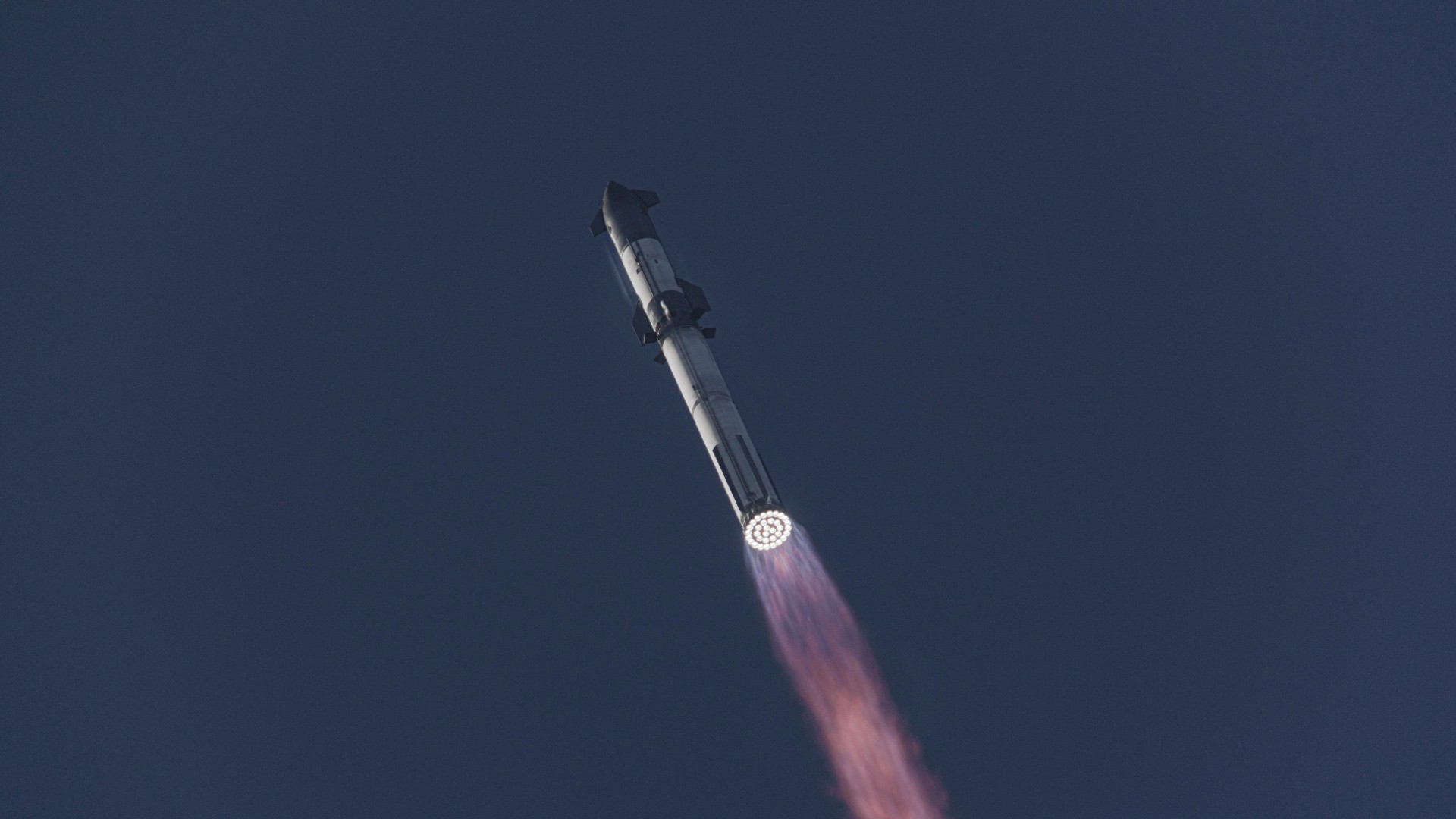
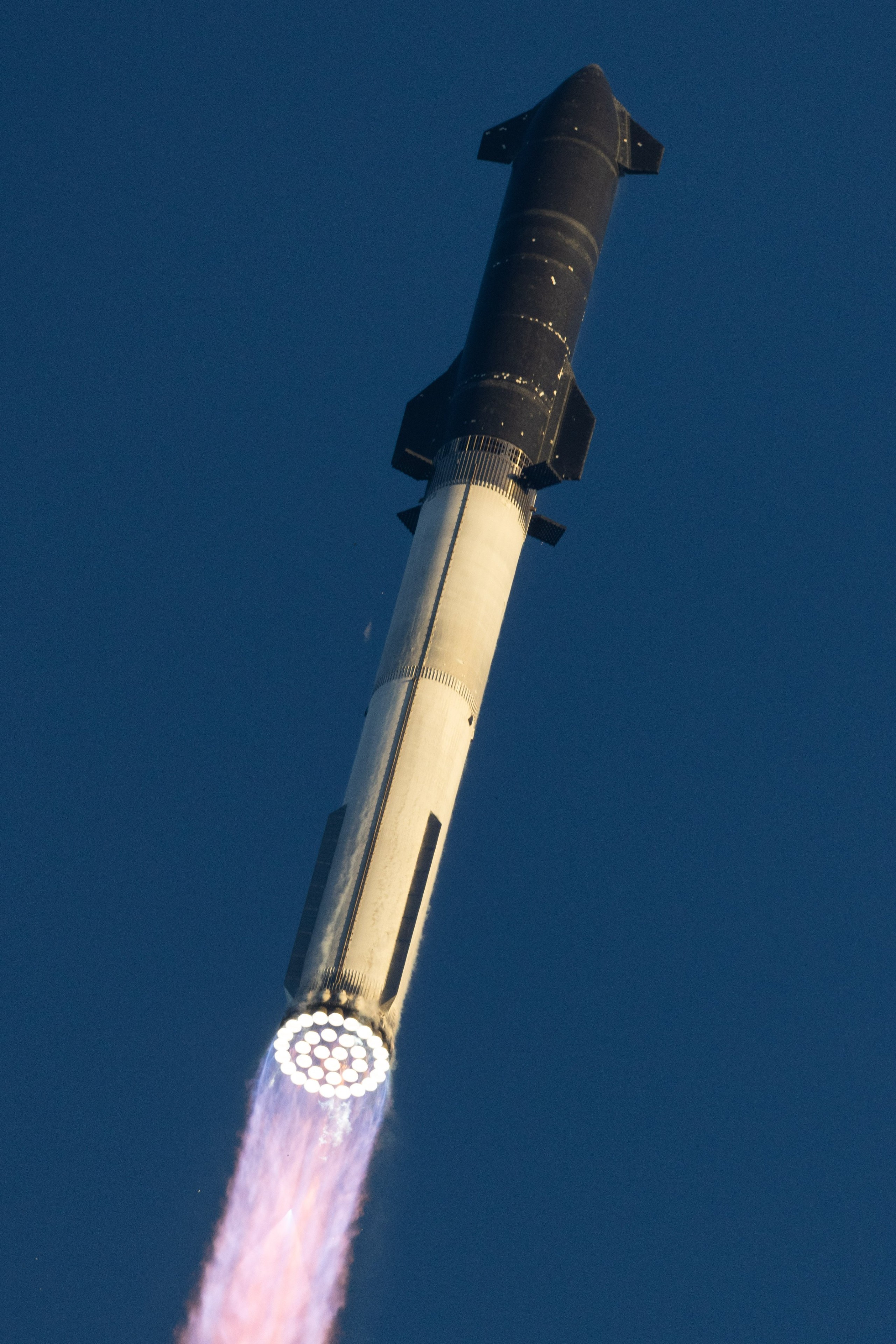
The launch came at 13:25 UTC, with the ignition of the 33 Raptor 2 motors lifting the roughly 5,000 tonne mass of the combined Ship 30 and Booster 12 into the morning skies above south Texas. All 33 motors had a good clean burn, and the stack quickly gained altitude. At 2m 40s after launch, and approximately 50km altitude, the majority of the engines on the booster shut down and the six motors on Ship 30 ignited in the “hot staging” burn ahead of separation. Following separation, the booster immediately commenced a manoeuvre to steer away from the starship, in readiness to commence a flight back towards the launch pad.

This started the critical phase of Booster 12’s flight. Initially it continued to gain height ballistically, reaching an altitude of approximately 100 km whilst performing a “boost back” engine burn to slow its ascent and then start a fall back towards the launch site. The manoeuvre was completed with a level of accuracy such that SpaceX confirmed they would proceed with the “return to base” and attempted booster capture. Had the boost-back been off, the capture phase would have been abandoned and the booster allow to make a controlled splashdown in the Gulf of Mexico.

Boost back: with the hot staging ring a bright dot at the bottom of the image, Booster 12 fall back towards Earth heading towards the launch site. Credit: SpaceX livestream

There followed a series of visible pulses from the booster as it purged excess vapour from this primary propellant tanks while the three central motors gimballed to direct their thrust and steer it away from the jettisoned hot staging ring falling below it. Canting over to being close to horizontal, the booster descended to some 10 km altitude, racing back towards the launch facilities with a speed of 2,860 km/h, before the inner ring of 10 motors fired committing it to an initial braking manoeuvre.

At this point, and abort and splashdown was still possible, but the guidance system on the launch tower was working perfectly, allowing the booster to home into it. At 5km and still travelling at over 1750 km/h the 13 motors that have been firing all shut down, the booster gradually righting itself and decelerating through 1200 km/h before all thirteen re-fired in a final deceleration move before the inner ring of ten engines shut down and the three centre engines took over at at 1 km altitude to steer the booster in for capture.

With propellant vapours also burning form the mid-point vents, Booster 12 approaches the launch tower in readiness for capture. Credit: SpaceX livestream

The final part of the descent witnessed flames rising along two sides of the booster. The first, and larger of the two appeared to originate at the Quick Disconnect ports at the bottom of the booster (the connectors for loading propellants into the booster). The second appears part-way up the booster, possibly at vent ports for the main propellant tanks. This may have been ignited by flames from the lower fire reaching around the vehicle and setting vapours from the vents alight. Neither fire affected the vehicle’s performance as it slowed rapidly and descend precisely between the Mechazilla “chopsticks”, although it did actually come quite close to striking the tower in the process.

At precisely the same time, the “chopsticks” started to close on either side of the booster such that once it was vertical, the arms were close enough for it to gently lower itself onto them using four hard points around its hull (called “pins”, and specifically designed to allow the “chopsticks” take the booster’s unladen weight when raising / lowering it), which came to rest precisely on “shock absorbers” running along the length of the arms, designed to dissipate the weight of the booster as it dropped onto them. At this point, the Raptor engines shut down, and because of the fire, the onboard fire suppression system appeared to activate.

Even so, the fire rocket continued for several minutes, giving rise to fears of a possible post-capture explosion, but vent valves at the top of the booster were opened, allowing any remaining propellant vapours in the header tanks (smaller propellant tanks used for the final decent and capture) to be released away from the vehicle, greatly reducing the rick of explosion, and the vehicle remained intact on the launch tower.

In all, a remarkable achievement for a first attempt. Kudos to SpaceX.

However, the booster’s successful capture just under 8 minutes after launch wasn’t the end of the flight. As Booster was making its return, Ship 30 continued on its way to orbit, reaching a peak altitude of some 211 km as it cruised half-way around the world.

As it passed across Africa, the vehicle started a slow decent back into the atmosphere, passing over the tip of southern Madagascar as it gently dropped from 119 km to 115km. At around 100m altitude, it started to show the first indications of plasma built-up due the frictions created as it pushed the air molecules around it against their neighbours in the increasing atmospheric density, signs which quickly grew in intensity.

Plasma flow around the side of the starship as it passes through the re-entry interface and enters into the period of maximum dynamic stress during descent. Thanks to Starlink, transmissions from the vehicle were largely uninterrupted during the re-entry phase. Credit: SpaceX livestream

At around 75 km altitude, the vehicle entered the period of peak heating – the roughly 10 minute period when the plasma generated around the vehicle reaches its highest temperatures. It was during the period during IFT-4 in June 24, that the starship started to suffer significant burn-through issues and structure loss with one it its aft aerodynamic flaps, and which continued through its decent, destroying pretty much all of the flap in the process. Not of this was evident at this point with Ship 30.

As re-entry progressed, propellant from the header tanks in the vehicle started to be pumped through the three motors that would be used during the final phase of the flight in a “chill down” process to get them down to the desired temperature for full ignition.

At 47 km altitude, and slightly lower than the previous flight, one of the aft flaps on Ship 30 (top left) shows evidence of burn-through along the hinge mechanism. Whilst showing there is is still an issue with the hinges, this time the burn-through did not result in the partial loss of the entire flap. Credit: SpaceX livestream

It was after the period of peak re-entry heating, as the vehicle entered the period of maximum  dynamic stress on its structure that the first hints of plasma burn-through began to make their presence visible on one of the two aft flaps (at roughly 48 km altitude), although there was no visible sign of large pieces of the flaps disintegrating, as had been the case in June.  Transmissions did break up at this point, resuming as the vehicle entered aerodynamic fee-fall (the “bellyflop”), which showed all four flaps functioning despite the burn-through damage to one.

With less than a kilometre to fall, the three Raptors ignited, and the vehicle tipped upright, and 1 hour 5 minutes after launch, it splashed-down at night, precisely on target in the Indian Ocean. There was around a 20-second period where the vehicle appeared to settle in the water prior to it exploding, the event caught via a remote camera on a buoy positioned a short distance from the target splashdown zone.

20 seconds after splashing down in the Indian Ocean and precisely on target, Ship 30 exploded, the moment caught by a remote camera mounted on a buoy anchored close the the landing zone. Even so, IFT-5 can be counted as nothing short of a successful flight. Credit: SpaceX livestream

The cause of the explosion has yet to be determined – but given that Starship isn’t actually designed to land on water, and the mix of super-heated engine elements and cold sea water isn’t a particularly good one, the explosion shouldn’t be surprising, and doesn’t negate the overall success of the flight.

There is still much more to do in testing this system – such as demonstrating these kinds of “return to base” flights and captures can be achieved consistently. There is also much that is questionable about the starship  / super heavy launch system as a whole, particularly in terms of crewed missions to Mars and even in supporting NASA’s Project Artemis lunar aspirations. However, none of this negates what is a remarkable first time achievement for SpaceX with IFT-5.

And here’s another view of the Booster 12 capture – from a camera mounted on the launch tower:

 Europa Clipper  Update

Previewed in my previous Space Sunday update (see: Space Sunday: Europa Clipper, Vulcan Centaur and Voyager 2), Europa Clipper, NASA’s mission to study the Jovian moon Europa, which had been due to lift-off on Thursday, October 10th, suffered a launch postponement courtesy of Hurricane Milton. The launch is now targeted for 16:06 UTC on Monday, October 14th for launch from Launch Complex 39A at Kennedy Space Centre, Florida.
Space Sunday: lunar delays and planetary dances

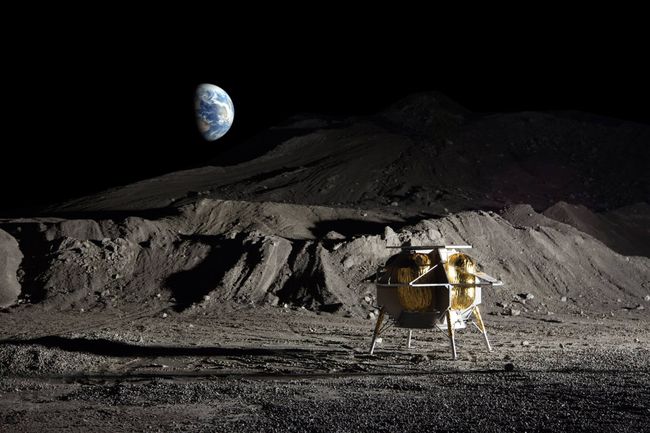
The Peregrine Mission One lander on the surface of the Moon, as imaged by Astrobotic Technology, the company responsible for the lander’s design and construction. Credit: Astrobotic Technology

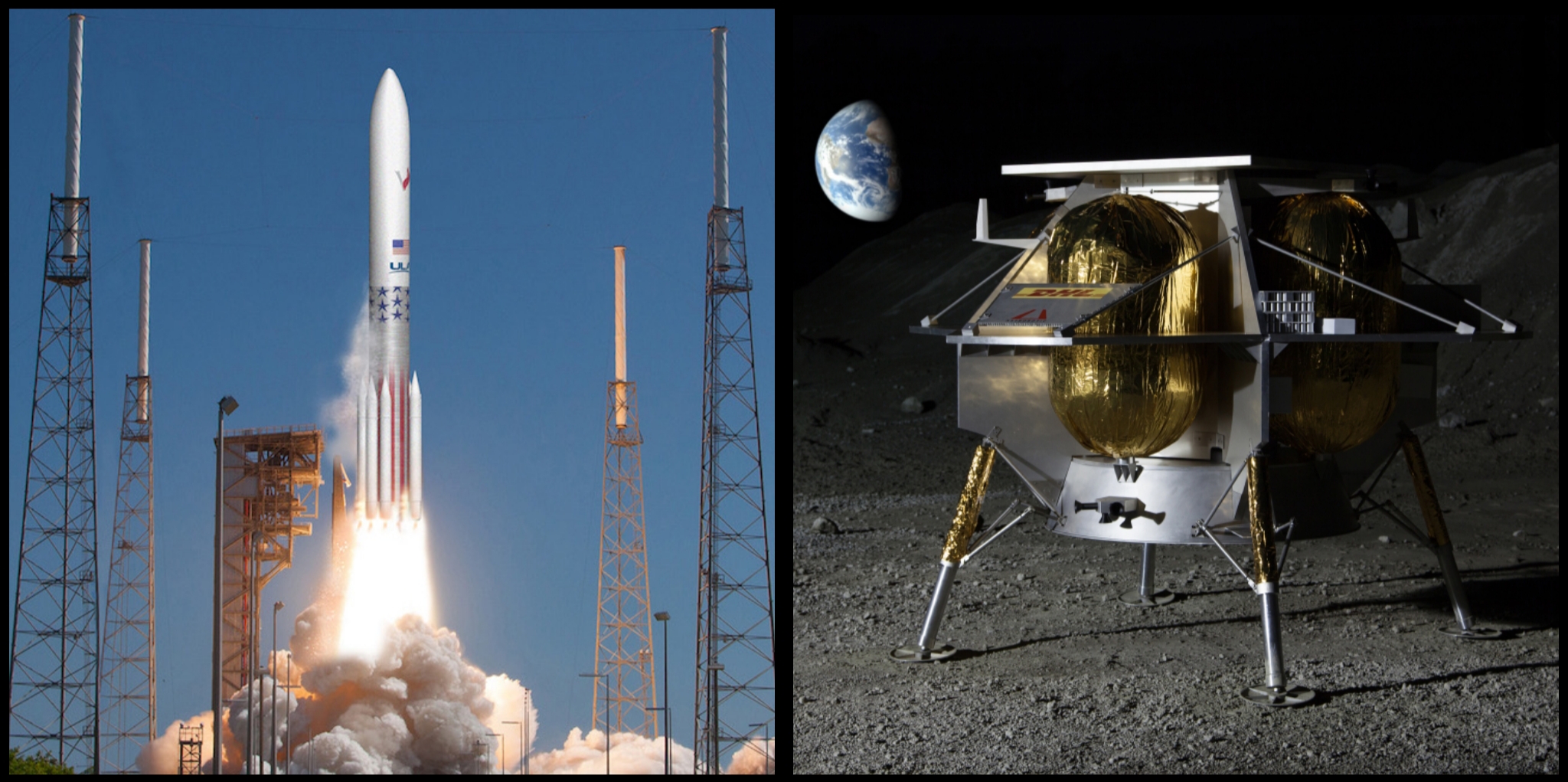
America’s return to the surface Moon as a part of government-funded activities will start in earnest over Christmas 2023, with the launch of the NASA-supported Peregrine Mission One and the Peregrine lander, built by Astrobotic Technology, which will take to the sky on December 24th, 2023 atop a Vulcan Centaur rocket out of Cape Canaveral Space Force Base, Florida.

Originally a private mission, Mission One qualified for NASA funding under the agency’s Commercial Lunar Payload Services (CLPS) in 2018, effectively making it the first lander programme funded by NASA under the broader umbrella of the Artemis programme. In this capacity, the mission will fly 14 NASA-funded science payloads in addition to the original 14 private payloads planned for the mission.

The mission will be the inaugural payload carrying flight for the Vulcan Centaur, with the lander arriving in lunar orbit after just a few days flight – but will not land until January 25th, 2024, the delay due to the need to await the having to wait for the right lighting conditions at the landing site.

I’ll have more on this mission closer to the launch date, but in the meantime, as the Peregrine Mission One launch date is getting closer, the date for America’s return to the Moon with a crewed mission is slipping further away.

The Peregrine Lander (r) will mark the first flight of United Launch Alliance’s (ULA) new Vulcan Centaur launch vehicle (l). Credits: ULA and Astrobotic Technology

In terms of the Artemis crewed programmed, there have been a number of flags raised around the stated time-frame for Artemis 3, the mission slated to deliver the first such crew to the surface of the Moon in 2025, over the past few years. These have notably come from NASA’s own Office of Inspector General (OIG), but similar concerns have also started to be more openly voiced from within NASA.

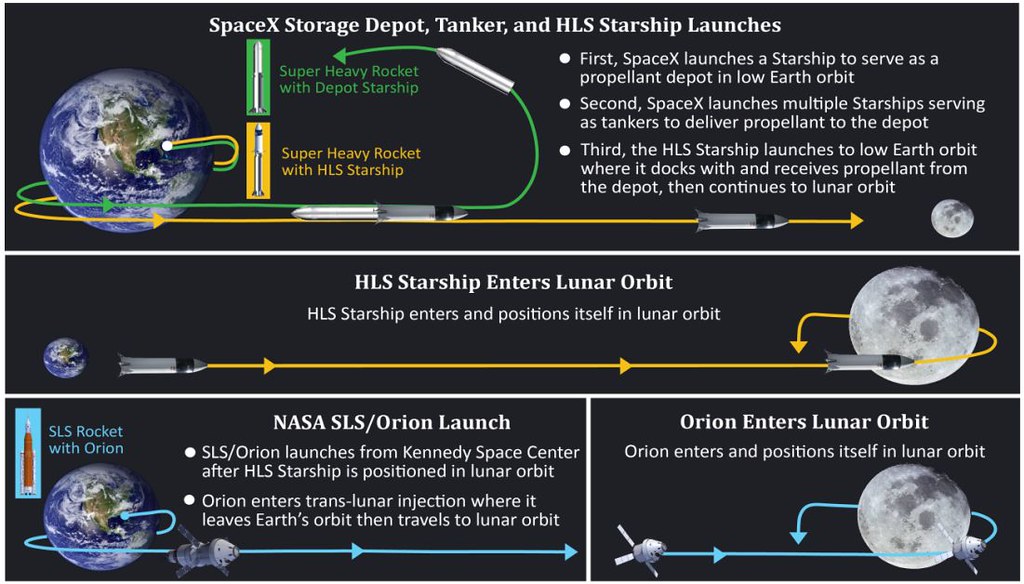
These concerns largely focus on whether or not SpaceX can provide NASA with its promised lunar lander and its supporting infrastructure in anything like a timely manner, given that SpaceX has yet to actually successfully fly a Starship vehicle. In this, the awarding of the lander vehicle – called the Human Landing System (HLS) in NASA parlance – to SpaceX, who propose using a specialised version of the Starship vehicle, was always controversial. For one thing, Starship HLS will be incapable of being launched directly to lunar orbit. Instead, it will have to initially go to low Earth orbit and reload itself with propellants – which will also have to be carried to orbit by other Starship vehicles.

Infographic produced by Blue Origin highlighting the likely launch requirements for a Starship HLS. Credit: Blue Origin

At the time the contract for HLS was awarded (2021), competing bidders Blue Origin noted that according to SpaceX’s own data for Starship, a HLS variant of the vehicle would require the launch of fifteen other starship vehicles just to get it to the Moon. The first of these would be another modified Starship designed to be an “orbiting fuel depot”. It would then be followed by 14 further “tanker” Starship flights, which would transfer up to 100 tonnes of propellant per flight for transfer to the “fuel depot”. Only after these flights had been performed, would the Starship HLS be launched – and it would have to rendezvous with the “fuel depot” and transfer the majority of propellants (approx. 1,200 tonnes) from the depot to its own tanks in order to be able to boost itself to the Moon and then brake itself into lunar orbit.

Despite such claims being made on the basis of SpaceX’s own figures, SpaceX CEO Elon Musk pooh-poohed  them, claiming all such refuelling could be done in around 4-8 flights, not 16. Despite their own OIG and the US Government Accountability Office (GOA) agreeing with the 16-flight estimation, NASA nevertheless opted to accept Musk’s claim of 4-8 launches, going so far is to use it in their own mission graphics.

A NASA infographic showing the Artemis 3 mission infrastructure. Note the (optimistic)  6 Starship launches required to get the SpaceX Starship HLS to lunar orbit. Credit: NASA/SpaceX

However, the agency appeared to step back from this on November 17th, 2023, when Lakiesha Hawkins, assistant deputy associate administrator in NASA’s Moon to Mars Programme Office, confirmed that SpaceX will need “almost 20” Starship launches in order to get their HLS vehicle to the Moon, with launches at a relatively high cadence to avoid issues of boil-off occurring when storing propellant in orbit.

Now the US Government Accountability Office (GOA) has re-joined the debate, underlining the belief that SpaceX is far from being in any position to make good on its promises regarding the available of HLS. In particular the report highlights SpaceX is still a good way from demonstrating it can successfully orbit (and re-fly) a Starship vehicle, and it has not even started to demonstrate it has the means to store upwards of 1,000 tonnes of propellants in orbit, or the means by which volumes of propellants well above what has thus far been achieved can be safely and efficiently be transferred between space vehicles, and it has yet to produce a even a prototype design for the vehicle.

Nor does the report end there; it is also highly critical of the manner in which NASA has managed the equally important element of space suit design, firstly in awarding the initial contract for the Artemis lunar space suits to Axiom Space – a company with no practical experience in spacesuit design and development –  rather than a company like ILC Dover, which has produced all of NASA’s space suits since Apollo; then secondly in failing to provide Axiom with all the criteria for the suits, necessitating Axiom redesigning various elements of their suit to meet safety / emergency life support needs.

As a result, the GAO concludes that it is likely Artemis 3 will be in a position to go ahead much before 2027; there is just too much to do and too much to successfully develop for the mission to go ahead any sooner. In this, there is a certain irony. When Artemis was originally roadmapped, it was for a first crewed landing in 2028; however, the entire programme was unduly accelerated in 2019 by the Trump Administration, which wanted the first crewed mission to take place no later than December 2024, so as to fall within what they believed would be their second term in office. Had NASA been able to stick with the original plan of 2028, there is a good chance that right now, it would be considered as being “on target”, rather than being seen as “failing” to meet time frames.

Hubble Hits Further Gyro Issues

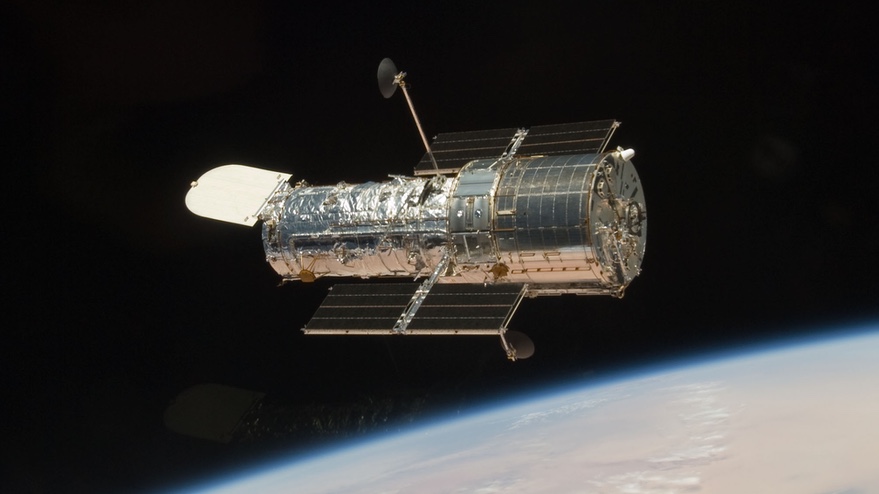
On November 29th, 2023, NASA announced that the ageing Hubble Space Telescope (HST) had entered a “safe” mode for an indefinite period due to further troubles with the system of gyroscopes used to point the observatory and hold it steady during imaging.

In all, HST has six gyroscopes (comprising 3 pairs – a primary and a back-up),with one of each pair required for normal operations. To help increase the telescope’s operational life, all three pairs of gyros were replaced in the last shuttle mission to service Hubble in 2009, and software was uploaded to the observatory to allow it to function on two gyros – or even one (with greatly reduced science capacity)  should it become necessary.

Today, only 3 of those gyros remain operational, the other three having simply worn out, and on November 19th, one of those remaining 3 started producing incorrect data, causing the telescope to enter a safe mode, stopping all science operations. Engineers investigating the issue were able to get the gyro operating correctly in short order, allowing Hubble to resume operations – only for the gyro to glitch again on November 21st and again on November 23rd, leading to the decision to leave the telescope in its safe mode until the issue can be more fully assessed.

The Hubble Space Telescope. Credit: NASA

The news of the problems immediately led to renewed calls for either a crewed servicing mission to Hubble or some form of automated servicing mission – either of which might also be used to boost HST’s declining orbit. However, such missions are far more easily said than done: currently, there isn’t any robotic craft capable of servicing Hubble (not the hardware or software to make one possible). When it comes to crewed missions, it needs to be remembered that Hubble was designed to be serviced by the space shuttle, which could carry a special adaptor in its cargo bay to which Hubble could be attached, providing a stable platform from which work could be conducted, with the shuttle’s robot arm also making a range of tasks possible, whilst the bulk of the shuttle itself made raising Hubble’s orbit much more straightforward.

Currently, the only US crewed vehicle capable of servicing HST is the SpaceX Crew Dragon – and it is far from ideal, having none of the advantages or capabilities offered by the space shuttle, despite the gung-ho attitude of many Space X supporters. In fact, it is not unfair to say that having such a vehicle free-flying in such close proximity to Hubble, together with astronauts floating around on tethers could do more harm than good.

A further issue with any servicing mission is that of financing. Right now, the money isn’t in the pot in terms of any funding NASA might make available for a servicing mission – and its science budget is liable to get a lot tighter in 2024, which could see Hubble’s overall budget cut.

Continue reading “Space Sunday: lunar delays and planetary dances”

Space Sunday: Starship Integrated flight Test 2

Lift off: 5 seconds after the ignition of its 33 Raptor engines, the SpaceX Integrated Flight Test (IFT-2) of a Starship / Super Heavy gets underway, December 18th, 2023. Credit: SpaceX

Saturday, November 18th, 2023 saw SpaceX attempt the second flight test of the Starship / Super Heavy behemoth out of their Starbase Boca Chica facility near Brownsville, Texas, in what is called the Integrated Flight Test 2 (IFT-2), featuring Booster 9 and Ship 25.

Regulars to the column will likely remember that the first such test of this launch combination on April 20th (and then called Orbital Flight Test 1), didn’t go that well; the launch stack was totally lost four minutes into the ascent, whilst the 31 operating engines on the booster spent the 5+ seconds between ignition and launch excavating the ground under the launch stand (see: Space Sunday: Starship orbital flight test).

The failure of that flight came as no surprise: the vehicle wasn’t fit for purpose (by Elon Musk’s own admission), and the launch infrastructure, as many (myself included) was not fit for purposes as long as it lacked a sound suppression system / water deluge system. In this regard, the April 20th attempt – which was more about boosting Musk’s ego on the so-called “Elon Musk Day” than anything practical – proved us right, the booster’s engines excavating the ground under the launch stand and throwing enough debris into themselves as to cripple the flight before it even left the launch stand.

So, how did the second flight go? Well – spoiler alert – both vehicles were again lost; the booster within the first 3.5 minutes of flight and the Starship around 4.5 minutes later. However, even this allows the flight to be recorded as a qualified success in that it will have yielded a fair amount of usable data and it did potentially succeed in meeting its two critical milestones.

Booter 9 / Ship 25 around a minute into the flight. Credit: Future / Josh Dinner

In all the flight might be summarised as:

  • T -02:00:00 hours: fast sequence propellant loading commenced, pumping around 4,536 tonnes into the tanks of both vehicles, less than the 4,800 tonnes full load required for an orbital flight.
  • T -00:00:05 seconds: the newly-installed and novel sound suppression system below the launch pad starts up, delivering a “cushion” of water under the launch stand in its first active launch test and the first critical milestone for the launch.
  • T-00:00:00: ignition of Booster 9’s 33 Raptor engines.
  • T +00:00:5 (approx 13:02:53 UTC): lift-off.
  • T +00:00:10 the vehicle stack clears the tower.
  • T +00:01:12 at 15km altitude and travelling at 1,500 km /h, the stack passes through Max Q, the period when it is exposed to the maximum dynamic pressure as it punches through the denser atmosphere.
  • T +00:02:40 main engine cut-off (MECO) commences, with the raptors on Booster 9 shutting down sequentially from the outer ring of 20 and progressing inwards to leave just three running.
A series of images showing the sequential shut-down of Booster 9’s engines, progressing from all 33 firing (l) through incremental shut-downs starting with the outer ring of 20 and commencing inwards, to leave just three firing (r). Credit: screen caps via the SpaceX live feed.
  • T + 00:02:48: Ship 25 ignites its engines in a “hot staging” process – second critical milestone for the flight.
  • T +00:02:49: Ship 25 separates from Booster 7, which fires upper and mid-point thrusters to tip itself away from Ship 25’s line of flight, using the thrust from its 3 remaining Raptor motors to increase its separation. Livestream graphic incorrectly shows 12 Raptors on the booster firing.
  • T +00:02:57: Booster 9 uses its small thrusters to flip itself over (so the top of the booster is pointing back towards the launch facility) ready to commence a “boost back” burn. Graphic continues to show incorrect number of engines firing.
  • T + 00:03:11: attempt to re-start the 10 motors of the inner ring to join the core 3 in firing for the “boost back” burn.
  • T +00:03:15: one or two engines flare briefly, following by attitude thrusters firing to correct, or some form of propellant venting.
  • T+00:03:17: further attempt at engine start-up, graphic now shows all 13 inner engines have shut down. Vehicle appears to be venting heavily from one side of the engine skirt.
  • T +00:03:20: one or more engines appear to explode. A fraction of a second late, the midsection explodes and vehicle is destroyed.
  • T +00:07:57: at an altitude between 140 and 148 km, and travelling at 23,350 km/h, Ship 25 appears to suffer an engine anomaly.
  • T +00:08:04: all flight telemetry seizes, showing the vehicle travelling at a flat trajectory at 149 km altitude.
  • T +00:08:08: Ship 25 is destroyed, – although mission control appear to be under the impression engine cut-off (scheduled for 8m 33s into the flight) had occurred prematurely and that the vehicle was still coasting in flight, publicly acknowledging it loss at 11m 23s after launch.
This image, taken within the first 90 seconds of launch, clearly shows the Starship vehicle to have lost numerous tiles from its thermal protection system (the white lines and dots on the black), making its ability to survive re-entry into the atmosphere – if it got that far – unlikely. Credit: SpaceX

Many were quick to hail the test as a huge win for SpaceX; others were equally quick to call it a further failure. The truth actually lies somewhere in between, as I noted earlier.

On the one hand, the flight was a success in that it clearly demonstrated the hot staging concept works, and the new sound suppression system may well protect vehicle and launch facilities at lift-off; the flight was also sufficiently long enough for a lot of data to be gathered.

On the other, the ways in which Booster 9 and Ship 25 were lost indicating there is a lot still to be done. Those claiming this flight to have failed also point to the fact that Ship 25 never got to coast on a sub-orbital hop to re-enter the atmosphere over the Pacific Ocean to splash-down near Hawaii.

However, while this was the supposed primary goal of April’s flight, for IFT-2, it was very much a tertiary objective; one a good distance behind hot staging and proving the sound suppression system. As such to call IFT-2 a failure based on this criteria is not entirely fair.

Of the two cited objectives, it is not unfair to say the jury is still out on the overall effectiveness of the sound suppression system. This is because – at the time of writing – we do not know its overall condition, as SpaceX has not released any post-launch images.

While there are various amateur videos of the launch stand and facilities post-flight, they are shot from a distance where it is impossible to judge the condition of the actual sound suppression system; therefore – and despite claims to the contrary made on their basis – we cannot tell how well it stood up to the blast from Booster 9’s engines.

All that can be positively determine from these videos is that the concrete on the launch stand withstood the blast considerably better than it did in April 2023, which show them to be in very good condition compared to the April 20th attempt, which might be indicative of the effectiveness of the sound suppression system – but that doesn’t mean it survived unscathed itself.

A further point here is that even if images do reveal the system to be relatively undamaged, that does not automatically mean it is fit for purpose; for one thing, this was an atypical launch: the stack was some 360 tonne lighter than it would be fully fuelled and with a payload – which likely reduced the degree of exposure the sound suppression system had to the fury of 33 Raptors operating at maximum thrust. Thus, it’s going to take a few more launches to really find out if the system is up to snuff or not.

Meanwhile, hot staging refers to igniting the motors of one stage of a rocket while it is still attached to a lower stage, rather than separating them first and then igniting the engine. When done right, it imparts an extra kick of velocity into the ascending stage which can be translated into a larger payload capability. Russia has been using hot staging in vehicles like Soyuz for decades, so the idea is not new; however, their rockets are built with it in mind; Super Heavy is effectively being retro-fitted with the capability, so there was a lot riding on this flight.

A diagram of the Soyuz FG variant, showing the hot staging structure between the core stage (called “Stage II” as the Russians refer to the strap-on boosters as “Stage I”) and the vehicle’s Stage III, allowing the motor on Stage III to fire before it separates from the core stage. Credit: as per the image

Continue reading “Space Sunday: Starship Integrated flight Test 2”

Space Sunday: Hawaii on Mars and deluge systems

Olympus Mons via ESA Mars Express Credit: ESA  /DLR / Andrea Luck

Olympus Mons is one of the many reasons I have an abiding fascination with Mars. Located to the northwest of the Tharsis Montes (Tharsis Mountains), a chain of super volcanoes marching across the planet’s northern hemisphere, Olympus Mons is the largest of all the volcanoes so far discovered in the solar system and boasts some incredible statistics.

For example, it rises a huge 26 km above the surrounding plains, or 21.9 km above datum for the planet, marking it as being around twice the height on Hawaii’s Mauna Kea as it rises from the sea bed. It is over 600km, covering an area almost the size of Poland. The volcano’s peak comprises a series of nested caldera craters which all speak to a violent volcanic past, and which at their widest measure some 60 km x 80 km and are up to 3.2 km deep.

So broad is the volcano that its slopes would not be at all mountain-like, but rather a continuous incline rising for the most part at an angle of just 5% from the horizontal; outside of the base escarpment that is. The latter, running around the volcano forms a near-continuous set of cliffs rising up to 8 km from the plains on which it sits.

Olympus Mons overlaying a map of Poland to give an idea of its surface area. Credit: NASA / Seddon / Szczureq

Precisely how Olympus Mons formed has been open to some debate. While it and the three volcanoes of the Tharsis Montes – Arsia MonsPavonis Mons, and Ascraeus Mons (all of which are as impressive as Olympus Mons, if each somewhat smaller) – formed in the same period of Mars’ early history some 3.7 to 3 billion years ago, Olympus Mons is potentially the eldest. Now a team led by Anthony Hildenbrand of Université Paris-Saclay in France believe they can show that a major contributing factor in the formation of Olympus Mons was water.

Using data from a range of missions in orbit around Mars, the team has carried out an extensive comparative study between Olympus Mons and volcanic island chains such as the Azores, the Canary Islands and the Hawaiian islands. In doing so, they have found evidence which strongly supports the idea of the escarpment around Olympus Mons were laid over thousands of years through the interaction of lava from the volcano and a surround ocean.

That an ocean once existing in the northern lowland of Mars – called the Vastitas Borealis – has long been known. However, given the elevation at which Olympus Mons sits, it had long been assumed it was above this ancient ocean. However, in their work, Hildenbrand’s team suggest Olympus Mons actually grew out of the ocean, rising through successive eruptions in much the same way as, say, Mauna Kea, until it broke the surface of the sea, and the interaction of the hot lava and cold water giving rise to the escarpment as the volcano contained to rise.

In support of this, the team found evidence that the flanks of Alba Mons, another huge, but much flatter – a mere 6.8 km in elevation – volcano further north along the edge of Vastitas Borealis and much older than Olympus Mons, suffered a series of violent tsunamis. These were likely the result of the violence of the eruptions which raised Olympus Mons.

An oblique view of Olympus Mons seen from the N-NE, created using a Viking Orbiter from 1976, overlain on data gathered by the Mars Orbiter Laser Altimeter (MOLA) on the Mars Global Surveyor orbiter (1997-2006). The vertical elevation has been exaggerated to show the 6-8 km base escarpment in sharp relief. Credit: NASA / MOLA Science Team

If Hildenbrand’s team are correct in piecing their evidence together, it could help explain one of the many mysterious of Mars. The edge of Vastitas Borealis has two shorelines differing substantially in elevation. Until this study, it had been widely accepted that the two shorelines were the result of two different oceans having once occupied the lowlands. The first, much higher (and older) shoreline marked a time very early on in Mars’ history when Vastitas Borealis was home to a broad, deep ocean which, due to climatic changes was almost completely lost.

Then, as volcanism again took hold, warming the planet again a few hundred million years later, a new, much shallower sea formed within Vastitas Borealis, evening rise to the younger shoreline at the lower elevation. However, this idea has always had its problems; in particular, it seems unlikely a vast, globe-circling ocean would form, and then almost complete recede, only to return again, even during Mars’ somewhat cyclical warm, wet period of history.

Olympus Mons: a flash colour image intended to present it as volcanic island in the middle of a vanished Martian ocean. Credit: A.Hildenbrand / Geops / CNRS

Instead, Hildenbrand’s work suggests that both shorelines belonged to the same ocean, one which was continuously present on Mars for perhaps close to a billion years. What changes was that in that period, the massive volcanic activity that gave rise to first Alba Mons and then to Olympus Mons and the Tharsis Montes and Tharsis Bulge, pushed up the overall elevation of the northwest quadrant of the planet to a far greater extent than thought.

Again, if this theory is correct, and Mars likely had a single, continuous northern ocean directly interacting with the volcanic activity in the region, it would have had a significant impact on the development of the planet’s climate and environment, including the development of any life which may have also developed.

The volcanic shorelines proposed in our paper may be an unambiguous witness for past sea level, where research for traces of early life (organic matter) could be targeted. More generally speaking, knowing where and when past Martian oceans may have been has significant implications for climatic models, because this would give decisive constraints on the initial amount of stable liquid water, the physical conditions for the persistence of a stable atmosphere, until when magmatic degassing associated with major planet activity may have occurred.

– Anthony Hildenbrand

Continue reading “Space Sunday: Hawaii on Mars and deluge systems”

Space Sunday: Debris, Artemis delays, SpaceX Plans

The International Space Station. Credit: NASA

Anyone  who follows news on space activities will be aware that on November 15th, Russia carried out the test of an anti-satellite(ASAT) missile system that resulted in the destruction of a defunct Soviet-era electronic signals intelligence (ELINT) satellite – and required the crew of the International Space Station (ISS) to move to their respective Earth return vehicles (Soyuz MS-19 and Crew Dragon Endurance) due to risk of being hit by the debris.

To be clear, ASAT systems are not new. The United States and Russia (/the Soviet Union) have between them spent decades developing and testing such systems (the last successful US test was in 2006, with both the USAF and USN having significant ASAT capabilities), and China and India have also demonstrated ASAT systems as deliberate demonstrations of force.

However, the November 15th test by Russia was somewhat different. Occupying a polar orbit at an average altitude of around 470 km, the 2.2 tonne Kosmos 1408 as both a substantial target risking a massive debris cloud, and routinely “passed over” the orbit of the ISS (ave 420 km), putting it at clear risk.  Nor did Russia give any forewarning of the test.

Instead, the US Space Command only became aware of what had happened after they tracked the missile launch all the way to impact – and then started tracking the cloud of debris. This presented no danger to the ISS in its first orbit, but tracking showed it was a very define threat to the station on its 2nd and 3rd orbits, prompting mission controllers to order the ISS crew to start shutting down non-essential operations and sealing-off hatches between the various science modules.

Some 15 minutes before the second pass of the debris field across the station’s orbit, controllers called the station to order the US / European astronauts in the “US section” of the station to secure all remaining hatches to minimise the risk of explosive decompression in the event of a hit, and evacuate to Crew Dragon Endurance both in case an emergency undock was required, and because it presented a significantly smaller target for any stray debris travelling at 28,000 km. The controllers also noted the Russia cosmonauts on the station were engaged in similar actions, and would be retiring to their Soyuz MS-19 vehicle.

In all, the crews were restricted to their Earth return vehicles for somewhere in the region of 3-3.5 hours before it was considered the most significant risk of and impacts had for the most part passed. Even so, it was not until November 17th that all hatches on the ISS were unsealed to allow normal operations to resume throughout all modules. Currently, NASA is still monitoring the situation and may postpone  a spacewalk planned for November 30th as a result of the debris risk.

Ironically, on November 11th, the ISS had to raise its orbit somewhat using the thrust from a docked Progress re-supply vehicle in order to completely remove the risk of debris from 2007 Chinese ASAT weapon test striking it, 14 years after the test.

In these images, Kosmos 1408 can be seen ringed on the left. The image on the right highlights some of the larger clumps and pieces of debris left after the kinetic “kill” by the Russian ASAT weapon. Credit: Numerica and Slingshot Aerospace

Following the test, Russia attempted to play down the risk, stating it posed “no threat” to other orbital vehicle, crewed or uncrewed – a less than accurate statement. Analysis of the debris cloud by both US Space Command and civilian debris tracking organisations reveals much of the cloud will remain a threat for the next several years – if not decades – as the convoluted nature of orbital mechanics and impact velocity gradually increases the cloud’s orbital altitude for a time as it continues to disperse, putting satellites in higher orbits at risk – particularly the likes of the SpaceX Starlink and the OneWeb constellations.

Russia has demonstrated a deliberate disregard for the security, safety, stability, and long-term sustainability of the space domain for all nations. The debris created by Russia’s DA-ASAT will continue to pose a threat to activities in outer space for years to come, putting satellites and space missions at risk, as well as forcing more collision avoidance manoeuvres.

– U.S. Army General James Dickinson, Space Command.

Some 1500 individual pieces of debris from the test are of a trackable size, with potentially tens of thousands more that are too small to be identified. Tim Flohrer, head of the European Space Agency’s (ESA) Space Debris Office noted that the test means that debris avoidance manoeuvres made by satellites in the 400-500 km orbit range may increase by as much as 100% for the next couple of years before the threat is sufficiently dissipated. One of the biggest risks posed by this kind of action is the Kessler Effect (or Kessler Syndrome), wherein debris from one impact causes a second impact, generating more debris, and so setting off a chain reaction.

Given its size and orbit, there is simply no way Russia was unaware of the threat posed by Kosmos 1408 to low-orbit vehicles – particularly crewed vehicles and facilities – if the test was successful. As such, some have seen it as irresponsible due to the impact it could have on general orbital space operations, while others see it as a sign of aggressive intent on Vladimir Putin’s part.

Currently, Russia has not indicated as to whether this was a one-off incident (a previous test in 2020 missed its target), as has been the case in the US, Chinese and Indian tests, or if it could be a part of a wide series of tests. If the latter, then international relationships are liable to be further strained.

NASA OIG: No Moon Landing Before 2026

Following NASA’s indication that the first Artemis lunar laying won’t come “earlier” that 2025, the agency’s own Office of Inspector General (OIG) has thrown a bucket of realism over the entire project, pretty much confirming comments made in this blog concerning vehicle development timelines, whilst also questioning the sustainability of the programme.

Having carried out an extensive audit of the programme, OIG has issued a 73-page report which critiques the current Artemis programme and time frames, although it can only offer suggestions on what might be done, not instigated changes.

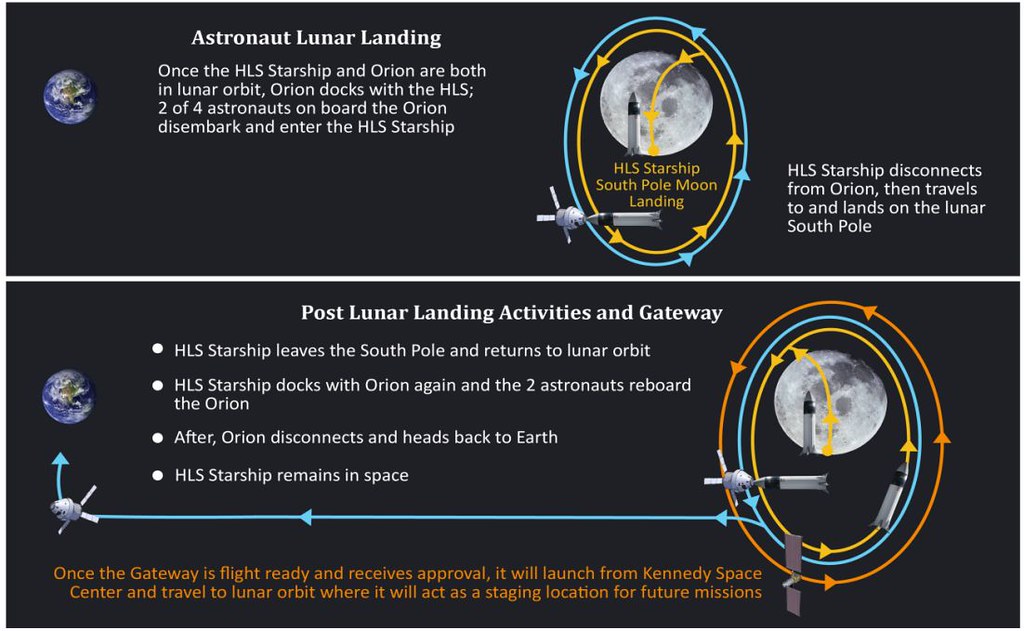
Artemis 3 mission (1): the OIG report outlines the first mission to return 2 humans to the Moon – Artemis 3 – as designed by NASA / SpaceX. This uses the SpaceX Starship HLS – which will now be supported by a SpaceX “fuel depot” (a modified Starship hull) sitting in Earth orbit, and frequently refuelled by between 4 and 8 additional Starship vehicles – and the Orion MPCV for transporting a crew of 4 forth and back between Earth and the Moon. Credit: NASA / NASA OIG

It terms of the development of the Human Landing System (HLS), required to get crews to / from the surface of the Moon, the report follows what has been noted in Space Sunday: the 4-year development time frame is simply unrealistic. In particular, the report notes that even in partnerships such as the Commercial Crew Programme, NASA tends to require around 8.5 years to develop a new spaceflight capability – more than double that allocated for HLS (in fact, NASA / SpaceX believed Crew Dragon could be developed and ready for operation in 6 years – it took 10). It also indicates that while a reliance on a single vehicle design / contractors (currently SpaceX) reduces costs, it also places further risk on the entire programme time fame and operations.

Further, the OIG report states that realistically, the first flight of the first Space Launch System (SLS) rocket is unlikely to take place until mid-2022; somewhat later than NASA is still projecting (early 2022). It goes on to point of that given the delays on Artemis 1, it is unlikely that the Artemis 2 mission scheduled for 2023 and which will fly a crew around the Moon and back to Earth in a manner akin to Apollo 8 is unlikely to be ready until mid-2024, simply because NASA plan to re-use elements from the Artemis 1 Orion vehicle in the Artemis 2 Orion, and these will need a comprehensive post-flight examination and refurbishment.

Artemis 3 (2): The report shows the rendezvous with the HLS for the surface mission (2 crew), and leaps ahead to future missions and the establishment of the Lunar Gateway station. What is left unclear is whether the HLS vehicle will be reused (returning it to be refuelled) or simply abandoned (marking it as a waste). Credit: NASA / NASA OIG

Beyond this, the report also raises concerns whether the space suit required for lunar operations – the Exploration Extravehicular Mobility Unit (xEMU) – will actually be ready for operations in 2025, issues in technical development, and in NASA flip-flopping between in-house and commercial contract development of the suit being pointed to as reasons for the delays.

The biggest critique in the report, however, is related to costs. The OIG report notes that at current levels of expenditure, Artemis will cost US $93 billion by 2025/26, with the first four Artemis SLS / Orion launches (Artemis 1 through 4) alone costing US $4.1 each – and this estimate does not include the development of the actual HLS system or the costs to launch / operate it.

NASA OIG estimates the Space Launch system will cost US $4.1 billion per launch for the 1st four flights, with total Artemis development and infrastructure costs (excluding HLS) being some US $93 billion by 2026. Credit: NASA

To reduce these costs, OIG suggests looking to alternate launch vehicles  to deliver crews to lunar orbit, but NASA management has already rejected such ideas and had refuted OIG’s cost analysis and call for most closely accounting for expenditure. However, it has accepted the report’s other concerns; although it will take time to see if this translates into any form of re-assessment of the programme as a whole.

Continue reading “Space Sunday: Debris, Artemis delays, SpaceX Plans”

Space Sunday: throwing things into space; NASA & SpaceX round-ups

A conceptual model of a SpinLaunch coastal launch facility with the vacuum accelerator exposed – the launch vehicle is located at the outer end of the black rotating arm. Credit: SpinLaunch

Up until now, the only means to get payload into space has been through chemical propulsion – rockets. And while they are not entirely efficient, they do work. However, if an American company gets its way, launching small payload into orbit could see the core part of their rocket replaced by a vacuum accelerator. Think of whirling an object around at speed on the end of a piece of string and then releasing it vertically, and you’ll get the picture.

The idea may sound bonkers, but it is precisely what US company SpinLaunch is planning to do.

They propose building a 100-metre diameter vacuum accelerator that, over the course of 90 minutes can accelerate an 11.2 tonne launch system up to a speed of Mach 5 before releasing it to travel along a launch tube and into the air. This velocity should be sufficient to propel the launch vehicle – comprising an aerodynamic aeroshell within which is placed a two-stage rocket carrying a 200 Kg payload.

The SpinLaunch payload vehicle, showing the outer dynamic shell, the two-stage rocket vehicle, and a pair of small satellites as the payload. Credit: SpinLaunch

On reaching a altitude matching that of a Falcon 9 first stage, the aeroshell would then split open, releasing the rocket to power itself and its payload on to orbit. Sound this work, it could reduce the cost of placing small payloads into space by around 80%, and allow for multiple launches from a single facility per day, if required.

To prove the idea works, SpinLaunch has constructed a one-third scale version of the accelerator, and on October 22nd, used it – operating at around 20% of rated output – to propel a 3-metre long ballistic projectile “tens of thousand of feet” into the atmosphere. According to SpinLaunch, the test was the first of 30 to take place over the next 6 months before they start work on construction on what they claim will be the first of a number of full-scale launch facilities at various points on the American coast.

That said, there are some significant technical challenges. Spinning at a maximum speed of 450 rpm, the system will subject the launcher and its payload to a peak dynamic load of 10,000 G; that’s a lot for the more sensitive part of the rocket motor to handle. More particularly, when it breaks the vacuum seal at the end of the launch tube, it will be travelling at Mach 5 – and slamming straight into the densest part of the atmosphere, again placing a massive load on it and its payload, as well as generating a lot of frictional heat as a result of its passage through the air. And that’s without considering the challenges in translating the spin of the accelerator into linear motion for the launch vehicle such that it can smoothly and successfully exit the launch tube, etc.

Even so, SpinLaunch appear to be carrying out the right amount of research – even if they are somewhat circumspect in addressing specific technical questions. As such, it will be interesting to see where things lead.

SpaceX Starship Update

With the public phase of the FAA’s Programmatic Environmental Assessment (PEA) of the Starbase facilities at Boca Chica now closed and the agency putting together its final version of the report, SpaceX has been moving ahead with site and vehicle development.

Most notably with the former has been work on erecting the framework of the new Wide Bay facility that could allow work to progress on up to four Super Heavy / Starship vehicles at a time, massively increasing the ability for the company to stack vehicles elements together. At the same time, in the current 2-vehicle High Bay, Booster 5 is nearing stack completion, and work has resumed on Starship 21.

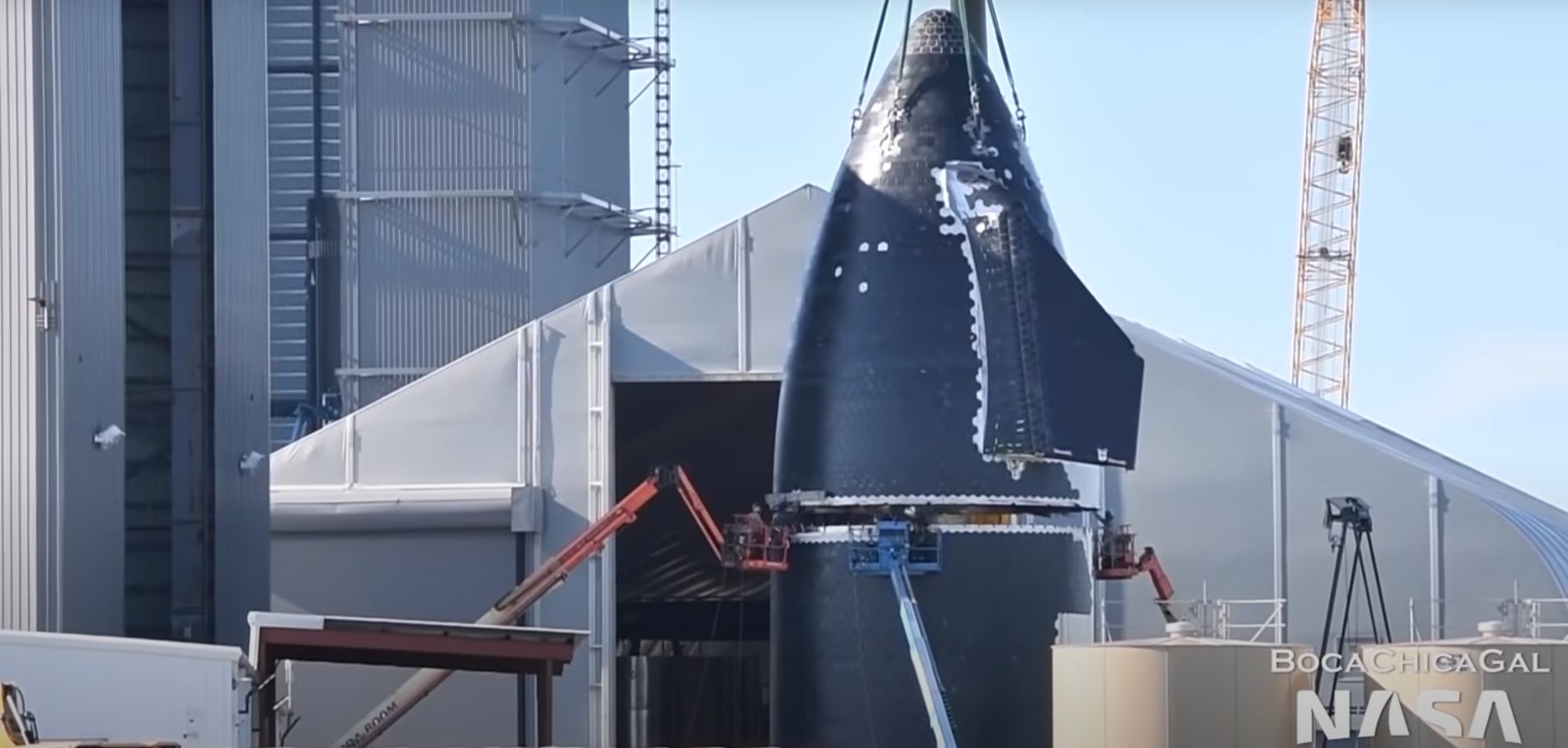
The nose cone section of Starship 21, due to be the second orbit-capable test vehicle, is mounted onto the upper section of the vehicle. Note the thermal protection system already installed on both sections. Credit: BocaChicaGal / NASASpacelfight.com
Booster 5 includes significant differences to Booster 4, which is now sitting on a hard stand at the launch facilities as work continues on the launch platform there. Most notably, elements of the booster are emerging from the fabrication facilities in a completed state than was the case with Booster 4 – which even now, is still awaiting various elements of aerodynamic casing, etc., to protect various parts during its ascent and decent through the atmosphere. Similarly, Starship 21 is showing differences in construction to Starship 20, most notably in having sections fitted with their thermal protection blankets and tiles prior to being stacked together.

At the launch site, work has continued in getting the catching mechanism on the launch support tower properly rigged to the cable system and massive winches that will allow it to move up and down the tower for eventual stacking and catching operations. A short distance away, Booster 4 has started to receive the protective skirting around its base to keep the more sensitive parts of its ring of outer engines safe from the flames and heat of ignition, as well receiving the last of its 29 Raptor engines.

However, the biggest new in recent weeks came with the pre-burn and static fire test of all six Raptor motors on Starship 20. These came almost back-to-back on November 12th, with the pre-burn (a kind of clearing the rocket engines’ throats) coming first and lasting just under a second. Then, around an hour later came a 2-second firing of the vehicles’ 3 sea-level engines and the 3 vacuum rated engines.

As with the last static fire test (with just 3 motors), some of the vehicle’s thermal protection tiles were blown clear, with a good number coming off lower down the vehicle when compared to the 3-engine test. Although brief, the static fire gave a small taste of the amount of noise that will be generated when Booster 4 ignites all 29 of its motors and then sustains their thrust through an actual launch.

Whether or not this launch, which will hopefully carry Starship 20 aloft, will come before the end of the year still hangs in the balance, with a lot riding on the outcome of the FAA’s final version of their PEA.

NASA Updates

Hubble Partially Recovered

On October 25th, the Hubble Space Telescope (HST) entered a “safe” mode, shutting down all science operations, the result of “multiple losses of synchronisation messages” – messages designed to coordinate how the various science instruments on HST receive and transmit data to / from the telescope’s primary computer system. While of concern, and possibly a little more frequent than initially diagnosed, the issue left Hubble in good health and engineers confident science operations could be recovered.

During the week, further tests were carried out that gave NASA the confidence to return the Advanced Camera for Surveys (ACS) to operational status on November 7th. The coming week will see the completion of additional tests with the hope that the more sensitive instruments on the telescope can be returned to operational status.

Artemis 3 Moon Landing Now “No Earlier” Than 2025

In a move that should have surprised no-one interested in space exploration, NASA has pushed back their return to the Moon to at least 2025, citing four reasons: the disagreement with Blue Origin over the contract for the Human Landing System (HLS), delays due to COVID working restrictions in 2020, Congress “failing” to fund HLS development and the Trump Administration placing unrealistic time frames on the programme.

Of the four reasons, the last is perhaps the most accurate: you simply cannot lop 4 years off of a programme and expect it to succeed (simply so you can take the credit as theoretically still be in office), without a commensurate increase in budget to allow NASA to achieve the required goals in the reduced time frame. On the other hand, blaming Congress isn’t entirely honest. In 2019, NASA stated they need $5+ billion for HLS development – but only requested less than $2 billion – hoping they could take money from the infrastructure bill and put into HLS – which Congress refused to allow.

The Artemis 1 mission profile. Credit: NASA – click for full size

As it is, the “no earlier” statement is standard NASA parlance when they do not wish to commit to a specific data as yet, in this instance it is perhaps indicative that Artemis 3 could slip to 2026. A lot is riding on the Artemis 1 mission, which has already slipped to February 2022, being the first flight of the Space Launch System (SLS) rocket critical in getting crews to the Moon. Should this first (uncrewed) flight reveal issues with either SLS or the Orion crew vehicle, then it is likely to seriously impact the entire Artemis timeline.

Similarly, while Elon Musk claims SpaceX will be able to land a crewed Starship HLS vehicle on the Moon in 2023, his time-frames tend to be over-optimistic. Also, there are some major questions around the Starship HLS that have yet to be answered; plus SpaceX are working to NASA’s crew safety requirements, not their own, which can (rightly, given crew safety is at stake) cause additional overheads on a development programme.

Crew Dragon: 4 Down, 4 Up

After uncooperative weather mixed things up, and caused delays, SpaceX Crew Dragon Endeavour has returned to Earth, bringing with it NASA astronauts Shane Kimbrough and Megan McArthur, ESA astronaut Thomas Pesquet and JAXA astronaut Aki Hoshide, who were all just a few hours short of spending 200 days aboard the space station.

Departure and splashdown took place on November 8th, with only the late-opening of one of the 4 main parachutes preventing the return from being perfectly textbook.

A remarkable shot captured by the NASASpaceflight.com team showing Crew Dragon Endeavour forming a bright star as it flies through re-entry high above the SpaceX Starbase at Boca Chica. In the foreground is the launch support tower for Super Heavy / Starship. Credit: NASASpaceflight.com

The departure left a lone US astronaut on the ISS along with two Russian cosmonauts. Mark Vende Hei arrived on the station aboard Soyuz MS-18 in April 2021. In September he and cosmonaut Pyotr Dubrov, who also flew to the station on MS-18, had their stay on the station extended through until March 2022. This means that Vende Hei will take the record for the longest individual space flight by an American – 353 days.

However, on Thursday, November 11th, he was joined by NASA colleagues Raja Chari, Tom Marshburn, and Kayla Barron, who arrived at the ISS along with ESA astronaut Matthias Maurer aboard Crew Dragon Endurance as the Crew 3 mission. They had launched earlier on Thursday, November 11th (Late on Wednesday, November 10th, US time), marking the maiden flight of the third Crew Dragon vehicle to enter service. They will remain aboard the station for 6 months.

Further Push to Retire SOFIA

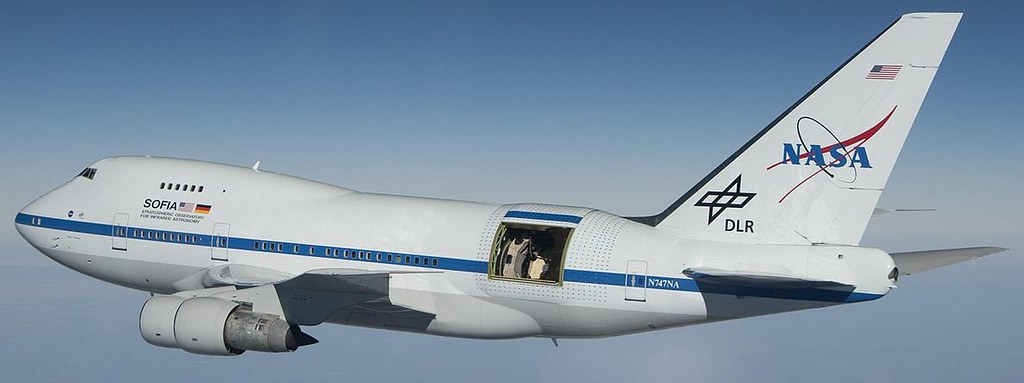
NASA’s Stratospheric Observatory for Infrared Astronomy (SOFIA), the 2.5 metre telescope flown aboard a converted 747 SP aircraft has been recommended for “termination” by the committee that originally prioritised it.

The astrophysics decadal survey committee, which originally pushed for the airborne observatory in both 1990 (when it was not funded) and 2000 (when it was, although technical issues meant it did not enter service until 2014), now believe it is not worth the annual US $85 million cost of operating it and a “lack” of “scientific productivity”.

SOFIA: the Stratospheric Observatory for Infrared Astronomy, a flying observatory, capable of flying high enough to put it above the majority of atmospheric interference – but again threatened with cancellation. Credit: NASA

The “lack of productivity” references the fact that in its first 6 years, SOFIA has only generated 178 scientific papers that were cited 1,242 times, far less than other, more specialised observatories like the Transiting Exoplanet Survey Satellite (TESS); however, supporters of SOFIA note that the figures ignore the fact that in the last 12 months there has been a 59% increase in SOFIA papers, and the observatory is gaining more use in a variety of roles.

NASA has twice tried to cancel SOFIA, but in 2020 Congress provided sufficient funding for operations to through 2021 and into 2022. Currently, the House has also provided funding for the observatory until the end of 2023, although the Senate has yet to make a determination on funding.

Blue Origin Space Tourist Killed

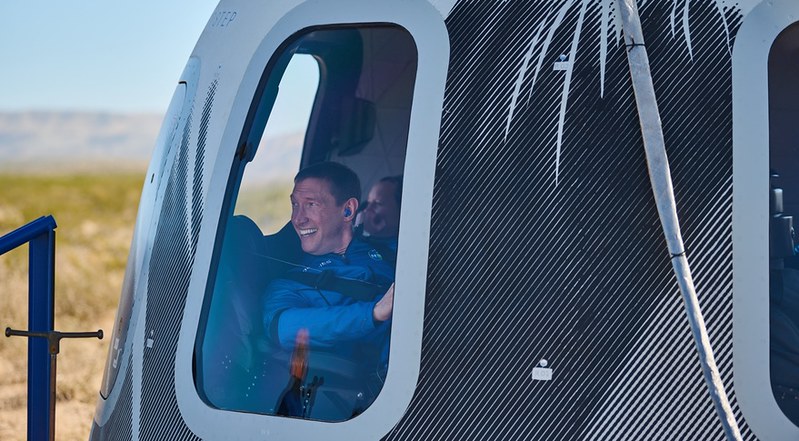
Glen de Vries, who flew with William Shatner, Chris Boshuizen and Audrey Powers, a Blue Origin vice president on the second passenger-carrying Blue Origin New Shepard sub-orbital flight, was one of two people on a Cessna 172 aircraft that crashed in New Jersey on November 11th.

Glen De Vries aboard New Shepard NS-18 capsule prior to launch

De Vries, a biomedical entrepreneur and self-described “space nerd”, paid an undisclosed sum for the flight, and had been giving talks and presentations on his experience since his return to Earth.

At the time of his death, he had been flying with Thomas Fischer from Essex County Airport in Caldwell, N.J. Both men were well-qualified pilots – Fischer also being a flight instructor – but it is not clear who was flying the aircraft. Emergency services were alerted after the pair failed to arrive at their destination, and the wreckage of the aircraft were subsequently found  in a heavily wooded area near Hampton Township, about 64 kilometres northwest of New York City. At the time of writing, the cause of the crash remains undetermined.

We are devastated to hear of the sudden passing of Glen de Vries.  He brought so much life and energy to the entire Blue Origin team and to his fellow crewmates. His passion for aviation, his charitable work, and his dedication to his craft will long be revered and admired.

Blue Origin statement on the death of Glen de Vries