Space Sunday: China; NASA shockwaves; IFT-9

Space Epoch’s Yuanxingzhe-1 (YXZ-1 or Hiker-1) verification test article rocket hovers over the sea before splash-down, May 28, 2025. Credit: Space Epoch

China is continuing to expand its space endeavours on both the public and private fronts – drawing some flak from SpaceX fans in the process.

On Wednesday, May 28th, a Long March 3B rocket lifted-off from the Xichang Satellite Launch Centre, southwest China at 17:31 UTC, carrying aloft the Tianwen-2 explorer, bound for 469219 Kamoʻoalewa (2016 HO3), an Apollo class, near-Earth object (NEO) and quasi-satellite of this planet.

A sample-return mission, Tianwen-2 is due to rendezvous with the 40-100 metre diameter asteroid in July 2026. It will spend some 7 months examining it and attempt to collect samples from its surface and sub-surface, using both touch-and-go (dropping briefly onto the asteroid in an attempt to gather samples before being pushed away using spring tension in the sample arm), and anchor-and-attach (literally hooking itself onto the asteroid). Departing the asteroid in April 2027, Tianwen-2 will then swing by Earth, dropping off gathered samples in a re-entry capsule in November of that year. In all, it is hoped that around 100 grams of material will be gathered from the surface and sub-surface environments of the asteroid. An interesting aspect of the mission is that Tianwen-2 will attempt to deploy a nano-rover onto the surface of 469219 Kamoʻoalewa, and place a nano-satellite in orbit around it.

An artist’s rendering of Tianwen-2. Credit: Najing University via Weibo

The aim of the mission is to gain insight into 469219 Kamoʻoalewa, and either answer questions as to whether or not it is actually a chunk of the Moon blasted clear following an asteroid impact or, if not, it is hoped the mission will provide insight into the nature and characteristics of NEOs (particularly whether they also contain organic molecules), and allow comparative studies between the samples returns and those from Hayabush2 and OSIRIS-REx, furthering our understanding of asteroids and the role in the early solar system.

Returning the samples to earth will not be the end of Tianwen-2’s mission. Using Earth’s gravity after releasing the sample return capsule the vehicle to push itself onto a rendezvous 311P /PANSTARRS (aka P/2013 P5), which it will reach in 2031. This is an unusual object called an active asteroid – an object with an asteroid-like orbit, but exhibiting comet-like visual characteristics (such as having a tail). Estimated to be 240 metres across and with a sidereal period of 3.24 years, it was first located in 2013, and attracted attention due to its fuzzy, smudged appearance in initial images. Later that year, the Hubble Space Telescope revealed that the fuzziness was due to it having around 6 individual tails. These are thought to be the result of the asteroid is either spinning so fast, lose surface material is being thrown off of it, or that a series of “impulsive dust-ejection events” of unknown origin gave rise to a cloud of debris around the asteroid, which were then formed into the tails by solar radiation pressure.

Rather than just making a fly-by of 311P /PANSTARRS, the plan is for Tianwen-2 to use its solar-eclectic propulsion system to decelerate as it approaches the asteroid so that it can enter orbit and study it at length.

Asteroid 311P /PANSTARRS (P/2013 P5) revealing is multiple tails as revealed by the Hubble Space Telescope. Credit: NASA / ESA

Also on May 28th, the private-venture launch company, Space Epoch, became the first Chinese company to make a sea-based vertical launch of a reusable rocket element and successfully recover it in a controlled splash-down.

The Yuanxingzhe-1 (YXZ-1 – also referred to a “Hiker 1”) is designed to be a reusable booster some 64 metres tall and capable for delivering 6.5 tonnes to a Sun-synchronous orbit (SSO). For the May 28th, flight, a test article standing 26.8 metres tall and using a single Longyun methane-liquid oxygen (methlox) motor and massing 57 tonnes, lifted-off from the sea-based Haiyang spaceport, Shandong province, at 20:40 UTC, climbing to an altitude of 2.5 km. The motor brought the vehicle to a hover before shutting down, allowing the vehicle to fall back towards the sea using four grid fins to maintain its vertical orientation. After a free descent, the motor then re-lit, slowing the vehicle and bringing it to a safe hover just a metre or so above the water. It then shut down, allowing the vehicle to gently enter the water and topple onto its side and await recovery. In all, the 125-second flight verified the broad operational parameters of the full-size Hiker-1, which will also splash-down at the end of its flights, rather than trying to land or be caught out of the air.

The flight, defined by Space Epoch as “100% successful”, immediately came under attack by SpaceX fans. The latter claimed China was merely “copying” SpaceX rather than innovating, particularly through the use of stainless steel in vehicle construction and methlox propellants, together the the use of four grid fins on the rocket for steerage / stability – as if SpaceX had any sole claim to these capabilities (they have not even patented the use of grid fins for rocket attitude control in an atmosphere).

A similar “they’re just copying!” came on May 29th, when another Chinese start-up, Astronstone, announced it has received sufficient initial funding to push ahead with its design for a reusable launch vehicle. Called the AS-1, this is intended to deliver up to 10 tonnes to low-Earth orbit (LEO) when being reused and up to 15.7 tonnes in fully expendable mode. It is to utilise methlox propulsion, stainless steel construction, grid fins for descent control and is to be designed to boost-back to its launch facilities and captured by “chopsticks” mounted on the launch tower.

A Render of an Astronstone AS-1 (with payload attached!) “caught” within the “chopsticks” of its launch tower. Credit: Astronstone

In this, Astronstone is not shy about taking a leaf from the SpaceX book; the only difference is that of scale: AS-1 will be a modest 70 metres tall with a 4.2 metres main diameter (roughly the height of SpaceX Super Heavy, with half the diameter), while its 10-tonne reusable payload lift capacity is well in keeping with most modern commercial launch requirements. If successful, the company plan on offering the AS-2, capable of around two or three times the payload capacity of AS-1.

NASA: Budget Fears Confirmed; Administrator Nominee Removed

Earlier in May 2025, I covered the threats to NASA’s budget under cuts being considered by the Trump administration (see: Space Sunday: of budgets and proposed cuts and Space Sunday: more NASA budgets threats). At the time, the concerns were based on a so-called “skinny” budget document released by the administration, which outlined where the cuts would fall.

On May 31st, 2025, the administration quietly published a more detailed version of its federal budget proposal. This solidifies many of the threats to NASA’s mission. It confirms the intent to slash NASA’s budget by 24%, with the majority of the cuts coming within NASA’s space science, Earth sciences, aeronautic and education areas. In real terms, and adjusted for inflation, it sees the agency’s budget reduced to levels not seen since 1961, with the potential for 5,500 job losses and possible centre closures.

The science budget zeros-out 41 in-development or in-progress science missions. These Include:

  • Many NASA Earth science programmes and missions, current and future, including the decadal survey Earth System Observatory missions; cancellation of most venture-class Earth science missions; and potentially impacts to the “cyclone watching” CGNSS network currently in operation.
  • The in-development DAVINCI and VERITAS missions to Venus, and the Mars Sample Return Mission (MSR – not helped by NASA repeatedly shooting itself in the foot where this is concerned).
  • The operational Mars Odyssey and MAVEN Mars orbiters (ending two valuable missions and limiting relay communications with other Mars missions); the New Horizons mission; OSIRIS-APEX – a mission extension to the highly-successful OSIRIS-REx, and intended to provide information on the Earth orbit crossing asteroid (and potential future impactor) 99942 Apophis.
  • Multiple astrophysics programmes and missions, including the Chandra X-Ray Observatory, the Fermi Gamma-ray Space Telescope, and multiple, low-cost but highly effective Explorer-class missions.
The Chandra X-Ray Observatory: earmarked for cancellation under the Trump 2026 budget. Credit: NASA

The budget additional calls for an effective crippling of NASA’s biological and physical sciences,  reducing its budget to just US $25 million from US $87 million, and ending cooperation with the European Space Agency on Venus and Mars missions. While the flagship Nancy Grace Roman Telescope survives cancellation, it receives just half its requested budget – US $156.6million – potentially impacting its ability to be launched in 2026.

In terms of human spaceflight, the Trump administration is apparently initiating a “bold mission of planting the American flag on Mars”, which sees some 6.38% of NASA’s total budget being steered into Mars-centric initiatives:

  • US $864 million for a “Commercial Moon to Mars (M2M) Infrastructure and Transportation Program” (which as side-note, will replace SLS / Orion after Artemis 3 – assuming any such system is actually flying by then).
  • A total of US $400 million to be put into a “near-term entry, descent, and landing demonstration for a human-class Mars lander”, and commercial payload deliveries to Mars.

Some of this will be offset by the cancellation of the Lunar Gateway boondoggle; however, it is hard not to see hints of the influence of the SpaceX CEO in these matters. He has been vocal in his opposition to anything other than his “grand vision” of colonising Mars, and these budget allocations, particularly the US $400 million appear to be directly tailored to SpaceX’s benefit, the company apparently prioritising landing a “human-class lander” as soon as possible, and then moving directly to cargo deliveries.

Isaacman Out

The budget details came alongside the shock announcement that the White House has withdrawn entrepreneur Jared Isaacman at its nominee to lead NASA.

Isaacman’s nomination caused mixed reactions when first announced. Whilst the majority were positive, there were also concerns over his ties to the SpaceX CEO, and the latter’s views on NASA’s future direction. During his Senate confirmation hearings, Isaacman handled the latter concerns directly, and indicated his own opposition to some of the proposals in the Trump NASA 2026 budget. As such, it was widely anticipated the Senate would confirm his appointment on June 3rd, 2025.

Jared Isaacman during his Senate confirmation hearing. Credit: Associated Press

No reason has been given by the White House for withdrawing his nomination. Some have speculated it is as a result of the recent rift between the President and the SpaceX CEO, with whom Isaacman has a strong association. Also, Isaacman’s confirmation hearing also revealed he has been a past financial supporter of the Democratic Party – something hardly likely to endear him to the White House incumbent. In a statement on the withdrawal, White House assistant press secretary Liz Houston would only say:

The Administrator of NASA will help lead humanity into space and execute President Trump’s bold mission of planting the American flag on the planet Mars. It’s essential that the next leader of NASA is in complete alignment with President Trump’s America First agenda and a replacement will be announced directly by President Trump soon.

Again, the emphasis on Mars here is loud enough to be almost deafening – and in line with the goals of the SpaceX CEO. This is not to say the the latter will now be the likely pick to head-up NASA; it is highly unlikely he would survive Senate hearings even if nominated. However, it does perhaps indicate his push for having NASA effectively abandon the International Space Station and the Artemis programme in favour of Mars have been taken to heart by a President who is all about being “first” in everything.

Thus far, all of the Trump administration proposals for NASA’s budget have been met with widespread condemnation from the aerospace, science and educations sectors in the US. Many are hoping that Congress will stop this tear-down of NASA dead in its tracks when the budget comes before the Capitol later in the year. As to Isaacman being removed as nominee, this has been received with dismay and upset within the US space industry, and leaves NASA in a continuing state of limbo.

Starship IFT9: Up and Bang Again1

On Tuesday May 27th, 2025, SpaceX once again attempted to carry out their 9th integrated flight test (IFT-9) of their Starship / Super Heavy combination in the hope of getting the former into sub-orbital space to carry out a series of tests, and use the latter as a test article during its descent back to the Gulf of Mexico. As such, the flight had a number of distinct goals for both the booster and the starship vehicle.

  • Booster (√ = success; Χ = failure):
    • Re-fly a Super Heavy for the first time – the unit used in the January 2025 test article flight (with just 4 of its 33 Raptor 2 motors replaced)  (√).
    • Attempt a new “rollover” manoeuvre after starship separation (√).
    • Test a new high angle of attack re-entry into the lower atmosphere in an attempt to use atmospheric drag to reduce velocity and reduce the need to carry propellants for propulsive braking (Χ).
    • Carry out an updated engine braking burn (Χ).
    • Splash-down in the Gulf of Mexico (Χ).
  • Starship (√ = success; Χ = failure):
    • Reach a sub-orbital trajectory (√).
    • Deploy a set of 8 Starlink satellite simulators, testing the payload bay slot in the process (Χ).
    • Carry out the re-start of a sea-level Raptor engine to test de-orbit burn capabilities (Χ).
    • Make a successful re-entry into the atmosphere and test updates made to the thermal protection system and to hopefully reduce burn-through on the fore-and-aft aerodynamic flaps (Χ).
    • Splash-down in the Indian Ocean (Χ).
SpaceX IFT-9: lift-off of the Starship / Super Heavy combination, Boca Chica, Texas, 23:37 UTC (19:37 local time). Credit: SpaceX

Lift-off was at 23:37 UTC, from the SpaceX Starbase City facilities in Texas, and proceeded to a successful staging. The booster then performed its intended roll-over and carried out a good boost-back burn. It was lost 6 minutes 20 seconds after launch, as 13 of the engines were due to fire at the start of their braking burn.

The starship vehicle continued on to its sub-orbital trajectory and successfully shut-down its motors. The deployment of the payload simulators was due at 18 minutes into the flight, but was abandoned when the deployment slot door again failed. By 30 minutes into the flight the vehicle was pitching / rolling wildly, and SpaceX confirmed they had lost all attitude control, likely the result of a propellant system leak. The vehicle subsequently made an uncontrolled re-entry over the Indian Ocean 46 minutes after launch and largely burned-up.

With the six engines of the starship vehicle burning brightly “beneath” it (actually at a higher altitude), and with its own three steerable motors firing, the Super Heavy booster is seen entering its new “roll-over” manoeuvre, aligning itself for its boost-back burn of 13 motors. Credit: SpaceX

Whilst subject to confirmation, the propellant leak potentially hints at a vulnerability in the starship design. Most space vehicles utilise hypergolic thrusters for attitude control and fine manoeuvring. Independent of the main propulsion system, these avoid the need for complicated propellant bumps, etc.. However, the propellants are high toxic, and such systems do add mass to a vehicle. By contrast, SpaceX effectively pumps boil-off gases from the main propellant tanks around the vehicle to so-called “cold thrusters” and their own small tanks. Doing so removes the need for the majority of the mass (and engineering space) used by hypergolic thruster systems and avoids the complications of handling toxic materials during vehicle refurbishment between flights. However, the plumbing used to deliver the gases around Starship and Super Heavy is all interconnected; thus – and possibly as demonstrated with IFT-9 – there is a risk of a single leak impacting multiple attitude control thrusters.

Both the booster and the starship came down within their designated hazard zones; however, the flight will be subject to an FAA-required mishap investigation.

  1. With apologies to the estate of J.R.R. Tolkien and Bilbo Baggins, Esq., formerly of The Shire

Space Sunday, of planets, signs of life, and an award

Comparing the large dwarf planets with Earth and the Moon. Credit: unknown

As I noted back in July 2024, classifying just what “is” and “is not” a “planet” is something of a minefield, with the entire debate going back to the 1800s. However, what really ignited the modern debate was – ironically – the search for the so-called “Planet 9” (or “Planet X” as it was then known), a body believed to be somewhere between 2 and 4 times the size of Earth and around 5 times its mass (see: Space Sunday: of “planet” and planets).

That hunt lead to the discovery of numerous bodies far out in the solar system’s Kuiper Belt which share similar characteristics to Pluto (size, mass, albedo, etc), such as Eris (which has at least one moon) Makemake, Haumea (which has two moons), Sedna, Gonggong and Quaoar (surrounded by its own ring of matter), all of which, like Pluto, appear to have reach a hydrostatic equilibrium (aka “nearly round shape”).

Is it a dwarf planet? A TNO? A Plutoid? This Euler diagram, used by the  IAU Executive Committee, demonstrates the complexity in trying to classify objects within the solar system. Credit: Holf Weiher

The discovery of this tiny worlds led to an increasing risk that the more we looked into the solar system, so the number of planets would require updating, causing confusion. So, in 2006, the IAU sought to address the issue by drawing up a definition of the term “planet” which would enable all these little planet-like bodies to be acknowledged without upsetting things too much. In the process, Pluto was relegated to the status of “dwarf planet”, in keeping with the likes of Ceres in the inner solar system, Eris, Makemake et al. This make sense – but that’s not to say it didn’t cause considerable upset.

The definition was also flawed from the outset in a couple of ways. Firstly, if taken strictly, the criteria the IAU had chosen meant that Saturn Jupiter, Mars and Earth were actually not planets, because all of them have not “cleared the neighbourhood around [their] orbit[s]”: all of them have gatherings of asteroids skipping around the Sun in the same orbit (notably some 10,000 for Earth and 100,000 for Jupiter).

Secondly, that body has to be “in orbit around the Sun” pretty much rules out calling called planet-like bodies orbiting other stars “planets”; something which given all the exoplanet discoveries by Kepler and TESS et al has become something of a bite in the bum for the IAU. As a result, the “pro-Pluto is a planet” brigade have felt justified in continuing their calls for Pluto to regain its planetary status.

Several attempts have been made to try to rectify matters in a way that enables the IAU to keep dwarf planets as a recognised class of object (including Pluto) and which addresses the issues of things like exoplanets. The most recent attempt to refine the IAU’s definition took place in August 2024, at the 32nd IAU General Assembly, when a proposal offering a new set of criteria was put forward in order for a celestial body to be defined as a planet.

Unfortunately, the proposal rang headlong into yet more objections. The “Pluto is a planet” die-hards complained the new proposal was slanted against Pluto because it only considered mass, and not mass and hydrostatic equilibrium, while others got pedantic over the fact that while the proposal allowed for exoplanets, it excluded “rogue” planets – those no longer bound to their star of origin but wandering through the Galaxy on their own – from being called “planets”. Impasse ensued, and the proposal failed.

In the meantime, astronomers continue to discover distant bodies that might be classified as dwarf planets, naturally strengthening that term as a classification of star system bodies. This last week saw confirmation that another is wandering around the Sun – and a very lonely one at that.
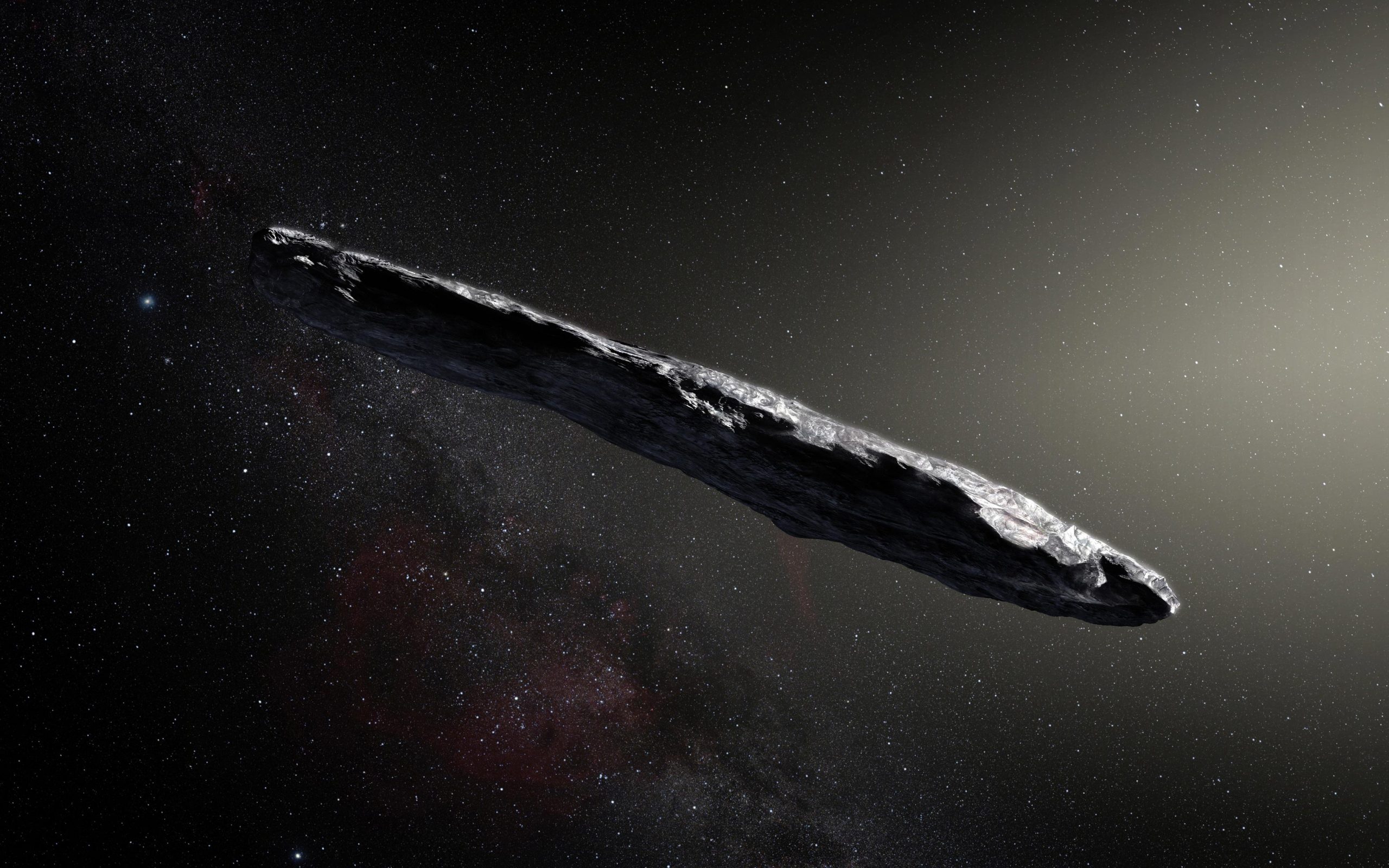
Called 2017 OF201 (the 2017 indicating it was first spotted in that year), it sits well within the size domain specified for dwarf planets, being an estimated 500-850 metres across, and may have achieved hydrostatic equilibrium (although at this point in time that is not certain). Referred to as an Extreme Trans-Neptunian Object (ETNO, a term which can be applied to dwarf planets and asteroids ), it orbits the Sun once every 25,000 years, coming to 45 AU at perihelion before receding to 1,700 AU at aphelion (an AU – or astronomical unit – being the average distance between Earth and the Sun).

As well as strengthening the classification of dwarf planets (and keeping Pluto identified as such), 2017 OF201 potentially adds weight to the argument against “Planet 9”, the original cause for the last 20 years of arguing over Pluto’s status.

2017 OF201 imaged by the Canada–France–Hawaii Telescope on 31 August 2011

To explain. Many of ETNOs and Trans-Neptunian Objects (TNOs) occupy very similar orbits to one another, as if they’ve somehow been clustered together. For example, Sedna has a number of other TNOs in orbits which closely match its own, leading the group as a whole to be referenced informally as “sednoids”. Among “Planet 9” proponents, this is taken as evidence for its existence, the argument being that only the influence of a large planetary body far out beyond Neptune could shepherd these ETNOs and TNOs into clusters of similar orbits.

However, by extension, this also means that 2017 OF201 – together with 2013 SY99 and 2019-EU5 should have also fallen to the same influence – but none of them have, orbiting the Sun quite independently of any clusters. This potentially suggests that rather than any mysterious planet hiding way out in the solar system and causing the clustering of groups of TNO orbits, such grouping are the result of the passing influence of Neptune’s gravity well, together with the ever-present galactic tide.

Thus, the news concerning 2017 OF201 confirmation as a Sun-orbiting, dwarf planet-sized ETNO both ups the ante for Pluto remaining a dwarf planet and simultaneously potentially negating the existence of “Planet 9”.

Jupiter: Only Half the Size it Once Was?

Definitions and classifications aside, Jupiter is undoubtedly the planetary king of the solar system. It has a mass more than 2.5 times the total mass of all the other planetary bodies in the solar system (but is still only one-thousandth the mass of the Sun!) and has a volume 1,321 times that of Earth. It is also believed to have been the first planet to form in the solar system; possibly as little as one million years after the Sun itself was born, with Saturn following it shortly thereafter.

Jupiter is an important planet not just because of its dominance and age, but because of the role it and Saturn played in the overall formation of the solar system, although much of this is subject to contention. The primary concept of Jupiter’s and Saturn’s voyage through the solar is referenced as the “grand tack hypothesis“, on account of the two giants migrating through the solar system in the first few millions of years after they form.

Jupiter as it is today, as seen by the Hubble Space Telescope. Not long after its formation, it might have been twice its current size. Note the black dot to the left of the image is the shadow Io, the innermost of Jupiter’s large moons. Io itself is outside of the frame. Credit: NASA/JPL / University of Arizona

Under this theory, Jupiter formed around 3.5 AU from the Sun, rapidly accreting a solid core and gaining mass to a point where it reach around 20 times Earth’s mass (although Earth would not form for another 45-50 million years). At this point, it’s mass and size (and those of Saturn) were such that they entered into a complex series of interactions with one another and the Sun, with both migrating towards the Sun, likely destroying a number of smaller proto-planets (all of them larger than Earth) along the way. At some point, these interactions reversed, and both infant planet started migrating away from the Sun again, clearing the way for the remnants of the smaller proto-planets they’d wrecked to gradually accrete to form what we now know to be the inner planets, as Jupiter and Saturn continued outwards to what are now their present orbits.

Believed to have occurred over between 4 to 6 million years, the “grand tack hypothesis” is contentious, as noted, and there are alternate theories concerning Jupiter’s formation and the early history of the solar system. Because of this, astronomers Konstantin Batygin (who, coincidentally, is one of the proponents of the “Planet 9” theory) and Fred C. Adams used complex computer modelling to try to better understand Jupiter’s formation and early history, in order to try to better determine how it may have behaved and affected the earliest years of the solar system’s formation.

In order to do this, and not be swayed by any existing assumptions concerning Jupiter’s formation, they decided to try to model Jupiter’s size during the first few million years after its accretion started. They did this using the orbital dynamics of Jupiter’s moons  – notably Amalthea and Thebe, together with Io, Jupiter’s innermost large moon – and the conservation of the planet’s angular momentum, as these are all quantities that are directly measurable.

Taken as a whole, their modelling appears to show a clear snapshot of Jupiter at the moment the surrounding solar nebula evaporated, a pivotal transition point when the building materials for planet formation disappeared and the primordial architecture of the solar system was locked in. Specifically, it reveals Jupiter grew far more rapidly and to a much larger size than we see today, being around twice its current size and with a magnetic field more than 50 times greater than it now is and a volume 2,000 times greater than present-day Earth.

Having such a precise model now potentially allows astronomers to better determine exactly what went on during those first few million years of planetary formation, and what mechanisms were at work to give us the solar system we see today. This includes those mechanisms which caused Jupiter to shrink in size to its present size (simple heat loss? heat loss and other factors?) and calm its massive magnetic field, and the time span over which these events occurred.

Yeah. Finding Life is Hard

In March, I reported on a possible new means to discover evidence of biosigns on worlds orbiting other stars by looking for evidence of methyl halides in their atmospheres (see: Space Sunday: home again, a “good night”, and seeking biosigns). In that reported, I noted that astronomers had potentially found traces of another element associated with organics, dimethyl sulphide (DMS) , within the atmosphere of exoplanet K2-18b, a hycean (water) world.

This is the strongest evidence yet there is possibly life out there. I can realistically say that we can confirm this signal within one to two years. The amount we estimate of this gas in the atmosphere is thousands of times higher than what we have on Earth. So, if the association with life is real, then this planet will be teeming with life.

– Prof Nikku Madhusudhan, lead investigator into the study of the atmosphere of K2-18b and the apparent discovery of dimethyl sulphide.

Now in fairness, the team behind the discovery did note that it needed wider study and confirmation. Extraordinary claims requiring extraordinary proof and all that. And this is indeed what has happened since, and the findings tend to throw cold water (if you forgive the pun) on that potentially wet world 124 light-years away, having  dimethyl sulphide or its close relative, dimethyl disulfide (DMDS) in anywhere near detectable levels.

An illustration of what K2-18b may look like. Credit: NASA / ESA / CSA / Joseph Olmsted

The more recent findings come from a team at the University of Chicago led by Rafael Luque and Caroline Piaulet-Ghorayeb. Like Madhusudhan and his team at Cambridge University, the Chicago team used data on K2-18b gathered by the James Webb Space telescope (JWST). However, in a departure from the Cambridge team, Luque and his colleagues studied the data on the planet gathered by three separate instruments: the Fine Guidance Sensor and Near Infrared Imager and Slitless Spectrograph (FGS-NIRISS), the Near Infrared Spectrograph (NIRSpec) and the Mid-Infrared Instrument (MIRI) – the latter being the sole source of data used by the Cambridge team.

Combing the data from all three instruments helps ensure a consistent, planet-wide interpretation of K2-18b’s atmospheric spectrum, something that cannot be obtained simply by referencing the data from a single instrument. And in this case it appears that by only focusing on MIRI, the Cambridge team inferred a little too much in their study.

We reanalyzed the same JWST data used in the study published earlier this year, but in combination with other JWST observations of the same planet … We found that the stronger signal claimed in the 2025 observations is much weaker when all the data are combined. We never saw more than insignificant hints of either DMS or DMDS, and even these hints were not present in all data reductions.

Caroline Piaulet-Ghorayeb

Most particularly, the much broader set of spectrographic data gathered from the three instruments points to some of the results observed by Madhusudhan’s team could actually be produced entirely abiotically, without any DMS being present. The Chicago paper has yet to be peer-reviewed, but their methodology appears sufficient to roll back on any claims of organic activities taking place on K2-18b or within its atmosphere.

AAS Recognises Gene Kranz

The “original four” NASA Flight Directors. Back row, (l to r): Glynn Lunney and John Hodge. Bottom (l to r): Gene Kranz and Chris  Kraft. Credit: NASA

Eugene Francis “Gene” Kranz is a genuine NASA legend. He may never have flown in space, but he played a crucial role – along with the late Christopher C. Kraft (also see: Space Sunday: a legend, TESS and a rocket flight), John Hodge and Glynn Lunney (also see: Space Sunday: more from Mars and recalling a NASA legend) – in formulating how NASA runs it manned / crewed spaceflights out of their Mission Operations Control Centre, Houston.

He is particularly most well-known for his leadership of his White Team during the Apollo 11 Moon landing in 1969, and for leading the work to get the crew of Apollo 13 back to Earth safely when that mission faced disaster. As a result of the latter, Kranz and his entire White Team received the Presidential Medal of Freedom in 1970 as well as being immortalised in film and television (although the line “Failure is not an option” was not something Kranz ever said – he instead used it as the title for his 2000 autobiography; the quote was purely fiction and used in the 1995 Ron Howard film Apollo 13, which saw Ed Harris play Kranz).

His career at NASA ran from 1960 through 1994, during which he rose from Mission Control Procedures Officer to Director of Mission Operations. As a result, he has been the recipient of NASA’s own Distinguish Service Medal, Outstanding Leadership Medal and Exceptional Service Medal.

And he has now been similarly recognised by the American Astronautical Society, which on May 21st, 2025, named him the recipient of their 2024 Lifetime Achievement Award. Only presented every 10 years, the award recognises Kranz for his “exemplary leadership and a ‘must-never-fail’ style that ensured historic mission successes, empowered human space exploration, saved lives and inspired individuals around the world.”

The ceremony took place at the Johnson Space Centre, Houston, Texas, where Kranz was also able to revisit the place where he and his teams and colleagues made so much history: the Apollo Mission Operations Control Room (MOCR – pronounced Mo-kerr – NASA has to have an acronym for everything 🙂 ).

Gene Kranz, with his AAS Lifetime Achievement Award, seated at the restored console he occupied at the White Team Lead Flight Director, notably during the Apollo 11 and Apollo 13 missions. Credit: NASA

The latter had been recently restored as a direct result of a project initiated and driven by Kranz in 2017 in memory of Apollo and so many of his colleagues who have since passed away (the most recent, sadly, being Robert Edwin “Ed” Smylie whose team worked alongside Kranz’s White Team to make sure the Apollo 13 astronauts returned to Earth safely, and who passed away on April 21st, 2025). Fully deserving of the AAS award, Gene Kranz remains one of the stalwarts of NASA’s pioneering heydays.

Space Sunday – Tiangong expansion, Neutron and Voyager

An artist’s rendering of China’s Tiangong station – potentially set to double in size in the next few years. Credit: CCTV

As NASA faces the threat of significant cuts in its science missions and research budgets, together with a potential overhaul of the US-led Artemis Project, China has further indicated its commitment to expanding its human presence in space, while the European Space Agency could see an increase in its budget (subject to end-of-year approval), amidst a call for Europe in general to increase its overall spending on space-based activities.

China has confirmed that it will be moving ahead with an expansion of its Tiangong space station with up to three new modules, potentially doubling its size. First hinted at in late 2022, the new modules are believed to comprise:

  • An updated version of the Tianhe core module , being referred to as the expansion module, providing additional power systems, a new multi-port docking adaptor equipped to handle a range of vehicles, including the upcoming next generation crew vehicle.
  • Two multi-function science modules, likely updated versions of the current Wentian, and Mengtian science modules.

The new modules are to include state-of-the-art engineering and maintenance capabilities, such as 3D printers capable for producing replacement parts used on the station (as had been introduced with the International Space Station), as well as allowing the total crew mission complement aboard the station to be expanded.

A Long March 5B rocket being assembled. Credit: CCTV

In confirming the expansion plans during a China state television interview, Wang Jue from China Aerospace Science and Technology Corporation (CASC) stated that the timeline for the expansion has yet to be confirmed, but in keeping with launches for the station to date, the modules will be flown aboard the Long March 5B booster, currently China’s most powerful launch vehicle and capable of pushing up to 25 tonnes of payload to low-Earth orbit (LEO).

Wang also confirmed that Long March 5B is itself undergoing “reliability and safety” updates – although these are not interrupting the current launch schedule. In particular, China is looking to make the re-entry of the rocket’s large first stage a more controlled affair. The country has been heavily critiqued for its Laissez-faire attitude of just allowing the first stage, which tends to fly higher than the first stages of comparable western rockets, to simply make an uncontrolled re-entry and break-up over the Pacific Ocean, rather than actually guiding it towards doing so.

Most recently, the Long March 5B has been used to launch the first batching of China’s Guowang (also called Xingwang and Hulianwang – the latter being the name of the satellite class) megaconstellation to compete with Starlink. It has taken over this role from the Long March 2 and 3 vehicles to accelerate the deployment of some 13,000 operational Hulianwang satellites of various classes. These will be placed into a range of orbits, as is the case with Starlink, allowing the system to join Starlink in further interfering with Earth-based astronomy on a global basis and adding to the amounts of pollutants dumped into the upper atmosphere annually as defunct satellites in the systems re-enter and burn-up.

The next space station related launch for Long March 5B, meanwhile, is due in 2026. This will be to deliver the free-flying Xuntian space telescope, a “Hubble class” orbital observatory. It will operate largely remotely from, but in a co-orbit with, Tiangong, the crews from which will perform routine maintenance on the telescope.

A mock-up of the Xuntian space telescope on display at the National Museum of China

With a 2-metre diameter primary mirror offering a field of view some 300 times greater than the Hubble Space Telescope, Xuntian will be equipped with a 2.5 gigapixel imaging system and will be used to study areas including dark matter, dark energy, galaxy formation and evolution of the cosmos. China has stated the observatory will be offered for international science and research.

One major aspect of the Tiangong expansion will be the ability for the station to house larger crews, including tiakonauts from China’s partner nations. The country is due to shift its crewed spaceflight capabilities from its current Shenzhou, 3-person vehicles, to its modular, multi-function and semi-reusable Mengzhou (“Dream Vessel”) craft.

A model of the lunar-capable of the Mengzhou reusable space vehicle mated to its expendable service module (l), a version of which will carry crews to and from the Tiangong space station. For missions to the Moon, the craft will rendezvous with the Lanyue lander, seen in model form on the right, mounted on its service module. Note the rover vehicle stowed on the side of the lander. 

The latter, due to commence operations in 2027 or 2028, will be able to deliver up to 6 crew at a time to Tiangong (or 3 crew and a half-tonne of equipment). A further variant of the craft will form the vehicle for delivering crews of three to lunar orbit in the 2030s, who will then use the companion Lanyue (“embracing the moon”) lunar lander (launched separately) to descend to and return from the surface of the Moon, in order to achieve China’s intent to establish a permanent human presence on the Moon in the 2030s.

Rocket Lab Gains US DoD Support

Rocket Lab, the little company looking to out-SpaceX SpaceX, has gained a further boost in confidence.

Currently, the company is best known for its Electron semi-reusable launcher capable of putting 320 kg to LEO and 150 kg to Sun-synchronous orbit (SSO). However, Electron is just one element in a multi-part strategy that has enabled Rocket Lab to achieve considerable success. As well as the booster, the company has developed its own range of 3D printed rocket engines, develops satellite for customers, and has built a multi-purpose spacecraft “bus” called Proton, capable of delivering payloads to orbit or to other planets, as well as other tasks.

But one thing CEO Sir Peter Beck said the company would never do was move into the field of building “big” rockets – and he was so adamant in this, he promised to eat his hat if the company decided otherwise. And eat his hat he did, some four years ago, when Rocket Lab announced it was developing Neutron, a medium-lift launch vehicle (MLLV) capable of delivering up to 13 tonnes to low-Earth orbit.

A rendering of Rocket Lab’s Neutron Rocket. Credit: Rocket Lab

As launch vehicle go, Neutron is unique. The entire first stage of the vehicle is a rocket unto itself – and fully reusable. Rather than comprise a first stage with one (or more) stages bolted on top of it and the payload on top of those, Neutron is designed to carry its “upper” stage and its payload inside itself. On reaching orbit, the nose of the vehicle opens up, allowing the “upper” stage (an expendable kick stage) with the payload attached, to be pushed clear, prior to igniting its motor.

The first launch of a Neutron vehicle is due later in 2025, and in keeping with the likes of SpaceX and Blue Origin, Rocket Lab will attempt to recover the first stage with an at-sea landing on specially adapted landing barge. But even before its first flight, Neutron has been given a double boost (no pun intended) by the US Department of Defence. The first of these is that Rocket Lab, with Neutron, has been cleared to bid for US National Security Space Launch (NSSL) contracts through to 2029. As SpaceX knows, this is a lucrative market, and Rocket Lab is the first public-traded launch company to be selected to possibly fly NSSL missions to orbit. The company has already commenced launch assurance reviews with the US military, and Beck has indicated that Rocket Lab could present bids for NSSL launches as soon as mid-2026.

In addition, the US Air Force (somewhat keen to regain some of the space high ground it has had to cede in the formation of the United States Space Force) has also selected Neutron as the test vehicle for the Rocket Experimentation for Global Agile Logistics (REGAL) initiative, intended to assess the use of rocket vehicles to rapidly deploy materiel from locations in the United States to “anywhere in the world” in what are referred to as “point-to-point” flights.

This idea was recently given a stir by the SpaceX CEO, stating that company’s Starship / Super Heavy combination would be “ideal”. While interest in the concept has remained within the USSF and USAF, the selection of Neutron for initial testing is a poke in the eye for SpaceX and one which makes a lot of sense. While Neutron cannot lift the upper end of Starship’s payload spectrum, it is entirely possible that in point-to-point operations, Starship would have its payload capacity somewhat limited. Further, Neutron is ready-made for landing on its own feet, Starship isn’t, and it doesn’t require a bloody great booster to get it (and any payload it has to carry off the ground at either end of the operation.

The “hungry Hippo” a test article for the payload doors for Rocket Lab’s Neutron rocket undergoing qualification testing. Credit: Rocket Lab

However, that said, the whole idea of REGAL is questionable. It’s not like you can simply lob a rocket on a ballistic flight, flip it over and land it anywhere you like. It requires quite substantial infrastructure at either end of the equation (assuming you’d like it to return to base after a flight, at least). A landing / launch platform is required; you need propellant storage and delivery / pumping capabilities; payload handing equipment, skilled personnel and facilities to undertake these and other operations. None of which can just be thrown up overnight.

As such, any idea of “point-to-point” capabilities is at best limited to complex facilities fully capable of handling the receipt and launch of the booster vehicle and payload. While this doesn’t entirely rule the idea out, it does restrict where and how such capabilities might be used; it’s hard to see such a system dropping into a FOB in a zone of conflict, or putting down right on top of a natural disaster to deliver aid – two of the promoted ideas behind REGAL. Given this, it will be interesting to see what develops as REGAL testing commences, potentially (again) in 2026.

Voyager 1: Thrusters Recovered

In another deep space piece of miracle working that would impress Montgomery Scott, NASA engineers have recovered a set of thrusters vital for communications with Earth, on their Voyager 1 spacecraft – twenty years after the system was considered defunct.

The Voyagers maintain communications with Earth via a large high-gain communications dish they carry on their “backs”. However, as they move through interstellar space, both Voyager 1 and Voyager 2 must carry out periodic “roll manoeuvres” to ensure these dishes remain  aligned with Earth for communications to continue.

These manoeuvres are carried out using small sets of thrusters on each vehicle, under the guidance of a star tracker system. The latter calculates the position of Earth and the spacecraft’s required orientation thereto by means of observing a set of notable stars the system can “see”, and using their positions to calculate where Earth is and the degree of roll the vehicle must make to re-centre the communications dish.

Artist’s rendering of the twin Voyager 1 and Voyager 2 spacecraft, in mission configuration. Credit: NASA

In 2004, the heater units required to warm the “primary” thrusters on Voyager 1 started to show signs of failure, risking a possible thruster misfire which could swing the vehicle so far off-axis, its star tracker would no longer be able to identify the stars in needed to  carry out its calculations. Because of this, operations were switched to the “back-up” thrusters.

By 2018, these “back-up” thrusters (now re-designated the “primary thrusters) were encountering issues as a result of the build-up of residual material in their chambers after each use.  Steps were taken to reduce this issue by placing some of the remaining thrusters into “reserve”, the idea being to switch to the “reserve” thrusters if those remaining in operation become too unreliable for continued use.

This actually happened in September 2024 – however, it transpired that the “reserve” thrusters were already badly “clogged” with residual material. This might not have been a critical issue but for the fact that, starting in May 2025, the 70-metre diameter Deep Space Station 43 (DSS-43) radio communications dish located in Canberra, Australia, would be going off-line for a 10-month overhaul. A part of NASA’s Deep Space Communications Network (DSN), DSS-43 is the only Earth-based communications system available to NASA for communications with either of the Voyager craft.

The DSS-43 communications dish located at Tidbinbilla, near Canberra, Australia, a part of NASA’s Deep Space Network Credit: NASA

The concern was that if Voyager 1 was allowed to continue to rely on its increasingly faulty thrusters, a misfire might occur whilst DSS-43 was offline, and the craft would be “lost” as a result of a communications breakdown. To avoid this, the decision was taken in March 2025 to try to recover the original thrusters system on the grounds that they would have 20 years less wear-and-tear and residue build-up, due to being inactive.

Even so, switching back to them would not be without risk; Voyager 1 would have to restore power to the thrusters disabled in 2004. However, with a dwindling ability to generate electrical power (since 1998, NASA has had to periodically shut-down instruments on each Voyager craft so they could maintain some degree of minimal operational and communications capability); as such there was real concern any power-up of the electrical systems on the 2004 thrusters could cause a damaging electrical surge – particularly given the previously-faulty heaters – or a thruster misfire, ending communications with Earth.

The attempt to do so was made in March 2025; it was carried out in stages designed to ensure if anything went wrong, Voyager 1 would still be capable of locating Earth again in the event of the latter occurring.  With a 46-hour lag in two-way communications between Earth and Voyager 1, the attempt was made in late Match 2025 – and proved a success.

On March 20th, 2025, mission control at the Jet Propulsion Laboratory, Pasadena, California, received the information they’d hoped: Voyager 1 had successfully brought the 2004 thruster system back on-line. There was no power spike, no issue with the thrusters firing, and Voyager 1 confirmed it had completed the test manoeuvre.

Since then, the system has continued to be monitored, and with DSS-43 due to go down for its upgrade, control was swapped from the increasingly at-risk “back-up” thrusters back to the “primary” thrusters.  This should hopefully allow Voyager 1 to maintain contact with Earth, even without it being able to receive commands of any complexity (there are narrow windows of opportunity in the DSS-43 overhaul during August and December 2025, where it could send short sequences of commands to the Voyager craft), and be ready to say “hello!” once more when full communications are resumed in 2026.

Space Sunday: Venera and a return 53 years in the waiting

A model of a Soviet-era 3MV (3rd generation Mar-Venus vehicle with a 1-metre diameter Venera lander attached (the spherical object, foreground), flanked by the vehicle’s solar arrays. The far end of the vehicle (to the left) is the propulsion module, the umbrella-like object is the high-gain communications antenna and the hemispherical object flanking the solar array mounts are the thermal radiators. Credit: Anatoly Zak, RussianSpaceWeb.

A Soviet-era space mission finally drew to a close on Saturday, May 10th, 2025 (UTC) after 53 years in space – although admittedly, that wasn’t really the plan when it was launched. Also, it’s fair to say that for the vast majority of that time, it has been little more than a hefty lump of space junk looping repeatedly around the Earth rather than doing anything useful.

However, its return marks an opportunity to recall an interesting period of the early era of the space age. A time when both the US and the Soviet Union were just starting to get to grips with lobbing humans into orbit, but when the latter already had grander designs in mind – starting with an aggressive programme to study Venus.

Initiated in 1961 – the same year as a human first flew into space – the Soviet Venus, or Venera, programme was a daring and high-stakes programme given the overall reliability and sophistication of rocket vehicles and space probes at the time. Thus, over a period of 23 years and 29 missions, it had a fair few highs and lows.

Massing 1.5 tonnes and standing some 2 metres tall, Venera 9 and its sister, Venera 10, were the first to Venus landers to return images of the surface of the planet to Earth. They are also, to date, the heaviest vehicles to land on Venus. Credit: K. E. Tsiolkovsky Museum of the History of Cosmonautics

For example, of those 29 missions, 12 never even made it Venus, while several others didn’t go fully to plan. However, of those that did get to Venus, their successes were remarkable, whether or not all mission objectives were achieved:

  • The first fly-by of another planet (Venera 2, 1965/66- although contact was lost prior to any data being returned).
  • The first vehicle to impact the surface of Venus (Venera 3, 1965/66 and twin to Venera 2, although a failure with the carrier vehicle meant that again, no data was returned).
  • The first vehicle to reach the atmosphere of another planet and return data to Earth (Venera 4, 1967).
  • The first vehicles to perform a deep analysis of the atmosphere of Venus, down to an altitude of around 20 km (Venera 5 and Venera 6, 1969).
  • The first vehicle to successfully land on another planet and return data from it (Venera 7, 1970).
  • The first vehicles to successfully return images from the surface of Venus (Venera 9 and Venera 10, 1975).
  • The first vehicles to return colour images from the surface of Venus and the first to record sounds from Venus -the wind the mechanical operations associated with the landers. (Venera 13 and Venera 14, 1982).
  • The first vehicles to deploy balloons on Venus (Vega 1 and Vega 2, 1985).

Among these missions, some are worth a little further highlighting. For example, because it was still considered that the surface of Venus could have liquid water present, Venera 4 was designed to float in event of a splashdown, despite massing 383 kg. It was also fitted with antenna deployment locks made of sugar.

The idea behind this latter point was that if Venera 4 landed on water, the impact force might not be sufficient to trigger the release of the locking mechanism and allow the main communications antenna deploy. However, the impact on water would result in the locking mechanism being splashed with water – which would (in theory) dissolve the mechanism, allowing the antenna to be deployed!

First view and clear image of the surface of Venus, taken by the Venera 9 lander on October 22nd, 1975. Credit: Soviet Academy of Sciences

It was initially thought that Venera 4 was the first vehicle to actually reach the surface of Venus. However, due to a combination of error margins built into some of the instruments coupled with inconsistencies between data obtained by Venera 4 and later probes, it is now believed that Venera 4 only reached somewhere between 55 and 26 km above the planet’s surface before succumbing to the harsh conditions.

Whilst Venera 5 and Venera 6 also failed to reach the surface of Venus in an operational capacity, they are remarkable as they were able to remain aloft for more than 50 minutes each, drifting under their parachutes and gathering data on the nature and composition of the planet’s atmosphere, gently descending to with 20 km of the surface before finally being overwhelmed.

The story of Venera 7 is in part one of diligence over dismissal. Immediately after receiving confirmation the vehicle was on the surface of Venus, mission controller seemed to lose all contact with the lander. Attempts were made to re-establish contact, with the recording tapes on the communications link still recording. Eventually, unable to diagnose the issue, the mission was dismissed as lost without data.

However, several weeks later, radio astronomer Oleg Rzhiga decided to review the recordings of the landing and subsequent events. In doing so, he found 23 minutes of faint, data-carrying signal had in fact received from the lander. Venera 7 hadn’t failed, it had simply been knocked off-axis on landing, resulting in its radio signal only being faintly received but passed unnoticed by mission controllers at the time.

A model of Venera 7, the first human-made craft to land on another planet, as displayed at the at the Sergei Pavlovich Korolyov Museum of Cosmonautics. Credit: Emerezhko via Wikipedia

Finally, there are the two Vega missions, remarkable for a number of reasons. “VeGa” is actually a westernisation of ВеГа, itself taken from the first two letters of the Russian for “Venus” (Венера) and Галлея (“Halley”  – or “Galleya”). This latter part of the name indicated their primary mission focus – rendezvousing with Comet Halley, which was making one of its (on average) 76-year revisits to the inner solar system.

However, in order to reach the comet, the probes would need a gravity assist from Venus. This meant that they could also piggyback Venus-centric missions, releasing them as they approached Venus for their fly-by. The Venus element comprised two landers of a similar design to earlier Venera craft, and intended to study both the atmosphere and surface of the planet. Unfortunately, turbulence encountered during descent caused the surface instruments on the Vega 1 lander to activate before touch-down, so that only the mass spectrometer returned data once on the surface. The Vega 2 lander was more successful, returning data for a period of 56 minutes, post-landing.

Vega balloon probe model on display at the Udvar-Hazy Centre of the Smithsonian Institution. Credit: Geoffrey A. Landis

The more fascinating part of these missions was the use of balloons. These were released as a package by the landers at some 60 km above the surface of Venus. Parachutes initially slowed their descent to a point where, at an altitude of around 50 km, a mechanism attached to the parachute systems inflated each balloon with helium, the parachute and inflation system then being jettisoned. This allowed both balloons, each dangling a 7 kg gondola of instruments, to climb back to an altitude of some 53 km, which they drifted 11,000 km around Venus – 30%of its circumference – transmitting data to their respective Vega craft for relay to Earth. Both balloons were still actively transmitting when the Vega craft passed out of communications range, 45 minutes after the balloons started sending data.

Of the failures, the majority came, not unreasonably, in the early days of the programme. Of the first eight attempts to reach Venus between February 1961 and April 1964 (launch dates), all failed. As a result, six were never officially designated – as was the Soviet approach in the first years of their space programme (i.e. if it doesn’t have an official designation, it didn’t happen and so couldn’t have failed). Of the remaining two, one gained the Venera 1 designation, as it made it out of Earth orbit (but failed while en route to Venus) and the other being designated a “Kosmos” mission.

Originally, “Kosmos” was a catch-all designation for Soviet Earth-orbiting uncrewed missions. It was intended to obfuscate and confuse western agencies, in that it didn’t matter the object in question was a piece of test hardware or a surveillance satellite or a communications relay, or a navigation beacon, or a weather satellite or whatever. If it was orbiting the Earth, it was called “Kosmos” and given a number. In 1962, the designation was extended to include any Soviet interplanetary probe that failed to leave Earth orbit, allowing failure to be hidden in plain sight. Only after a mission was on its way to its intended destination would it be given an actual mission designation (e.g. Venera 1, etc.).

Within the Soviet-era Venera programme, five vehicles gained the Kosmos designation:

  • Kosmos 27 (one of two Zond missions for Venus launched on March 27th, 1964, and breaking-up in the upper atmosphere 24 hours later after failing to achieve a stable orbit).
  • Kosmos 96 (launched on 23rd November 1965, failed to depart Earth orbit, burned-up in the upper atmosphere on December 9th, 1965, possibly resulting in the  Kecksburg UFO incident).
  • Kosmos 359 (launched on 22nd August, 1970, suffered an upper stage motor failure and re-entered the atmosphere on November 6th, 1970)
  • Kosmos 482 – the cause of this article, and of which more below.

Intended to be the partner probe to Venera 8 (keeping to the naming convention to the actual run of successes), what was to become Kosmos 482 was launched on March 31st, 1972. However, a malfunction occurred as the upper stage booster motor was re-lit to transfer the probe onto its trajectory to rendezvous with Venus, and the vehicle broke up.

Some of the debris from the break-up fell to Earth in the form of 38-cm diameter, 13.6 kg titanium pressure spheres, most likely from the booster stage. These struck crop fields just outside of Ashburton, New Zealand, 48 hours after launch. However, the two larger elements of the break-up were pushed into 210 km x 9,800 km elliptical orbit around Earth, initially travelling close together, gaining the Kosmos 482 designation.

In the west, there larger of these two elements was identified as the remnants of the booster rocket and the Venus Bus, intended to provide power to the 495 kg lander. They were given the Designation 1972-023A. The smaller of the two was identified as most likely being the lander itself, clearly separated from its bus and booster, and so designated 1972-023E.

Over the next nine years, the two travelled in partnership, looping around the Earth, each pass having an increasing effect of 1972-023A, which gradually started breaking up, depositing pieces of itself to burn-up in the atmosphere (some surviving to fall on poor New Zealand again!) until it succumbed to atmosphere friction and burned-up on re-entry in mid-1981.

A Venera V-72 Venus lander, the same type of lander launched in 1972 as a part of the mission later designated Kosmos 482. Credit: Anatoly Zak, RussianSpaceWeb.

The lander – or 1972-023E – was made of sterner stuff, and continued to loop around Earth largely unfazed and forgotten. But each time it did make a close flyby there was exchange: a little velocity here, a little change in trajectory there. Over the decades, these little changes served to pull the craft closer and closer to Earth, such that by this year, it was looping around us once every 80-90 minutes, with its apogee and perigee both slipping into sub-200 km altitude figures. All of which meant that atmospheric entry was all but certain; the question was when? By the start of May 2025, NASA and ESA were looking to a re-entry window extending from May 9th through May 13th,which was then quickly narrowed down to the early hours of May 10th (UTC) – albeit with an initially wide margin of error (+/- 3.3 hours).

Given the orbital track of the debris, and the fact it was designed to survive the much tougher entry into the atmosphere of Venus, there were fears it could come down intact on a populated area. However, this was always unlikely, given that while it did pass over population centres each and every orbit, it also passed over large tracts of largely empty land (in human habitation terms), and even greater amounts of open ocean. Further, even if it did survive re-entry (not an absolute certainty given that both its age and the fact it would likely start tumbling during an uncontrolled atmospheric and most likely break-up / burn-up), it would not come crashing through the atmosphere at a huge velocity and explode in a massive air-burs. Rather, it would fall with a maximum velocity of around 250 km/h – enough to be decidedly upsetting if it hit a building or similar, but not enough to result in something like a city-wide disaster.

As it is, and at the time of writing, Roscosmos have stated that the vehicle re-entered the atmosphere at 06:24 UTC on May 10th over the Bay of Bengal, 560 km west of the Andaman Islands and prior to impacting the Indian Ocean somewhere west of Jakarta, Indonesia. However, this had yet to be confirmed by other agencies, although ESA indicated the vehicle potentially re-entered the atmosphere between 06:04 and 07:32 UTC, which would place its impact point most likely somewhere in the Indian or Pacific Oceans.

Kosmos 482 marked the last failure within the Soviet-era Venera programme, and its return to Earth acts as a very physical closure to that era of space history. However, it does not close the book on Russia’s ambitions where Venus is concerned. Currently, Russia is planning a return to Venus as it resumes its Venera programme with Venera D.

This mission – which is subject to a lot of ifs and maybes, already having been delayed on multiple occasions. When first conceived in 2003, it was targeting a 2013 lunch date; currently, the mission is slated for a launch no earlier than 2031, although it has yet to have its science packages finalised and developed. Comprising an orbiter and lander, if it does go ahead, Venera D (also sometimes called Venera 17) will deliver heavyweight (1.6 tonne) lander to the surface of Venus with the intentions of it being able to survive and carry out science studies for up to 3 hours after landing.

Space Sunday: more NASA budgets threats

NASA’s Space Launch System (SLS) and Orion multi-purpose crew vehicle (MPCV):now earmarked for “phasing out” in the White House budget request for NASA. Credit NASA

In my previous piece on the NASA upcoming budget, as being put forward by the US 47th executive administration, I focused on how the proposal could impact NASA’s science capabilities. At the time, the entire budget request had yet to be published, and my article was based on what had been made public by way of passback documents circulating in Washington DC.

At that time, it was anticipated that the White House would push for around a 20% cut in NASA’s annual budget, the majority of which would target NASA’s Earth and Space Science operations. However,  on Friday, May 2nd, 2025, the  “skinny” version of the White House budget request was published, revealing that the administration is seeking an overall 24.8% cut in NASA’s spending compared to the agency’s existing budget. If enacted, it will be the biggest single-year cut in NASA’s entire history. And whilst around two-thirds of the proposed cuts do land squarely on NASA space / Earth science and legacy programmes, they do touch the agency’s human spaceflight ambitions as well.

First and foremost, the request calls for the immediate cancellation of the Lunar Gateway station (aka “Gateway”). This actually makes sense, simply because since its inception, Gateway has itself never made sense.

Starting as a series of studies called the  Deep Space Gateway (DSG) in the mid-2010s, it became an official NASA project under – ironically – the first Trump Administration, when it became the Lunar Orbital Platform-Gateway (LOP-G). It was presented at both a means to enable a return to the surface of the Moon and a gateway to the human exploration of the solar system. However, intended to occupy a Polar near-rectilinear halo orbit (NRHO) around the Moon, travelling up to 70,000 km from the lunar surface whilst never coming closer than 3,000 km, it has been more a limitation than an enhancement to lunar operations.

An artist’s impression of the first two modules of Gateway – the Power and Propulsion Element (PPE) and Habitation and Logistics Outpost (HALO) passing by the Moon. Credit: NASA

While this orbit would allow for uninterrupted communications between the station and Earth, it also introduced multiple complexities of operation into any return to the Moon. As a result, multiple ancillary reasons for Gateway’s existence were cooked up:  Earth sciences, heliophysics, fundamental space biology research, etc., all of which could be achieved more directly and cost-effectively through other means.

Thus, over the last 6 years Gateway has been consistently downsized and de-prioritised, constantly criticised by experts from within and outside NASA, and even seen as something of a complicated boondoggle in terms of design by those actually engaged in its design. Add to this the fact it offers little or nothing to lunar operations that could not be achieved from within a modest lunar orbit (200-300 km). Given all this, cancelling the project – even if it means pissing off international and commercial partners – is a sensible move.

As I noted in a recent Space Sunday report, the arrival of the Trump administration coincided with calls for the outright cancellation of NASA’s Space Launch System (SLS) on the ground of outright expense. but as I mentioned in that piece, any such complete cancellation of SLS would have left Artemis high and dry, and ideas of simply launching Orion utilising other launchers were as close to be nonsensical as to make no difference.

In a follow-up piece to that article, I suggested that a preferable approach would be to go ahead with Artemis with SLS until such time as the latter could be replaced. This is more-or-less what the Trump budget proposes, albeit it on a far tighter time frame; looking to “phase out” both SLS and Orion completely following the first lunar landing of the Artemis programme (Artemis 3), in favour of a “commercial” solution.

The Orion MPCV mounted atop its ESM and mating adaptor to be used in the Artemis 2 cislunar space mission, was officially handed over to NASA on May 1st, 2025. Credit: Lockheed Martin

Given that Artemis 3 is unlikely to fly before around 2028/9 (simply because the SpaceX lunar lander is unlikely to be ready before then), this does present an – albeit tight – window of opportunity; albeit one biased in favour of one commercial operator – SpaceX.

That company’s Crew Dragon vehicle has proven itself a remarkably versatile vehicle, capable of not only ferrying crews to the International Space Station, but also of carrying out space missions of 4-5 days duration in its own right. While its life-support and general facilities would require upgrade, as (likely) would the heat shield (which would have to protect the vehicle when re-entering Earth’s atmosphere at around 40,000 km/h compared to the 28,000 km/h experienced during a return from low-Earth orbit (LEO). But such upgrades are necessarily outside the realm of possibility.

A critical part of these upgrades would lie with the service module (aka “trunk”) supplying power and consumables (e.g. water and air) to Crew Dragon. This would have to be considerable beefier in terms of propellants and consumables it can carry, and also its propulsion. However, this is not something insurmountable. SpaceX has been working on a design for a “Dragon XL”, a large-capacity Cargo Dragon supported by an enhanced “trunk” which would have been used to support operations at Gateway. In theory, there’s a potential for this “trunk” to be enhanced into a suitable service module for Crew Dragon, allowing it to make trips to lunar orbit and back.

This does involve a number of challenges – one of them being how to launch such a combination. Currently, the heaviest payload SpaceX can send to the Moon is between 20-24 tonnes, using the Falcon Heavy (I am intentionally ignoring Starship here, as that is a long way from being anywhere near an operational, human-capable launch system). However, it’s unlikely a combined Crew Dragon + enhanced service module is going to fall within this limit (for example, the Apollo Command and Service modules massed 28.8 tonnes and Orion and its lightweight ESM mass 26.5 tonnes). Falcon Heavy is also not human-rated, so even if it could lob a Crew Dragon / enhanced service module combination to the Moon, it would need to undergo some degree of modification in order to gain a human flight rating, adding further complications.

Dragon XL: an uncrewed cargo vehicle NASA has requested from SpaceX to deliver cargo to to the Lunar Gateway station might help form a part of a replacement (also using Crew Dragon) for Orion to help deliver crews to lunar orbit. Credit: SpaceX

That said, even this is not a blocker: allowing for the risk of damage to the Crew Dragon’s heat shield, it might be possible to launch a crew to LEO atop a Falcon 9, allowing then to rendezvous and mate with an uprated service module and Falcon upper stage placed in to LEO by a Falcon Heavy. This would eliminate the need to human-rate Falcon Heavy whilst enabling the latter to launch a more capable combination of upper stage (to boost the combined Crew Dragon and service module onwards to the Moon) and service module to await the arrival of the Crew Dragon.

As noted, there are technical caveats involved in this approach. It also requires the provisioning of funding for said vehicle development – something not within the pages of this budget proposal; and it would make NASA exceptionally dependent on SpaceX for the success of Artemis.

Beyond changes NASA’s lunar ambitions, the 2026 budget request is seeking a reduction in International Space Station (ISS) spending of around half a billion dollars a year on 2024 spending, in “preparation” for the station’s 2030 decommissioning. The most immediate impact of the cut will be a reduction in overall ISS crew sizes, together with a reduction in the number of annual resupply missions – something that could impact the likes of Sierra Space with their contract for ISS resupply flights due to commence in 2026. In addition, the budget request seeks to “refocus” (aka “restrict”) research and space science activities in the ISS to those directly related to “efforts critical to the moon and Mars exploration programmes”.  However, what this precisely means is not made clear.

Whilst promoting human mission to Mars, the budget proposal offers little if anything concrete, other than the cancellation of the automated Mars Sample Return (MSR) mission, stating the return of any samples can be deferred until such time as humans reach Mars and can collect such samples directly.

Even in a massively simplified proposal from Rocket Lab (when compared to NASA’s multi-vehicle internationally-split idea), the Mars Sample Return Mission has been identified for complete cancellation. Credit: Rocket Lab

In this, MSR is the only science mission named for cancellation in the budget request. Given the manner in which NASA has consistently fumbled around with the mission over that last half-decade, its cancellation doesn’t come as a surprise. The non-mention of other programmes also doesn’t mean the concerns I raised in my previous Space Sunday have gone away; as noted, the budget request confirms the desire to make very deep cuts into NASA’s ability to carry out science and research across all disciplines.

Two additional programmes potentially impacted in this regard are the LandSat Earth imagining programme – which the Trump administration wants to see downscaled, and NASA’s research into what the administration calls “legacy space programmes” – such as their research into nuclear propulsion systems. The latter is again ironic given nuclear systems are potentially the most effective means of propulsion for Mars missions, and the budget request flag-waves the idea of humans to Mars.

As with Trump’s first term in office, the White House is seeking to eliminate all of NASA’s involvement in STEM and education (STEM being disgustingly referenced as being “woke” in the budget request). This includes cancelling the Established Programme to Stimulate Competitive Research (EPSCoR). This is again ironic, given that during his initial Senate confirmation hearings, prospective NASA Administrator Jared Isaacman (who is now almost certain to be confirmed, following a 19-9 vote by the Senate Commerce Committee) referred to EPSCoR as an “essential” NASA educational programme because “it helps connect students and researchers from underserved regions and institutions to the opportunities that NASA provides.”

In my last update, I noted that there is a reported desire among some within the Administration to see at least one NASA centre – The Goddard Space Flight Centre – to be closed. While the budget request does not directly earmark any NASA centres for closure, it does call for NASA to “streamline the workforce, IT services, NASA Centre operations, facility maintenance, and construction and environmental compliance activities”. As such, downsizing / closures remains a threat, and Goddard remains the centre with direct responsibility for many aspects of NASA’s science missions.

All of the above said, this is – at this stage at least – only a budget request. It remains to be seen as to how those in both side of Capitol Hill respond, and whether the White House will actually listen  if / when objections are raised. Given the attitude of many within (notably, but not exclusively) the Republican Party towards science, climate change, the environment, DEI (which the budget also targets), green initiatives, etc., I have my doubts as to whether strong objections to the cuts to NASA’s science programmes will be raised.

Certainly there has been some push-back from within the bipartisan U.S. Planetary Science Caucus, but thus far the loudest voices of protest have come from outside US government circles, such as the globally-respected American Astronomical society and The Planetary Society – two organisations well-versed in America’s leadership in the fields of space and science – among others.

If enacted, the 56% cut to the National Science Foundation, the 47% cut to NASA’s Science Mission Directorate, and the 14% cut to the Department of Energy’s Office of Science would result in an historic decline of American investment in basic scientific research. These cuts would damage a broad range of research areas that will not be supported by the private sector. The negative consequences would be exacerbated because many research efforts can require years to decades to mature and reach fruition. Without robust and sustained federal funding, the United States will lose at least a generation of talent to other countries that are increasing their investments in facilities and workforce development. This will derail not only cutting-edge scientific advances, but also the training of the nation’s future STEM workforce. These proposed cuts will result in the loss of American leadership in science.

– from a statement issued by the American Astronomical Society, May 2nd, 2025

As it is, NASA is already tightening its belt: on April 29th, 2025, it postponed the release of the Announcement  of Opportunity (AO) for the next Small Explorer (SMEX) mission.

Established in 1988 as a continuation of and enhancement to  the long-running Explorer Programme, SMEX focuses on well-defined and relatively inexpensive space science missions in the disciplines of astrophysics and space physics which cost less than US $170 million per mission (excluding launch). Currently, the last SMEX mission was selected in 2021, but its launch has been delayed until 2027. As such, the 2025 AO would have earmarked a launch window between 2027 and 2031 for the selected mission. However, given the potential for up to two-thirds of the agency’s astrophysics budget to be cut, NASA has indicated it would not now issue the SMEX AO “until at least 2026”.

It is anticipated that more upcoming requests for science mission proposals will be placed “on hold” whilst this budget request is debated.

Space Sunday: FRAM2, private missions, asteroids

Crew Dragon Resilience splashes down of the coast of California at the end of the 4-day FRAM2 mission. Credit: SpaceX

Previewed in my previous Space Sunday update, the FRAM2 mission lifted-off almost precisely on time from Kennedy Space Centre’s Launch Complex 39A at 01:46:50 UTC on April 1st, carrying the first humans to ever orbit the Earth in a low-Earth polar orbit.

The ascent to orbit, travelling south from the space centre, proceeded smoothly, the SpaceX Crew Dragon capsule and service module (“Trunk” in SpaceX parlance) entering a low Earth orbit with an apogee of 413 km and a perigee of 202 km some eight minutes after launch. The orbit, referred to as a polar retrograde, due to the fact the vehicle travelled first over the South Pole then around and over the North Pole, lay at an inclination of 90.01°, breaking the previous high inclination orbit record for a crewed space vehicle set by Vostok 6 in 1963.

Aboard the vehicle were Chinese-born, but Maltese citizen and crypto currency entrepreneur Chung Wang, who will be the mission’s commander and is a co-bankroller of the flight; Jannicke Mikkelsen, a Scottish-born Norwegian cinematographer and a pioneer of VR cinematography, 3D animation and augmented reality, who is the other co-bankroller for the flight; Eric Philips, a 62-year-old noted Australian polar explorer, who will be the first “fully” Australian national to fly in space, and Rabea Rogge, a German electrical engineer and robotic expert.

The 4-day mission comprised an extensive science programme, focusing on human health in space, growing food supplements on-orbit (oyster mushrooms) and investigating the Phenomena known as STEVE (see my last Space Sunday update) from orbit. The mission also included educational broadcasts to schools and a lot of social media-posted videos.

A video of Antarctica recorded by the FRAM2 crew. Seen in the footage is videographer Jannicke Mikkelsen, and the voice-over is from Eric Philips

To assist in observations and measurements, Resilience was fitted with the transparent Copula to replace the outer  airlock hatch and docking mechanism within the forward end of the capsule, affording the crew near-360º views of Earth once the vehicle’s protective nose cone had been opened.

The launch itself required a complete update of the Crew Dragon navigation software, originally written for lower 51º inclination orbits. This included a complete overhaul of the launch abort software for both capsule and launch vehicle. The latter was made necessary by the fact the ascent to orbit carried the vehicle over parts of South America, so any abort situation had to ensure that both booster and capsule would not return to Earth over land, and the capsule would be able to splashdown safely with the crew.

What really marked this mission, however, was the sheer transparency of operations; nothing in the video logs was pre-scripted or rehearsed; camera were rolling with conversations going on in the background – including conversations between crew members and SpaceX mission control about “known issue” with the space vehicle (not sure how significant – but being told that there is a “known issue” with a vehicle when you’re sitting in it in space might not be the most comforting thing to hear!), informal chit-chat during observations and an introduction to the fifth “crew member”, Tyler.

A compilation video of the mission, including shot through the inner hatch of the airlock showing Earth beyond the Copula. Note the inner hatch could also be opened to allow crew to enter the forward are and look out of the Cupola

While the mission had a lot of science goals – including testing a portable MRI unit, carrying out x-rays of the human body, studies into blood and bone health and glucose regulation in the body in micro-gravity – it has not stopped criticism being levelled at it, with some scientists stating the period spent in space being too short to yield practical results in some areas, and other aspects of the mission being labelled “a notch above a gimmick”.

For Chung, Mikkelsen and Philips in particular, however, the mission was as much personal as scientific: they have spent fair portions of their adult lives exploring the Polar regions, carrying out studies and research (the four all actually met during an expedition to Svalbard (leading them to nickname the mission “Svalbard 1”).

The first ever x-ray of a human hand taken in space (right) during tests of a small x-ray unit aboard the FRAM2 mission. The hand (with ring) was used in homage to the first ever x-ray of a human, captured by Wilhelm Conrad Röntgen (of his wife’s hand) in 1895 (l). Credits: Wilhelm Conrad Röntgen; FRAM2 / SpaceX

FRAM2 came to an end on April 4th, 2025, when, following an extended de-orbit, the combined vehicle re-entered the atmosphere and headed for a splashdown off the California coast where the SpaceX recovery ship was waiting for the vehicle. This marked the first splashdown for Crew Dragon off the west coast of the USA – although more will be following.

SpaceX has been criticised for the fact that during several missions returning crews from the International Space Station, the “Trunk” service module has in part survived re-entry, with elements coming down very close to populated areas. To avoid this, the company is moving crewed splashdowns to the west coast of the USA in order to ensure that should any parts of the Trunk survive re-entry they will splashdown in the Pacific Ocean.

As a test of this, the module used by Resilience remained attached to the vehicle for longer during the initial re-entry operations, in order to ensure that if any part of it did survive the heat of re-entry, the debris would fall to Earth over Point Nemo – the remotest part of the Pacific Ocean relative to human habitation, and referred to as the “spacecraft graveyard”.

A re-entry seared Resilience is lifted aboard the SpaceX recovery vessel in preparation for crew egress. Credit: SpaceX

Splashdown occurred at 19:28 UTC on April 4th, with the capsule and crew safely recovered to the SpaceX recovery vehicle for transport to the port of Los Angeles.

NASA Opens-Out Requirements for Private Missions to the ISS

NASA has announced it is seeking proposal for two further private astronaut missions (PAMs) to be conducted to the ISS – and for the first time, the requirement that such missions must be commanded by former NASA astronaut has been removed.

The agency is planning to pivot away from the International Space Station (ISS) operations as it nears its end-of-life (some of the Russian elements of the station are already well outside their “warranty” – that is, their intended lifespan), with the hope that the private sector will take over low-Earth orbit research and station operations. Currently, there are a number of proposals for doing so – perhaps most notably Axiom Space and the orbital Reef consortium led by Blue Origin and Sierra Space.

Axiom Space already has a contract with NASA to add its own modules to the ISS, starting in 2027 with the launch of the PPTM – Power, Propulsion and Transfer Module. This will then be joined by at least a second module, Hab-1, prior to the decommissioning of the ISS. These modules will then be detached from the ISS to become a free-floating hub to which Axiom will add further modules.

An artist’s impression of the Axiom space station as it will look when completed and free-flying. Credit: Axiom Space

To prepare for this, Axiom signed an agreement with NASA to fly four missions to the ISS between 2022 and 2025, with the option on a fifth. Three of these form the only fully private missions yet flown to the ISS, and all have been commanded by former NASA astronauts – Michael López-Alegría (Axiom AX-1 and Ax-3) and Peggy Whitson (Ax-2), with Whitson also set to command AX-4, currently targeting a May 2025 launch.

Under the new NASA PAM requirements, private missions are now required to be commanded by any astronaut who has served as a long-duration ISS crewmember (defined as 30 days or more in the ISS) and who has been involved in ISS operations in the last five years or else shows evidence of “current, active participation in similar, relevant spaceflight operations”. This therefore opens the door for missions to be commanded by Canadian, French, German, English, Japanese, etc., astronauts meeting the requirements to command missions by commercial providers.

The move to relax the requirements is to help remove the reliance on purely NASA-based experience to lead private sector missions into orbit and allow companies like Axiom, Blue Origin and – most notably, perhaps – Vast Space, who have a MOU with SpaceX to fly two PAM missions to the ISS but have yet to meet NASA’s requirements to do so, to start formulating their own requirements, gain expertise and build partnership and processes to assist in their efforts to establish on-orbit facilities.

The Blue Origin / Sierra Space-led Orbital Reef space station design, which will utilise the Boeing CST-100 Starliner for crew transfers, and the Sierra Space Dreamer Chaser spaceplane for cargo transfers. Credit: Blue Origin / Sierra Space / Boeing

The announcement by NASA is of potential import to the UK: Axiom have an agreement in place with SpaceX to fly a total of five Ax missions to the ISS. However, the fifth – provisionally aiming for 2026 – has yet to be crewed, and there have been discussion between Axiom and UK officials about the mission being an “all British” crew, comprising Tim Peake as mission commander, who flew the Expedition 46/47 rotations on the ISS, together with fellow UK European Astronaut Corps members  Meganne ChristianRosemary Coogan and Paralympic sprinter (and surgeon)  John McFall.

New Glenn Mishap Investigation Completed

The Federal Aviation Administration announced March 31st, 2025 that it has accepted the findings of an investigation led by Blue Origin following the loss of the first stage of the company’s New Glenn heavy lift launch vehicle during its maiden flight on January 16th, 2025 (see: Space Sunday: NG-1 and IFT-7).

While the overall goals of that mission were met, a secondary goal – recovering the rocket’s large first stage by landing it at sea board a landing vessel – failed, the booster stage falling back into the Atlantic Ocean. Whilst no debris was strewn across flight corridors or fell on populated areas (unlike recent SpaceX Starship launch attempts), the failure of the planned booster recovery, whilst always rated by Blue Origin as having a minimal chance of success on the very first flight of the rocket, meant the vehicle’s launch license was correctly suspended by the Federal Aviation Authority (FAA) until a full Mishap Investigation into the cause of the loss had been carried out by Blue Origin and the FAA had accepted the findings and remedial actions taken.

The investigation report was duly supplied in March 2025, and identified the booster’s inability to re-ignite its motors during descent as the cause of the loss. Whilst no precise cause(s) for this failure have been openly published, Blue Origin has indicated seven areas where remedial work has been undertaken on the vehicle’s flight systems, and the FAA now consider the investigation closed. As a result – subject to a final inspection of the changes made – the license suspension should be lifted before the end of April. In the meantime, Blue Origin has been given the all-clear to resume preparations for the next New Glenn launch.

The maiden flight of Blue Origin’s New Glenn rocket lifts-off from Launch Complex 36 at Cape Canaveral Space Force Station on January 16th, 2025. Credit: Blue Origin / USSF

All of this is in stark contrast to the handling of the last two SpaceX Starship launches (IFT-7 and IFT-8). Both resulted in the complete loss of the Starship upper stages well within Earth’s atmosphere, resulting in debris falling over the Greater Antilles (and some of it striking close to populated areas on the Turks and Caicos islands) together with a degree of disruption to commercial flights in the region. However, in the case of IFT-7, the FAA cleared the launch of IFT-8 before the Mishap Investigation was closed, and appears to be on course to do so in the case of IFT-8, with SpaceX already ramping-up for the next test article flight.

In the meantime, assuming the New Glenn license is renewed in April, the next launch for the vehicle could come as soon as “late spring 2025” (end of May). However, no payload for the flight has been specified, only that it will include a further attempt to return the first stage to an at-sea landing aboard Landing Platform Vessel 1 Jacklyn.

Some reports had suggested this next launch could comprise the Blue Moon Mark 1 lander – an automated vehicle capable of delivering up to 3 tonnes of payload to the surface of the Moon and intended to demonstrate / test technologies to be used in the company’s much larger Blue Moon Mark 2 lander, designed to deliver crews to the surface of the Moon. However, in discussing the launch path for New Glenn, Blue Origin CEO David Limp indicated that a launch of Blue Moon Mark 1 is unlikely to occur before late summer 2025 at the earliest.

2024 YR4 Seen At Last

As I noted in February 2025, 2024 YR4 is an Earth-crossing Apollo-type asteroid discovered on December 27th, 2024. It caused a bit of stir at the time, as there was a non-zero chance that as it pursued its own orbit around the Sun, in 2032 it could end up trying to occupy the space volume of space as taken-up by or own planet, with potentially disastrous and deadly results for anyone and anything caught directly under / within the air blast that would likely result from its destruction as it tore into our atmosphere.

Fortunately, continued observations of the asteroid – which passes across Earth’s orbit roughly once every 4 years – have shown the threat of any impact in 2032 are now very close to zero (although it does still exist on the tiniest of scales, together with a smaller chance of it hitting the Moon).

At the time of its discovery, 2024 YR4 was classified as a stony S-type or L-type asteroid, somewhere in the region of 50-60 metres across (roughly the same size as the fragment which caused the 1908 Tunguska event). That size estimate has now been confirmed, and what’s more, we now have our first (and admittedly fuzzy) images of the fragment, courtesy of the James Webb Space Telescope (JWST), and they reveal it to be a strange little bugger.

2024 YR4 imaged by JWST’s NIRCam on 8 March 2025. Credit: NASA/ESA

Imaged and scanned by the US Near-InfraRed Camera (NIRCam) and British-led European Mid-InfraRed Instrument (MIRI), 2024 YR4 is indeed some 60 metres across at its widest. It is also somewhat unlike similar asteroids in its spectral type, in that it has a high spin rate as it tumbles around the Sun and appears to be more a conglomeration rocks banded together, rather than a single chunk of rock.

Observations are continuing to ensure the 2032 rick of impact is completely eliminated and also to provide data to calculate impact risks beyond 2032, whilst the data obtained by JWST – which mark 2024 YR4 as the smallest object the observatory has every imaged from its L2 HALO orbit – are being used to help scientists to better characterise NEOs of a similar size and spectral type and more fully understand how they might react were one to strike our atmosphere.