
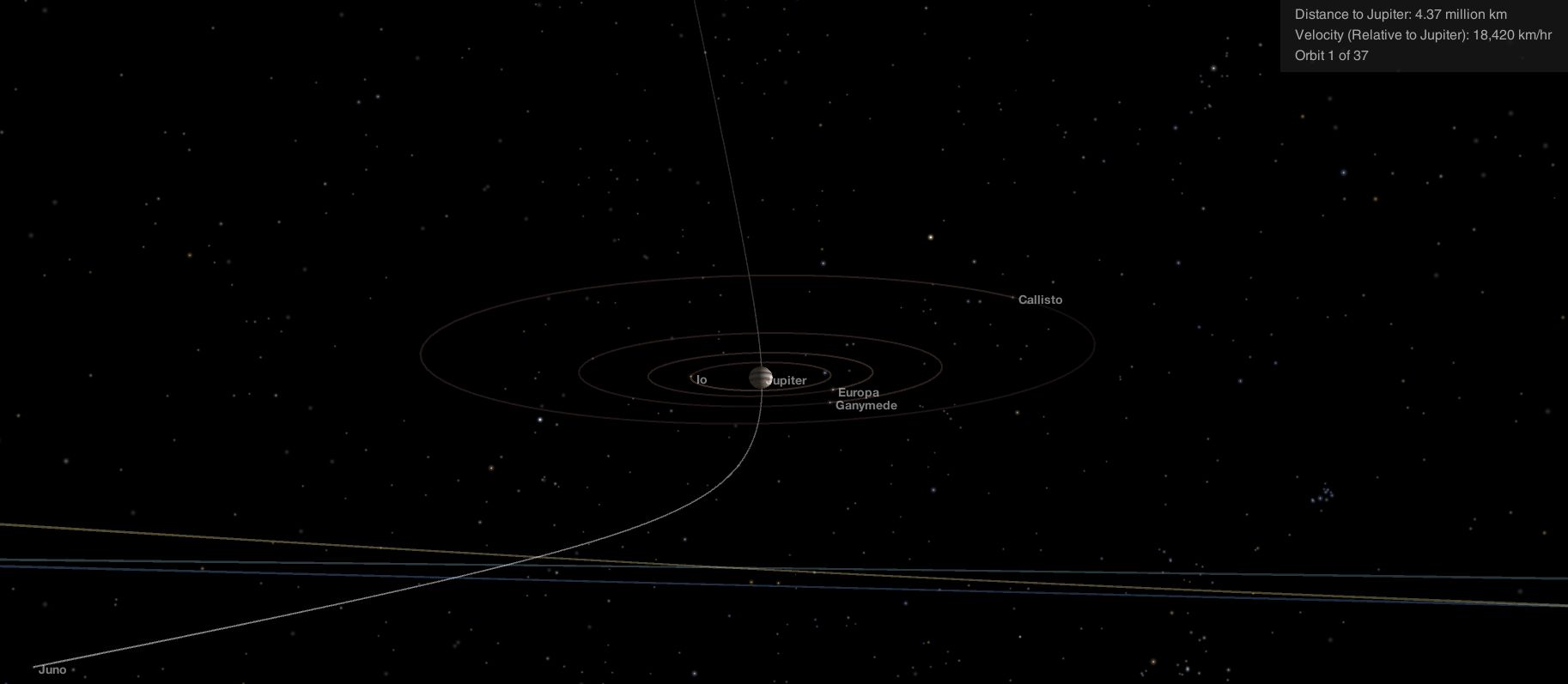
NASA’s Juno mission to Jupiter is swinging back in towards the gas giant, on route to complete the first of some 37 planned polar orbits of the planet between now and February 2018 which are designed to probe the mysteries of the giant planet as never before.
As I reported in early July, the Juno space vehicle arrived at Jupiter on July 4th, where it completed a critical burn of its UK-built Leros-1b engine to ease its way into a highly elliptical orbit around Jupiter after a voyage of 2.8 billion km (1.74 billion miles) and 5 years, during which the craft first looped out past the orbit of Mars before falling back towards Earth to pick up a “gravity assist” to accelerate it on to its rendezvous with Jupiter.
The July 4th braking manoeuvre placed Juno in an orbit which, at its closest to Jupiter, skims just a few thousand kilometres above the planet’s cloud tops, and at its furthest sees Juno over 3 million kilometres from the planet. That first braking manoeuvre was undertaken with the probe’s science systems powered-down as a precautionary measure, and were powered-back up a few days after closest approach.
On August 27th, the vehicle will complete the first of these 53.5-day during “long” orbits, once again passing to within 4,200 km (2,600 mi) of Jupiter’s cloud tops at the equator, after arcing down over the planet’s north pole – and this time, all of the science instruments will remain operational, including JunoCam, the vehicle’s imaging system.
JunoCam has actually be in continuous operation in ” marble movie” mode since July 11th, 2016, capturing 5 full-colour images per hour, watching Jupiter spin from a distance (a sample of this movie is embedded blow – not Jupiter’s spin is greatly speeded-up). However, Jupiter is so small in most of the images – just 50 pixels across – that these haven’t been a source of interest to the media. As Juno approaches Jupiter on August 27th, however, the imaging system will switch from “marble movie” mode to gathering images at a higher rate to fully capture the close flyby as the craft passes over Jupiter’s north pole, curls around the planet north-to-south, before heading back out into space once more on the second of its “long” orbits.
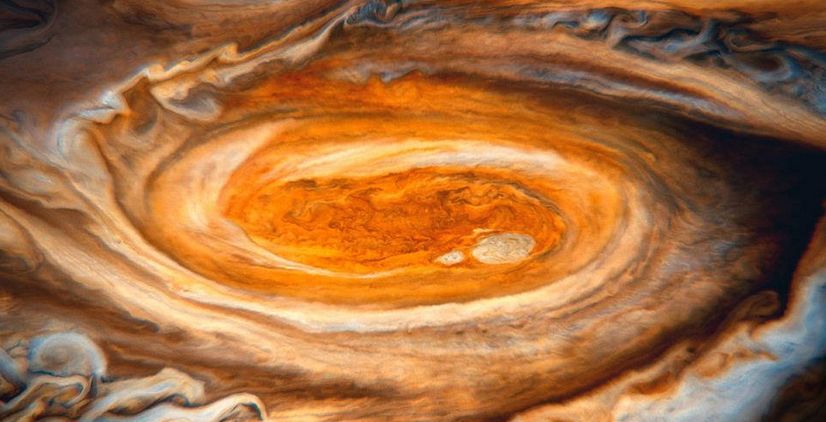
JunoCam has a relative narrow field of view, so the images it captures on August 27th will be tightly focus on Jupiter’s clouds, and not as panoramic as those we’re been accustomed to seeing from the Hubble Space Telescope and from the now defunct Galileo mission. But they should still hopefully prove spectacular.
The next time Juno makes a close approach to Jupiter after this will be on October 19th. At that time, the science instruments will again be powered-off while the craft makes a second orbital burn, this time to reduce its orbit around Jupiter of 53.5 days to just 14 days, allowing the primary science mission to start.
This is intended to improve our understanding of Jupiter’s formation and evolution. The spacecraft will investigate the planet’s origins, interior structure, deep atmosphere and magnetosphere. Juno’s study of Jupiter will help us to understand the history of our own solar system and provide new insight into how planetary systems form and develop in our galaxy and beyond. It will also, for the first time, allow us to “see” below Jupiter’s dense clouds.
Selling the ISS?
This past week, NASA hosted a Journey to Mars showcase, looking at the space agency’s plans for developing the means to send humans to Mars in the 2030s. The actual plans for doing so are still pretty nebulous, but much of in revolves around the current development of the Orion Multi-Purpose Crew Vehicle (MPCV) and its supporting systems (including deep-space habitat modules), and the rocket system which will be used to launch it, the Space Launch System (SLS).
This being the case, the event was hosted at NASA’s Michoud Assembly Facility in New Orleans, where the core stage of the SLS vehicle the Orion MPCV. Included in the event was a trip to see a further test firing of one of the RD25 engines which will power the SLS at launch, and were previously used to power the space shuttle during its ascent to orbit.
However, what particularly grabbed the attention of the media was the announcement that the space agency is looking to sell the International Space Station to a private entity or entities in the mid-2020s, under the understanding that said entity/ies will keep the station active and continue to allow NASA to have access to it.
The move is a bold one. Currently, the ISS is the biggest single component of NASA’s budget, (just over US $3 billion in 2016 and projected to pass US $4 billion in 2020), and is only funded through until 2024. Thus, selling it to a private concern, could allow NASA to continue to make use of the station for research purposes beyond 2024 without having to meet all of the hefty costs involved in actually operating the station, potentially freeing-up some of the money dedicated for ISS support for use elsewhere.
Quite who would be willing to buy the ISS – both SpaceX and Boeing are apparently on NASA’s list of potential interested parties, although the interest may not be reciprocal – and quite how NASA’s international partners feel about the idea, is unclear.






 Inara Pey: Living in a Modemworld