Space Sunday: mesas, dunes NEOs, comets and launches

A dramatic look back: in the foreground is the lower slope of one of the "Murray Buttes", in the far distance the tall peaks of Gale Crater's huge rim. One of the final images taken by Curiosity from within the region of the buttes on Thursday, September 8th, the rover's 1,454 sol on Mars. Credit: NASA/JPL / MSSS
A dramatic look back: in the foreground is the lower slope of one of the “Murray Buttes”, in the far distance the tall peaks of Gale Crater’s huge rim. One of a series of images taken by NASA’s Curiosity rover on Thursday, September 8th, the rover’s 1,454 sol on Mars. Credit: NASA/JPL / MSSS

NASA’s Mars Science Laboratory rover, Curiosity, has said “farewell” to “Murray Buttes” in a stunning series of images, as it continues its climb up the slopes of “Mount Sharp”, a massive mound of deposited material located at the central impact peak of Gale Crater.

The mesas of “Murray Buttes” mark the upper extend of the transitional “Murray Formation”, where the material deposited during the earliest centuries of “Mount Sharp’s” formation merge with the rock comprising the crater floor. Curiosity has been passing by the area of the buttes for a little over a month now, carrying out examinations of the rock surface and gathering samples of mudstone for analysis.

Murray Buttes with the faint outlines of Gale Crater beyond, as images on Thursday, September 8th 2016, by NASA's Curiosity rover during its 1m454 sol on Mars. Credit: NASA/JPL / MSSS
“Murray Buttes” with the faint outlines of Gale Crater beyond, as images on Thursday, September 8th 2016, by NASA’s Curiosity rover during its 1,454 sol on Mars. Credit: NASA/JPL / MSSS

Believed to be the eroded remnants of ancient sandstone that originated when winds deposited sand after lower “Mount Sharp” had formed, the buttes rival anything of a similar nature found on Earth in terms of dramatic looks and structure. So much so that while we’re hardly likely to see Clint Eastwood ride his horse around the base of one, they would nevertheless fit neatly into a Sergio Leone western.

Several of the pictures – mosaics of images captured by the rover which have been white-balanced to match typical Earth daylight lighting conditions and then stitched together to offer complete scenes – reveal the deeply layered nature of the sandstone, sandwiched in what is referred to as “cross-bedding”. This indicates that the formations are the result of both wind deposition of material and then wind erosion, further confirming the idea that “Mount Sharp” was initially formed as a formed as a result of Gale Crater once being home to a great lake, before the waters receded and wind action took over.

A closer view of the layered nature of the sandstone deposits forming "Murray Buttes", showing the "cross bedding" of the layers, indicative of the role that wind played in their deposition / formation. This picture comprises a mosaic of images captured by Curiosity rover on Thursday, September 8th, 2016 during its 1,454 sol on Mars. Credit: NASA/JPL / MSSS
A closer view of the layered nature of the sandstone deposits forming “Murray Buttes”, showing the “cross bedding” of the layers, indicative of the role that wind played in their deposition / formation. This picture comprises a mosaic of images captured by Curiosity rover on Thursday, September 8th, 2016 during its 1,454 sol on Mars. Credit: NASA/JPL / MSSS

The images were taken as Curiosity traversed the base of the final butte, where it gathered a final drilling sample on September 9th. On completion of the sample-gathering, the rover will continue farther south and higher up Mount Sharp, leaving these spectacular formations behind.

Curiosity's route up the slopes of "Mount Sharp". Credit: T.Reyes / NASA/JPL
Curiosity’s route up the slopes of “Mount Sharp” – click for full size. Credit: T.Reyes / NASA/JPL

The Sand Dunes of Shangri-La

On September 7th, NASA issued a video showing the latest radar images captured by the Cassini probe of the surface of Saturn’s largest moon, mighty Titan. The data was gathered as the probe swept by the huge moon – which is blanketed by a thick atmosphere and is known to have lakes and rivers of liquid hydrocarbons on its surface – at a distance of some 976 km (607 mi) on July 25th, 2016 – one of the closest passes over the moon the vehicle has ever made.

Because of the moon’s thick atmosphere, conventional camera systems cannot be used to probe Titan’s mysteries, so Cassini uses a radar system to “map” surface features in black-and-white. Of particular interest to mission scientists during the July 25th flyby was a dark patch along Titan’s equator, previously images by the radar system at much greater distances and dubbed “Shangri-La”. And area which revealed itself to be – in part – a region of linear dunes, mostly likely comprised of grains derived from hydrocarbons that have settled out of Titan’s atmosphere, and which have been sculpted by Titan’s surface winds. Scientists can use the dunes to learn about winds, the sands they’re composed of, and highs and lows in the landscape.

Also captured by the radar is an arena dubbed “Xanadu annex”, believed to be an out-thrust of chaotic terrain from a region dubbed “Xanadu” just to the north of “Shangri-La”. First imaged by the Hubble Space Telescope in 1994, just before the Cassini / Huygens mission was launched, “Xanadu” and its annex are thought to be remnants of the moon’s icy crust before it was covered by organic sediments from the atmosphere.

OSIRIS-REx Lifts-off as an Asteroid Sweeps By Earth

On Thursday, September 8th, NASA successfully launched OSIRIS-REx on a 7-year trek to reach asteroid Bennu, where it will gather surface samples and return them to Earth for analysis. The mission, which I previewed in my last Space Sunday report, lifted-off flawlessly from Space Launch Complex 41 at Cape Canaveral Air Force Station at 19:05 EDT, atop its Atlas V booster at the start of a journey which will carry it a total of 7.2 billion kilometres (4.5 billion miles).

The Atlas V booster carrying OSIRIS-REx shortly after lift-off on Thursday, September 8th. Credit: Ken Kremer

Witnessing the launch was principal investigator Dante Lauretta, from the University of Arizona. “I can’t tell you how thrilled I was this evening, thinking of the people who played a part in this,” he said following the launch.

“This represents the hopes and dreams and blood, sweat and tears of thousands of people who have been working on this for years.”

The mission will gather samples from the surface of the asteroid – a remnant from the formation of the solar system – and will also map Bennu’s orbit around the Sun and the influences affecting it.

This is because the asteroid is a near-Earth object (NEO): an asteroid which periodically passes across Earth’s orbit around the Sun, and can come very close to our planet whilst doing so. So close, in fact, that some estimates of Bennu’s future orbit suggest it will collide with Earth towards the end of the next century.

Continue reading “Space Sunday: mesas, dunes NEOs, comets and launches”

Space Sunday: Juno, ISS and SLS

July 14th: Jupiter with Io, Europa and Ganymede as seen by Juno after the craft had finished its critical orbital burn to slip into a 53.5 day orbit around the giant planet
July 14th: Jupiter with Io, Europa and Ganymede as seen by Juno after the craft had finished its critical engine burn to slip into a 53.5 day orbit around the giant planet. Juno will once again skim Jupiter’s cloud tops on Saturday, August 27th. Credit: NASA / JPL; SwRI / MSSS

NASA’s Juno mission to Jupiter is swinging back in towards the gas giant, on route to complete the first of some 37 planned polar orbits of the planet between now and February 2018 which are designed to probe the mysteries of the giant planet as never before.

As I reported in early July, the Juno space vehicle arrived at Jupiter on July 4th, where it completed a critical burn of its UK-built Leros-1b engine to ease its way into a highly elliptical orbit around Jupiter after a voyage of 2.8 billion km (1.74 billion miles) and 5 years, during which the craft first looped out past the orbit of Mars before falling back towards Earth to pick up a “gravity assist” to accelerate it on to its rendezvous with Jupiter.

The July 4th braking manoeuvre placed Juno in an orbit which, at its closest to Jupiter, skims just a few thousand kilometres above the planet’s cloud tops, and at its furthest sees Juno over 3 million kilometres from the planet. That first braking manoeuvre was undertaken with the probe’s science systems powered-down as a precautionary measure, and were powered-back up a few days after closest approach.

On August 27th, the vehicle will complete the first of these 53.5-day during “long” orbits, once again passing to within 4,200 km (2,600 mi) of Jupiter’s cloud tops at the equator, after arcing down over the planet’s north pole – and this time, all of the science instruments will remain operational, including JunoCam, the vehicle’s imaging system.

JunoCam has actually be in continuous operation in ” marble movie” mode since July 11th, 2016, capturing 5 full-colour images per hour, watching Jupiter spin from a distance (a sample of this movie is embedded blow – not Jupiter’s spin is greatly speeded-up). However, Jupiter is so small in most of the images  – just 50 pixels across – that these haven’t been a source of interest to the media. As Juno approaches Jupiter on August 27th, however,   the imaging system will switch from “marble movie” mode to gathering images at a higher rate to fully capture the close flyby as the craft passes over Jupiter’s north pole, curls around the planet north-to-south, before heading back out into space once more on the second of its “long” orbits.

JunoCam has a relative narrow field of view, so the images it captures on August 27th will be tightly focus on Jupiter’s clouds, and   not as panoramic as those we’re been accustomed to seeing from the Hubble Space Telescope and from the now defunct Galileo mission. But they should still hopefully prove spectacular.

The next time Juno makes a close approach to Jupiter after this will be on October 19th. At that time, the science instruments will again be powered-off while the craft makes a second orbital burn, this time to reduce its orbit around Jupiter of 53.5 days to just 14 days, allowing the primary science mission to start.

This is intended to improve our understanding of Jupiter’s formation and evolution. The spacecraft will investigate the planet’s origins, interior structure, deep atmosphere and magnetosphere. Juno’s study of Jupiter will help us to understand the history of our own solar system and provide new insight into how planetary systems form and develop in our galaxy and beyond. It will also, for the first time, allow us to “see” below Jupiter’s dense clouds.

Selling the ISS?

This past week, NASA hosted a Journey to Mars showcase, looking at the space agency’s plans for developing the means to send humans to Mars in the 2030s. The actual plans for doing so are still pretty nebulous, but much of in revolves around the current development of the Orion Multi-Purpose Crew Vehicle (MPCV) and its supporting systems (including deep-space habitat modules), and the rocket system which will be used to launch it, the Space Launch System (SLS).

This being the case, the event was hosted at NASA’s Michoud Assembly Facility in New Orleans, where the core stage of the SLS vehicle the Orion MPCV. Included in the event was a trip to see a further test firing of one of the RD25 engines which will power the SLS at launch, and were previously used to power the space shuttle during its ascent to orbit.

However, what particularly grabbed the attention of the media was the announcement that the space agency is looking to sell the International Space Station to a private entity or entities in the mid-2020s, under the understanding that said entity/ies will keep the station active and continue to allow NASA to have access to it.

The move is a bold one. Currently, the ISS is the biggest single component of NASA’s budget, (just over US  $3 billion in 2016 and projected to pass US $4 billion in 2020), and is only funded through until 2024. Thus, selling it to a private concern, could allow NASA to continue to make use of the station for research purposes beyond 2024 without having to meet all of the hefty costs involved in actually operating the station, potentially freeing-up some of the money dedicated for ISS support for use elsewhere.

Quite who would be willing to buy the ISS – both SpaceX and Boeing are apparently on NASA’s list of potential interested parties, although the interest may not be reciprocal – and quite how NASA’s international partners feel about the idea, is unclear.

Continue reading “Space Sunday: Juno, ISS and SLS”

Space Sunday: of Martian and lunar robots, distant worlds and ET

CuriosityAugust 2016 sees NASA’s Mars Science Laboratory rover Curiosity rack up four (terrestrial) years of operations on the surface of Mars.

The rover marked this anniversary rather quietly, by preparing to take further rock samples, this time from a target dubbed “Marimba”. Once gathered, the samples will be subjected to on-board analysis by Curiosity using the compact laboratory systems contained the rover’s body.

The sampling take place as the rover is engaged in a multi-month ascent of a mudstone geological unit as it continues its climb towards higher and progressively younger geological areas on “Mount Sharp” (more correctly, Aeolis Mons), which will include some rock types not yet explored.

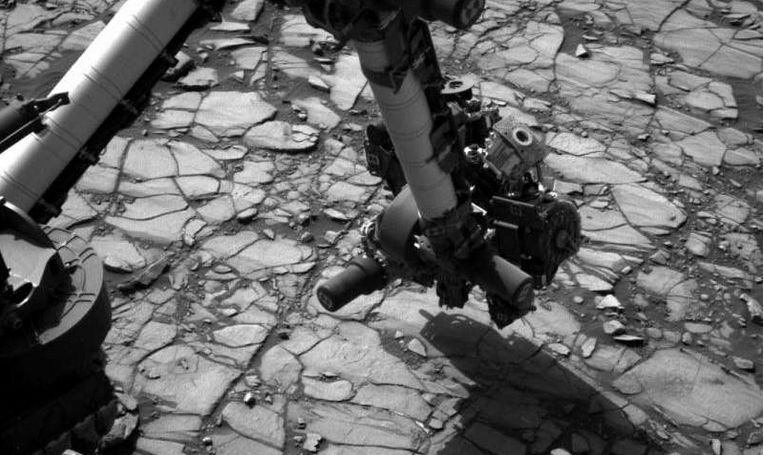
August 2nd, 2016 (Sol 1,418)T: the Navigation Camera (Navcam) on Curiosity's mast images the rover's extended robot arm over a section of the "Marimba" target rock, ready to use the wire brush mounted on the "hand" at the end of the arm in order to scour surface material which otherwise might contaminate and samples gathered from the rock, prior to the rover taking a drilling sample. Credit: NASA/JPL / MSSS
August 2nd, 2016 (Sol 1,418)T: the Navigation Camera (Navcam) on Curiosity’s mast images the rover’s extended robot arm over a section of the “Marimba” target rock, ready to use the wire brush mounted on the “hand” at the end of the arm in order to scour surface material which otherwise might contaminate and samples gathered from the rock, prior to the rover taking a drilling sample. Credit: NASA/JPL / MSSS

In the meantime, examining the samples gathered from “Marimba” will allow a direct comparison with mudstone samples gathered further down the slopes of “Mount Sharp” and from the flatlands of Gale Crater. This will enable scientists to  build a more complete picture of the mineral and chemical  environment the rover is travelling through, and so further understand the general conditions which may have once have existed within the crater.

Goodnight from a Lunar Jade Rabbit

China has finally bid farewell to Yutu (“Jade Rabbit”, named for the companion to the Moon goddess Chang’e), its first lunar robotic explorer, after 31 months of surface operations.

The little solar-powered rover arrived on the lunar surface as part of Chain’s Chang’e 3 lander / rover mission on December 13, 2013, and was deployed from the lander some  7.5 hours after touch-down.

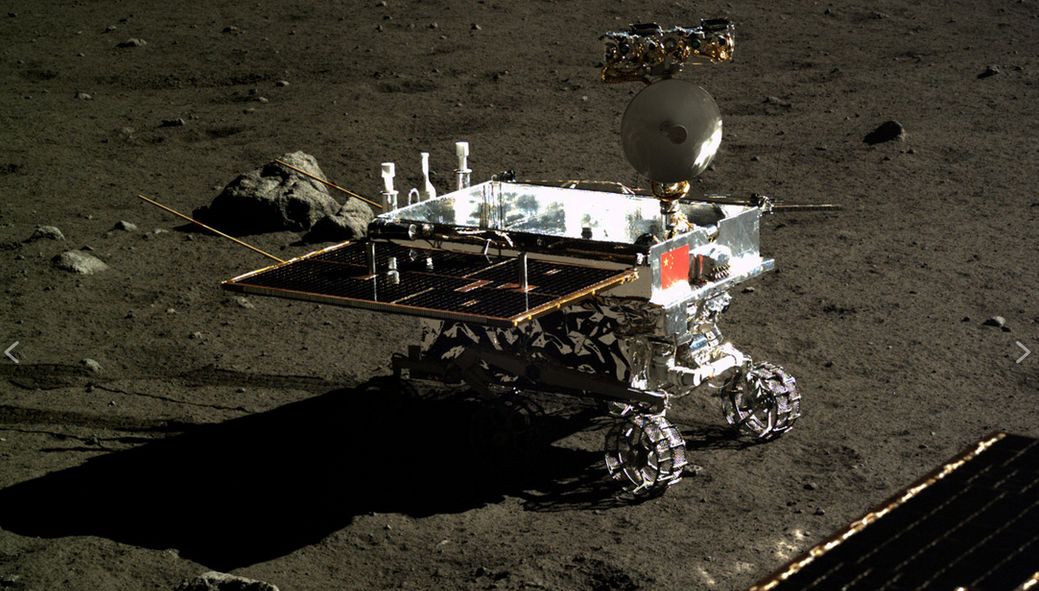
Yutu as imaged from the Chang'e 3 lander (part of the solar pnael from which can be seen in the lower right corner). Credit: National Astronomical Observatories of China
Yutu as imaged from the Chang’e 3 lander (part of the solar panel from which can be seen in the lower right corner). Credit: National Astronomical Observatories of China

However, due to the vast temperature differential experienced between the sunlit and shadowed parts of the rover at the time of the landing, operations didn’t commence until December 21st, when the rover was uniformly lit by the Sun. It’s first activity was to drive part-way around its parent lander and photograph it. After this, the rover travelled some 40 metres (130 ft) from the lander to commence independent science operations studying the lunar surface.

Yutu was designed to operate for just three months and travel up to 10 km (6.2 mi) within an area of 3 square kilometres (1.2 sq mi). Following its expose to the first 14-day long lunar “night”, the rover resumed operations in January 2014. However, as the second lunar night period approached (lasting 14 terrestrial days), the rover suffered a glitch in its drive mechanisms, leaving it susceptible to the harsh cold of the night-time, and on February 12th, following its second Lunar night, the rover was declared lost … only to resume communications with Earth within 24 hours.

Since that time, although immobilised, the little rover has maintained almost regular contact with Earth, but with each night period taking an increasing tolls on its systems. Even so, its continued survival gained it a huge and loyal following on the Chinese micro-blogging site, Weibo, where in a leaf firmly pulled from NASA’s book of social media engagement, Yutu had a first-person account.

It was via that social media account that Yutu’s final demise was announced, as if from the rover itself, on August 2nd 2016:

This time it really is goodnight. There are still many questions I would like answers to, but I’m the rabbit that has seen the most stars. The Moon has prepared a long dream for me, I don’t know what it will be like – will I be a Mars explorer, or be sent back to Earth?

The message gained a huge response from the rover’s 600,000 followers, and the Chinese space agency officially confirmed the rover had “died”, on Wednesday, August 3rd.

Continue reading “Space Sunday: of Martian and lunar robots, distant worlds and ET”

Space Sunday: rockets, red spots, fireballs and spaceplanes

SpaceX's plan to start down the road to their first human mission to Mars with their 2018 automated mission to the Red Planet -which NASA suggest will cost the company around US $320 million
SpaceX’s plan to start down the road to their first human mission to Mars with their 2018 automated mission to the Red Planet – which NASA suggests will cost the company around US $320 million

NASA has indicated that the SpaceX Red Dragon mission to Mars, which the company plans to carry out in 2018, will likely cost around US $320 million for SpaceX to mount, ad NASA itself will spend around US $32 million over four years in indirect support of the mission.

The Red Dragon mission, first announced in April 2016, will be financed entirely by SpaceX; NASA’s costs will be related to providing technical and logistical support – such as using its Deep Space Tracking Network for communications with the vehicle.

If all goes according to plan, the Red Dragon mission could be launched as early as May 2018. It is the crucial first step along the road towards the company’s ambitions to land a human crew on Mars by the end of the 2020s. If successful, it could potentially be followed by at least three further uncrewed Red Dragon flights in 2020/22, prior to the company commencing work on building-up matériel on Mars in preparation for a crewed mission.

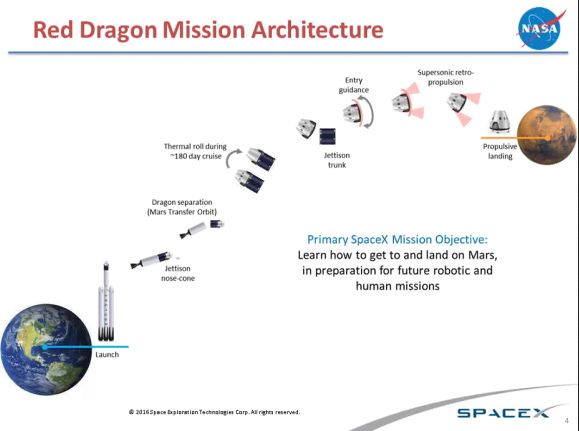
A SpaceX / NASA infographic outlining the 2018 mission
A SpaceX / NASA infographic outlining the 2018 mission. Credit: NASA / SpaceX

Red Dragon is the name of an uncrewed variant of the SpaceX Dragon 2 vehicle, which will enter service in 2018 ferrying astronauts to / from the International Space Station. Intrinsic to the mission is the plan to conduct a propulsive landing on Mars using the craft’s SuperDraco Descent Landing capability. This is vital on two counts.

For SpaceX, a crewed variant of the Red Dragon will likely be the Mars descent / ascent vehicle during a human mission to the planet. So understanding how it operates in the Martian atmosphere is a vital part of preparing to land a crew on the planet. NASA is similarly interested in learning how well retropropulsion works in slowing a vehicle to subsonic speeds in the Martian atmosphere, as it now looks likely they will use the same approach for their human missions to Mars, which may occur in the 2030s. Gaining the data from the SpaceX missions means that NASA doesn’t have to fly its own proof-of-concept missions all the way to Mars.

A Dragon 2 text article test-fires its eight SuperDraco engines during a hover test in 2014

Whether or not Red Dragon will fly in 2018 is still a matter of debate. SpaceX has some significant commitments and obligations on which to focus: commercial Falcon launches, resupply missions to the ISS, the start of crewed flights to the ISS, introducing the Falcon 9 into its flight operations, etc. These all tend to suggest that the development of the Red Dragon capsule, which will require some significant modifications when compared to the Dragon 2, will be subject to the company’s existing commitments taking priority over it.

In the meantime, the company plans to release more information on the overall Mars strategy, up to and including their human mission, in September.

Jupiter’s Great Red Spot: Atmospheric Heating for a Giant

As the Juno space vehicle reached the farthest point from Jupiter in its first orbit around the gas giant and begins a 23-day “fall” back towards the planet, scientists on Earth may have unlocked the secret of why Jupiter’s upper atmosphere is so warm.

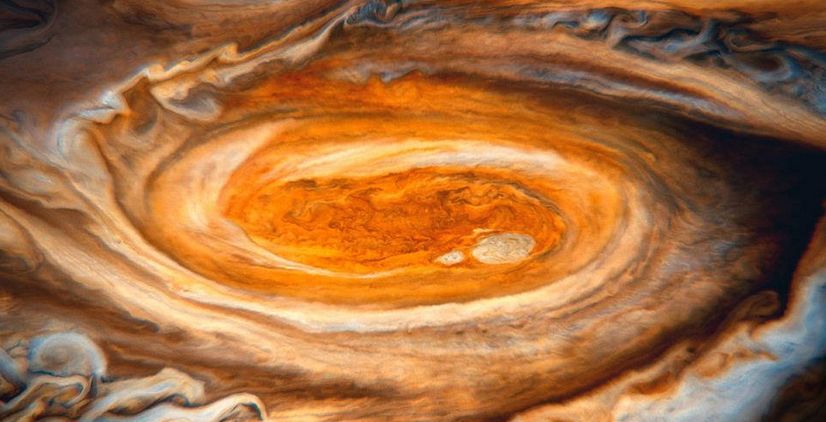
The Eye of Jupiter: a CGI recreation of the Great Red Spot based on observations from the Voyager spacecraft and Hubble Space Telescope, and as used in the television series Cosmos: A Spacetime Odyssey. Credit: 21st Century Fox.

Here on Earth, the atmosphere is heated by the Sun. However, despite being five times further from the Sun than Earth, the upper reaches of the Jovian atmosphere share similar average temperatures to our own when they should in fact be a lot colder. Many theories have been put forward as to why this is the case, but now a team from Boston University, Massachusetts,  believe they’ve found the answer: the heating of Jupiter’s upper atmosphere is the combined result of the Great Red Spot (GRS) and Jupiter’s aurorae.

The Great Red Spot is one of the marvels of our solar system. Discovered within years of Galileo’s introduction of telescopic astronomy in the 17th Century, it is a swirling pattern of red-coloured gases thought to be a hurricane-like storm raging down through the centuries in the Jovian atmosphere. Roughly 3 Earth diameters across, its winds take six days to complete one spin around its centre, driven in part by Jupiter’s own high-speed spinning about its own axis, completing one revolution every ten hours.

Continue reading “Space Sunday: rockets, red spots, fireballs and spaceplanes”

Space Sunday: looking back, looking forward, looking inside

A composite image: The Apollo 11 Saturn V on LC 39A during a countdown demonstration test on July 11th, 1969, and the Apollo 11 crew (l to r): Commander Neil Armstrong; CSM Pilot Michael Collins and LEM Pilot Edwin "Buzz" Aldrin
A composite image: The Apollo 11 Saturn V on LC 39A during a countdown demonstration test on July 11th, 1969, and the Apollo 11 crew (l to r): Commander Neil Armstrong; CSM Pilot Michael Collins and LEM Pilot Edwin “Buzz” Aldrin. Credit: NASA (both)

July 20th marked two anniversaries, the first manned landing on the Moon (July 20th, 1969) by Apollo 11, and the first American automated soft-landing on Mars with Viking Lander 1 (July 20th, 1976). As such, I’m starting this Space Sunday with a short look at both events.

Apollo Lunar Module (LEM) Eagle arrived on the surface of the Moon at 20:18:04 UTC on July 20th, 1969 after being launched atop a Saturn V rocket along with Neil Armstrong, Michael Collins and Edwin “Buzz” Aldrin from the Kennedy Space Centre Launch Complex 39A at 13:32:00 UTC on July 16th, 1969. It was the culmination of John F. Kennedy’s vision to re-assert America’s industrial and technological leadership in the world.

This composite of images from NASA's Lunar Reconnaissance Orbiter (LRO) mission from 2014 highlight elements of the Apollo 11 landing site on the Moon - notably the lower section of the LEM and some of the science equipment
This composite of images from NASA’s Lunar Reconnaissance Orbiter (LRO) mission, released in 2014 highlight elements of the Apollo 11 landing site on the Moon – notably the descent section of the LEM and some of the science equipment – watch the video

The land was dramatic in every sense of the word. On separation from the Command Module, the LEM immediately experienced issues communicating directly with Earth, then there were the infamous 1202 master alarm which triggered the LEM’s landing computer to re-boot itself, followed by a 1201 alarm. Then there was the discovery that, fair from being smooth and flat, the main landing site was boulder strewn, forcing Armstrong to fly the LEM to the limits of its available descent fuel in order to find a suitable landing area.

Armstrong finally set foot on the Moon on July 21st at 02:56:15 UTC, after he and Aldrin (the LEM Pilot)  had been given the opportunity to rest. Aldrin followed Armstrong down the ladder 20 minutes later, and together they spent about 2.5 hours on the surface, collecting 21.5 kg (47.5 lbs) of lunar material for return to Earth. Their total time on the Moon was short – just under 22 hours – but Aldrin and Armstrong between them, seen in fuzzy black-and-white television footage and (later) crisp photos, forever changed humanity’s perception of the Moon and its place in the cosmos.

To Mark the 47th anniversary of the landing, which also saw Collins remain in orbit piloting the Command and Service Module (CSM), The National Air and Space Museum in Washington, DC has produced a 3D tour (with other goodies) of the Apollo Command Module Columbia, as seen from the pilot’s (Collin’s) seat. This can be run in most browsers and offers a first-hand tour of the vehicle.

For those who prefer a visual record, NASA issued a restored film of the entire Apollo 11 EVA on YouTube in 2014. Or you can re-live the entire mission in just 100 seconds, courtesy of Spacecraft Films, which I’ve embedded below.

Apollo 11 was the first of six missions to the Moon (Apollo 13 being famously aborted after a critical failure within the Service Module whilst en route to the Moon), which concluded on December 19th, 1972, when Apollo 17 splashed down in the South Pacific Ocean, the only Apollo mission to fly a fully qualified geologist to the Moon (Harrison Schmitt).

In the 44 years since the end of the Apollo lunar project, human spaceflight has been confined to low-Earth orbit and will not move beyond it until the 2020s (with the uncrewed Exploration Mission 1 serving as the preliminary flight for that move in 2018). As such, it is all too easy to dwell on the political motivations which led to the programme, rather than on the phenomenal achievement Apollo actually was. Today’s plans for moving beyond LEO once more, and for sending Humans to Mars, may seem long overdue but they nevertheless build on the foundations laid down by Apollo.

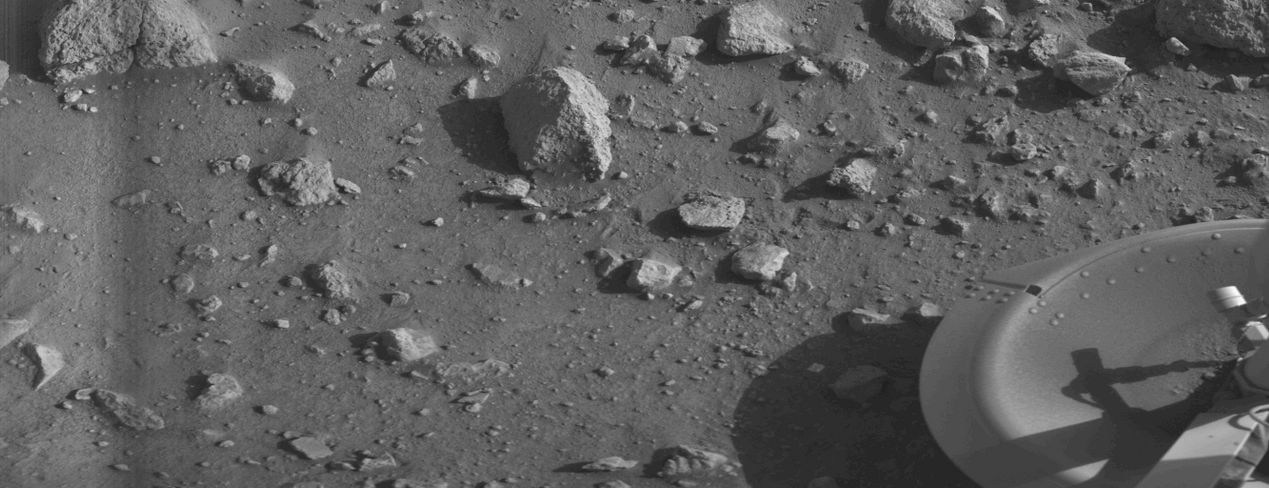
The first "clean" image of the surface of Mars returned by Viking 1 on July 20th, 1976
The first “clean” image of the surface of Mars returned by Viking 1 on July 20th, 1976. Credit: NASA / public domain

Viking Lander 1 arrived on the surface of Mars seven years to the date after Apollo 11 arrived on the Moon – although that hadn’t been the original intent. 1976 saw the United States celebrating its bicentennial, and it had originally been intended that the Lander would touch-down on the Red Planet on July 4th of that year.

However, after arriving in orbit on June 19th, 1976, the Viking orbiter craft used its imagining systems to survey the proposed landing site, which had been “scouted” from orbit  by the Mariner 9 mission  – the first vehicle to orbit Mars – in 1971 / 72. Unfortunately, the Viking orbiter’s much more capable cameras revealed the primary landing site to be far rougher than had been believed, leading to a decision not to land there, but to survey the back-up sites prior to committing to a landing on July 20th, and thus to instead celebrate Apollo 11’s triumph instead of America’s Independence Day.

Given the state of play of planetary exploration at the time, Viking was a massively impressive mission: two orbiter vehicles launched back-to-back, carrying two lander vehicles in turn carrying an impressive set of 5 experiments intended to seek signs of life on Mars. At the time, no-one actually knew the density of the Martian upper atmosphere or the load-bearing strength of the Martian surface or what they might actually find on the surface. There were genuine fears that the latter might be all dust, and the lander could simply dig itself a hole when firing its retro-rockets at the final point of landing and then fall into it, or if it did arrive safely, whether it might sink into the Martian dust; hence why the first image to be returned by the lander following touchdown prominently featured one of its own landing pads (above).

Continue reading “Space Sunday: looking back, looking forward, looking inside”

Space Sunday: celestial harmonics, breathing air and singing for Pluto

July 14th: Jupiter with Io, Europa and Ganymede as seen by Juno after the craft had finished its critical orbital burn to slip into a 53.5 day orbit around the giant planet
July 10th: Jupiter with Io, Europa and Ganymede as seen by Juno after the craft had finished its critical orbital burn to slip into a 53.5 day orbit around the giant planet on July 4th. Credit: NASA/JPL / SwRI / MSSS (click and image for full size)

The banner image, captured by NASA’s Juno spacecraft, might look like the one I used in my last Space Sunday update, but there is one important difference. The images used last time around had been captured by Juno on June as it approached the Jovian system on June 29th, five days before the craft had to complete a critical engine burn whilst almost scraping the planet’s cloud tops, to place itself in an extended orbit around Jupiter. The image above was captured on July 10th, as Juno headed away from Jupiter, having successfully completed the manoeuvre.

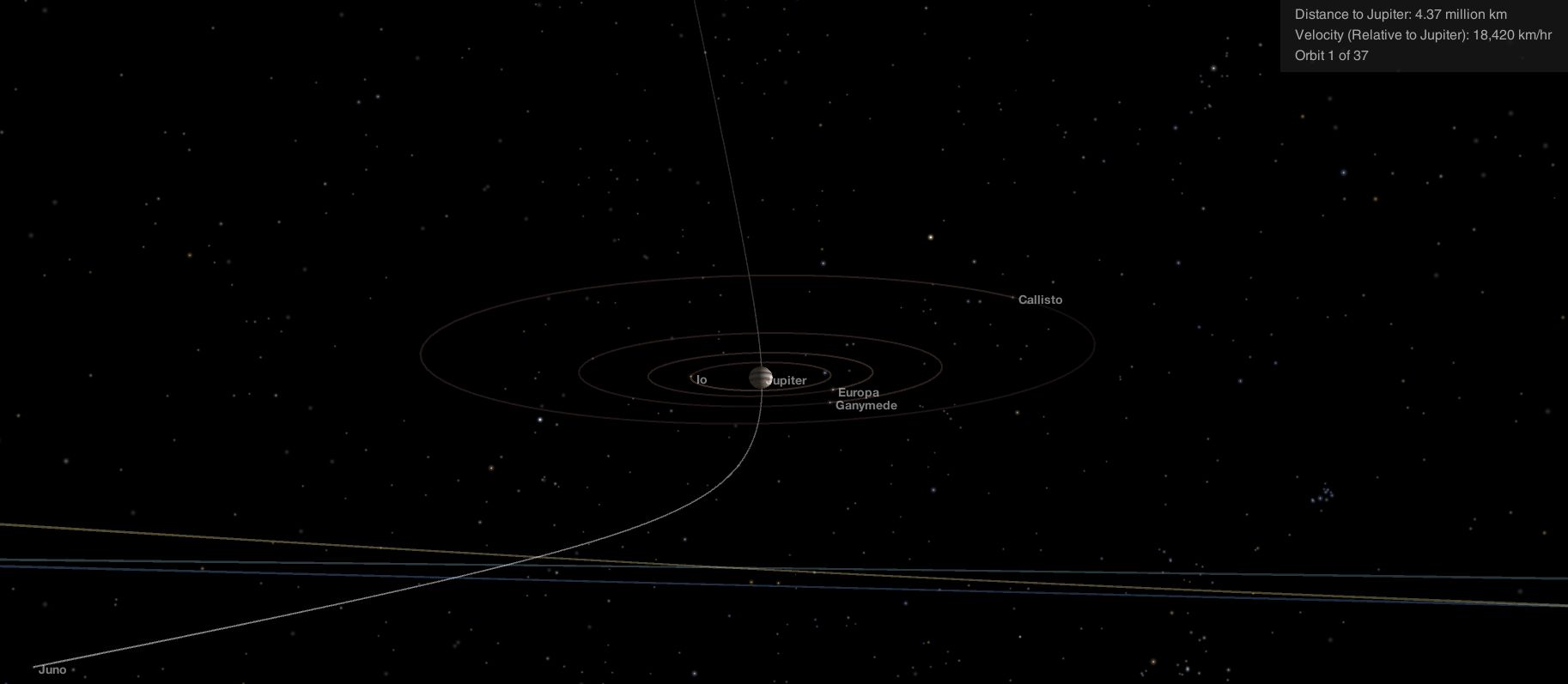
At the time the picture was captured, 17:30 UTC on July 10th, 2016, Juno was already  4.3 million kilometres (2.7 million miles) distant from the planet, and heading away from it at a relative velocity of 18,420 km / hour (11,446 mph) and decelerating under the influence of the Jupiter’s gravity.

Juno's flight around the poles of Jupiter and it's position on July 10th, as seen by the NASA Eyes application
Juno’s flight around the poles of Jupiter and it’s position on July 10th, as seen using the NASA Eyes simulator (click for full size)

Juno’s imaging system – JunoCam – had, along with other major systems aboard the craft, been shut down prior to the July 4th engine burn, both to conserve power – Juno had to turn its solar panels away from the Sun during the burn manoeuvre, limiting the available electrical power – and to protect them through the initial passage through Jupiter’s tremendous radiation fields. It wasn’t until July 6th that the instruments were all powered back up, and after testing them, the July 10th exercise was the first opportunity to have a look back at the Jovian system.

Juno will keep travelling outwards from Jupiter until the end of July, slowing to a relative velocity of just 1,939 km/h (1212 mph), before it starts to “fall” back towards the planet, making a second close flyby on August 27th. At this time, the craft will pass just 4,142 km (2,575 mi) above the Jovian cloud tops at a speed of 208,11 km/h (129,315 mph). More importantly, all of vehicle’s science instruments will remain powered-up, and JunoCam in particular should gain some stunning images of Jupiter during this second close pass.

To celebrate Juno’s arrival around Jupiter, NASA released a time-lapse video of the Jovian system as seen by the approaching spacecraft. It begins on June 12th with Juno 16 million km (10 million mi), and ends on June 29th, when JunoCam was shut down and Juno was 4.8 million km (3 million mi) distant.

Made possible by Juno’s high angle of approach into the Jovian system, it is the first close-up view of celestial harmonic motion we’ve ever had. Also, the 17-day duration of the movie means we see Callisto (flickering very faintly) make a full orbit around Jupiter, and get to see Ganymede, Europa and Io (counting inwards towards the planet) each experience eclipse as they pass through Jupiter’s shadow. Note that the flickering exhibited by the moons is an artefact of JunoCam, which is optimised to image bright features on Jupiter, rather than capturing the (relatively) dim pinpoints of the distant moons as they circle the planet.

Curiosity Resumes Operations as 2020 “Sister” Takes Shape

In my last update I reported that NASA Mars Science Laboratory, Curiosity, had entered a “safe” mode on July 2nd.  On July 9th, the mission team successfully recovered the rover from this safe mode – a precautionary state the rover will set for itself should it detected an event which could damage its on-board systems – and then subsequently returned Curiosity to a fully operational status on July 11th.

The cause of the problem lay in  a glitch in one of the modes by which images are transferred from the memory in some of the rover’s camera systems to its main computers. This generated a data mismatch warning, prompting the rover to active its “safe” mode and call Earth for assistance. Use of this particular data transfer mode between the identified camera systems and the computers is now being avoided in order to prevent a repeat of the problem.

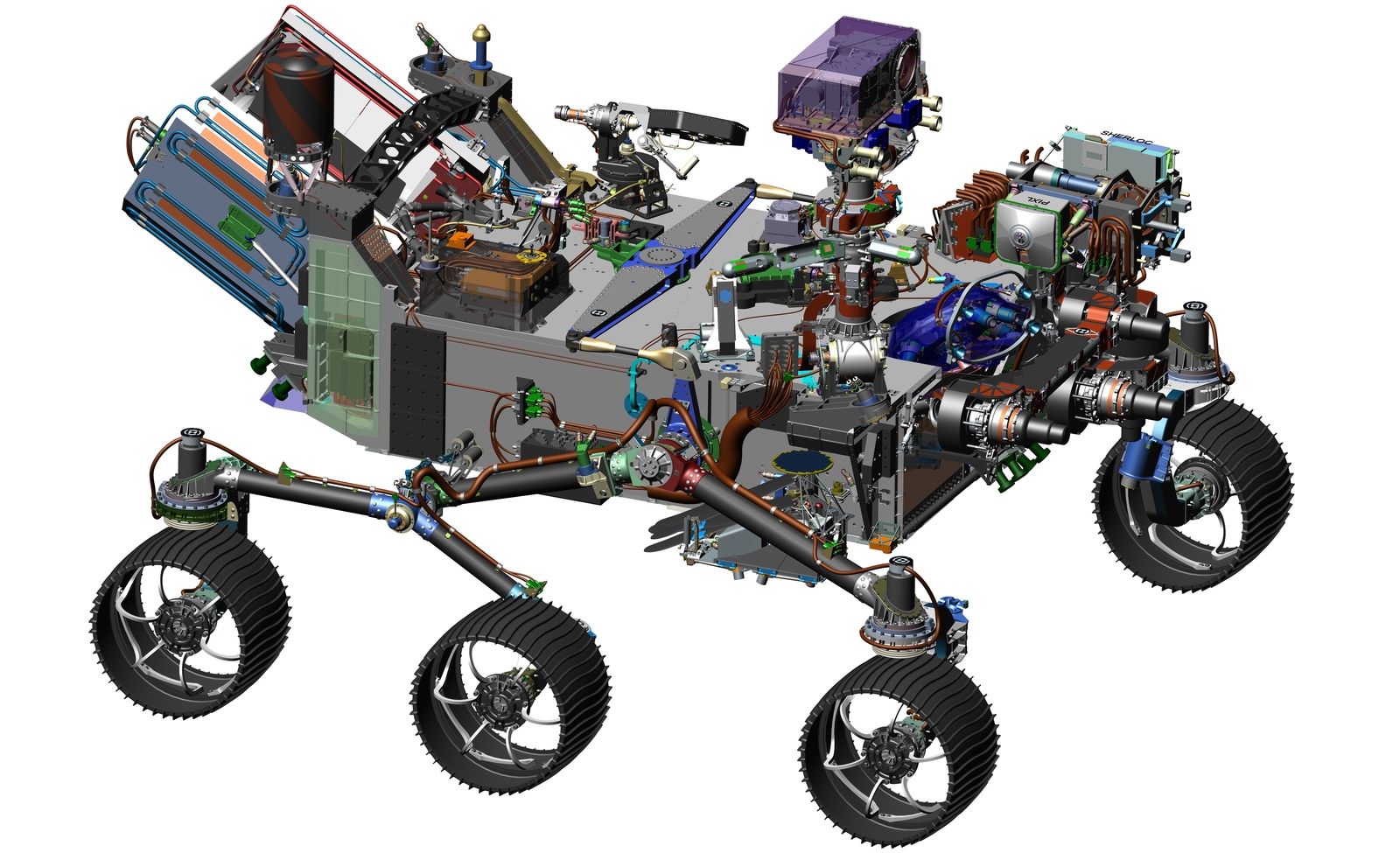
Meanwhile, NASA’s next rover mission – designated Mars 2020 at present, as it will launch in the summer of that year to arrive on Mars in February 2021 – is taking shape. The basic vehicle will be based on the Curiosity class of rover, but will carry a different science suite and have somewhat different capabilities.

A CAD image of the Mars 2020 rover: visibly similar to MSL's Curiosity rover. Credit: NASA
A CAD image of the Mars 2020 rover: visibly similar to MSL’s Curiosity rover. Credit: NASA

In particular, the new rover will carry an entirely new subsystem to collect and prepare Martian rocks and soil samples which can be stored in sample tubes. About 30 of these sample tubes will be deposited at select locations, so that they might be collected by a possible future automated mission and returned to Earth for direct analysis for evidence of past life on Mars and possible health hazards for future human missions.

Two science instruments mounted on the rover’s robotic arm will be used to search for signs of past life and determine where to collect samples by analysing the chemical, mineral, physical and organic characteristics of Martian rocks, while a suite of advanced camera systems will be housed on the vehicle’s mast. As with Curiosity, Mars 2020 will carry a comprehensive meteorological suite for monitoring the Martian environment and weather, together with a ground penetrating radar system for determining what is going on under the rover’s wheels.

Continue reading “Space Sunday: celestial harmonics, breathing air and singing for Pluto”