Space Sunday: TRAPPIST-1, planet 9 and Europa

An artist's impression of the seven TRAPPIST planets, with -1b lower left and -1h lower right. The three planets in the star's habitable zone, -!e, -1f and -1g are the right-hand three in the top row. Credit: NASA
An artist’s impression of the seven TRAPPIST planets, with -1b lower left and -1h lower right. The three planets in the star’s habitable zone, -!e, -1f and -1g are the right-hand three in the top row. Credit: NASA

I recently wrote a space update special on the TRAPPIST-1 star system with its seven roughly Earth-sized planets. Since then, there has been speculation about whether any of them might support life, and what conditions for life might be like.

Whether life may have arisen on any of the worlds is tough question to answer. Three of the seven lie within the “habitable zone” where liquid water might exist (TRAPPIST-1e, -1f and -1g) – which is a positive for life as we know it. But for that liquid water to remain liquid, the planets must have an atmosphere. Currently, only TRAPPIST-1b and -1c have, through spectral analysis, been shown to harbour atmospheres, but these seem to be limited in scope, and could range from a water vapour rich atmosphere through to an environment similar to that of Venus.

On the negative side of the equation, the nature of their parent star, a super cool red dwarf with all internal action entirely convective in nature, means that all seven planets are likely subject to sufficient irradiation in the X-ray and extreme ultraviolet wavelengths to significantly alter their atmospheres, potentially rendering them unsuitable for life. Further, all seven are tidally locked, meaning they always keep the same face towards their parent star. This will inevitably give rise to extreme conditions, with one side of each world bathed in perpetual daylight and the other in perpetual, freezing darkness, resulting in extreme atmospheric movements and likely harsh weather.

Comparing the TRAPPIST-1 system with the solar system. Credit: European Southern Observatory / O. Furtak

Daylight on the planets would also be very different. Although one side of these worlds be forever in daytime, and despite the relative proximity with which they orbit their parent star, days on their surfaces would never be much brighter than sunset here on Earth, both in terms of colour and light intensity. This is because most of the light emitted by TRAPPIST-1 is radiated in the infra-red wavelengths, rather than visible wavelengths.

One the more positive side of the equation, despite the low levels of visible light, TRAPPIST-1 could still be able to sufficiently warm an atmospheres the planets might have, and the weather conditions might actually dissipate this warmth evenly over the planet’s surface, perhaps making it more hospitable to life.

It’s also likely the planets experience a lot of tidal flexing as they come under the influence of one another as well as their parent star. This flexing might give rise to hydrothermal and volcanic vents, which in turn could provide the necessary heat (energy), minerals and chemicals necessary to kick-start basic life.

Artist's impression of the three planets in TRAPPIST-1's habitable zone and to scale relative to one another. -1e (l) is the most likely to have extensive liquid water. It is 92% as big as Earth, with a mass of 62% that of Earth. It orbits its parent star about 10.8 times the distance from Earth to the Moon. -1f (c) is 1.04 times the size of Earth, but with only 62% of its mass. It is potentially water rich, and gets as much light from its star as Mars does from the Sun. -1g (r) is the outermost of the three
Artist’s impression of the three planets in TRAPPIST-1’s habitable zone and to scale relative to one another. -1e (l) is the most likely to have extensive liquid water. It is 92% as big as Earth, with a mass of 62% that of Earth. It orbits its parent star about 10.8 times the distance from Earth to the Moon. -1f (c) is 1.04 times the size of Earth, but also with  62% of its mass. It is potentially water rich, and gets as much light from its star as Mars does from the Sun. -1g (r) is the outermost of the three. It is 1.13 times Earth’s size with 1.34 times its mass. It is far enough away from its parent star that the surface is likely to be entirely frozen, but the gravitational influence of the other planets could give rise to a liquid water ocean under the ice. Credit: NASA

Studies of the TRAPPIST system will continue using the Spitzer and Hubble space telescopes and via ground-based observatories. However, as mentioned in my special report, it is likely to be the James Webb Space Telescope which will hopefully reveal many of the secrets of the TRAPPIST-1 system.

That said, and for those still wondering about intelligent life arising on any of these worlds, SETI, the Search for Extra-Terrestrial Intelligence has been “listening in” on the star for indications of radio traffic for some time (pre-dating the discovery of the first two planets in the system in 2016). Those surveys haven’t revealed any kind of radio emissions from the system that might be of artificial origin, but now we know there are seven planets, SETI has marked TRAPPIST-1 for further investigations with their Allen Telescope Array (ATA).

A Further Clue in the Hunt for Planet 9

Last year, Caltech astronomers Mike Brown and Konstantin Batygin found indirect evidence for the existence of a large planet in the outer reaches of our Solar System well beyond Pluto; since then, the search has been on. I first covered the hunt in January 2016, and followed it with updates in February 2016 and October 2016, and it now seems a new clue to the planet’s existence may have been revealed.

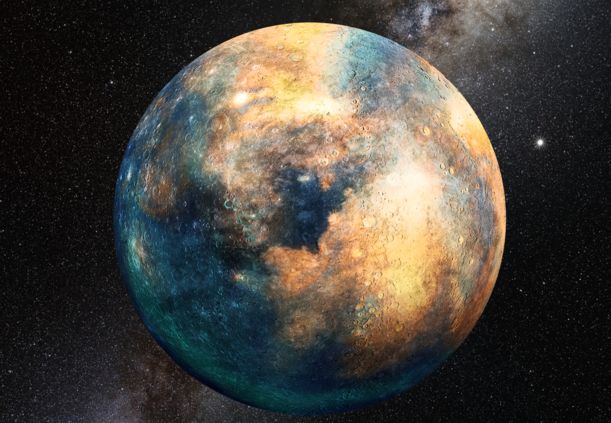
Planet X, if it exists,could equal Neptune in size, and orbits the Sun 200 times further away than Earth. Credit: Caltech / R. Hurt

Astronomers using the Gran Telescopio CANARIAS (GTC) in the Canary Islands looked at two distant asteroids, called Extreme Trans Neptunian Objects (ETNOs). Spectroscopic observations 2004 VN112 and 2013 RF98 suggest that the two were once a binary asteroid pairing that were pulled apart as a result of the influence of a mass massive body between 10 and 20 Earth masses in size and about 300 to 600 AU from the Sun. As a result of this, the two bodies drew further and further apart over, time they became more and more separated to become how we see them today.

“The similar spectral gradients observed for the pair 2004 VN112 – 2013 RF98 suggests a common physical origin,” said Julia de León, an astrophysicist at the Instituto de Astrofísica de Canarias (IAC). “We are proposing the possibility that they were previously a binary asteroid which became unbound during an encounter with a more massive object.”

de León and his team carried out thousands of computer-based simulations to see how this might have happened, and found the most consistent result suggested the bodies were separated as a result of a close passage by a massive planetary object around 5-10 million years ago.

As it might be: estimates concerning Planet Nine's possible size, mass, etc., should it exist. Credit: Space.com / Karl Tate
As it might be: estimates concerning Planet Nine’s possible size, mass, etc., should it exist. Credit: Space.com / Karl Tate

What is particularly interesting here is that the location of the two asteroids, coupled with the suggested mass of the body which pulled them apart and the distance it is believed to have been from the Sun, also fit the broader parameters for where the orbit of Planet 9 might reside, and the estimated mass of the planet. Thus, when combined with the eccentric orbits of several Kuiper Belt Objects believed to have been perturbed in their orbits around the Sun by planet 9, it gives further credence to the idea it really is out there, somewhere.

When – and if – it might eventually be found is open to question. However, it is hoped that a  recently started “citizen scientist project will encourage amateur astronomers around the world to join in the hunt for Planet 9.

Continue reading “Space Sunday: TRAPPIST-1, planet 9 and Europa”

Space Sunday: Jupiter, Enceladus and Ceres; SLS, SpaceX and Dream Chaser

This stunning enhanced colour images of Jupiter's south polar region was captured by the JunoCam instrument aboard the Juno spacecraft on February 2nd, 2017. It reveals a complex series of interactions occurring in the fast-spinning atmosphere
This stunning enhanced colour images of Jupiter’s south polar region was captured by the JunoCam instrument aboard the Juno spacecraft on February 2nd, 2017. It reveals a complex series of interactions occurring in the fast-spinning atmosphere. Credit: NASA/JPL / SwRI

Following its latest close flyby of Jupiter – passing just 4,200 km (2,600 mi) above the gas giant’s cloud tops on February 2nd, 2017, NASA’s Juno mission spacecraft is now heading away from the planet once more and the next of its 53.5 day orbits. As I’ve previously reported in these Space Sunday columns, the original plan had been to use one of these close passes over the planet (October 2016), in conjunction with a sustained burn of the spacecraft’s British-built rocket motor, to move it into a short, 14-day period orbit around Jupiter.

However, a potential fault detected within the engine system meant the October burn was cancelled, and since then, engineers had been trying to assess if the issue  – a set of faulty valves – could be overcome, and the consequences of attempting an additional engine burn if not. No definitive answer has been found and so, following the February 2nd flyby, the decision was taken to cancel all plans for the engine burn and leave the spacecraft in its current 53.5 day orbit around Jupiter.

Doing so doesn’t compromise the overall mission objectives, but it does reduce the number of close passes over Jupiter the vehicle can make. If the reduced orbital period had been possible, the spacecraft would have made some 30 close flybys over Jupiter’s cloud tops during the primary mission period, set to end in July 2018. Remaining in the 53.5 day orbit means it will only make around 12 such close flybys in the same period.

The Juno spacecraft was supposed to complete two 53-day orbits around Jupiter, then lower its orbit Oct. 19 to fly around the planet once every 14 days. That engine burn has been postponed. Credit: NASA / JPL
The Juno spacecraft was supposed to complete two 53.5-day orbits around Jupiter in July and August 2016 (shown in green), before using its main engine to brake itself into a 14-primary science orbit (shown in blue). Due to continued concerns about the vehicle’s engine unit, the decisions has now been made to leave it in the 53.5 day orbit. Credit: NASA / JPL

A positive point with the spacecraft remaining in its more extended orbit is that it will spend less time within the harsher regions of Jupiter’s radiation belts, and could thus remain active for longer than the primary mission period – and mission planners are already considering applying for further funding to allow the mission to extend beyond July 2018. It also means that the spacecraft will be able to engage in additional science activities.

The close encounters with Jupiter have already allowed the spacecraft to probe deep within the planet’s cloud belts and discover they extend far deeper into the planet’s atmosphere than had been imagined, and that Jupiter’s magnetic field and auroras are more powerful than previously thought.

“Juno is providing spectacular results, and we are rewriting our ideas of how giant planets work,” Juno principal investigator Scott Bolton, of the South-west Research Institute in San Antonio, Texas, said of the decision to leave the spacecraft in its current orbit. “The science will be just as spectacular as with our original plan.”

NASA Considering Crewed Option for Orion / SLS First Launch

NASA is considering making the first launch of its new Space Launch System (SLS) rocket, currently slated for September 2018, a crewed mission.

Under the agency’s existing plans, the first launch of the new rocket, topped by an Orion Multi-Purpose Crew Vehicle and dubbed Exploration Mission 1 (EM-1), would have seen SLS send an uncrewed Orion vehicle to the Moon and back, with around 6 days spent in lunar orbit. A crewed flight of the SLS / Orion combination would not take place until at least 2021, when crew would use Orion to rendezvous to a small asteroid previously captured via robotic means and moved to an extended orbit around the Moon – an idea which has garnered a certain amount of criticism from politicians.

An artist's impression of a Space Launch System / Orion combination lifting off from Kennedy Space Centre's Pad 39B. Credit: NASA
An artist’s impression of a Space Launch System / Orion combination lifting off from Kennedy Space Centre’s Pad 39B. Credit: NASA

If approved, the new proposal – put forward by NASA’s Acting Administrator, Robert Lightfoot – would see the planned EM-1 mission pushed back to 2019 (allowing the Orion vehicle to be outfitted with the crew lift support and flight systems) and flown with a crew of two. While this would mean a delay in the initial launch of SLS / Orion, it could ultimately accelerate NASA’s plans, allowing the agency to present a wider choice of crewed missions in the 2020s, and respond to criticism that it is not doing enough to demonstrate how it plans to achieve a return to the Moon and / or  missions to Mars.

Enceladus: Cradle for Life?

On February 17th, 2005 NASA’s Cassini space probe, part of the Cassini / Huygens mission, made its first flyby of Saturn’s moon Enceladus.

Scientists were naturally curious about the 500 km (360 mi) diameter moon, which is the most reflective object in the solar system, but assumed it was essentially a dead, airless world. However, Cassini immediately found this was not the case.

A dramatic plume sprays water ice and vapor from the south polar region of Saturn's moon Enceladus. Cassini's first hint of this plume came during the spacecraft's first close flyby of the icy moon on February 17, 2005. Credit: NASA/JPL / Space Science Institute
A dramatic plume sprays water ice and vapour from the south polar region of Saturn’s moon Enceladus. Cassini’s first hint of this plume came during the spacecraft’s first close flyby of the icy moon on February 17, 2005. Credit: NASA/JPL / Space Science Institute

The first thing that happened was the magnetometer on the spacecraft revealed that Saturn’s magnetic field, which envelops Enceladus, was perturbed above the moon’s south pole in a way that didn’t make sense for an inactive world – it was as if there was some interaction with an atmosphere.

In the second flyby, a month later, Cassini found the interaction seemed to suggest a plume of water vapour was rising from the moon. Then, in the third flyby, in July 2005, the probe imaged geysers of water vapour erupting from the moon’s south polar region, and thus Enceladus became the target of intense study. So much so, that while only those initial 3 flybys of the moon had been a part of the primary Cassini /Huygens mission profile, the mission was updated to allow 20 more flyby of the moon.

Today, we know that beneath the mantle of ice enclosing Enceladus there is an ocean of liquid water – the geysers are the results of that water breaking through this ice and jetting into space, giving rise to Saturn’s E-ring in the process. This ocean is likely to be warmed and kept liquid by hydrothermal vents on the sea floor, and these in turn – just like the vents theorised to be on the ocean floor of Jupiter’s Europa – might provide all the ingredients for basic life to arise.

To celebrate the 12th anniversary of Cassini’s discoveries with Enceladus, NASA has released a video documenting those initial findings from 2005.

Continue reading “Space Sunday: Jupiter, Enceladus and Ceres; SLS, SpaceX and Dream Chaser”

Space Sunday: Martian quandaries, universal epochs and Jovian journeys

"Yellowknife Bay" a region examined by the Curiosity Rover in 2012/13 indicated that a lake was once present in Gale Crater. However, the same rock has revealed that potentially, there was not sufficient carbon dioxide present in the atmosphere to help keep the water unfrozen
“Yellowknife Bay” a region examined by the Curiosity Rover in 2013 indicated that a lake was once present in Gale Crater. However, the same rock has revealed that potentially, there was not sufficient carbon dioxide present in the atmosphere to help keep the water unfrozen. Credit: NASA

Mars scientists are wrestling with a problem. Ample evidence says ancient Mars was sometimes wet, with water flowing and pooling on the planet’s surface. Yet, the ancient sun was about one-third less warm and climate modellers struggle to produce scenarios that get the surface of Mars warm enough for keeping water unfrozen.

A leading theory is that ancient Mars had a thicker carbon-dioxide atmosphere forming a greenhouse-gas blanket, helping to warm the surface. However an analysis of data from NASA’s Mars rover Curiosity, suggests that even 3.5 billion years ago there was too little carbon dioxide present in the Martian atmosphere to provide enough greenhouse-effect warming to prevent water freezing.

The source of these findings is the very same bedrock in which the rover found sediments from an ancient lake in which microbes might have thrived. When analysing the bedrock, Curiosity detected no carbonate minerals, leading to the conclusion that Mars’ atmosphere was almost devoid of carbon dioxide when the lake existed 3.5 billion years ago. And that’s a quandary for scientists.

Curiosity took this selfie while at "Yellowknife Bay" in 2013 whilst gathering rock samples for analysis. Note that while the shadow of the rover's robot arm can be assn, the arm itself is blanked from the images purely as a result of the angles used in individual shots and the way the images have been stitched together to provide a view of the rover
Curiosity took this selfie while at “Yellowknife Bay” in 2013 whilst gathering rock samples for analysis. Note that while the shadow of the rover’s robot arm can be seen, the arm itself is blanked from the images purely as a result of the angles used in individual shots and the way the images have been stitched together to provide a view of the rover. Credit: NASA

“We’ve been particularly struck with the absence of carbonate minerals in sedimentary rock the rover has examined,” Thomas Bristow, the principal investigator for Curiosity’s Chemistry and Mineralogy (CheMin) instrument,  the primary source of the analysis work. “It would be really hard to get liquid water even if there were a hundred times more carbon dioxide in the atmosphere than what the mineral evidence in the rock tells us.”

In water, carbon dioxide combines with positively charged ions such as magnesium and ferrous iron to form carbonate minerals, and CheMin can identify carbonate if it makes up just a few percent of the rock. Yet Curiosity has made no definitive detection of carbonates in any lakebed rocks sampled since it landed in Gale Crater in 2012. However, other minerals – magnetite and clay minerals – not only indicated in the same rocks indicate the ions needed to form carbonates were readily available, they also provide evidence that subsequent conditions never became so acidic that carbonates would have dissolved away over time.

The dilemma between a warm, wet Mars and the lack of carbonates has actually been growing for years. For two decades researchers have been using spectrometers on Mars orbiters to search for carbonate that could have resulted from an early era of more abundant carbon dioxide in the atmosphere, only to find far less than anticipated. Yet clues such as isotope ratios in today’s Martian atmosphere continue to indicate the planet once held a much denser atmosphere than it does now, which has largely been seen as being rich in carbon dioxide. Thus, a paradox has arisen.

Curiosity uses a spectrometer on its robot arm to check a rock dubbed "John Klein" in "Yellowknife Bay" for its suitability as a drilling target, January 25th, 2013. The drill itself can be seen on the robot arm's "hand", pointing up and to the right
Curiosity uses a spectrometer on its robot arm to check a rock dubbed “John Klein” in “Yellowknife Bay” for its suitability as a drilling target, January 25th, 2013. The drill itself can be seen on the robot arm’s rotating “hand”, pointing up and to the right. Credit: NASA

It had been thought that the lack of evidence for carbonates when seen from orbit could simply be the result of  dust covering them, or the carbonates having moved underground. Finding them would thus resolve the paradox and reveal what had happened. However, the Curiosity results tend to overturn this idea. Simply put, the rover has failed to detect carbonate minerals precisely where they should be located, within rocks formed from sediments deposited under water.

“This analysis fits with many theoretical studies that the surface of Mars, even that long ago, was not warm enough for water to be liquid,” said Robert Haberle, a Mars-climate scientist at NASA Ames. “It’s really a puzzle to me.”

One idea put forward is that perhaps the lake was never a body of open water, but was covered in ice. The problem with this idea is none of the expected evidence for an ice-covered lake, such as large and deep cracks called ice wedges, or “dropstones,” which become embedded in soft lakebed sediments when they penetrate thinning ice, have been found. Thus, scientists have a lot of head scratching and theorising to do in order to make sense of the dilemma.

Traversing Mars with Curiosity

A simulated Curiosity rolls over the "Naukluft Plateau" in this still from Seán Doran's video simulation of the rover's traverse
A simulated Curiosity rolls over the “Naukluft Plateau” in this still from Seán Doran’s video simulation of the rover’s traverse. Credit: Seán Doran

Ever wondered what it would be like to witness Curiosity trundling across the surface of Mars? Seán Doran has. What’s more, he’s been putting together animated films using Digital Terrain Model (DTM) data from the HiRISE imaging system on NASA’s Mars Reconnaissance Orbiter together with photomosaics of images from the rover, and combining them with a drivable correctly scaled model of the rover to provide movies of Curiosity as it rolls across Mars.

Continue reading “Space Sunday: Martian quandaries, universal epochs and Jovian journeys”

Space Sunday: Juno and Jupiter, China, Google and the Moon

An artist's impression of Juno firing its main engine at it passes over Jupiter's cloud tops. Credit: NASA
An artist’s impression of Juno firing its main engine at it passes over Jupiter’s cloud tops. Credit: NASA

On Thursday, February 1st, 2017, NASA’s Juno spacecraft completed its fourth 53.5 day orbit of Jupiter since its arrival on July 4th, 2016. The vehicle, reached perijove – the point at which it is closest to Jupiter’s cloud tops at 12:57 GMT (07:57  EST), just 4,300 km (2,670 mi) above the cloud top at a velocity of about 208,000 km/h (129,300 mph) relative to the planet.

As there were no plans to utilise the craft’s main engine to slow the craft into a 14-day orbit around Jupiter – a issue with a potentially faulty set of valves in the motor system is still being investigated – the spacecraft was able to conduct a “close-up” data gathering exercise as it swept around Jupiter, gathering data on atmospheric radiation and plasma.

Also active during the flyover was the spacecraft’s imaging system, dubbed “JunoCam”. This has already captured some stunning images of Jupiter during past perijoves, and the hope is it will have done so again. Thanks to an outreach programme in which NASA invite “citizen scientists” to download raw JunoCam images and process them at their leisure, together with a programme that allows the public to suggest areas the camera might image during each perijove, JunoCam has become extremely popular.

A stunning view of the intricate boundaries between Jupiter's bands of cloud, as captured by JunoCam during the December close pass over the cloud tops in December. The white spot is one of the
A stunning view of the intricate boundaries between Jupiter’s bands of cloud, as captured by JunoCam during the December close pass over the cloud tops in December. The white spot is one of the “pearls” – thought to be a storm – which form bright “strings” in Jupiter’s southern hemisphere

The next close flyby will be on March 27th. It’s not clear yet whether this will be a science pass, or whether the Juno Mission team will risk firing the vehicle’s motor to slow it into the planned 14-day orbit. If they do, then the science suite will likely be powered down to conserve electrical power during the manoeuvre.

But even if Juno doesn’t achieve that final 14-day orbit, its science mission will not be unduly compromised. The craft will be able to meet all of its mission goals even if it remains in the 53.5-day polar orbit it currently occupies.

A major reason for Juno's polar orbit around Jupiter is that it allows the vehicle to pass
A major reason for Juno’s polar orbit around Jupiter is that it allows the vehicle to pass “between” the most powerful and intense radiation belts emanating from the planet. However, as the mission continues, the tilt of the spacecraft’s orbit relative to the planet means that over time, it will increasingly delve into these more intense radiation belts. Credit: NASA

The Jovian system is a place of intrigue. Not only is Jupiter a potential key to helping us understand the evolution of such gas giant planets, it sits at the centre of a gigantic magnetosphere so vast and powerful, it extends 5 million kilometres (3 million miles) towards the Sun, and reaches out as far as the orbit of Saturn – 651 million kilometres (407 million miles) – in the other direction.

All of Jupiter’s Galilean moons,  Callisto, Ganymede, Europa and Io, orbit within this magnetosphere, “bubble” and are affected by it. However, it is innermost Io which has the greatest interaction, and a proposal has been put forward to have Juno examine the relationship between Io and Jupiter in greater detail.

A false colour enhanced image of a volcanic plume above Io. Credit: NASA

With Jupiter on one side, and the other three big moons on the other, Io, roughly 320 km (200 mi) small in diameter than the Moon, is constantly being flexed by the opposing gravitational forces. This flexing physically manifests in the moon being the most volcanically active place in the solar system. At any given time, Io has an estimated 300 active volcanoes belching sulphur, sulphur dioxide gas and fragments of basaltic rock up into the space above itself to interact  with Jupiter’s magnetosphere.

As the material from the eruptions rise from Io, it is bombarded by high-energy electrons withing Jupiter’s magnetsphere.  These ionise the ejected material, forming a vast plasma torus of highly energised (aka radioactive) particles around the Jupiter and straddling Io’s orbit. In addition, Jupiter’s magnetic field also couples Io’s polar atmosphere to the planet’s polar regions, pumping this ionised material through two “pipelines” to the magnetic poles and generating a powerful electric current known as the Io flux tube, which can most visibly be seen (if you are close enough) as Jupiter’s polar aurora.

Continue reading “Space Sunday: Juno and Jupiter, China, Google and the Moon”

Space Sunday: remembrance and the future

Credit: NASA

The end of January / beginning of February is a time of pause and reflection for the American space programme and NASA. A span of five days, spread across a 36-year period, mark the three greatest tragedies of US human space flight, and so this period is always marked as a time of remembrance.

I’ve marked these three events – the Apollo 1 fire of January 27th, 1967, the Challenger disaster of January 28th, 1986 and the loss of the Columbia on February 1st, 2003 – in past Space Sunday updates. However, January 27th, 2017 marked the 50th anniversary of the Apollo 1 fire, which claimed the lives of Command Pilot Virgil I. “Gus” Grissom, Senior Pilot Edward H. White II, and Pilot Roger B. Chaffee in just 16 seconds. To mark it, and the start of NASA’s period of remembrance, the US space agency unveiled a new Apollo 1 tribute in its visitor complex at the Apollo/Saturn V Centre.

The Apollo 1 astronauts remembered at the Space Mirror Memorial, Kennedy SPace Centre's visitor centre
The Apollo 1 astronauts remembered at the Space Mirror Memorial, Kennedy Space Centre’s visitor centre. Credit: NASA

Grissom, White (the first American to walk in space during the Gemini 4 mission in 1965), and rookie Chaffee were participating in a “plugs out” test of the Apollo Command module intended to determine whether the vehicle was fit to fly at a time when many in NASA – Grissom included – felt it was not (Grissom had once famously hung a lemon in the Command Module simulator during training to signify his dissatisfaction with the state of the vehicle’s development).

It should have been a routine launch pad test of the vehicle the crew were due to fly in the first crewed test of Apollo in the run-up to a lunar landing. Instead, a spark from faulty wiring combusted the oxygen-rich atmosphere, causing a flash fire. This, aided by the many flammable materials used in the construction of the vehicle caused the air pressure inside the vehicle to rapidly rise, sealing the cabin’s inward opening hatch so that the crew could not open it themselves.

The deaths of these three men ultimately made Apollo – and the US space programme itself – far safer for those going into orbit. Flammable materials were all but eliminated from designs wherever possible; the atmosphere used within vehicles was altered so as not to be oxygen-rich, reducing the risk of fires rapidly building up and spreading; exit hatches were all changed so they would open outward, and the mechanisms for opening them either from within or without a vehicles were designed to be as simple and direct as possible.

To mark the 50th anniversary of the fire, NASA has placed the most significant part of the Apollo 1 vehicle – the hatch – on public display, with the full blessings of the surviving members of the astronaut’s families. It is a belated addition to similar exhibits of both the Challenger and Columbia accidents were placed on public display over 18 months ago in order to more fully commemorate those incidents.

All three disasters are commemorated at the Space Mirror Memorial  at the Kennedy Space Centre. However, while both Challenger and Columbia are also marked by memorials at America’s Arlington National Cemetery, no similar memorial currently exists for Apollo 1 (although Grissom and Caffee are interred there – White is interred at the West Point Cemetery). So, as a further mark of the 50th anniversary of the fire, Representative Eddie Bernice Johnson (D-Texas) has re-introduced a bill to Congress to have an Apollo 1 memorial established at Arlington.

The Challenger and Columbia memorials, Arlington National Cemetery
The Challenger and Columbia memorials, Arlington National Cemetery. Credit: Arlington National Cemetery

Apollo 1, Challenger and Columbia, together with a loss of life which occurred during the Soviet manned space programme, serve as a reminder to all of us that space exploration is still a dangerous undertaking, despite all of the “shit sleeve” images we see of people working aboard the International Space Station. But then, all acts of expanding the human frontier carry with them inherent risks and the potential for loss of life.

This doesn’t mean we should shirk such activities or retreat from them; the rewards are simply too great, not only in terms of our potential to learn and grow and ensure our continuance as a species, but also to out ability to mature as a species and reach beyond the petty nationalisms and narrow-minded thinking which plague so much of what happens in the world today.

Remembering; Apollo 1 (top): Virgil "Gus" Grissom, Edward H. White II, and Roger B. Chaffee; STS-51l (Challenger - left): Sharon Christa McAuliffe, Gregory Jarvis, Judith Resnik, Francis "Dick" Scobee, Ronald McNair, Michael J. Smith and Ellison Onizuka; STS-107 (Columbia, right): David M. Brown, Rick Husband, Lauren Blair Salton Clark, Kalpana Chawla, Michael Anderson, William McCool, and Ilan Ramon. All images credit: NASA
Remembering; Apollo 1 (top): Virgil “Gus” Grissom, Edward H. White II, and Roger B. Chaffee; STS-51l (Challenger – left): Sharon Christa McAuliffe, Gregory Jarvis, Judith Resnik, Francis “Dick” Scobee, Ronald McNair, Michael J. Smith and Ellison Onizuka; STS-107 (Columbia, right): David M. Brown, Rick Husband, Laurel Blair Salton Clark, Kalpana Chawla, Michael P. Anderson, William C. McCool, and Ilan Ramon. All images credit: NASA – click for full size

NASA’s official Day of Remembrance will be held on Tuesday, January 31st, 2017. With it comes the opportunity to not only look back to the sad events of January 27th, 2967, January 28th, 1986 and February 1st, 2003, but also to look forward to what might yet be achieved for all of human kind. Which is why I’m once again quoting Francis “Dick” Scobee, Commander of Challenger mission STS-51L, lost on that cold January morning in 1986.

Words: Francis Scobee via June Rodgers (formerly June Scobee). image: NASA

Continue reading “Space Sunday: remembrance and the future”

Space Sunday: the last man on the Moon

Eugene Andrew "Gene" Cernan, Commander, Apollo 17, in the Taurus-Littrow valley, December 1972
Eugene Andrew “Gene” Cernan, Commander, Apollo 17, in the Taurus-Littrow valley, December 1972. Credit: Harrison Schmitt / NASA via Getty / AFP

Eugene Andrew “Gene” Cernan, Captain, United States Navy (retired) and former NASA astronaut, passed away on Monday, January 16th 2017 at the age of 82. The commander of Apollo 17, he was – and currently remains – the last man to walk on the surface of the Moon, in what was arguably the most significant of the Apollo lunar missions.

Born in Chicago, Illinois in March, 1934, he attended Purdue University, Indiana, where he gained a Bachelor of Science degree in Electrical Engineering in 1956. While at the university. he took a commission as an Ensign in the U.S. Naval Reserve Officers Training Corps. Following his graduation, he attended U.S. Naval Flight Training, qualifying as an attack pilot, and went on to log more than 4,000 flying hours in jet aircraft and completed over 200 aircraft carrier landings.

In 1963, Cernan completed his education under the auspices of the US Navy, obtaining a Master of Science degree in Aeronautical Engineering from the  U.S. Naval Postgraduate School. Later that same year, he was selected by NASA as a part of their third intake of Astronaut Candidates, and participated in both the Gemini and Apollo programmes.

His first flight into space, aboard Gemini 9A started with a tragedy. The original Gemini 9 flight had been scheduled for Elliot See and Charlie Bassett. However, when they were unfortunately killed when their NASA aircraft crashed at the end of February 1966, the mission was re-rostered as Gemini 9A, and Cernan and his flight partner, Thomas Stafford, were promoted from back-up to prime crew.

Gemini 9A was to prove a mission plagued with misfortune. The first attempt to launch the mission, in May 1966 had to be scrubbed when the uncrewed Agena Target Vehicle Gemini 9A would rendezvous and dock with once in orbit  was lost not long after launch. This required a delay while a second Agena was prepared for flight, being launched on June 1st, 1966. However, once in orbit, telemetry from the vehicle suggested a launch shroud had not been correctly jettisoned.

On approaching the Agena following their launch on June 3rd, Stafford and Cernan confirmed the sections of the shroud, although open, had failed to detach, leaving the vehicle looking – in Stafford’s words – “Like an angry alligator out here rotating around”. He and Cernan indicated they were willing to carefully approach the Agena and try to nudge the shroud elements clear of the docking adapter, but mission control nixed the idea, fearing the Gemini vehicle might be damaged in the process. Instead, the crew rehearsed docking runs with the target vehicle and tested rendezvous abort procedures.

The "angry alligator" of the Agena target vehicle with launch shroud elements still attached, as seen from Gemini 9A on June 3rd, 1996. The nose of the Gemini vehicle can be seen at the top of the image, and the craft were some 20.3 metres (66ft) apart
The “angry alligator” of the Agena target vehicle with launch shroud elements still attached, as seen from Gemini 9A on June 3rd, 1996. The nose of the Gemini vehicle can be seen at the top of the image, and the craft were some 20.3 metres (66ft) apart. Credit: NASA

On the third day of the flight, Cernan became the third man (and America’s second) to walk in space. However, this part of the mission also proved troublesome. The Gemini spacesuits were not water-cooled, and had to be “inflated” prior to egressing the vehicle. Cernan found the latter made the suit almost completely inflexible and a serious impediment to his movement. This meant he had to exert himself a lot more, and because the suit had no proper cooling, he face the genuine risk of suffering heat prostration.

Nor was this all; the build-up of heat meant his helmet faceplate fogged to the point where he could barely see, and there were serious concerns about him getting back into the Gemini. His EVA was  curtailed without all goals being met, and after 128 minutes in space, Cernan eventually made it back inside the spacecraft. As a result of this experience, the Apollo spacesuits were redesigned to incorporate an undergarment using a water circulation system to cool the wearer – and approach still used in modern space suits.

Cernan next flew in space in May 1969 as part of the final Apollo dress-rehearsal mission for an actual landing on the Moon. Apollo 10, which saw Cernan and Stafford again fly together, and joined by John Young, became the second crewed mission to orbit the Moon (the first being Apollo 8, in December 1968), and the fourth crewed flight of Apollo overall. The focus of the mission was for Stafford and Cernan to pilot the Lunar Module to just 15.6 km (8.4 mi) above the lunar surface, gathering critical data which would allow the powered descent systems aboard future Lunar Modules to be correctly calibrated for their missions.

Gene Cernan in 1969, ahead of the Apollo 10 flight during a NASA press conference. A Snoopy toy sits next to him, indicative of the Apollo 10 lunar module call sign
Gene Cernan in 1969, ahead of the Apollo 10 flight during a NASA press conference. A Snoopy toy sits next to him, indicative of the Apollo 10 Lunar Module’s call sign. The Command Module was called Charlie Brown. Credit: NASA

In most respects, the Apollo 10 Lunar Module was fully capable of flying a mission to the surface of the Moon – it just lacked sufficient propellent in its ascent engine fuel tanks to make a successful flight back to rendezvous with the Command Module.  This later prompted Cernan to joke, “A lot of people thought about the kind of people we were: ‘Don’t give those guys an opportunity to land, ’cause they might!’ So the ascent module, the part we lifted off the lunar surface with, was short-fuelled. The fuel tanks weren’t full. So had we literally tried to land on the Moon, we couldn’t have gotten off.”

Apollo 10 reached lunar orbit on May 21st, 1969, three days after launch, and remained there for a further three days, completing the Lunar Module tests in the process, before returning to Earth. It was a mission which set both records and firsts. It was the first (and only) Apollo Saturn V mission to launch from Pad 39B at Kennedy Space Centre; it was the first (of only two, the other being Apollo 11) Apollo missions to comprise veterans of previous missions into space.

Continue reading “Space Sunday: the last man on the Moon”