Space Sunday: Cassini’s Grand Finale begins; Voyager’s Grand Tour remembered

An artist’s impression of NASA’s Cassini passing Titan, Saturn’s largest moon. Credit: NASA

NASA’s Cassini spacecraft performed what is effectively its last close flyby of Titan, Saturn’s largest moon on Saturday, April 22nd, 2017, marking a final opportunity for the mission to make up-close observations of the lakes and seas of liquid hydrocarbons that spread across the moon’s northern polar region and for the probe to use its radar imager pierce the haze enveloping the moon and map its surface. The next time the spacecraft passes Titan, it will be on its way to its destruction.

It is twenty years since the mission was launched from Earth, a combined NASA / ESA attempt to explore Saturnian system and probe the mysteries of Titan. It took seven years for the vehicle, carrying the European Huygens Titan Lander to is own rendezvous with the surface of Titan. Over the last thirteen years, the Cassini vehicle, roughly the size of a small truck and massing (at launch), 5 tonnes, has revolutionised our understanding of Titan and the potentially habitable moon of Enceladus.

July 22nd, 1997, the Cassini probe, with the Huygen’s lander attached (left side, in the gold aeroshell), is hoisted aloft in the spacecraft’s assembly clean room at NASA’s Jet Propulsion Laboratory, California, ready to be mated to is launch vehicle adapter (seen under it). Credit: NASA/JPL

However, all good things must eventually come to an end. The Cassini vehicle now has limited manoeuvring fuel left in its tanks, and while its three plutonium radioisotope thermoelectric generators (RTGs) are still capable of producing around 600 watts of electrical power, a decision was made some time ago to ensure the probe ended its mission before its tanks were dry and it was left to tumble around Saturn, where it might one day collide with one of the moons and contaminate it.

Instead, it was decided to direct the probe to into a series of orbits which would eventually see it enter the upper regions of Saturn’s atmosphere to burn up. This might seem an ignominious end for such a grand mission, but it is not without purpose.

This final plunge will not occur until September 15th, 2017, and the flyby of Titan – Cassini’s 127th –  was the first step in that final journey, turning as it did, Cassini’s path in towards Saturn as it loops around the planet from pole-to-pole. But before that fiery end comes, the vehicle will complete 22 more orbits of Saturn which will see it repeatedly  dive between the gas giant and its series of concentric rings, giving it an unprecedented science opportunity – a dive into the unknown.

“No spacecraft has ever gone through the unique region that we’ll attempt to boldly cross 22 times,” Thomas Zurbuchen, associate administrator for the Science Mission Directorate at NASA Headquarters in Washington said. “What we learn from Cassini’s daring final orbits will further our understanding of how giant planets, and planetary systems everywhere, form and evolve. This is truly discovery in action to the very end.”

“Based on our best models, we expect the gap to be clear of particles large enough to damage the spacecraft,” Earl Maize, Cassini project manager at JPL added. “But we’re also being cautious by using our large antenna as a shield on the first pass, as we determine whether it’s safe to expose the science instruments to that environment on future passes. Certainly there are some unknowns, but that’s one of the reasons we’re doing this kind of daring exploration at the end of the mission.”

In mid-September, Cassini will make a final, distant pass by Titan. Distant, but still close enough for the moon’s gravity to turn the craft into its rendezvous with Saturn’s cloud-tops. And when Cassini makes that final plunge on September 15th, it will send data from several instruments  until its signal is lost.

Ahead of the April 22nd Titan flyby, Cassini captured an image of Earth as seen through the ring of Saturn. Taken on April 13th, the probe was 1.4 billion kilometres (870 million miles) from Earth. when the image was taken.

April 13th, 2017: the “evening star” of Earth, as seen through Saturn’s rings by Cassini. Credit: NASA/JPL

Visible in the picture are, on the right, the A ring and the Keeler and Encke gaps, with the F ring over to the left. Earth is plainly visible in the gap between the rings. During this observation, Cassini was looking toward the backlit rings with the sun blocked by the disk of Saturn. The part of Earth facing toward Cassini at the time was the southern Atlantic Ocean.

Seen from Saturn, Earth and the other inner solar system planets always appear close to the sun much like Venus and Mercury do from Earth. All orbit interior to Saturn; even at maximum elongation, they never get far from the Sun. Early this month, as viewed from Saturn, Earth was near maximum elongation east of the sun, thus an “evening star,” making it an ideal time to take a picture.

A cropped and rotated version of the Cassini image, showing the Earth and, a short distance away, below and to the left of Earth, the Moon. Credit: NASA/JPL

Continue reading “Space Sunday: Cassini’s Grand Finale begins; Voyager’s Grand Tour remembered”

Space Sunday: hydrogen, imaging a black hole, and exoplanet hunting

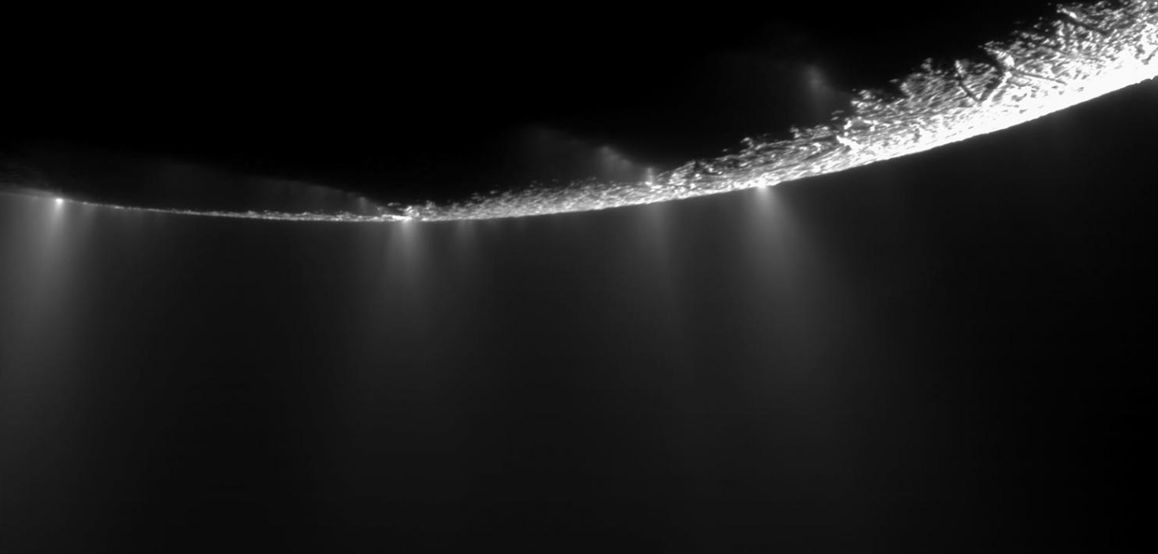
A dramatic plume sprays water ice and vapor from the south polar region of Saturn’s moon Enceladus. Cassini’s first hint of this plume came during the spacecraft’s first close flyby of the icy moon on February 17, 2005. Credit: NASA/JPL / Space Science Institute

I’ve written a lot of late about Saturn’s icy moon, Enceladus. Covered by an icy crust, there is a good chance this distant moon harbours a liquid water ocean beneath that ice. NASA’s Cassini mission has imaged geyser plumes erupting through the ice, and the speculation is that if Enceladus does have an ocean beneath its crust.  Now that speculation has been given a sizeable boost.

As a result of a long-term study, on April 13th, 2017 NASA announced the icy plumes of Enceladus contain hydrogen. This is a huge finding; not only does this main the plumes are water vapour, it directly points to a geo-chemical / geo-thermal interaction taking place deep within Enceladus between warm water and rocks which could provide an energy source of microbes.

Current thinking is that life requires three things to get started:  water, energy, and the right chemicals. As we know from Earth’s deep oceans, sunlight doesn’t actually enter into the equation; hydrothermal vents provide the energy to support – albeit on a fragile basis – an entire ecosystem from bacteria at the base of the food chain, through tube worms, shrimp, crabs and more. This could well be the case with Enceladus.

As the hydrogen is vented, it is possible that any microbes present in the water of Enceladus could use hydrogen and dissolved carbon dioxide in the water to produce methane in a process called biomethanation (or methanogenesis), one of the foundation processes of life on Earth.

The hydrogen was measured using Cassini’s Ion and Neutral Mass Spectrometer (INMS) instrument. Designed to sample the upper atmosphere of Saturn’s moon Titan, INMS was turned towards Enceladus to follow-up on several discoveries of plumes emanating from the moon’s southern regions dating back as far as 2005.

“This is the closest we’ve come, so far, to identifying a place with some of the ingredients needed for a habitable environment,” Thomas Zurbuchen, associate administrator for NASA’s Science Mission Directorate stated in reference to the report.

Linda Spilker, Cassini project scientist at NASA’s Jet Propulsion Laboratory added,  “Confirmation that the chemical energy for life exists within the ocean of a small moon of Saturn is an important milestone in our search for habitable worlds beyond Earth.”

NASA’s Orion / SLS Ambitions Face Delays

In February I wrote about NASA possibly re-scheduling the first flights of their new Space Launch  (SLS) rocket system so that the maiden flight could include a crew aboard the Orion Multiple-Purpose Crew Vehicle due to fly as a part of the mission, rather than flying it as an uncrewed mission, and then flying a crew on a second later mission.

Such a move would mean the initial flight of SLS, referred to as Exploration Mission 1 (EM-1), would need to be put back from 2018 to 2019 (at the earliest), to allow time for the Orion vehicle to be correctly outfitted and tested for a crewed mission. However, a new report from NASA indicates that Orion itself may not be ready in time to meet and EM-1 launch in either 2018 or 2019.

The Orion MPCV with its European Service Module (the section with the four solar panels), attached to a propulsion stage in Earth orbit. The Service Module is one part of the system facing delays, according to a NASA report. Credit: NASA

The report, published on April 14th, 2017, highlights three significant areas of concern for the programme. The first is that design changes made to Orion’s heat shield now raise technical risks which need to be eliminated. The second is that the Service Module for Orion, which is being developed by the European Space Agency, is facing delays. The third – which is particularly underlined in the report, is that critical software required by both the SLS / SLS systems and need for ground systems at the Kennedy Space Centre in Florida, will not be ready in time.

As a result of the report, NASA is now weighing pushing back the SLS / Orion launch schedule. Nor do the programme’s woes end there; the report also questions NASA’s ability to achieve its longer-term goals with regards to SLS, Orion and Mars, citing the fact that there is no clear roadmap for developing systems (such as a deep-space habitat module, lander / ascent vehicles, etc.) vital for Mars missions.

Without such a roadmap being put in place within the next few years, the report indicates it will be impossible to tell if planned Orion / SLS project expenditure – which is slated to rise to US $23 billion in 2018 and to US $33 billion (including Mars systems expenditure) by 2030 – will be sufficient for the space agency to meet its goals.

Continue reading “Space Sunday: hydrogen, imaging a black hole, and exoplanet hunting”

Space Sunday: of atmospheres, reusable rockets and Trojans

Artist’s concept showing what each of the TRAPPIST-1 planets may look like, based on available data about their sizes, masses and orbital distances. Credit: NASA

Back in February 2017, I covered the news about seven Earth-sized planets found in orbit around the super-cool red dwarf star TRAPPIST-1, roughly 40 light years away (see here and here for more).

While three of the planets lie within their parent star’s “habitable zone”, and so might have both an atmosphere and liquid water on their surfaces, I mentioned in both of those articles that the planets may still not be particularly habitable for life for a number of reasons, one of which is TRAPPIST-1 itself. As I noted in a previous article:

The nature of their parent star, a super cool red dwarf with all internal action entirely convective in nature, means that all seven planets are likely subject to sufficient irradiation in the X-ray and extreme ultraviolet wavelengths to significantly alter their atmospheres, potentially rendering them unsuitable for life.

A new study of TRAPPIST-1 now appears to show that it is a particularly active and violent little star.

Utilising data gathered on it by the Kepler Space Telescope, a team at the Konkoly Observatory, Hungary, lead by astronomer Krisztián Vida, have identified 42 strong solar flares occurring with TRAPPIST-1 over a period of just 80 days. Five of these events were multi-peaked, and the average time between flares was only 28 hours.

The most violent of the outbursts correlated to the most powerful flare observed on our Sun: the Carrington Event of 1859.

This was an enormously powerful solar storm, in which a coronal mass ejection struck Earth’s magnetosphere, causing auroras as far south as the Caribbean, and which resulted in chaos in telegraph systems around the world, with some operators receiving electric shocks through their handsets and telegraph pylons throwing sparks. Such was the power of the event, telegraph messages could be sent and received even with the power supplies to telegraphic equipment turned off.

The TRAPPIST-1 planets are far closer to their parent than the Earth is to the Sun, so events on an equivalent scale to the Carrington Event would hit the seven planets with a force hundreds or even thousands of times greater than Earth experienced in 1859. This, coupled with the general frequency of TRAPPIST-1 flares would most likely destroy any stability in a planet’s  atmosphere, making it extremely difficult for life to develop. And that’s assuming any of the planets orbiting TRAPPIST-1 have atmospheres.

Repeated strikes from solar flares can, over time, strip away a planet’s atmosphere. Again, given the proximity of the TRAPPIST planets to their parent, and the frequency of the stellar outburst exhibited by the star, it would seem likely that rather than being unstable, any atmosphere which may have once formed around any one of the seven planets has long since been stripped away, leaving the as barren, exposed lumps of rock.

SpaceX Successfully Flies Refurnish Falcon 9 First Stage & Announces Falcon Heavy Hopes

In April 2016 SpaceX made the first successful recovery of the first stage of a Falcon 9 launch system. Used to lift the SpaceX Dragon CRS-8 resupply mission capsule from the launchpad up towards orbit and a rendezvous with the International Space Station (ISS), the first stage of the rocket successfully touched-down vertically on the autonomous spaceport drone ship Of Course I Still Love You, 300 km (190 mi) from the Florida coastline just nine minutes after lift-off. In doing so, it achieved a long-sought-after milestone for the SpaceX reusable launch system development programme.

The world’s first reflown rocket booster, a SpaceX Falcon 9 first stage, is towed back into Port Canaveral, serving the Kennedy Space Centre, just before sunrise on securely mounted on the autonomous landing barge Of Course I Still Love You, on which it landed less than 10 minutes after a successful launch on March 30th, 2017. Credit: Ken Kremer/Kenkremer.com

On March 30th, 2017 that booster made its second successful launch and recovery, boosting the SES-10 telecommunications satellite  on its way towards orbit, before completing a successful boost-back to Earth, where it again landed on the waiting  Of Course I Still Love You.

“This is a huge revolution in spaceflight,” billionaire SpaceX CEO and Chief Designer Elon Musk told reporters at the post launch briefing at the Kennedy Space Centre press site, barely an hour after lift-off.The ability to re-use booster in this way could dramatically cut the cost of launch operations, removing the need for a brand-new rocket to be built and then disposed of with each launch – and lowering the cost of operations will not only make SpaceX vastly more competitive on pricing compared to rivals, it is also key to the company’s longer-term goals such as human missions to Mars.

The first flight of the SpaceX Falcon Heavy, may see the company attempt to recover the three first stage boosters and the upper stage of the vehicle, marking it as fully reuseable

Following the re-launch and recovery of the “used” Falcon 9 booster, Musk provided further details on the upcoming launch of his new super-booster, the Falcon 9 Heavy.

This vehicle comprises 3 Falcon 9 First stages  – one acting as the “core” to the rocket and two as “strap-on” boosters. It’s long been known that SpaceX plans to recover all three boosters following each Falcon Heavy launch. However, given the complexities involved in the first flight of a launch system, it hadn’t been entirely clear if attempts would be made to recover the boosters when Falcon Heavy flies for the first time in summer 2017.

But speaking at the SES-10 post-launch press conference, Musk confirmed that SpaceX would indeed try to recover all three boosters used be the vehicle, two of which will be refurbished Falcon 9s used on previous missions.

Landing three boosters requires considerable planning: SpaceX only has two landing options at Florida right now: the drone ship Of Course I Still Love You (the other, Just Read The Instructions, is currently based in California to support SpaceX operations out of Vandenberg Air Force Base), and their landing facility at Cape Canaveral Air Force Station. Thus, the launch will involve some aerial ballet, as Musk explained:

It will be exciting mission, one way or another. Hopefully in a good direction. The two side boosters will come back and do sort of a synchronized aerial ballet and land … That’ll be pretty exciting to see two come in simultaneously, and the centre core will land downrange on the drone ship.

A few days after this, he upped the ante further, announcing the flight will also attempt something never tried before – the recovery of the rocket’s upper stage as well. If successful – although even Musk believes the odds of recovering the upper stage on the first attempt to do so are slim – it will signal that his  dream of a fully reusable launch vehicle: first stage, payload fairings, and second stage, has come to fruition.

Continue reading “Space Sunday: of atmospheres, reusable rockets and Trojans”

Space Sunday: 100+ planets, taking a balloon to orbit, and budgets

A chart showing the to-scale sizes of two planets, 19 moons, 2 asteroids, and 87 trans-Neptunian objects, all of which could technically be considered planets orbiting our Sun. Credit: Emily Lakdawalla. Data from NASA / JPL, JHUAPL/SwRI, SSI, and UCLA / MPS / DLR / IDA, processed by Gordan Ugarkovic, Ted Stryk, Bjorn Jonsson, Roman Tkachenko, and Emily Lakdawalla

When is a planet not a planet – or more precisely, when should what is not regarded as a planet be a planet?

Right now, according to the International Astronomical Union (IAU), our solar system comprises eight formally recognised planets: Mercury, Venus, Earth, Mars, Jupiter, Saturn, Uranus and Neptune. That’s been the case since 2006, when the IAU opted to classify bodies orbiting the Sun in three ways:

  • As planets – defined as a) celestial bodies that (a) are in orbit around the sun; b) have  sufficient mass for their self-gravity to overcome rigid body forces so they assume a hydrostatic equilibrium (nearly round) shape; c) have cleared the neighbourhood around their orbit of other objects
  • As Dwarf planets – defined as celestial bodies which a) orbit the sun; b) have sufficient mass for their self-gravity to overcome rigid body forces to assume hydrostatic equilibrium (aka “is nearly round” in shape);  c) have not cleared the neighbourhood around their orbit; and d) is not a natural satellite
  • As Small Solar System bodies:  all other objects except satellites orbiting the Sun.
A composite image showing Pluto and Charon to scale to one another (but not at a scale separate from one another) using images returned by the New Horizons mission. Credit: NASA / John Hopkins University APL / SwRI

Thus, since 2006, Pluto has been a dwarf planet. However, moves are afoot to get things changed – and not just for Pluto.

In a paper authored by planetary scientists involved in the New Horizons mission which zipped through the Pluto system in July 2015, there is a call for the term “planet” to be redefined; if not by the IAU then at least in popular use. Should it happen, it could see the number of planets in the solar system leap from 8 to over 100.

The scientists argue that the IAU definition of “planet” focuses only on the intrinsic qualities of the body itself, rather than external factors such as its orbit or other objects around it. In fact, under the IAU’s definition, Earth, Mars, Jupiter and Neptune don’t actually qualify as “planets” as none meet the third criteria (c) – Earth, for example, has regular “close encounters” with asteroids which cross its orbit. Instead, the team offer a simpler definition:

A planet is a sub-stellar mass body that has never undergone nuclear fusion and that has enough gravitation to be round due to hydrostatic equilibrium regardless of its orbital parameters.

Such a definition would mean that Pluto could regain its planetary status – as would the proto-planet (or small solar system body) Ceres, the dwarf planets of 136199 Eris (discovered in 2005, and the trigger-point for Pluto’s “downgrading”) , 136472 Makemake, and 136108 Haumea, together with (possibly) 50000 Quaoar, 90377 Sedna, 90482 Orcus and a host of trans-Neptunian objects tumbling around the Sun. Nor is that all; the new definition would also mean that the likes of  Jupiter’s Galilean moons, Saturn’s Titan and  Enceladus, Neptune’s Triton and many other bodies we regard as “moons” would be lifted to planetary status – including our own Moon.

A composite image using data gathered by the radar imager aboard NASA’s Cassini mission to Saturn to look through the normally opaque haze of Titan’s dense atmosphere to reveal its planet-like surface. Credit: NASA/JPL / University of Arizona

The paper proposing the change will be presented at the Lunar and Planetary Science Conference on March 20th to 24th, 2017 in Texas. And it has already come in for some criticism.

Mike Brown is the scientist largely behind Pluto’s demotion. Currently engaged in the search for the elusive “Planet Nine”, he (somewhat harshly) sees the efforts of the New Horizons team to get Pluto reclassified as being  about them wanting the prestige of having run a planetary mission, more than anything else.

However, there are valid reasons for seeking some kind of change, even if it is only informal. One is as basic as gaining more public interest in efforts to explore and understand the many environments found on planets and moons alike within our solar system.

“Every time I talk about this [the science and data gathered about Pluto by New Horizons] to the general public, the very next thing people say is ‘Pluto is not a planet any more’,” said Kirby Runyon, the lead author of the paper. “People’s interest in a body and exploring it seems tied to whether or not it has the name ‘planet’ labelled on it.”

How Pluto compares with other large Trans-Neptunian Objects, some of which also have their own moons. Earth and our moon can be seen at the bottom of the picture. Credit: Lexicon / Wikipedia, using NASA / Hubble Space Telescope data

There are scientific reasons for the definition to be broadened as well. Places like Pluto, Ceres, Europa, Io, Ganyemede, Callisto and Triton all evidence geophysical, hydrothermal, atmospheric and other characteristics very much in keeping with bodies such as Earth, Mars, and Venus. They are thus of exceptional interest to planetary scientists the world over. In fact, many of them (like Pluto) are completely re-writing our understanding of “planetary bodies”.

Ultimately, the team behind the paper aren’t going to put their proposal before the IAU for a change in the “official” definition of “planet”.  “As a geophysical definition, this does not fall under the domain of the IAU, Runyon notes, “[It]  is an alternate and parallel definition that can be used by different scientists. It is “official” without IAU approval, partly via usage.”

Continue reading “Space Sunday: 100+ planets, taking a balloon to orbit, and budgets”

Space Sunday: submarines, balloons and rockets

The four Galilean moons of Jupiter from volcanic Io (l) to distant Callisto (r). Europa and Ganymede (2nd and 3rd respectively) are thought to have liquid water oceans under their icy crusts, and each will be investigated by upcoming NASA (Europa) and European (Ganymede) missions. Callisto also may have a subsurface ocean, although it is thought to be more likely frozen or at least slushy ice. It will also be examined by the European mission

At the end of February / start of March 2017, NASA hosted the “Planetary Science Vision 2050 Workshop” at their headquarters in Washington, DC. The workshop covered a number of ideas for the future exploration of the solar system using automated means.

Two of the more interesting areas of discussion were the exploration of the “ocean worlds” of the solar system, notably Jupiter’s Europa and Saturn’s Enceladus. The other was options for exploring Saturn’s moon Titan.

The “Icy Worlds”

As I’ve recently reported Europa is already the target of the upcoming Europa Multi Flyby mission, due to launch in the early 2020, and which is now known once more by its earlier title of Europa Clipper. However, at the workshop, scientists looked at future options for exploring it,  starting with the lander mission already being planned as a follow-on mission.

What makes these icy worlds so interesting is that under their crusts of ice, there may well be oceans of liquid water. Europa and Enceladus in particular have demonstrated very strong signs that under a surface coating of ice, they have liquid water oceans, perhaps 100 km (62.5 mi) deep in the case of Europa.

Europa’s internal structure, showing the subsurface ocean which could be up to 100 km (62.5 mi) deep. This layer might also either be relatively solid ice or icy slush, depending on the amount of heat being generated deeper inside Europa

These oceans are kept in a liquid state due to gravitational flexing: they are constantly being pulled in different directions by the gravities of their parent planet and the other moons in orbit around it. The flexing generates heat, and this heat could be sufficient to keep the water trapped under the ice crust of such a world in a liquid state. It could also mean that the ocean bed of such a world might be the locations of hydrothermal vents and fumeroles which are pushing out the heat, energy, minerals and chemicals needed to kick-start life.

The reason Europa’s ocean might be liquid is flexing. The gravitational pull of Jupiter and from the other Galilean moons constantly plays on Europa, causing it to flex as it is pulled in different directions. This flexing generate heat deep inside the moon, and this heat could both radiate out to warm the waters of the ocean and give rise to hydrothermal vents of the sea bed, which could harbour basic life

Europa, Ganyemede and Callisto, around Jupiter show every indication of such sub-surface oceans, although Ganyemede’s and Callisto’s case, it might be more icy slush than liquid water. Both will be the subject of study by Europe’s Jupiter Icy Moons Explorer, due for launch in 2022.

Europa’s ocean is believed to be liquid both as a result of spectral analysis of the ice covering it, and because images of the moon captured by the Hubble Space Telescope appear to show huge geysers erupting from the moon’s south polar regions.

Geysers of water vapour have also been seen erupting from Enceladus by NASA’s Cassini mission, indicating it also has a liquid ocean under its covering of ice.

Worldlets like Ceres and Pluto also appear to have liquid interiors overlaying their cores, although the processes that might by allowing such liquid layers – likely water – have yet to be properly understood.

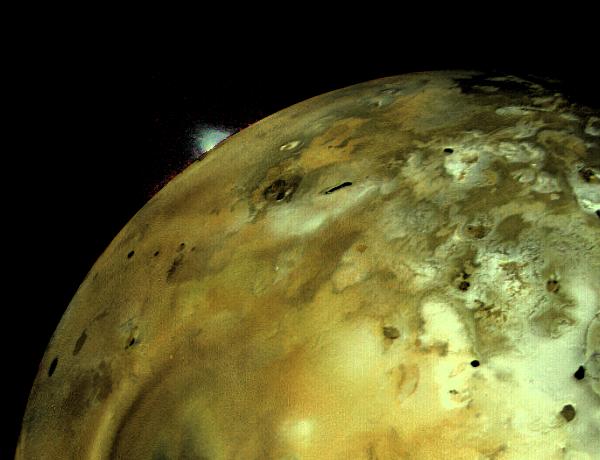
Of them all, Europa perhaps shows the strongest evidence for harbouring life-giving nutrients within its oceans, marking it as a prime candidate for study. This is because of the reddish-brown staining covering much of its surface. Most of this is likely debris from the huge volcanic eruptions which occur on Io, the innermost of the Galilean moons of Jupiter, and the one experiencing the greatest levels of gravitational flexing. However, some of Europa’s straining might be material deposited as a result of geyser action, particularly where the stains appear to run along many of the fault lines which crack Europa’s surface.

Given all this, planetary scientists are itching to get a vehicle onto the surface on Europa and – if possible, get one through the ice and into the ocean beneath it. Hence the discussions at the NASA workshop.

A dramatic line of plumes spray water ice and vapour from the south polar region of Saturn’s moon Enceladus as seen by the Cassini mission in February 2005. Similar venting of water may give rise to some of the brown stains of material covering much of Europa’s surface Credit: NASA/JPL / Space Science Institute

As I noted in writing about Europa Clipper (see the link above), a lander mission is already in the advanced planning stages thanks to strong support for missions to Europa in Congress. It could potentially take place just a couple of years after Europa Clipper arrives in orbit around Jupiter, and would have three mission objectives:

  • Search for biosignatures and signs of life by analysing the surface and subsurface deposits on Europa, particularly recently erupted material near the lander’s location
  • Analyse the composition of the surface ice and determine the proximity of liquid water beneath the ice
  • Attempt to identify the dynamic processes responsible for shaping Europa’s surface and its properties.
An artist’s impression of a possible Europa submersible, with it deployment system in the background. Credit: NASA

If the lander mission detects signs of life or strong evidence of life-giving materials within Europa’s ice sheet, then it will  likely pave the wave for the most ambitious mission of all: sending a vehicle to Europa with the means to penetrate the surface ice and release an automated submersible into the waters below to search for possible life.

While there is no time frame for such a mission, it has long been a goal for NASA and scientists. So much so that there have been numerous studies and even competitions for such vehicles, and a broad range of proposals and designs have been put forward. As such, it could be that such a mission could follow the Europa lander mission relatively quickly – perhaps within a decade.

Continue reading “Space Sunday: submarines, balloons and rockets”

Space Sunday: Moon flights and the winds of Mars

The Dragon 2 crew capsule attached to its service module. Credit: SpaceX

While most private space tourism companies are busily going about various routes to offer sub-orbital flights to those who can afford them, Elon Musk’s SpaceX has stepped into the arena – and, as might be expected, made the bold announcement it will go one better: fly paying passengers around the Moon and back. And they plan to do it in 2018.

The announcement was made by Musk on Monday, February 27th during a press teleconference. If the flight goes ahead, it will allow two fare-paying passengers the opportunity to undertake a week-long journey out to and around the Moon, before returning to Earth. The flight would use a “free return” profile which would see it skim over the surface of the Moon and continue outward beyond it, possibly as far as 480,000 Km (300,000 mi) from the Earth (the average distance of the Moon from Earth is around 384,400km /  240,000 mi), before Lunar gravity takes over and hauls the vehicle back towards the Earth, where it would splash down.

It’s not clear how much the passengers would pay to be on the flight – but the going price for a seat aboard the Dragon 2 vehicle, which would be used for the flight, will be around US $58 million a pop to get to the International Space Station, once it enters service. It’s also far from clear if SpaceX can actually deliver on the goal of launching the flight in late 2018.

SapceX plan to use the Falcon Heavy as the launch vehicle for the lunar flight. When it enters service later in 2017, the Falcon Heavy will be the most powerful launch vehicle in the world today
SpaceX plan to use the Falcon Heavy as the launch vehicle for the lunar flight. When it enters service later in 2017, the Falcon Heavy will be the most powerful launch vehicle in the world

In order to take place, the flight first and foremost needs a launch vehicle and a suitable space vehicle. SpaceX plan to use their mighty Falcon Heavy and – as noted – their new Dragon 2 crewed vehicle. There’s just a couple of problems with both.

The Falcon Heavy is not due to fly until some time later in 2017, and even then it will not be rated for crewed launches. For that to happen, it will have to be certified for crew use, and depending on how the initial flights go, that could take time. In terms of the Dragon 2, that is not scheduled to enter service until 2018 – and even then, its primary function is to fly crews to and from  the International Space Station (ISS).

Ferry flights to the ISS are vastly different to going out around the Moon and back. To start with, the outward flight from Earth to the ISS can be measured in just a couple of days – around a quarter of the time needed for the lunar trip.  The velocity (delta vee)  imparted to a spacecraft going to the ISS (28,000 km/h / 17,500 mph) is also a lot less than required to go to the Moon (40,000 km/h / 25,000 mph).

Elon Musk unveils a mock-up of the Dragon V2 capsule in May 2014. SpaceX now has their firs NASA contract to fly a crew to the ISS aboard the vehicle, probably in 2018
Elon Musk unveils a mock-up of the Dragon 2 capsule in May 2014.Credit: SpaceX

This means a returning Dragon 2 will be re-entering the Earth atmosphere a lot faster than the same craft coming back from the ISS, and will have to face much higher re-entry temperatures and a harsher deceleration regime. While the Dragon 2 can in theory do so, it is likely that significant testing on uncrewed vehicles will be required before the Federal Aviation Authority and NASA agree to any such flight taking place. On top of this, it will have to be demonstrated that the Dragon 2 can be outfitted for a deep space mission and keep a crew alive and well for around 7-8 days.

Given all this, there are widespread doubts the company can meet a 2018 deadline for such a mission – and SpaceX has tended to be ambitious with its time frames for achieve goals. They had originally slated 2013 as the year in which the Falcon Heavy would make its first flight – although in fairness, setbacks following the loss of two Falcon 9 vehicles also contributed to its launch being pushed back to 2017.

Red Dragon Delayed

As further evidence of SpaceX presenting time frames which are perhaps a little ambitious, on February 17th, the company announced its mission to land a variant of the Dragon 2 – dubbed Red Dragon – on Mars has been pushed back from 218 to 2020.

The aim of the mission so to fly an uncrewed 10-tonne Dragon 2 vehicle to Mars and land it safely. In doing so, the company hopes to gain valuable data on landing exceptionally heavy vehicles on Mars using purely propulsive means. This is because crewed landing vehicles on a Mars mission are liable to have a mass of at least 40 tonnes – far too much to be safely slowed in a descent through the thin Martian atmosphere by parachutes.

A SpaceX / NASA infographic outlining the Red Dragon mission - now slated for 2020
A SpaceX / NASA infographic outlining the Red Dragon mission – now slated for 2020

The planned mission would be undertaken entirely at the company’s own expense, although it would can science instruments and experiments supplied by NASA. For Musk it, and possibly three further Red Dragon mission which could follow it in the 2020-2024 time frame, is a vital precursor to greater ambitions for Mars.

As he outlined in September 2016 (see: Musk on Mars), Musk plans to start launching crewed missions to Mars, possibly before 2030. The initial missions will doubtless be modest in size in terms of crew and goals. However, his overall stated goal is to kick-start the colonisation of Mars. To do that, he plans to use vehicles massing at least 100 tonnes and which can make a propulsive landing on Mars. Whether he can succeed in even the step to land a crew on Mars  – and bring them back to Earth – remains to be seen. However, his Red Dragon mission is an important first step.

Continue reading “Space Sunday: Moon flights and the winds of Mars”