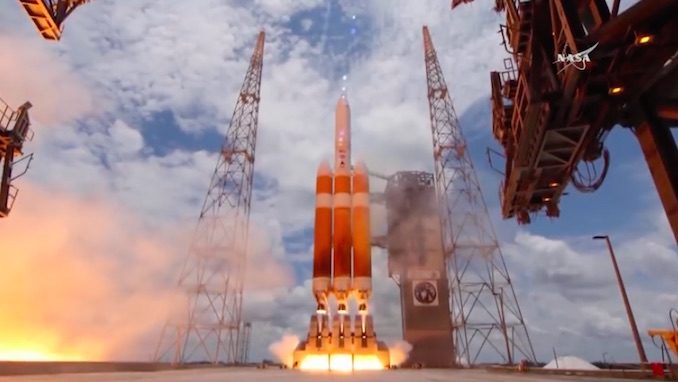
On the morning of Sunday, August 12th, 2018, NASA launched the Parker Solar mission, which it describes as being “to touch the face of the Sun”. It will be the first mission to fly through the Sun’s corona – the hazardous region of intense heat and solar radiation in the Sun’s atmosphere that is visible during an eclipse, and it will gather data that could help answer questions about solar physics that have puzzled scientists for decades. Over the course of its initial 7-years the Parker Solar Probe mission will allow us to better understand the fundamental processes going on in, on, and around the Sun, improving our understanding how our solar system’s star influences, affects and changes the space environment, through which we travel as the Earth orbits the Sun.
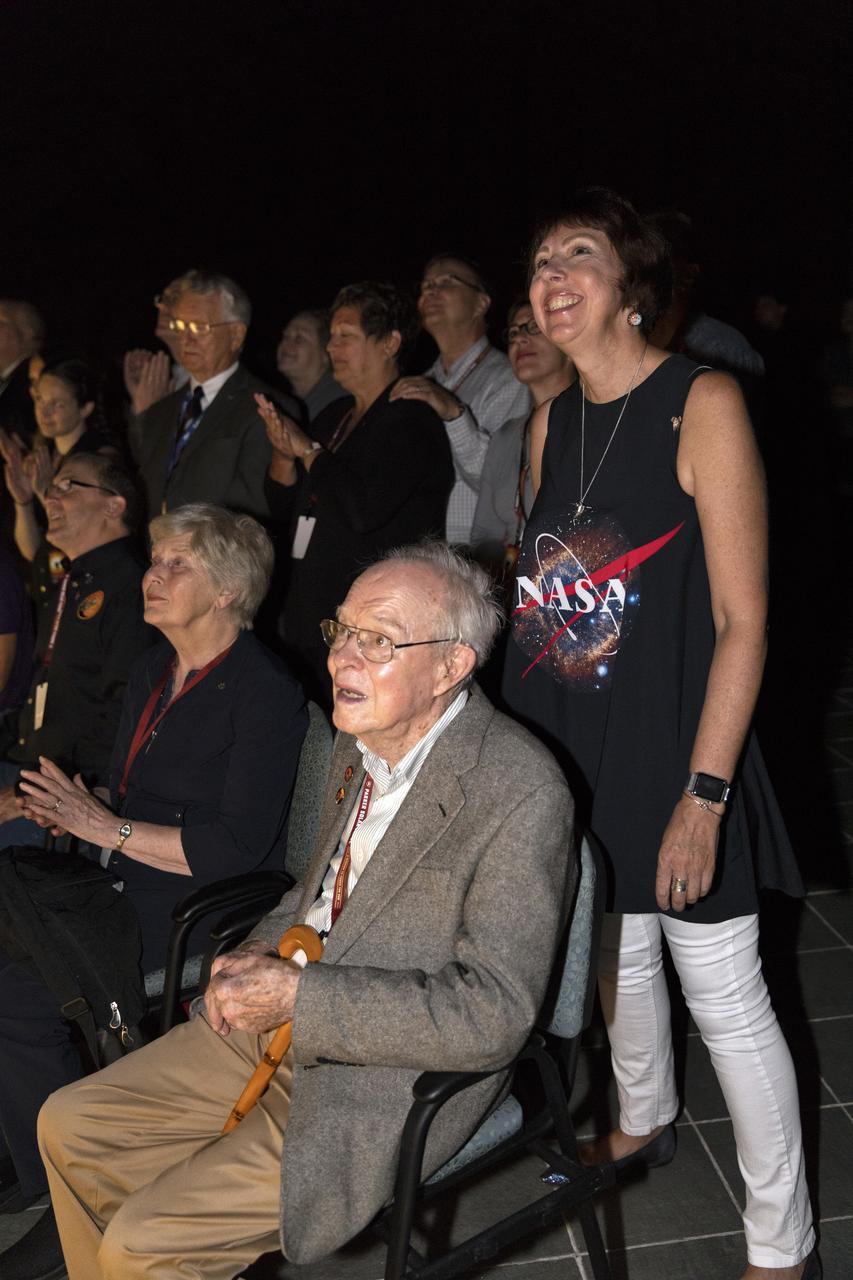
The probe and mission are named for Dr Eugene Parker, an American solar astrophysicist, who in 1958 first posited the theory of the supersonic solar wind, and who also predicted the Parker spiral shape of the solar magnetic field in the outer solar system. Now 91, he was present at NASA’s Kennedy Space Centre as a distinguished guest of the agency, to witness the probe’s launch, the mission (and vehicle) being the first in NASA’s history to be named after a still-living person.
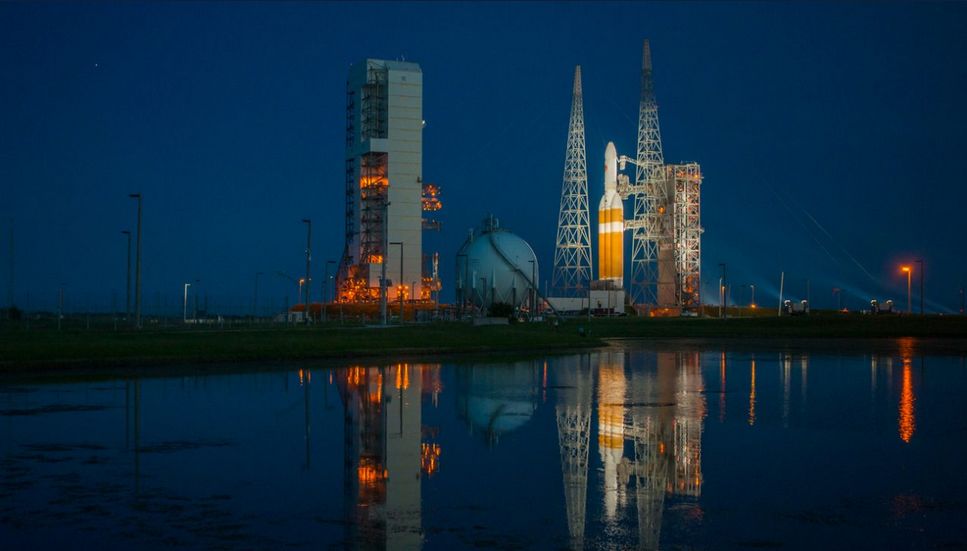
Lift-off came at 03:31 EDT (6:31 GMT / 7:31 BST) on Sunday, August 12th, after the initial launch attempt was scrubbed on Saturday, August 11th, when a troubled countdown was halted just one-minute, 55 seconds before the engines on the United Launch Alliance (ULA) Delta 4 Heavy rocket were to ignite. The halt was called following a gaseous helium red pressure alarm, and investigations into its cause extended beyond the 65-minute launch window, resulting in the launch scrub.
The Sunday morning launch countdown proceeded without any significant hitches, and the Delta 4 Heavy – the most powerful rocket in ULA’s fleet of launch vehicles, comprising 3 Delta 4 first stages strapped side-by-side, the outer two functioning as “strap-on boosters” – lit up the Florida coastline as it took to the early morning skies.
Although a flight to the Sun might sound an easier proposition than reaching the outer solar system, it actually isn’t; it actually requires 55 times more launch energy than a launch to Mars. Hence why the relative small and light Parker Solar Probe, weighing just 685 kg (1,510 lb) at launch, required the massive Delta 4 and a rarely-used Star 48BV variant of the Payload Assist Module (PAM).
Originally developed as the upper stage for Delta 2 launch vehicles in the 1965, the Star family of solid-fuel PAM units were commonly used with the space shuttle for satellite launches from orbit: the shuttle would carry them aloft, release the PAM / Satellite combination, then move to a safe distance before the PAM motor was ignited to push the satellite on to its require Earth orbit. For the Parker Solar Probe, the Star 48BV was used to impart as much velocity as possible into the vehicle at is starts on it journey.
What makes a flight to the Sun so hard is that the Earth is moving “sideways” relative to the Sun at about 107,000 km/h (67,000 mph), and the probe has to cancel out a whopping 84,800 km/h (53,000 mph) of that “sideways” motion as it makes its way to the Sun in order to achieve orbit. At the same time, the probe needs to gain velocity as it moves in towards the centre of the solar system in order for it to balance the Sun’s enormous gravitational influence and achieve the required elliptical orbit.
The use of the Delta 4 / Star 48BV combination got both of these requirements started, by pushing the probe towards Venus in an arc that will both start to shed the “sideways” velocity, whilst also accelerating the craft in towards the Sun. But it will be Venus that does the real grunt work for the mission.
On October 1st, 2018, the probe will make the first of a series of flybys of Venus, where it will use the Venusian gravity to shed still more of the angular velocity imparted by Earth’s orbit and increase its velocity towards the Sun.
In all, seven such fly-bys of Venus will occur over the 7 year primary mission for the probe, and while only the first is required to shunt the vehicle into its core heliocentric orbit, the remaining six play an important role in both maintaining the vehicle’s average velocity across the span of the mission and in gradually shrinking its elliptical orbit around the Sun as the mission progresses.
The first pass around the Sun – and the start of the science mission – will occur in November / December 2018. At perihelion, the vehicle will be just 6.2 million km (3.85 million mi) from the Sun’s photosphere (what we might call its “surface”). During this time, the vehicle will be well within the corona, and will also temporarily become the fastest human-made vehicle ever made, achieving a velocity of around 700,000 km/h (430,000 mph) – that’s 200 km per second (120 mi/s), or the equivalent of travelling between London and Tokyo in around 50 seconds! At aphelion – the point furthest from the Sun, and brushing Earth’s orbit, the craft will be travelling a lot slower.
The corona is a very hot place – hotter than the “surface” of the Sun, however, it is also comparatively thin as far as an “atmosphere” goes. The distance at which Parker Solar Probe will be travelling from the Sun at perihelion, combined with its speed, mean that the ambient heat of the corona isn’t a significant issue. Direct sunlight radiating out from the Sun, however, is a significant problem.
Continue reading “Space Sunday: to touch the face of the Sun”





 Inara Pey: Living in a Modemworld