Space Sunday special: Michael Collins

Michael Collins in his official NASA Apollo 11 photo. Credit: NASA

On Wednesday, April 28th, 2021. the news came that Michael Collins, the Command and Service Module pilot on Apollo 11 had passed away at the age of 90.

Collins was the unsung hero of Apollo 11. While Armstrong and Aldrin held the world’s attention, he quietly circled the Moon in the CSM on his own. A natural loner, he stated he never really felt lonely, and in the 48 minutes of each orbit when he was out of radio contact with the Earth as Columbia passed round the far side of the Moon, has was not afraid. Rather, he felt “awareness, anticipation, satisfaction, confidence, almost exultation”.

Born on October 31st, 1930 in Rome, Italy, Collins, was the second son and forth child of James Lawton Collins and Virginia Collins ( née Stewart). The Collins family was steeped in military service, a fact that helped shaped Michael’s life.

Rising to the rank of of major-general, his father served in the 8th Cavalry during the Philippine–American War, and also saw deployments in both World Wars; he was also an aide-de-camp to General of the Armies John Joseph (Black Jack” Pershing. His brother – Michael’s uncle – was General J. Lawton Collins, the Army Chief of Staff during the Korean War. Collins’ elder brother, James Lawton Collins Jr., also served in US Army in World War II and rose to the rank of brigadier general, and served as the U.S. Army Chief of Military History from 1970 to 1982.

Given his father’s career, Collins spent the first 17 years of his life following his father to his various US and overseas posting. During this time – and possibly fuelled by his father’s tale of flying on a Wright Brother’s biplane in 1911 – he jumped at the chance to take the controls of a US Army Air Corp Widgeon being flown by a family friend, awakening a nascent talent for flying.

Graduating from college in 1948 Collins briefly toyed with the idea of entering the US diplomatic service,  but opted to follow in the footsteps of his father and older brother, entering the United States Military Academy at West Point, sharing his class with future fellow astronaut Ed White. Graduating from West Point in 1952 with a BSc in military science, Collins had the choice of pursuing an Army or Air Force career and decided on the latter in part because of his love of flying and the rate at which aeronautics were developing, and in part because given the careers of his father, uncle and brother, he was worried about accusations of nepotism should he enter the Army.

Collins aboard Apollo 11. Credit: NASA

It  turned out that Collins was a “natural” pilot who easily took to flying jets. After training, he was selected for advanced day fighter training – a highly dangerous activity at the time, with 11 of his classmates killed during the 22 weeks of the training course. He also trained with fighter-bombers and gained qualifications in nuclear weapons delivery as well as maintaining his edge as a fighter pilot, winning first prize in a 1956 gunnery competition.

During the late 1950s, Collins was awarded command of a Mobile Training Detachment allowing him to accumulate over 1,500 hours flying time, which in turn gained him admittance to the USAF Experimental Flight Test Pilot School. From 1960 through 1962, he flew numerous jet aircraft – although the test pilot’s life of hard flying and occasional ’bouts of hard drinking in celebration / commiseration encouraged him to quit smoking, with a four-hour flight as co-pilot of a B52 Stratofortress bomber getting him through the initial stages of nicotine withdrawal.

In 1962, like millions of others, Collins witnessed the flight of John Glenn, the first American to orbit the Earth. As s result, he applied to be a part of the second NASA astronaut intake, but his application was unsuccessful. However, as the Air Force was trying to enter space research via its own means, Collins applied for a new postgraduate course offered on the basics of space flight. He was accepted into the third class, studying alongside future astronauts: Charles Bassett, Edward Givens and Joe Engle.

In mid-1963 NASA started recruitment for their third astronaut intake – and Deke Slayton, the Chief of the Astronaut Office at NASA, personally called both Collins and Bassett and offered them places in the astronaut training programme after reviewing their applications.

After completing his basic training, Collins opted to take pressure suits and extravehicular activities (EVAs, also known as spacewalks) as his specialised area of study. In writing his autobiography, he admitted that he was concerned at being excluded from the planning for the first American space walk – undertaken by Ed White in June 1965 – despite have the greatest expertise in the practical operation of space suits and in EVA protocols.

He was the first Group 3 astronaut to receive a crew assignment – back-up pilot for Gemini 7, which assigned him a flight seat on Gemini 10, alongside mission commander John “Jim” Young, who would go on to become NASA’s most experienced astronaut, flying Gemini, Apollo and the space shuttle.

Collins (right) with John Young ahead of their Gemini 10 flight. Credit: NASA

Gemini 10 was one of the most ambitious of the Gemini programme. It carried fifteen scientific experiments – more than any other Gemini mission outside of Gemini 7; it also called for two EVAs, and multiple rendezvous and docking with two Agena target vehicles. The EVAs meant that Collins became the first person to complete two spacewalks in the same mission.

Following the success of the 3-day Gemini 10 mission, Collins was assigned to the backup crew for the second crewed Apollo flight (Apollo 2), serving as the lunar Module Pilot, with Frank Borman as Commander and Thomas P. Stafford the Command Module Pilot. The training exposed Collins to both piloting the lunar module and the command module, and allowed him to receive training as a helicopter pilot – helicopters being believed to be the best way to simulate the descent of the lunar module.

With the ending of the Gemini programme, NASA opted to reshuffle the Apollo mission line up, axing Apollo 2 as it was seen as largely a re-run of Apollo 1. This and alterations to the crew rosters resulted in Collins – with the benefit of his experience and vehicle exposure – being transferred from lunar module pilot to command module pilot. In his role, he was promoted to the prime crew for Apollo 8.

Tragedy and health then intervened: the first in the form of the Apollo 1 fired that killed Gus Grissom, Ed White and Roger Chaffee, and which prompted a redesign of the Apollo Command Module and a reorganisation of the planned Apollo flights. The second came as a result of Collins suffering a cervical disc herniation in early 1968 that required surgery. As a result, Collins was initially moved from Apollo 8 to Apollo 9, and then removed from that mission to allow time to recuperate from his surgery.

As a result of all of this, Collins was selected with fellow Group 3 astronaut Edwin “Buzz” Aldrin and the exceptional Group 2 astronaut Neil Armstrong for the crew of Apollo 11, now earmarked to make the first crewed landing on the Moon – providing Apollo 9 and Apollo 10 missions completed successfully.

Collins (left) with Edwin Aldrin and Neil Armstrong in an engaging black and white portrait (later colourised). Credit: NASA

Given his role as Command Module Pilot, Collins often trained separately to Armstrong and Aldrin – and given they would be the two who would be the first humans to land on the Moon, they often took the lion’s share of media interest . Yet it was his role in the mission that perhaps carried the heaviest burden: if anything went wrong with the lunar module that left his colleagues stranded, Collins would be the one who would have to abandon them to their deaths and return to Earth alone.

Apollo 11 lifted-off from Kennedy Space Centre on July 16th, 1969. The mission has been documented to such a degree (including in these pages), that little need be said about the major elements. While Armstrong and Aldrin were on the lunar surface, Collins – who was also responsible for design the mission’s patch – kept himself busy with a range of tasks aboard the command and service module, which he came to regard as his personal space to the extent he wrote a dedication to the vehicle in the equipment bay:

Spacecraft 107 — alias Apollo 11 — alias Columbia. The best ship to come down the line. God Bless Her. Michael Collins, CMP

He also dealt with a potential malfunction in the vehicle’s coolant system which, if unchecked, might have resulted in parts of Columbia freezing.

Mission Control advised him to follow a complicated procedure for taking manual control of the system as he passed out of radio range around the far side of the Moon. When he regained radio contact, he reported the issue dealt with – although he did so by the simple expedient of ignoring Mission Control entirely and simply switching the system to manual control and then back to automatic!

I am alone now, truly alone, and absolutely isolated from any known life. I am it. If a count were taken, the score would be three billion plus two over on the other side of the moon, and one plus God knows what on this side.

– Michael Collins, recounting how he felt after Armstrong and Aldrin had departed for the lunar
surface, and he was passing around the Moon’s far side
Carrying the Fire: An Astronaut’s Journeys, 1974)

Continue reading “Space Sunday special: Michael Collins”

Space Sunday: flights and MOXIE on Mars, ISS news

A comparison of the altitudes reached by Ingenuity during its first and second flights. Via NASA / JPL / iGadgetPro

Ingenuity, the small drone helicopter that forms part of the Mars 2020 mission, completed its 2nd successful flight on Mars on Thursday, April 22nd, 2021 (mission Sol 61), just days after become the first powered vehicle from Earth to lift-off and fly on another planet (see: ). And in keeping with the promise from the flight and engineering team, the second sortie was a  little more ambitious than the first.

Lifting-off at 09:33 UTC, the helicopter rose to an altitude of 5 metres before hovering and then transitioning into a controlled sideways flight covering a distance of around 2 metres before again coming to a halt. It then hovered in place, rotating itself to point its on-board colour camera in several different directions before transitioning back into horizontal flight to hover over its landing site and then descend to a safe landing.

In all, the light lasted 52 seconds, and was watched by the Mars 2020 Perseverance rover, parked some 64 metres away on “Van Zyl Overlook”. During the flight, Ingenuity used  its black-and-white camera to image the ground beneath it. Also – in another first – the helicopter took the first image of the surface of Mars captured by an operating aerial vehicle in controlled flight. The image clearly shows the tracks left by Perseverance as it manoeuvred around “Wright Brothers Field”, the location where Ingenuity is being tested.

An image from Ingenuity captured on April 22nd showing tracks left by Perseverance, note the helicopter’s shadow at the bottom of the image, and the landing feet visible top left and top right. Credit: NASA/JPL

While not overly dramatic in terms of manoeuvrings, the second flight paved the way for the third of five flights, which took place in the early hours on Sunday, April 25th, commencing at 05:31 UTC.

In this flight – for which data was still being received as this article was being prepared – Ingenuity rose to a height of 5.2 metres, hovered, and then flew a distance of some 50 metres downrange at a maximum speed of 2 metres / second (7.2 km/h). Following a further hover, the helicopter than returned uprange to again land at “Wright Brothers Field”. As with the 2nd flight, Ingenuity was able to use both its black-and-white and colour cameras, which have been received by NASA JPL and published.

Today’s flight was what we planned for, and yet it was nothing short of amazing. With this flight, we are demonstrating critical capabilities that will enable the addition of an aerial dimension to future Mars missions.

– Dave Lavery NASA program executive for Ingenuity, Washington DC

A further image captured by Ingenuity, this time during its April 25th 50-metre downrange flight. Credit: NASA/JPL

The April 25thflight was the longest yet, lasting 80 seconds. It now in turn paves the way for the last two in the pre-planned sequence of five initial flights in the coming days, and potentially opens the door for flights beyond those, if both are successful.

The video below compares Ingenuity’s first and second flights using animations of frames captured by the Mastcam-Z system on Perseverance. Note that the “side-to-side blinking” at the end of the video is a repeated showing of images captured by the left and right cameras of the Mastcam-Z system (which can also be used to produce stereoscopic images).

Perseverance also made history on April 22nd, by turning a sample of the Martian atmosphere into oxygen. Using the Mars Oxygen In-Situ Resource Utilisation Experiment ( MOXIE), a unit roughly the size of a car battery, the rover produced an initial 5 grams of  oxygen – the equivalent to about 10 minutes of breathable oxygen for an astronaut carrying out normal activity, as explained in the video below.

Five grams is an impressive, but small amount;  however, when running at full output, the MOXIE test-bed should produce around 10 grams per hour. More particularly, when scaled-up to a one tonne unit, MOXIE could produce 25 tonnes of usable oxygen over the course of several months.  That’s enough to help fuel a vehicle from the surface of Mars and back into orbit.

And this is why MOXIE is important. A major part of the mass required for a human mission to Mars is the oxygen and fuel feed stock the crew will need both to survive some 500 days on Mars and to power the vehicle that must lift them back up to orbit (and / directly back to Earth). That adds up to a lot of payload mass that has to be carried to, and landed on, Mars. So, if a good proportion of that mass could be removed from the equation, then human missions to Mars become a lot less payload intensive.

This idea was first put forward in the late 1990s by Drs. Robert Zubrin and David Baker as a part of the Mars Direct mission concept. In that idea, they postulated not only producing oxygen using the Martian atmosphere, but also methane fuel. Their idea meant that potentially, 112 tonnes of fuel and oxygen could be produced on Mars ahead of each crewed mission – enough to fuel their return vehicle to Earth and provide a reserve for use during their stay on Mars, all for the cost of lifting around 6 tonnes of hydrogen to Mars.

The Mars Direct proposal used hydrogen as as a feed stock to produce both oxygen and methane that could be used to fuel the Earth Return Vehicle a crew would use travel back to Earth. Credit: Zubrin & Baker / Pey

NASA’s goal is more modest, with the focus currently only on oxygen production; fuel such as liquid methane would still have to carried to Mars from Earth and suitably stored – although there is no reason why a broader use of ISRU – In-Situ Resource Utilisation, as the process is called – to produce oxygen and fuel could not be tested in the future. On Earth, using a NASA research grant, Zubrin proved the basic concept he and Baker developed (which in turn uses 19th century chemistry) actually works, producing oxygen, methane and water using just carbon dioxide and hydrogen.

China Names Their Rover

Mid-May should see China place its first lander / rover combination on the surface on Mars. A part of the Tianwen-1 mission that arrived in Mars orbit ahead of NASA’s Mars 2020 mission, the rover has up until recently remained unnamed.

However, on Saturday, April 24th, the China National Space Administration (CNSA) announced the rover will now be called Zhurong after the god of fire and of the south, and an important personage in Chinese mythology and Chinese folk religion (also known as Chongli).

An artist’s impression of Chinese Zhurong rover on Mars. Credit: CNSA

The name was selected following a national competition of the kind NASA has used for the naming of its Mars rovers. It was seen by CNSA as being particularly apt as the Chinese name for Mars is Huoxing, or “fire star” – so it’s the god of fire on the fire star.

Roughly the size of NASA’s Wars Exploration Rovers Opportunity and Spirit, although slightly heavier, Zhurong carries panoramic and multispectral cameras, instruments to analyse the composition of rocks and ground-penetrating radar to also investigate subsurface characteristics. It  will most likely set down on Utopia Planitia, a Martian plain where NASA’s Viking 2 lander touched down in 1976.

Continue reading “Space Sunday: flights and MOXIE on Mars, ISS news”

Mars Monday: Ingenuity flies

Ingenuity hovers 3m above the surface of Jezero Crater, Mars, watched by the Mars 2020 rover Perseverance. Credit: NASA/JPL

April 19th saw aviation and space flight history made 288 million kilometres from Earth, when a tiny drone-like craft weighing just 1.8 kg spun-up two contra-rotating rotor blades, each 1.2 metres in diameter, to 2,500 rpm and then rose into the tenuous atmosphere of Mars to a height of 3 metres, hovered rotated about its vertical axis, then descended to land on the Martian surface once more.

Ingenuity, a proof-of-concept system to test the feasibility of controlled, powered flight on Mars, is a remarkable little vehicle that holds great promise for the future of the exploration of that world. While this initial flight was short – under a minute in total length from spinning-up its rotors to touch-down, it opens the door to more extensive flights over the coming days that will see the vehicle complete more complex manoeuvres. In doing so, it will provide vital information on the behaviour of rotary vehicles on Mars, vehicles that could in the future provide enormous additional potential and capabilities to future robotic missions on Mars and eventually support human missions.

The flight occurred at 07:31 UTC on Monday, April 19th, with telemetry being recorded by the helicopter’s own systems and relayed to the Mars 2020 Perseverance rover, which also recorded the event using its Mastcam-Z camera system and its navigation cameras. The initial data from the flight was then transmitted to Earth some three hours later, with additional images and video being transmitted throughout the day.

The first indication of the success of the flight came not through any pictures but via a simple graphic track of altimeter readings made by Ingenuity. Mostly flat to show the vehicle was sitting on the ground, the track was marked by a sudden “bump” recording the vehicle rise to just over 3 metres, its hover, and then its descent. It was enough to get the helicopter’s flight team – a handful at JPL practising social distancing in a large room, the rest working from home – rejoicing. But the chart was just the opening treat.

The altimeter data track from Ingenuity was the first solid indication that Ingenuity had successfully flown. Credit: NASA/JPL

Following the initial receipt of data, still images in low-resolution captured by Perseverance’s navigation cameras clearly showed the helicopter “jumping” between to close-together points, indicating that during the period between the images, it had flown and landed. However the biggest treat came later in the day with a stream of frames captured by the Mastcam-Z system on the rover.  When strung together, these produced a video of the flight.

Ingenuity is a project more than six years in the making, and has uniquely involved not only multiple NASA space and science centres, but also their aviation research and development centres as well. It was actually a late addition to the Mars 2020 mission, requiring some extensive changes to the rover that had to be made in order to mount the helicopter beneath the rover’s belly, and include a mechanism for deploying Ingenuity onto the surface of Mars.

Ahead of the Mars 2020 launch, Ingenuity want through extensive testing to simulate flight conditions on Mars. This involved placing the vehicle a large vacuum chamber filled with carbon dioxide to a pressure to match the surface atmospheric pressure on Mars – which is the equivalent of Earth’s at an altitude of 30 km. To simulate the low Martian gravity (38% that of Earth’s), a special rig was attached to the demonstrator to counter 62% of its mass. Finally, a wall of 900 computer fans was used to simulate typical surface wind speeds on the surface of Mars, as recorded by the Mars Science Laboratory rover Curiosity.

 All of this allowed engineers to define the optimal size of the helicopter’s rotors, balancing them against Ingenuity’s mass and size and to determine things like their required rate of spin to achieve flight – between 2,400 and 2,500 rpm  – five times the speed of Earth-based helicopter rotors.

A low-resolution image taken by Ingenuity’s downward point camera showing the helicopter’s shadow on the surface of Mars as it hovers at a height of 3m. Credit: NASA/JPL

Even so, flying an engineering test model in a controlled environment is very different to doing the same on Mars – hence a lot was riding on this first flight.

Ahead of it, the area selected for the test flight sequence and previously dubbed “the airfield” was unofficially renamed “Wright Brothers Field”. Having safely dropped off the helicopter there in early April, Perseverance had driven some 70 metres from Ingenuity at a rise overlooking the area that NASA has dubbed “Van Zyl Overlook” in honour of key Ingenuity team member Jakob van Zyl, who passed away unexpectedly in August 2020. From this vantage point it is hoped that the rover will be able to record all of Ingenuity’s flights.

Captured by Ingenuity’s downward-pointing camera, this image shows Ingenuity’s shadow on the surface of Mars just before it lands. Two of the vehicle’s legs can be seen top left and top right, while the 2,500 rpm spin of the contra-rotating blades used to provide lift makes them appear semi-transparent. Credit: NASA/JPL

Prior to the flight, and as noted in my previous Space Sunday update, the flight team had to make some changes to the software overseeing Ingenuity’s first flight. Not only have these adjustments worked well, it is hoped that they will remove any need for running a complete software re-installation on the vehicle – a process that could take several days to complete and severely impact the ability to complete all of the remaining four planned test flights. However, the option of a full re-installation is being kept open should further issues arise with the timing and control processes.

Inn the meantime, it’s going to be a few days before all of the data from the first flight has been analysed. As such, the next flight for Ingenuity has yet to be scheduled.

When it does goes ahead, it should see the helicopter rise to an altitude of around 5 metres, then translate into horizontal flight for a distance of some 50 metres before coming to a stop, then returning once more to land.

As it is, the initial telemetry from Ingenuity shows it is a good health – better, in fact than before it lifted off. This is because the flight removed dust that had been accumulating on the solar cells located above the vehicle’s rotors, interfering with their efficiency.

In all the Mars Helicopter project has three goals:

  • Show via Earth-based testing that it should be possible for a heavier-than-air vehicle  to take flight on Mars – achieve via the vacuum tests described above.
  • Achieve stable flight on Mars – now achieved through this first flight.
  • Obtain data that can inform engineers as to the design and capabilities required by future aerial vehicles that could be deployed to Mars – and also elsewhere in the solar system, such as Saturn’s moon Titan.
Following the flight, the ICAO has officially designated Ingenuity the first of aircraft type IGY, and gave its testing area on Mars the airport code JZRO. image credit: NASA

Continue reading “Mars Monday: Ingenuity flies”

Space Sunday: to the Moon, ready to fly and pioneers

An artist’s rendering of the SpaceX Starship HLS, now selected by NASA. Credit: SpaceX

On April 16th, in what was something of a surprising announcement, NASA confirmed that SpaceX has been granted the sole contract to develop the first Human Landing System (HLS) required for the Artemis project to return humans to the Moon.

HLS is the technical name given to the vehicle that will physically deliver crews to the surface of the Moon and return them back to lunar orbit. It is also the single element of the Artemis project that more-or-less ruled out the agency meeting the goal of returning the first crew to the Moon by the end of 2024. Developing a space vehicle is not a short-term activity, it requires years of development and testing, and a lot of money. Prior to the announcement, and with just 3.5 years to go for NASA to be able to meet the 2024 goal, it felt as if the decision on any HLS contract was being pushed down the road, NASA’s 2021 budget for any development stood at just US $850 million, around a quarter of the amount requested from Congress.

It was not until April 2020 that initial contracts were awarded to SpaceX and teams led by Blue Origin and Dynetics for initial proposal and develop of potential landing systems (see:  Space Sunday: the Sun’s twin, going to the Moon & SpaceX). At the time NASA indicated they would likely proceed with two of the options; hence the reason for some of the surprise expressed after what was something of a hastily-arranged press conference the focused only on SpaceX gaining the initial contract – although the door is being kept open for the other teams to bid / compete for future Artemis missions.

During the announcement, NASA admitted that costs and a limited budget were a major factor in the decision – the SpaceX bid price for the contract was significantly lower than either Blue origin or Dynetics. A further factor in SpaceX’s favour is their long-term operational relationship with NASA.

In this 2020 rendering (sans the revised landing legs), three of the exhaust ports for the high-thrust RCS system that will be used to bring the SpaceX HLS into a landing can be see below and to the right of the crew egress door. Credit: SpaceX

The contract to develop HLS is US $2.9 billion,  which covers the development of the system over the next few years, and the first two flights – an uncrewed test flight / landing and the first crewed landing. While a lot, this is actually around 13% of the cost of developing the Apollo Lunar lander when the latter is adjusted for inflation.

Nevertheless, the selection of the SpaceX vehicle is somewhat odd. The will be a significantly different vehicle from the proof-of-concept craft SpaceX is currently demonstrating, requiring as it will fully propulsive landings. It will also require substantial on-orbit refuelling just to get to the Moon.

As the vehicle is designed to land tail-first, and the Moon isn’t exactly concrete smooth, it will require substantial landing legs both to land on and keep it upright. These will mean the vehicle will likely require an additional “waist level” set of motor to mange the landing, and thus a substantially different internal layout of motors and fuel tanks.

Nor does it get any easier – for once on the Moon, the crew will be up in the nose of the vehicle, 25-30 metres above the lunar surface. So, to get down to it, they’ll need a complex airlock. elevator system that is robost enough to make repeated trips down from and back up the the crew module – something that is liable to be tiresome when it comes to off-loading equipment.

As the HLS remains in lunar orbit, crews will be delivered to it via the Gateway station using the Orion Multi-Purpose Crew Vehicle / SLS booster combination.

NASA Announcements

Alongside the SpaceX HLS announcement, NASA has also announced a new competition for the development of commercial services that can be used in support of human operations on the Moon – cargo delivery systems and similar.

It has also been confirmed that the second crewed launched to the International Space Station using a SpaceX Crew Dragon vehicle should lift-off fro Kennedy Space Centre at 10:11 UTC on Thursday, April 22nd. The crew, comprising NASA astronauts Shane Kimbrough and Megan McArthur, France’s Thomas Pesquet and Japan’s Akihiko Hoshide, arrived at Kennedy Space Centre on Friday, April 16th, and performed a final pre-launch dress-rehearsal in readiness for the flight which allowed NASA and SpaceX to confirm the launch vehicle is ready for flight.

The NASA / ESA / JAXA Crew-2 arrive at Kennedy Space Centre. (l to r): Thomas Pesquet (ESA / France), Megan McArthur (NASA), Shane Kimbrough (NASA) and Akihiko Hoshide (Japan / JAXA).Credit: NASA

Crew-2 will fly to the ISS aboard the Endeavour, the Crew Dragon used for the August 2020 Demo-2 mission that saw astronauts Douglas Hurley and Robert Behnken made the first human flight to orbit from US soil since the space shuttle was retired in 2011. Similarly, the Falcon 9 booster that will carry them to orbit was also used to fly the Crew-1 astronauts to the ISS in November 2020.

NASA has also received a potential boost from the Biden Administration, which is seeking a 6.3% increase in the agency’s budget for the next fiscal year. In all, the plan published by the administration is requesting US $24.7 billion for the space agency, with US $6.3 billion earmarked for the Artemis programme and US $3 billion for the ISS.

Some US $2.3 billion has been requested for understanding and alleviating climate change, a 10% increase over the prior year. The summary of the spend does not go into specifics on individual missions already in development or being planned, but does point to funding for the Nancy Grace Roman Space Telescope (formally WFIRST), which the Trump administration repeatedly tried to cancel, and a 16% increase for NASA’s STEM funding, which again the Trump administration tried to eviscerate through a combination of closing down related NASA departments and reducing funding.

The Biden Administration is seeking a 6.3% expansion of NASA’s budget for 2022, specifically earmarking the Nancy Grace Roman Space Telescope for funding – a move likely to find favour in congress, which refused three attempts by the Trump administration to kill the project despite its advanced state of developing and low cost. Credit: NASA

Alongside of NASA, the Biden federal budget looks to increase the National Science Foundation’s government funding by 20% (US $10.2 billion) and raise the National Oceanographic and Atmospheric Association’s budget to US $2 billion.

Continue reading “Space Sunday: to the Moon, ready to fly and pioneers”

Space Sunday: Mars, galaxies and starships

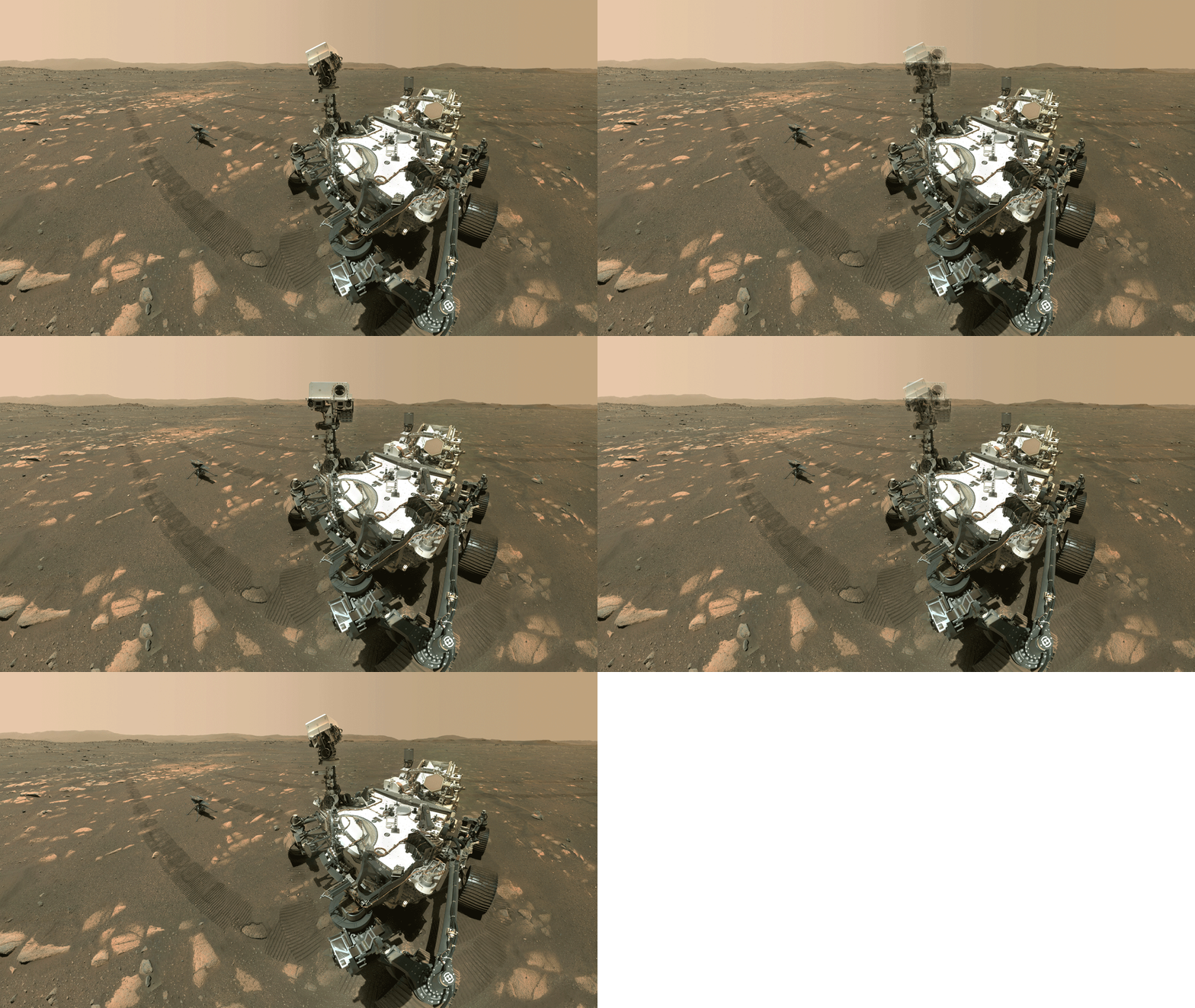
 Mars 2020 mission Sol 46 (April 6th), 2021, a series of 62 images captured using the WATSON imager on the robot arm of the Perseverance rover were used to create this “selfie” of the rover “looking” at the camera, then back at the Ingenuity helicopter sitting on the ground some 4 metres away. Credit: NASA/JPL

NASA has delayed the first flight of the Ingenuity helicopter on Mars after the vehicle detected an issue during one of its pre-flight tests.

For the past week, the agency has been preparing the little helicopter drone, part of the Mars 2020 mission, for the first of a series of 5 pre-planned test flights within Jezero Crater. It had been hoped the flight could take place on Sunday April 11th / Monday April 12th, 2021 (depending on where you are in the world); however it will now not take place until Wednesday, April 14th at the earliest.

After being dropped on the surface of Jezero Crater by the Mars 2020 Perseverance rover (see my previous space Sunday report), Ingenuity successfully recharged its batteries using solar energy and survived its first night alone on Mars without incident. This was a major milestone for the project, as there were fears that if the batteries couldn’t be fully charged and generate sufficient heat, the extreme cold of the Martian night could freeze the vehicle’s electronics, and even crack the batteries themselves.

Since that first night, the helicopter has shown it can keep itself warm and the flight team has spent the week conducting a range of pre-flight checks, including unlocking Ingenuity’s pair of contra-rotating propellers and then testing them under power and at low speeds, then speeding up to higher speeds, including an attempt to reach the 2400 rpm required for take-off.

Part of testing Ingenuity included taking a low-resolution image via its downward-looking camera system while it was still sitting under the rover. April 3th, 2021 / Sol 42. Credit NASA/JPL
All of these tests were completed successfully, with the exception of the final full-speed test attempted on Friday, April 9th. This aborted during the phase when the command programme on Ingenuity was supposed to switch from “pre-flight” to “flight” mode, as will be required ahead of the actual flights. However, a guardian “watchdog” timer designed to oversee the correct execution of command sequences expired before the switch-over occurred, prompting Ingenuity to safely shut-down its motor and await further instructions from Earth.

Following a full evaluation of telemetry received following the curtailed test, the flight team were confident that no actual damage had occurred to the helicopter, stating the full spin-up test of the rotors would be postponed and the flight itself delayed until April 14th. They also indicated that assuming the first flight was completed without incident, the second flight will take place on Sunday, April 18th.

The rotor tests took place once Perseverance was well clear of the helicopter – the rover is gradually making its way to the look-out point where it will record Ingenuity’s flights. However, before it did so, engineers took the opportunity to use the WATSON (Wide Angle Topographic Sensor for Operations and eNgineering) camera on the rover’s robot arm to capture a series of 62 images that were stitched together to produce a picture of Perseverance apparently “looking” back at the helicopter using its mast cam imaging systems, and which can be seen at the top of this article.

Another image Perseverance took that recently caused excitement was one that appeared to show a “rainbow” arcing across the dusty Martian sky. Captured on April 4th (Sol 43), the image spread quickly across social media, as did the “rainbow” explanation.

Captured on April 4th (Sol 43), this image via the rear-facing Hazcam system on Perseverance caused excitement in the media, being described as a “rainbow”. However, it wasn’t any such thing, as NASA was forced to explain. Credit: NASA/JPL

The only problem being, rainbows are impossible on Mars, as NASA quickly stepped in to note through social media:

Many have asked: Is that a rainbow on Mars? No. Rainbows aren’t possible here. Rainbows are created by light reflected off of round water droplets, but there isn’t enough water here to condense, and it’s too cold for liquid water in the atmosphere.

NASA, via the @NASAPersevere Twitter account.

Rather, the “rainbow” was the result of lens flare – light being scattered by the lens of the Hazcam (HAZard avoidance CAMera) that captured the image, to strike the imaging sensor in multiple places like an arc of machine-gun bullets. Such effects are prevented on the front-facing Hazcams (the ones most frequently used by the rover, as they are equipped with sunshades; however, similar shades were deemed superfluous on the rear-facing Hazcams, and so lens flares like this are actually quite common should the system be in use and the Sun happens to be in the right position.

Continue reading “Space Sunday: Mars, galaxies and starships”

Space Sunday: Ingenuity readies for flight

Ingenuity hangs under the belly of Perseverance at the end of several days of initial deployment.Credit: NASA/JPL

This past week has seen the Mars helicopter Ingenuity successfully deployed onto the surface of Mars in readiness for its first flight – although NASA has announced the flight itself has been delayed.

As I noted in my previous Space Sunday report, the helicopter was unpacked over several days (the work actually commencing prior to that report appearing). It took several days because each stage of the deployment had to be verified to ensure it had been correctly completed using the WATSON camera on  the rover’s robot arm imaging the helicopter from several angles after each phase of the deployment so that engineers on Earth could confirm everything looked correct. However, everything went as expected, and by March 31st (UTC), Ingenuity was in an upright position under the rover, but still connected to it via the power umbilical and backplane support.

At this point proceedings were paused whilst systems were given a final check-out prior to the command being given to release the helicopter to drop the 10-13cm down onto the Martian surface. Once released, Ingenuity would be on its own power-wise, with a limited period in which to charge up its batteries using sunlight, so the engineering team wanted to run through final verification that everything was OK.

On Sunday, April 4th, the Jet Propulsion released images revealing that final step of deployment had been completed, and Ingenuity is standing on Mars, Perseverance having moved several metres away to establish line-of-sight communications with the helicopter.

Caught by the Hazcam system on Perseverance, Ingenuity sits on the surface of Mars after the rover had initially moved away from it following release. This image was taken on mission Sol 43 (Sunday, April 4th, 2021) at a local mean solar time of 15:14. It is a raw image that has not been white balanced for Earth lighting. Credit: NASA/JPL

The next challenge is to ensure the solar cells that the very top of the rotor mast are able to provide energy to the batteries, which can only survive 25 hours without recharge now Ingenuity has been separated from the rover.

It had been hoped that the first in a sequence of five planned flight tests would commence on Thursday, April 8th. However, this has now been delayed until Sunday, April 11th, at the earliest.

A further view of Ingenuity sitting in Jezero Crater after the rover has moved further away. Sol 43 (April 4th, 2021)

The delay is to allow for a full regime of tests to be carried out on the helicopter – which has gained the nickname “Ginny”  among the engineering and flight team at JPL – including its ability to survive the harsh cold of Martian nights and then recharge its batteries during daylight hours. Should all go according to plan, Perseverance will capture the flight, and images / video from both the rover and the helicopter will be released on or shortly after April 12th.

Providing the first straight-up-hover-straight-down flight is a success, the flight team will move on to the remaining four pre-flights for the helicopter, which the hope to complete well inside the 30-day window allowed for the tests – and potentially complete more, if there is sufficient time left before Perseverance must turn to its now duties and say “bye-bye” to  Ingenuity.

Following the first flight, Ingenuity will perform a more complex series of flights, such as the one shown above. Credit: NASA/JPL

When it does commence its own science work, Perseverance may not initially travel too far from the helicopter’s flight zone: whilst Ingenuity was unfolding beneath it, the rover’s team became increasingly intrigued by a green-tinted rock a short distance away.

The yet-to-be-dubbed rock is thought to be a possible meteorite or a piece of bedrock that may have been “popped” up from under the layers of sedimentary rock on which the rover is parked. However, the science team will not be drawn on any conclusions until Perseverance has had the chance to get up close to the rock and focus all of its attention on it. Thus far, the rover has only been able to image the rock using its Mastcam-Z system and zap it a few times with the SuperCam laser system.

That the rock – roughly 15 cm in length – might be a meteorite is not beyond the bounds of possibility: Perseverance’s “sister” rover, Curiosity, happened upon a similar odd rock sitting on the landscape in 2014. Once its duties watching over Ingenuity have ended, Perseverance will be able to devote its full attention on the rock, further utilising its SuperCam laser and spectrometer, as well as the SHERLOC and WATSON combination on its robot arm in an attempt to decipher the rock’s mystery.

The interesting rock – possibly a meteorite – Perseverance has been studying from a distance whilst the Ingenuity helicopter deployment has been underway. Credit: NASA/JPL

Meanwhile, and half a world away, Curiosity has been busy as it continues its investigations of  “Mount Sharp”, the 6 km high mound of deposits left in the centre of Gale Crater, the result of multiple periods of flooding.

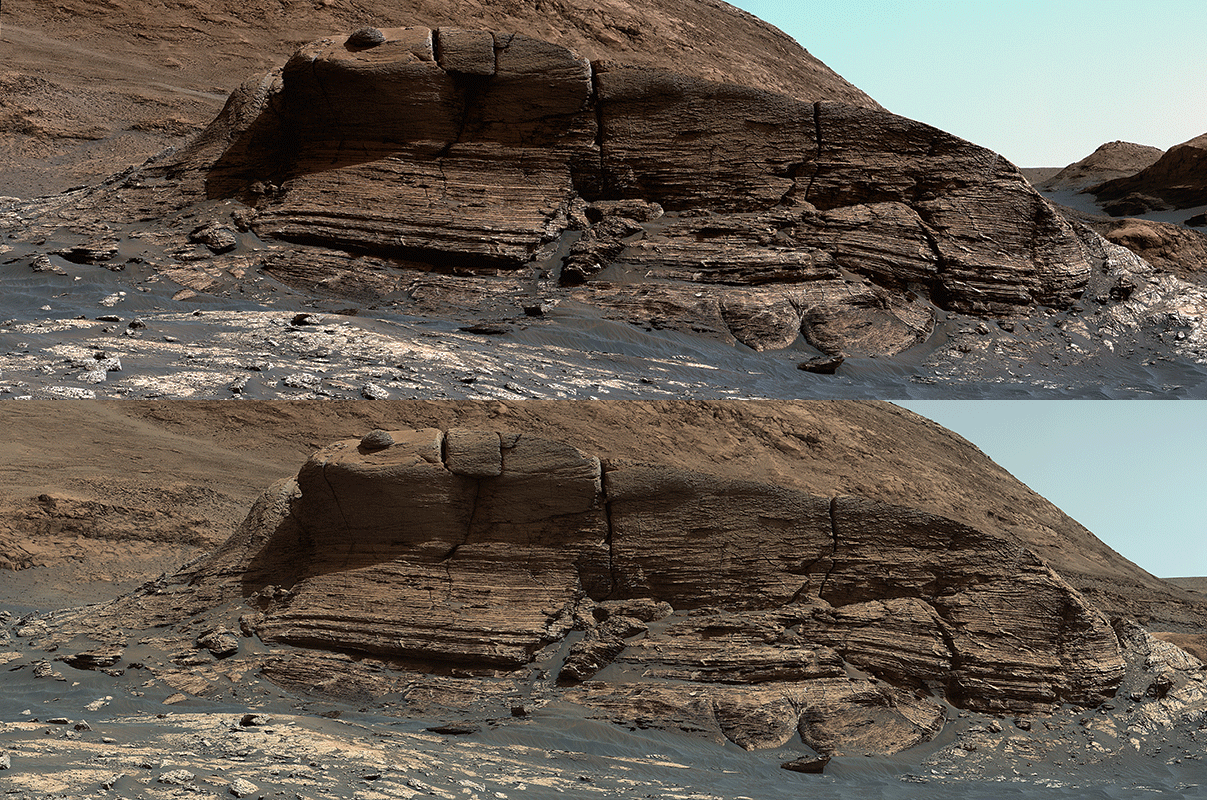
At the start of March, Curiosity commenced it most recent science campaign, examining an impressive 6 metre high rock formation dubbed “Mont Mercou” after a mountain in France close the village of Nontron, which is being used to generate monikers for features in the area the rover is exploring due to the presence of nontronite, a type of clay mineral (also named for the village) within the area.

A 3D view of “Mont Mercou” created from a total of 32 images captured by Curiosity on Sol 3049 of its mission – March 4th, 2021. It was made by taking 16 images from one location and then moving 4 metres to take a second set. The resulting stereoscopic effect helps scientists get a better idea of the geometry of the mound’s sedimentary layers, as if they’re standing in front of the formation. This finished view has been coloured balanced to match Earth-type lighting conditions. Credit; NASA/JPL

Continue reading “Space Sunday: Ingenuity readies for flight”