
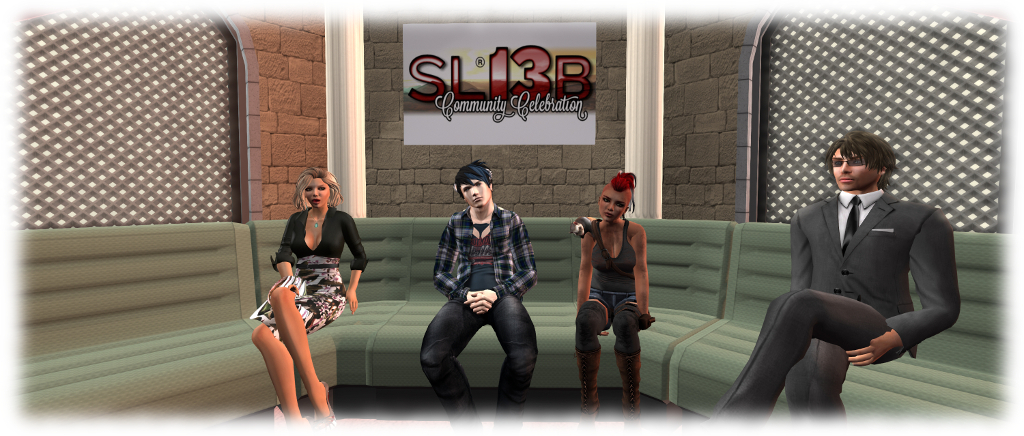
Meet the Lindens is a series of conversations / Q&A sessions with staff from Linden Lab, held as a part of the SL Birthday celebrations in-world. They provide opportunities for Second Life users to get to know something about the staff at the Lab: who they are, what they do, what drew them to Second Life and the company, what they find interesting / inspirational about the platform, and so on.
Monday, June 19th saw Dee and Patch Linden sit down with Saffia Widdershins, and this article hopefully presents some “selected highlights” of the chat, complete with audio extracts from my recording of the event. The official video of the event is available at the end of this article.
About Dee and Patch
Dee Linden is the Land Operation Supervisor for the Lab, and her introductions often includes the phrase, “older than the terrain itself”, reflecting her experience from the physical world realty market. She discovered Second Life in 2003, and quickly decided she wanted to be a part of the Lab’s and of Second Life’s growth, taking to dropping note cards on various Lindens, including Char and Philip, encouraging them to consider hiring her.
This happened in around 2005, when she was recruited as a liaison, prior to joining the concierge team, where she was responsible for training Patch. When he moved to set-up the land team, she lobbied him to join the team, where she has a particular interest in supporting non-profits and groups seeking land for events.
Patch Linden started as a Second Life resident, first joining the platform in 2004, and has been a male fashion designer, mentor, and community lead. His efforts with the latter brought him to the attention of the Lab, and in 2007, it was suggested he consider applying to work for the company.
Initially working as a support agent, he worked his way up through the concierge team, eventually becoming the team’s manager. He later moved to the role of Operations Support Manager for a year prior to pivoting away from support entirely and joining the Product group at the Lab, the group responsible for defining the features, etc., found within Second Life. Here he developed the land operations team, which includes the Land Department of Public Works (LDPW) and the Moles. He’s now the Senior Director of Product Operations, a role in which he is also responsible for the Lab’s support organisation.

Recalling the Early Days
The first part of the interview focuses on Patch and Dee’s time before Linden Lab, on-boarding with the Lab: Patch through his men’s fashion business mentoring new starters, Dee through working with hosting events, mentoring new starters, etc. In discussing their backgrounds and joining the Lab, Dee brought up the very early days of Second Life, mentioning two things in particular those of us with long memories are likely recall.
The first of these was the avatar rating system. Back then, the old-style profile floater (still used by some TPVs) had a tab in it called Ratings, which had five categories in it: appearance, behaviour, building skills, and two others I now cannot remember (age does that…).
These rating categories were open to others to vote on – so as Dee said, became a kind of “popularity contest” among users (and one that tended to be gamed – “you rate me and I’ll rate you!”). Ratings could only be awarded once per avatar per category, and cost L$25 to award, the money going to Linden Lab.
Also recalled was the original means for the Lab to raise revenue – the “prim tax“. This started when Second Life entered its “closed” Beta phase in late 2002 and ran through the “open” beta which started in April 2003. Initially, this saw a fee of L$10 charge for rezzing a prim, with a flat weekly fee of L$3 (I think) to keep an object in-world. Over time, this system evolved to calculating taxes based on each prim’s volume and also its altitude, and with a sliding scale of fees for objects using prim lighting (starting at L$5).
These changes gave rise to the infamous tax revolt during the latter half of 2003, when users who were working to build infrastructure in SL for other to enjoy – communities, roads, event centres felt they were being unfairly penalised against. This revolt in turn brought about the shift in the economic model of Second Life from the “prim tax” to land tax (tier), with the release of version 1.2 of the service, in December 2003 – although this also wasn’t without its own controversy.

Patch also discusses the teleport hubs (“telehubs”) and their impact on community and immersion in Second Life. Again, for those who don’t remember, in the early days of SL there was no direct teleporting. Everything was mainland-based, and teleporting was via teleport hubs, with a free payable to LL. These hubs naturally became the focal points for people to build around, so they’d get traffic / an audience. Thus, the hubs in turn encouraged people to hop around the mainland and then go and explore what lay around each hub and get involved in activities they discovered.
He went on to say the Lab may be looking at the surviving telehubs and doing something with them. Whether this means re-establishing the network in some manner than encourages people to use it, or whether it is a case of “restoring” them as museum pieces is something he and Dee refused to offers further hints about, other than in the most general terms.
Selected Q&A Items
Most Interesting / Challenging Projects To Work On
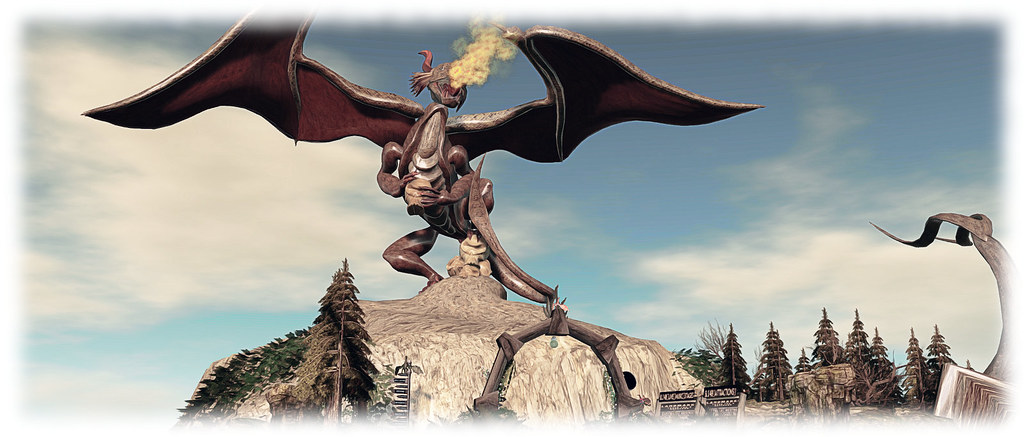
Patch: There’s PaleoQuest, learning island and social island, I think rank right up there with it; you know, coming from the whole mentor, “I like to help people, I walk in the residents’ shoes every day” perspective that I put on all of our projects, I’d have to say that one’s very important to me.
Probably the Portal Park would be my third favourite … as far as most challenging, I would say Linden Realms. You know, it’s the grandfather of the Experience Keys system [aka “Experiences” today] … it’s basically what experience tools were built upon / along side of or in parallel with, were developed for. We basically set out to say, if we were to try to give people a way to create games or put a gaming engine creation tool within Second Life, what would we do? And out of that was born both experience tools, the tool set and Linden Realms at the same time as demonstrator for it.
The interesting thing about that is, that over all of the years it’s been running it is still one of the most popular experiences, with a very high number of unique visitors daily. And it keeps us on our toes! Again, with ageing content and such, more maintenance tends to go into it to keep it running over time; so we want to make sure it doesn’t break down, and with that, we also have to have the agility to be able to respond to any changes to the tool set that it runs on, as that may occur. So keeping up with all of that over the years has probably been the primary challenge, because just short of rewriting the whole thing or just scrapping the whole thing, we’ve found some pretty interesting ways to keep it going.
Dee: Linden Realms will always hold a very special place in my heart. It was one of the first really big one that I worked on; Linden Homes as well, the originals. PaleoQuest is still my favourite to play, and Horizons, I think, was probably the most challenging of the more recent ones … Unlike Linden Homes, with Horizons parcels you can deed your parcel into your group, and we had to make the mailbox [configuration controllers] and the houses work for the group, where we didn’t have to worry about that with Linden Homes … there are now a few businesses in Horizons, but it is predominantly residential.



 Inara Pey: Living in a Modemworld