Space Sunday: Mars, Starship and a meteor that flattened a city

September 10th, 2021: after successfully gather two samples from the rock dubbed “Rochette” (seen in the foreground, the bore holes clearly visible), the Mars 2020 rover Perseverance paused for a “selfie” using the WATSON imager mounted on the robot arm turret. Credit: NASA/JPL

It’s getting interesting on Mars. Jezero Crater, the home of the Mars 2020 mission is going through a change in seasons, bringing with it a drop in atmospheric density that is proving challenging for the Ingenuity helicopter, which recently completed its 13th flight.

The little drone was designed to fly in an atmosphere density around 1.2-1.5% that of Earth, but with the seasonal change, the average afternoon atmospheric density within the crater – the afternoon being the most stable period of the day for Ingenuity to take flight – has now dropped to around 1% that of Earth. This potentially leaves the helicopter unable to generate enough lift through its rotors to remain airborne.

The solution for this is to increase the rate of spin within rotors to something in excess of their nominal speed of around 2,500-2,550 rpm. However, this is not without risk: higher rpm runs the risk of a significant increase in vibrations through the helicopter that could adversely affect its science and flight systems. Also, depending on the wind, it could result in the propeller blades exceeding 80% of the Martian speed of sound. Sound this happen, the rotor would pick up enough drag to counter their ability to generate lift, leading to a mid-flight stall and crash.

To better evaluate handling and flight characteristics, therefore, the flight team are going back to basics an re-treading the steps taken to prepare Ingenuity for flight. This will see the propellers spun to 2,800 rpm with the helicopter remaining on the ground. Data gathered from this test will be used to make an initial assessment of blade speed required to get Ingenuity off the ground – believed to be somewhere between 2,700 and 2,800 rpm, and make an initial assessment of vibration passing through the helicopter’s frame. After this, it is planned to carry out a very simple flight: rise to no more than 5 metres, translate to horizontal flight for no more that a few metres, then land. Data from this flight – if successful – will then be used in an attempt to determine the best operating parameters for Ingenuity going forward.

The power of Perseverance’s camera: The lower image shows a true colour view of a feature dubbed “Delta Scarp”, captured by the rover’s MastCam Z system from a distance of 2.25 km. The upper picture shows details of the feature, as captured from the same distance, using the rover’s SuperCam instrument.. Credit: NASA/JPL

In the meantime, the Perseverance rover is continuing its work. Following the successful gathering of its first ample, the rover has been further revealing the power of its imaging systems, Mastcam Z and SuperCam, the two camera system mounted on its main mast.

Designed for different tasks, the two systems nevertheless work well together to provide contextual and up-close images of features the rover spies from distances in excess of 2 km away, allowing science teams to carry out detailed assessments before sending the rover to take a closer look. Also, in the wake of the sample gather exercise at the rock dubbed “Rochette”, NASA have provided a general introduction to two more of the rover’s instruments, which are mounted on the turret at the end of the rover’s robot arm. Catch the video below for more.

At the same time, and half a world away, the InSight mission Lander, despite suffering a severe degrading of its power capabilities as dust continues to accumulate on its circular solar arrays, has detected a  powerful Marsquake less than a month after detecting two equally powerful quakes originating at two different point under the planet’s surface.

All three were the latest in a long like of Marsquakes – also called “tumblors” – that have revealed much about the planet’s interior in the almost three years since InSight placed its seismometer on the planet’s surface, including the fact its core is larger than had been believed. The vast majority of the tumblors thus far detected have originated in the  Cerberus Fossae region of Mars, some 1,600 km from the lander. However, on August 25th, a quake measuring 4.1 magnitude was recorded with an epicentre just 925 km from the lander whilst marking it as the most powerful tremblor Insight had recorded (the previous record holder measure 3.7 – five times less powerful).

Captured in July 2021, this image shows InSight’s Seismic Experiment for Interior Structure (SEIS) instrument dome on the surface of Mars. This is the instrument that has been recording tremblors on Mars. Credit: NASA/JPL

But then on the same day, a second quake was detected, hitting 4.2 magnitude, marking it particularly powerful, given its epicentre was calculated to be 8,600 km from the lander, and possibly focused within Vallis Marineris, the “Grand Canyon of Mars. This was matched on September 18th by a further 4.2 magnitude quake – epicentre currently unknown. But what made this tremblor remarkable was its duration – almost 90 minutes! (By comparison, the longest recorded duration of an quake on Earth is under 5 minutes.) Exactly why and how such an event should or could last so long is unknown, and has the InSight science teams scratching their heads.

Did a Cosmic Event Give Rise to the Biblical Legend of Sodom and Gomorrah?

Tall el-Hammam was – up until 3,600 years ago – a thriving centre of life and commerce for an estimated 8,000 people. Located close to the Dead Sea in what is now modern day Jordan, the valley it occupied lay some  22 km west of the city of Jericho and was one of the most productive agricultural lands in the region before being practically deserted for some 500-700 years, the soil inundated with salts to the extent nothing would grow.

The location of the city has been subject to archaeological study since 2005, and researchers there have been struck by the curious nature of what little remains of the city: foundations with melted mud brick fragments, melted pottery, ash, charcoal, charred seeds, and burned textiles, all intermixed with pulverised mud brick and minerals that can only be produced under extremes of temperature and / or pressure. The more the city’s ruins were uncovered, the more the evidence pointed to some terrible calamity having befallen Tall el-Hammam and its surroundings, prompting the archaeologists to call in experts from the field of astronomy, geology, and physics. Their research has lead to the conclusion that the city was practically at the epicentre of a “cosmic airburst”.

Moment of detonation: an artist’s (rather mild) interpretation of the moment a 50m diameter chunk of rock travelling at 61,000 km/h detonated in the skies above Tall el-Hammam, Jordan, 3,600 years ago in a 15 megaton blast that obliterated the city in seconds. Credit: Allen West and Jennifer Rice, CC BY-ND

In short, 3,600 years ago, a piece of rock probably 50 metres across slammed into the atmosphere at 61,000 km/h. It survived the initial entry and fell to an altitude of approximately 4km above Tall el-Hammam before air resistance finally overcame its integrity. The result was a  15 megaton explosion that instant drove air temperatures to around 2,000ºC, enough to instantly flash-burn textiles, wood and flesh, and melt everything from swords and bronze tools to pottery and mud brick.

Seconds later, the shockwave from the explosion struck the city. Travelling at 1,200 km/h, it utterly pulverised what was not already aflame. Roughly a minute after the explosion, that same shockwave rolled over the city of Jericho, probably demolishing a good portion of its defensive wall and the buildings within it. That same shockwave also impacted the Dead Sea, potentially lifting vast amounts of salt water into the air, which rained back down over the valley, rendering it infertile for the next few hundred years, until rainfall could wash the salts out of the top soils.

The evidence for the cataclysm comes in multiple forms, from the melted pottery and mud brick through the clear evidence the city was pulverised in a manner that left a clearly defined “destruction layer” within the ruins, to the fact that within those ruins are deposits of shocked quartz, which are only formed when grains of sand are compressed with of force of 725,000 psi, and microscopic diamondoids, produced when carbon materials (e.g. plants, wood, etc.), are simultaneously exposed to massive extremes of temperature and pressure, and are a hallmark of ancient impact sites around the world.

A satellite image of the Middle East, showing the location of Tall el-Hammam on the northern coastal area of the Dead Sea. Satellite image via NASA

The ruins bring home the very real risk posed by near-Earth objects as they zap around the Sun, crossing and re-crossing Earth’s orbit. That a cosmic object also brought about the destruction of a small city and its 8,00 inhabitants raises the question of whether someone witnessed the event (obviously from many kilometres away) or its aftermath, and the telling and re-telling of the tale of destruction eventually morphed into the Biblical tale Sodom and Gomorrah, the two “cities of the plains” of the Dead Sea (and therefore potentially close to the site of Tall el-Hammam), supposedly destroyed by God in a rain of fire and rock falling from the sky.

Continue reading “Space Sunday: Mars, Starship and a meteor that flattened a city”

Space Sunday: rovers, rockets and telescopes

An image of a ridge line on the flank of “Mount Sharp” (Aeolis Mons) captured by MSL rover Curiosity on Sol 3167 (July 4th, 2021). A CGI model – to scale – of the rover has been superimposed on the image to show how the rover’s climb up the ridge might appear to someone watching it. Credit: NASA/JPL with additions by Seán Doran

Rovers on Mars continue to been busy as they trundle around the planet. While it has been there the longest, NASA’s Mars Science Laboratory (MSL) rover Curiosity has been somewhat out of the news, courtesy of it’s sister Perseverance and China’s Zhurong. However, it has recently re-grabbed the science news headlines thanks to a couple of studies.

Methane blips have pinged on Curiosity’s Tunable Laser Spectrometer (TLS) six times since the rover landed in Mars’ Gale crater in August 2012. These events have been seen as important, because methane is the by-product of two processes that share equal interest to scientists, because one is the result of organic processes – life – and the other, though inorganic in nature, points to geological activity closely tied to the presence of liquid water, a vital ingredient for past or present life as we know it to thrive.

A critical factor with methane is that once exposed to sunlight, it breaks down over a period of just 300-330 years, so for Curiosity to be able to detect it, it must have come from a relatively recent source – one that still may be active. The problem until now has been to locate that source – or even confirm Curiosity’s findings.

The European Space Agency’s Trace Gas Orbiter, part of the ExoMars mission, and currently studying Mars. Credit: ESA

The best placed tools for doing the latter are aboard the European Space Agency’s Trace Gas Orbiter (TGO), but to date, TGO has been unable to detect any methane within Gale Crater. The could either be because there isn’t any methane to be found, or the minute amounts  – just 10 parts per billion (10 ppb) – is too small and too localised for TGO to accurately detect from orbit, and Curiosity just happens to be sitting practically on top of it.

In one of two reports released in June, members of the MSL’s extended science team they have pin-pointed the source location for the methane, and that the rover happened to arrive in Gale Crater at a point extremely close to it.

This was done by treating each point of detection as a discrete packet of methane, then calculating the wind speed and direction at the time it was detected. This allowed them to trace the parcels back through time to their possible points of emission. By doing this for all of the different detection spikes, they were able to triangulate regions where the methane source is most likely located- and one of them is just a few tens of kilometres to the north-west of “Mount Sharp” and Curiosity’s area of exploration.

Sadly while tantalisingly close to the rover, the point is still well outside of Curiosity’s route of exploration.

MSL Curiosity, imaged by the HiRISE camera aboard NASA’s Mars Reconnaissance Orbiter, on April 18, 2021. Credit: NASA/JPL

A second study coming out of Curiosity’s science data suggests that a process has been at work on Mars that has been both eradicating evidence for possible past life on Mars – and creation conditions in which new life might arise.

In short, when reviewing the result of samples taken of ancient mudstone, a sedimentary rock containing clay, taken from two points just 400 metres apart and believed to have both been laid down some 3.5 billion years ago. Both should have been very similar in nature, rich in clay, an important element in the search for life, as it is both created in the presence of water and is an excellent medium for storing microbial fossils. However, one of the samples contained just half the anticipated amount of clay minerals in comparison to the other, but a much higher concentration of iron oxides –  the compounds that give Mars its rusty hue.

The researchers behind this discovery believe it is the result of one of the two areas of mudstone being exposed to brine: salty water that leaked into the mineral-rich mudstone and effectively leached the clays and other minerals out of them, effectively eradicating both the geological and possibly the biological record that might otherwise be present in the deposits. Given that evidence of potentially brine-rich outflows have been found elsewhere on Mars, this study suggests this process might be common to regions of the planet believed to have once housed bodies of water, possibly destroying any evidence of past life.

However, the process – called diagenesis – is not all bad news. While it may well help erase any record of past organic activity from parts of the surface or Mars, it may also have triggered new life processes under the surface, the salty water being a source of potential energy that could help kick-start new organic processes.

Image of the “Raised Ridges” that Ingenuity captured on its ninth flight. Credit – NASA / JPL

The findings of both of these studies are being used to inform the science mission of NASA’s latest Mars rover, Perseverance, allowing the science team to apply what has been found in Gale Crater to Jezero Crater, to better direct that rover towards places of interest.

“Percy”, to use the nickname for NASA’s latest Mars rover is also being assist in finding places of interest – and the best route to them – by the Ingenuity helicopter. This has now completed its 9th flight , during which it acted directly as an aerial scout for the rover, including the “Raised Ridges”, a feature that suggests it may one once had a water channel beneath it. Ingenuity has also identified a dune field that could result in “Percy” becoming bogged down – as happened with the MER Spirit rover in 2009/10 – ending its mission.

What is particularly fascinating about this work is that the information gathered by Ingenuity can be fed back to Perseverance and used by its auto-drive system to identify local hazards – rocks, etc – the rover can then navigate itself around without having to “‘phone home” for assistance from the Earth-based driving team.

Ingenuity’s view of the “Séítah” dune field on it’s ninth flight. Part of the helicopter’s landing gear can be seen on the left side of the screen. Credit: NASA / JPL 

Meanwhile, China’s Zhurong rover is now 2/3rds of the way through its initial 92-day / 90 Sol mission. During that time, the rover has travelled a total of 450 metres, and on July 12th, 2021, it arrived at a special point of study – but one that is neither geological nor meteorological / atmospheric, the rover’s primary science interest.

Instead, the rover had arrived at the impact / landing point for the backshell and parachute that had helped it to reach the ground safely. Following it separation from these during descent, the rover had moved away from it under the power of its lander’s rocket motors ready to make a soft landing. The backshell and parachute continued downward to eventually land some 350 metres from the lander / rover.

Studying both the backshell and parachute helped engineers understand how well both handled the descent through the Martian atmosphere, something that can help inform future missions. At the same time, the rover imaged raised mounds in the region, which could be inverted impact craters or possibly small volcanic domes or other features could be the result of tectonic activity – their nature has yet to be made clear (one of which has been incorrectly labelled as a “outflow delta” in the video below).

Continue reading “Space Sunday: rovers, rockets and telescopes”

Space Sunday: selfies, missions, budgets and rockets

Zhurong and its lander. Credit: CNSA

You would be forgiven for thinking the banner image for this update is an artist’s impression of China’s Zhurong rover and its lander on Mars. But you’d be wrong – the image really was taken on Mars.

It is part of a batch of images the China National Space Administration (CNSA) have released charting the recent activities of their rover on the Red planet, and they are as remarkable as anything seen with the US rover vehicles, with others showing panoramic views around the rover and shots of its lander vehicle.

The Zhurong lander, part of China’s Tianwen-1 Mars mission., as seen from the rover vehicle at a distance of some 6 metres. Credit: CNSA

Captured on June 8th, the image of rover and lander was taken by a remote camera originally stowed in Zhurong’s belly, and which had been safely deposited on the surface of Mars some 10 metres from the lander, allowing mission control to remote capture the unique sight of a rover and its lander side-by-side.

Zhurong has now completed the first third of its initial 90-day mission on Mars, and is well into its survey of its surroundings within Utopia Planitia. In addition to the high-resolution cameras, used to produce these images, the rover is fitted with a subsurface radar instrument, a multi-spectral camera and surface composition detector, a magnetic field detector and a weather monitor.

A 360 panorama of the Zhurong landing site, captured by the Chinese rover prior to is descent from the back of its lander. Credit; CNSA

Ahead of the images released by CNSA, NASA released their own image of the Chinese rover and lander as seen by the HiRISE camera on the Mars Reconnaissance Orbiter  from an altitude of around 400 km.

Taken on June 6th, three weeks after Zhurong touched-down, the image clearly shows green-tinted lander (a result of the image processing, not the actual colour of the lander) sitting between two areas of surface material discoloured by the thrust of the lander’s outward-angled descent and landing motors. Zhurong itself can be seen a short way south of the lander, within the eastern arc of discolouration.

Captured by the HiRISE imager on NASA’s Mars Reconnaissance Orbiter on June 6th, this image shows the Zhurong lander surrounded by surface material discoloured by the lander’s rocket motors, with the rover sitting just to the south. Credit: NASA/JPL

And turning to NASA’s surface mission on Mars (specifically Mars 2020): on June 8th, the Ingenuity helicopter completed a 7th flight, this one error-free.

Lifting off at around 12:34 local mean solar time (roughly 15:54 UTC on Earth) proceeded south during the 63-second flight, covering a distance of around 106 metres before touching down at a new location.

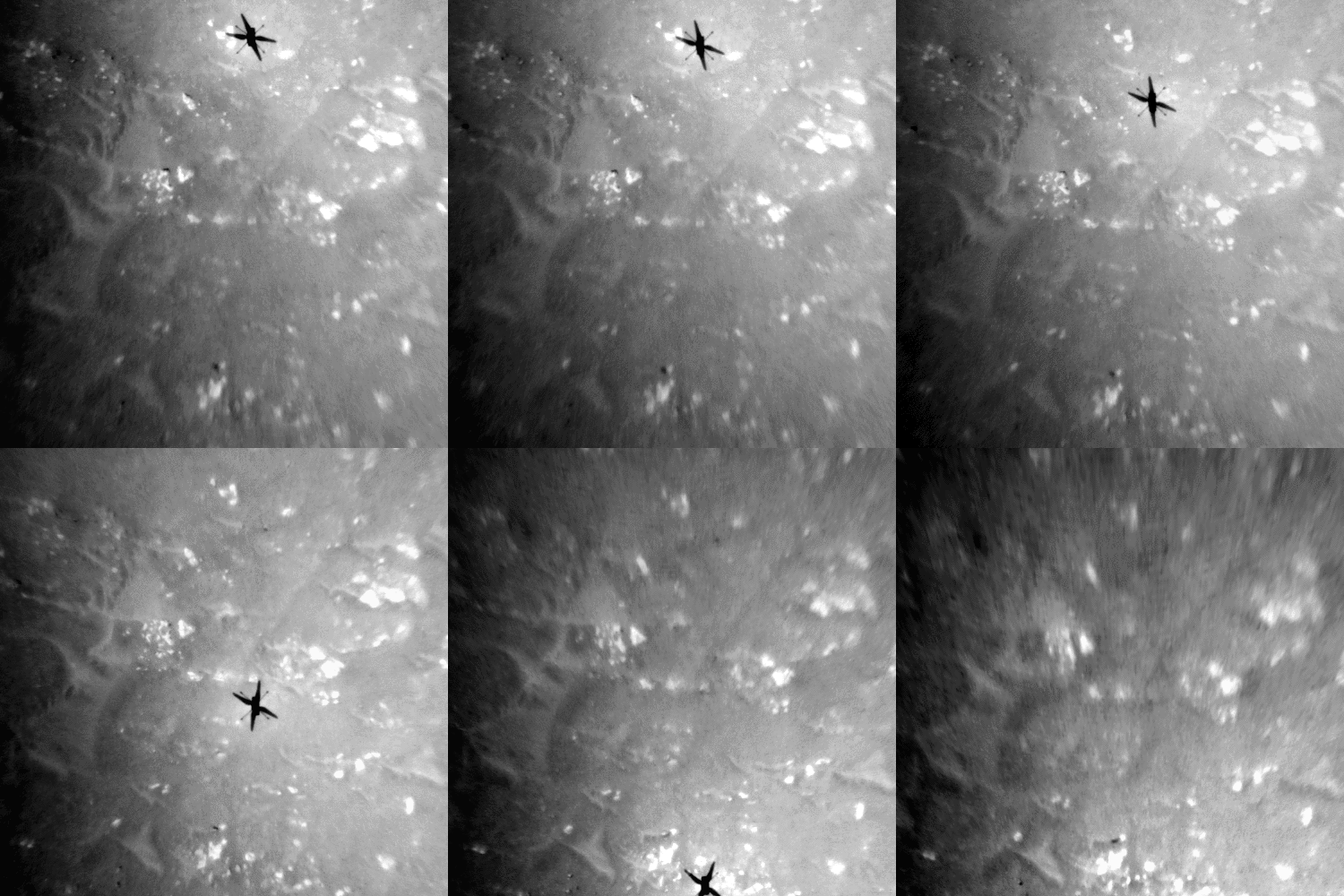
Ingenuity captured this image of its shadow passing over the surface of Mars on June 8th, 2021 during its 7th flight. Credit: NASA/JPL

In difference to the 6th flight on May 22nd, which saw the helicopter encounter some anomalies (see: Space Sunday: Martian Clouds, Lunar missions and a Space Station), the seventh flight was completed with incident, once again raising confidence that the helicopter will be able to continue flying several more times.

Overlaid onto an image be NASA’s Mars Reconnaissance Orbiter are the routes for the first and second science sorties to be made by Perseverance. Credit: NASA/JPL

Now regarded as fully commissioned, Perseverance has put its duties as caretaker-watcher for Ingenuity largely behind it, as is now driving south and away its landing zone on its way to study a 4 square kilometre of crater floor, where it will examine two very different geological units and collect samples for analysis and for storage and possible return to Earth as part of a future mission.

“Crater Floor Fractured Rough” is a region of ancient bedrock, whilst “Séítah” (Navajo for “amidst the sand”) presents a mix of bedrock overlaid with more recent ridges and also sand dunes. The rover will perform a gentle loop through these areas, visiting “Crater Floor Fractured Rough” first then travelling through the ridgelands and then back up through “Séítah S” and Séítah N”, before heading for its next target, an area dubbed “Three Fours”.

ESA Looks to Venus and the Outer Planets

The European Space Agency has announced its goals for the next several decades in terms of robotic exploration of the solar system and cosmic science.

Announce on June 10th, the EnVision mission will carry a suite of spectrometers, sounders and a radar to study the interior, surface and atmosphere of Venus. The target launch period is May 2032, with the vehicle arriving in orbit around Venus in August 2033, where it will use the planet’s upper atmosphere to aerobrake into its final science orbit over a 3-year period, before commencing its four-year primary mission. It  is expected to cost around 500 million Euros.

ESA plans to further extend our knowledge and understanding of Venus with the EnVision mission, due to launch in 2032. Credit: ESA

While there has been no coordination between NASA and ESA in terms of mission selection, EnVision’s science mission is highly complementary to the two NASA missions – VERITAS and DAVINCI+ – also recently announced, covering aspects of Venus science they do not. Further, ESA will be flying science packages on VERITAS, and NASA will be providing the synthetic aperture radar for EnVision.

EnVision is the fifth M-class mission ESA has selected as part of the Cosmic Vision program. The first, Solar Orbiter, was launched in February 2020, and three others are in development: Euclid, a mission to map dark matter and dark energy to launch in 2022; Plato, an exoplanet search mission launching in 2026; and Ariel, an exoplanet characterisation mission launching in 2029.

In addition To EnVision, ESA intends to spend the next several decades developing  missions to follow after the Jupiter Icy Moons Explorer, that will help assess the habitability of the icy moons in the outer solar system and seek any biosignatures they may have. At the same time ESA intends to support further science endeavours aimed at increasing our understanding of our own galaxy and the likely state and development of the early universe.

Continue reading “Space Sunday: selfies, missions, budgets and rockets”

Space Sunday: starships, helicopters and rockets

A camera close to the landing zone captures Starship SN15 with two good Raptor motor burns bringing it into a safe landing on May 5th. Credit: SpaceX

SpaceX has achieved its first successful landing of a Starship prototype after Starship SN15 was launched on May 5th, 2021.

The vehicle was the fifth full-scale prototype of the vehicle SpaceX intends to use on missions to Mars – and so much more – with the previous four, prototypes SN8, SN9, SN10 and SN11 all having suffered failures of various descriptions: SN8 came in too “hot” blowing up as it hit the landing pad; SN9 encountered motor issues that lead to being unable to remain upright so it also crashed into the landing pad; SN10 actually made a touch-down, but issues with one of its motors meant it blew up shortly afterwards; and SN11 exploded prior to landing after encountering issues when re-starting its Raptor motors.

Just before launch, Starship SN15 on the launch stand, venting excess vapours. The structure to the left is a test rig that is being used to simulate the dynamic stresses the forward section of an unladen Starship will face during atmospheric entry. Credit: SpaceX

SN15, however, is a substantially different vehicle to those. As the first of the “next generation” prototypes, it includes multiple updates and improvements throughout – including flying with the very latest iteration of the Raptor motors. Proof of this came in the run-up to the flight, when SN15 completing all its pre-flight tests without a significant issue – unlike the earlier models.

The vehicle lifted-off at 23:24 UTC, rapidly vanishing into low-altitude cloud as it climbed to the expected altitude of 10 kilometres, where it flipped into a horizontal skydiving descent. Just over 6 minutes after lift-off, the roar of the three Raptor engines re-starting reverberated through the clouds before the vehicle re-appeared in a tail-fist descent on  two of the three engines to complete a successful landing.

Starship SN15 on the landing pad, post-flight. The fire around the engine skirt is visible, and the fire suppression system can be seen dousing the area in water. Credit: SpaceX

Following landing, a small fire was visible at the base of the vehicle – the result of excess methane venting, and an issue SpaceX will need to address. However, it was clear that SN15 was safely down on the ground and “safing” procedures could commence.

Despite the atmospheric conditions, the team at NASAspaceflight.com team (this is not an official NASA group) had a number of video cameras placed around the SpaceX facilities at Boca Chica, Texas, and following the flight, they edited the footage from those cameras together to show the lift-off and landing sequences from different angles, some with the audio delay created by the distance of the camera from the launch stand edited out.

Some of these clips bring home the raw power of the Raptor engines – seconds after ignition, the shockwave of sound from the three engines on the Starship starts the camera vibrating – a small demonstration of what is to come when a Super Heavy / Starship combination lifts-off with no fewer than 28 of these engines firing simultaneously.

Following the flight, some pundits were forecasting SN15 could be set to make a second flight, possibly in short order – an idea fuelled be Elon Musk. This seems unlikely, as SpaceX will doubtless want to carefully examine the vehicle to learn all that they can from it prior to attempting to fly it a second time – if, indeed, they do.

All six of SN15’s landing legs suffered severe damage, as shown in this image, possibly the result of lateral loads placed on the vehicle on landing. Credit: SpaceX

As it is, the the landing legs – and possibly the base of the vehicle as well – suffered considerable damage during the “nominal” landing, as the image to the right shows.

Thought to be the result of lateral loading – the vehicle may have skidded sideways on touch-down – the damage is further evidence that SpaceX needs to seriously re-think how landing legs are mounted and deployed.

This is something the company his indicated it would be doing – and images of the proposed Starship Human Landing System (HLS) points to the direction in which they may move – although Musk has also floated the idea of eventually discarding any landing legs, and “catching” returning Starships via a launch tower, a-la his idea for Super Heavy – an idea that will presumably only apply to those Starships intended to operate no further than Earth orbit.

The next vehicle in the fleet that is likely to fly will be SN16, The legs on SN15 are the same as those on the earlier SN8-SN11 vehicles, and they are slated to be replaced by a more robust system,  and the degree of damage they suffered either as a result of a heavier touch-down or a possible lateral load being placed on the legs as a result of the vehicle “sliding” as it touched down. Either way, this damage along means that SN15 is unlikely to re-fly soon (although that doesn’t mean it won’t re-fly at some point).

As it stands, SN16 is now fully stacked and ready for transfer to a launch stand in order to have its Raptor engines fitted in preparation for a flight – this transfer could take place as soon as the coming week.

It is unclear how many more Starship launches will occur in the short-term: SpaceX is attempting to carry out an orbital launch of a Super Heavy Booster and an unladen Starship in July. Given the state of preparations – the company has yet to produce a fully flight-ready Super Heavy (Booster Number 1 has been scrapped, and work appears to have ceased on BN2 and BN2.1, leaving only BN3 under assembly at the moment), plus the orbital launch facilities are still under construction. Thus, unless attention and resources are significantly further shifted to booster development and testing, that July date seems to be highly ambitious.

Ingenuity Says ‘Farewell’ to “Wright Brothers Field”

On  Friday, May 7th, 2021, the Mars helicopter drone Ingenuity completed its 5th of five pre-planned test flights. In doing so, the little 1.8 Kg helicopter both set a new record and commenced a new phase in its mission.

During this flight, Ingenuity initially rose to the “usual” altitude of 5 metres, then said “farewell” to its operational based of “Wright Brother’s Field”, and headed south for a distance of  129 metres before coming to a hover. It this ascended further – climbing to 10 metres to take high-resolution of the area around itself, before descending to a landing in a flight lasting a total of 108 seconds.

The new landing site was selected on the strength of images gathered during the 4th flight for Ingenuity. It lies fairly close to the path the Mars 2020 Perseverance rover will follow as it now commences its science operations in earnest. The initial plans for the rover do not require it to make long-haul drives, but rather investigate the area to the south of the mission’s landing site, and this will allow the Ingenuity team to carry out further flights that can both further test their vehicle and allow them to potentially assist the rover team by scouting possible places of interest for the rover to explore.

Overall, Ingenuity is in fair better shape than had been expected at this point in its flight regime: the solar collectors are working optimally, the battery system is providing more than enough energy to both power the little vehicle and to keep it warm during the harsh Martian nights.

The plan forward is to fly Ingenuity in a manner that does not reduce the pace of Perseverance science operations. We may get a couple more flights in over the next few weeks, and then the agency will evaluate how we’re doing. We have already been able to gather all the flight performance data that we originally came here to collect. Now, this new operations demo gives us an opportunity to further expand our knowledge of flying machines on other planets.

– Bob Balaram, Ingenuity Chief Engineer, NASA/JPL

Prior to the 5th flight, NASA issued an audio recording captured by Perseverance of Ingenuity’s 4th flight – something the mission teams had been hoping to do.

The recording is a fascinating demonstration of the difference in how sound travels on Mars compared to Earth. Given the speed the rotors on Ingenuity spin (2400 rpm), one might expect the helicopter to generate the same high-pitched whine common to radio control helicopters on Earth. However, as the recording reveals, the less-dense atmosphere of Mars reduces the motor sounds from Ingenuity to a low-pitched hum. When listening, also note the doppler shift created by the drone’s motion away from, and back towards, the rover.

Continue reading “Space Sunday: starships, helicopters and rockets”

Space Sunday: a helicopter, a space station and a big ‘plane

April 25th (mission Sol 64), Ingenuity’s sideways looking colour camera just manages to image NASA’s Perseverance rover as it observes the helicopter’s 3rd flight from a distance of 85 metres from Ingenuity. The black disc in the lower left is one of the helicopter’s landing feet. Credit: NASA/JPL

NASA’s Ingenuity helicopter drone has now complete four of its five initial flights on Mars, and in doing so, NASA has announced the programme has moved from demonstration flights to an extended “operational” flight regime covering at least a further 30 days. In particular, Ingenuity will be used to test how future aerial drones might be used in support of ground-based operations, with Ingenuity working in partnership with Perseverance, the Mars 2020 rover, as the latter commences the operational phase of its own science mission.

For Ingenuity to now enter a new operational demonstration phase, our team has been extremely happy and proud. It’s like Ingenuity is graduating from the test demo phase to, now, the new demo phase, where we can show how rotorcraft can be used.

– MiMi Aung, Ingenuity Project Manager

During its third flight, which occurred on Sunday, April 25th (mission Sol 64) Ingenuity flew a total of 100 metres, again at an altitude of around 5 metres, lifting-of from “Wright Brothers Field” to travel 50 metres downrange before hovering briefly and then returning to “Wright Brothers Field” and making a safe landing.

Along the way, the helicopter achieved another first – capturing a shot of Perseverance from the air. When enlarged, the image of the rover was slightly grainy, but the helicopter was moving at speed and was some 85 metres from Perseverance, with the colour camera set to periodically take photos – given the Earth-Mars distance, it simply isn’t possible to aim the camera in real time during a flight.

A series of still images from the downward-facing camera on Ingenuity strung together to produce an animation of the helicopter’s shadow passing over the surface of Mars. NASA/JPL

The helicopter’s 4th flight had been planned for Thursday 29th at 14;12 UTC, but was cancelled when Ingenuity has a further timing issue of the kind that caused a postponement of its pre-flight checks in early April. Whilst adjustments were made to the helicopter’s software to correct the issue, the engineering team noted that there was potential for it to again occur.

However the fact that the issue had been encountered meant the team were prepared for the problem, and 24 hours later, Ingenuity lifted-off to cover a total distance of 266 metres – 133 downrange and 133 back to “Wright Brothers Field”, flying for a total of 117 seconds, – well in excess of the planned maximum flight time of 90 seconds, and reaching a horizontal speed of 13 km/h.

Images from the flight were still being received and processed at the time of writing this article, but it is hoped that Ingenuity may have again caught Perseverance in one the five 13 megapixel shots taken with its sideways-looking colour camera. It  is also hoped that the microphones aboard the rover, which were turned on during the flight, may have caught the sounds of Ingenuity flying.

The Mastcam Z system on NASA’s Perseverance rover captures an image of Ingenuity flying downrange from during its 4th flight on April 30th, 2021. NASA/JPL

The decision to extend Ingenuity’s mission beyond the initial 30 days came as something of surprise: prior to the 4th flight being delayed, NASA were still talking in terms of the flight regime ending after the initial 30 days.

However, a re-evaluation of Perseverance’s science programme brought about a change of heart.  The initial flight extension is for a further 30 days, with further extensions possible if the helicopter can continue to operate in partnership with the rover, rather than the latter being a passive observer. Theoretically, there are no limits to how long Ingenuity might operate: it has no limiting consumables, and the only real threats to its operation being a crash, a mechanical issue or a failure resulting from the thermal stresses imparted by the day / night temperatures extremes.

China launches First Space Station Element

At  03:23 GMT on April 29th, a heavy-lift Long March 5B booster lifted-off from China’s Wenchang Spacecraft Launch Site on the island of Hainan, carrying the core module of the nation’s long-awaited permanent space station into orbit.

The Long March 5B used to launch the Tianhe-1 core module of the Chinese space station rolls out to the launch pad at the Wenchang Spacecraft Launch Site on Hainan Island, April 23rd, 2021, ahead of its April 29th launch. Credit: STR/China News Service
The 22.6 tonne Tianhe-1 (“Harmony of the Heavens”), also known as the Crew Cabin Module, is a 3-section unit designed to provide living quarters for a planned crew of 3 tiakonauts (as Chinese astronauts are called), with the associated life support systems, a power, propulsion facility that will provide power, life support, control and guidance for the entire station, and a docking hub.

Overall, the Tiangong space station is expected to comprise Tianhe-1 and two additional modules, Wentian and  Mengtian. The latter will provide a mix of research and science capabilities, together with further navigation avionics, propulsion and orientation control systems. Once launched, they will bring the station to around 60 tonnes in mass, with the option of additional capabilities being provided by Tianzhou resupply vehicles.

An artist’s illustration of China’s space station in Earth orbit. The core Tianhe-1 module extends from the centre to lower right, with a Tianzhou automated cargo / resupply vehicle docked at the aft airlock. Upper left shows a Shenzhou crew vehicle docked at the forward docking hub airlock. lower left and upper right are the two science modules with their solar arrays extended. Credit: Adrian Mann/All About Space magazine/Future Plc

Tiangong builds on the experience China gained in operating two (relatively short-lived) orbital laboratories, Tiangong-1 and Tiangong-2.  Despite its small size when compared to the 460-tonne International Space Station, the Chinese station will have a powerful research capability: fourteen internal experiment racks and more than 50 external docking points for instruments designed to gather data in the space environment, with 100 experiments already earmarked for flight on the station.

The two additional modules will not be launched until 2022. Before then, Tianhe will be visited by a automated Tianzhou resupply vehicle in May 2021. This will be followed in in June 2021 by the first crewed flight to the station. Tianzhou and crewed missions will then continue alternately in September / October 2021 and April / May 2022, before the science modules are launched for automated rendezvous with Tianhe-1 in May or June 2021 and August or September 2022.

Among its duties, the station will help China prepare for its planned crewed missions to the Moon and also co-operate a Hubble-class space telescope China plans to launch in 2024. This will occupy an orbit in a similar inclination to the station, allowing it to be serviced by crews operating from the station.

In  the meantime, the booster used to launch Tianhe-1 has caused consternation as China has effectively abandoned the 30 metre long core in low Earth orbit, and it is expected to make an uncontrolled re-entry into Earth’s denser atmosphere some time in the next week. This is a cause for concern as the booster’s orbit carries it over population centres such as New York, Madrid, Beijing and Wellington, New Zealand, and there are elements such as the motors that could survive entry into the atmosphere and strike the ground.

This is not the first time China has taken a cavalier attitude towards large mass orbital debris coming back to Earth: both the Tiangong 1 and Tiangong 2 orbital laboratories were left to make uncontrolled re-entries into the atmosphere, risking potential ground impacts.

Continue reading “Space Sunday: a helicopter, a space station and a big ‘plane”

Space Sunday: flights and MOXIE on Mars, ISS news

A comparison of the altitudes reached by Ingenuity during its first and second flights. Via NASA / JPL / iGadgetPro

Ingenuity, the small drone helicopter that forms part of the Mars 2020 mission, completed its 2nd successful flight on Mars on Thursday, April 22nd, 2021 (mission Sol 61), just days after become the first powered vehicle from Earth to lift-off and fly on another planet (see: ). And in keeping with the promise from the flight and engineering team, the second sortie was a  little more ambitious than the first.

Lifting-off at 09:33 UTC, the helicopter rose to an altitude of 5 metres before hovering and then transitioning into a controlled sideways flight covering a distance of around 2 metres before again coming to a halt. It then hovered in place, rotating itself to point its on-board colour camera in several different directions before transitioning back into horizontal flight to hover over its landing site and then descend to a safe landing.

In all, the light lasted 52 seconds, and was watched by the Mars 2020 Perseverance rover, parked some 64 metres away on “Van Zyl Overlook”. During the flight, Ingenuity used  its black-and-white camera to image the ground beneath it. Also – in another first – the helicopter took the first image of the surface of Mars captured by an operating aerial vehicle in controlled flight. The image clearly shows the tracks left by Perseverance as it manoeuvred around “Wright Brothers Field”, the location where Ingenuity is being tested.

An image from Ingenuity captured on April 22nd showing tracks left by Perseverance, note the helicopter’s shadow at the bottom of the image, and the landing feet visible top left and top right. Credit: NASA/JPL

While not overly dramatic in terms of manoeuvrings, the second flight paved the way for the third of five flights, which took place in the early hours on Sunday, April 25th, commencing at 05:31 UTC.

In this flight – for which data was still being received as this article was being prepared – Ingenuity rose to a height of 5.2 metres, hovered, and then flew a distance of some 50 metres downrange at a maximum speed of 2 metres / second (7.2 km/h). Following a further hover, the helicopter than returned uprange to again land at “Wright Brothers Field”. As with the 2nd flight, Ingenuity was able to use both its black-and-white and colour cameras, which have been received by NASA JPL and published.

Today’s flight was what we planned for, and yet it was nothing short of amazing. With this flight, we are demonstrating critical capabilities that will enable the addition of an aerial dimension to future Mars missions.

– Dave Lavery NASA program executive for Ingenuity, Washington DC

A further image captured by Ingenuity, this time during its April 25th 50-metre downrange flight. Credit: NASA/JPL

The April 25thflight was the longest yet, lasting 80 seconds. It now in turn paves the way for the last two in the pre-planned sequence of five initial flights in the coming days, and potentially opens the door for flights beyond those, if both are successful.

The video below compares Ingenuity’s first and second flights using animations of frames captured by the Mastcam-Z system on Perseverance. Note that the “side-to-side blinking” at the end of the video is a repeated showing of images captured by the left and right cameras of the Mastcam-Z system (which can also be used to produce stereoscopic images).

Perseverance also made history on April 22nd, by turning a sample of the Martian atmosphere into oxygen. Using the Mars Oxygen In-Situ Resource Utilisation Experiment ( MOXIE), a unit roughly the size of a car battery, the rover produced an initial 5 grams of  oxygen – the equivalent to about 10 minutes of breathable oxygen for an astronaut carrying out normal activity, as explained in the video below.

Five grams is an impressive, but small amount;  however, when running at full output, the MOXIE test-bed should produce around 10 grams per hour. More particularly, when scaled-up to a one tonne unit, MOXIE could produce 25 tonnes of usable oxygen over the course of several months.  That’s enough to help fuel a vehicle from the surface of Mars and back into orbit.

And this is why MOXIE is important. A major part of the mass required for a human mission to Mars is the oxygen and fuel feed stock the crew will need both to survive some 500 days on Mars and to power the vehicle that must lift them back up to orbit (and / directly back to Earth). That adds up to a lot of payload mass that has to be carried to, and landed on, Mars. So, if a good proportion of that mass could be removed from the equation, then human missions to Mars become a lot less payload intensive.

This idea was first put forward in the late 1990s by Drs. Robert Zubrin and David Baker as a part of the Mars Direct mission concept. In that idea, they postulated not only producing oxygen using the Martian atmosphere, but also methane fuel. Their idea meant that potentially, 112 tonnes of fuel and oxygen could be produced on Mars ahead of each crewed mission – enough to fuel their return vehicle to Earth and provide a reserve for use during their stay on Mars, all for the cost of lifting around 6 tonnes of hydrogen to Mars.

The Mars Direct proposal used hydrogen as as a feed stock to produce both oxygen and methane that could be used to fuel the Earth Return Vehicle a crew would use travel back to Earth. Credit: Zubrin & Baker / Pey

NASA’s goal is more modest, with the focus currently only on oxygen production; fuel such as liquid methane would still have to carried to Mars from Earth and suitably stored – although there is no reason why a broader use of ISRU – In-Situ Resource Utilisation, as the process is called – to produce oxygen and fuel could not be tested in the future. On Earth, using a NASA research grant, Zubrin proved the basic concept he and Baker developed (which in turn uses 19th century chemistry) actually works, producing oxygen, methane and water using just carbon dioxide and hydrogen.

China Names Their Rover

Mid-May should see China place its first lander / rover combination on the surface on Mars. A part of the Tianwen-1 mission that arrived in Mars orbit ahead of NASA’s Mars 2020 mission, the rover has up until recently remained unnamed.

However, on Saturday, April 24th, the China National Space Administration (CNSA) announced the rover will now be called Zhurong after the god of fire and of the south, and an important personage in Chinese mythology and Chinese folk religion (also known as Chongli).

An artist’s impression of Chinese Zhurong rover on Mars. Credit: CNSA

The name was selected following a national competition of the kind NASA has used for the naming of its Mars rovers. It was seen by CNSA as being particularly apt as the Chinese name for Mars is Huoxing, or “fire star” – so it’s the god of fire on the fire star.

Roughly the size of NASA’s Wars Exploration Rovers Opportunity and Spirit, although slightly heavier, Zhurong carries panoramic and multispectral cameras, instruments to analyse the composition of rocks and ground-penetrating radar to also investigate subsurface characteristics. It  will most likely set down on Utopia Planitia, a Martian plain where NASA’s Viking 2 lander touched down in 1976.

Continue reading “Space Sunday: flights and MOXIE on Mars, ISS news”