Sous les Oliviers in Second Life

Sous les Oliviers, April 2025 – click any image for full size

Ely (Elyjia Baxton) keeps herself busy! It was just back in January when I wrote about her (then) recently-opened Full region design entitled After the Rain. It was a delightful place to visit and wander, and I was happy to add it to my growing list of articles on her region designs. However, After the Rain has now gone, and in its place has sprung Sous les Oliviers (“Under the Olive Trees”).

As the theme of Tuscany, Sous les Oliviers is a place to relax, explore, or simply admire the view. Sous les Oliviers is the ideal retreat. Every nook and cranny is designed to offer you an immersive and soothing experience, away from the hustle and bustle.

Sous les Oliviers About Land / Destination Guide description

Sous les Oliviers, April 2025

Whilst stating – and primarily displaying – a Tuscan theme in terms of architecture, the setting carries broader European themes within it. There is, for example, its very French name, coupled here and there with signage on walls. The local open-sided chapel bears the Spanish name Parroquia des St. Maria de los Caballeros – Parish of St. Mary of the Knights, as it sits on its own little island, and the windmill almost overlooking the chapel (but for the intervening olive tree!) is perhaps atypically Tuscan in styling, and would look equally at home in, say France or England. There is even a little touch of Americana waiting to be found!

This is not in any way to complain; rather it is to note that Ely cats a wide net in the creation of Sous les Oliviers, and the catch she brings forth offers a delightfully rich study and setting for people to enjoy.

Sous les Oliviers, April 2025

The landscape is, for the most part, flat and cut through with waterways which break it up into island-like masses of differing sizes. This in itself is suggestive of low-lying wetland as might be found elsewhere in Europe rather than being specific to Tuscan. Say, for example, the Netherlands or England’s fenlands to name but two. This further enhances the setting as being a place of the imagination, rather than having firm roots in the physical in terms of location.

The waterways are in part fed from waterfalls dropping from the western border of the land.  These separate Sous les Oliviers from the neighbouring Loulou. However, a path leading to their mid-point and the gates to be found there suggest the two regions will be linked; but at the time of my visit, Loulou was under reconstruction and so closed to public access.

Sous les Oliviers, April 2025

Most of the landmasses making up the setting have structures on them, the majority of which are distinctly Tuscan in styling as noted. One the houses on the lowlands artificially elevated above the land on which it sits, suggesting there is a risk of flooding that had to be countered. The large, raised terrace of this house sits as a place where live music might be enjoyed.

No such protection is required for the houses to the south of the setting; they sit elevated as the land naturally rises. They also overlook a cliff-sided, rocky cove. One of the villas here sits before tidy rows of vines, together with large casks, suggesting it is a home to local wine or sherry production, if on a modest scale. The presence of bee hives might also hint at a little mead might be on offer as well!

Sous les Oliviers, April 2025

A little eastward from this villa, the land rises further, passing by way of an old stone-built cabin with steps down to the cove, to reach a large, flat-topped table of grass. This is home to both a large villa and a pool of deeply blue water suggestive of great depth. The pool feeds two streams which further add to the setting’s waterways, the first sitting at the foot of sheer waterfalls dropping away from one side of the pool, and the second being more of a bubbling brook dancing and bouncing away from the opposite side of the pool, as it tumbles down the slope to the waters below.

As one might expect, multiple bridges help connect the various parts of the landscape together, allowing visitors to wander from place-to-place without getting their feet wet. The Landing Point sits mid-way between the lowlands and the upper highlands in terms of elevation, and alongside one of the aforementioned streams as it tumbles down waterfalls from the large villa. A paved footpath gets arrivals started on exploring, running as it down south towards the local beach or north down to the lowlands proper, where a choice of routes to follow awaits.

Sous les Oliviers, April 2025

Wherever you wander, however, there is plenty to enjoy. The landscape is  – as one would expect – entirely natural and flowing in its look, rich in grasses, flowers, trees, and lots of little details. Runs of sand offer miniature beaches, deckchairs and benches offer places to sit outdoors, gazebos and pavilions offer both the opportunity to sit and also to break bread or enjoy a meal. Lavender fields alongside the windmill dash the land with deeper purple, and so much more.

About the only places where feet might get wet is in taking a wade through the waters to reach the chapel on its little isle or to reach that of the local lighthouse. However, as the latter sits on the shoulders of rocks which appear intend on rebuffing visitors from climbing them and leaving only the sands at their feet as an easy visit, then the lighthouse is perhaps better appreciated from the other sides of the waters!

Sous les Oliviers, April 2025

In all, a delightful – as ever – setting from Ely, and one highly recommended as a place to visit.

SLurl Details

After the Rain in Second Life

After the Rain, January 2025 – click any image for full size

Note: After the Rain has been updated to become Sous Les Oliviers – read here for more, and the SLurls here have been updated to the new landing point.

Ely (Elyjia Baxton) recently opened a new Full region design entitled After the Rain, and as always with her work, it is an absolute delight to visit, explore and photograph, being packed with detail. It is also a setting with a couple of related venues about to come on-stream, although at the time of my visit, one had only “soft” opened, and the other was still being finalised.

I’ve covered Ely’s work extensively in this blog – all the way back to some of her earliest co-designs, in fact; and it has been an absolute pleasure to be able to witness and share in her growth as a noted and visual region designer in that time, and After the Rain continues to demonstrate her skill in presenting richly engaging and photogenic locations.

After the Rain, January 2025

This is a place offering everything from a bustling little town through quiet country walks and rural retreats to a coastal fishing harbour, passing by way of livestock farming, natural parkland and cosy homes, all without ever feeling overcrowded or cramped.

Immerse yourself in the enchanting world of After the Rain, a place of tranquillity and beauty. Discover a quaint little town, a charming harbour, and welcoming homes. Stroll along trails that wind past picturesque farms and peaceful rest areas. Whether you’re looking for a place to relax, explore, or simply admire the view, After the Rain is the ideal retreat. Every nook and cranny is designed to offer you an immersive and soothing experience, away from the hustle and bustle of the outside world. Let yourself be swept away by the magic of After the Rain; here every visit is a new adventure. 

– After the Rain Destination Guide description

After the Rain, January 2025

The Landing Point sits in the south-east corner of the region, where lies the little town. Small it might be, and with the buildings largely unfurnished, the town still has a feeling of life about it, and (Land Capacity allowing) it might yet see a little décor entering some of the shops. This aside, the streets are certainly decorated and offer nice touches of detail.

Follow the cart track north from the town and you’ll pass by the park offices and the hilltop park with its cosy places to sit. Winding on, the track reaches to a covered bridge passing over one of the many channels and bodies of water breaking up the landscape. It is here that the farmstead might be found. With the house furnished and plenty of little details scattered around the horse meadow and barns, there’s a lot to take in here.

After the Rain, January 2025

Carry on westwards along the track, and a slightly rickety bridge provides access to another farmstead where sheep and chickens are being raised, prior to the track reaching the little fishing harbour.

However, before carrying on the the harbour, take a moment to wander through the garden of the farmhouse; you’ll find stone steps rising to a rugged and wooded headland carrying on it signs of abandoned use: a broken greenhouse, abandoned furniture and a deserted cabin and outhouse crouch among the trees and rocks, largely ignored by the stream tumbling and bubbling through the headland to drop into one of the region’s larger bodies of water, overlooked by a comfortable camp site.

After the Rain, January 2025

A second way out of the town lies under the umbrella-hung archway down the steps from the Landing Point. Here, the cobbled street passes an outdoor market and up to an impressive covered square and its nearby stone bridge standing tall over the same body of water as the covered bridge mentioned above. Beyond this stone bridge one might find a cottage with a charming view over another body of water, the region’s lighthouse (again furnished), and walks among the trees and uplands on this southern side of the region.

All of this barely scratches the surface of After the Rain, given I’ve skipped over many of the little touches – from wildlife to places to sit, indoors and out – some of them on the water or tucked away – to cats and horses and sheep, to a richness of flora throughout. However, two I really should mention are the café and music venue, both of which, at the time of writing, had yet to formally open – although the café is available for visits.

After the Rain, January 2025

The Loulou Café sits on the north side of the region on  square of land which, but for the two short causeways reaching out to it, is close to becoming and island in its own right. Presented within a wild garden and offering its own indoor and outdoor seating, the café is available for people to visit, and its terraces and ivy-hung walls, welcome visitors who find it by watch of the parkland or the horse farm. I understand from Ely that it will be used for a music event venue in time.

Located in the sky over the café, Loulou club. Yet to open to the public, this presents a fusion of avant-garde and art deco  stylings with a fusion of techno and retro in a manner which both captures the eye and reflects the kind of music it will offer once open: deep house, prog house and electro, and will feature DJs and live performers.

After the Rain, January 2025

I’m not sure when the club is due to open – the best way to find out is perhaps to visit the region and see when the club is accessible (or ask Ely – there is no Group to currently join).

That said, whether or not you’re interested in joining events at the club, After the Rain is a must-see setting for anyone who enjoys exploring Second Life; you’re not going to be disappointed. My thanks to Cube Republic for the pointer!

After the Rain, January 2025

SLurl Details

An Evergreen visit in Second Life

Evergreen, July 2023 – click any image for full size

Elyjia Baxton sent me an invitation to tour her latest region design which recently opened to the public, and given her past work – often featured in this blog – I was delighted to accept as soon as time allowed.

Evergreen is a Full private region leveraging the land capacity bonus, and held by Karo Camorra (abella74). It has been designed as a public space by Ely to provide, in Karo’s words, a place where people can:

Chat with your friends in the town overlooking the beach, or enjoy a solitary or romantic stroll in the forest or follow the path along the river while taking advantage of the various places to relax in a calm and lush setting, and take some photos.

– Karo Camorra (abella74)

Evergreen, July 2023

The town and beach in question lie to the north-east of the region, the landing point sitting at the top of steps connecting the former with the latter. Extending into the south-eastern quarter of the region, the town is a small, but distinctly European-looking affair, the tall houses  – some with ground level business – are all façades, rather than furnished buildings. However, it offers numerous little places to sit and pass the time, while the steps and path leading down to the beach run between saplings and shrubs before reaching the warm sand. This is guarded by a tall tall wooden watchtower / radio shack, now converted into another cosy hideaway, under which the path runs, but accessed directly from the beach.

The beach also offers various places to sit and pass the time as it runs along the north coast to arrive at stone steps rising to the western side of the main island, passing by way of a raised wooden deck where an artist appears to have taken up shop. The beach is given a sense of popularity courtesy of a schooner apparently passing by in full career just off-region, and two Linden Endurance-class sailing boats moored in the shallows.

Evergreen, July 2023

Prior to reaching the beach, the gravel path almost branches to the left, passing alongside a low wall separating the little town from the land flowing down to the sands. With birch trees lining one side of it and saplings  the other, the latter also providing some shade to the wild growth of flowers sitting between the path and the beach. Narrowing as it reaches the western side of the town, the path meanders its way west, passing by a summer house, a cylindrical folly and a gravel pool, all of which offer places to sit, with the latter linking to a path pointing back eastwards to a gazebo and chaise lounge sit among the wildflowers and overlooking the beach.

As it reaches the summerhouse and folly, the westward-pointing path splits, a rougher trail continuing west to offer the way up to the region’s lighthouse as well as the means to reach what had likely once been a north-western headland.

Evergreen, July 2023

Now separated from the rest of the land by a narrow channel, this former headland has the feel of having been long since deserted; Nature is in command, what had once been a brick-and-wood greenhouse sits abandoned to her claim. This may have once have been a base of operations for the artist who has taken over the wooden deck mentioned above; if so, then perhaps advancing years had caused the artist to foreshorten the walk from town to studio, leaving the latter to its fate in favour of using the deck for their artistic expression.

The path to the western isle also branches prior to reaching the channel separating the headland from the bulk of the region. Pointing south, this passes by a very modern-looking pavilion built over the west coast before branching yet again, one arm looping back to the summer house and folly, the other continuing on through the trees and plants to a little cove cuddling a secluded shack and its dock within its shallow arms, a home for moored rowing boats and deckside rocking chairs.

Evergreen, July 2023

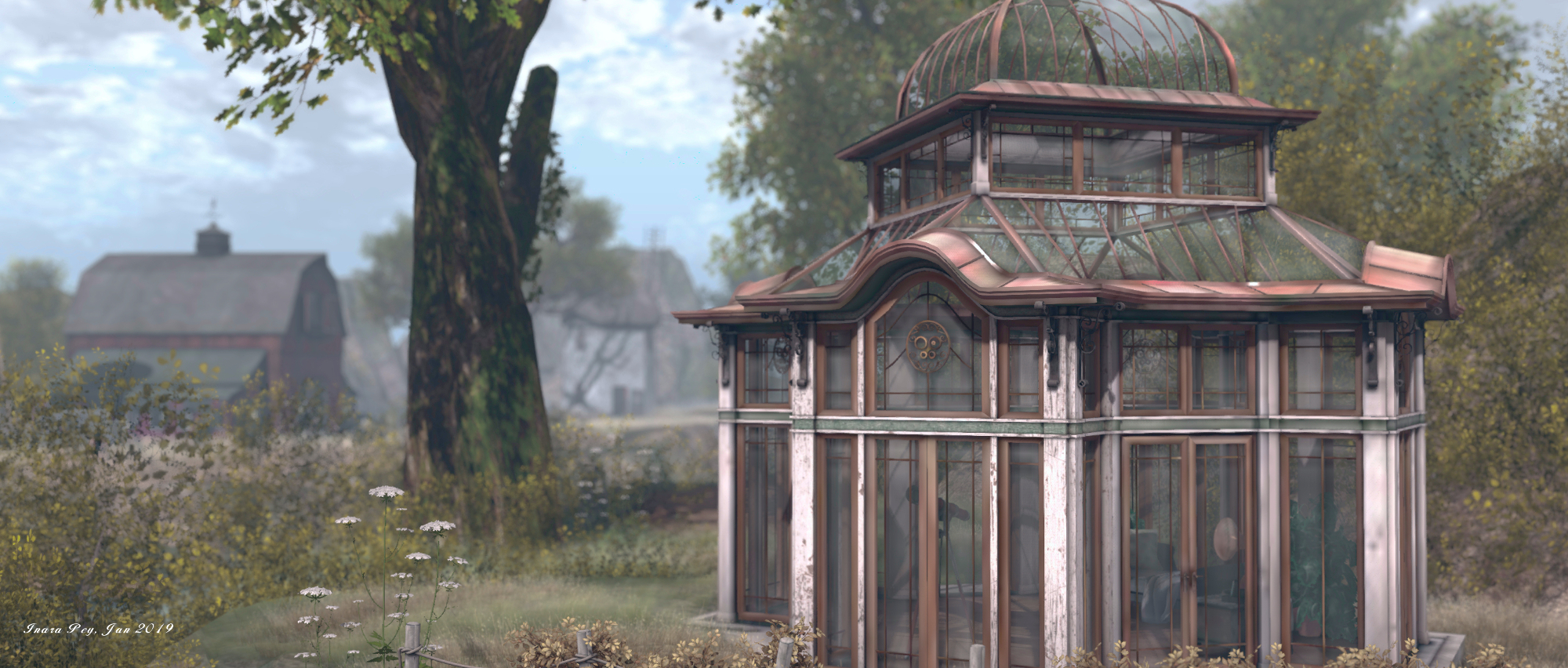
Inland from this shack, the land is split by a stream which descends in a series of low falls from the uplands on which the town sits, to finally turn south and fall into a broad pool which does much to help form the landscape of southern half of the region. In doing so, the stream gives form to a tongue of land running east from the edge of town, caught between the stream to one side and the drop down to the waters below on the other. It is home to a steel-framed conservatory, home to tropical plants within an otherwise temperate setting.

With the waters of the pool and the streams flowing outward from it, the southern side of the region is perhaps the most photogenic. Once again, paths meander around it, starting with the one descending from the town to the south-east. Here, streams flowing out from the pool cut the land into slices and give rise to very natural lowlands which are in equal part rocky, rich in plant life and with plenty of places to sit and pass the time – as well is in which to take photos.

Evergreen, July 2023

The south-eastern corner of the region is dominated by a wooden windmill overlooking the south coast. It is reached via a gravel path which curves south and west from the foot of the steps descending from the town and carried over the gorge of a stream by a covered bridge. After passing the furnished windmill, this path continues onwards to offer the best route of southern exploration.

Following it will take visitors past a pier extending out into a shallow bay (and the home of table-top games which can also be reached from a teleport station near the region’s landing point), and by more places to sit – a riverside covered picnic spot, another folly and an old bandstand – to cross another small stream before curling itself around the large pool mentioned above. It ends in at a little cottage on the east coast.

Evergreen, July 2023

All of which is a long-winded way of saying this is a region worthy of seeing first-hand; there is a lot to see and appreciate – more so than I’ve presented in the last 1,000+ words. Offered under a fairly neutral selection of environmental settings, Evergreen naturally lends itself to a broad range of EEP settings, with opportunities for photography large and small throughout.

Finished with a matching natural soundscape and given a sense of age through the scattered ruins and derelict building awaiting discovery and live via the presence of wild and domestic animal and the furnished cottages and cabins, Evergreen makes for a thoroughly engaging visit.

Evergreen, July 2023

SLurl Details

A walk through Ely’s Grand Garden in Second Life

Grand Garden, February 2023 – click any image for full size

Elyjia Baxton has a long association with regions designs in Second Life, be it those of her own, or created in collaboration with others or on behalf of others, many of which I’ve covered in these pages. So when she invited me to hop along and visit her latest work, it quickly went up towards the top of my list of places to visit.

Grand Garden, February 2023

Ely’s Grand Garden is a public space Elyjia has designed on behalf of R&G Estates. Located within Nautilus, it presents an opportunity to wander along gravel paths, view the houses offered for rent on either side and make your way through parts of the broader R&G Estate within the region – and even find your way to Ely’s own studio.

At the Grand Garden in Salerio you will find twelve intimate waterfront locations surrounded by gardens, three grand gardens to admire and walk in peaceful nature alone or with friends, one playground, and a rezzer station for boats. It is an enchanting place near the Blake Sea. Take a walk in the gardens, relax, and have fun.

– Grand Garden Destination Guide entry

Grand Garden, February 2023

The landing point sits towards the middle of the region in which the park sits, alongside one of the public pavilions within the gardens. From here the paths run in several directions, with the main one running north to hop back and forth over the stream to reach a broader waterway cutting into the region, crossed by a broad wooden bridge.

North of this, the path continues between a further stream on one side and a large natural pool on the other, fed by falls dropping from the curtain walls of rock which border the gardens here on two sides. A second path switchbacks away from the pavilion sitting alongside the pool and the channel bridge, paralleling the channel as it cuts deeper into the region.

Grand Garden, February 2023

To avoid trespass, the rental houses are set back from the public footpaths, their parcels generally marked by fences if they connect directly to the gardens, with a gate to provide renters with access to the gardens if they want.

With places to sit: benches, chairs and tables, a rowing boat rocking on the pond – while waterfowl fly overhead and rest on rocks, foxes wander the paths whilst a gentle soundscape of flow water from the streams and bird song filling the air. All of which makes for an engaging and relaxing visit.

Grand Garden, February 2023

SLurl Details

Winter’s blanket at The Four Seasons in Second Life

The Four Seasons, November 2019 – click any image for full size

Elyjia Baxton has a long association with regions designs in Second Life, be it those of her own, or those created with Brayan26 Friller, and I’ve been fortunate to cover a number of them in these pages. In 2018, she produced Snow Falls, a winter wonderland rich in detail (and later to become A Way of  Life – see: Enjoying some Snow Falls in Second Life and A Way of Life in Second Life). Now, for 2019, she has (with Brayan’s involvement) returned to the theme of Snow Falls, turning her current Homestead region The Four Seasons into another winter wonderland.

It’s a setting that has a certain Scandinavian feel in that the region is intended to be surrounded by tall, snow-capped mountains which, together with the crystal clear (and cold-looking) waters, bring to mind a location sitting within a deep fjord.

The Four Seasons, November 2019

I say “intended”, because the region seems to be a victim of BUG-225295, which can make whether or not a region surround rezzes something of coin toss. During our first visit, we saw the region entirely sans surround, for example, and when I returned to take the photos seen here, it only popped-up when I was well into the second hour of my visit, despite several attempts on my part to force it to rez.

However, whether or not the surround pops up for you is actually  – to me – neither here nor there; the region is attractive in its own right with our without the frame of mountains ringing it. In fact, I’d go so far to say that I found the lack of the surround allowed more of the colours evident in the region’s windlight setting to be better reflected within the region itself – as I hope is apparent in the majority of the photos in this article.

The Four Seasons, November 2019

Certainly, the lack of the surround, should it fail to rez for you, doesn’t actually detract from the beauty of the region, which is a wonderful mix of a low-lying landscape running south to north from the landing point, and Arctic-looking waters that cut into it to form channels and bays frozen into stillness by the cold, and on which snow is in places lying.

The landing point, with its parade of shops, offers the suggestions that beyond it, there just might be a bustling town, while the land to the north, with its wooden cabins, stone-build pavilion and gazebos and timber church, speak to the “rural” outlying regions of that town; a place where winter brings with it a sense of Yuletide spirit and celebration by means of crisp walks in the snow and cuddles under blankets before open braziers.

The Four Seasons, November 2019

From the shops and landing point, a rutted, snowy track points the north, an invitation to set forth and explore and visit places like the timber chapel, the pavilion and Santa in his gazebo. Along the way, there is plenty of detail to appreciate, from foxes to snowmen to reindeer and more. Rowing boats bravely left out on the water now sit frozen in place, offering more places to sit and appreciate the landscape.

This is very much a place that puts one in the winter spirit: the weather has been handled such that just looking at the setting makes you want to bundle up in warm clothes before going out into the snow and exploring – to the degree that I felt my avatar was positively under-dressed in jeans, shirt and western boots and at risk of catching a nasty cold!

The Four Seasons, November 2019

As well as following the main path around the region,  there’s also the opportunity to head westwards from the landing point and visit a glass-sided pavilion where shelter from the weather might be found in front of a decorated tree (although a little fireplace would help add to the appeal!). Meanwhile, across the first bridge and off to the east, a cosy little cabin offers a similar refuge from the cold, warmed by a cast iron stove.

Rounded-out by a soft sound scape over which a slightly mournful bell slowly tolls (perhaps bringing to mind the words of John Donne), The Four Seasons offers a rich, wintertime setting for the time of year, with many opportunities for photography. Those taking pictures may like to consider submitting them to the region’s Flickr group.

The Four Seasons, November 2019

With thanks to Shawn for the pointer to the region!

SLurl Details


A Way of Life in Second Life

A Way of Life; Inara Pey, January 2019, on FlickrA Way of Life – click any image for full size

Update February 27th: A Way of Life / Snow Falls has been relocated. Refer to Winter’s blanket at The Four Seasons in Second Life for more. SLurls in this article now point to that location.

A Way of Life is the name given to the latest region design by Elyjia (Elyjia Baxton), and which replaces winter’s Snow Falls (read here for more).

This is another delightful setting, carrying with it echoes of Elyjia’s previous designs, developed in co-operation with Brayan Friller (Brayan26 Friller), such as Tavana Island (read more here), the gorgeous Au Petit Jour (see here for more), the Heart of the Sea (see here for more); all of which have been wonderfully exquisite island / pastoral / coastal designs we’ve always thoroughly enjoyed visiting. But while it does carry those echoes, A Way of Life offers its own unique setting and sense of place and freedom.

A Way of Life; Inara Pey, January 2019, on FlickrA Way of Life

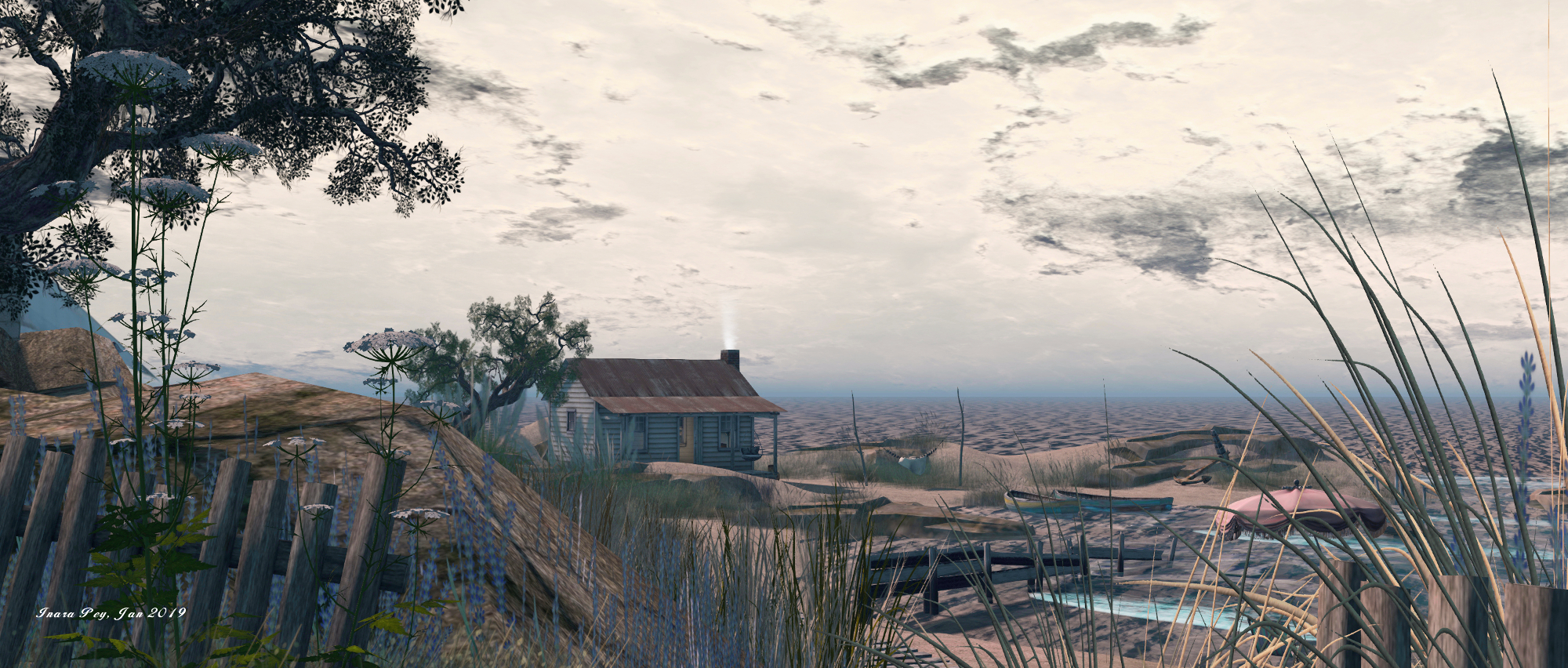
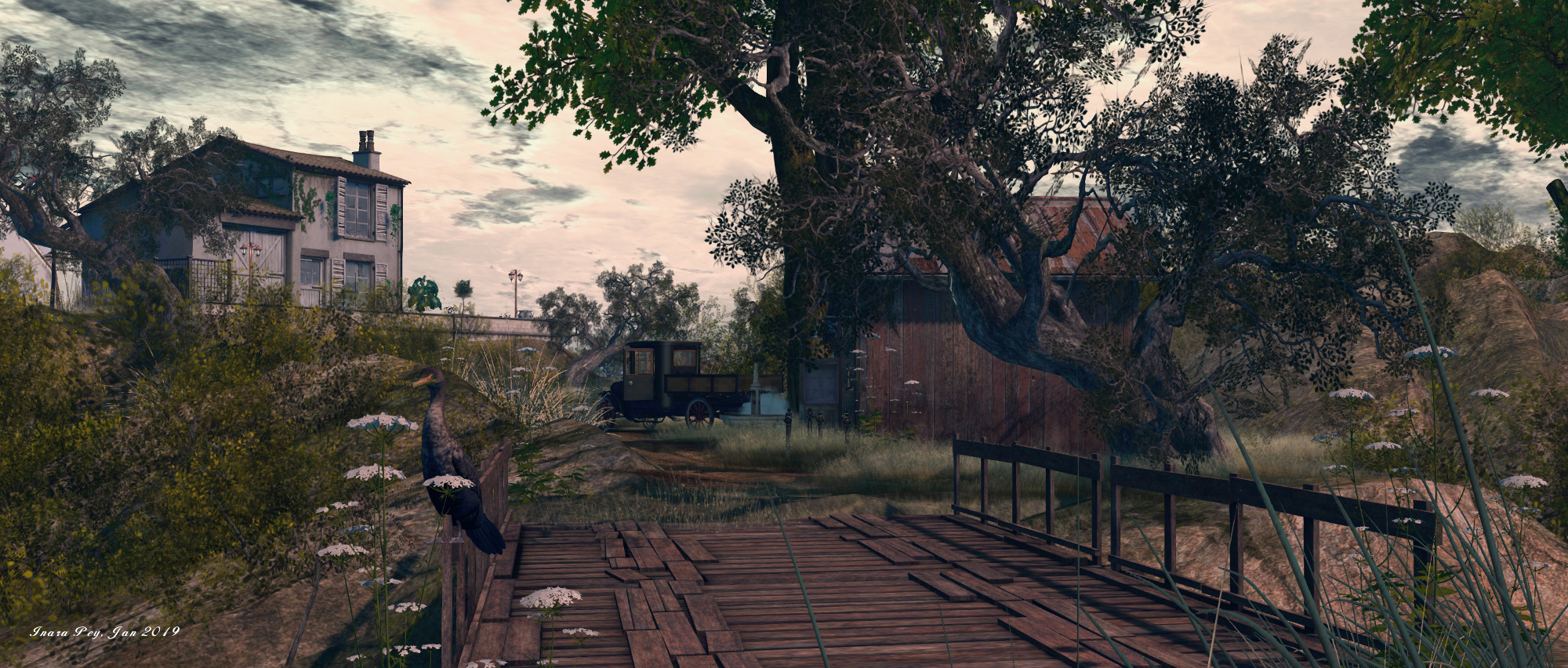
Surrounded by open sea and with two of its buildings clearly of Tuscan design / heritage, A Way of Life seems to suggest a Mediterranean setting. Perhaps it might be a part of the Tuscan Archipelago in the Tyrrhenian Sea. But a further look across the undulating island reveals structures that are perhaps more American in nature: a water tower sitting atop a great steel pylon structure, a classic wood framed and clad barn, a broken wooden windmill. Together these push the mind perhaps to an island of mixed history and settlement sitting within a more temperature region of America’s vast coastlines.

When I say “island”, I should perhaps clarify: the setting is almost a mini archipelago in its own right. While dominated by two large landmasses to the east and west, separated by a narrow channel that’s spanned by a single bridge, the region presents a number of islands of varying sizes, some occupied by structures, others the home of grass and trees or rocks and sand.

A Way of Life; Inara Pey, January 2019, on FlickrA Way of Life

Wherever it may reside, A Way of Life is clearly popular: sailing boats sit moored in the mouths of bay and channels while a large schooner appears to be passing close by to the east, sails fully unfurled in the light wind that ruffles the wave tops. The large villa to the east, with its paved terrace, folly and track winding west and south to a pavilion hiding behind the hunched shoulder of a low hill, suggests this is perhaps a holiday getaway point, or a stop-off on a coastal route followed by weekend sailors. The beach just below the villa, pointing a tongue of sand out at the sea certainly adds to this.

But then, close to the channel separating to two large islets, and on the land to the west, the presence of a workshop-like barn, together with the larger barn and water tower, suggests this might be a working island with the villa and nearby house sitting on its own small island perhaps the home to those who husband the sheep and horses under the squeak and clank of the sails belonging to a traditional European-style of windmill.

A Way of Life; Inara Pey, January 2019, on FlickrA Way of Life

It is perhaps the nature of these contrasts that make A Way of Life appealing. The aforementioned juxtaposition of European and American influences, for example. Or the contrast of Mediterranean skies with the trees and foliage suggestive of more northerly European or American climates; or the wagons and old truck (and perhaps event the schooner) hinting at a bygone era contrasting with the modern lines of the sail boats nestled around the coast. These all draw the visitor into the setting.

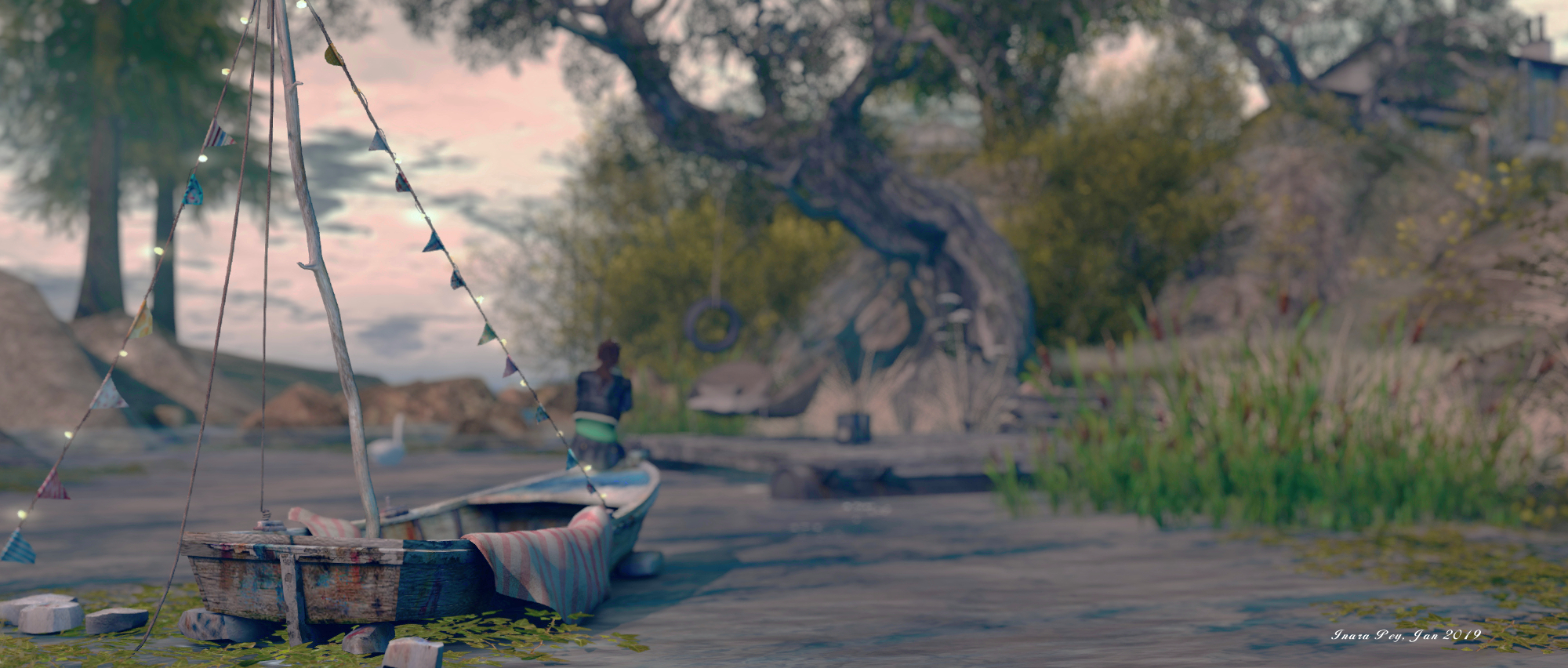
Throughout the landscape are numerous places to sits and rest and appreciate your surroundings. In this, I particularly like the little cove between villa and island house, where a small deck and a stranded old rowing boat (now converted to a little snuggle point festooned with flags and lights) can be found.

A Way of Life; Inara Pey, January 2019, on FlickrA Way of Life

Finished with a natural ambient sound scape, A Way of Life makes for an idyllic visit well suited to its name. Photographs taken within the region are welcome at the Hrodas Fen Flickr group, and  should you enjoy your visit, do please consider making a donation at one of the tip jars to help towards the region’s upkeep and future design iterations.

With thanks to Shakespeare for the nudge to re-visit Hrodas Fen.

SLurl Details