
NASA has indicated that the SpaceX Red Dragon mission to Mars, which the company plans to carry out in 2018, will likely cost around US $320 million for SpaceX to mount, ad NASA itself will spend around US $32 million over four years in indirect support of the mission.
The Red Dragon mission, first announced in April 2016, will be financed entirely by SpaceX; NASA’s costs will be related to providing technical and logistical support – such as using its Deep Space Tracking Network for communications with the vehicle.
If all goes according to plan, the Red Dragon mission could be launched as early as May 2018. It is the crucial first step along the road towards the company’s ambitions to land a human crew on Mars by the end of the 2020s. If successful, it could potentially be followed by at least three further uncrewed Red Dragon flights in 2020/22, prior to the company commencing work on building-up matériel on Mars in preparation for a crewed mission.
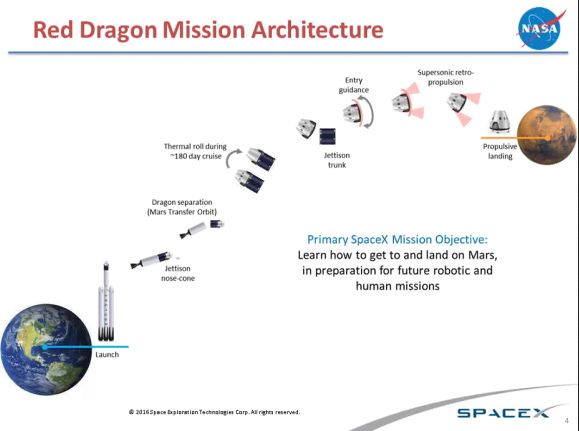
Red Dragon is the name of an uncrewed variant of the SpaceX Dragon 2 vehicle, which will enter service in 2018 ferrying astronauts to / from the International Space Station. Intrinsic to the mission is the plan to conduct a propulsive landing on Mars using the craft’s SuperDraco Descent Landing capability. This is vital on two counts.
For SpaceX, a crewed variant of the Red Dragon will likely be the Mars descent / ascent vehicle during a human mission to the planet. So understanding how it operates in the Martian atmosphere is a vital part of preparing to land a crew on the planet. NASA is similarly interested in learning how well retropropulsion works in slowing a vehicle to subsonic speeds in the Martian atmosphere, as it now looks likely they will use the same approach for their human missions to Mars, which may occur in the 2030s. Gaining the data from the SpaceX missions means that NASA doesn’t have to fly its own proof-of-concept missions all the way to Mars.
A Dragon 2 text article test-fires its eight SuperDraco engines during a hover test in 2014
Whether or not Red Dragon will fly in 2018 is still a matter of debate. SpaceX has some significant commitments and obligations on which to focus: commercial Falcon launches, resupply missions to the ISS, the start of crewed flights to the ISS, introducing the Falcon 9 into its flight operations, etc. These all tend to suggest that the development of the Red Dragon capsule, which will require some significant modifications when compared to the Dragon 2, will be subject to the company’s existing commitments taking priority over it.
In the meantime, the company plans to release more information on the overall Mars strategy, up to and including their human mission, in September.
Jupiter’s Great Red Spot: Atmospheric Heating for a Giant
As the Juno space vehicle reached the farthest point from Jupiter in its first orbit around the gas giant and begins a 23-day “fall” back towards the planet, scientists on Earth may have unlocked the secret of why Jupiter’s upper atmosphere is so warm.
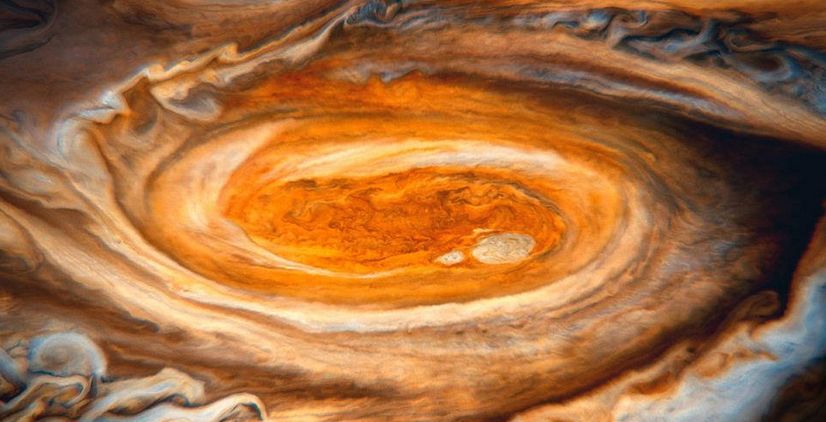
Here on Earth, the atmosphere is heated by the Sun. However, despite being five times further from the Sun than Earth, the upper reaches of the Jovian atmosphere share similar average temperatures to our own when they should in fact be a lot colder. Many theories have been put forward as to why this is the case, but now a team from Boston University, Massachusetts, believe they’ve found the answer: the heating of Jupiter’s upper atmosphere is the combined result of the Great Red Spot (GRS) and Jupiter’s aurorae.
The Great Red Spot is one of the marvels of our solar system. Discovered within years of Galileo’s introduction of telescopic astronomy in the 17th Century, it is a swirling pattern of red-coloured gases thought to be a hurricane-like storm raging down through the centuries in the Jovian atmosphere. Roughly 3 Earth diameters across, its winds take six days to complete one spin around its centre, driven in part by Jupiter’s own high-speed spinning about its own axis, completing one revolution every ten hours.
Continue reading “Space Sunday: rockets, red spots, fireballs and spaceplanes”





 Inara Pey: Living in a Modemworld