Space Sunday: lunar ambitions: the real and the not-so-real

The core stage of China’s new Long March 10 (CZ-10A variant) booster uses a single motor to ease itself into the waters of the South China Sea to await recovery after a highly successful test flight. Credit: CCTV video footage

The current “race for the Moon” is turning into a hare-and-tortoise situation on several levels, including internationally. On the one hand, there is America’s (arguably over-complicated, thanks to NASA’s insistence on the use of cryogenic propulsion to get to / from the lunar surface) Artemis programme, which seems to race along in fits and bursts (and frequently slams itself into a wall of delay) and then there is China’s more conservative “latter-day Apollo” approach, which quietly plods along, racking up achievements and milestones whilst seeming to be technologically far behind US-led efforts.

As noted, China’s approach to reaching the Moon, is something of a harkening back to the days of Apollo in that it uses a relatively small-scale crewed vehicle for getting between Earth and the Moon, and a similarly small-scale lander. However, size isn’t everything, and both crew vehicle and lander (the latter of which has a cargo variant) would be more than capable in allowing China to establish a modest human presence on the Moon, just as their Tiangong space station, whilst barely 1/4 the size of the International Space Station, has allowed them to do the same in Earth orbit. It is also important to recognise it as part of an integrated, step-by-step lunar programme officially called the Chinese Lunar Exploration Programme (CLEP) and familiarly referenced as the Chang’e Project after the Chinese Goddess of the Moon, which has allowed China to develop both a greater understanding of operations on the Moon and in understanding the Moon itself.

The Chang’e project commenced over 20 years ago, and recorded its first successes in 2007 and 2010 with its Phase 1 orbital robotic missions. This was followed by the Phase II lander / rover missions (Chang’e 3 and Chang’e 4) in 2013 and 2018 respectively, and then the Phase III sample return mission of Chang’e 5 (2020).

Currently, the programme is in its fourth phase, an extensive study of the South Polar Region of the Moon in preparation for human landings, nominally targeting 2030. This phase of the programme has already seen the highly successful Chang’e 6 mission, the first to retrieve surface samples from the Moon’s far side, as well as deploying a rover there. 2026 will see Chang’e 7 launched, a high concept resource seeking mission comprising an orbiter, lander and “lunar flyer”, all geared to locate resources which can be utilised by future missions.

China’s Chang’e 6 mission, launched in May 2024, was the first Chinese mission to the far side of the Moon, and the first mission to ever return samples gathered from the lunar far side and return them to Earth (June 2024). In this image, Chang’e 6 is seen from the Jinchan mini-rover, which piggybacked a ride to the Moon with the lander. Credit: CNSA.

In 2028, the last of the Phase IV mission will launch. Chang’e 8 is intended to be a combination of in-situ resource utilisation (ISRU) test bed, demonstrating how local materials (water ice, regolith) can be used to produce structures on the Moon via advanced 3D printing, and to establish a small ecosystem experiment in advance of human landings.

This approach means that from a standing start, China has replicated much of NASA’s work of the 1960s that helped pave the way for Apollo, but in much greater depth. It’s not unfair to say that by retuning such a focused series of mission phases – notably Phase IV – China potentially will develop a greater spread of knowledge concerning the Moon’s South Polar Region than NASA.

At the same time, China has been developing the hardware required for the human side of the Chang’e Project. This primarily takes the form of their Mengzhou (“Dream Vessel”) reusable crewed vehicle, the Lanyue (“Embracing the Moon”) 2-stage lunar  lander / ascent vehicle and the Long March 10 semi-reusable heavy lift launch vehicle (HLLV) offering a very similar capability to Blue Origin’s New Glenn vehicle.

Mengzhou is being developed in two variants: a low Earth orbit (LEO) variant, designed to ferry crews to / from the Tiangong space station. The second is being developed expressly for lunar missions, offering an increased mission endurance capability. The first uncrewed orbital test-flight for the 14-tonne LEO version of Mengzhou is due to take place in 2026, the system having been going through progressive flight tests throughout the 2010 and early 2020s. If successful, it will pave the way for the vehicle to start operating on crewed flights to Tiangong alongside the current Shenzhou craft, which it will eventually replace.

Launch of the CZ-10A and Mengzhou test vehicles, February 11th, 2026. Credit: CCTV

On February 11th, 2026, a test article of the 21-tonne Mengzhou lunar vehicle completed a significant test atop the core reusable stage Long March 10 (Chinese designation CZ-10A) booster. This was a combined mission to test both the Mengzhou launch abort system (LAS) whilst under the rocket’s maximum dynamical pressure flight-regime, and also the booster’s ability to complete an ascent to its nominal stage separation altitude of 105 km, and then make a controlled descent and splashdown close to its recovery ship.

Following a successful launch, the combined vehicle climbed up to the period of “Max Q”, around 1 minute into a flight and wherein the maximum dynamic forces are being applied to the entire stack. The Mengzhou LAS successfully triggered, boosting the vehicle away from the Long March core stage at high speed. The Mengzhou capsule then separated from the LAS performed a splashdown downrange.

The Mengzhou LAS powers away from the CZ-10A corse stage, carrying the Mengzhou capsule with it, as would be required should a critical malfunction occur with the Long March 10 rocket. Credit: CCTV
The Long March 10 core stage then continued a powered ascent profile, performing engine shutdown at 105 km before simulating an upper stage separation followed by a post-separation manoeuvre. This saw the stage enter “glide” phase, using its aerodynamic fins to maintain its orientation.

During this “glide” phase (actually a controlled descent, the stage orienting itself to fall engines-first), the booster carried out an automated pre-cooling of its engines in readiness for re-use and raise the pressure within the propellant tanks to settle their contents in readiness for engine re-use.

Cameras on the booster capture the deployment of the SpaceX-like grid fins on the upper end of the stage, which help it to maintain the correct orientation during its descent back to Earth. Credit: CCTV

Roughly one minute before splashdown, several of the engines successfully re-lit in a braking manoeuvre to bleed off much of the stage’s velocity. These were quickly reduced to just 3 motors and then a single motor as the stage came to a near-hover before that motor shutdown allowed it to settle smoothly and vertically in the water just 200 metres abeam of its recovery ship.

As an aside, it is interesting to contrast reporting on this flight with media coverage of SpaceX Starship “integrated flight tests”. In the case of the latter, almost every flight has been reported as some kind of spectacular success, despite most of the flights blowing up, barely meeting their assigned goals, or simply re-treading ground already covered. By contrast, the Mengzhou / CZ-10A core stage test flight has largely been defined as a “small step” in China’s progress, with some emphasising the flight “not reaching orbit” – which it was never intended to do.

In reality, the entire flight was a complete success. Not only did it demonstrate the Mengzhou vehicle’s LAS fully capable of lifting the command module and crew clear of an ascending CZ-10A should the latter suffer a malfunction during the most dynamically active phase of it flight, it also further demonstrated the capsule’s parachute descent system and its ability to make a recoverable splashdown (Mengzhou is capable of both water and land-based touchdowns, being able to be equipped with either a floatation device or airbags prior to launch).

Another still from the video of the test flight, showing the booster entering the see and its proximity to the recovery vessel, just visible on the right of the image. Future tests will see the recovery vessel attempt to “catch” a returning booster directly using a “tether” system. Credit: CCTV

Further, the test demonstrated the CZ-10A core stage’s ability to undertake a return to Earth and splashdown (again, the booster is designed to both land on a recovery ship a-la Falcon 9 and New Glenn, or make a splashdown close enough to the recovery ship so it can then be recovered – direct returns to the recovery vessel will be a part of future tests). Finally, such was the accuracy of the guidance systems, the rocket splashed down just 200 metres from the recovery ship, as planned.

That said, it is true that all the core components of the crewed phase of the Chang’e project still have a way to go before China can send a crew to the Moon. But like the tortoise, their one-step-at-a-time / keep-it-simple approach could yet see them become the first nation to do so since 1972.

Why SpaceX is most likely “Shifting from Mars to the Moon”

Thirteen months ago, in an attempt to bolster his failing “Mars colony plan” (a totally unrealistic fever dream of sending a “Battlestar Galactica” scale feet of 1,000 Starship vehicles carrying 1 million people to Mars to establish a colony there), the SpaceX CEO declared “the Moon is a distraction” and Mars was the focus for his company.

Well, he’s had 13 months to forget all that, as on the weekend of February 7th and  8th, 2026, the self-styled man who “knows more about manufacturing than anyone else alive on Earth” and yet cannot deliver on a single one of his manufacturing promises, declared that the Moon is now the focus of SpaceX’s endeavours, all as a part of a grand plan to “expand human consciousness and support his equally questionable idea of operating a 1-million strong constellation of Starlink satellites as a string of “data centres in space”. For good measure he mixes in terms such as “climbing the Kardashev scale” )the latter seems to be a particular reference point for so-called space entrepreneurs of late).

However, the real reason is liable to be far more mundane: the SpaceX CEO is again trying to justify the US $1.2 trillion valuation he and his fellow broad members arbitrarily awarded the company in January, and to justify such a figure in the face of an upcoming IPO whilst also possibly trying to further dazzle investors with shiny promises about orbital data centres and moon bases at a time when SpaceX has just “inherited”xAI and its cash burn-through of around US $1 billion a month.

The promise of a fully operational “Moon Base Alpha” (yes, once again we have a sci-fi trope to add gloss to an idea) in “10 years” will, undoubtedly go the same way as the more than a decade old claim that Tesla vehicles will be capable of full self driving “next year”; the statement that SpaceX would have Starship operational by 2022, and that Starship would fly around the Moon in 2023 and to Mars in 2024, err, 2026, err, 2028. That is to say, most likely never.

Martian Organics Cannot be Entirely Explained by Non-organic Processes

One of the major mysteries of Mars is the question of methane. It was first detected in more than faint trace amounts by the European Space Agency’s Mars Express mission in 2004. A decade later, NASA’s Mars Science Laboratory (MSL) rover Curiosity,  detected methane spikes and  organic molecules whilst exploring the floor of Gale Crater. Then in 2019, the rover a massive spike as it explored “Teal Ridge”, a formation of bedrock and deposits on “Mount Sharp” (Aeolis Mons).

Alongside of this is the vexing discovery of organic elements on Mars. These and the methane seem to point a finger towards the idea that the planet may have once harboured life. However, as even proponents of this idea point out, both organics and methane can result from purely inorganic interactions. The tick is – how to determine which might be the case.

An artist’s rendering of Curiosity at work in Gale Crater. Credit: NASA

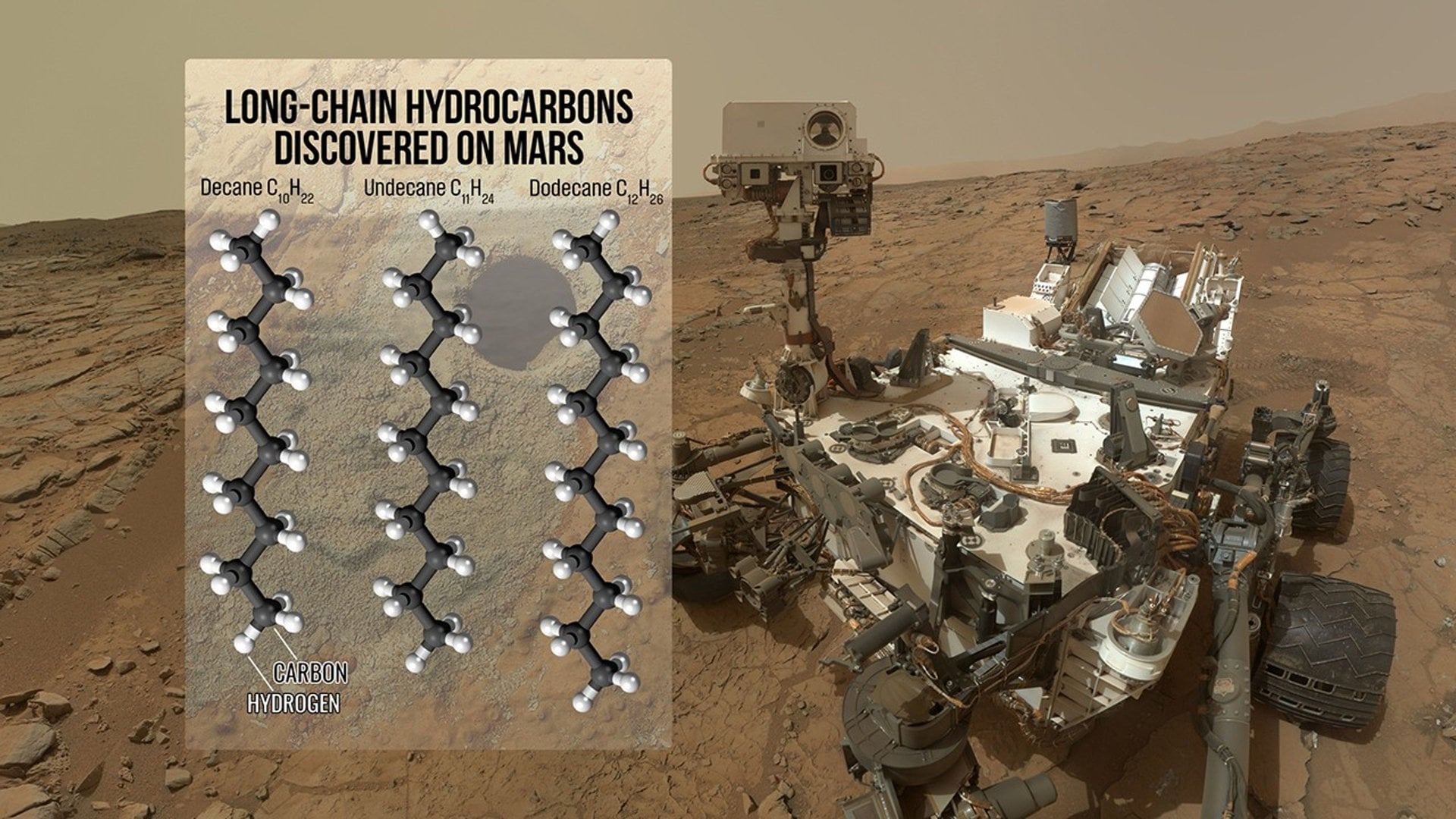
In March 2025, Curiosity detected small amounts of decane, undecane, and dodecane in a rock sample, which constituted the largest organic compounds found on Mars to date. These offered the potential to determine which option might be more likely to cause their existence – organics or inorganic chemical reactions. All three are hydrocarbons could be fragments of fatty acids, also known as carboxylic acid.

On Earth, carboxylic acid (aka fatty acids) is a natural by-product of life. Such acid can be found in animal tissues, nuts and seeds. In the case of animal tissues, carboxylic acid is predominantly formed by the breakdown of carbohydrates by the liver and found within adipose tissue, and the mammary glands. however, they can also be created by inorganic reactions – such as lightning striking chemically rich soils (or regolith), hydrothermal interactions and photochemical reactions between ultraviolet radiation and hydrocarbon-rich mixtures.

In order to try to determine whether the fatty acids discovered by Curiosity preserved in ancient mudstone are the result of organic processes or inorganic. Whilst limited with working only with data from the rover’s Sample Analysis at Mars (SAM) spectrometer, the team sought to recreate the likely conditions on Mars some 80 million years ago – this being the amount of time the rock containing the acids would likely have been exposed to the surface atmosphere – and then work back from there to try to determine which would survive the longest: carboxylic acid produced by organic or inorganic means.

What they found was that organic mechanisms appear to leave far more in the way of organic remnants – such as decane, undecane, and dodecane – than the typical non-biological processes involved in forming carboxylic acid could produce. The team suggest that this might be because any organics responsible for the fatty acids might have been assisted by periodic impacts by carbonaceous meteorites, known to be sources of fatty acids formed in space.

A graphic shows the long-chain organic molecules decane, undecane, and dodecane, the largest organic molecules discovered on Mars to date. Credit: NASA/Dan Gallagher

However the team also urge caution: whilst their finding might move the needle further towards the idea that Mars once harboured life, they also clearly note that there is a need for greater study; Mars is a complex world, rich in complex interactions. As such, more and detailed study is required – preferably first-hand, through the obtaining of samples from Mars itself. Currently, and rather ironically, whilst NASA had planned to make samples from the Mars 2020 rover Perseverance available for return to Earth, these do not contain samples of a similar nature to those found by Curiosity.

More particularly, at the time Perseverance had launched to Mars with sample retrieval in mind, no-one had actually sorted out how such a retrieval might be achieved. As such, a series of highly complicated, overly expensive proposals were put forward, involving both US and European co-operation. Each of these were knocked down on the basis of complexity and escalating price – up to US $11 billion – or close to half of NASA’s overall budget – for such a mission was just too big an ask. Thus, despite more cost-effective proposals such has Rocket Lab’s (still complex) three-launch mission slated to cost a “mere” US $4 billion, the entire idea of a sample return mission has been cancelled as a result of NASA’s budget being tightened.

Space Sunday: China’s ambitions, telescopes and SLS

Sunrise as seen from the Tianhe core module of China’s Tinagong space station ahead of the arrival of Shenzhou-12. Credit: China National Space Administration / China State Media

Shenzhou-12, China’s first crewed mission to orbit in almost 5 years, lifted-off from the Jiuquan Satellite Launch Centre in northwest China at 01:22 UTC on the morning of Thursday, June 17th, heading towards the Tianhe core module of the country’s new space station.

Carried aloft by a Long March 2F booster, the mission comprises three taikonauts Nie Haisheng (mission commander) and Liu Boming, both of whom have previously flown in space, and rookie  Tang Hongbo. Together, they will spend three months at the space station, putting it through a series of commissioning tests and operations.

The Long March 2F carrying Shenzhou-12 mission lifts-off from the Jiuquan Satellite Launch Centre, June 17th (UTC), 2021. Credit: China Stat Media

Following launch, the Shenzhou vehicle performed a rapid chase-and-catch with the Tianhe module, docking with it some 6 hours 32 minutes later. In doing so, it became the second vehicle to dock with the module, the first being the Tianzhou-2 resupply vehicle which delivered essential supplies and equipment to the fledgling space station at the end of May 2021.

Overall, Shenzhou-12 is the the third of eleven flights China has planned between now and the end of 2022 in order to complete the Tinagong station, the first having been the Tinahe module itself. These launches will include two science modules and additional Shenzhou crew and Tianzhou resupply missions.

The Shenzhou-12 crew aboard Tianhe. Form left to right: Tang Hongbo, mission commander  Nie Haisheng and Liu Boming. Credit: China State Media

The flight of Shenzhou-12 also marked the first time China has used the chase-and-catch approach to orbital rendezvous. It is a technique both Russia and the United States have started to employ in order to more quickly deliver cosmonauts and astronauts to the International Space Station; for China, it meant reducing a typical two-day rendezvous time seen with the earlier Tiangong orbital laboratories to just the 6+ hours seen in this flight.

Prior to launch, the crew were treated to a parade and celebration by members of the People’s Liberation Army and their families (there is no real civil / military distinction in China’s human spaceflight operations), whilst their arrival and boarding the Tinahe marked the first time since May 2000 that two orbiting space stations have been simultaneously inhabited – back then it was the ISS and Russia’s soon-to-be-decommissioned Mir. Now it is the ISS and the nascent Tiangong station.

Ahead of the launch and during an international conference on space development, China joined with Russia in formally announcing the International Lunar Research Station (ILRS), intended to serve as ” a comprehensive scientific experiment base built on the lunar surface and on [sic] the lunar orbit”, inviting international partners to join them.

ILRS is seen as something of a competitor to the American-led Artemis programme, and during the presentation  representatives of Russia’s Roscosmos and the China National Space Administration (CNSA) indicated that ILRS will (like Artemis) combine a Moon-orbiting space station with a surface base in the lunar south polar region.

First announced in March 2021, after Russia rejected US overtures to be a part of Artemis, the ILRS looks set to undergo a rapid cycle of development. China and Russia anticipate working together between 2021 and 2025 to select the preferred location for the lunar base, with actual deployment and construction to commence in 2026 and continue through until 2036. During the construction phase, the two countries plan to place a station into cislunar space which will act as a waystation between their orbital facilities in Earth orbit and the lunar base (China will use their Tiangong station at the “earth end” for flights to / from the Moon, and Russia will use its recently-announced new space station, which it intends to have operational by 2030).

An artist’s impression of the Russia-China ILRS, showing the main pressurised facilities in the foreground, solar power facilities to the right and communications arrays in the background. Credit: Roscosmos / CNSA

According to both countries, the focus of ILRS will be to “carry out multi-disciplinary and multi-objective scientific research activities including exploration and utilisation, and lunar-based observation.” They further indicated that the European Space Agency (ESA), Thailand, the United Arab Emirates and Saudi Arabia have all declared an interest in joining the project.

And if that weren’t enough, China has also announced it intends to develop the means to establish a long-term / permanent human presence on Mars.

Speaking at the same event at which the ILRS was officially confirmed, Wang Xiaojing, president of the China Academy of Launch Vehicle Technology (CALT), unveiled an ambitious programme that would see China extend is robotic exploration of Mars before moving to more extended automated missions using chemical rockets to deliver ISRU (in-situ resource utilisation) missions for the production of air, water and fuel through locally-available resources. From there, Wan indicated the country would start delivering payload missions to Mars aimed at supporting a human presence.

For actual crewed missions, Wan said China would use nuclear-powered “ferries” operating between Earth and Mars, dramatically reducing flight times. Built in Earth orbit, these would eventually become “cyclers”, with two or possibly three craft looping between the two planets, with crews and their equipment launching from Earth to join one for the trip to Mars, and then at the end of their mission hitching a ride home on another of the ferries as it swings around Mars.

No time frames for when all this might happen were given, and China has a huge mountain to climb in terms of technology development – ISRU system, life support systems, operating human missions in deep space (and with suitable solar / cosmic radiation protection). It also has to develop the planned nuclear thermal engines the “ferries” would use and gain experience in operating them and ensuring they don’t add radiation exposure risks to crews . All of this, coupled with the ILRS plans, likely means China will not be in a position to undertake any kind of human mission to Mars before the 2040s, even if Wan’s presentation turns into a programme.

Continue reading “Space Sunday: China’s ambitions, telescopes and SLS”

Space Sunday: selfies, missions, budgets and rockets

Zhurong and its lander. Credit: CNSA

You would be forgiven for thinking the banner image for this update is an artist’s impression of China’s Zhurong rover and its lander on Mars. But you’d be wrong – the image really was taken on Mars.

It is part of a batch of images the China National Space Administration (CNSA) have released charting the recent activities of their rover on the Red planet, and they are as remarkable as anything seen with the US rover vehicles, with others showing panoramic views around the rover and shots of its lander vehicle.

The Zhurong lander, part of China’s Tianwen-1 Mars mission., as seen from the rover vehicle at a distance of some 6 metres. Credit: CNSA

Captured on June 8th, the image of rover and lander was taken by a remote camera originally stowed in Zhurong’s belly, and which had been safely deposited on the surface of Mars some 10 metres from the lander, allowing mission control to remote capture the unique sight of a rover and its lander side-by-side.

Zhurong has now completed the first third of its initial 90-day mission on Mars, and is well into its survey of its surroundings within Utopia Planitia. In addition to the high-resolution cameras, used to produce these images, the rover is fitted with a subsurface radar instrument, a multi-spectral camera and surface composition detector, a magnetic field detector and a weather monitor.

A 360 panorama of the Zhurong landing site, captured by the Chinese rover prior to is descent from the back of its lander. Credit; CNSA

Ahead of the images released by CNSA, NASA released their own image of the Chinese rover and lander as seen by the HiRISE camera on the Mars Reconnaissance Orbiter  from an altitude of around 400 km.

Taken on June 6th, three weeks after Zhurong touched-down, the image clearly shows green-tinted lander (a result of the image processing, not the actual colour of the lander) sitting between two areas of surface material discoloured by the thrust of the lander’s outward-angled descent and landing motors. Zhurong itself can be seen a short way south of the lander, within the eastern arc of discolouration.

Captured by the HiRISE imager on NASA’s Mars Reconnaissance Orbiter on June 6th, this image shows the Zhurong lander surrounded by surface material discoloured by the lander’s rocket motors, with the rover sitting just to the south. Credit: NASA/JPL

And turning to NASA’s surface mission on Mars (specifically Mars 2020): on June 8th, the Ingenuity helicopter completed a 7th flight, this one error-free.

Lifting off at around 12:34 local mean solar time (roughly 15:54 UTC on Earth) proceeded south during the 63-second flight, covering a distance of around 106 metres before touching down at a new location.

Ingenuity captured this image of its shadow passing over the surface of Mars on June 8th, 2021 during its 7th flight. Credit: NASA/JPL

In difference to the 6th flight on May 22nd, which saw the helicopter encounter some anomalies (see: Space Sunday: Martian Clouds, Lunar missions and a Space Station), the seventh flight was completed with incident, once again raising confidence that the helicopter will be able to continue flying several more times.

Overlaid onto an image be NASA’s Mars Reconnaissance Orbiter are the routes for the first and second science sorties to be made by Perseverance. Credit: NASA/JPL

Now regarded as fully commissioned, Perseverance has put its duties as caretaker-watcher for Ingenuity largely behind it, as is now driving south and away its landing zone on its way to study a 4 square kilometre of crater floor, where it will examine two very different geological units and collect samples for analysis and for storage and possible return to Earth as part of a future mission.

“Crater Floor Fractured Rough” is a region of ancient bedrock, whilst “Séítah” (Navajo for “amidst the sand”) presents a mix of bedrock overlaid with more recent ridges and also sand dunes. The rover will perform a gentle loop through these areas, visiting “Crater Floor Fractured Rough” first then travelling through the ridgelands and then back up through “Séítah S” and Séítah N”, before heading for its next target, an area dubbed “Three Fours”.

ESA Looks to Venus and the Outer Planets

The European Space Agency has announced its goals for the next several decades in terms of robotic exploration of the solar system and cosmic science.

Announce on June 10th, the EnVision mission will carry a suite of spectrometers, sounders and a radar to study the interior, surface and atmosphere of Venus. The target launch period is May 2032, with the vehicle arriving in orbit around Venus in August 2033, where it will use the planet’s upper atmosphere to aerobrake into its final science orbit over a 3-year period, before commencing its four-year primary mission. It  is expected to cost around 500 million Euros.

ESA plans to further extend our knowledge and understanding of Venus with the EnVision mission, due to launch in 2032. Credit: ESA

While there has been no coordination between NASA and ESA in terms of mission selection, EnVision’s science mission is highly complementary to the two NASA missions – VERITAS and DAVINCI+ – also recently announced, covering aspects of Venus science they do not. Further, ESA will be flying science packages on VERITAS, and NASA will be providing the synthetic aperture radar for EnVision.

EnVision is the fifth M-class mission ESA has selected as part of the Cosmic Vision program. The first, Solar Orbiter, was launched in February 2020, and three others are in development: Euclid, a mission to map dark matter and dark energy to launch in 2022; Plato, an exoplanet search mission launching in 2026; and Ariel, an exoplanet characterisation mission launching in 2029.

In addition To EnVision, ESA intends to spend the next several decades developing  missions to follow after the Jupiter Icy Moons Explorer, that will help assess the habitability of the icy moons in the outer solar system and seek any biosignatures they may have. At the same time ESA intends to support further science endeavours aimed at increasing our understanding of our own galaxy and the likely state and development of the early universe.

Continue reading “Space Sunday: selfies, missions, budgets and rockets”

Space Sunday: Martian clouds, lunar missions and a space station

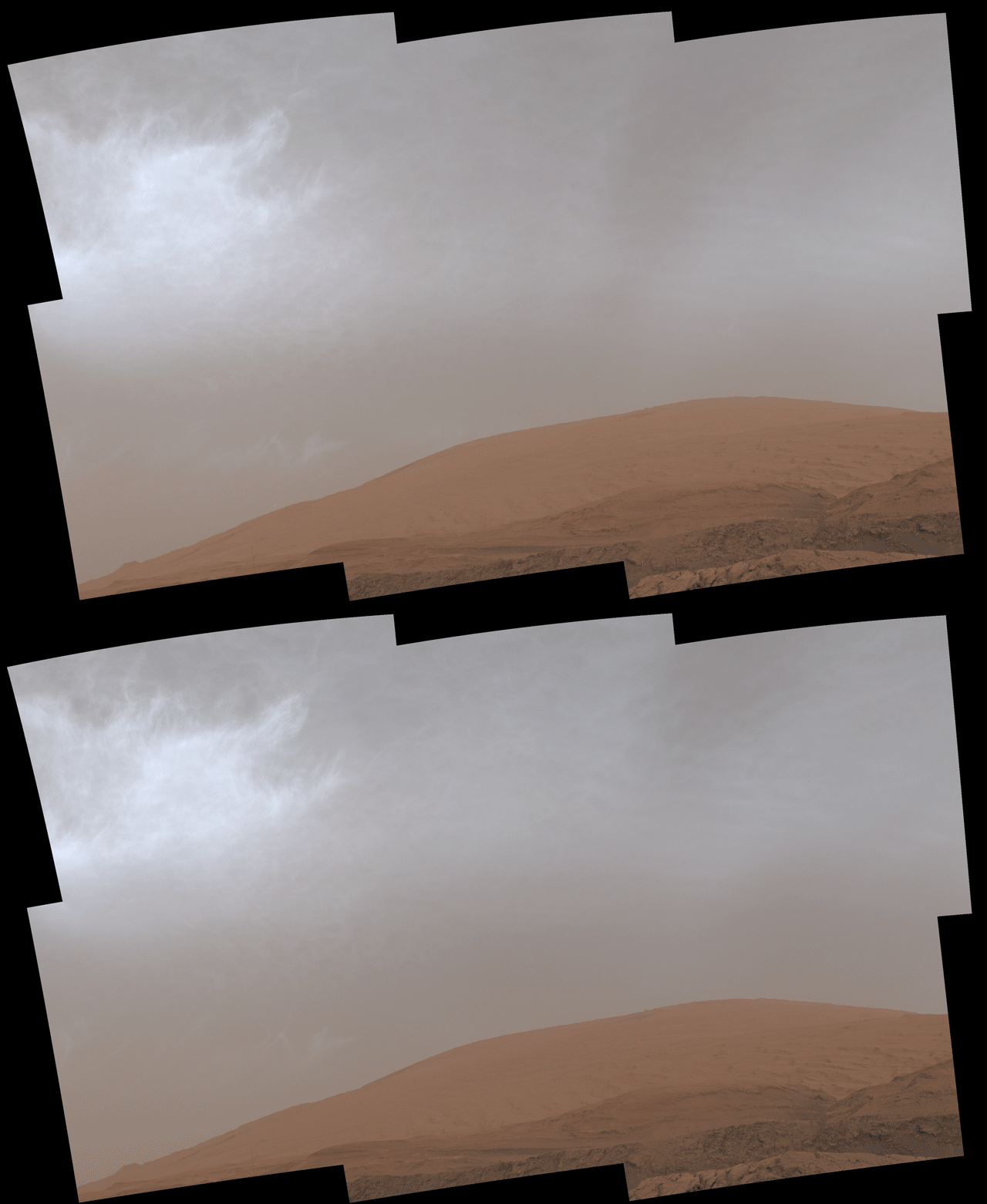
NASA’s Curiosity Mars rover captured these clouds during the twilight period on March 19, 2021, the 3,063rd Martian day, or sol, of the rover’s mission. The image is made up of 21 individual images stitched together and colour corrected so that the scene appears as it would to the human eye. The clouds are drifting over “Mont Mercou,” a cliff face that Curiosity has been studying on “Mount Sharp”. Credit: NASA/JPL

Clouds are rare on Mars, but they can form, being typically found at the planet’s equator in the coldest time of year, when Mars is the farthest from the Sun in its oval-shaped orbit. However, in 2019 – a year ago in Martian terms – the Mars Science Laboratory team managing NASA’s Curiosity rover in Gale Crater noticed the clouds there forming earlier than expected.

With the onset of winter in the region earlier in 2021, the MSL team wanted to be ready in case the same thing happened, training the rovers cameras on the sky around “Mount Sharp” to catch any evening cloud formations that might appear as the tenuous atmosphere cooled towards night-time temperatures.

Clouds moving over Mount Sharp, as captured by Curiosity on March 19th, 2021. Credit: NASA/JPL

What resulted are images of wispy puffs filled with ice crystals that scattered light from the setting Sun, some of them shimmering with colour. Visible through both the black-and-white lenses of the rover’s navigation cameras and the high-resolution lenses of the Mastcam system, the pictures captured by Curiosity might easily be mistaken for high-altitude clouds here on Earth.

And high altitude is precisely the term to use for this clouds. Most clouds on Mars largely comprise water vapour and water ice. They tend to occur some 60 km above the planet, although they can occur much lower – the massive shield volcano of Olympus Mons, for example, has oft been images with cloud formations around its  flanks, the product of differing atmospheric temperature regimes on the slopes.

However, the clouds seen by Curiosity are believed to be far higher than 60 km in the Martian atmosphere, and are thought to be largely composed of frozen carbon dioxide (dry ice). They occur during the twilight hours – although the mechanism that gives rise to them is not fully understood; but they are thin enough for sunlight to pass through them, catching the ice crystals and causing them to shimmer for a time before the Sun drops below their altitude, causing them to darken. This effect gives them their name: noctilucent  (“night shining”) clouds.

These clouds are best seen in the black and white images captured by the rover’s Navcams, as shown here. However, there is a second form of clouds best seen via Curiosity’s Mastcam colour images. These are iridescent, or “mother of pearl” clouds, rich in pastel colours.

Mother of Pearl clouds spotted by Curiosity in March 2021. Credit: NASA/JPL

They are the result of the cloud particles all being nearly identical in size, something that tends to happen just after the clouds have formed and have grown at the same rate. The colours are so clear, were you able to stand on Mars and look at the clouds, you’d see the shades with your naked eye, and they are another part of the beauty of Mars.

Ingenuity Hiccups During Sixth Flight

NASA’s Mars helicopter Ingenuity encountered some trouble on its sixth flight – the first flight of its extended mission  – on May 22nd.

The flight should have seen the helicopter climb to a height of 10 metres, then fly some 150 metres south-west of its starting point to reach a point of interest where it would travel south for 15 metres, imaging the terrain around and below it for study by scientists on Earth, before making a return to a point close to where it lifted-off.

This image was taken from the height of 10 metres by NASA’s Ingenuity Mars helicopter during its sixth flight on May 22, 2021. Credit: NASA/JPL

The flight was designed to be the first specifically targeted at testing the helicopter’s ability to be used in support of ground operations on Mars, offering the mission team the chance to determine if the area images might be worth a future foray by the Mars 2020 Perseverance rover.

However, 54 seconds into the flight, Ingenuity suffered a glitch that interrupted the flow of images from its navigation camera to its onboard computer. This meant that each time the navigation algorithm performed a correction based on a navigation image, it was operating on the basis of incorrect information about when the image was taken, leading to incorrect assumptions about where it was and what it should be doing.

This lead to Ingenuity pitching and rolling more than 20 degrees at some points during the flight as it struggled to return to its landing zone, post-flight telemetry revealed the helicopter experienced some significant power consumption spikes. However, it maintained its flight and  executed a safe landing just 5 metres from the intended touch-down point.

In a very real sense, Ingenuity muscled through the situation, and while the flight uncovered a timing vulnerability that will now have to be addressed, it also confirmed the robustness of the system in multiple ways. While we did not intentionally plan such a stressful flight, NASA now has flight data probing the outer reaches of the helicopter’s performance envelope That data will be carefully analysed in the time ahead, expanding our reservoir of knowledge about flying helicopters on Mars.

Håvard Grip, Ingenuity’s chief pilot.

Making the Moon a Busy Place

It’s starting to look like the Moon is going to be a terribly busy place. NASA’s Artemis programme is gathering pace in several areas – despite a degree of in-fighting among the principal US contractors – Russia and China have signed an accord that is liable to see them operating in the lunar south pole regions alongside the US-led mission (although the two will remain separate mission entities), whilst Canada and Japan have announced missions to the Moon as a part of the overall Artemis framework, and NASA is seeking ideas from lunar rover vehicles.

The in-fighting revolves around NASA’s April announcement that SpaceX will be granted a sole contract to develop the HLS – Human Landing System – the vehicle that will place humans on the surface of the Moon and return them to orbit. It was a contentious decision; the US agency had previously indicated that two contracts for HLS would be granted, with three players involved: a team led by Jeff Bezos’ Blue Origin, a team led by Dynetics, and the late-comer to the party, SpaceX.

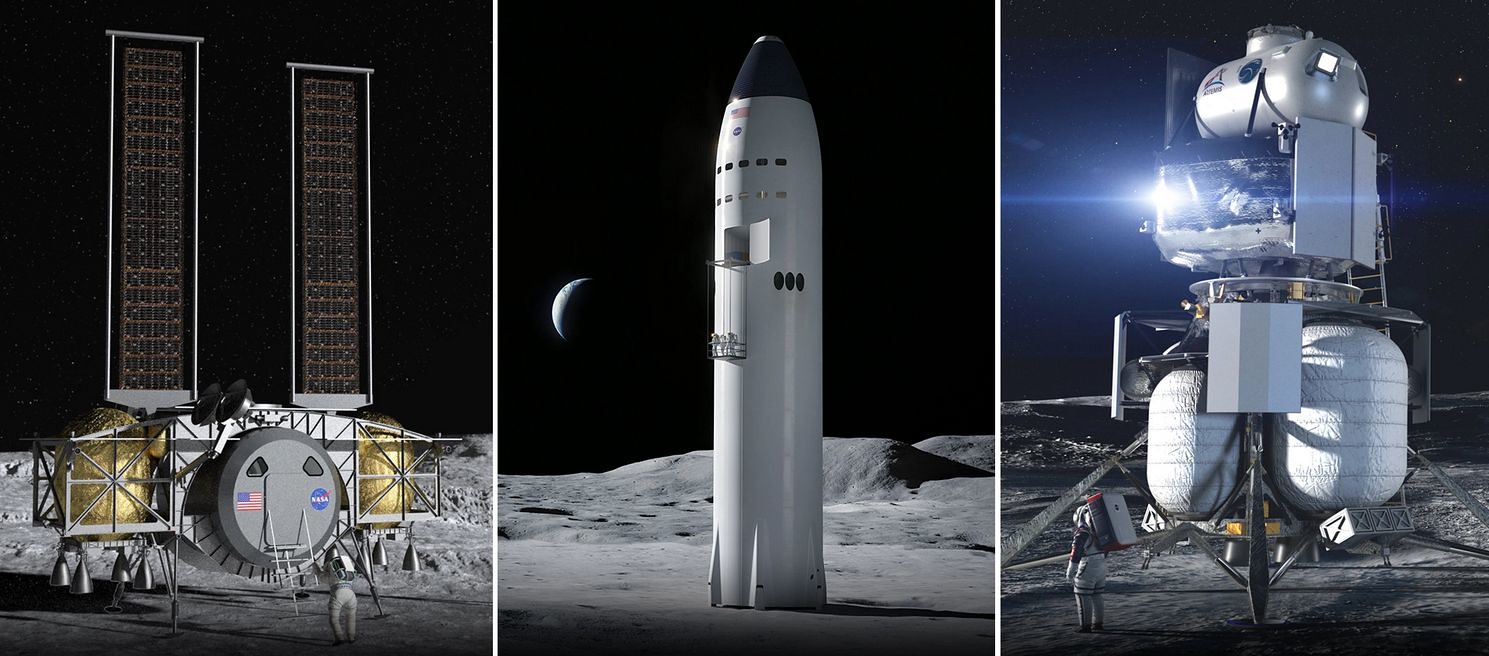
The three proposals for NASA’s Human Landing System vehicles that had been under consideration for the Artemis programme. Left: the Dynetics lander / ascent vehicle; centre: the modified SpaceX Starship NASA has opted for; right: the National Team’s descent / ascent modules. Credit: NASA

There were several leading reasons for the decision – including the matter of cost. However, both Dynetics (potentially with the most flexible approach to HLS) and Blue Origin raised objections with the Government Accountability Office (GAO), which ordered NASA to cease any financial support to SpaceX (worth a total of US $2.9 billion) to the SpaceX effort until it has completed an investigation.

The US Senate has also weighed-in on the subject, with Senator Maria Cantwell (D-Wash.), chair of the Senate Commerce, Science and Transportation Committee, adding an amendment to the Endless Frontier Act which forms the backbone for financing the Artemis programme, requiring NASA put a further US $10 billion into HLS – whilst Senator Bernie Sanders (D-Vermont) went the other way by calling for the cancellation of the entire HLS programme, wrongly characterising it as the “Bezos Bailout”, and so doing what he does best; creating further division and confusion.

As it is, the GAO will release its findings on the matter in August, and while it is hard to ascertain the impact of the delay, it would likely further diminish NASA’s chances of achieving the original goal of a return to the Moon by the end of 2024.

NASA’s Nancy Grace Roman Space Telescope has been targeted for continued financial support by the Biden administration, potentially ending ill-conceived attempts by the previous administration to axe the project.  Credit: NASA Goddard Space Flight Centre / CI Lab

Continue reading “Space Sunday: Martian clouds, lunar missions and a space station”