Sansar Product Meetings week #29: UGC quests and the XP system

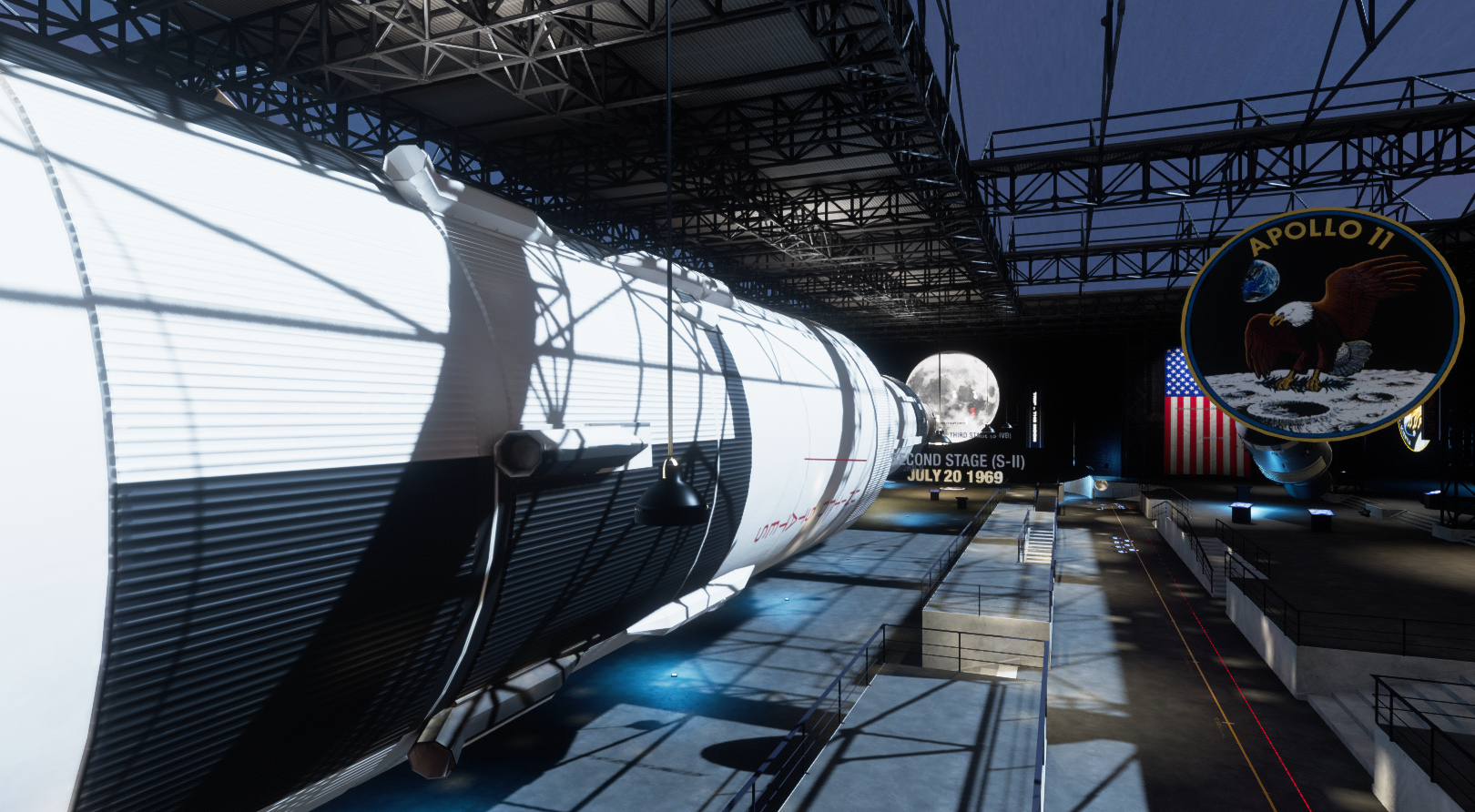
50 years on: recalling Apollo 11 in Sansar – the Apollo Museum in Sansar

Oops! this was drafted on July 19th, then the weekend came, and I forgot to publish it!

The following notes were taken from my recording of the July 18th (week #29) Product Meeting. This meeting focused on the new quest system.

Quest Authoring

  • Week #30 (commencing Monday, July 22nd) should see a point release of the first version of Sansar’s in-client quest editor, together with a new library of scripts designed to enable linking quest elements within the authoring tool with in-scene objects.
  • The editor will be accessible through the Create button on the left-side menu in the Sansar client. It allows quests to be created, objectives named and set within it (and reordered, if required).
  • Ease-of use will allow quests to be associated with scenes, tested with scenes, and iterated without actually having to continually rebuild the scene(s) in which the quest runs.
  • Quests can be experience specific, or – providing all the experiences are owned by the same account setting-up the quest – span multiple experiences.
  • The system supports placing links within objects that can be used to send users to a specific point in the quest.
  • It is acknowledged that the editor’s UI will be a “little rough” in the first release, but the Sansar team have ideas for improving it, and are also open to feedback from creators for improvements.
  • For the initial release, it will not be possible to fully interconnect quests via prerequisites (e.g. quest A must be completed before a user can progress to quest B). However, creators should still be able to create multiple quests which can have a degree of relationship one to the next (e.g. to open door A and access quest B, the user must find key A).
  • The authoring tool is seen by the Lab as a significant step forward from the internal tools that Sansar team have used up until now to create quests such as those seen in the Social Hub. In particular, it was reported that some of the Lab’s quests took around a month to build; the new editor allows that same amount of work to be completed a just a couple of days.

Rewards System

  • Coming at some point after the initial release of the quest system will be a  rewards system.
    • A tab for the rewards system will appear in the quest authoring tool, but will not be available for the first release(s) of the quest system.
  • When available, the rewards system will:
    • Allow creators to specify (initially) up to three objects (not Sansar Dollar amounts) users participating in a quest can win / obtain.
    • The system will allow for user choices within the three (e.g. a reward might offer a user a choice of A or B as one of the rewards).
    • If it is felt the system needs to be expanded to support more rewards per quest, the Sansar team is open to discussing this down the road.
  • Rewards will be collected by users on completion of a given quest, using the Sansar Store mechanism for delivery.
  • The rewards system is not being released with the first pass of the quest system so that creators can have a chance to test the latter, gain familiarity with it and offer feedback and suggestions for improvement before more complex capabilities are layered on to it.
    • However, once the rewards system may not be turned on from day one, the design of the editor means that once it is available, creators can easily go back over their defined quests and add rewards to them.

Experience Points (XP) System

  • The experience points system is still being developed and will be released at some point after the quest authoring tools.
  • The system will follow “traditional” XP system lines – the more a user participates in activities, the more points they can obtain, and thus “level up”.
  • It will be a global system – users can accumulate points right across Sansar, wherever they participate, rather than individual experiences just offering point applicable within that experience.
  • The first iteration of the XP system will be geared towards users gaining points within existing Sansar quests.
    • Those who have already completed the existing Sansar quests will be grandfathered in to the XP system when it is launched.
    • A future expansion will allow creators to award experience points within their own quests / experiences.
    • The system will also support experience creators specifying the level users must be at in order to access their quests.
  • To achieve the broadest range of applications, Sansar experience points will be split into three different  activity groupings:
    • Exploring – people who like visiting and exploring experiences, playing games within experiences and generally interacting in experiences.
    • Socialising – people who like going to events, spending their time making friends and interacting with friends and participating in activities that require more than one person.
    • Creating – anyone who enjoys creating in Sansar, be it experience, accessories, games, etc.
  • These are very broad activity definitions, but LL believe they encompass the major high-level ways in which people use Sansar, and thus have the opportunity to earn experience points. However, there may be more granularity within each.
  • Exactly what the returns will for those achieving a given level is still TBD – ideas mooted range from profile badges / icons / similar, through to ideas like entire avatar looks.
  • The system will initially have a level cap to limit how many experience points a user can earn. This is in part because the system is still being built-out and in part because the Lab would like to evaluate how people respond to and use the XP system. As more activities are supported by the XP system, the cap will be increased.
  • Also to be associated with the XP system is a “milestone” system – as users achieve certain XP levels, so those levels will unlock new rewards. What the levels and the “special” rewards might be will be discussed at a later date, once LL have finalised how they’d like the milestone system to work.

The overall goal in building the questing system, the rewards element, the XP system is to develop a framework for such capabilities that  is consistent across all experiences, making it easier for creators to leverage, and for users to understand, without having to re-learn the basics each time they visit a new experience.

Q&A

  • Who will provide the Avatar 2.0 file for use with Marvelous Designer – Sansar or Marvelous Designer? If Sansar, will it be possible to include the rigged bones? The Sansar team is working with Marvelous Designer on the files, and it is not clear if rigged bones can be included.
  • Would it be possible for LL to give more warning on themed Store events to give creators more time to work on items? Generally speaking, yes.
  • When will the event ticketing system be available for experience creators? Not on the immediate roadmap, as the Lab would like to polish the system a little more before opening it out.
  • Sitting – is there a plan and will sit points work with move objects? Yes to both, but not going to be available in the short-term.
  • How will the disparity in using items in VR and in Desktop Mode be overcome (e.g. allowing Desktop user to swing bats / clubs in the same way as VR users)? The Sansar team are aware of this, and there are currently internal discussions taking place on how best to bring more parity between the two modes of use.
  • Can experience creators have a pop-up warning appear in active versions of an experience they’ve just updated, so visitors can click on it and teleport to the updated version? Will be looked into.
  • Elements of the client UI are intrusive – like the emote system in Desktop Mode (it pops up over the middles of the screen). Are issues like this going to be addressed? Focus at the moment is getting the core capabilities like the quest, rewards and XP systems out and available. However, there are discussions on the subject of improving the UI, and feedback is appreciated.
  • Is it possible to have a feature to change clothes and attachments in the thumbnail pic after the initial upload? Being worked on, and should be out “soon”.
  • Will Sansar have real-time reflections / mirrors? Unlikely, due to the complexity  / performance hit, unless the platform can be shown to perform well at scale.
  • Keybindings / control options: the eventual goal is to allow Sansar users to define their own keyboard key binding / controller options for movement, etc.
  • When will creators be able to limit the number of people able to access an instance of an experience?
    • Not for a while. Before then, it a likely that there will be some form of “instance browser” that will show how many instances of and experience are running and who is in them, and potentially allow users to select which instance they wish to join and also pull their friends into.
    • Low user density per experience instance increases costs. For example: limiting access to a game to 5 people per instance and having 10,000 people playing the game means running 2,000 servers – so who meets the cost of running those servers? Should there be a business model that passes on the cost to the creator and (ultimately) those playing the game?
  • One of the reasons there were a rapid-fire series of updates following the R34 deployment is that one of the updates accidentally caused a memory leak in the client, and the update intended to fix it contained code that actually made it worse.

Note: there is due to be a general internal meeting at the Lab on Sansar and goals / capabilities, so some of the more frequently-asked question things like sitting in Sansar, the opening of the ticketing system, etc., might be clearer in terms of possible time-frames once this meeting has taken place.
 

LEA: more on the closure, and a move to save it

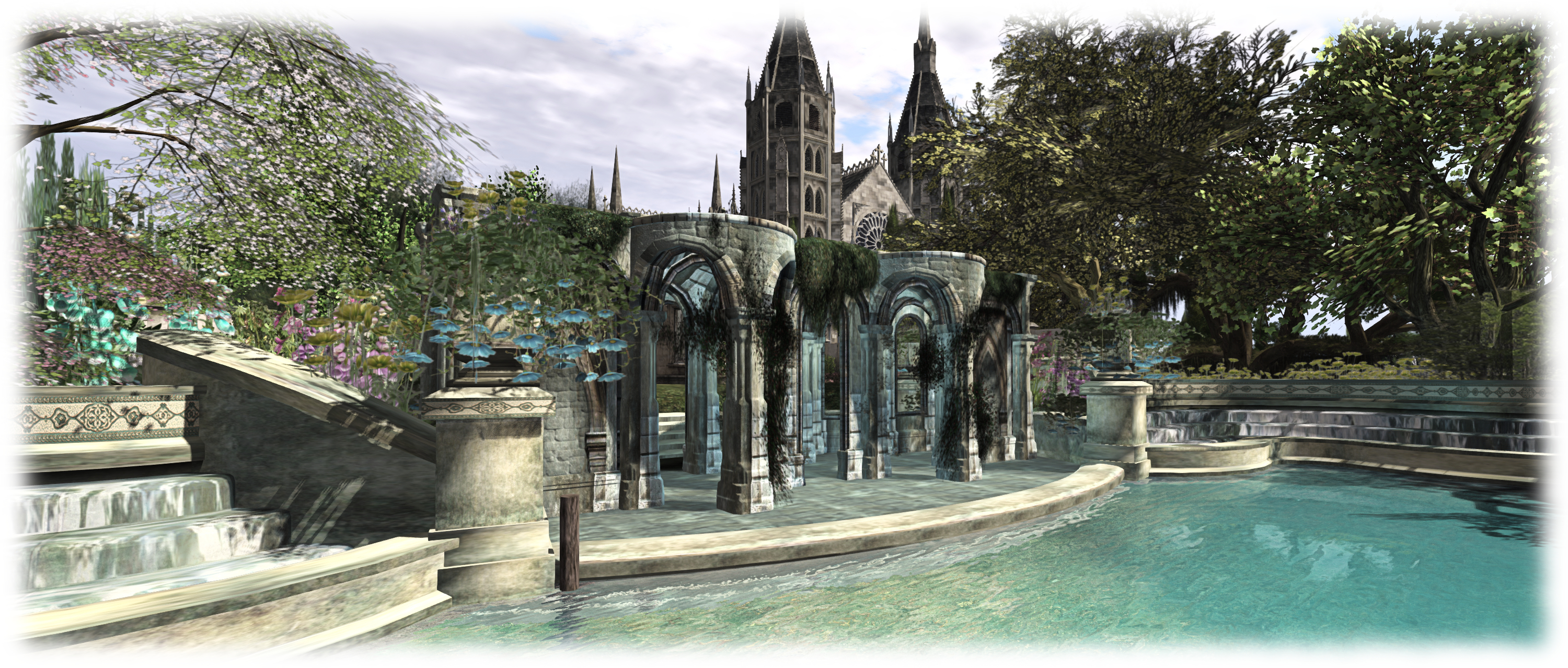
Linden Endowment for the Arts: Another World, May 2017

Following my post on the forthcoming closure of the Linden Endowments for the Art (see: Linden Endowment for the Arts to officially close), committee member JMB (Jo) Balogh posted a personal statement on the closure to Facebook.

As I’m not active in any capacity on that platform, Jo subsequently sent me a copy of her comments via note card, and since I have received numerous questions both in IM and via Twitter, etc., on why the LEA might be closing, I sought Jo’s permission to reprint her thoughts below.

At the same time, and for interested parties, there is a new in-world group for those would would like to see the LEA’s work continue into the future in some manner.

Jo’s Comments on the LEA’s Closure

Again, please note, as Jo states, these are her views on the LEA closure, rather than any form of official statement on the matter; nor do they represent the views of other committee memebers. Nevertheless, they may help shed some light on things.

This is a personal statement, not on behalf of the committee, just my point of view.

For quite a while it was obvious to the Committee that the LEA program as such was slowly dying. Applications for grants were way down and there were complaints that LEA had become boring and predictable. The committee had shrunk in numbers and giving up the right to apply for a grant made becoming a member a non starter for many good people. We spend months discussing it amongst ourselves and in meetings with LL. We concluded that it was not fixable within the current framework and that the only way forward was to step down and let a new group of people with new innovative ideas take it forward. Basically for LEA version II to be started from scratch again, just as it was in 2010. So that’s what we did. We stepped down and left it with LL.

So this is where it stands. I’m sure that LL would be happy to provide the regions again if some of you can come up with a solid proposal for promoting the Arts in Second Life and be willing to run it because it is takes work, a lot of work, trust me on that. It’s a labour of love because it is not paid work. In those years since 2010 Art in SL has changed dramatically and will continue to do so. Go for it! Make it happen.

JMB Balogh (Jo Balogh)

Linden Endowment for the Arts: Serotonin Reuptake Inhibitor, April 2016

The New In-World Group Seeking a Continuance of the LEA’s Work

Potentially (but not necessarily) as a result of Jo’s comments, a new in-world group has started, called LEA 2.0 The New Future~ SAVE LEA! Which can be joined by visiting the group join boxes at LEA 5 (up until the end of August 2019, at least).

Founded by artists Tansee Resident and Riannah Avora, the function of the group is described as:

Join Group to SAVE The LEA Sandbox, AIR grants, Core grants and the future of SL Virtual Art and Creativity. Be Proactive. This is an opportunity for “Positive” voices to be heard and be a part of the continuing growth and innovation of virtual art and creativity at LEA with dignified and equal respect to all concerned artists.

Please Be specific with your suggestions. Offer reasonable solutions.

Suggestions can be sent to either Tansee or Riannah in-world or dropped into the green boxes placed on LEA 5 (again, at least until the end of August 2019). In an introductory note card, Tansee adds:

Be Proactive & Positive. Avoid Negativity. Write your suggestions and observations on a note card. Be specific. Be respectful. Offer realistic solutions and explanations why you think something will work and how you envision it working. We have 2 weeks to compile input & present to LL. The plan then is to have a meeting at LEA Theatre.

So, if you wish to contribute ideas of a realistic and positive nature for the future of the LEA – or some next generation LEA – now is the chance to do so.

Linden Endowment for the Arts – Love, Henry, July 2015

For my part, I would simply suggest the following regarding an future organisation akin to the LEA:

  • Keep things simple, keep them open. One of the long-running critiques concerning the LEA was its star-chamber like nature. Meetings were largely closed-door affairs, the by-laws tended to discourage guests  rather than welcome them (with some understandable reasons for doing so); the grant selection process came to be seen (and not entirely fairly) as biased in favouritism; the blog / website never really reported on committee activities, furthering perceptions that it was all somehow secretive, etc.
  • Revisit the AIR grants: these were set-up at a time when arts installations had to be largely built and scripted by hand, making them intensive builds. Times have changed, and as more recent years have shown, installations can be developed using prefabricated mesh elements that can be used in a transformational manner, rather than being built from scratch. So, are 6-month grants actually still required? Could they be reduced somewhat to allow a greater range of expression through a year? Need they all aligned, starting and finishing on the same dates twice a year, or could they be set to operate on a more rolling-style basis with smaller groups of them overlapping with start / end dates? Is 20 AIR regions actually too much to be properly managed, and would a smaller number be preferable?
  • Utilise outreach and engagement. This loops back to the first bullet point in some respects. For assorted reasons, it is not unfair to say the LEA often tended to be regarded as being “apart from”, rather than “a part of” the broader diversity of arts and expressionism in Second Life. Better engagement with the broader arts information groups (e.g. SL Art, Cercle Fafner, to name two of the more prominent groups) would therefore perhaps be beneficial.

There is a lot more on specifics that will likely need to be looked into – up to, and including, I would suggest – the Lab’s own involvement in any LEA-like organisation (and their willingness to be perhaps be more involved than has in the past been the case; but then, this is the Linden Endowment for the Arts – at least for the time being). However, I offer these points as more generic points for possible discussion, if deemed relevant.

Should you have ideas of your own, then please – as noted – contact Tansee and Riannah, or drop your feedback into the green boxes on LEA 5 while they are available; and if you’re interested in keeping track of what might come of this move, join the in-world group.

2019 viewer release summaries week #29

Logos representative only and should not be seen as an endorsement / preference / recommendation

Updates for the week ending Sunday, July 21st

This summary is generally published every Monday, and is a list of SL viewer / client releases (official and TPV) made during the previous week. When reading it, please note:

  • It is based on my Current Viewer Releases Page, a list of all Second Life viewers and clients that are in popular use (and of which I am aware), and which are recognised as adhering to the TPV Policy. This page includes comprehensive links to download pages, blog notes, release notes, etc., as well as links to any / all reviews of specific viewers / clients made within this blog.
  • By its nature, this summary presented here will always be in arrears, please refer to the Current Viewer Release Page for more up-to-date information.
  • Note that for purposes of length, TPV test viewers, preview / beta viewers / nightly builds are generally not recorded in these summaries.

Official LL Viewers

  • Current Release version 6.2.3.527758, formerly the Rainbow RC viewer dated June 5, promoted June 18 – No change.
  • Release channel cohorts:
    • Love Me Render viewer updated to version 6.2.4.529302, on July 15th.
    • The EEP RC viewer updated to version 6.4.0.529247 on July 15th (dated Friday, July 12th).
  • Project viewers:
    • 360 Snapshot project viewer updated to version 6.2.4.529111, on July 16th.

LL Viewer Resources

Third-party Viewers

V5/V6-style

V1-style

  • Cool VL Viewer Stable Branch updated to version 1.26.22.54 and Experimental Branch to version 1.26.23.7, both on July 20th (release notes).

Mobile / Other Clients

  • MetaChat updated to version 1.2.9107 on July 21st (profile button hotfix).

Additional TPV Resources

Related Links

Space Sunday special: Apollo 11 at 50 Part 3

NASA’s official Apollo 50th anniversary logo. Credit: NASA

This is the concluding part of a special Space Sunday series, celebrating the 50th anniversary of  Apollo 11 landing on the Moon, and follows on directly from Part 2: “The Eagle Has Landed!”. To follow the full series, please click over to Part 1: Lift-off! We Have lift-off!

Part 3: “Magnificent Desolation” And The Voyage Home

I had asked [Neil] before the mission launch several times what he was going to say on the occasion of this historic moment, setting foot on the lunar surface, and he always replied, “I’m a test pilot, I’ll probably just say how dusty it is or something like that. Don’t worry.” But he came back with his now famous [line]. The media immediately wanted to know if it was one small step for a man, or just man. There was a little bit of static, so it wasn’t entirely clear.

– Astronaut Bruce McCandless, Capsule Communicator (CapCom),
Mission Control Green Team

Whether or not Armstrong had said “a man” in his statement was to become a matter of debate in the decades that followed Apollo 11, almost overshadowing that first step itself. With the indefinite article included, his comment makes sense: he is clearly referring to himself (“one small step for a man”). Without it, “man” becomes more reflective of humanity as a whole, making his comment the equivalent of “That’s one small step for humanity. One giant leap for mankind”.

Such was the level of debate with one analysis of recording suggesting he said “a man”, another suggesting he didn’t, that not long before his death, Armstrong noted a little ruefully – and quite correctly:

I would hope that history would grant me leeway for dropping the syllable and understand that it was certainly intended, even if it wasn’t said – although it might actually have been.

– Neil Armstrong

A ghostly image from the broadcast TV footage – captured by the news agencies by having to re-film live footage received from the Moon and played on a special monitor. Credit: CBS News

But on the Moon, and unaware of the controversy that was even then brewing around his words, Armstrong collected a contingency sample of rock and surface material in case an unexpected issue required the EVA to be curtailed. Then he took the remote-control TV camera mounted on the Lunar Module to take a panoramic shot around the Eagle before setting it on a tripod a short distance from the LM to allow Mission Control to use it to record the EVA.

That  camera is the reason why the Apollo 11 video footage looks ghostly. Its scan rate was incompatible with those used by US TV networks, so the live transmission had to be shown on special monitors with TV cameras set-up in front of them which then re-broadcast the images – with a significant loss of picture quality in the process. (It’s also worth notingthat while NASA recorded the footage onto magnetic tape, it was eventually lost through the agency’s policy of tape re-use.)

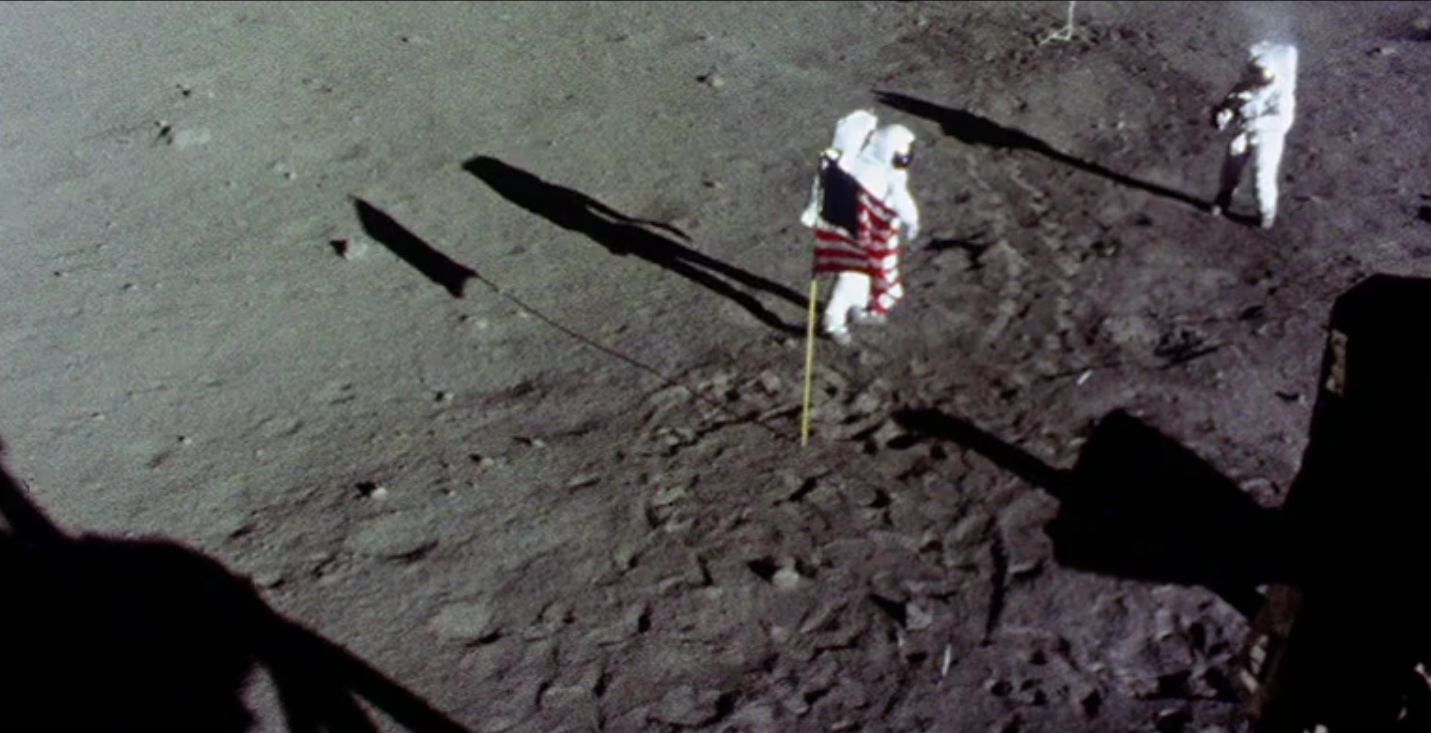
Shot from an automated camera aboard the Lunar Module, this shot shows Aldrin standing close to the US flag as Armstrong back away to take a photo of Aldrin saluting the flag. July 20th/21st, 1969. Credit: NASA

Aldrin set foot on the Moon 19 minutes after Armstrong with the words, “Beautiful view. Magnificent desolation.”

There was little time to appreciate it, however. The two men were on a tight schedule: because there was no empirical data on how well the portable life support system (PLSS) in the astronaut’s backpacks would perform on the Moon, it had been decided to limit this first (and only, for Apollo 11, which would spend less than a day on the Moon) EVA to just over 2 hours. Before that time expired, both men had to set-up the US flag, deploy the instruments of the EASEP, the Early Apollo Scientific Experiments Package, survey their location and collect and many rock and soil samples as they could manage.

The shot of Aldrin saluting the flag as taken by Armstrong, July 20th/21st, 1969. Credit: NASA

The flag (purchased from a Sears store) proved a little problematic. Its telescopic pole refused to go deep into the ground, leaving Aldrin fearing it would unceremoniously topple over while on camera. Nevertheless, he dutifully saluted it as a still-commissioned US military officer before taking up position in front of the TV camera to demonstrate various means of locomotion in the low gravity for the benefit of future crews.

While he was doing that we were all wondering what Neil was doing. Well, Neil was collecting this very fine and diverse group of rocks and soil. Not only did he get a very wide distribution, but he also thought the box looked a little empty, so at the last minute he filled it with just the dirt, so to speak, what we call the lunar regolith. That sample turned out to be the best, most comprehensive sample of lunar regolith that was ever taken on any of the Apollo missions.

– Harrison Schmitt, the only geologist-astronaut in the Apollo programme,
who served as both advisor to crews and as the Lunar Module pilot for Apollo 17

Continue reading “Space Sunday special: Apollo 11 at 50 Part 3”

Cica’s Dogwood in Second Life

Cica Ghost: Dogwood – July 2019

An arid land surrounded by the sea, conical hills sprouting from its back to rise above both the nude ground and denuded briar-like trees – this is the strange landscape that greets visitors to Dogwood, Cica Ghost’s latest installation in Second Life.

Within this landscape is an equally curious mix. Two slightly porcine dogs, the kind you might expect to see romping through an animated film, appear to stand guard either side of a ramshackle pair of fences that  themselves appear to be protecting a group of strange structures.

Looking like a mix of gourds, pearl drops and long-necked vases, these structures sprout valve-like arms from  necks rising up to open mouths. Combined with their sometimes bent shapes, these “arms” and open mouths give these forms a comically anthropomorphic look about them, little little odd women and men waving little arms at one another or to visitors, and exchanging conversation.

Cica Ghost: Dogwood – July 2019

Two more dogs stand among these structures, again appearing to have dropped in from an animated film. One is a toothy and slightly worried-looking bulldog, the other an almost Chihuahua-like companion. Together they have an air of a Laurel and Hardy pairing about them.

Also scattered across the island are black birds, standing some in groups some on their own. With their colouring, long legs and beaks, they resemble a cross between a stork and a crow; but like the dogs and the strange structures, they have a strong sense of individual personalities.

Both dogs and birds are nicely animated – the eyes of the dogs dart around, while the birds move their eyes, turn their heads and raise the occasional leg as if about to take a step, then lowering it again in an change of mind.  These animations, together with the multiple avatar sit points with their share of dances waiting to be found throughout the region, add a subtle dynamic to this setting.

Cica Ghost: Dogwood – July 2019

But sitting under a hazy sky, even with its oddly comical-cum-fairytale look, it’s hard to completely understand Dogwood – until that is, you reach the south-west corner of the region. It is here, with a narrow channel of water acting like a moat to separate it from the rest of the land, that a another hill rises. It is topped by a tall tower, reached by precarious-looking flights of steps stacked together without support. The tower is itself enfolded by the scaly tail of a great, wingless wyvern, who rests his bulk on the crown of the tower, eyes roving over the landscape before him.

Tower and wyvern add a further fairytale feel to Dogwood – but it is what lies within the tower, at the end of that precarious stairway that offers a key to Dogwood. A lone flower stands here, the brightness of its colours and the redness of its pot standing in strong contrast to the rest of the landscape. Put them with the quote Cica has selected to frame the installation, and the poetry of Dogwood falls into place:

Just living is not enough… one must have sunshine, freedom, and a little flower.

– Hans Christian Andersen

Cica Ghost: Dogwood – July 2019

Perhaps initially hard to grasp but equally quirky and cheekily humorous, Dogwood is genuinely poetic in its presentation, carrying a rich vein of fairytale under the banner of the Andersen quote.

SLurl Details

  • Dogwood (Dueville, rated Moderate)

Peaches, ice, spring and summer in Second Life

Seanchai Library

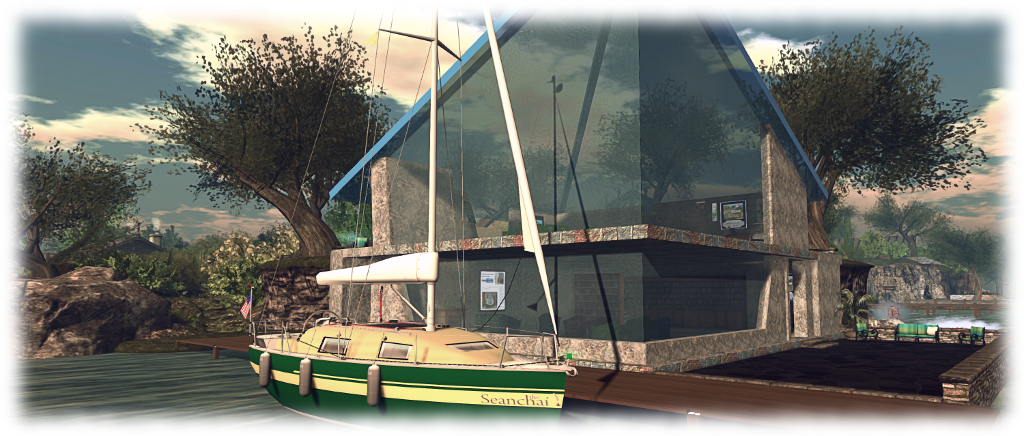
It’s time to highlight another week of storytelling in Voice by the staff and volunteers at the Seanchai Library. As always, all times SLT, and events are held at the Library’s home at Holly Kai Park, unless otherwise indicated.

Sunday, July 21st 18:30: James and the Giant Peach

Caledonia Skytower reads Roald Dahl’s first and most widely celebrated book for young people at a part of the Magicland Storytime series.

When his parents are killed by a rhinoceros that has escaped from the zoo, 4-year-old James Henry Trotter is forced to live with Spiker and Sponge, his mean-spirited aunts, who treat him badly.

One day, after an argument with his aunts, James runs from the house, only to meet a strange man who gives him a small sack. He tells James that if he goes home and makes a potion using the sack’s contents, something spectacular will happen.

Excited, James runs home to carry out the instructions, but he trips, spilling the contents of the sack, which fall into the ground alongside of a barren peach tree, apparently lost, and a despondent, James re-enters the cruel world of his aunts. But then Things begin to happen: a peach starts to grow at the top of the tree. And it grows, and grows and grows, until it is as big as a house.

Then, by chance, James discovers a secret entranceway into the fruit and crawls in. Once inside, he meets wonderful new friends: the Old-Green-Grasshopper, the dainty Ladybug, and the Centipede of the multiple boots. After years of loneliness, James finally found a place where he belongs. With a snip of the stem, the peach household starts rolling away – and the adventure begins!

Monday, July 22nd 19:00: The Ice is Coming

Gyro Muggins reads Patricia Wrightson’s 1977 novel.

Frost is seen in summer and ice patches form in spite of the hot Australian sun. To the Happy Folk, living on the continent’s green edges the frost is a reason to laugh and joke. For the Inlanders (Wrightson’s fantasy view of the Australian Aboriginals) however, the frost was once seen as a warning that an ancient foe, the ice-bearded Ninya, were on the rise – and so it might be that they are again.

The first to recognise the rise of the old threat is young Wirrun of the People. He leaves his job and sets out to meet the Ninya, taking with him as a sidekick, the petulant Mimi, and for protection, the Power bestowed by the first of the creatures in their path.

To assist in his quest, Wirrun sends for the men from Mount Conner to sing the Ninya down and keep them in their caves. But he must also beat the Ninya to the Eldest Nargun, source of fire, and use it to hold the Ninya until the men from Mount Conner arrive. And so his adventure begins.

Tuesday, July 23rd 19:00: The Penderwicks in Spring

Springtime is finally arriving on Gardam Street, and there are surprises in store for each member of the family. Some surprises are just wonderful, like neighbour Nick Geiger coming home from war. And some are ridiculous, like Batty’s new dog-walking business.

Batty is saving up her dog-walking money for an extra-special surprise for her family, which she plans to present on her upcoming birthday. But when some unwelcome surprises make themselves known, the best-laid plans fall apart.

Filled with all the heart, hilarity, and charm that has come to define this beloved clan, The Penderwicks in Spring is about fun and family and friends (and dogs), and what happens when you bring what’s hidden into the bright light of the spring sun.

Dive into Jeanne Birdsall’s classic revisiting to the lives of the Penderwicks, read by Caledonia Skytower.

Wednesday, July 24th: A Cyberpunk Summer

Short stories with Finn Zeddmore.

Thursday, July 25th

19:00: Sarra Cannon’s Loxley

In a dystopian world where citizens log into The Realm, an on-line world, to escape from their dark reality, one hacker fights to make a difference as she goes in search of a rare artefact. From Once Upon A Star: 14 SF-Inspired Faerie Tales. Also in Kitely – teleport from the main Seanchai World grid.kitely.com:8002:SEANCHAI.

21:00 Seanchai Late Night

Contemporary sci-fi with Finn Zeddmore.