Logos representative only and should not be seen as an endorsement / preference / recommendation
Updates for the week ending Sunday, April 12th
This summary is generally published every Monday, and is a list of SL viewer / client releases (official and TPV) made during the previous week. When reading it, please note:
It is based on my Current Viewer Releases Page, a list of all Second Life viewers and clients that are in popular use (and of which I am aware), and which are recognised as adhering to the TPV Policy. This page includes comprehensive links to download pages, blog notes, release notes, etc., as well as links to any / all reviews of specific viewers / clients made within this blog.
By its nature, this summary presented here will always be in arrears, please refer to the Current Viewer Release Page for more up-to-date information.
Note that for purposes of length, TPV test viewers, preview / beta viewers / nightly builds are generally not recorded in these summaries.
Official LL Viewers
Current Release version version 6.3.8.538264, dated March 12, promoted March 18th. Formerly the Premium RC viewer – No Change.
Kolmannskuppe, April 2020 – click any image for full size
On April 10th, 2020, Serene Footman opened his latest limited-time region build to once again transport us to one of the most unusual places to be found on Earth.
I tend to wax lyrical over Serene’s designs, and for three good reasons: the first is they are invariably elegant in design and statement, packed with details that may be both obvious and subtle, whilst also incorporating Serene’s own recognisable individuality of touch that has marked all of his designs. The second is that they demonstrate that while Second Life sets the imagination free and can become the home of the strange, the out-of-the ordinary and the unique – so too can the physical world around us, which is every bit as richly diverse as anything to be found in-world; the difference is, Second Life offers the means for to visit such places where otherwise they might forever be out of out reach save for photographs and videos seen in publications and on-line.
The third reason is that his builds are always educational, both in terms of what can be achieved in Second Life with care and forethought in design and because as soon as I visit one of his designs, I’m reaching for the encyclopaedia and calling up my search engine to find out as much as I can about the locations he picks, so I might broaden my own knowledge.
Kolmannskuppe, April 2020
And so it is with Kolmannskuppe – The Ghost Town of Namib Desert, his build for April 2020, which brings to SL the long-deserted mining town of Kolmannskuppe or (to give its name in Afrikaans) Kolmanskop located on the inter-coastal erg of the southernmost reaches of the massive Namib desert in modern-day Namibia, but was at the time of the town’s founding, German South West Africa.
Named for a nearby kopje, or hillock, which had in turned been dubbed Kolmannskuppe “Kolman’s Head” after the wagon driver who had been forced to abandon his wagon there after a particularly violent sand storm in 1905, the town came to prominence as one of the first areas along the Namib coast to experience a diamond rush.
Three years later, a railway was being built between the territory’s major harbour town of Lüderitz on the coast and the inland town of Aus. The man in charge of the work was German-born August Stauch, who has moved to the territory in the hope of alleviating his asthma. An amateur mineralogist in his spare time, Stauch became fascinated the tales surrounding the territory’s founder, Franz Adolf Eduard Lüderitz (after whom the the harbour town was named) and his belief the region contained diamonds just waiting to be found.
Kolmannskuppe, April 2020
So firm was his belief Lüderitz had been correct, Stauch obtained a prospecting licence and told his railway workers to bring him any unusually shiny stones they might turn over whilst digging to lay the train line’s foundations, and in April 1908, one of his aides, Zacharias Lewala – who had previously worked at the Kimberley diamond mines in South Africa – did just that. Systematically searching the area Lewala had been scouting, Stauch found more of the stones and took them to Lüderitz, where his friend and mining engineer Sönke Nissen confirmed they were diamonds.
Using Stauch’s prospecting licence, the two men secured a 75-acre claim at Kolmannskuppe. At first they tried to keep the mine and their growing wealth secret, but news inevitably spread, sparking a diamond rush into the area, and Kolmannskuppe grew to become an extremely wealthy settlement, boasting all the amenities of a modern town: a rail link to Lüderitz (itself massively enriched by the flow of diamonds from Kolmannskuppe and further deposits found to the north), its own tram service, a host of civic facilities and utility services form a hospital (with the southern hemisphere’s first x-ray machine) through a theatre, ballroom and casino to its own power station and ice-making factory.
Kolmannskuppe, April 2020
The town reached its peak in the years immediately before and after the first world war. However, the discovery of a huge deposits of diamonds 270 km to the south around the mouth of the Orange River that did not require complex mining, resulted in many from Kolmannskuppe simply up and moving south, leaving their homes and possessions to the sands of the desert. These moves marked the start of 3-decade decline for Kolmannskuppe, the last inhabitants leaving the town to the shifting desert sands in 1956.
More recently, Kolmannskuppe has become a tourist attraction – if one that is corporately managed, De Beers and the Namibian government jointly funding it. This remaining buildings sit alongside a dusty road, dunes of tufted sand wrapping themselves around wooden, sun-bleached walls that are so leached of moisture they don’t so much fall down as crumble away. It’s a place that is beloved of photographers, artists and film-makers for its sense of desolation and nature’s reclamation of man’s fragile foot-hold in this harsh desert environment. As Serene notes in his own informative blog post on the setting, it is in some ways a contrived and artificial location, centred upon the hulking form of the former casino (and now the nexus for tourists) – but it is undeniably photogenic and captivating.
Kolmannskuppe as it is today. Via Wikipedia
It is in this form that Serene captures the town, and does so quite magnificently, from the high shoulders and roof of the former casino through to the crumbling skeletons of houses and the bare bones of former utilities. While some of the house styles may be more esoteric than those of the actual town, he has perfectly captured and embodies the spirit of Kolmannskuppe, right down to the touches of corporate artificiality, such as the misplaced baths.
As the same time, he has added his own touches, notably in the form of multiple places where visitors can sit and immerse themselves in the setting, watching the coming and going of others, the entire region surrounded by high dunes that mirror the Namib’s reputation for sand dunes that can reach heights of up to 300m. Rounded-out by the presence of oryx gazella, Kolmannskuppe – The Ghost Town of Namib Desert is yet another remarkable location presented by one of Second Life’s foremost region designers.
The Apollo 13 crew: Fred Haise, Jack Swigert and Jim Lovell. Credit: NASA
It is hard to believe fifty years after the fact, that with only two missions to surface of the Moon, America was ready to end its love affair with NASA by the time Apollo 13 lifted-off from Kennedy Space Centre’s Pad 39A at 19:13 UTC (14:13 EST) on Saturday, April 11th, 1970.
Already by that date, the Saturn V construction programme had been cancelled, leaving NASA with enough vehicles for seven more flights, and one of those (formerly Apollo 20) had been re-assigned to fly what would become the Skylab orbital laboratory (Apollo mission 18 and 19 would be later be cancelled completely their launch vehicles relegated to museum pieces).
Even Apollo 13 itself had something of a rocky path to the launch pad. Under the prevailing NASA crew rotation protocols, the prime crew for the mission was to have been Gordon Cooper, Edgar Mitchell, and Donn F.Eisele, but NASA’s Director of Flight Crew Operations Donald “Deke” Slayton vetoed any participation in a prime crew by Cooper, who had a lax attitude towards training, and by Eisle as a result of incidents that occurred in the Apollo 7 flight and for bringing the agency’s public image into disrepute as a result of an extramarital affair.
Up until two days before launch, Ken Mattingly had been Apollo 13’s Command Module Pilot
Instead, Slayton placed the crew due to fly Apollo 14 forward to take the prime slots for Apollo 13, with US Navy captain and veteran of three previous space flights, James Arthur “Jim” Lovell Jr., as commander and fellow test pilots Fred Haise (USAF) Thomas Kenneth “Ken” Mattingly II (USN) as the lunar module pilot (LMP) and command module pilot (CMP) respectively. Their back-up crew were John Young, Charles Duke and John Leonard “Jack” Swigert Jr, with whom they shared time in training and simulation work for the mission.
Seven days prior to launch, Charles Duke was diagnosed with rubella, and Mattingly was the only man in the two crews not immune through prior exposure. Because of this, flight surgeons insisted he be removed from the prime crew in case he developed symptoms during the mission, and two days before launch, he was replaced by Swigert from the back-up crew (Mattingly subsequently never developed symptoms, and would eventually fly to the Moon on Apollo 16).
Even during the launch, the mission suffered what at the time appeared to be a relatively minor issue. Shortly after the separation of the Saturn V’s first stage the centre-most of the S-II second stage’s five engines was abruptly shut down automatically just 4 minutes into a planned 6.4 minute burn. The remaining four engines performed flawlessly, and no more thought was given to the issue at the time. Two and half hours later, the S-IVB upper stage motor was re-lit and Apollo 13 started its journey to the Moon.
Except for the launch, the three major TV networks showed little interest in Apollo 13. Planned broadcasts by the crew were not transmitted live, and America and the world carried on as if Apollo 13 wasn’t there.
After six successful Apollo flights, including two lunar landings, people were getting bored.
– Apollo 13 commander Jim Lovell reflecting on the lack of public
interest in the Apollo13 flight
All that changed on the night of April 13th/14th 1970, when the flight was almost 56 hours old and Apollo 13 was 330,00 km from Earth and less than a day from the Moon. The crew had just completed yet another televised transmission that had been ignored by the networks (and which included Richard Strauss’ Also Sprach Zarathustra, used as the iconic theme for Stanley Kubrick’s 2001 A Space Odyssey – the latter being the command module’s (CM) call-sign), when mission control requested the crew carry out a number of tasks minor tasks, including one for Swigert, as CMP, to “stir” both of service module’s (SM) oxygen tanks.
The television broadcast that took place just before the Apollo 13 accident, and at least watched by mission control. Fred Haise can be seen in on the large screen while in the centre foreground, lead flight director Gene Kranz looks on. Credit: NASA
These two tanks supplied oxygen both to the CM’s cabin and to the three fuel cells alongside them that provided electrical power to the entire command and service module (CSM) combination. Due to solar heating the oxygen in the tanks would “stratify”, so each day fans in to the tanks would be turned on to normalise the temperature and pressure readings. However, an extra stir had been requested in the hope of eliminating an incorrect pressure reading.
Swigert duly turned on the fans in both tanks as requested, and 90 seconds later, Apollo 13 was rocked by a “pretty large bang” that caused the attitude control system (ACS) to automatically fire to stabilise the vehicle, and the CM’s instruments to register sudden power fluctuations within the Main Bus B, one of the two electrical power distribution systems delivering electrical power to the CM.
The bang and fluctuations prompted Swigert and Lovell to both report to Earth that the vehicle had had a problem – but as instrument readings returned to normal, astronauts and engineers were momentarily confused. Lovell actually thought Haise had opened the LM’s cabin repressurisation valve (which also caused a bang) in an attempt to startle his crew mates. But Haise’s expression as he came up through the docking tunnel from the LM indicated he was as equally confused by the noise. Then the electrical output from both the power distribution systems started falling.
“OK Houston, we’ve had a problem here…” Swigert and Lovell in turn report Apollo 13 could be in difficulties
Checking the status of the three SM fuel cells, Haise found two completely dead and the third dangerously low. Swigert, engaged in checking the slowly decreasing pressure in oxygen tank 1 flipped the displays to check tank 2, only to find it completely depleted. Moving to the CM’s windows, Lovell reported the SM appeared to be venting “a gas of some sort” and the vehicle as being surrounded by a cloud of fine debris – clearly, something was seriously wrong.
Worse, struggling to maintain power levels, the surviving cell was drawing on oxygen from the CM’s surge tank. This was a reserve of oxygen intended to supply the crew with a breathable atmosphere at the end of a mission, between the CM detaching from the SM and splashing down on Earth. Were that supply to be depleted, the crew would face certain death.
Realising the significance of the surge tank situation, veteran flight controller and White Team leader Eugene Francis “Gene” Kranz, ordered the fuel cell immediately isolated from the surge tank’s oxygen supply. This left the crew with an estimated 2 hours of oxygen to in tank 1 to power the remaining fuel cell before it was also depleted, killing the command module – and the crew. With that realisation, Apollo 13 switched from being a lunar landing mission to a rescue mission.
My concern was increasing all the time. It went from, “I wonder what this is going to do to the landing?” To “I wonder if we can get back home again?”
– Apollo 13 commander Jim Lovell at a post-flight press conference,
May 1970.
Two options were available for bringing the crew home: a direct abort or a free return. The first involved turning the CSM / LM combination through 180° and then using the big service propulsion system (SPS) on the SM to reverse course and fly back to Earth, which would take about 2 days.
The free return option involved continuing on around the Moon and using its gravity, combined with an engine burn, to return to Earth in about 4 days. Both approaches would require the crew to power down the CM and use the LM as a lifeboat – something that NASA had actually planned for just after the first Apollo flight to the Moon (Apollo 8, which also had Jim Lovell as a member of the crew).
Gee, I think back in Apollo 9 we first started looking at the LEM [Lunar Excursion Module, NASA’s original official title for the lunar module] as more-or-less a lifeboat and fortunately, although the exact procedures do not tailor the exact case we’ve got, we looked at the utilisation of the LEM for an awfully long time. So we knew what the limitations were and we developed workaround procedures wherever it was possible. I think the LEM spacecraft is in excellent shape and it’s fully capable of getting the crew back.
– Lead Flight Director, Apollo 13, Gene Kranz during a press conference,
April 14th, 1970
A crowd Vilnius, Soviet Latvia, watch Russian coverage of Apollo 13 through a store window. Credit: delfi.lv
Aneli Abeyante opened the April 2020 exhibition at La Maison d’Aneli on Wednesday, April 8th, and once again she offers an intriguing and engaging selection of art and artists, with content running from physical world art through to digital media whilst enfolding both 2D and 3D art. In keeping with the gallery’s ensemble style of art shows, six individual exhibits are presented for April, the work of seven artists in total split between the lower and upper levels of the gallery.
On the lower floor, and to the south side of the central aisle are contrasting 2D art displays by Agleo Runningbear and Tralala Loordes.
La Maison d’Aneli: Agleo Runningbear
Known as April Louise Turner in the the physical world, Agleo is a woman of many colours – art, shaman, teacher, poetess, to name but four – who presents her work under her own name and the title ArtShifter. She is a gifted portrait artist and caricaturist, who here presents 20 of her pieces in both line drawing and colour, of celebrities from the worlds of art, entertainment and fashion, some of them more than once.
Most of the faces (particularly if you have a long memory or a love or the arts, entertainment and fashion) may leap out at you, as did for me, Jaques Brel, Charles Aznavour (x2), Gerard Depardieu, the charcoal (?) caricature of Catherine Deneuve, the pairing of Karl Lagerfeld images (one a slight giveaway as his name is added) and the pair of Yves Saint Laurent pictures (although I did initially wonder if his blue-toned painting might be Isaac Asimov on first sighting it).
La Maison d’Aneli: Tralala Loordes
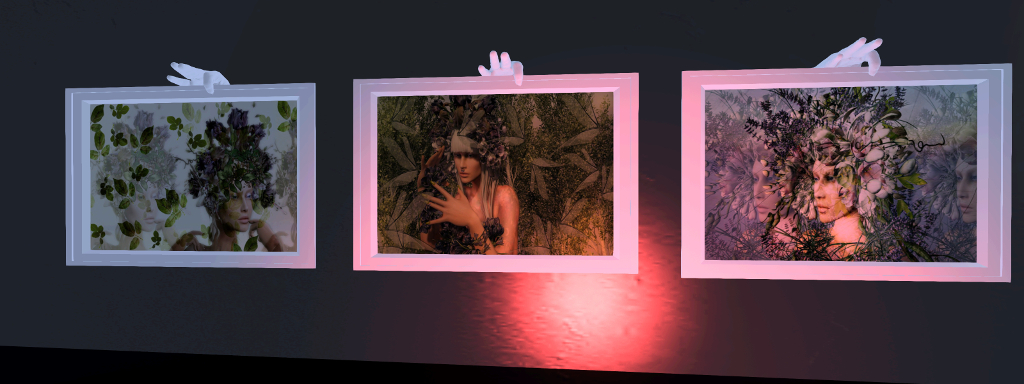
Tralala – perhaps best known for her Tralalas Diner location designs, presents a further series of self-portraits featuring LODE headpieces in what might be described as a celebration of the warmer seasons mixed with a hint of fantasy. These are quite gorgeous pieces – although I admit to feeling that the ambient lighting for the display does not do them the justice they deserve.
Across the central aisle to the north are the digital media presentations by Etamae and the combined talents of Kalyca McCallen and Eifachfilm Vacirca (aka Proton d-oo-b) operating under the combined name of Alchemelic.
La Maison d’Aneli: Etamae
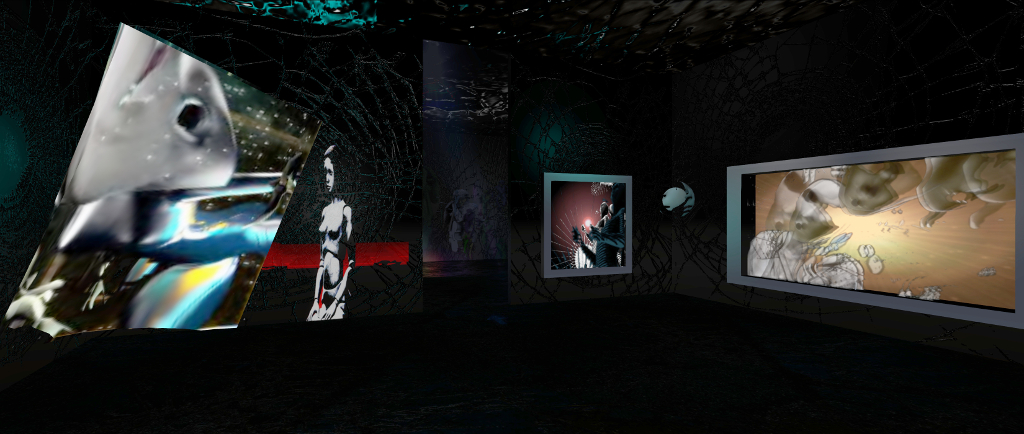
Hailing from the UK, Etamae has a gift for producing striking images from Second Life of – to use her own words – “the things she has seen and loved which have inspired her to transform them into something else – not more, nor better – simply different.” The results are always captivating, and here she offers an installation of what might be described as two parts – both of which require the use of the viewer’s Advanced Lighting Model (ALM: Preferences → Graphics, with the further advisory that your local viewer time is set to midnight). The first presents a series of animated digital images that challenge the eye in an almost hypnotic manner, the subtle motion drawing us into them and gently holding us in a trace. The second part is an equally hypnotic chamber that again involves animated elements.
Alchemelic describe themselves as “a Zurich-based music and art project with cinematographic background, mixed media, and 3D modelling [who] aspire to spark your imagination and elevate your mood with our unique blend of visual art and original music.” At La Maison d’Aneli they offer a two-part installation, The Space Between, which again particularly requires ALM to be enabled) might be described as an examination of the nature of space and relationships that has taken on something of a new meaning in recent times. Take the Anywhere Door to reach the second part of the installation.
La Maison d’Aneli: Etamae
On the upper floor of the gallery, and lying to either side of the events areas are the exhibits by FionaFei and Xirana Oximoxi.
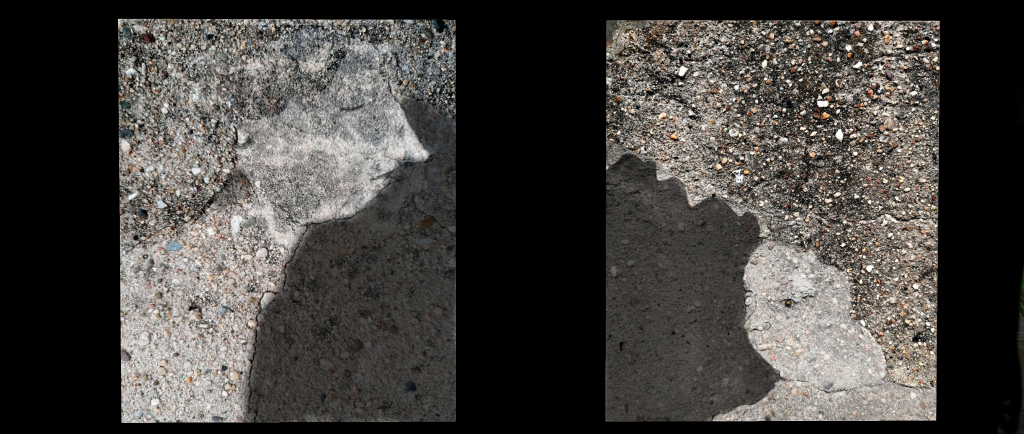
An artist from Catalan, Xirana describes her art as reflecting her concerns and moods at different times, abstractions or “mental landscapes” that are rooted in a number of artistic mediums and genres. With Lost Souls she offers a marvellous unique series of images that have been born out of the pandemic worries of 2020, and which offer an entrancing play on the the idea of portraiture. Trapped by social isolation and visiting a rooftop, Xirana found herself drawn to the irregular nature of the walls and their coverings. Weathered and cracked, in places broken, rough conglomerate abutting smooth surface finish, lined and cracked, the surfaces suggest – with a gentle touch of post-processing – faces and characters. The result is is series of utterly captivating “portraits” of “souls” caught within plaster, stone and concrete that brings an entire new meaning to the expression if these walls could speak.
La Maison d’Aneli: Xirana Oximoxi
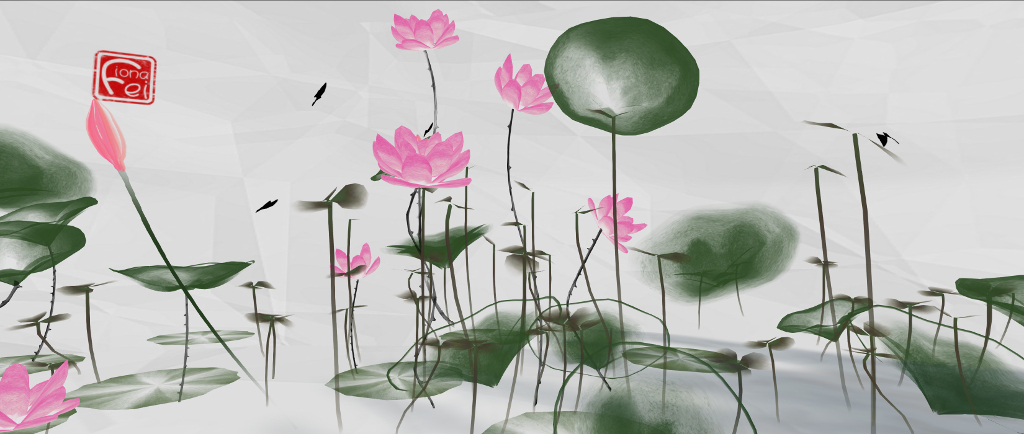
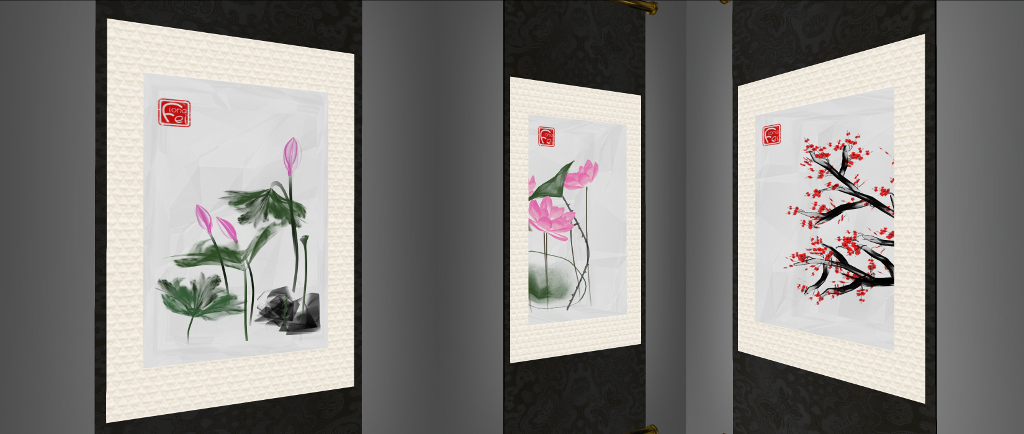
Facing Lost Souls, FionaFei offers us the chance to visit a wonderful ink wash garden of water lilies in bloom as they are admired by butterflies. Initially appearing to be 2D pieces, these are all more of Fiona’s thoroughly delightful, almost fragile-looking sculptures-as-paintings. Six are offered as hanging scrolls, the seventh, sitting behind a small pond of Fiona’s lilies, as a painting. A small table offers 2D representations of this main painting as a gift to all who visit.
Individual, evocative and fascinating, April at La Maison d’Aneli presents another collection of art that should not be missed.
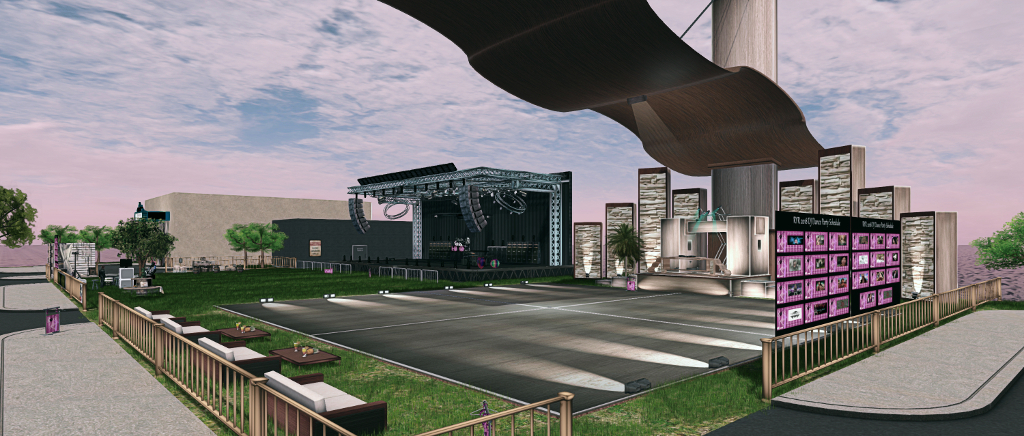
Rock Your Rack, the annual fund-raiser organised by Models Giving Back (MGB) in aid of the National Breast Cancer Foundation (NBCF), will again take place between Saturday, October 3rd and Sunday, October 18th, 2020, inclusive.
Officially endorsed by the National Breast Cancer Foundation, Rock your Rack celebrates its eighth year of fund-raising in Second Life. Each year it brings together music, art and entertainment into a 14-day event that both raises for for, and awareness of the work carried out by, the National Breast Cancer Foundation. Activities at the event include:
Designer booths.
Fashion shows.
Live performers and DJs.
An art show.
Auctions and hunts.
The theme for this year’s event is Gardens of Hope, with the organisers planning to have different garden themes for each of the event areas.
Rock Your Rack 2018
Designer Registrations
At the start of April 2020, the event opened applications from designers wishing to participate in Rock Your Rack. These are available to any content designers and SL established businesses. Those interested in participating are asked to meet the following high-level requirements:
Provide an Exclusive item not for sale anywhere else during the time of the event and has never been previously sold or given away (designer keeps 100% of sales from this item).
Provide a Limited Edition item which can be a new design or a remake of an old favourite. 100% of proceeds from this item must go to Rock Your Rack for the National Breast Cancer Foundation, and the item must be marked as such and retired from sales after the event.
Provide one item of the designer’s choice for the event’s L$10 Hunt, which gives 100% of funds raised to the NBCF.
Sales of all other items can be offered at 100% of proceeds going to the designer, or can be set to give a percentage donation to Rock Your Rack, entirely at the designer’s discretion.
Prices for participation commence at L$2,000 for a basic package that includes a 50 LI allowance which can be used for vendors and decoration; the designer’s logo displayed on the booth and on the Rock Your Rack website, and a SLurl listing to the designer’s in-world store; event advertising on social media and with in-world groups alongside the Rock Your Rack website; and paid advertising through Seraphim and other outlets if approved by those outlets.
There are then a series of options and upgrades available at additional pricing which designers can opt to take advantage of in order to maximise their exposure in this event.
For a full run-down of the designer participant guidelines and rules plus pricing, please refer to the Rock Your Rack designer’s information page, and proceed to the registration form.
Rock Your Rack 2017
About Rock Your Rack and Models Giving Back
Rock Your Rack is the annual fundraiser started in October of 2012 by Jamee Sandalwood and the team at Models Giving Back. MGB is the grid leader in trusted charity events. Jamee takes care of everything from Designers, to bloggers, to musicians, to models. This way any confusion is avoided and no one has to wait to check with anyone else before things are getting done. Rock Your Rack provides full transparency: all of the event’s documentation from screenshot totals, to Lindex transactions, to donation receipts account for every penny that was earned and donated all being posted to the Rock Your Rack website. The event has also, in previous years, obtained formal approval from the NBCF – see the 2018 approval letter for 2018 as an example.
Models Giving Back is the professional team of elite models in Second Life who have dedicated themselves to supporting the efforts of verified RL charities. This team of models gives tirelessly to the events we are involved with always giving of their time and talents to promote those designers involved in our events. For more information on Models Giving Back an how you can become a part of the team, visit the Models Giving Back Facebook Page for information about casting dates and times.
Devins Eye, April 2020 – click any image for full size
I was a little stunned to realise that it’s been close to two years since I last blogged about Devins Eye, the Homestead region designed by Ally Mildor & Roy Mildor (and which is also their home and the base for their store).
Always an eye-catching place to visit, Devins Eye currently sports a wide-open setting much in keeping with past designs, and with the familiar care and eye for detail Ally and Roy share with their designs, set under what resembles a spring afternoon sky.
Devins Eye, April 2020
On that last occasion of a visit, we found the region was enclosed in a off-sim surround; this time it stands alone, and in doing so offers a very defined island setting with an equally clearly defined north-south orientation in which the landing point lies slightly off-centre to the east, caught between the rugged southern uplands and the northern dimpled coastline.
Such is the lie of the land, that standing on the grass of the landing point, the land sloping and stepping upwards to the south and dropping gently down to the waters of the north, it’s entirely possible to imagine Devins Eye not so much as an island but a stretch of inter-coastal lowlands backed by a spine of hills that conceal the lands beyond them from view.
Devins Eye, April 2020
This is a place of wonderful contrasts and settings, perfectly blended together into a whole that is an honest delight to explore – and one of the best ways to do so is on horseback. Sadly, scripts are turned off within the region which means that if you want to ride your own wearable horse, you must mount it before teleporting to the region. Fortunately, a rezzing point close by the landing point is available to offers “local” horses to riders.
Buildings are few and fair between, adding to the richness of the setting, while the age and condition of some of them offer a sense of life and history to the island. To the south and at the end of a climbing walk among the hills sits a Tuscan villa. Reached via a grassy path that passes through iron gates and between blankets of lavender floors, it crowns the region, looking down from on high across the lowlands to the west and north.
Devins Eye, April 2020
Down on that coast sits an old pier, home to a squat radio shack, long since converted into something of a den for visitors. This and the villa make up the two main fixed “residential” structures on the island, although scattered between them is an old stone cone of a windmill, its ageing sails still turning, a trailer home that has seen better days, and a small hut occupying sitting on a pier extending into the waters of the region’s lake, watched over by a tall water tower. Power lines are strung across one side of the region, held aloft by a marching line of wooden poles – but whether they still offer a service is debatable – they start and end without connecting to anything.
The age and lie of the buildings provide a sense of the history I spoke of above, giving the island a feeling of being lived in – something readily apparent of the hints of ruins and aged cut stone the are scattered across the grasslands. But there are also signs that this is also a place that is still being renewed: two new looking, stout bridges span the fast-flowing stream that flows out to the sea from the island’s lake, and the water tower is obviously maintained.
Devins Eye, April 2020
Another attraction to the region is the low coastal region to the north. Broken by humpbacked, rocky hills and shingle banks, this coast shares the sense of age of other parts of the region, inlets hiding a variety of elements from wreck fishing boats and rowing boats to places to sit while more sprays of lavender provide a colour link to the higher slopes. Poppies also add their colour to the region – in fact it is the colour casts by the flowers, lavender plants, poppies, yellow daisies, white wildflowers, and so on – that provide more of the region’s depth.
Cut by pools and streams, rising from water’s edge too high hills, there is nothing that can be found in Devin’s Eye that isn’t immediately photogenic, the entire region finished by an ideal windlight and a gentle sound scape. It’s a place of quite remarkable views and quite original features – full kudos to Yvonita Dash for her composite creation ~ xantes ~ Tears Rock, and to Roy and Ally for using it.
Devins Eye, April 2020
Simply put: not a region design not to be missed whether you are seeking a place for photography or for a like romance – or to experience a sense of the outdoors at a time when we’re all being encouraged to minimise out time outdoors.






 Inara Pey: Living in a Modemworld