Paint your skies with Stevie Davros’ EEP sets

A dramatic EEP Fixed Sky with custom cloud texture (Painted Drama Windy Afternoon from the Painted Clouds set) by Stevie Davros

Back in 2018, I wrote about Stevie Davros, and Australian photographer, who had produced as series of Windlight skies and clouds for people to use to help enhance their environment when taking pictures, or to offer a unique environment within their region (see: Clouds and windlight skies by Stevie Davros).

Since the arrival of the Lab’s Environment Enhancement Project (EEP), Stevie has been working on new skies and cloud assets specifically for use with EEP, and offered me the opportunity to try some of them out. And I have to say, that like his Windlight skies and clouds, these are impressive collections, ideal for photographers looking to enhance their images, and offering region and parcel holders a set of options for setting a Fixed Sky over their parcel / region (and which can also be used to create dynamic Day Cycles).

If you are unfamiliar with using EEP assets and settings, I recommend you refer to one of the following:

However, and for completeness, these notes include a quick overview of how to apply Stevie’s settings.

Saturn looms large: a EEP Fixed Sky setting from the Cosmic Skies set by Stevie Davros

At the time of writing this article, Stevie had a dozen EEP packs available via his Marketplace store, comprising:

  • Painted Clouds: a folder of 13 Fixed Sky assets featuring cloud texture files sampled from the brush strokes of 19th Century French impressionist painters.
  • Aussie Cirrus: a folder of 19 skies featuring cloud texture files created from photographs Stevie took of the skies over Adelaide in Australia, and then processed.
  • Gossamer Cirrus: a set of 19 skies featuring cloud textures depicting very high altitude cirrus strands, some of which are presented in a their own “fantasy” style of sky.
  • Cirrus Cloudbank: a set of 21 skies featuring strands of cirrus cloud overlaid with / extending from banks of cloud
  • Cirrus Clouds: a bumper set of 34 cloud textures, suitable for “real” and “fantasy” settings.
  • Stormy Skies: a selection of cloud texture collages created by Stevie to give dramatic sky and cloudscapes.

All of these packs, whilst focusing on cloud formations, include customised ambient lighting and may include custom Sun / Moon textures.

Painted Sky Banded Sky from the Painted Clouds set by Stevie Davros

In addition, Stevie has produced several sets of Fixed Skies offering more of a “cosmic” setting:

  • Replacement Moons: a set of six replacement Moon textures (crescent, waxing, full, gibbous dual crescent and blue).
  • Replacement Suns: a set of replacement Sun textures very suitable for sci-fi settings, including a blue giant and a binary system with a blue giant and red dwarf star.
  • Cosmic skies: a set of 10 textures offering various astronomical / sci-fi images, including solar eclipses, a comet, a (frighteningly large) meteor, galaxies, a crescent Earth (ideal for a Moon base setting) and Saturn with his rings.
  • Aurora Night Sky: a selection of night skies with cloud textures designed to give the effect of looking at the aurora (Borealis or Australis, you pick 🙂 ).

The remaining two packs are more quirky in nature the first presents something for the romantics: link heart clouds,  and the second that places an erupting volcano on the horizon (the volcano replacing the Sun texture).

A radical sunrise (Gossamer Cirrus Surf Beach Sunrise from the Gossamer Clouds set) by Stevie Davros

There are a few points worth noting with these sets:

  • When purchased, each pack is delivered as a folder to the Received Items folder / panel of  your inventory (so no unpacking required). They can all be used directly from the folder they are received in; however, you might want to copy said folder to the Settings folder in your inventory – the system folder than is intended to contain all EEP assets you create and / or purchase.
  • As Fixed Sky elements, these are all assets that have fixed ambient lighting, and fixed Sun / Moon positions in the sky, with the clouds moving dynamically in response to the wind direction and speed.
  • The assets are supplied Copy / Modify, so you can make copies of any of them and then make alterations to it using the EEP Fixed Sky editor to produce your own variants. You can also use any of them as a basis to create your own dynamic Day Cycles.
  • Alternatively, to make changes purely for photography purposes, these assets can be applied and then adjusted using the Personal Lighting panel.
Use the standard EEP options for using Stevie’s assets

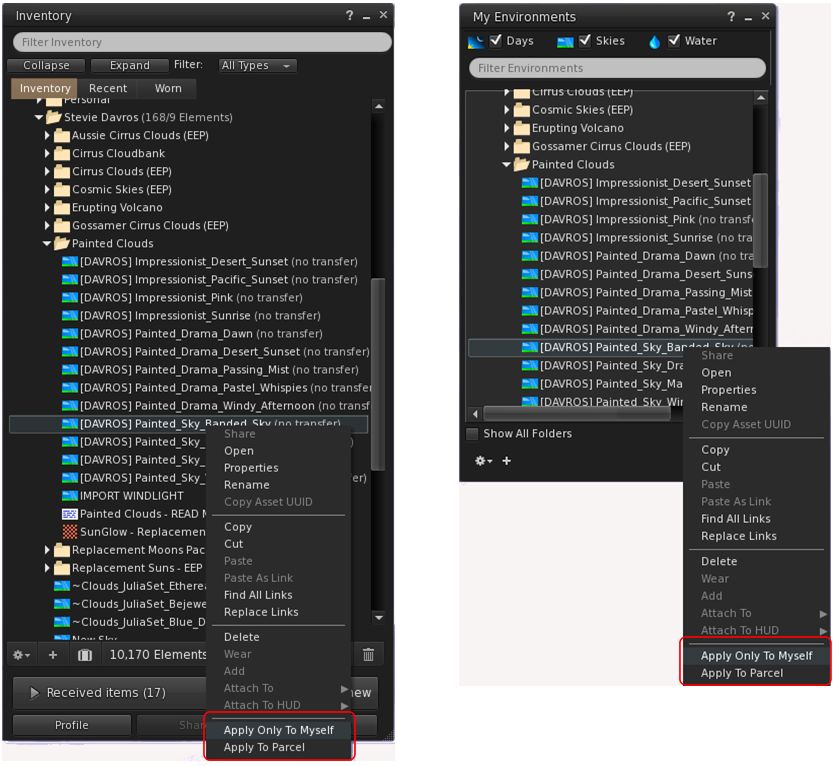
The easiest way to use these assets is to apply them directly to your avatar – highlight the asset you wish to use the right-click on it and select Apply only To Myself. This can be done from inventory or from World → Environment → My Environments … Applied in this way, the setting you’ve selected is only visible within your viewer, and will not be seen by others.

Alternatively, and if you have the requisite permissions, you can apply the asset to your parcel, where anyone within it who is using an EEP-supporting viewer set to (World → Environment →) Used Shared Environment, will also witness it. Further, if you are a region holder, you can apply the asset to your region  this option is not shown in the image above, as I do not have region rights, and so Firestorm has removed the option from my context menu).

Rigel in the sky (Big Giant Sun from the Replacement Suns set) by Stevie Davros
With prices ranging from L$99 to L$399 for the cloud packs, and the “cosmic” sky packs all priced below L$100, Stevie’s EEP sets represent very good value for money for photographers, and a potentially useful means for those interested in learning how to manipulate EEP settings (although the latter can admittedly be done via EEP settings available through the Library → Environments folder as well).

Again, you  can pick up Stevie’s packs from his Marketplace Store, and my thanks to him for taking them for a test drive.

Capturing some still memories in Second Life

The Isle of Elar, December 2020; click any image for full size

Second Life blogger and photographer Rig Torok led me to Shayn Mackenzie’s Full region, The Isle of Elar, for what will be one of my last region visits for 2020.

With life being what it is right now thanks to the SARS-CoV-2 pandemic refusing to to leave us alone and limiting opportunities for physical world interactions and getting out and about, coupled with various personal matters that have left me feeling I could do with time in the outdoors, wandering unknown paths under boughs heavy with leaves, The Isle of Elar proved to be just the ticket.

The Isle of Elar, December 2020

Rugged and split by streams fed by waterfalls, with rocky plateaus, shingle and sandy beaches, woodland trails and open spaces, cabins and ruins, deer and rabbits – and even a dragon awaiting discovery – the region genuinely offers something for everyone to appreciate – blogger, photographer, explorer or someone looking for a little space and / or peace a quiet.

From the landing point on the north side of the region, a path cuts its way south, apparently heading directly to the southern coast of the region before peeling off to cross the two streams via wooden footbridges. It presents the most direct means to start any exploration of the region, and a horse rezzer just off of the track presents a means of transportation for those who prefer exploring without necessarily relying on the use of their own pedal extremities.

The Isle of Elar, December 2020

However, it is not the only path to take; others are awaiting discovery, winding their way to numerous places of interest, be it old chapel ruins among the trees or a farm shop with camp site or garden chair overlooking the ocean, a greenhouse overlooking the main trail, a walled garden, and steps and an elevator that wind and lead their way up the rocky highlands of the region. All of these, and more besides, await visitors.

This is a place rich a detail, obvious and subtle. Some of the more obvious I’ve noted above. The more subtle include a little faerie garden, complete with magical ring, sings of various kinds awaiting discovery, a highland bench watched over by a friendly weasel, a raft in a little cove, rabbits enjoying the peace of the old chapel and the aforementioned dragon. All of this is supported by a fitting sound scape that encourages relaxation when making use one of the many places to sit waiting to be found throughout the setting.

The Isle of Elar, December 2020

The wealth of detail available within the region makes it easy to lose oneself during a visit, the sound scape encouraging cares and concerns to slip away, or to reminisce – hence the Still Memories part of the region’s name – whilst bringing to life the promise of its About Land description:

Elar is a woodland themed region depicting natural beauty all around you, Here you can explore, be romantic, spend time with friends, or take creative photos. 
The Isle of Elar, December 2020

Whether wandering alone or with a loved one, The Isle of Elar makes for an ideal destination, and visitors who take photos are invited to share them via the region’s Flickr group.

Not a destination to miss.

The Isle of Elar, December 2020

SLurl Details

Space Sunday: conjunctions, radio signals and budgets

Jupiter (bottom and brighter) and Saturn as seen between the sails of the post windmill at Brill, Buckinghamshire, UK. Credit: Jim Dyson / Getty Images

Monday, December 21st, the winter solstice, saw Jupiter and Saturn reach their closest point of mutual approach to one another when viewed in our evening skies, in what is referred to as a great conjunction.

I covered the event in some detail in my previous Space Sunday report, noting that 2020 would see the two planets appear to come with 6 arc minutes of one another as they lay low over the south-western horizon in last light following sunset.

Caught via a camera with telephoto lens is Jupiter (l) with the Galilean moons also visible (from top left: Calisto, Io, Europa, and furtherest out, lower right, Ganymede). Saturn, to the right, appears as a distinct oval due to its ring system not being sufficiently resolved by the camera lens. Credit: Peter Jay / Getty Images.

Unfortunately, British weather being what it tends to be, I didn’t get to see things on the night thanks to cloud and rain.  To add insult to injury, the skies were clear just 40 km away, allowing friends to witness the event on the night, while the rain and cloud continued here most of the rest of the week, preventing me from getting a further look at the two planets as they dropped ever closer to the horizon. Ho hum.

Not of this Earth: Jupiter and Saturn with rings visible, as seen on December 21st from lunar orbit in an image captured by NASA’s Lunar Reconnaissance Orbiter. Credit: NASA

Fortunately, however, many around the world did have clear skies and captured the event using cameras equipped with telephoto lenses or attached to telescopes. I’ve included a handful of my favourites shots here.

The event was also captured on film by Jason De Freitas, who captured the space between Jupiter and Saturn being neatly “cut” by the passage of the International Space Station.

ET Probably Isn’t Radioing Us

A radio signal detected in a part of the sky that neatly aligns with our closest stellar neighbour,  Proxima Centauri, is unlikely to be of extra-terrestrial origin.

The radio burst was detected in  April-May 2019 by the Parkes Radio Telescope in  Australia, one of two radio telescopes used by the Breakthrough Listen project, which since 2015 has been listening to the one million closest stars to our own in an attempt to pick up artificial radio signals that might indicate extraterrestrial intelligence.

The primary 64-metre radio telescope dish of the Parke observatory, New South Wales. Credit: John Sarkissian

At the time the signal was detected, the telescope was engaged in radio observations of Proxima Cantauri, some 4.2 light years away, and a star known to have two planets orbiting it, one of which – Proxima b – is a rocky world about 1.7 times the size of Earth that sits within the star’s  habitable zone.

Parkes wasn’t listening for radio signals at the time they were picked up, but was engaged in radio observations of flare activity from the star. However, when detected, the signal was immediately intriguing due to its relatively narrow frequency – 982.002Mhz – which ruled out it being caused by known natural phenomena. In order to verify it, the Breakthrough Listen team received permission to “nod” the telescope dish.

This is a common technique used to verify radio signals that involves deliberately swinging the receiving dish away from a signal for a period of time, and then back towards it in order to see if it can be re-acquired (indicating it is not an artefact of the telescope itself), and to measure whether the signal has moved relative to the dish (which would indicate the source is likely in Earth’s orbit). In this case, the signal was reacquired, with measurements suggesting it could be emanating from Proxima b.

When news of the signal, and the on-going analysis to try to determine it’s likely point of origin / cause, was anonymously leaked recently, it was picked up by a number of media outlets and caused something of a stir. However, before ET Hunters get too excited, there are a number of additional facts to consider.

Firstly, it is devoid of any modulation – and so is likely devoid of any meaningful data, were it indeed to by an extra-terrestrial, which makes sending it a little pointless. Secondly, it was entirely transient; following the period of initial detection in April / May 2019, it was “lost”, and has never been re-acquired. Were it a deliberate signal, it would not be unreasonable to expect it to remain fairly constant in terms of detection, either by Parkes or (preferably) other centres around the world.

But the biggest counts against it being ET “‘phoning home” (or at least us), lies with the fact that the signal came from the general direction of Proxima Centauri. As our nearest, and oft-observed stellar neighbour, the star has been under observation for decades, and nary a once have we received anything amounting to an peep out of it that might suggest aliens are playing with radio systems there.

More particularly, however, is the fact that Proxima Centauri is a red dwarf star. As I’ve noted numerous times in these pages, these  M-class stars are prone to exceptionally violent solar flare. Given the close proximity of Proxima b to its star, these flares would likely, at a minimum, be bathed in hard radiation, and at worse, completely rip away the planet’s atmosphere within a period of around 100-200 million years. Therefore, it is highly unlikely the planet really is the point of origin for the signal.

An artist’s impression of Proxima b with Proxima Centauri low on the horizon. The double star above and to the right of it is Alpha Centauri A and B. Credit: ESO

instead, the most likely explanations for the signal are that it might either be something like the carrier wave from a long-forgotten piece of orbital debris of human manufacture or – mostly likely – actually originated on Earth, with conditions in the upper atmosphere serving to “bounce” it into the Parkes Telescope sphere of detection.

The Breakthrough Listen team and their partners certainly lean towards the latter as an explanation, although as noted,  they are still analysing the data gathered on the signal.

This is not a natural phenomenon—I haven’t seen the data, but if it passed BL’s tests then it’s too narrowband to be natural. It’s definitely caused by technology. But it’s almost certainly our own technology.

– Jason Wright, Professor of Astronomy and Astrophysics at Penn State University

Continue reading “Space Sunday: conjunctions, radio signals and budgets”

Artistic Gratitude in Second Life

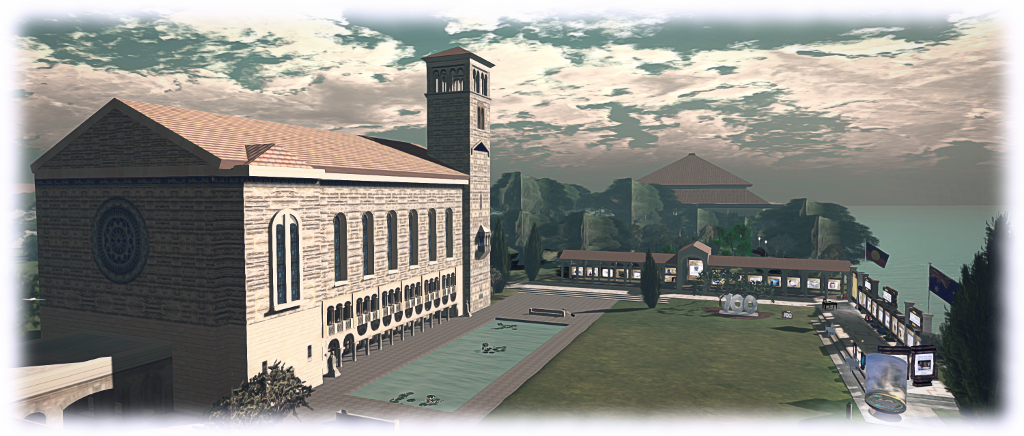
The University of Western Australia has been a long-term patron of the arts in Second Life

The end of 2020 marks the end of an era in Second Life, as we will be saying farewell to the in-world presence of the University of Western Australia, as their last remaining active region is due to close.

Between 2009 and 2018, the University’s name was synonymous with patronage of the arts in Second Life, sponsoring as it did numerous Art Challenges with large-scale cash prizes on offer to participating artists. In the process these challenges yielded some of the most exceptional displays of art and creativity seen within – and beyond – Second Life. Art that I had both the privilege and the honour to both cover in these pages, and to help adjudicate as an invited judge for several of the challenges, allowing me to witness an appreciate first-hand the depth of creativity they seeded and nurtured.

UWA: Gratitude – Suzanne Graves
By way of a last farewell and to offer a “thank you” to the UWA for its support of the arts down the years, the arts platform over the region is currently home to a special exhibition of 2D and 3D art.

Entitled Gratitudes, the exhibition has been organised by Chuck Clip, who issued an invitation for artists to contributed 2D and 3D pieces back in September (see: Calling artists: an exhibition to say farewell to the UWA in Second Life). The result is a exhibition that includes news pieces created specifically for inclusion in it, as well a pieces that have been past UWA Grand Challenge winners – such as Sharni Azalee’s evocative Never Say Never,  a Grand Prize winner back in 2014.

UWA: Gratitude – Elle Thorkveld

The art is displayed on the sky platform over the UWA campus grounds in the region, and is framed by a collection of posters marking some of the art challenges organised by UWA under the stewardship of Jayjay Zifanwee and UWA in SL curator Freewee Ling.

Artists who responded to the open invitation to participate in the event include Sharnee Azalee, Chic Aeon, Suzanne Graves, Pixels Sideways, Merranda Ginssberg, Vroum Short, Ciottolina Zue, Cherry Manga, Alpha Auer, Sheba Blitz, Kayly Iali, Judylynn India, Monroe Snook and Chuck Clip himself, among numerous others. All of whom present s rich mix of 2D and 3D art to be appreciated and admired. Further 3D art selected by Jayjay can be found within the ground level of the university in what is very much a 3D art garden.

UWA: Gratitude – 2D art

All told, Gratitude presents a rich cross-section of art and creativity, and is well worth taking the time to visit and appreciate. It will remain open until the end of December 30th, 2020.

SLurl Details

  • Gratitude (University of WA, rated General)

Second Life and the Lab: looking back at 2020

It’s become an end-of year tradition in the blog to offer a look back over the past 12 months and summarise much of what has happened in terms of Second Life, Linden Lab, my involvement in the platform, and the various other topics covered in these pages.

Last year I altered my usual approach to these look backs, as I felt the 2-part format I had been using was perhaps a little dry, so instead, I focused more on the notable events in SL through the year. I’ve opted to follow that approach, with some the highlights of the year (at least, as I see them).

Linden Lab

Acquisition

The biggest news of the year with regards to Linden Lab was the July announcement that the company was in the process of being acquired by new investors. At the turn of the year, the negotiations, etc., still appear to be in progress, although there have been no further updates from the Lab on the matter. The latter is hardly surprising,  given the complexity that can be involved in such deals, which in some cases can take well over a year to complete.

At the time of the announcement, the news brought forth a lot of angst and some negativity – although such acquisitions are not uncommon by by no means  indicative of “bad” news. With this situation, and given the backgrounds of the new investors, the move appears positive,  prompting me to point out a couple of things and offer some speculation.

J. Randall Waterfield (l) and Bradford Oberwager, the incoming Linden Research Inc., investors.

Sansar

The start of the year was not a little confusing for Sansar. 2019 had seen some rapid changes of direction with the platform, suggesting Linden Lab were having trouble settling on a market  / audience for Sansar, with a portion of staff working on the platform being laid off. In February, rumours were circulating that the Lab had suspended all development for Sansar and were laying off the rest of their staff working on the platform. Such were the rumours, the Lab took the step of publicly providing  reassurance about the future of Second Life, whilst seeking a future for Sansar.

In March it was confirmed Sansar had been sold to Wookey Projects Inc., (later Wookey Technologies). The deal was largely brought about by members of the Lab’s team directly involved in managing and running Sansar, and saw the majority of those who had been laid-off being hired by Wookey, whilst former Linden Lab Management Team members Sheri Bryant and Julia Munck also moving to Wookey to directly manage things.

Following its acquisition, the platform continued to focus on “live” events, including a major link-up with Lost Horizons to host a virtual Glastonbury Shangri-La festival in the summer, and a further Lost Horizons set of events at the end of the year – see my general Sansar reporting for more.

Tilia

Tilia Inc., is the wholly-owned subsidiary of Linden Lab that handles all micro-transactions and payments /payouts related to Linden Dollars and Sansar Dollars, and which manages the Lab’s compliance with regulations relating to its role as a Money Transmitter / Money Services Business (MSB).

I’d previously speculated that Tilia might be a means for the Lab to spin-off its expertise with managing micro-currencies to other companies wish to offer such services. With the sale of Sansar, Wookey Technologies effectively became the Lab’s first customer in this regard. Then in May 2020 it was announced that the property trading game Upland. had become Tilia’s second client customer.

Merchandise

After requests to do so for many years, Linden Lab started offering SL-related merchandise via RedBubble – see: Linden Lab launches the Official Second Life Merchandise store.

Second Life Marketing

2020 allowed users to see into the Lab’s marketing efforts for Second Life – which, contrary to popular belief – are actually carefully managed and coordinated. In February, Brett Linden penned The Heart & Science of Second Life Marketing, while in March, he and Darcy Linden appeared on Lab Gab information / insight into the Marketing Team’s work, with the entire team also participating in the 2020 Meet the Lindens sessions at SL17B.

Then at the end of the year, Brett followed-up with a further blog post looking back  at yhr year and offering a “behind the scenes” look at a Second Life’s first broadcast quality commercial – about which I’ll have a lot more to say come 2021.

Two of the more curious aspects of the 2020 marketing activities came in the form of tie-ins with  [Adult Swim], the American adult-oriented night-time programming block of the Cartoon Network (see: Adult Swim special streaming event in Second Life), and with animation studio Titmouse (see: Second Life to have a smashing time with Titmouse).

Technical Updates

Project Uplift: AWS Migration

The majority of the year was dominated on the technical front by the work to migrate all of the Second Life services and infrastructure to Amazon AWS hardware and infrastructure. Initiated in 2017, the reached a point of critical mass in 2020 with the transfer of all services from the Lab’s co-location facility in Arizona to running on AWS service out of Oregon. The last major element of the project was the migration of all of SL’s main grid regions to AWS, a process that came in the last part of the year, and proceeded relatively rapidly and smoothly, with the Lab confirming all regions were running on AWS services on November 19th.

The migration of all regions was not the end of the work, nor was it entirely without issues, technical and otherwise. In the case of the latter,it did require the suspension of new region provisioning from May through November. The work also saw a delay in the release of the Premium Linden Homes Stilt theme. However, by the end of 2020, the vast majority of the work had been completed, the Lab to discontinue all operations out of the Arizona co-location  facility just before Christmas 2020.

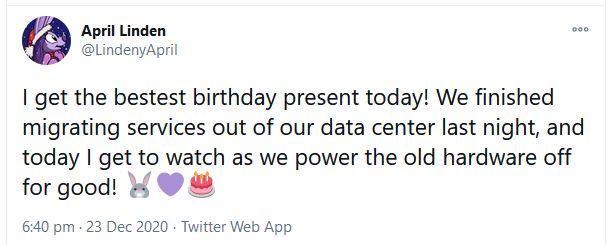
April Linden celebrates the Lab moving out of their former co-lo facilities.

2021 will see further adjustments and fine tuning of all SL-related services that will hopefully see like general improvements. For you wish to review the year’s progress, please use my SL in the Cloud and Cloud Uplift tags.

Viewer Highlights

  • In January 2020,the Lab ceased providing support and viewer-side updates for Windows 7, in line with Microsoft ending its support of the operating system.
  • Camera Presets – the ability to create a save multiple positions for your viewer camera arrived in a Release Candidate viewer. When the viewer reached de facto release status, I provided a complete tutorial for the capability.
  • The Environment Enhancement Project – a complete replacement for the Windlight rendering system – was launched in April, and I provided both a primer and an in-depth tutorial.

The official iOS / Android client continued to progress, with the iOS version making it to a closed alpha release, and from that to being submitted to Apple for evaluation – which remained its status at the end of the year. The Android client has year to surface, but is being actively worked on. Details on both can be found in my SL Mobile updates.

Second Life and the SARS-CoV-2 Virus

March 2020 saw the growing issue of the SARS-CoV-2 / COVID-situation start to bite the world very hard. As a result, the Lab switched to fully remote  working (a large portion of the Lab’s staff already worked from home either full-time or on a regular basis, allowing the company to switch all of its centres  – Seattle, San Francisco, Boston and Atlanta – more readily  than other companies might have managed).

At the same time, the Lab put in place some practical steps to help those wishing to use Second Life as a means to support their staff working remotely. These steps included:

  • A new micro-website secondlife.com, and an accompanying updated FAQ on working in Second Life.
  • A reduction in region fees for registered non-profits and educational organisations / institutions, with Full regions fixed at US $99 a month.
  • Region holders experiencing difficulties in meeting their tier obligations as a result of the pandemic were encouraged to contact LL to discuss their situation and to see if assistance could be obtained.

In addition, I provided coverage of a number of ways in which Second Life was utilised by various organisations and groups as a direct result of the pandemic. See:

The Balticon science fiction convention was one of a number of physical world event that used Second Life as a means for attendees to come together

The pandemic also gave me pause to look at what was left of one of the most extensive past uses of Second Life – by the US Armed Forces in the platform’s early years. See Coalition Island: looking at the US military’s use of Second Life.

The pandemic almost also brought about the end of one of the popular Second Life estates – Second Norway – but rescue came, and the estate not only survived, but is growing. See: Second Norway & Sailor’s Cove East: rumours & statements, Second Norway and Sailor’s Cove East – status update, Second Norway: the future is bright, Second Norway: making the changes and Second Norway: a closer look.

Continue reading “Second Life and the Lab: looking back at 2020”

A Bridge House in Second Life

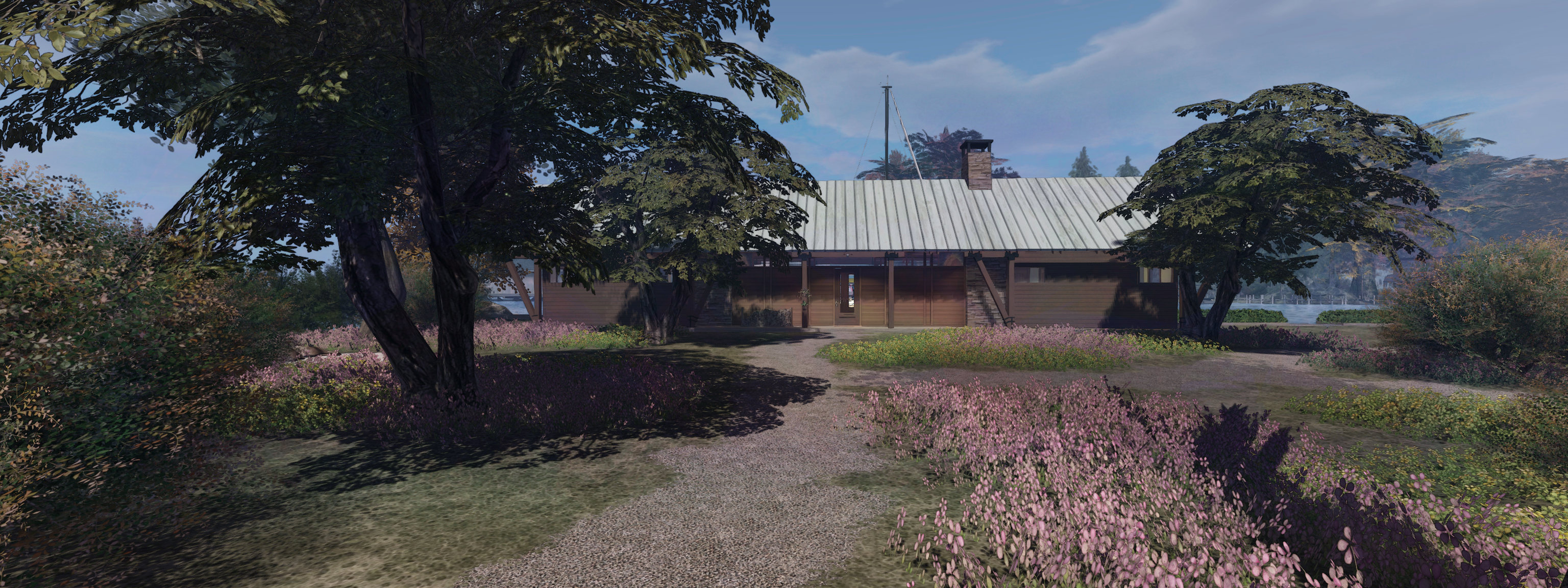
The CONVAIR Bridge House at Isla Caitinara, with modified bridge / deck with added pergola from Maya’s Builds

So, another couple of months have gone by, so it must be time for a change of house at Isla Pey 🙂 . Well, the reason is a bit more complicated than that, given it involves things going on in Second Life and the physical world that combined to make me feel I needed to tinker around and ktbash … again.

The SL side of things was in part down to the fact that, while the last house was fun to covert (see: A Country Hall in Second Life), it was, given the size of our new island, a little small. So, given we were in Second Norway, I hunted around for a design that might be taken to have something of a Scandinavian feel to it. And I found the CONVAIR Bridge House by Tobias Convair.

Priced at L$2,00 in-world, or L$2,200 via the Marketplace, the Bridge House is a single-storey property with a linear layout: a central lounge / kitchen /dining area flanked by end rooms on either side, one the same width as the lounge area,  they other slightly narrower, and with a narrow fourth room – advertised as a bathroom – to one side.  The lounge area benefits from a large fireplace and exposed ceiling trusses and boarding that gives it a very spacious build. The three remaining rooms all have flat, lower ceilings in wood. Outside, the house has extended eaves, particularly at either end, whilst one side also has full hight windows that could offer picturesque views in the right setting, the other having small windows. double doors are set into the “windows” side of the house, and a single door on the other.

The re-textured CONVAIR Bridge House, coloured in an attempt to match the original, sitting without our garden

No lighting is supplied, nor does the house come in a rezzer – at 56 LI, the structure doesn’t need one, being a single linkset. However, it comes are a range of deck / bridge “add-ons” that can be used in a variety of ways to extend the available space around the house and offer various over-the-water options. These are something I found particularly attractive, as they gave me a range of ideas for dock and deck options for a water-side setting like Isla Caitinara.

However, there are a couple of small niggles I have with the design. The fist is that it includes baked textures. Nothing unusual with this – many SL items do include shadow elements, both baked and linkset elements. However, with this house, the bakes reflect the shadows cast by chimneys, eaves, timber frames, etc, by a static Sun. Not a problem if you run with Shadows disabled in the viewer or life under a fixed sky. Bu, if you’re like me, and run with shadows enabled and under a dynamic sky, these baked shadows can conflict with “natural” shadows, and look odd. Getting around this was was no biggie; as I like kitbashing (and wanted to retexture the floors and stone walks in the build, it was a simple task to replace the supplied textures – once I’d found some that close matched the original woodwork and roof, as I wanted to maintain as much as a the original character of the design as possible.

The other point to note with this design is that it relies very heavily on transparent prims to provide physics / “solidity”. Again, there’s nothing wrong with this per se, particularly if you’re using the house “as is”. However, I found it preferable to remove those making up the floors and the floor mesh with prims I could then more easily texture to suit our needs, Doing so his increase the default LI a little – from 56 to 61; but it allowed for a better finish from my perspective.

This slideshow requires JavaScript.

Like the Country Hall build, I opted to make  the new house a waterside house adjoining our boat docks, and the included bridge add-ons worked as a good template for me to re-work the existing dock, and a deck for a gazebo. However, again given the use of transparent prims, I opted to replace almost all of the bridge elements with my own, again for no increase in LI – at least until I linked them in to the existing docks on the island!

Despite the above niggles on my part, the Bridge House does make for a stylish home, and can be used “as is” from the box – instructions are supplied with it for correctly aligning the desired bridge and deck sections; although this does assume the bridge goes to one side of the house and the deck to the others. But again, if you’re OK with editing and moving items in-world, manual  alignment of elements can be done relatively easily.

Overall, an aesthetically pleasing build offering plenty of scope for customisation / expansion that can easily be tailored to suit individual needs. Ours came out at a total of 89 LI, including additional rugs, pictures and wall hangings, lighting, net curtains and window blinds.

Link and SLurl