The following notes were taken from the Tuesday, January 12th, 2021 Simulator User Group (SUG) meeting.
Server Deployments
At the time of writing,the release notes for the week had yet to be produced. However, Rider Linden described the RC release planned for the week thus:
So, We’re doing the first roll of the year this week to the RC channels. This includes among other things a fix to experience notifications (they weren’t always being sent) and I was able to throw in some missing constants from llSetAgentEnvironment. We also have something in there that we hope will positively impact some of the timing changes that we’ve been seeing on uplifted simulators.
– Rider Linden
SL Viewer
There have been no changes to the current crop of official viewers, leaving them as:
Current release viewer version 6.4.11.551711, formerly Cachaça Maintenance RC viewer promoted on November 12 – No Change.
Project Jelly viewer (Jellydoll updates), version 6.4.12.553798, January 7, 2021.
Custom Key Mappings project viewer, version 6.4.12.553437, January 7, 2021.
Dawa Maintenance RC Viewer, version 6.4.12.553723, December 15.
Project viewers:
Love Me Render (LMR) 5 project viewer, version 6.4.12.553511, issued on January 7, 2021.
Simple Cache project viewer, version 6.4.11.551403, November 12.
Legacy Profiles viewer, version 6.4.11.550519, October 26.
Copy / Paste viewer, version 6.3.5.533365, December 9, 2019.
Project Muscadine (Animesh follow-on) project viewer, version 6.4.0.532999, November 22, 2019.
360 Snapshot project viewer, version 6.2.4.529111, July 16, 2019.
In Brief
Extended error return for llHTTPRequest
This is a feature suggestion by Rider Linden – see BUG-230026 – and he is requesting constructive feedback via the Jira on the idea.
Experience Improvements
Rider Linden is working on three experience-related feature requests, although there is no time frame for delivery (he can only type so fast, and is working on a number of other projects!). These are:
BUG-9890 “[Feature Request] – Improvements to llUnsit() and inclusion with experience permissions use.”
BUG-228540 “Allow llTeleportAgent() to be executed on anyone on owner land.
BUG-228541 “Allow experience scripts to use llUnsit() on any experience participant.
BUG-228540 will need some limitations imposed. for example, to prevent it teleporting people who are passing over an area using the capability in an aircraft are not summarily teleported.
Chat Ranges
Changes were made simulator-side to allow chat to be heard over greater distances. However, further work is required viewer-side before they can be considered “deployed”.
In July 2020, we made our first visit to Mount Campion National Forest, the marvellous setting created by Marz (Mar Scarmon) around the highest peak on Second Life’s mainland continent of Heterocera (see: The climbs and caves of Mount Campion in Second Life).
Rising towards the peak of the mountain and encompassing the razor back ridge that runs down from it, the forest is a stunning place of beauty, both above ground and underneath it – for within the granite cliffs and high steps of rock runs a network of tunnels and caverns that is so natural in look and feel, it is possible to imagine them having been formed in ages past by the passage of water through the rocks.
Mount Campion National Forest: Roscommon Ridge
Fast forward six months, and a lot has changed for the forest. It has expanded mightily, actually tripling in size to just shy of (at the time of writing) 100,000 square metres – that almost 25 acres, for those who prefer to work in “old money”. It runs through three region of Heterocera to offer Second Life users both the opportunity for extensive out-door exploration and the opportunity to actually rent a property within it and fully appreciate its splendour.
I know this because Marz recently invited Caitlyn and I back to the forest for a further visit – and truth be told, I’m writing this article between our bouts of wandering the paths and trails above ground and exploring the further caves and tunnels that lie beneath them.
Mount Campion National Forest: Roscommon Ridge
We started our return visit – on Marz’s recommendation – at the high plateau of Roscommon Ridge to the north-west of Mount Campion. Here can be found numerous paths and trails – the main ones of which lead the way past some of the rental properties to be enjoyed here, so if visiting, do avoid trespassing and invading people’s privacy.
The plateau is also home to small lakes among the trees, together with fast-flowing streams – perhaps fed by the thaw (a small corner of the plateau still exhibits snow) as much as by the lakes. A short walk from the landing point is an entrance to the cave system under the plateau, one that includes a neatly tucked away rentals vendor providing details on the houses available for rent within the forest.
Mount Campion National Forest: Roscommon Ridge
Through the considered use of many of the same landscaping elements found within the “original” Mount Campion setting: flora, tracks, landscaping elements, etc., Marz has layered the entire forest, from Camion through the south-western corner of Highflyer and then through Spinach, with a sense of continuity of featuring and setting that is both natural and which encourages explorers to continue their wanderings.
Those who do keep a an eye out for the unusual when exploring may come across one or two little surprises along the way, such as a Sasquatch enjoying a stroll along the banks of a stream or the outhouse that have been placed for the … convenience … of visitors, and more, both above and underground (I’m not going to give all that we found away!).
Mount Campion National Forest: Roscommon Ridge
As well as the Roscommon Ridge additions, I believe I’m correct in saying the cave complex in Campion has been extended, with a series of tunnels and caverns that are partially flooded (if these were around in July 2020, then silly me for missing them on our fist visit!). Find the right way into these, and it is possible to take an air mattress from a rezzer and paddle through the waterways – just mind the waterfall that marks one of the routes out!
The goal of the National Forest is to have a public place of scenic beauty that encourages exploration. A secondary goal is to renew interest in mainland SL. The National Forest has the highest mountain in SL (Mount Campion), miles of scenic trails, forests, canyons, and of course the largest connected cave system in SL. I hope you will visit us again, I am giving you the location for one of our newer areas, but again the areas are all adjacent and connected by trails and caves so I hope you will roam around. Thanks and I look forward to seeing you there.
– Marz (Mar Scarmon)
Mount Campion National Forest: Roscommon Ridge
A captivating beauty spot since Marz took it on, Mount Campion Natural Forest was always a worthwhile visit, and this expansion has increased its attractiveness, offering multiple reasons for a visit. As noted above, at the time this piece was written, Caitlyn and I hadn’t completed our own explorations – so maybe we’ll see you there!
Update February 2nd: part 2 of American Shot is now open at Nitroglobus.
Opening today at Nitroglobus Roof Gallery, curated by Dido Haas, is the first element in a two-part exhibition entitled American Shot, by Milena Carbone.
Both Nitroglobus and Milena have reputations for presenting and creating thought-provoking exhibitions that challenge perceptions and thoughts; and in this exhibition, we have one of the most expansive and provocative installations I’ve seen within Second Life. For her canvas, Milena essentially takes the entirety of human history, using it to outline the rise of civilisation – notably western civilisation – and the corruptions that have inevitably followed, with a focus on the American Empire.
To say American Shot is richly layered would be an understatement; truth be told it is a complex piece that, for some at least, might make for uncomfortable viewing, given it is exceptionally timely in its presentation, indirectly touching, as it does, on events that have recently unfolded in the United States.
Nitroglobus Gallery: American Shot
This layering starts with the title of the installation itself. The “American shot” (or plan américain), was a term from French film criticism. It refers to a medium-long (“knee”) film shot used in the early years of cinematography to record a group of characters engaged in complex dialogue, with all of them visible to the camera, thus negating the need for a more complex (and time-consuming at the time) multiple shots that might otherwise be required were close-ups of individuals to be used. It particularly became a staple of early American western movies of the 1930s and 40s, thus earning it the name.
Within the exhibition, the term refers not so much to the framing of the images, but to the idea that, in the history of world shaping civilisations, it is currently the “American Empire” that holds sway – is calling the shots -, although it now appears to stand at a junction in its own history, the paths before it leading either to further greatness for the benefit of humankind, the other leading to collapse and decay.
Further layering comes in the form of presentation: for the first part of the exhibition, fourteen out of 28 images are presented; these will be swapped at around the mid-point of the exhibition’s run for the remaining fourteen. Each of these images offers something of a reflection on humanity and / or the American experience, the commentary within them both clear and subtle.
Nitroglobus Gallery: American Shot
The “clear” commentary among the first fourteen images is perhaps best exemplified in Million Dollar Priest, an underscoring of the way in which the Christian religion has been subverted over the decades in America through the rise of the “tele-evangelists” with their messages of godliness being invariably tied to the idea of their own personal aggrandizement through the acquisition of wealth through the concept of prosperity theology.
The inclusion of this image also brings into focus one of the themes that can be found throughout Milena’s art: questioning the nature of God and religion. Nor is it the only one of her themes. Also to be found here are thoughts on the collapse of humanity, the roles of science and spirituality, our perception of fiction, reality and consciousness. Some of the pieces also are relevant to the current US situation in their commentaries on the nature of authoritarianism and the role of violence in shaping civilisation – again, notably, but not exclusively, Army of Bataclan.
I’ve selected the latter image both to highlight the the point made above, and because it encompasses another element of the pieces here: a neo-classical linking of modern civilisation with the great empires of the past. These are again both somewhat clear in places, and elsewhere subtle, with some also layered in broader references. The mirage of democracy, for example, reminds us that the democratic ideal has been the goal of western civilisation – but is something that can easily be subverted (as seen with the Rome Empire and, again, the events in the United States of the first week of January 2021).
Nitroglobus Gallery: American Shot
Much more awaits discovery within this installation, including a a book that helps chart the way through the images and Milena’s ideas in American Shot. Rather than forming a simple expositional piece, however, the book actually forms an integral part of the installation, offering categories for the images that help with their context as well as a story that brings together Milena’s ideas and focus for the installation. It can be found for sale both at the landing point for the gallery and at the café, and I recommend visitors consider purchasing it.
There really is a lot to unpack within this exhibition, as such a visit is highly recommended – as is a return when the second group of images in unveiled (all 28 are contained with the accompanying book), something I’ll be doing later in the month. As such, I’ll finish her by pointing out the official opening takes place on Monday, January 11th at 12:00 noon SLT.
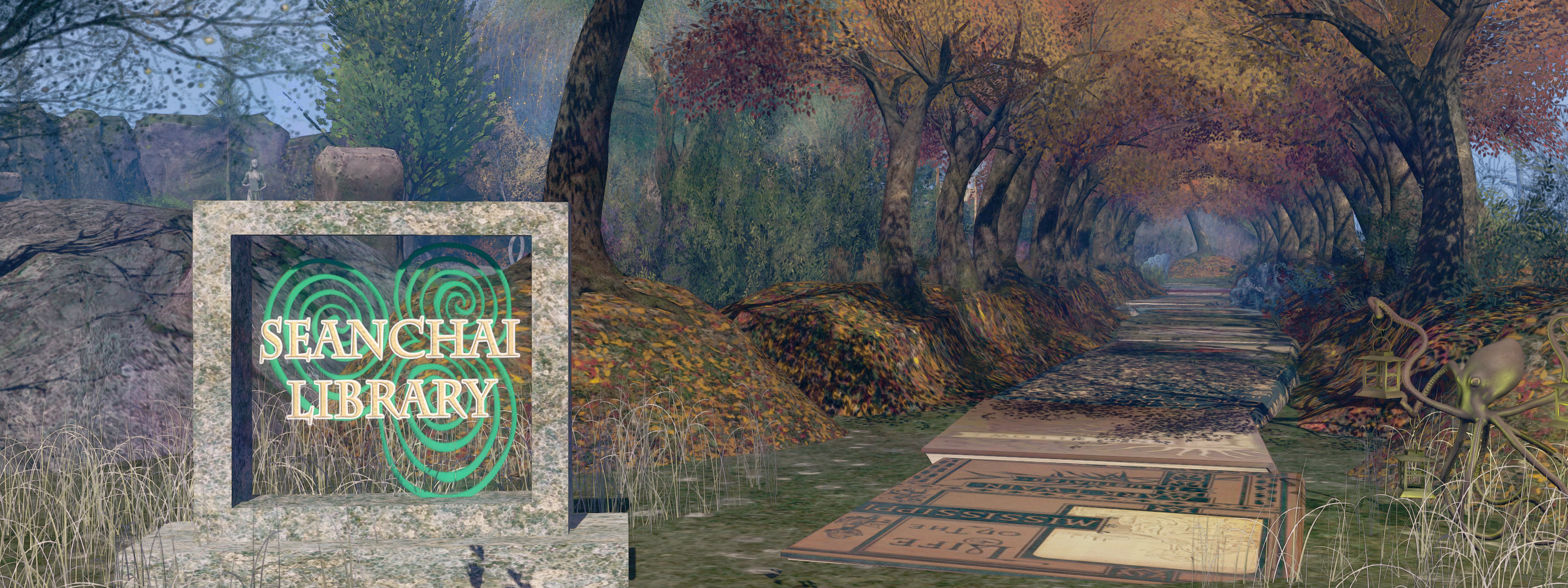
It’s time to highlight another week of storytelling in Voice by the staff and volunteers at the Seanchai Library. As always, all times SLT, and events are held at the Library’s home in Nowhereville, unless otherwise indicated. Note that the schedule below may be subject to change during the week, please refer to the Seanchai Library website for the latest information through the week.
Monday, January 11th, 19:00: The Dark Bright Water
Gyro Muggins reads Patricia Wrightson’s second novel charting the life of Wirrun of the Inlanders.
First encountered in The Ice Is Coming, when Wirrun set out on a quest to overcome the rise of the ancient enemy of Australia, the ice-bearded Ninya, the young janitor now has a reputation as a Hero among the Inlanders (Wrightson’s fantasy view of the Australian Aboriginals). It’s not a title he appreciates; he would much rather just get back to his janitorial work.
But the spirits of the land are restless: Yunggamurra, a river spirit is lost, so uses her siren-like powers of song to draw to herself those who might might take her home. Her singing come to Wirrun’s ears, and those of an elderly aboriginal emissary, and he realises he must journey to the very heartlands of Australia to better understand what he is feeling.
This he does, with the old emissary and his friend Ularra. Once there, he discovers that a storm is indeed rising within the domain of the spirits, and he is uniquely placed to both find Yunggamurra and prevent the coming storm. And so his new adventure begins.
19:00: Written in History: Letters that Changed the World
WRITTEN IN HISTORY celebrates the great letters of world history, creative culture and personal life. Acclaimed historian Simon Sebag Montefiore selects over one hundred letters from ancient times to the twenty-first century: some are noble and inspiring, some despicable and unsettling; some are exquisite works of literature, others brutal, coarse and frankly outrageous; many are erotic, others heartbreaking.
The writers vary from Elizabeth I, Rameses the Great and Leonard Cohen to Emmeline Pankhurst, Mandela, Stalin, Michelangelo, Suleiman the Magnificent and unknown people in extraordinary circumstances – from love letters to calls for liberation, declarations of war to reflections on death. In the colourful, accessible style of a master storyteller, Montefiore shows why these letters are essential reading: how they enlighten our past, enrich the way we live now – and illuminate tomorrow.
Join Caledonia Skytower as she reads selections from this remarkable book.
Wednesday, January 13th 19:00: In Walt We Trust
More from Craig Johnson’s Sheriff Longmire Series with Kayden Oconnell.
Thursday, January 14th
19:00: Monsters and Myths
The Pig’s Ploughman – Part 2, Shandon Loring presents another mythic adventure from the works of Bernard Evslin. Also in Kitely! Find teleport from the main Seanchai World grid.kitely.com:8002:SEANCHAI.
21:00: Seanchai Late Night
Finn Zeddmore presents contemporary sci-fi-fantasy from such on-line sources as Escape Pod, Light Speed, and Clarkesworld magazines.
Logos representative only and should not be seen as an endorsement / preference / recommendation
Updates for the week ending Sunday, January 10th
This summary is generally published every Monday, and is a list of SL viewer / client releases (official and TPV) made during the previous week. When reading it, please note:
It is based on my Current Viewer Releases Page, a list of all Second Life viewers and clients that are in popular use (and of which I am aware), and which are recognised as adhering to the TPV Policy. This page includes comprehensive links to download pages, blog notes, release notes, etc., as well as links to any / all reviews of specific viewers / clients made within this blog.
By its nature, this summary presented here will always be in arrears, please refer to the Current Viewer Release Page for more up-to-date information.
Note that for purposes of length, TPV test viewers, preview / beta viewers / nightly builds are generally not recorded in these summaries.
Official LL Viewers
Current release viewer version 6.4.11.551711, formerly Cachaça Maintenance RC viewer promoted on November 12th – No Change.
Release channel cohorts:
Project Jelly viewer (Jellydoll updates), updated to version 6.4.12.553798 on January 7th, 2021.
Custom Key Mappings project viewer, updated to version 6.4.12.553437, on January 7, 2021..
Project viewers:
Love Me Render (LMR) 5 project viewer, version 6.4.12.553511, issued on January 7th, 2021.
A stunning image of Starship SN9 standing on the Boca Chica launch platform framed by a low Sun. Credit: Mary “BocaChicaGal”
In December 2020, and following the not-quite-successful flight of Starship prototype SN8, SpaceX suffered what might have been a further setback in their flight test plans for the Starship vehicle, when prototype SN9 toppled sideways whilst in the stacking facility at the company’s Boca Chica, Texas, construction and flight test centre (see: Space Sunday: the flight of SN8 and a round-up).
However, the vehicle was quickly righted and following examination, work commenced on repairing / replacing the damaged elements (notably one of the forward aerodynamic surfaces). This work proceeded at a surprising pace; so much so that on December 22nd, 2020, it was delivered to he Starship launch platform.
Since then work has continued at the same rapid pace, such that within the two weeks since its arrival on the stand, SN9 has completed the majority of its pre-flight checks that took around 2 months to complete for SN8. These included initial fuel tank pressurisation tests using inert liquid nitrogen (to test the tanks and structure for leaks), partial and fuel test fuelling operations, vent system tests, testing of the reaction Control system (RCS) thrusters that help maintain the vehicle’s orientation in the atmosphere and will provide manoeuvring capabilities in space, and even a full static fire test of the vehicle’s three Raptor engines, which took place on January 6th.
SN9 static fire engine test. Credit: Mary “BocaChicaGal”
Two tests were skipped in the process – but this is seen as not so much because the company is trying to make up for any “lost time”, but rather the result of growing confidence in the process of taking a prototype vehicle from fabrication to test flight. However, while the engine firing was successful, it was somewhat shorter than those for SN8 – the Raptors fired for less than 2 seconds – so it is not clear whether or not an issue was encountered, forcing a premature shut-down. If this is the case, then it might be that further static fire tests may be announced ahead of any flight; if the brief firing was intentional, then it is possible a flight test could come within the next week or so.
As it is, the exact date of any actual flight test for SN9 – which will seek to repeat the 12.5 km altitude reached by SN8, but hopefully follow it with a successful landing – hasn’t been confirmed. However, to avoid a repeat of the SN8 crash, SpaceX CEO Elon Musk confirmed that the Methane header tank – a smaller tank designed to feed fuel to the Raptor motors during the landing sequence – for SN9 and at least some of the prototypes that follow it will be “pressed” with helium (this is, helium will be forced into the tank in order to force the methane out and to the engines) in order to avoid any pressurisation issues. However, it is not clear if this will be the permanent solution to the problem, or an interim update to allow test flights to continue whilst SpaceX develop a more permanent solution to the problem.
A diagram showing Starship and Super Heavy prototype development. On the left, SN9 is complete, and awaiting its flight. SN10 is awaiting Raptor motor installation and the attachment of its aft flaps, and SN11 has yet to have its upper sections installed and is awaiting its tail flaps and motors. All of the major hull elements of SN12 have been fabricated but have yet to be assembled. The diagram also show the assembly of SN15, which is will in advance of SN13 and SN14, while to the right is the status (as of January 9th) of the first Super Heavy prototype. Credit Brendan Lewis
At the same time as pre-flight tests have been continuing with Starship SN9, work has been continuing with a number of further prototypes. SN10 very close to completion, with just engines and aft aerodynamic flaps to be mounted, and SN11 will be receiving its upper sections in the coming week. Further down the chain, SN15 is also progressing, as is SN16. These will likely be the first two prototypes fully fitted with the thermal protection system used to safeguard the vehicle’s hull during atmospheric entry. This doesn’t necessarily mean either will make an orbital flight – SpaceX will doubtless want to text how the entire thermal system holds up under atmospheric flight prior to committing to an orbital attempt.
However, work currently appears to be on hold for vehicles SN13 and SN14, and SN12 has yet to be stacked. Whether these vehicles will be completed remains to be seen: Musk has previously indicated that the SN15 vehicle and beyond will include “significant upgrades” compared to earlier vehicles, so it is possible SpaceX may opt to skip from SN11 to SN15 in the flight test programme.
An image demonstrating the relative size of SpaceX vehicles and the shuttle. Left: the Crew Dragon – capable of flying up to 7 into LEO; right: a starship vehicle with a shuttle orbiter alongside. The orbiter could carry up to 7 into LEO with up to 28 tonnes of cargo. Starship can carry up to 100 people + cargo or up to 100 tonnes (cargo variant) to LEO. A Tesla 4×4 and human are included for scale. Credit: Dale Rutherford
Puerto Rico Governor Supports Rebuilding Arecibo
The outgoing governor of Puerto Rico, Wanda Vázquez Garced, signed an executive order on December 28th, 2020 backing the rebuilding of the 305-m diameter Arecibo radio telescope that collapsed in November 2020 (see: Space Sunday: returns and a collapse).
The order states that US $8 million is to be “assigned and allocated” for removing the debris of the collapsed telescope and “remedial environmental” work be completed at the site. It further states that the Puerto Rico government wishes to see the development of a telescope with a larger effective aperture, wider field of view and a more powerful radar transmitter to replace the original, thus providing the nucleus of “a world class science and education facility”.
Arecibo as it was: visible is the main dish with the central receiving platform suspended over it via the three towers. Credit: NASA
However, things are not as clear cut as this. For one thing, the construction of a new telescope is liable to cost more than ten times the funding stated in the order. It’s also not clear where the $8 million will come from; the order only suggests it could be provided through “state, federal and private sources (including public-private partnerships and state-federal partnerships)”.
More particularly, Arecibo is not under the funding auspices of the Puerto Rican government, but rather that of the National Science Foundation (NSF), which it turn is funded directly by the US government. Thus far, the NSF has not committed to any rebuilding / replacement at the site, nor have any funds been allocated by Congress in the 2021 federal budget – although the NSF has been directed to prepare a study / report on the telescope’s collapse, the clean-up operation and to determine whether a replacement / comparable facility should be established at the sit, together with the associated costs for doing so.
After the fall: the telescope after the collapse of the receiving platform (the wreckage of which can be see to the right of the disk. Also clearly visible is the scar where the collapsing platform and cables tore through the disk. Credit: NASA
NSF has a very well-defined process for funding and constructing large-scale infrastructure, including telescopes. It’s a multi-year process that involves congressional appropriations and the assessment and needs of the scientific community. So, it’s very early for us to comment on the replacement.
– Ralph Gaume, director of NSF’s Division of Astronomical Sciences







 Inara Pey: Living in a Modemworld