The following summary notes were taken from the Tuesday, March 29th, 2022 Simulator User Group (SUG) meeting. It forms a summary of the items discussed, and a video of the entire meeting is embedded at the end of the article – my thanks to Pantera for recording it.
Tuesday, March 29th: the Main SLS channel simulators were restarted, but without any update deployment.
Wednesday March 30th: all RC channel will be updated with simulator release 569934, which primarily contains a update to support the move of profile information back to the viewer, hopefully allowing the Legacy Profiles viewer (see below) to move forward.
Available Official Viewers
All official viewer pipelines remain as follows:
Release viewer: version version 6.5.3.568554 – formerly the Maintenance J&K RC viewer, promoted Monday, February 28 – No Change
MFA RC viewer, update to version 6.5.4.569725, on March 24.
Performance Improvements RC viewer version 6.6.0.569349, dated March 14.
Lao-Lao Maintenance RC viewer, version 6.5.4.569191, issued on March 11.
Project viewers:
Performance Floater project viewer, version 6.5.4.569531, March 18.
Mesh Optimizer project viewer, version 6.5.2.566858, dated January 5, issued after January 10.
Legacy Profiles viewer, version 6.4.11.550519, dated October 26, 2020.
Copy / Paste viewer, version 6.3.5.533365, dated December 9, 2019.
In Brief
Note: this meeting was another live music event, so discussions were limited. So very little to report.
BUG-231876 “llRequestSimulatorData() frequently and silently fails” – a fix has been developed for this issue and is currently with QA for testing. It had been hoped this would be ready for a deployment this week, but unfortunately this is not the case.
Some have been reporting an issue whereby their Friends list reports all (or most) contacts as off-line when logging into a region the first time after a restart, requiring them to TP to another region entire for a Friends list update, or (if they are the region holder) restarting / requesting a s restart for the culprit region. LL have no information as yet on why this is occurring.
Lost Unicorn, March 2022 – click any image for full size
I recently received word from Natalie Starlight that she and Nessa Nova have been re-working their Lost Unicorn estate, together with an invite to drop in for a visit.
I just wanted to let you know that we have brought back an all new Lost Unicorn (forest)! Nessa and I both missed the magic of the old sim with the elves, unicorns, mermaids, etc. We’ve added much of that back and are also currently working on a new Storybook area behind the gallery on the other region!
Just thought you might want to stop by when you can and see the changes.
– Natalie Starlight
Lost Unicorn, March 2022
Given how much I’ve enjoyed previous iterations of the Lost Unicorn builds, I made sure to hop over and take a look.
Lost Unicorn has always offered a special delight for me ever since my first visit to it, the gallery and the delightful and the soon to return (as Natalie indicates above) Storybook, some four years ago. A dreamy and mystical elven realm shrouded in mist, the home of fairies, centaurs, unicorns and more, Lost Unicorn has always been a rewarding visit, with much to see, photograph and simply enjoy whilst following the paths and trails that wander through it.
Lost Unicorn, March 2022
With this returning, Natalie and Nessa have fully recaptured all of this richness and beauty found in earlier iterations of the region, and wrapped it all in something new but just as engaging.
From the landing point towards the east of the region, visitors can wander as their moods dictate. Take the path down from it and across the bridge and make your way up to the high castle as it commands a view across the region towards the (under reconstruction at the time of my visit) Lost Unicorn Gallery.
Lost Unicorn, March 2022
Or you can go by way gazebo and path around the base of the peak on which the castle is built with where another bridge spans a gorge to reach a fair elven home and stairs spiral up around the trunks of giant trees and span the air by means of further bridges to again offer a means to reach the high castle, passing by way seats and games a free houses along the way.
Those who find there way down to the valleys and lowlands shaded as they are by the richness of boughs from the forest will find more paths and trails, some in shadow others lit by streamers of sunlight falling through those same boughs, all leading to points of interest and beauty. Some of these – such as the gardens with the piano, ancient walls and sakura blossoms – may be easy to find; other might be more hidden, requiring a trip away from sunlight altogether and into caverns old; still others might be said to hide in plain sight – should you have the eyes to see them.
Lost Unicorn, March 2022
For those who don’t there are experience-based teleport portals waiting to carry visitors directly to points of interest – but again, finding these is all part of the broader experience of discovery. All I will say is that at the feet of bridges, secrets may be found. Nor, in fact does everything necessarily lie either above or below ground.
But the truth is, wherever your feet take you within Lost Unicorn, you will find something to captivate, be in elves, fairies, art, mermaids, centaurs, animals – or simply a place to sit and past the time, listing to the ambient soundscape and perhaps the notes of the piano drifting through the trees.
Logos representative only and should not be seen as an endorsement / preference / recommendation
Updates from the week ending Sunday, March 27th, 2022
This summary is generally published every Monday, and is a list of SL viewer / client releases (official and TPV) made during the previous week. When reading it, please note:
It is based on my Current Viewer Releases Page, a list of all Second Life viewers and clients that are in popular use (and of which I am aware), and which are recognised as adhering to the TPV Policy. This page includes comprehensive links to download pages, blog notes, release notes, etc., as well as links to any / all reviews of specific viewers / clients made within this blog.
By its nature, this summary presented here will always be in arrears, please refer to the Current Viewer Release Page for more up-to-date information.
Note that for purposes of length, TPV test viewers, preview / beta viewers / nightly builds are generally not recorded in these summaries.
Official LL Viewers
Release viewer: version version 6.5.3.568554 – formerly the Maintenance J&K RC viewer, promoted Monday, February 28 – no change.
Release channel cohorts:
MFA RC viewer updated to version 6.5.4.569725 on March 24.
Nitroglobus Roof Gallery: Elfi Siemens – Status Menti
The April 2022 exhibition hosted in the main hall of the Nitroglobus Roof Gallery, operated by Dido Haas, features the work of Elfi Siemens within a collection she has called StatusMenti. It is a richly metaphorical examination of self, as the artist notes:
We all have those dark, sinister places inside our minds: Areas where the sun does NOT shine all the time. And oh, how hard we try to hide them from the world around us!
Status Menti / State Of Mind is an emotional trip through my personal darkness – and who knows, maybe you will find parts of your own inner twilight zone in those images painted with shadows.
– Elfi Siemens
Nitroglobus Roof Gallery: Elfi Siemens – Status Menti
Thus, through the fourteen images presented at Nitroglobus, we are invited to tour elements of Elfi’s Country of the Mind, to use a term coined in fiction by Greg Bear to describe a means of visually exploring a person’s psychology. True, Greg – notably through his novel Queen of Angels (1990) – used a form of virtual reality to allow a character to directly interact with another’s psychology / subconscious, but the fact that we are viewing Elfi’s work through a virtual medium – Second Life – does allow for a foundational link between Bear’s fiction technique and our explorations of the art present here.
More particularly, the subject matter projected through the fourteen images allows us the ability – as Elfi notes – to witness and explore the more shadowed aspects of her psyche, to join her on a journey through her thoughts and fears, reflection and projections.
What is particularly engaging about the fourteen pieces Elfi has presented is the sheer diversity of presentation and symbolism. From monochrome to colour through varying degrees of hue and tone, from the direct portrait through to framed story, in the use of surrealist through to the abstracted, each piece is unique to itself, yet retains strands of identity, self-doubt / self awareness that binds it to the rest, and the idea of exploring one’s subconscious.
Nitroglobus Roof Gallery: Elfi Siemens – Status Menti
Some of the imagery is both powerfully clear and also marvellously layered – just take Madness, Cornered, Who Am I Today? and Decisions as examples; elsewhere it is more nuanced – as with Time (complete with a subtle borrowing from Dali), for example. Then there is the use of motif, notably that of the heart (which also appears within the one 3D piece Elfi has included in the exhibition), and the layering of its use.
Of course, one might question as to had genuine a story of self we are on, by virtue of these fact that, like it or not, these are images that have been consciously constructed and thus subject to the influence of the artist’s mind rather then being pure observations of what lies beneath. However, whether this matters or not is down to the individual witnessing the pieces offered; at the end of the day, the artist set out to offer an insight into her thoughts and moods – so even if the results are influenced by conscious thought, they nevertheless still sit as windows to what lies within.
Nitroglobus Roof Gallery: Elfi Siemens – Status Menti
Thus, Status Menti sits as a valid exploration of self / self-doubt and the darker thoughts that are a necessary part of out psyche. While, for those who wish to appreciate art for its own sake, they also sit as a set of rich images to enjoy, each on its own merit.
Sometimes playing pot luck with Second Life’s Destination Guide can result in the most unexpected visits. Recently, for example, I riffled through the DG and ended up dropping into a pair of builds by Mitch Charron; both are located within the same region and both offers their own sense of history, albeit in very different ways.
The first of these is a genuine page from history and takes the form of HMS Iron Duke, the flagship of the British Grand Fleet operating out of Scapa Flow in the Scottish Orkneys during the First World War. Sporting no fewer than 10 13.5-inch guns, Iron Duke and her four sister ships were, for a short time following the outbreak of hostilities, the most powerful warships in His Majesty’s Royal Navy. In 1916, three of them participated in the Battle of Jutland, the only major clash of battleships of that war – and the last major naval engagement fought primarily by capital ships before aircraft became the main offensive weapon in naval warfare.
HMS Iron Duke
Within Second Life, Iron Duke is offered as a WWI role-play environment, the vessel appearing to be moored within Scapa Flow. The landing point in on her main gun deck, close to the aft superstructure that mounts one of the ship’s massive twin turrets of its main armament. This superstructure provides access to the below decks areas where can be found offices, the main mess deck for ratings (complete with hammock rigged over the tables and benches), the officer’s mess with it modest comforts, etc.
Forward of the landing point, past the midships main turret, it is possible to reach the armoured steering house and the flying bridge with its charthouse that rises above the forward superstructure. Other details include the vessel’s casement-mounted secondary guns, her steam tenders and general deck details that match available drawings of the ship for the period 1914-1919, all of which make for an engaging visit.
Moonbase Alpha: Main Mission
Located high above the mists of Scapa Flow, meanwhile, sits another location risen of the history of television. Located within the magnificent desolation of the Moon’s surface over which a (rather large) gibbous Earth hangs, is the grey bulk of Moonbase Alpha, a place made famous – and most media sci-fi fans will likely know – by the 1970s live-action TV series Space: 1999, created by Gerry and Sylvia Anderson (and the last production in their partnership).
For those who aren’t familiar with it, the series focused on the plight of the inhabitants of Moonbase Alpha, a scientific research centre, after Earth’s Moon is blasted out of its orbit – and out of the solar system – on September 13th, 1999 courtesy of a massive nuclear explosion. While we now may be looking back at 1999 knowing this never happened, at the time it allowed the series to offer the 311 people stranded on the wandering Moon to partake in numerous adventures (some of them very hooky) in deep space.
Moonbase Alpha: Medical Centre
The series drew inspiration from some of the production designs seen in Stanley Kubrick’s 2001: A Space Odyssey and this is very much in evidence within Mitch’s design, presenting as it does various interior spaces of Moonbase Alpha, all of which are intended to offer a free-form role-play space for those wishing to get involved.
Those familiar with the TV series will instantly recognise what can be found here, from Main Mission, the station’s control centre dominated by the base commander’s large desk, through the plastic-walled corridors to the recreational facilities, the medical centre, the science labs, crew quarters and even a travel tube car. Corridor intersections include the show’s iconic communications posts, while out of the landing pads a (possibly more iconic) Eagle Transporter awaits lift-off.
The interior of an Eagle forms the landing point, with a loading door accessing the travel tube (and thence the rest of the station), while the computer panel to one side of the Eagle’s pod offers teleports to the ground-level sights within the region, which may well be the subject of a future visit. Other teleports will deliver people to some of the outlining facilities around the core of the base.
Moonbase Alpha: Recreation and Dining
From reading the notes (provided via the Communications Posts), I understand the station is to be extended, and custom props are to be developed and supplied to those involved in RP within the setting. The role play itself is apparently set some two years prior to the events of the TV series, meaning the station in not under the command of Martin Landau’s John Koenig, but will progress to that fateful day in September 1999. Anyone who does fancy becoming an Alphan should contact Mitch Charron directly.
I’ve no idea how much actual role-play goes on at either location, but for the historically-minded, Iron Duke makes for an interesting visit. Moonbase Alpha is a very credible reproduction of the environment from the TV series – so much so that I wouldn’t have been surprised if Nick Tate’s Alan Carter had stepped out of the cockpit of the Eagle interior landing point.
Both Moonbase and battleship make for very eclectic visits, but both offer multiple opportunities for photography, (although the battleship could perhaps benefit from the use of materials to help bring the texturing to life, land impact allowing; it also would also perhaps be nice if the ship had an information giver similar to the ones at Moonbase, but this is a minor quibble.
What it might look like: an animation of the first Starship orbital flight. Credit: C-Bass Production / Neopork
Such is the pace of development, the first orbital flight of the SpaceX Starship / Super Heavy combination will now not take place as originally planned.
It had been thought that the flight, which has been repeatedly delayed for a number of factors, including slippages in the Federal Aviation Administration being able to publish the final version of its study into the impact of SpaceX’s operations in Boca Chica on the surrounding environment, would be made by Starship No. 20 (“Ship 20”), and Super Heavy booster No 4 (Booster 4), both of which have been going through a wide range of cryogenic and static fire tests since mid-2021, the most recent of the cryogenic tests occurring just over a week and a half ago, with both vehicles stacked together on the launch platform.
However, on Saturday, March 22nd, Starship 20 was “destacked” from Booster 4 and removed from the orbital launch facilities, and 24 hours later, Booster 4 was also removed, with Elon Musk Tweeting that neither would now play a role in the first orbital flight attempt. The reason for this is simple: work on developing and enhancing the design of both the Starship vehicle and the Super Heavy booster now means that Booster 4 and Ship 20 are essentially obsolete.
March 22nd, 2022: Mechazilla on the orbital support tower lowers Starship 20 following its disconnect from Booster 4. Credit: NASA Spaceflight
The major cause for this is that – despite a scary e-mail from Musk at the end of 2021 stating SpaceX could go bankrupt if issues with the powerful Raptor 2 engine were not quickly sorted out and production ramped – the company is now solely focused on boosters and ships built to mount the much more compact Raptor 2 motors, the sea level versions of which (primarily used to power Super Heavy, but three are also used in each Starship) are considerably smaller and less complicated than their Raptor 1 cousins, and generate far more thrust (from 230 to 250 tonnes per Raptor 2 compared to a maximum 185 tonnes for a Raptor 1).
Left: a sea-level Raptor 2 engine compared to its much larger Raptor 1 equivalent. Credit: Nic Ansuni / NASA Spaceflight
The more compact size of the Raptor 2 makes it possible for SpaceX to increase the total compliment of engines on a Super Heavy from 29 to the planned 33. The reduction in their complexity also makes all of the plumbing required to feed them propellants and the electronics needed to control them a lot easier to manage. For starship vehicles, the smaller Raptor 2 motors should make it easier to increase the number of engines from 6 to the planned 9 (3 sea-level and 6 vacuum engines with their much large exhaust bells).
Booster 7 and Ship 24 are also the first of each design to incorporate other critical design changes. Some of these are to easy the fabrication and assembly process, others are to help improve performance or meet the demands of having more engines, and still other to improve aerodynamics.
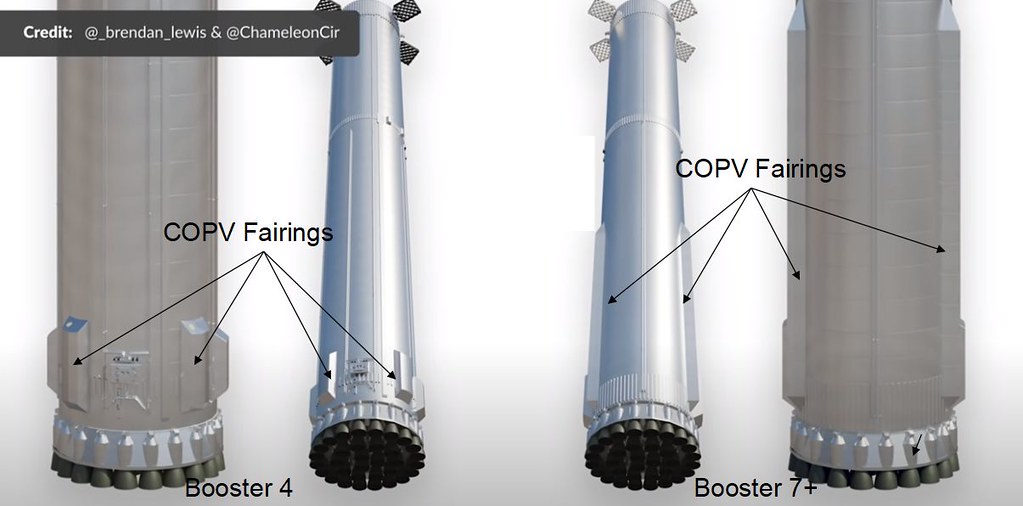
In the case of the Super Heavy booster, one of the cleverest – and most visible – changes is in the number and positioning of the Composite Overwrapped Pressure Vessels (COPVs).
COPV are tanks of hydrogen used in the ignition process for the outer ring of Raptor motors on a Super Heavy. With Booster 4, four pairs of COPVs were placed equidistantly around the base of the booster, covered by steel aeroshells.
However, with the increased number of Raptor engines, Booster 7 and those that follow it require 10 COPVs each. Were the extra two COPV to be paired at the base of the rocket, they would work with the other four pairs to disrupt airflow over the tail of the booster during ascent, generating both drag and potential buffeting / vibration.
To prevent this, Booster 7 is the first Super Heavy to have the COPV stacked vertically along its sides in two sets of five. Not only does this remove the risk of additional drag / buffeting during ascent, it also simplifies the overall plumbing to supply hydrogen to the Raptors, as each set of 5 can use common feedlines down the the engines. However, what is particularly clever is that offsetting each stack of COPVs slightly from the rocket’s centreline, their aerodynamic covers can actually help generate a degree of lift around the base of the rocket during its descent back through the atmosphere, helping to both slow it and provide a greater degree of control during the descent.
The COPV changes: left, as they were on Booster 4, and as they are on Booster 7. Credit: Brendan Lewis / ChameleonCir
As it is the closest to completion, Starship 24 would appear to be the primary candidate for joining booster 7 on the orbital flight attempt (work on ships 21 through 23 having been abandoned / bypassed) – but this far from certain. Recent work on the vehicle has seen it installed with a small prototype payload bay door, suggesting it has been earmarked for a payload bay test flight, something yet to be scheduled. As such, it is possible that Ship 25, also being assembled at Boca Chica, might be selected for the first orbital attempt.
Although the switch to using more recent versions of Super Heavy and Starship means that the first orbital flight attempt is now unlikely to occur before late May 2022, when it does happen, it will allow SpaceX to gather more relevant data on vehicle performance, which should help benefit the programme overall. It also means that by the time the booster / ship combination is ready to go, the FAA’s report on its environmental review of the Boca Chica site should have been published (the release date was recently pushed back again from the end of March to the end of April), and SpaceX should be in a position to know whether or not they are to be granted a licence for their orbital launches from the site.





 Inara Pey: Living in a Modemworld