Space Monday – going nuclear

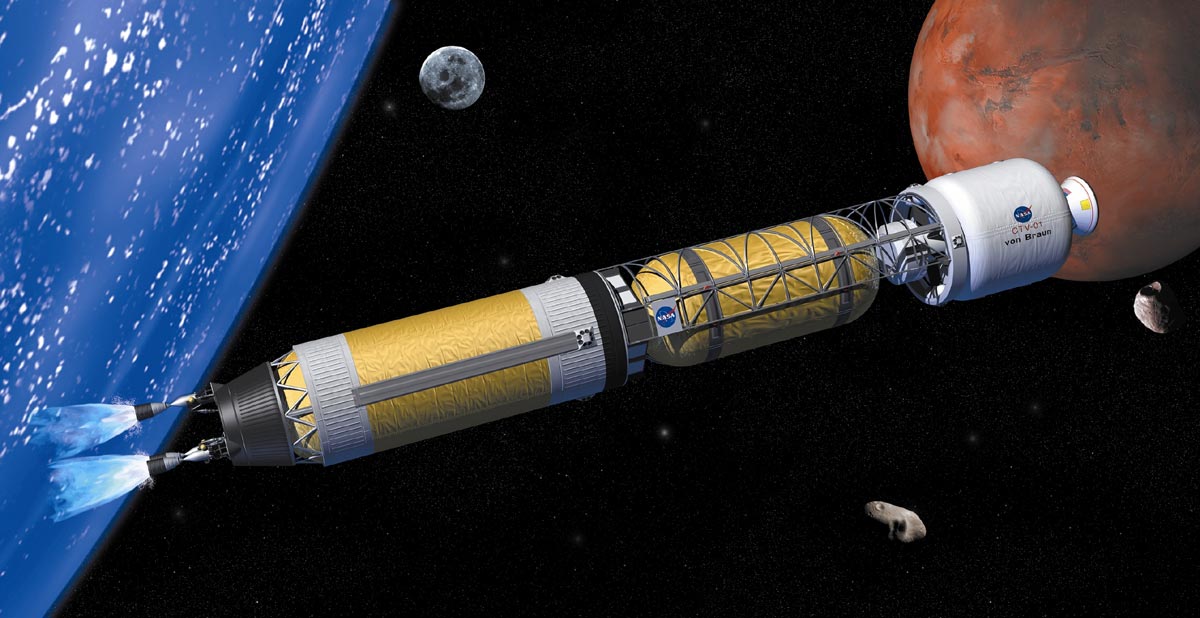
An artist’s concept of a nuclear bimodal crewed transport, which could be used to deliver crews to the Moon or – in just 45 days – to Mars (Earth, the Moon and Mars not to scale). Credit: NASA

In the heydays of the early space race, both the Americans and Russians toyed with various concepts involving nuclear propulsion for human space exploration within the solar system.

In the United States, this work focused on three major areas of study: nuclear pulse propulsion (NPP) – literally exploding atomic bombs behind a space vehicle, propelling it forward, as exemplified by Project Orion; Nuclear-Thermal Propulsion (NTP) – the use nuclear motors in place of chemical rockets either from launch or once in orbit as seen with Project NERVA; and Nuclear-Electric Propulsion (NEP) – the use of nuclear energy to power low-thrust ion propulsion motors.

NPP was effectively (and perhaps fortunately) abandoned over both the fear of fallout from the vehicle’s atomic explosions during its ascent through the atmosphere and the signing of the Partial Test Ban Treaty in 1963. NTP, using a nuclear reactor to heat liquid hydrogen (LH2) propellant to create ionized hydrogen gas (plasma) which can be expelled via engine bells, has continued to be researched, although its use from launch was overruled dues to the radioactive exhaust plume (thus requiring liquid-fuelled rocket to lift the propulsion units to orbit where they might be used), and remains a solid concept for propulsion that could help reduce the journey time to Mars by weeks.

Nuclear-Electric Propulsion (NEP), relies on a nuclear reactor to provide electricity to an ion engine using an inert gas (like xenon) to create thrust (rather than spewing a radiative exhaust). The resultant thrust is less than that of either NTP or chemical propulsion, but it has the advantage of being able to be maintained for far longer periods, potentially allowing a crewed vehicle to gently accelerate to the half-way point to Mars before trying around and using that same thrust to decelerate gently and achieve orbit around Mars. This could cut a 6-month journey to Mars in half.

Experiments in NEP have continued through until recent times, including space-based test; NTP, however, only reached the stage of ground-based testing before being curtailed. However, it has remained the preferred approach to crewed deep-space missions, should nuclear propulsion on crewed vehicles again be seriously considered. The interest is now re-awakening in light of Project Artemis and America’s stated desire to both return to the Moon and reach beyond it to Mars, with a focus on new approaches to methods of propulsion.

One of these new approaches is the rather tongue-twisty Bimodal NTP/NEP With A Wave Rotor Topping Cycle. The “bimodal” references combining NTP fission to generate the electricity required to power a NEP ion engine, while the “wave rotor” effectively meaning a “supercharger” which further compresses the reaction mass to deliver greater power to the NEP. Research into the approach suggests a transit time to Mars could be reduced to just 45 days.

Based on conventional propulsion technology, the most fuel-efficient Mars crewed mission profile offering the longest period for surface exploration is the Opposition Mission. This requires crews to spend between 6 an 9 months each way in transit between the two planets, with a surface stay of up to 23 months. However, a bimodal nuclear propulsion system could both reduce the transit time each way to 45-60 days, allowing crews to spend more time on Mars, whilst also potentially releasing a mission for the 26-month launch windows, enabling a crew to make an emergency return to Earth if required.

A breakdown of a biomodal transport vehicle. To the right, and docked against the Transhab module is an Orion MPCV, used to deliver crews to the vehicle from Earth and return them home at the end of a mission. The TransHab is a 6m diameter living / working module, powered by conventional solar arrays. Aft of this is the Mars descent / ascent vehicle, then the propulsion control module. The centre of the vehicle comprises the fuel tanks (which also help shield the crew vehicles from radiation from the propulsion module). The combined propulsion (NEP / NTP) module is to the left, also housing the Wave Rider “supercharger”). Credit: NASA

As well as propulsion, NASA is looking at ideas using nuclear power systems for long-duration surface missions when solar and wind power cannot be used / relied upon, These include  KRUSTY, the  Kilopower Reactor Using Sterling Technology, a joint venture between the space agency and the US Department of Energy’s National Nuclear Security Administration (NNSA) successfully demonstrated in 2018. Then there is a new take on the hybrid fusion / fission reactor, first selected by NASA for development in 2013 and which has recently seen renewed investigation, and which is now showing promising signs for future use.

Conventional fusion methods generally comprise either inertial or magnetic confinement, using extreme pressure or a powerful magnetic field to compress a fuel such a deuterium (hydrogen-2), forcing fusion to occur. Both require significant energy input and the generation of significant amounts of heat – around 15 million degrees centigrade. As such, both require large, heavy systems and associated cooling – although this hasn’t stopped the likes of Boeing developing concepts for hybrid systems to propel crew-carrying interplanetary spacecraft to rival biomodal NTP / NEP powered craft.

Hybrid fusion / fission utilises high-energy fast neutrons from a fusion reactor to trigger fission in non-fissile fuels. It is still a complex method, but it has the advantage of being capable of of generating multiple fission events from a single neutron, rather than a single reaction per neutron, requiring less fuel feedstock, and as the fuel is non-fissile, output from the reaction is not radioactive. In fact, such a reactor could even use waste from other fission reactions, disposing of it. Even so, the systems required for hybrid fusion / fission reactors have tended to be extensive and mass-heavy, competing directly with bimodal NTP / NEP systems in size, complexity and mass.

The Boeing hybrid fusion-fission crew-rated space transport, 2021. Credit: Boeing Aerospace
However, a team from NASA’s Glenn Research Centre, Ohio, have developed a potential way in which the complexity (and mass) of a hybrid propulsion system could be significantly reduced.

Selected for Phase I development by the NASA Innovative Advanced Concepts (NIAC) programme, the team has focused on the development of a special lattice into which deuterium can be packed in densities around a billion times greater than a within the core of a conventional hybrid reactor. This, combined with the ability of the fusion process to generate multiple fission reactions, means that overall, less deuterium fuel needs to be carried for feeding into the reactor, thus also reducing the mass of all the associated tanks, piping, etc., required to handle it. Further, the nature of system means that reactions can occur at far lower temperatures than a standard bimodal system, further reducing mass and complexity by eliminating much of the thermal control mechanisms and radiator surfaces required to remove the heat needed to generate the fusion reaction, and the heat it also generates.

Continue reading “Space Monday – going nuclear”

2023 SL viewer release summaries week #3

Logos representative only and should not be seen as an endorsement / preference / recommendation

Updates from the week through to Sunday, January 22nd, 2023

This summary is generally published every Monday, and is a list of SL viewer / client releases (official and TPV) made during the previous week. When reading it, please note:

  • It is based on my Current Viewer Releases Page, a list of all Second Life viewers and clients that are in popular use (and of which I am aware), and which are recognised as adhering to the TPV Policy. This page includes comprehensive links to download pages, blog notes, release notes, etc., as well as links to any / all reviews of specific viewers / clients made within this blog.
  • By its nature, this summary presented here will always be in arrears, please refer to the Current Viewer Release Page for more up-to-date information.
  • Note that for purposes of length, TPV test viewers, preview / beta viewers / nightly builds are generally not recorded in these summaries.

Official LL Viewers

  • Release viewer: Maintenance P (Preferences, Position and Paste) RC viewer version 6.6.8.576863 Monday, December 12.
  • Release channel cohorts:
    • Maintenance R RC viewer, version 6.6.9.577678, released January 19- translation updates and the return of slam bits.
    • Maintenance (Q)uality RC viewer, version 6.6.9.577581, January 18, 2023.
  • Project viewers:
    • glTF / PBR Materials project viewer, version 7.0.0.577610, January 19, 2023 – Screen Space Reflections update + fixes. This viewer will only function on the following Aditi (beta grid) regions: Materials1; Materials Adult and Rumpus Room 1 through 4.

LL Viewer Resources

Third-party Viewers

V6-style

V1-style

Mobile / Other Clients

  • No updates.

Additional TPV Resources

Related Links

JadeYu’s A Kind Of in Second Life

Artcare Gallery, January 2023 – JadeYu Fhang, Une Sorte De…

Currently open at Artcare Gallery, the art hub curated and operated by Carelyna, is Une Sorte De… – “A Kind Of…”, by JadeYu Fhang.

JadeYu has a reputation for being one of the most visually evocative artists in Second Life, and her installations often plumb the depths of the human consciousness and psyche (examples: Roots and War, Everywhere and Nowhere and OpeRaAxiEty). She is also perhaps best known for her 3D installations (such as those mentioned above, offering deeply evocative, layered and expressive pieces – which can also be enigmatic when JadeYu sways in that direction. However, she is also a 2D artist, as Une Sorte De… reminds us.

Artcare Gallery, January 2023 – JadeYu Fhang, Une Sorte De…

Provided within a futuristic display space also designed by JadeYu, the exhibition opened on January 19th, 2023, and is presented sans any artist’s notes. However the 18 pieces presented – a mix of colour and greyscale images – combined with the exhibition’s title suggests these are images intended to convey a feeling and / or emotion or a sense of mood.

From the pictorial to the abstract by way of real and faux 3D elements, these are all highly individual works, exhibiting and intensity of image and form that deserve individual interpretation. As such, this is another exhibition for which I’m again not going to overlay with my personal reflections or reactions – I’d rather JadeYu’s work speak directly to you, and so encourage you to pay a visit to Une Sorte De… for yourself.

Artcare Gallery, January 2023 – JadeYu Fhang, Une Sorte De…

SLurl Details

2023 week 3: SL CCUG and TPV Developer meetings summary

Where Our Journey Begins, November 2022 – blog post
The following notes were taken from
  • My audio recording and chat log transcript of the Content Creation User Group (CCUG) meeting held on Thursday, January 19th 2023 at 13:00 SLT.
  • Pantera’s video of the Third Part Viewer Developer (TPVD) meeting held on Friday, January 20th, 2023 at 13:00 SLT, embedded at the end of this article.
These meetings are chaired by Vir Linden, and their dates and times can be obtained from the SL Public Calendar; also note that the following is a summary of the key topics discussed in the meetings and is not intended to be a full transcript of all points raised. Note, The TPVD meeting was abbreviated to 20 mins.

Official Viewers Status – TPV Meeting

Available Viewers

  • On Thursday, January 19th, 2023, the Maintenance R RC viewer was updated to version  6.6.9.577678 – translation updates and the return of slam bits.
  • On Wednesday, January18th, 2023:
    • The Maintenance (Q)uality RC viewer was updated to version on 6.6.9.577581 – new Debug settings UI, quality of life improvements.
    • The PBR Materials project viewer updated to version 7.0.0.577610, on January 19, 2023 – SSR support.
      • This viewer has been reported as “broken” when running on systems with AMD GPUs, a situation that was being investigation as these notes were being written.
This leaves the rest of the currently-available official viewer as:
  • Release viewer: Maintenance P (Preferences, Position and Paste) RC viewer version 6.6.8.576863 Monday, December 12, 2022.
  • Release Candidate viewers:
    • Performance Floater / Auto-FPS RC viewer, version 6.6.9.577251, January 4, 2023.
  • Project viewers:
    • Puppetry project viewer, version 6.6.8.576972, December 8, 2022.

General Viewer Notes

  • Vir pointed out that as Microsoft has ended support for Windows 8 on January 10th, 2023, it is no longer regarded as a supported operating system for running Second Life, and the viewer will not be tested against it (and the System Requirements page has been updated to reflect this, specifying Windows 10+ most recent service pack as the baseline supported Windows OS.
  • The second phase of the Github work in on-going, notably updating all the viewer build libraries.

Inventory Enhancement Project – Both Meetings

Linden Lab is looking to enhance the Inventory system.
  • The first element of this work is to be the addition of a fixed-resolution thumbnail preview capability, allowing users to see a small image of a given object (where this makes sense – so the likes of note cards and scripts would be excluded) within inventory, with these thumbnails either being of individual items or entire folders.
  • This work has now started, but it will be “some time” before there is anything user-facing to show.
  • A code contribution from Kitty Barnett (Catznip) for an inventory texture tool tip / preview may well be folded in to this work.
  • Once the thumbnail preview work has been completed, it is possible the Lab will look to further enhancements to inventory management. One future enhancement under consideration is support for folders to be included in the Contents inventory of individual objects.

glTF Materials and Reflection Probes – CCUG

Project Summary

  • To provide support for PBR materials using the core glTF 2.0 specification Section 3.9 and using mikkTSpace tangents, including the ability to have PBR Materials assets which can be applied to surfaces and also traded / sold.
  • To provide support for reflection probes and cubemap reflections.
  • The overall goal is to provide as much support for the glTF 2.0 specification as possible.
  • The project viewer is available via the Alternate Viewers page, but will only work on the following regions on Aditi (the Beta grid):  Materials1; Materials Adult and Rumpus Room 1 through 4.
  • Please also see previous CCUG meeting summaries for further background on this project.

Status

  • Viewer:
    • Screen Space Reflections (SSR) has now been integrated into the Project Viewer, (January 19th onwards), although work around this is still being finalised, notably mixed Reflection Probes with SSR.
    • Some fixing is required to the default colour curves in the viewer.
    • Stability issues have been noted on Intel integrated graphics hardware, and these are being investigated / fixed.
    • There have now been a total of two further weeks focused on optimising the viewer’s performance, and the results of this work should be available in the next update to the Project Viewer.
    • UI updates: the viewer will likely see some UI updates as it progresses:
      • The next update will likely include a new dedicated icon for on the Build floater for creating Reflection Probes.
      • The drop-down in the Build floater Textures tab (Currently Materials and Media on the release viewer, may be re-labelled for PBR (where it is Materials, Media, PBR) to more clearly differentiate between the current materials maps system and “new”” PBR materials.
      • Similarly, the new Materials Inventory folder in the Project Viewer may also be renamed to avoid the potential for confusion between the use of PBR materials assets and the current materials maps system.
      • Further, the menu option Build → Upload → Materials (in the Project Viewer) may be reamed to more clearly reflect it is for PBR materials, not material maps.
      • Exactly was terms will be used is TBD, but the general push (from LL’s perspective is to use meaningful lbeels on options and menus which can be Googled with some relevance by those wanting to know more about the underpinning file formats / standards, etc.
  • Work is going into messaging between the back-end and the viewer to ensure it will scale once the viewer starts to see widespread use.

In Brief

  • As the PBR Materials project is approaching a possible RC release, the questions has been asked as to what is next on the graphics front. While no formal decision has been made, options include:
    • A return to looking at adding something like Vulkan / MoltenVK (for OS X) API support alongside of the OpenGL API (which has been slated for deprecation by Apple and is growing increasingly long in the tooth). This work is being looked at more as a performance optimisation rather than a visual boost to rendering (e.g. allowing SL to be less CPU-bound and make more use of the GPU, reducing the volume of draw calls, etc.).
    • Further expansion of the glTF work to include mesh (and moving away from Collada .DAE), animations, etc. But again, no definitive plans / direction has been agreed within the Lab.
      • While there is a appetite at the Lab to support as much as the glTF 2.0 specification, some aspects will be excluded from the list – mentioned at the meeting were Setting the filter mode and sampler state of textures, both of which were described as “problematic” for implementation within SL.
    • Overhauling / updating support / options for ground textures.
  • The CCUG meeting saw a general discussion on animations, the skeleton and all that it involves (bones, attachment points, collision volumes, rigging, etc., and the rules / policies surrounding them, couched initially in the potential for expanding the skeleton / avatar system – for which there are currently no plans to do so beyond what has already been done.
  • Pivot points: (related to the above) past CCUG meeting saw some extended discussion on implementing pivot points on the skeleton, and LL indicated they would investigate this. Since then, it has become increasingly apparent that a node hierarchy would be beneficial and potentially easier to implement; ergo pivot points have been pulled into the pot for a future hierarchy project.
  • There is a known bug where Premium Plus users  – who gain free texture uploads – are being charged for textures included in mesh uploads. An upcoming simulator-side maintenance update should correct this.
  • A request was made at the CCUG meeting to allow mesh uploads greater than the 64m single object size limit, to make it easier to import large structures  / scenes without having to curt them into sections (and thus avoid potential issues in fit, scale, update, etc, and can result in Interest List related rendering issues).
    • LL is unlikely to change the limit, but would prefer to provide improved tools that can help content creators / scene builders.
    • One should tool discussed – which is currently not in development – is that of a “scene view” tool which identifies every individual instance of an object in scene, and provides a mechanism to allow (subject to permissions, obviously) them to be swapped-out to fix things like “broken” items / those for which there is an update / replacement.
 

Next Meetings

  • CCUG: Thursday, February 2nd, 2023.
  • TPVD: Friday, February 17th, 2023.

A visit to a hidden Library in Second Life

The Great Library of Eruanna, January 2023 – click any image for full size

Sam Rougefeu, by way of Twitter, alerted me to The Great Library of Eruanna, located close to the south-western coast of the northern continent of Gaeta. Occupying a quarter of a Full region, this is an imaginative build by Amara Shino, forming both her private home and a place open to exploration by visitors and  light role-play is welcome.

I say imaginative, as it takes the form of a stone castle sitting over a honeycomb of tunnels, caverns, halls and rooms – all of which is sitting on and within a giant floating island of rock. As such, despite the apparently small land area for the setting, it has – literally – a very real sense of depth to it.

The Great Library of Eruanna, January 2023

The landing point sits on one of the walls of the castle, immediately before one of the more notable of its towers (not that many are not noticeable!) and offering a view down into the main bailey.

The architecture is a curious mix, the design suggesting this is a place which has grown organically rather than any planned development. The tower immediately in front of the landing point perhaps offers the first curiosity, a tampering, angular finger topped by a single-story house extending beyond its narrow top on a wooden platform.

Across the grass sitting outside of the castle walls is another tall, angular tower, this one offering a sense of mystery to it, being the home of an apothecary / alchemist, the vapours from cauldrons within its the ground floor escaping under the front door. Stairs climb the inside of this tower, allowing an escape from the vapours to the upper levels – including an enclosed bridge spanning the gap between this tower and a great shoulder of rock rising over the bailey of the castle.

A Hobbit-like front down sits at the foot of this shoulder (one of two Hobbit houses backing their way into the rock, each furnished in a manner that should keep orc, dwarf hobbit or human in reasonable comfort), while the flat top is home to more spire-like towers with conical roofs of another castle awaiting exploration.

The Great Library of Eruanna, January 2023

This upper castle can be reached in one of two main ways: via the narrow tower rising from the keep of the lower castle, or via a path winding up the shoulder of rock itself. Both of the castles present multiple rooms to explore, one of the rooms in the lower keep hinting at the use of the building as a library, the walls lined with cabinets of scrolls.  But this is just the start.

The real secrets of this place  lie within the tunnels and caverns below the towers, keeps and little houses, together with the rooms they contain. These tunnels can be can be accessed from more than one point, but I’m not about to spoil things here by listing any of them; you’ll have to visit yourself to find them. All I will say is the majority – but not all – can be found within the castle.

The Great Library of Eruanna, January 2023

Once within the tunnels, you’ll again find there is much to explore, including the great library itself, tucked away in the depths of the rock. Spanning multiple levels and comprising several rooms, this is an ideal setting for casual role-play. Part of it even comprises a tower built within the living rock, its floors linked by wooden stairways and an open-sided elevator passing level after level of bookcases.

The lowest level of this “tower” accesses another larger hall; at one time, this may have also been a used to store books and scrolls, but it now stands empty, the upper floor broken, and only the side rooms remaining in use.  But books are not all that might be found here; some of the caverns have been turned into catacombs where mummified bodies lay at rest – those of past librarians perhaps? You decide

The Great Library of Eruanna, January 2023

I could write more here, but as noted above, this is a location thoroughly deserving of exploration – and as such, I’ll break off here and encourage you to do so!

SLurl Details

Banagher’s Whispering Sky in Second Life

Starborn Gallery, January 2023: Banagher Crisp – Whispering Sky

Whispering Sky is the title Banagher Crisp has selected for an exhibition of his Second Life photography, currently being hosted by Lizbeth Morningstar in the guest artist of her Starborn Gallery.

This is a selection of predominantly greyscale images with a focus on avatar studies, although they are interspersed with colour images and landscapes spread across the two levels of the hall. They are both evocative and personal pieces, each one focused to evoke a specific instant in time, intended to project an emotion and / or idea, as Banagher explains within his introduction to the exhibition:

We all remember certain moments in our lives where they makes us feel happy, sad, angry, grateful, or loved. My work focuses on “moments” a paused second in a certain place that reflects many different feelings. Each person sees that moment differently and that is what I find fascinating.

– Banagher Crisp

Starborn Gallery, January 2023: Banagher Crisp – Whispering Sky

Given this, these are all pieces that contain a richness of narrative that is quite extraordinary – made more so by the fact that Banagher has left each one untitled so as not to impose his thoughts or ideas onto our encounter with each image. Given this, I’m loathe to offer my own thoughts on individual pieces in this selection for the same reason; these are works that deserve to be seen fresh and unburdened by the interpretations of an intermediary.

What I will say is that the way they individually convey their emotional content: passion, regret, love, loneliness, joy, solitude, contemplation, honour, and more; is captivating, making each piece an image the eyes are drawn back to again and again. Even those without an avatar within them richly evocative in focus, colour (or tone) and content they naturally draw out an emotional response in which feelings and thought bubble.

This is, I believe, my first encounter with Banagher’s work; I’m not sure how long he has been producing pieces in-world, although I note his Flickr stream is no more than two years old – which might indicate the obsession which started as a hobby (to reverse Banagher’s own words) is recent. Be that as it may, both Whispering Sky and his Flickr speak to a depth of artistry I very much hope I will be expressed at more exhibitions in the future.

Starborn Gallery, January 2023: Banagher Crisp – Whispering Sky

Also, when visiting Whispering Sky, do be sure to step into the second hall within the gallery, where the latest exhibition of Lisbeth’s own work, How Many Faces Do We Have? can be appreciated.

SLurl Details