The following notes are taken from the TPV Developer meeting held on Friday, April 2nd, 2021.
These meetings are generally held every other week. They are recorded by Pantera Północy, and her video of the meeting is embedded at the end of this report – my thanks to her for allowing me to do so – and it is used with a transcript of the chat log from the meeting and my own audio recording to produce these notes.
As noted in my CCUG summary, the Custom Key Mappings viewer, version 6.4.17.557391 was promoted to de facto viewer release status on Thursday April 1st.
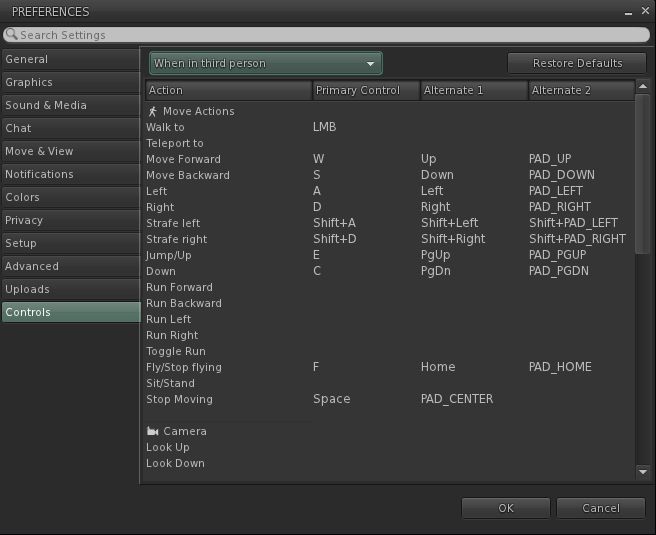
The Key Mapping viewer adds the ability to assign your own keyboard short-cuts to a list of defined commands
The rest of the current pipeline of upcoming RC and project viewers remains as follows:
Release channel cohorts:
Maintenance RC viewer – Eau de Vie, version 6.4.17.557412, dated March 25.
Love Me Render (LMR) 5 project viewer, version 6.4.14.556118, dated February 23.
Project viewers:
Legacy Profiles viewer, version 6.4.11.550519, dated October 26, 2020.
Copy / Paste viewer, version 6.3.5.533365, dated December 9, 2019.
Project Muscadine (Animesh follow-on) project viewer, version 6.4.0.532999, dated November 22, 2019.
360 Snapshot project viewer, version 6.2.4.529111, dated July 16, 2019.
General Viewer Notes
LMR 5 is being used to address crashes relating to older hardware using Intel Graphics drivers. These have proven difficult to track down as almost nothing is reported on where in the viewer the issue causing the crash occurred. In the meantime, those on systems using older Intel HD graphics drivers are encouraged to update to more recent versions.
Both LMR-5 and the Maintenance RC are awaiting merges with the new release viewer code.
The Simple Cache Viewer has been updated following the forced roll-back, and should be appearing as a new RC viewer some time in the next week.
The recent hold-up in the viewer update and release cycle means that there are now a number of Maintenance RC viewers, each with its own focus, awaiting initial release.
A further Lover Me Render viewer (LMR-6) is also in development, with around 8 known issues awaiting resolution before it can be considered for initial release as an RC viewer.
In Brief
[7:20-8:06] the re-working of the Map Tile code continues. It is believed “significant progress” has now been made, but no ETA on when the fully revised code will be in operation.
The following notes were taken from my audio recording and chat log of the Content Creation User Group (CCUG) meeting held on Thursday, April 1st. These meetings are chaired by Vir Linden, with dates available via the SL Public Calendar, and the venue is the Hippotropolis camp fire.
SL Viewer
On Thursday, April 1st the Custom Key Mapping viewer version 6.4.17.557391 was promoted to de facto viewer release status.
The rest of the official viewers remain as:
Release channel cohorts:
Maintenance RC viewer – Eau de Vie, version 6.4.17.557412, dated March 25.
Love Me Render (LMR) 5 project viewer, version 6.4.14.556118, dated February 23.
Project viewers:
Legacy Profiles viewer, version 6.4.11.550519, dated October 26, 2020.
Copy / Paste viewer, version 6.3.5.533365, dated December 9, 2019.
Project Muscadine (Animesh follow-on) project viewer, version 6.4.0.532999, dated November 22, 2019.
360 Snapshot project viewer, version 6.2.4.529111, dated July 16, 2019.
Graphics Work
The graphic team is addressing crashes relating to older hardware using Intel Graphics drivers. These are proving difficult to track down as almost nothing is reported on where in the viewer the issue causing the crash occurred. In the meantime, those on systems using older Intel HD graphics drivers are encouraged to update to more recent versions.
Project Muscadine (Animesh Follow-On)
Project Summary
Currently: offering the means to change an Animesh size parameters via LSL.
Current Status
On semi-permanent hold and unlikely to resume in the near future.
The initial project viewer had some significant issues, which have not as yet been addressed.
More particularly, as this was a test project prior to the work in transitioning the simulator software to the cloud, the necessary support code was never made a part of the core simulator core build, and so would require engineering time to be updated and integrated into the post-transition simulator code, and this is not something that is currently under consideration.
However, the hope is to at least get the LSL extensions work that has been done thus far into the simulator and the viewer updated “at some point”.
ARCTan
Summary: An attempt to re-evaluate avatar rendering costs and the cost of in-world scene rendering, with the current focus on avatar rendering cost / impact, with the in-world scene rendering to be tackled at some point in the future.
The updated Jelly Dolls rendering is seen as the first phase of the avatar work, even though it was more of a side project when initiated..
The next stage is to improve how Avatar Rendering Cost (ARC) information is presented to users, together with improved performance controls within the UI.
Once the UI updates have been made, the updated ARC calculation code can be integrated into the viewer – although these new calculations remain dependant on a Bake Service fix that has been awaiting the cloud migration work to complete before being scheduled for implementation.
The hope is to get through this work Soon™.
In Brief
Proposals for New Forms of Avatar Customisation / Skeleton Deformation
Two proposals have been put forward to allow for a more “dynamic” approach to customising the avatar skeleton on the part of the user.
BUG-230428 “Interpolate between poses/animations via script” presents the idea for allowing pairs of scripted animation to act on the skeleton in such a way that when used, they present a UI slider element the user can adjust to define how the two animations interact with one another. As cited in the feature request, this could be used to combine walking animations so as to produce a unique walk / stride for an avatar. Currently, the idea has been accepted for consideration as possible future work.
BUG-230430 “Ability to interpolate between mesh skeleton offsets/deforms” presents the idea for users to gain a greater degree of avatar customisation by being able to deform the avatar skeleton using dynamic sliders.
Currently, the avatar skeleton can be deformed in two ways: via joint offsets and via animations. These are particularly (but not exclusively) used to force the avatar skeleton to adopt the shape required by a non-humanoid mesh avatar – such as a dog or elephant, etc. These are more-or-less “permanent” deformations, in that as long as the offsets are applied / animations are running, the avatar skeleton will be deformed, and the user has no real control over the deformation.
BUG-230430 proposes a number of ideas (of decreasing complexity as thoughts are better crystallised) for presenting the means for the user to be able to use and adjust / interpolate different groups of offsets or animations (with the bias shifting towards the latter) by means of a set of sliders that are made available as the groups are applied to the avatar.
There are numerous complexities involved in the approaches suggested (e.g. animation priorities when running multiple other animations through AOs; predictability of results in running multiple animations and possible offsets where timing / relationships can be user-adjusted; added UI complexity; viewer / server / viewer synchronisation, etc.). As such this request is currently set to “needs more information” should animators / avatar creators wish to add thoughts.
New User Experience
As I’ve reported elsewhere in these pages, considerable effort is being applied to the new user experience and on-boards of new users. Some of the work is approaching the point where it should be surfacing in a few months time. Elements of the work have included:
Analysing the hardware incoming new users have by logging non-intrusive stats through the viewer. This is indicating that the majority of incoming new users have hardware of much lower specification than might be thought.
Work on simplifying / improving elements of the viewer UI, and looking at the potential of removing settings that are rarely, if ever used.
In a sampling of 10,000 individual user sessions it was found that over 700 of the 1,500 non-intrusive visible settings (i.e. settings that do give rise to privacy concerns if logged) the Lab now log in the official viewer, were never actually used by any user. This raises the question, would any of those 700 be missed if removed?
This does not mean those settings *will* be removed, and the Lab are aware their data doesn’t include TPV users, as third-party have yet to adopt the logging code – although the Lab would be happy to work with them on this.
Updating the learning and social islands incoming users encounter.
Performance updates. This includes considering ways users can be made aware of controls they can adjust / turn off to improve frame rates; possibly introducing a means to have the viewer adjust itself to optimise frame rates, etc.
General Notes
Feature request BUG-230429 “Morph Targets/Shape keys on Mesh” has been accepted by the Lab for consideration as a possible future project.
There was more discussion on the animation system, with views fairly split.
Some see the animations system and formats as being “too old” and needing replacement; others see the BVH format as being extraordinarily flexible in the way it allows control of individual joints when compared to other systems / engines.
Some would like to see a better internal engine with greater support for inverse kinematics, etc., but a concern here is potential knock-on effect / scope (how would such a system relate to the existing animation system? Would it require broader changes to the avatar system? Could it result in existing content breakage? And so on).
There was further discussion of whether or not a system like Marvelous Designer could be incorporated into Second Life as a means to provide a better means of adjusting / fitting clothing to an avatar.
Neither a complete overall of the animation system or the adoption of a Marvelous Designer like cloth / clothing system is currently under consideration.
The following notes were taken from the Tuesday, March 30th, 2021 Simulator User Group (SUG) meeting.
Server Deployments
Please refer to the server deployment thread for the latest news and updates.
Tuesday, March 30th: no planned deployment or restart.
Wednesday, March 31st: the SLS RC channels should all be updated with simulator release 557505, defined as containing “internal fixes”.
On Region Restarts
There is a general assumption that region restarts result in a region and its simulator being relocated to a new server. However, this is not always the case, as Rider and Simon Linden explained:
Simon Linden: the host change isn’t burnt into the design for a restart. basically you stop the region, and another part of the system sees the region is down and hands it out to a system to run it. Based on random timing that might end up on the same host.
Rider Linden: We simply do not guarantee that you will remain on the same host after a restart. Where a region comes back up depends on a lot of factors that are outside the realm of predictability.
Simon Linden: [However] during a version update, that’s VERY unlikely since the old ones get replaced with new ones.
SL Viewer
There have been no official viewer updates to mark the start of the week, leaving the pipelines as:
Release viewer: version 6.4.13.555567 (Jelly Doll improvements) originally promoted February 17th.
Maintenance RC viewer – Eau de Vie, version 6.4.17.557412, dated March 25.
Custom Key Mappings project viewer, version 6.4.17.557391, dated March 24.
Love Me Render (LMR) 5 project viewer, version 6.4.14.556118, dated 23, 2021.
Project viewers:
Legacy Profiles viewer, version 6.4.11.550519, dated October 26.
Copy / Paste viewer, version 6.3.5.533365, dated December 9, 2019.
Project Muscadine (Animesh follow-on) project viewer, version 6.4.0.532999, dated November 22, 2019.
360 Snapshot project viewer, version 6.2.4.529111, dated July 16, 2019.
In Brief
Region Crossings
While they were not intended to directly benefit vehicle region crossings, there have been reports by some that the changes made in the deployment over the previous two weeks have improved things. However, and equally, others are reporting declining smoothness of crossings. As it is, Rider noted that the team haven’t yet had the chance to dig deeply into the code since uplift.
BUG-229871 “Unable to re-enter or telport to a region that I’ve been to during same session” – this remains an issue. Unfortunately, issues with testing the upcoming simulator release been the work on a fix has been delayed.
Map Tiles
Map tiles continue to be worked on, but not fully fixed. There are now a couple of user-developed alternatives available, each with mixed functionality:
Adventures In Mad Wonderland January 2021 – blog post
The following notes were taken from the Tuesday, March 23rd, 2021 Simulator User Group (SUG) meeting.
Server Deployments
Please refer to the server deployment thread for the latest news and updates.
Tuesday, March 23rd: the SLS Main channel received simulator update 556847, which includes the optimisations for crossing and teleporting into a region. This should result in less of a performance hit being felt with lots of people entering a region.
Anecdotal evidence from reports after this update was deployed to RC regions suggested vehicle region crossing had improved.
The update also states that BUG-226851 – “Only 30 – 50% of scripts run on regions since SLS Main server roll of April 18th” – has been resolved. However, there are reports that the deployment appears to have made little or no difference.
Wednesday, March 24th: the SLS RC channels should all be updated with simulator release 557269, defined as containing “internal tweaks”.
On the Teleporting / Region Access Changes
The basic change seen in 556847 mean that instead of multiple avatars trying to get into a region at once, they are now, in a manner of speaking, waiting in line, thanks to the order in which things are handled, as Mazidox Linden described.
Previously, when you teleported to a new region, we stopped the world, grabbed all the data, and injected it into the simulation before resuming the world. Now when you teleport to a region, we grab all the data, stop the world, inject the data into the simulation, and resume the world. Very, very, very approximately.
– Mazidox linden on the changes to how avatars enter a region.
Rider Linden that added that the performance hit people feel in busy regions is not so much the result of the avatars in the region, but all of those trying to get into it, which the new approach should now help eliminate.
SL Viewer
There have been no official viewer updates to mark the start of the week, leaving the pipelines as:
Release viewer: version 6.4.13.555567 (Jelly Doll improvements) originally promoted February 17th.
Release channel cohorts:
Custom Key Mappings project viewer, version 6.4.17.556726, dated March 15.
Maintenance RC viewer – Eau de Vie, version 6.4.14.556149, dated March 4.
Love Me Render (LMR) 5 project viewer, version 6.4.14.556118, dated 23, 2021.
Project viewers:
Legacy Profiles viewer, version 6.4.11.550519, dated October 26.
Copy / Paste viewer, version 6.3.5.533365, dated December 9, 2019.
Project Muscadine (Animesh follow-on) project viewer, version 6.4.0.532999, dated November 22, 2019.
360 Snapshot project viewer, version 6.2.4.529111, dated July 16, 2019.
In Brief
In terms of monitoring changes as a result of fixes for issues such as BUG-226851, the Lab do check the data they are collecting, but it can take time after an initial deployment of fixes.
There are reports that mesh uploads are generating more HTTP 499 errors (the so-called “Linden catch all”) since the AWS transition. There is no known reason why this might be so, and it is not clear whether or not a bug report has been raised on the matter.
BUG-229871 TP issues: some people are experiencing teleport issues whereby they cannot teleport back to any region they’ve previously successfully teleported to previously in the same session, but are disconnected – still under investigation.
Map tiles continue to be worked on, but not fully fixed.
The following notes were taken from my audio recording and chat log of the Content Creation User Group (CCUG) meeting held on Thursday, March 18th 2021 at 13:00 SLT, and Pantera’s video recording of the TPV Developer’s meeting of Friday, March 19th, a copy of which is embedded at the end of this article.
There have been no changes to the current pipeline of SL viewers since the update to the Key Mappings viewer at the start of the week. This leaves the pipelines as follows:
Release viewer: version 6.4.13.555567 (Jelly Doll improvements) originally promoted February 17th.
Release channel cohorts:
Custom Key Mappings project viewer, version 6.4.17.556726, dated March 15.
Maintenance RC viewer – Eau de Vie, version 6.4.14.556149, dated March 4.
Love Me Render (LMR) 5 project viewer, version 6.4.14.556118, dated 23, 2021.
Project viewers:
Legacy Profiles viewer, version 6.4.11.550519, dated October 26.
Copy / Paste viewer, version 6.3.5.533365, dated December 9, 2019.
Project Muscadine (Animesh follow-on) project viewer, version 6.4.0.532999, dated November 22, 2019.
360 Snapshot project viewer, version 6.2.4.529111, dated July 16, 2019.
Viewer Status
The Simple Cache viewer is being updated and will re-enter circulation as a new RC viewer. Depending on the outcome of further testing this man or may not be the next viewer promoted to release status.
The other RC viewer with the potential to be promoted is the Key Mappings Viewer.
LMR 5 has encountered some additional crash issues centred on Intel GPU drivers, and so is unlikely to be in line for promotion at present.
Graphics Work
The graphic team is addressing bugs relating to lighting underwater and to the Moon haze. This work, together with the LMR 5 issues mean Euclid Linden’s work to separate out UI rendering from scene rendering is currently on hold.
ARCTan
Summary: An attempt to re-evaluate object and avatar rendering costs to make them more reflective of the actual impact of rendering either in the viewer. The overall aim is to try to correct some inherent negative incentives for creating optimised content (e.g. with regards to generating LOD models with mesh), and to update the calculations to reflect current resource constraints, rather than basing them on outdated constraints (e.g. graphics systems, network capabilities, etc).
As of January 2020 ARCTan has effectively been split between viewer renderings focused on revising the Avatar Rendering Cost (ARC) calculations and providing additional viewer UI so that people can better visibility and control to seeing complexity. This will be followed in the future by work on providing in-world object rendering costs (LOD models, etc.) which might affect Land Impact will be handled as a later tranche of project work, after the avatar work.
This project has reached a point where consideration needs to be given to how performance controls that can leverage the avatar-related ARCTan data can be implemented. However, this work is waiting on Steeltoe Linden.
In Brief
There was more general discussion on improved avatar scaling – uniform / proportional scaling, etc. However, as has been pointed out in the past, the general design of the avatar skeleton, coupled with the morphing capabilities (sliders) do not make uniform scaling easy to implement.
One of the calls for making such scaling possible is to allow users scale down their avatars so that regions feel much “bigger” and thus can present larger settings. However, this view ignores the fact that there are other practical constraints on the region and the underpinning simulator that mean just because avatars are smaller, “more” can be packed into a given space.
The majority of the meeting was general spitballing on options for revising the avatar per above, requests to implement Marvelous Designer, providing morph targets, and so on. However, none of the chat related to projects the Lab are currently working on or plan to implement in the foreseeable future.
The TPV Developer meeting amounted to some 6 minutes of discussion, ergo no timestamps to the video.
The following notes were taken from the Tuesday, March 16th, 2021 Simulator User Group (SUG) meeting.
Server Deployments
Please refer to the server deployment thread for the latest news and updates.
Tuesday, March 16th: no deployment to the the servers on the SLS Main channel.
Wednesday March 17th: all RC channel will receive simulator update 556847, comprising the following fixes / improvements:
Optimisations for crossing and teleporting into a region.This should result in less of a performance hit being felt with lots of people entering a region.
We were unwrapping the entire package of avatar data on arrival as soon as we got it. That processing is now being deferred, so the actual arrival may be a bit slower in high volume situations but you won’t get the hit on the main simulation frame that you did.
– Rider Linden on the changes to how avatars enter a region.
Maintenance RC viewer – Eau de Vie, version 6.4.14.556149, dated March 4th.
Love Me Render (LMR) 5 project viewer, version 6.4.14.556118, dated February, 23rd.
Project viewers:
Legacy Profiles viewer, version 6.4.11.550519, dated October 26th.
Copy / Paste viewer, version 6.3.5.533365, dated December 9th, 2019.
Project Muscadine (Animesh follow-on) project viewer, version 6.4.0.532999, dated November 22nd, 2019.
360 Snapshot project viewer, version 6.2.4.529111, dated July 16th, 2019.
In Brief
Map tiles continue to be worked on, but still not fully fixed. However an unspecified “technical hurdle” has been passed in getting the issue corrected.
Inventory syncing between Agni (the main grid) and Aditi (the Beta grid) is currently not working following the migration to AWS. The issue is being addressed, but there is currently, but no ETA at present.
BUG-226851 “Only 30 – 50% of scripts run on regions since SLS Main server roll of April 18th [2019]” – a long-standing issue for which LL now has some ideas on how to address, but no promise on a possible deployment date.
BUG-230415 “Region Lordshore (Jeogeot) cannot be entered via vehicle and will not rez objects (either on ground or on avatar)” – this is an issue that appears similar to a former griefing vector. It appears confined to the one region, and data is being gathered.
BUG-229227 “Offline group invites not working” – no update on this long-standing issue, however it has been noted by the Lab that the entire methodology with off-line message handling could benefit from a “revisit”.