On August 25th, and continuing his work in providing preliminary support for the Oculus DK2 in his CrtlAltStudio viewer, Dave Rowe announced the release of version 1.2.2.41190 Alpha 2 for Windows.
This is essentially the same release as the 1.2.2.41183 release for the DK2 made on August 19th, but sees positional head tracking support added to the viewer.
Commenting on the release, Dave stated:
This alpha release of the CtrlAltStudio Viewer adds positional head tracking support to take advantage of the DK2’s camera. You can look around, over, and under objects by moving your head. This adds significantly to the sense of immersion.
Usage is the same as the previous alpha. With the DK2 configured in extended mode: use the Windows key + RIGHT CURSOR to move your viewer window onto the Rift’s display, then CTRL+ALT+3 makes the window full screen and switches into Rift view.
CtrlAltStudio 1.2.2.41190 supports Rift DK2 positional head tracking (image: Le Journal du Gamer, July 5th, 2014)
The release also sees two other additions to the viewer:
A CTRL+Spacebar command that zeroes Rift sensor orientation and tracking position.
A user warnings if Rift HMD or camera not found at start-up.
There is still no support for basic shaders or the UI in Riftlook in the viewer, nor is there any Rift direct mode support. However, these are on Dave’s “to do” list for the future.
As with the previously alpha release with DK2 support, this version will install into its own directory, allowing it to be used alongside the release version.
Updates for the week ending: Sunday August 31st, 2014
This summary is published every Monday and is a list of SL viewer / client releases (official and TPV) made during the previous week. When reading it, please note:
It is based on my Current Viewer Releases Page, a list of all Second Life viewers and clients that are in popular use (and of which I am aware), and which are recognised as adhering to the TPV Policy. This page includes comprehensive links to download pages, blog notes, release notes, etc., as well as links to any / all reviews of specific viewers / clients made within this blog
By its nature, this summary presented here will always be in arrears, please refer to the Current Viewer Release Page for more up-to-date information
Alchemy viewer released version 3.7.14.33534 Beta on August 27th – core updates: UI refresh; legacy profiles; region tracker; snapshot floater updates (release notes)
Kokua release version 3.7.8.35024 for OpenSim on August 27th – core updates: refocus on SL 3.7.7 and 3.7.8 code base for better OpenSim stability (3.7.12 still available for SL) (release notes)
V1-style
Cool VL viewer updated on August 31st – Stable release to version 1.26.12.15 and Legacy version 1.26.8.73 – core updates: please refer to the release notes
On Wednesday August 27th, the Alchemy team released further beta version of their v3-style viewer, which they refer to as a celebratory release, marking their inclusion in the Lab’s Third Party Viewer Directory.
As a beta, version 3.7.14.33534, the release obviously isn’t a full feature release; as Cinder notes in the blog post, it is still a work-in-progress, and the Alchemy team are still working on things. As such, this article is a rapid-fire overview of points-of-note, rather than an in-depth article.
The new release is available for Windows (32-bit and 64-bit) and Mac (64-bit), with Linux referred to as “coming soon”. I installed the Windows 64-bit version, which not only suited my system, it allowed me to run the new beta alongside the 32-bit version of the previous beta release, which I looked at back in April. Installation was smooth and direct, with the viewer firing-up automatically once installation had finished. No anti-virus flags triggered, just my usual firewall warning about the SLplugin for voice,
Starting the viewer revealed the most notable change to it – the UI font presentation. To quote Cinder’s blog post:
We’ve decided that Adobe® Source Sans Pro is a little nicer on the eyes, and Sovereign went to great lengths to push around the pixels and make everything fit just right.
The viewer certainly reflects this effort; font presentation is crisp and sharp (doubly so, perhaps on my new shiny monitor! 🙂 ), and everything fits the floaters, button, icons, toasts, etc., perfectly when using a default UI size, and it scales nicely with the UI size slider. Alongside of this, the UI itself has been generally refreshed, although some of the updates may not appear obvious to the eye.
Preferences
The additional Move & View options in Preferences
Preferences get the same UI refresh as the rest of the viewer, and a couple of changes in the Move & View tab, which see the addition of two camera constraints check boxes (Disable Minimum Zoom and Disable Object Push), and a check box for Realistic Mouselook (which comes to Alchemy via NiranV Dean).
Toolbar Buttons
Alchemy 3.7.14 sees changes to the toolbar buttons available to users.
Alchemy Toolbar Buttons floater
Of particular note with this release is the addition of the buttons for sharing to Twitter and Flickr, the Region Tracker and Quick Settings buttons (both of which are examined later in this article), and the removal of the Windlight button.
Legacy Profiles
Alchemy’s new legacy profile display – integrated into the People floater
Legacy profiles come to Alchemy with a completely fresh implementation of the profile floater, which has been neatly integrated into the People floater. Accessing your own profile can be done from the Me menu or the Profile button, as per usual, while accessing other people’s profiles can be done through the right-click avatar context menu, also as per usual.
All of these options open the new profile panel within the People floater, and the arrow at the top left of the floater will switch you back to the People panel display itself, allowing you to page back and forth between, say, Nearby People and individual profiles quickly and easily, and without opening additional floaters. Note that in this regard, your own avatar is listed in Nearby People, allowing you a further means of accessing your own profile information.
This entire approach is smooth and sweet, and followed through with all other means of accessing a profile (e.g. through the mini-map, and so on). Nor does it end there. The updated Profile display neatly organises the various tabs – Second Life, Groups, Interests, etc, vertically, with what might be the mostly common-used option buttons (Chat, Add Friend, Block) ranged at the bottom of the display, with a gear icon providing access to additional options – share, offer teleport, request teleport, Pay, etc.
Snapshot Floater Update
As I’ve recently reported, the official viewer is gaining a more unified snapshot floater (at the time of writing, available via the Snowstorm RC viewer version 3.7.15.293295). Given that this beta release of Alchemy is based on the Lab’s 3.7.14 release code, it doesn’t include the newer snapshot floater; instead it provides its own means switching to the Facebook, Flickr and Twitter floaters.
This has been achieved via the addition of three links (rather than buttons) at the foot of the snapshot floater itself. Clicking on any one of these will close the snapshot floater and open the required upload floater.
The Alchemy snapshot floater with the links to switch to the Flickr, Facebook or Twitter upload floaters (l); and the additional image size options
Following the recent release of Firestorm 4.6.7 (see my overview for details), the Firestorm team has announced that Firestorm 4.5.1 will be blocked as from Friday September 12th, 2014.
The blocking of version 4.5.1 – which does not affect any of the more recent releases of Firestorm, is in keeping with the Firestorm team’s agreement with Linden Lab to only allow – as far as possible – only the most recent three releases of Firestorm to connect to Second Life.
Also unaffected by the block, and for the benefit of Mac users, is version 4.4.2 – in keeping with their promise to Mac users, Firestorm will not be blocking version 4.4.2 until such time as more of the Mac-specific bugs which have occurred in more recent SL viewer releases (and inherited by Firestorm and other TPVs) have been dealt with.
However, although the blocking is related to Second Life, please note that this announcement does mean that as from September 12th, Firestorm version 4.5.1 will no longer be able to connect to OpenSim grids as well.
If you want to know why Firestorm block versions, you can find an explanation on their blog. Similarly, if you wish yo know how Firestorm implement a block, you can do so via the Firestorm wiki.
In terms of the upcoming block, those users who are still running 4.5.1 are asked to update to a more recent very of Firestorm sooner rather than later. As the official blog post from the team notes:
If you wait until the last minute to update you will have a harder time reaching support since most people seem to wait until the last minute and then contact support for help.
As always, please refer to the server deployment thread on the forums for the latest updates and information.
On Tuesday August 26th, the Main channel was updated with the server maintenance release previously deployed to all three RC channels in week 34, which contains a single crash fix.
On Thursday August 28th, after a delay from the planned deployment, the three RC channels were all updated with the same server maintenance package, which contains further crash mode fixes and, fixes for SVC-2262 – “Incorrect height value in postcard which sent from above 256m” (a postcard being a snapshot sent to e-mail) and BUG-6466 – “Numbers expressed in scientific notation and include a plus sign in the exponent are not parsed as JSON numbers by LSL”, which was thought to have been fixed a while ago, but which in fact resulted in BUG-6657 – “Valid JSON numbers like 0e0 no longer valid after 14.06.26.291532″, prompting the original fix to be rolled back.
The crash mode fix deployed on the RC channels in week 34 and the Main channel in week 35 is apparently related to Skill Gaming regions (SEC-1458). Essentially, if you sent somebody a teleport offer from a Skill Gaming region, you could, depending on the circumstances, crash the region. Which sort-of sounds like a skill game in its own right …
The RC rolls were postponed 24 hours as a result of problems with the simulator deployment tool, rather than with the RC code itself. The postponement allowed the deployment team locate and fix the problem.
CDN and Map Tile Images
During the Server Beta meeting on Thursday August 28th, Maestro revealed that as well as looking to move mesh and texture fetching to a CDN, the Lab is considering using the same service to deliver map tile images for the world map. To test the idea, and while acknowledging it doesn’t have much of a load test, as the beta grid is much smaller than the main grid, map tiles are now being delivered to any viewers connected using Aditi via the CDN.
Hopefully, this should result in faster and more reliable map tile loading than when relying on the Amazon S3 servers.
Moving the delivery of world map tiles to the CDN should hopefully improve the loading time for the world map
Commenting on the current state of play with Aditi, Maestro said, “Aditi doesn’t have too many regions up, so there’s no exciting load test to do with a regular viewer, but for what it’s worth, I do see much lower latency when fetching map tiles from the CDN than from Amazon S3 (from my home, about 15ms vs 30-42ms, round trip).”
It’s not clear when this might be available on Agni, “I think it’s a matter of the ops team setting up an Agni-pointing CDN,” Maestro said.
The following notes are drawn from the TPV Developer meeting held on Friday August 28th, and shown in the video above. Time stamps, where relevant, have been included for ease of reference to the video. Note that items are listed according to subject matter, rather than chronologically, so time stamps may appear out-of-sequence. My thanks as always to North for the recording.
SL Viewer
There are no major changes to the various LL viewers; the Experience Keys project viewer has yet to be updated, and the Oculus Rift viewer will be getting updated as the Lab continue to work with their Oculus DK2 sets.
The Snowstorm RC is liable to remain in RC for a while yet, although it appears to be doing well in terms of crash rates. The Experimental log-in viewer is still available and being tested.
Autobuild work
[01:48] As reported following the last TPV Developer’s meeting, the Lab is updating the tool chain used to compile the Windows and Mac versions of the viewer, together with implementing a new viewer autobuild process. Referring to the latter at the TPV Developer meeting on Friday August 28th, Oz described the work as going “really well” and pointed to the fact that there are now two versions of the autobuild process that re “in theory” available for testing, “one that builds 64-bit, and one that does not.” These are liable to be merged in the near future.
Some TPV Devs have reported a few problems reported with the process, which may be library or environment related, but these still need to be looked into further to determine what the problems being experienced are and where they actually reside.
[03:50] There is some further work to be done on the new process, notably in making the handling of licenses and copyrights a lot stricter, but otherwise it is viewed as being very close to being ready to go. Oz hopes to have the latest bug fixes and updates merged into the process in week 36, and once that is done, the new autobuild process will be used in compiling the Lab’s viewers going forward as a part of the overall tool chain update.
Nikcy Perian has announced that Kokua is to fork development between Second Life and OpenSim.
While both versions of the viewer will operate on either OpenSim or Second Life for the immediate future, due to an increasing numbers of issues the viewer has been experiencing in connecting to OpenSim-based grids as a result of recent SL-specific updates, the two will diverge over time, each focusing on fixes and updates specific to the gird type to which they are intended to connect.
Commenting on the move in a blog post accompanying the release of version 3.7.8.35024, Nicky states:
The release of Kokua.3.7.12 exposed some vulnerabilities of having one viewer handle both environments. The problem with Kokua-3.7.12 was that it could log on and perform well on some OpenSim grids but, would hang and then crash on others. Particularly troublesome was that it would crash on a standalone instance built from opensim git Master , OpenSim’s development track. Also, as reported by Inara Pey LindenLab is moving to content delivery network (CDN) for Meshes and Textures and plans drop UDP portocol once CDN is adopted. I suspect there will be a delay while the OpenSim core developers determine how best to approach those changes.
The comment relating to the Lab’s plans to introduce a CDN solution for texture and mesh fetching (and possibly more in the future), is interesting, as it also applies to those other TPVs which span both OpenSim and Second Life in terms of how they handle the changes as the progress (will they attempt to retain the UDP legacy code once the Lab start to remove it from their core code base? Will they also opt to fork?). As Nicky points out; there is also the question as to how the OpenSim core developers respond to the Lab’s move, and whether CDN capabilities will be added as an option for those grids as can afford it, or whether grids themselves might opt to add supporting code, depending on their needs and the perceived benefits.
Kokua 3.7.8.35024
In the meantime, and alongside the announcement, Kokua have released version 3.7.8.35024 for OpenSim. The version number reflects the fact that the more recent code releases from the Lab (3.7.9 AIS v3 updates; 3.7.10 – SL Share 2; 3.7.11 – Snowstorm contributions: and 3.7.12 – Maintenance release quick fixes) have all been removed from the viewer, leaving it based on the 3.7.7 (interest list updates) and the 3.7.8 (Maintenance fixes) Linden code.
To assist those using Kokua on both OpenSim and Second Life, the OpenSim version of Kokua will (under Windows) install separately to the SL version – I assume the same is possible with the Mac and Linux versions, allowing for the differences in how software is installed on those platforms. This means that once the differences between the two versions of Kokua become more apparent, users will be able to move between them when logging between SL and OpenSim with relative ease.
In addition, the OpenSim release includes the following updates (please refer to the release notes for full attributions):
The chat text entry bar has tinted background based of the type of conversation. Nearby chat remains as white. The rest of the chat types are:
IM sessions are tinted red
Group chat sessions are tinted green
Conference sessions are tinted blue
Added the following to the avatar context menu:
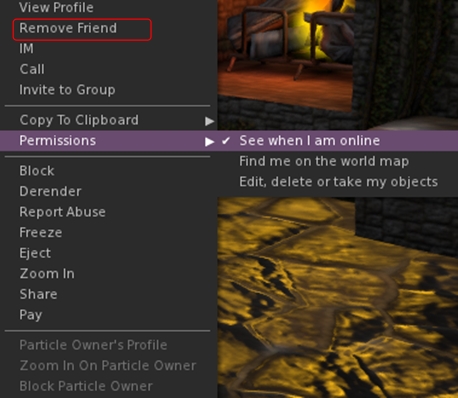
Remove friend
Grant or revoke permissions granted to a friend (see when you’re online, map you, etc) – only visible when clicking on a friend
The option to remove a friend from the avatar context menu (replaces Add Friend), and the Permissions sub-menu
Added the grant/revoke friend permissions sub-menu to the People floater right-click context menu (only visible when clicking on a friend’s name)
Added localhost Win Grid Proxy 127.0.0.1:8080 and localhost Local Grid 127.0.0.1:8002 to the default drop down list; also added Tangle Grid to the default grid selection.
Kokua 3.7.12.34831
Released on July 15th (and which I thought I’d written about at the time – my sincere apologies to Nicky) includes the changes noted above, and the additional LL code base updates (3.7.9-3.7.12) as listed above. Additional highlights for the release include (please refer to the release blog post for proper accreditation):
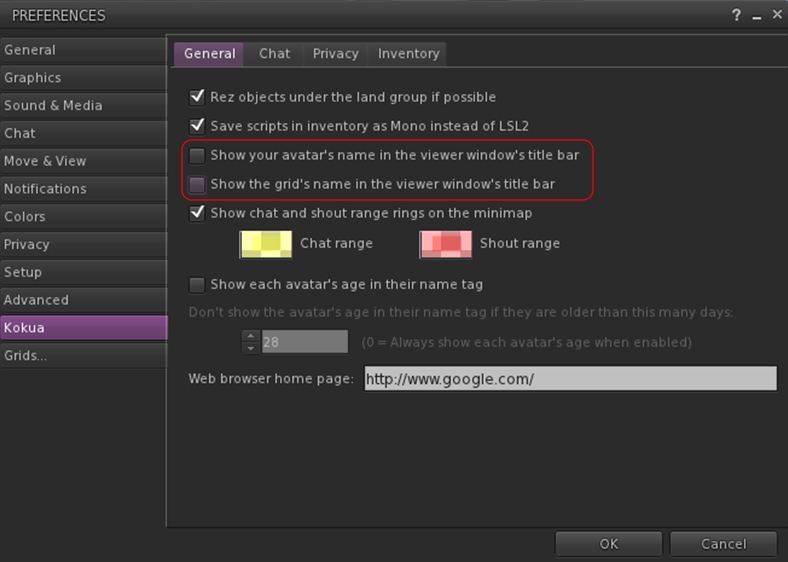
New Preferences option to display your avatar name and grid display in the program title bar (Preferences > Kokua – note these changes should only be set after logging-in; if set from the log-in splash screen, they will crash the viewer)
Kokua’s options to display your avatar name and the grid name in the program title bar
Received Items folder now displays as a system folder in Inventory when Preference set (Preferences > Kokua > Inventory > Show the Received Items Folder in Normal Inventory), rather than appearing as a normal folder
Ported, with author permission, a change by Aleric Inglewood that prevents wearing of Inventory and Library root folders.
Both the 3.7.8 and 3.7.12 versions of Kokua work well on Second Life; both had a test-drive while I took my PBY6A for another trip around Blake Sea – where I encountered not one, but two other Cats! Both viewers are also available for the Kokua wiki download page – just scroll down for the 3.7.8 version.
 On August 25th, and continuing his work in providing preliminary support for the Oculus DK2 in his CrtlAltStudio viewer, Dave Rowe announced the release of version 1.2.2.41190 Alpha 2 for Windows.