I recently wrote aboutCasablanca in Second Life, a fabulous recreation of the film and its sets, built by TracyLynne Carpenter for Sommer Carpenter, who hosts the build in the sky over her home.
Following that article, Sommer and TracyLynne both contacted me, and Sommer extended an invitation for Caitlyn and I to visit another of TracyLynne’s builds which demonstrates their joint passion for art, films and literature, which this time takes the form of an homage to writer Ernest Hemingway. It’s a build that is not open to the public (in fact it can only be accessed via a number of secret, or hidden entrances, making fining your way in an adventure in itself) so I’m not including a SLurl, but Sommer did give me permission to write about it.
Hemingway’s Wine Cellar
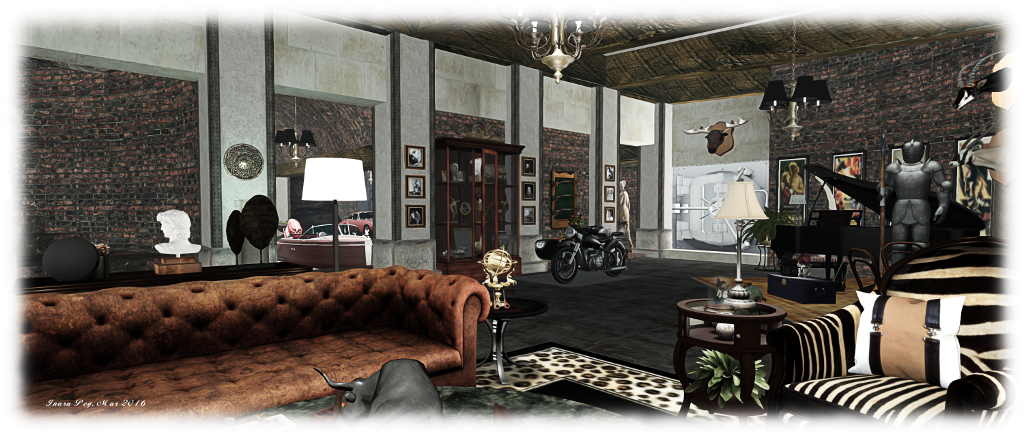
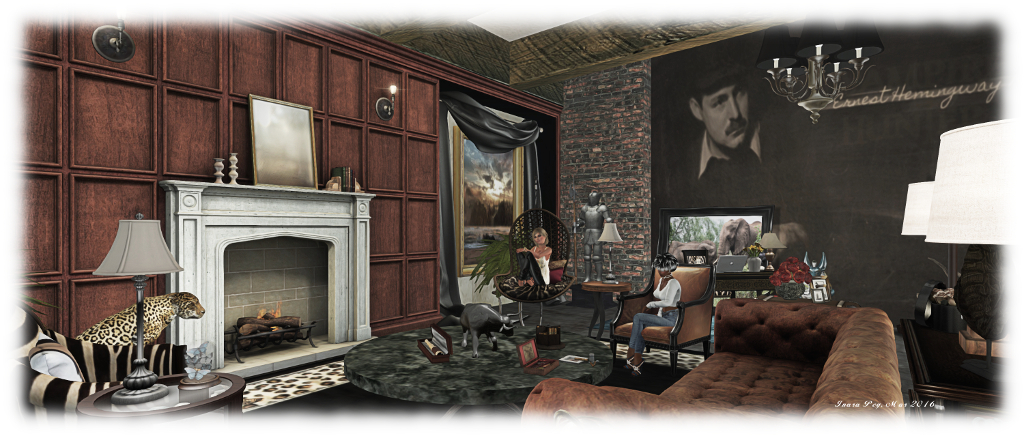
Residing under the grounds of a vineyard and winery, the “front door” to the build is cunningly hidden behind a secret door tucked away within a waterfront wine cellar, itself nested against the rocks of the vineyard island. Behind this, a brick-walled passageway leads the visitor to an underground lounge area. Comfortably furnished, this contains many nods and mementos to Hemingway, from the motorbike sitting against one wall, through to the posters of the film adaptations of his works, moving by way of nods to his love of hunting, enjoyment of cigars (and time in Cuba), photographs of the man himself, and more.
Adjoining this is a vaulted room, off of which sits a small bar area decorated in the manner of a gentlemen’s club. In both of these are more references to Hemingway – although some might be a little more esoteric. Is the model of the Titanic, for example, simply an adornment, or is it an oblique reference to Glenway Wescott, whom Hemingway unflatteringly presented through the character of Robert Prentiss in The Sun Also Rises, and once wished had perished, “with all his irk” in the Titanic disaster? Is the first aid cabinet a reference to Hemingway’s time as an ambulance driver in World War One?
Hemingway’s Wine Cellar
More obvious are the nods to Hemingway’s love of boats and fishing: tackle and rods are to be found, while on a wall hang images of Pilar, the fishing boat he acquired in 1934; and his love of the “occasional” tipple noted by the bar (and wine cellar setting).
There are further rooms to be found here as well. One of these, decorated in an oriental style, is hidden behind a further secret door, a tunnel leading from it back out to the sunlight and another nod to Hemingway’s love of sea fishing. Others are a little more obvious – such as the bathroom sitting behind the huge silver door normally found guarding a bank vault, while a bedroom, complete with a reminder of Hemingway’s time in Key West, Florida, can be found at the end of another brick walled passage opening of the main lounge area.
Hemingway’s Wine Cellar
Together with the above ground design of the island, this is another marvellous build by TracyLynne. Beautifully detailed, magnificently brought together and beautifully atmospheric, Caitlyn and I thoroughly enjoyed out time exploring.
Our thanks to Sommer for extending the invitation to visit, and allowing us to wander and enjoy the comforts of this hidden treasure.
Krissy Sinclair: Virtual Worlds, Disability, and New Cultures of the Embodied Self, Ethnographia Island
In January 2016, I wrote about an interview with Tom Boellstorff (Tom Bukowski in Second Life), a professor of anthropology at the University of California, Irvine, and which appeared in that august body’s newsletter, UCI News.
WithinA (virtual) world without Parkinson’s, Heather Ashbach discussed Tom’s work, touching on the fact that it is now part of a National Science Foundation funded study examining how on-line environments affect social interaction and self-understanding as well as physical-world experiences of disability. Having commenced in July 2015, this study will run through run through until June 2018, and one element of the work is currently taking place in Second Life at Ethnographia Island. Jadyn Firehawk, one of the participating artists in the Ethnographia Island study, IM’d me about it, prompting me to hop over and take a look.
The formal title of the research at Ethnographia is Virtual Worlds, Disability, and New Cultures of the Embodied Self, and Tom is co-Principal Investigator alongside Donna Z Davis (Tredi Felisimo in Second Life), a strategic communications professor at the University of Oregon. Donna specialises in mass media & society, public relations, strategic communication, virtual environments and digital ethnography. The work they are undertaking focuses on the experiences of people with disabilities who are using immersive virtual spaces to represent themselves free of the shadow of any disability, and do things they may not be able to do in the physical world.
In their introduction to the work, Donna and Tom describe it thus:
Since some early human first picked up a stick to use as a cane, people with disabilities have been at the forefront of technology innovation. What can their creative uses of and adaptions to on-line social interaction teach us? The researchers will explore this question by studying how people with disabilities create and interact socially in virtual worlds, and how they use different kinds of devices in their homes to experience these on-line environments.
Donna Z Davis and Tom Boellstorff (Tredi Felisimo and Tom Bukowski in Second Life), co-researchers in Virtual Worlds, Disability, and New Cultures of the Embodied Self, supported by the University of California, Irvine; the University of Oregon; and the National Science Foundation.
Twenty 32×32 metre studio parcels have been made available to applicants with disabilities, who have been invited to share their experiences, insights, and thoughts on their disability: what impacts has it had on them in terms of their experiences, social interactions, dreams, and how have they used it? How have they used it to change their experiences living with that disability?
How applicants use their space has deliberately been left open, although some pointers were given as to how they might think about using it: for expression through 2D or 3D art, thought media presentations / displays, as a space in which they can develop art or expression through external media such as blogs, or the creation of interactive spaces designed to give others insight into their experience or as a game – or any combination of these ideas.
Jadyn Firehawk at her installation, Reconstructing Identity After Disability, Virtual Worlds, Disability, and New Cultures of the Embodied Self, Ethnographia Island
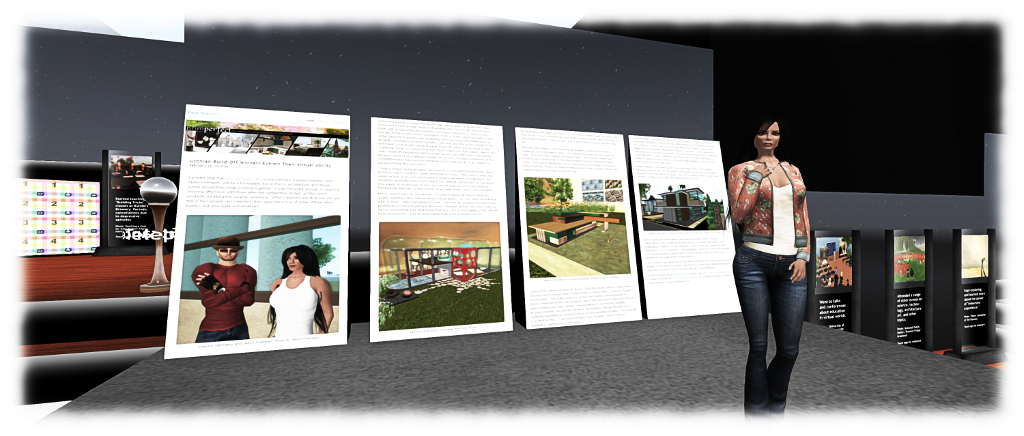
The result is a series of studies, widely varied in nature and content, some of which – such as Jadyn’s own Reconstructing Identity After Disability. This is a beautifully presented and moving story of how she has come to deal with her bipolar disorder after the condition left her unable to continue in her career as an assistant professor at the University of Texas, Austin, and how the use of virtual spaces in Second Life and the friends she has made here have empowered her creativity in both the digital and physical realms.
“When I sent in my application to participate in the project, I did not know yet what I wanted to build,” Jadyn says of the installation. “All I knew was, I wanted to create an installation that somehow represents the many-faceted, (re)enabled life that SL has made possible for me, but I had no idea exactly what I was going to build.
“I started looking back in my inventory to things that dated back to my earliest days in SL, and realised it essentially documents my entire time in SL. From that I got the idea of perhaps doing my build as a sort of museum exhibit, telling the story of my time in SL.”
Involvement in the project has been both cathartic and insightful for Jadyn, providing her with a clearer view of the last fifteen years of her life, the changes her condition has wrought and a understanding of ow she has come to terms with it.
Solas NaGealai chose to produce a 3D representation of Edmund Blair Leighton’s 1901 painting The accolade, allowing visitors to become a part of the setting, sharing in both her creativity and her love of nostalgia.
“I met Tom and Donna through the Parkinson’s disease support group at Creations Park four years ago, and I’m thrilled to be taking part,” Solas NaGaelai says of her involvement in Ethnographia. “Not just for the creative aspect but to be amongst others that have disability. I have a hunger for learning and adapting, and from what I see so does each individual involved in the project. The insight of dealing with their life challenges to me is a very enlightened experience, and helpful one.”
Solas was diagnosed with a particular form of Parkinson’s Disease known as Young Onset Parkinson’s Disease (YOPD) – the same form of the disease which struck Michael J. Fox. When first diagnosed, she was a full-time fashion designer. However, as the illness progressed, she was forced to leave that career behind. Fortunately, her discovery of Second Life provided Solas with a means to re-engage in her passion for design, notably through her Blue Moon Enterprise label.
For her piece, Solas has created a model based on Edmund Blair Leighton’s 1901 painting The Accolade. It’s an interactive piece in which visitors will be able take free costumes she has designed and dress as either the queen or the knight and take their places within the scene. As such it reflects both the creative freedom Solas has found in Second Life, and offered her the mean to present visitors with the opportunity to share in her love for a bygone era, as depicted by Leighton and his peers.
Slatan Dryke: Virtual Worlds, Disability, and New Cultures of the Embodied Self, Ethnographia Island
Virtual worlds, as Tom and Donna note, are just a part of the much larger domain of internet technology and on-line presence which we can use to define ourselves and potentially reach beyond our personal limitations, whatever form they may take. But studying the “whole” of the digital environment really isn’t that possible; as such, smaller scale studies like Virtual Worlds, Disability, and New Cultures of the Embodied Self allow researchers to focus down on smaller communities and groups and investigate specifics.
Through it, and the involvement of those participating in it, both Donna and Tom are confident they will be able to present a better understanding about how new on-line technologies influence how we think about our bodies, how we think about social interaction, and how we think about the role of the internet in everyday life, all of which will have implications for improving health care and social support for people with disabilities.
Visitors are welcome to tour the installations, and I recommend taking a look at the accompanying website when doing so – the links are given again below for convenience.
STOP PRESS NEWS
Having opened its doors in November 2015, Ethnographia Island had originally been set to run through until March 2016. However, as I worked on this article, Tom and Donna were in discussions concerning additional funding for the work.
On Friday, February 19th, they were able to tell me that the funding had been confirmed, and that as a result, Ethnographia Island is set to double in size with the addition of a second region.
“This means not only more spaces for individual disabled folks to have parcels for some creative building, but also some larger, collaborative parcels where groups of people with disabilities can let their imaginations run free!” Tom said as they passed on the news to me.
So, if you have a disability of any kind and would be interested in a parcel, please IM Donna (Tredi Felisimo in SL) or Tom (Tom Bukowski in SL), or email them at dzdavis@uoregon.edu or tboellst@uci.edu. They would love to have you participate!
“I create in Second Life for my own amusement, things for photos, things to adorn my avatar with, things just to see if I can,” Zib Scaggs says of her work as a creator and photographer. “I share many of those creations with others who adorn their avatars and take their own photos too. Simple enough.”
Simple it may be, but it is also something that has led to Zib becoming the latest artist to be invited to exhibit her photography at Dathúil Gallery, operated by Max Butoh and Lυcy (LucyDiam0nd). Entitled Slow Motion Riot and a Nude, the exhibition opens on Thursday, March 3rd at noon SLT, and will run through until the end of the month.
“The images,” Zib says of the exhibition, “are of those things I have made, or avatars I adorn.” She also notes that she doesn’t look for hidden messages or nor deeper meanings in life or art.and doesn’t hide them in her own work. Thus, Slow Motion Riot and a Nude presents a series of images, some in muted colours and tones, some black-and-white, which should be interpreted exactly as the eye sees them, and not with any idea that there is a particular story or nuance behind them.
Sitting between the images are little behatted zebras in ones and twos (and which also feature in one of the images in the exhibition). When touched, these will offer the visitor a little gift created by Zib, and which may be one of the items featured in the pictures around the gallery.
Given the artist’s statement about her work, I’m loathe to say too much on it, lest I perceive meanings which aren’t intended to be there. What I will say, however, is that each of the pieces offer at Dathúil is both intriguing and eye-catching; when taken together, they present another exhibition which should not be missed.
As noted towards the top of this piece, Slow Motion Riot and a Nude officially opens on Thursday, March 3rd at noon SLT, and runs through until March 30th.
There are certain places in Second Life to which I always enjoy making a return. One of these is Binemist, Biné Rodenberger’s Homestead region, which changes as the mood or season takes her, and which has long been a particular favourite of mine. I was therefore surprised to realise that it is actually more than a years since I last blogged about it, and almost a year since I last dropped in.
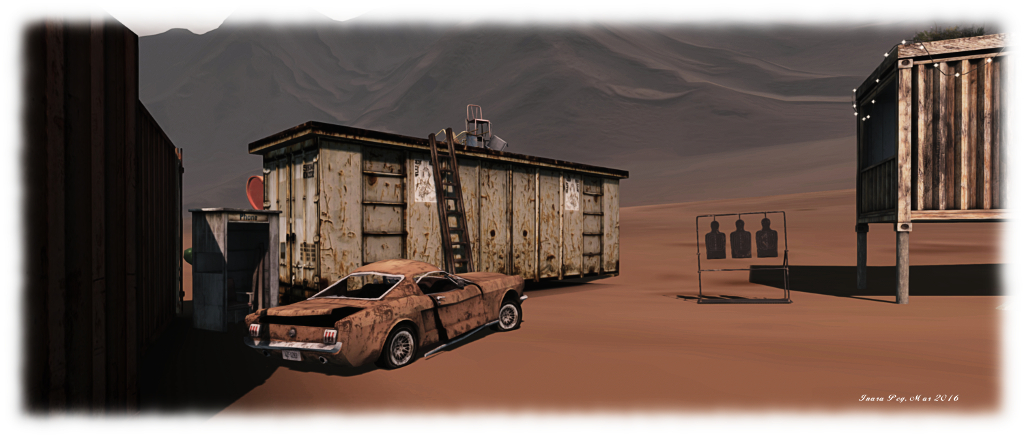
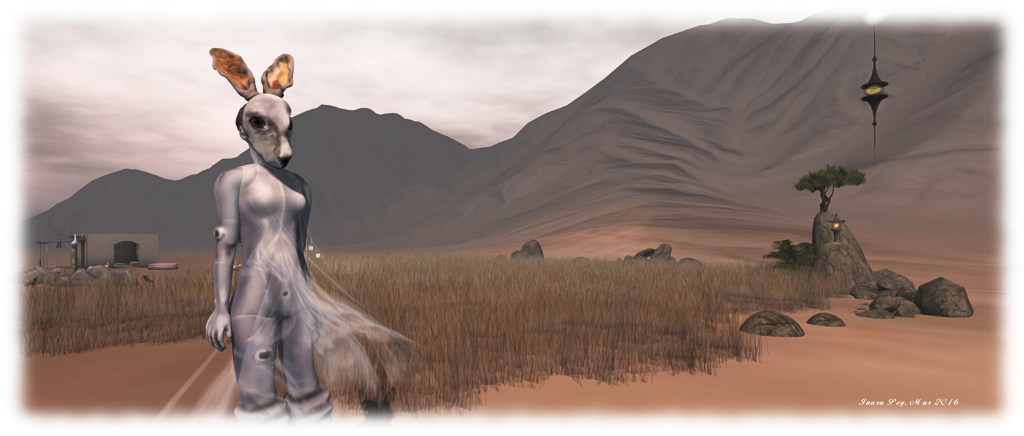
Those familiar with the region (you can also read about it here, here and here if not) will know it has traditionally been a water region – one of the reasons it has always endeared itself to me. However, in its new iteration for the start of 2016, this is no longer the case: Binemist has become a desert landscape.
“I love the colours, and I love the early morning sun,” Biné say of the new design, and I have to admit it is dramatic: an iron flat expanse of sand bounded by mountains on two sides, and across which are scattered a series of scenes visitors are invited to explore as crab-like robots skitter across its sandy surface.
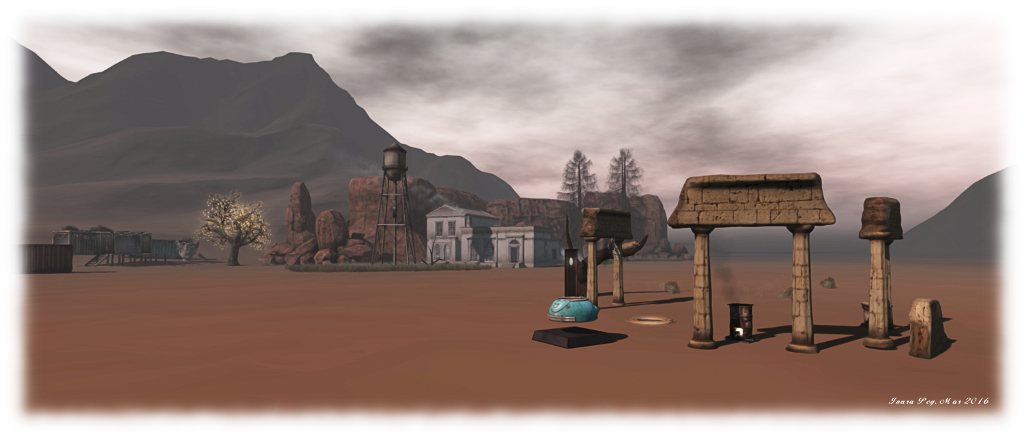
Two of these, located south of the landing point, are dwellings: a stone-built house with its own lush garden, complete with an attempt to cultivate a carpet of grass beyond its high walls, and a converted shipping container sitting among a collection of its peers (which also features a most unusual and adult take on a playground ride!). It is alongside these two homes that the otherwise flat expanse of the land is broken by a rocky upthrust of rock offering two plateaus linked by a stone span.
Northwards, across the sands from these, sits a little vignette visitors to Binemists Past will likely find familiar: the Buddha and floating eye, a gathering of pink flamingos, a grouping of mystic stones with an ethereal floating spire nearby and, standing at the very edge of the region while staring off to a distant horizon snuggled between the mountains, Bryn Oh’s White Balloon. Also, Just off sim to the east sits the familiar form of the wrecked Viking ship which has always been a motif got the region, while over in the north-west corner of the region sits Haveit Neox’s Ship of Fools.
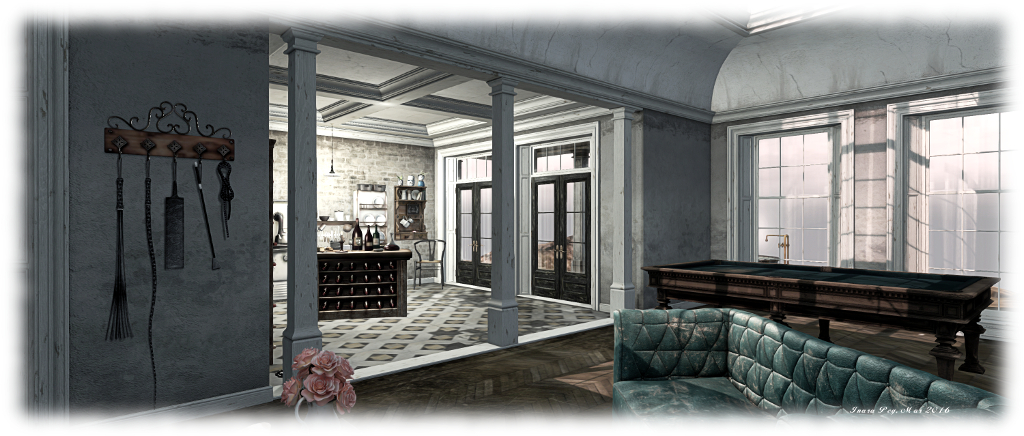
In addition to the ground level layout, the landing point offers two teleport portals to skyborne locations. The first of these is the sky rock which used to be the landing point for the region, where sits a rural scene reached by a teleport hole set in the ground. The second is a skybox set out as the interior of a house, where Biné experiments with interior design, and which is reached via a teleport door.
The new Binemist is very different to past iterations, and even though I perhaps miss the water and what could be found beneath it, there is a wonderful, desolate beauty about the new design which is equally as attractive and photogenic. And for the adventurous, there’s also the opportunity to ride around the sand in a novel little “bubble car”!
TerpsiCorps ARTWerks: the muse Terpsichore, presiding over the entrance to the Theatre of the Nine Muses
Caitlyn and I recently received an invitation to visit the new home TerpsiCorp ARTWerks, a relatively new art and performance company in Second Life. The invitation was extended by the company’s founder and director, Cassie Parker (nanki Hendes), and we were more than delighted to accept.
TerpsiCorpsARTWerks has been established with an ambitious vision to become a major force for performance art in Second Life, offering the potential to forge connections between performance art in the physical and virtual worlds whilst also supporting the arts in Second Life.
“From the very beginning, we wanted to create art that actually meant something … art that was more than simple entertainment,” Cassie Parker says of the company in an article she penned for Rez Magazine’s February 2016 edition. “I sought out artists that could bring a unique perspective to their performances, artists that were not only highly sensitive (as most artists are), but that could also bring a sense of intimacy to their performances on stage.”
It a fascinating piece to read, tracing the creative process that led Cassie from a casual introduction to in-world performance art and the SL art scene as a whole, through the formation of TerpsiCorps ARTWerks to their first in-world performance in September 2015, and onwards to the founding of their new base of operations at TerpsiCorps Isle.
The forcal point for this new home is a magnificent sky platform which officially opened on Sunday, February 21st. Designed by TerpsiCorp’s Artistic Director, Chrissy Rhiano, assisted by Cordelia Cerise, it is largely built along the lines of classical Greek architecture and is a work of art in itself, offering a range of public facilities in celebration of the arts.
Visitors to the centre arrive on a stone-paved avenue lined with olive trees and alcoves featuring the nine muses. This is bookended by two stunning theatres, one of which, The Theatre of the Nine Muses, continues the classic Greek theme, its entrance presided over by Terpsichore, one of the nine muses of dance, and from whom the company takes its name. At the other end of the avenue is the Belly Dance Pit, a structure of distinctly Arabian influence, offering an intimate theatre in the round design and which hosts performances of conventional and other styles of belly dance.
Between the theatres, and set back within lush wooded groves, lie three gallery spaces. Two of these are respectively dedicated to the work of Molly Bloom and Bryn Oh, while the third is offered to emerging artists within Second Life. Most recently (at the time of writing) this housed an exhibition by Lantana Silverweb, who is also the company’s official photographer. Also accessible from the central avenue is the Dionysus Workshop Pavilion, offering both a workshop space and room to host music events.
Nor does it end there. Reached via two flagstone paths flanking the entrance plaza to the Theatre of the Nine Muses, lies the Trail of the Muses: a walk designed by Cordelia Cercise which takes you around the theatre through eight shrines dedicated to each of the remaining muses. Within the lush wooded gardens there is more so discover: wildlife in the form of giraffe, elephant, caribou, and deer, as well as glades and water features.
The official opening of these facilities was marked by a performance of the company’s Gothic Opera at the Theatre of the Nine Muses. Such was the interest in the event that some 80 people were in attendance, with more wishing to see it. To this end, an encore performance is to be staged on Sunday, February 28th at the theatre, with curtain up at 19;00 SLT. However, if you do plan to attend, an earlier arrival might well be in order to secure a seat.
There is still some work to be done in support of the company’s activities; as I mentioned to Cassie (although she was already aware), the platform could benefit from some discrete information boards, or have gallery name boards and production advertising offer information note cards. These, I gather will be added. There are also plans for an associated website, but for now the best place to find out more on the company is via its Facebook page.
All told, this is a fabulous and fascinating venture, and I genuinely look forward to both witnessing more of TerpsiCorps ARTWerks activities as they continue to develop both their productions and the region, and to reporting more about their activities through the pages of this blog.
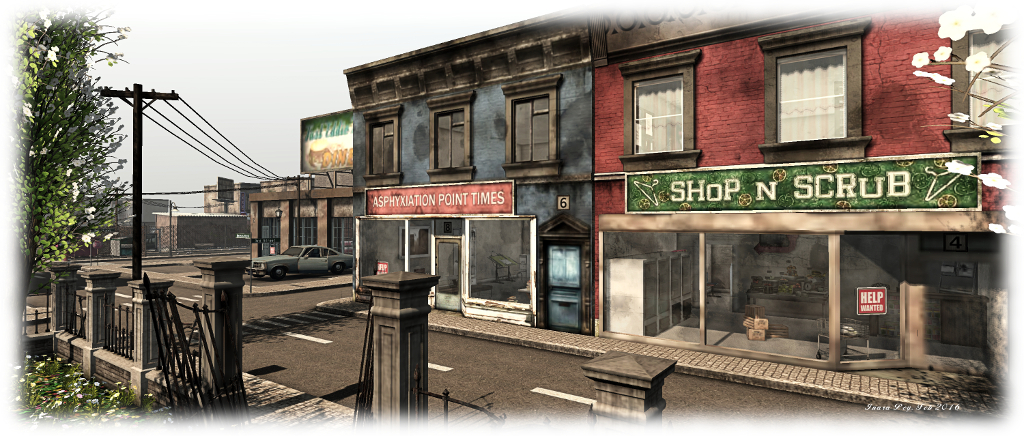
Asphyxiation Point wasn’t always the town that you see today. In fact, there was a time when it was nothing more than a small rocky outcrop jutting out of the ocean. The only way to get to it was past straits so narrow that sailors would hold their breaths as they made the perilous trip. And so the rock was named Asphyxiation Point and largely shunned for centuries.
All that changed when two fishermen – Jeremiah Newton and Fredrick Perry – happened to venture past the straits in search of new lobster hunting grounds.
So opens the back story to what is probably one of Second Life’s most immersive urban role-play environments to be opened in recent years. It is an elaborate story, rich in content, which steers the reader through a history which is both palpable and entirely believable; a story sharing the same depth and detail as the region itself.
Caitlyn and I were invited to tour Asphyxiation Point by one of the prime movers behind the role-play environment: Charles Newton Kuluk
Caitlyn and I were invited to visit Asphyxiation Point by one of region’s Admins and a prime mover in Asphyxiation Point’s development, Charles Newton Kuluk (kuluk).
Prior to his invitation, I’d only faintly heard of the region, knowing little more than it offered urban role-play. Charles was quick to offer more information, including the link to the region’s excellent website, which offers a wealth of detail for the interested visitor to the town.
“Asphyxiation Point was founded exactly one year back on February 22nd, 2015,” Charles said to me as we discussed a visit. “We’ve since grown to over 3000 members and enjoy a high level of both role-play activity and events, and my motivation for inviting you is primarily to get more people interested in the idea of free-form role-play, and also hopefully break down some misconceptions as to why a lot of such regions are labelled as Adult.”
As a free-form role-play environment, Asphyxiation Point doesn’t have a set structure on what it is necessarily about. There are no paragraph-heavy rules; common sense in the order of the day. Nor are there any pre-defined factions, political affiliations or anything else which might be found in more rigidly defined role-play environments. Players are free to establish their own factions and affiliations according to their in-game wants and needs; even the combat is role-played, rather than employing any metered system. Instead, the approach to role-play is perhaps best described by borrowing from the website:
A small fishing village turned tourist town, Asphyxiation Point is both beautiful and dangerous. [A place] where characters live, laugh and love while crime, despair and conflict brew just under the surface. Will you succumb to the darkness or will you rise above it all? Where will your adventure take you? Who will you be?
In other words, those joining the role-play here are free to read-up on the back story of the town, develop their character accordingly, immerse themselves in its environments and gain familiarity with ongoing story lines and existing RP, and to naturally engage and role-play with one another. Hence why there is no insistence that visitors employ any observer or out-of-character (OOC) tags.
“We believe in negotiation here,” Charles said of the latter. “So don’t worry about it. Stick to IMs once you leave the landing point. If you are approached in RP, just IM them and let them know you are observing / photographing or whatever.”
One way of keeping up with all that’s going on is to peruse the community’s local newspaper. In it you’ll find reports on the latest happenings in town, reviews on popular places and news on public events, such as the recent Mardi Gras festival. Again, the emphasis here is on community immersion and involvement: helping to make visitors and player feel fully a part of the local community.
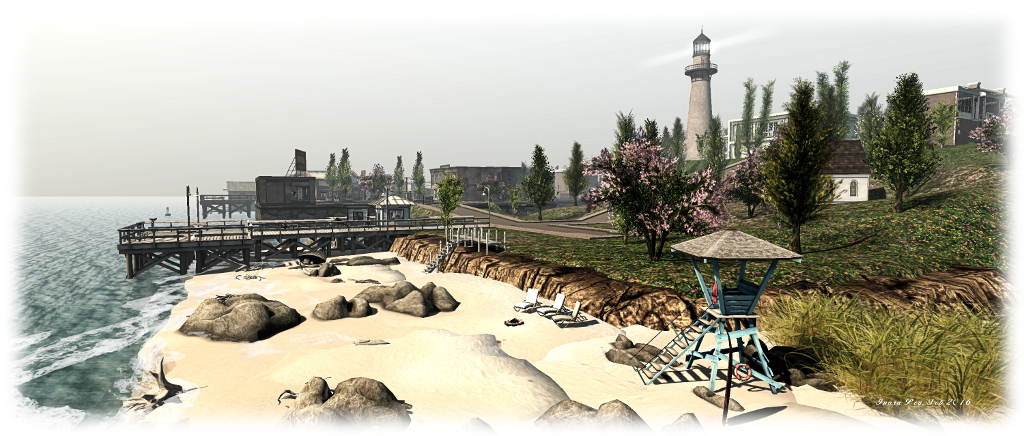
Asphyxiation Point – the beach and Upper Town to the right, Lower Town and the Red Light District in the distance
Players can further invest themselves within the community through the businesses established as a part of the role-play environment, or by starting their own business (again focused on role-play). A section of the website again provides a comprehensive guide to both, including an overview of the sim-owned businesses (which players can apply to run) located through the four districts of the town.
“Our objective is to promote diversity in RP opportunities and see what happens,” Charles told Caitlyn and I during our visit. “The build is cleaner in looks than a lot of urban RP environments, because we didn’t necessarily want crime on the surface – well, maybe except for some places like the Red Light District. But we did want to give opportunities to the more criminal elements too. The sewers are spread all under town and give folks an alternative path to stay out of the cops eyes.”