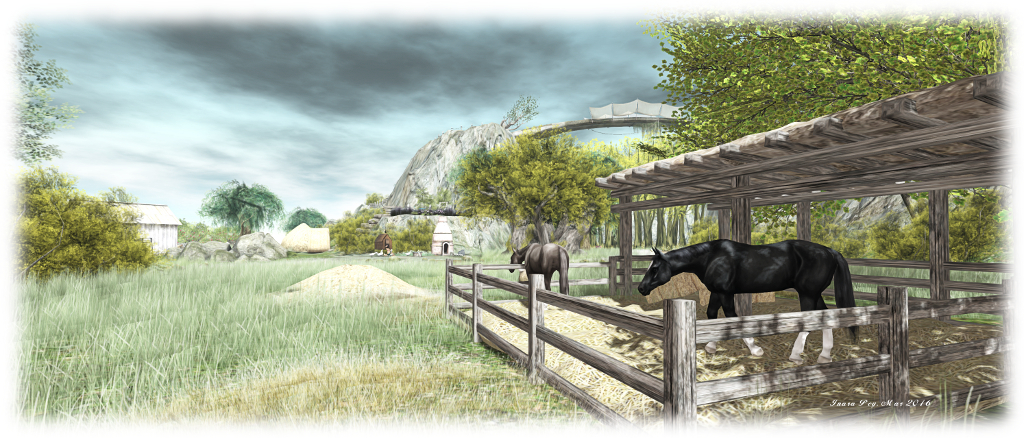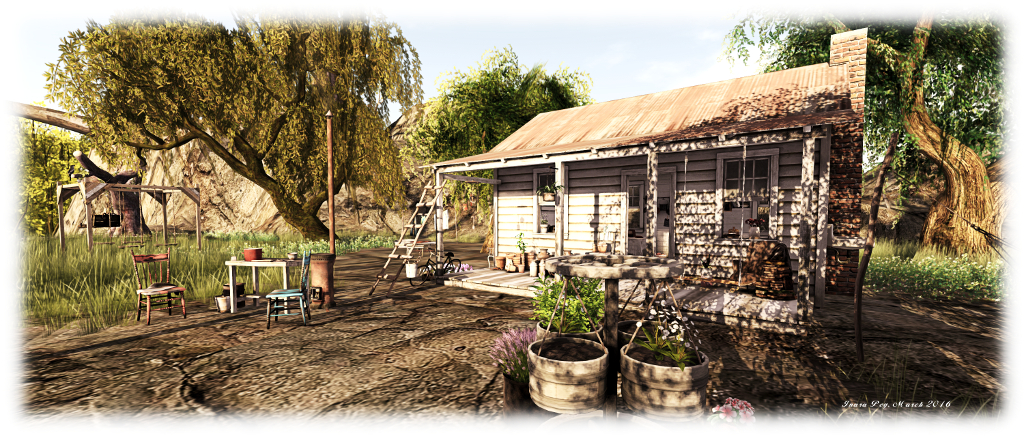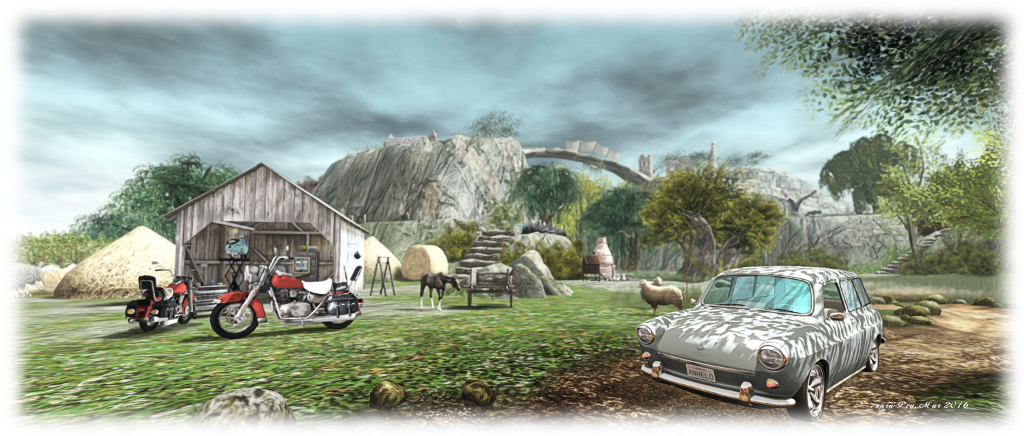
Enjoying spring at The Trace in Second Life

The Trace; Inara Pey, March 2016, on Flickr The Trace – click any image for full size

Kylie Jaxxon recently invited Caitlyn and I to visit the latest iteration of her homestead region The Trace (aka The Trace too), which recently re-opened following a further joint make-over by Kylie and Elvira Kytori (also the owner of White Dunes Estate rentals). As I’ve always enjoyed both Kylie’s and Elivra’s work, it was an invitation I was delighted to accept, and to introduce Caitlyn to The Trace.

The new design, as I commented to Ziki Questi, who was also visiting when Caitlyn and I hopped over, is perhaps the finest in the series of The Trace builds to date. Beautifully scenic, with open vistas at every turn, it is simply a joy to spend time there either wandering or, as Caitlyn and I have done, simply snuggling in one of the many  lookout points, and watch the world roll by.
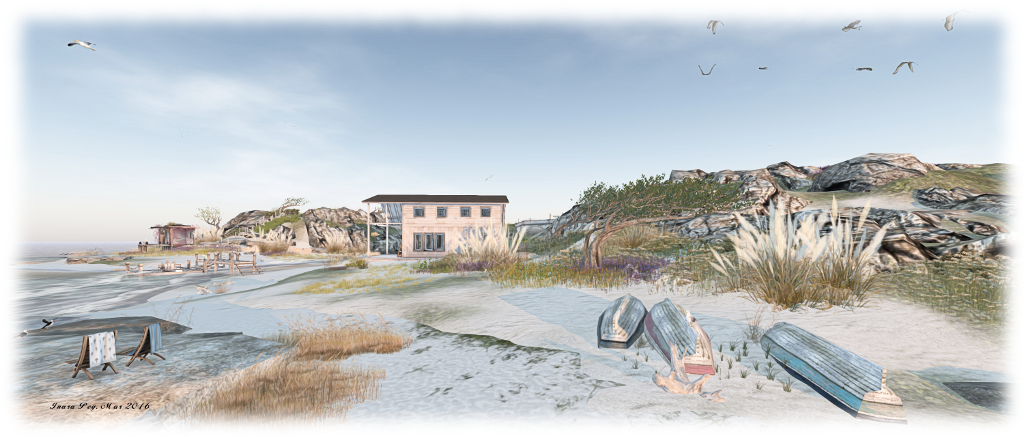
The Trace; Inara Pey, March 2016, on Flickr The Trace

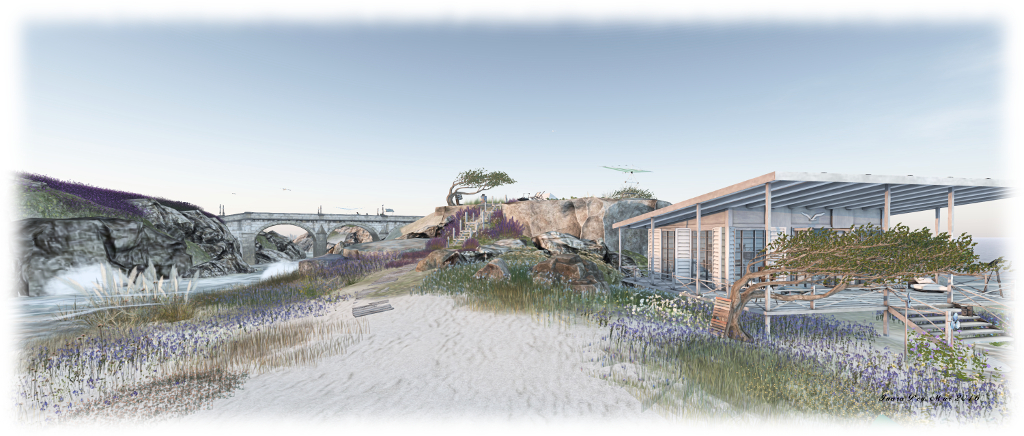
Two rocky shouldered islands make up the current design, one curved and pointing like an arrowhead to the north-west, the second more rounded and sheltered by the arms of the first, lying to the south-east. Between them runs a rocky channel of sea water spanned by the arches of a single bridge made of cut stone. Each island is also distinguished by its flora; the more northerly of the two is topped by long grasses and yellow wild flowers, while the more southerly island is rich in lilac wild flowers, given it the feel of heathland.

A number of houses and cabins at scattered across the islands, giving the impression that this is perhaps a vacation retreat; a place to come to and forget the stresses of every day life. Perhaps these islands are reached via a day trip out from a mainland which hides just over the horizon; far enough away to give the illusion of escape whilst here, but close enough to make a visit convenient.
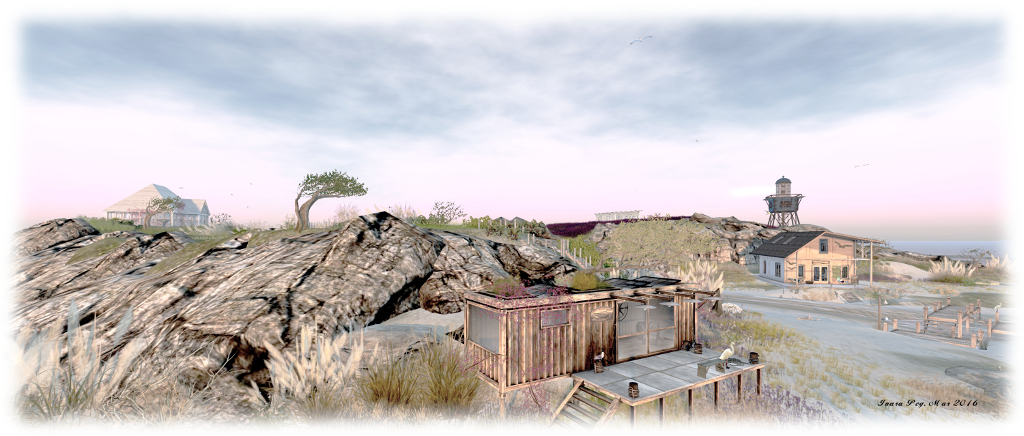
The Trace; Inara Pey, March 2016, on Flickr The Trace

Board walks lead the visitor across the north island, winding through the grass and flowers to the beaches at either end of the island’s curve. Across the solid span of the bridge, a cobbled road leads up to the top of the island, lilac flowers encroaching upon it, and to one of the flat-topped cabins.

An old lighthouse tower stand guard at the south-westerly edge of the rounded island, waves breaking against the rocks at its feet. Follow the slope down from the cabin towards the lighthouse, and you’ll discover a wooden walkway running around the island’s rugged coastline to a broad expanse of beach, which can also be reached overland from the top of the hill. Across the beach, a small wooden bridge and deck spans the watery channel separating the beaches of the two islands and connecting them – at least at low tide.
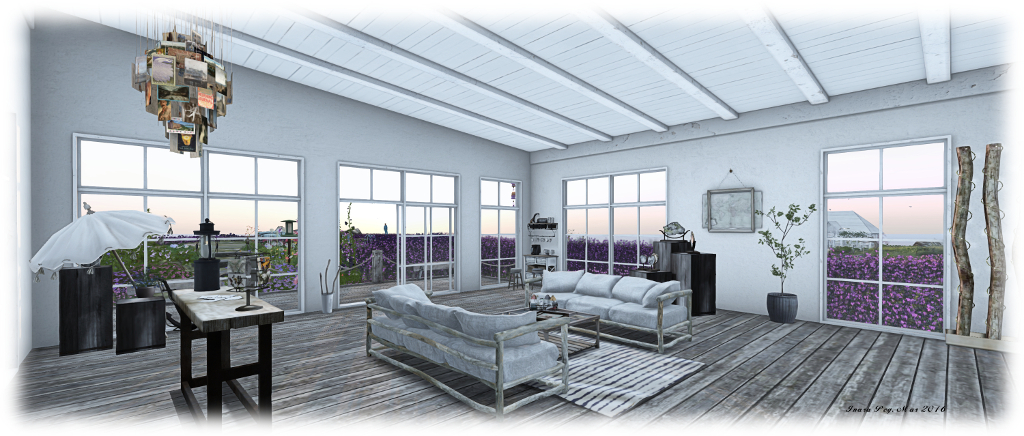
The Trace; Inara Pey, March 2016, on Flickr The Trace

As noted at the top of this article, this iteration of The Trace is perhaps the most eye-catching in the series, all of which I’ve enjoyed visiting and exploring. Matched by a perfect ambient sound scape, a windlight which reduces colours to perfect soft tones and colours, and plenty of opportunities for photography and for just sitting and relaxing. certainly, it has already drawn Caitlyn and I back to it more than once – and it may well have the same impact on you.

SLurl Details

The Good Days for art in Second Life

The Good Days: Immersed by Hillany Schofield

Friend and artist GoodCross recently opened a gallery of his own – and my sincere apologies to him for getting to this post later than intended. For it’s inaugural exhibition, The Good Days features Immersed by Hills (Hillany Schofield).

“Immersed is  an exhibition about the duality of being an insular individual in a world of contexts, interests, opinions, rules,” Hills says of the exhibit. “Whether it is the so-called ‘real life’ or this, our ‘second life’.”

The Good Days: Immersed by Hillany Schofield

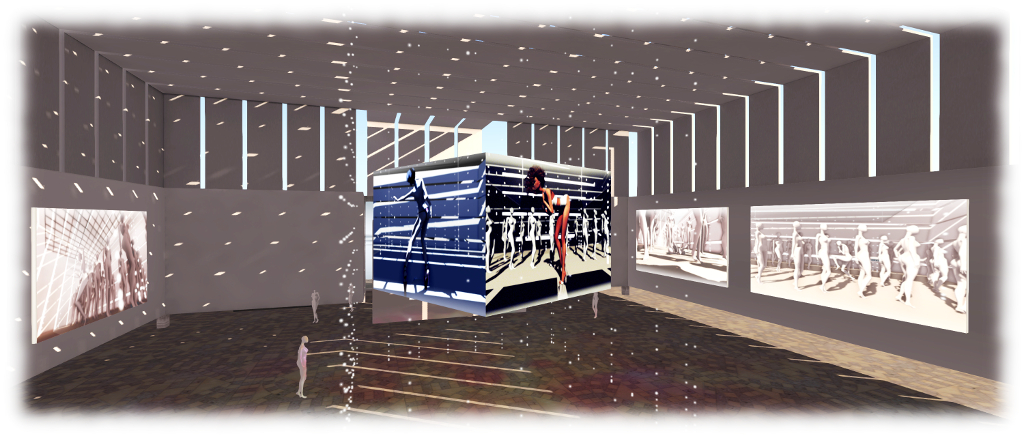
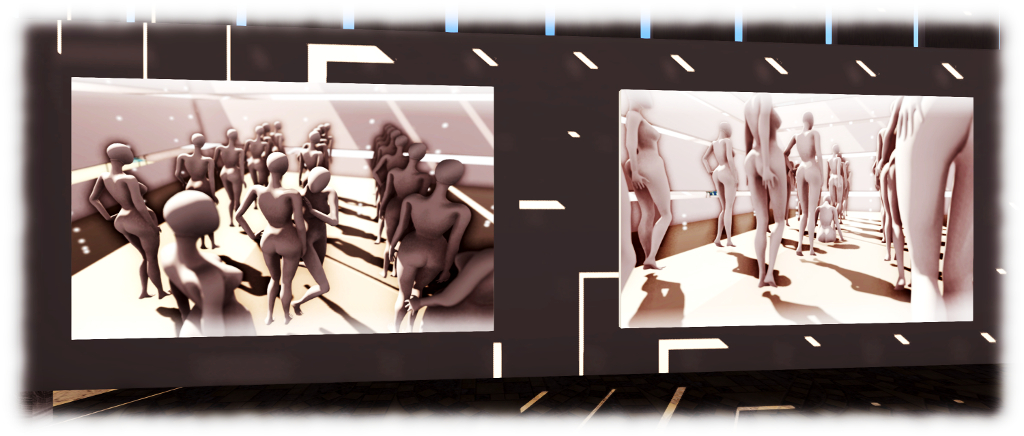
Around the walls of the gallery space are nine large format monochromatic pieces  depicting uniform female mannequins all striking very similar poses to one another, with the exception of one individual, who is in a strikingly different pose. In a tenth image, which adds a subtle splash of colour, the single figure of an avatar hangs in repose, floating over the floor. Finally, over the central area of the gallery, a slowly rotating box displays two monochrome and two colour images of avatars, either alone or posing before the mannequin-like figures.

The juxtaposition of individuality and living within a world of contexts is clearly expressed in each image; the individual or contrasting figures in each piece a manifestation of the former, the groupings of mannequins presenting the latter.  “We find safety, community and acceptance,” Hills says of our desire to find context among peers, the similarities expressed by the mannequins, “But we also stumble, fall, feel trapped and isolated.”

The Good Days: Immersed by Hillany Schofield

“So what do we do? We break out, we question ourselves, we go back with the flow. Or we try to dance away the pain.” And thus the individual figures express these latter responses – as do visitors to Immersed. To enter the exhibition space, we must walk between the mannequins, becoming the expression of the individual in their world of contexts, opinions and rules.

Immersed will remain at The Good Days through most of March, with GoodCross planning to hold monthly exhibits in the gallery.

SLurl Details

A return to Ironwood Hills in Second Life

Ironwood Hills; Inara Pey, March 2016, on FlickrIronwood Hills – click any image for full size

Ironwood Hills, designed by Cyrus Knight (josman2088) and Jestyr Knight (Zeke Jestyr), is perhaps not the neighbourhood we’d ideally like to pick to live. When I last visited, the town appeared to be deserted, caught within a forever twilight of swirling mist and rains, thrall to the soulful wailing of forgotten sirens.

Now occupying a new location, the story of Ironwood Hills continues – and the darkness shrouding it has not lifted; and as with the last build, this is a design which makes superb use of space, creating the feeling that the region is much larger than the supplied 65,536 square metres.

Ironwood Hills; Inara Pey, March 2016, on FlickrIronwood Hills

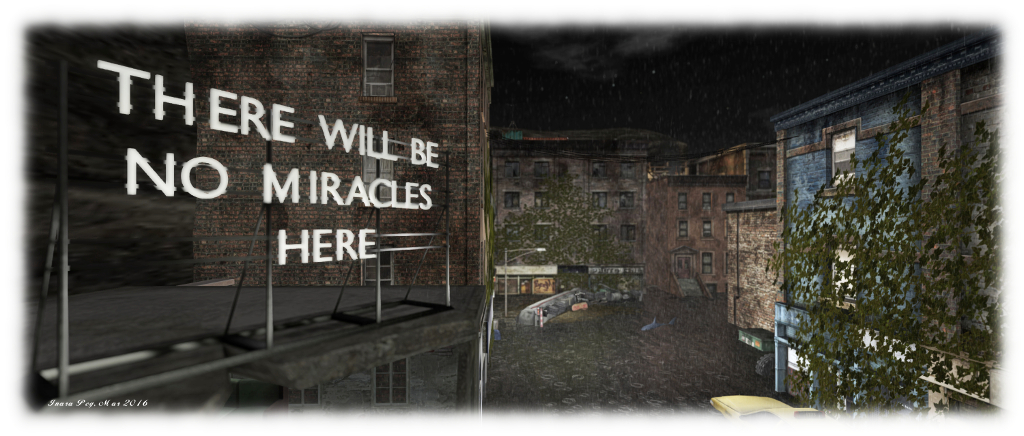
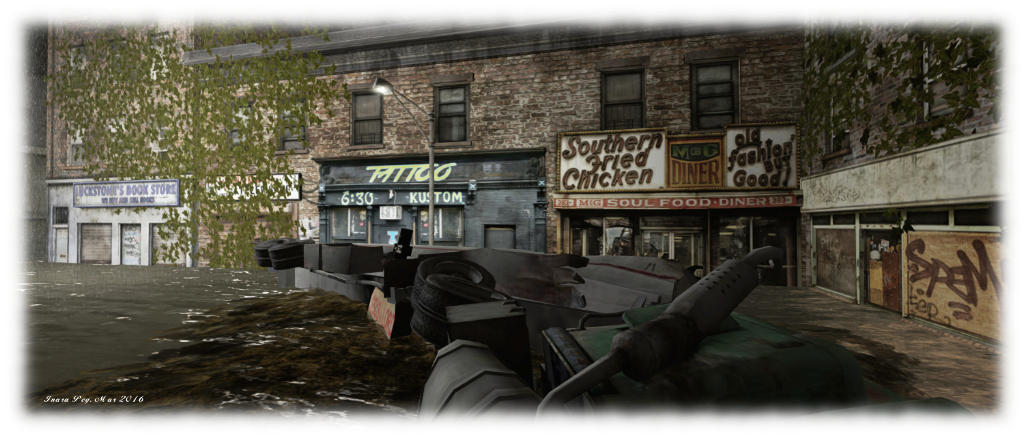
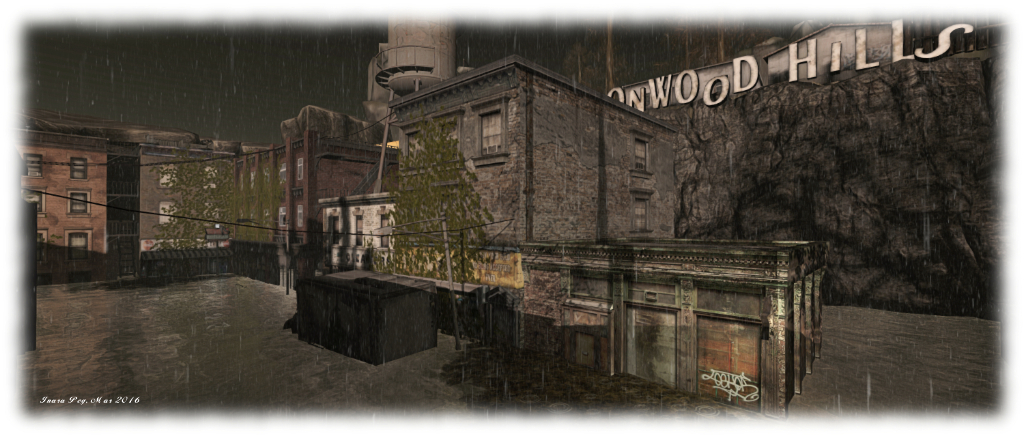
It is also a place where anyone who visited the last instalment of the town will, on arrival, feel an immediate sense of déjà vu. This may be a different location and the sirens may no longer be audible, but it is clearly part of the same town. Rain still falls from the heavy sky, lightning flickers, and the down town streets still offer the last vestiges of working electric lights amidst the decay. Here, however, water flooded the streets and alleys, perhaps the result of the same disaster that inundated the fairgrounds of the older Ironwood Hills build.

The flood presents the visitor with a problem. How to explore the streets without having to wade through the water and perhaps risk injury? Fortunately, the answer is supplied by a rowing boat sitting by the arrival point, allowing us to make our way around the ruined streets, past guttering street lights and the wrecks of cars and trucks; the broken windows of stores in places staring back at us like empty eye sockets.

Ironwood Hills; Inara Pey, March 2016, on FlickrIronwood Hills

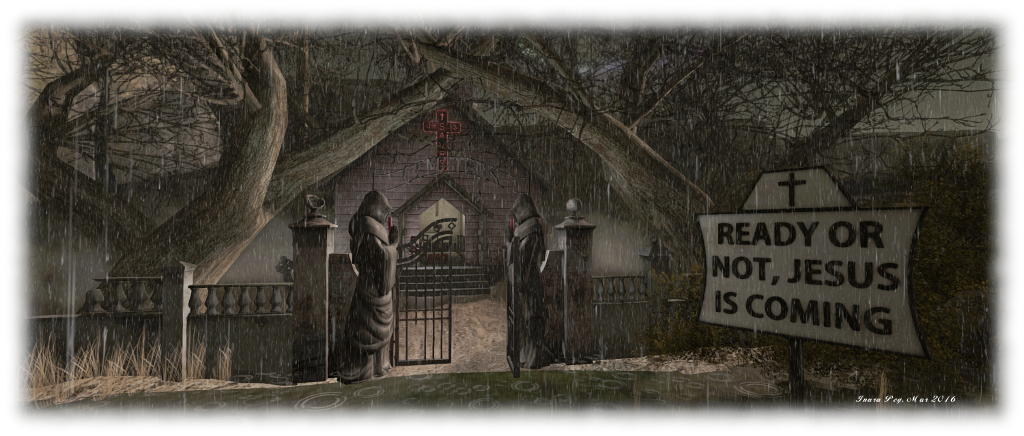
With careful navigation, it is possible to reach a route up to drier land, a route which will carry you past a church. But this  may not be a the place for spiritual restoration as one might expect. Carved stone figures, faces hidden under the hoods of their robes stand menacing guard at the church gates, while alongside the entrance a sign offers Ready or Not, Jesus Is Coming more in threat than in promise of salvation.

Beyond the church, the road continues upwards, climbing to a plateau sitting just above the roof tops of the down town area. Here, behind a protective wooden palisade, sits a cliff side residential area.  Beyond the houses nestled here, the rooftops of the taller down town buildings show more signs of habitation: a makeshift hospital here, a bar and still there, little huts, the gaps of alleyways separating them bridge by wooden planks while ladders connect roofs at different heights.

Ironwood Hills; Inara Pey, March 2016, on FlickrIronwood Hills

But where are the survivors now? To find that out, you must make your way between the houses and follow the road and it winds further up into the hills, the way getting darker, the warnings more grim as you progress. I’m not going to say any more here, because to do so would spoil the element of discovery.

Suffice it to say that there is as much to seen below ground here as there is above, and that the coiled snake of tunnels that leads you beneath the hills perhaps stands as a metaphor for the twisting descent into darkness taken by those who once survived here.

Ironwood Hills; Inara Pey, March 2016, on FlickrIronwood Hills

All told, this is another superb design by Cyrus  and Jestyr, one that adds a further chapter to the dark legend of Ironwood Hills. If you like your explorations of Second Life to have something of an edge to them, this is definitely a place to visit; and if you have enjoyed the town in its earlier incarnation, then this latest chapter is certain to be one you will not want to miss.

SLurl Details

Terrygold’s Black Box in Second Life

Back Box
Black Box

Black Box is the title of a new exhibition by Italian artist Terrygold, which opened on Sunday, March 13th, 2016. Located high above the Solo Donna club, home to the Art on Roofs series, Black Box is a compelling series, further enhancing Terrygold’s reputation as an artist with a considered eye for composition, nuance, framing and narrative in her work.

Following on from Ceramic Dolls (reviewed here) and Onirica (reviewed here), Black Box shares some aspects with the previous exhibitions, notably Onirica, whilst presenting new images and models, with the exhibition space itself very much as part of the overall installation in tone and form.

Back Box
Black Box

To appreciate Black Box in its fullest, it is essential you have Advanced Lighting Model (ALM) enabled through your graphics preferences. It is not required that you have Shadows enabled as well (which tends to be the heavy hitter when it comes to performance degradation); but as the exhibition space makes use of projected lights, ALM really is essential in order to gain the deepest exposure to the exhibit. Ambient Dark is also the recommended windlight setting.

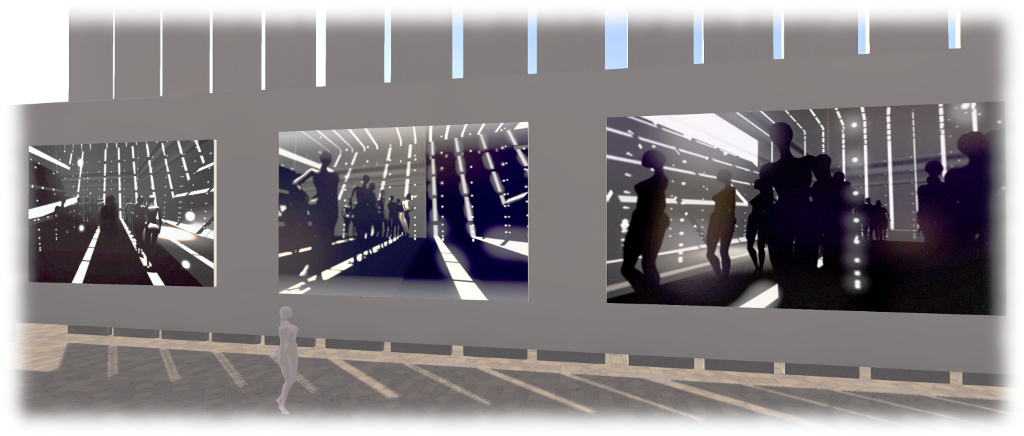
As with Onirica, the visitor is led through a series of rooms (initially by a blue line on the floor), each of which offers 2D or 3D art (or a mix of both) created by Terrygold, finely lit using projectors, and each piece evocative in its own right. As with Onirica, elements of the exhibition space also form backdrops or elements within some of the images displayed, making for something of an almost recursive experience when appreciating those images. Also like Onirica, passage from one room to the next is, on a couple of occasions, through an element of the displayed art, again adding depth to the exhibition.

Black Box
Black Box

With her work, Terrygold always presents a fine eye towards the use of black and white and the inclusion of colour. This was much in evidence in both Ceramic Dolls and Onirica, and is so again with Black Box; and if anything the subtle ebb and flow of colour through the images brings an additional vibrancy to the pieces displayed here, whilst presenting Black Box almost as the third part or a continuing chapter in a series which perhaps commenced with Ceramic Dolls.

As well as ensuring you have ALM and a suitable windlight when viewing Black Box, be sure to came around carefully –   there are places where you’ll need to cam up to catch everything.

Back Box
Black Box

All told, Black Box is another exquisite blending of 2D and 3D and environment,  one which comes highly recommended, and which will remain open through until Sunday, April 3rd.

SLurl Details

The Edge: fashion and art in Second Life

The Edge Gallery - Miele Tarantal
The Edge Gallery – Miele Tarantal

Opening Sunday, March 13th, 2016 at 14:00 SLT is the inaugural exhibition at a new Second Life gallery. The Edge Gallery,is the latest addition to the Windlight Magazine family, forming a part of the magazine’s The Edge brand managed by  Eleseren Brianna.

The Edge is the fashion division of Windlight Magazine, with a focus on the artistic and cultural side of fashion in both Second Life and the physical world. Eleseren, an accomplished Second Life model and designer and the 2015 Miss Virtual World, serves as both editor for The Edge and curator of The Edge Gallery.

The Edge Gallery - Wicca Merlin
The Edge Gallery – Wicca Merlin

The inaugural display brings together artwork by Honey Bender, Wicca Merlin, Danity Mynx, Tempest Rosca, Miele Tarantal and Joanne Vuitton. Many of the images are original pieces by the artists, and are presented in a variety of mediums.

The Edge Gallery is a clean, modern design, reflective of its purpose to showcase fashion-focused art, and the opening will be marked with a performance by live singer  Saintess Laria at 14:00 SLT on March 13th. The exhibition runs through until April 23rd, 2016.

The Edge Gallery - Honey Bender
The Edge Gallery – Honey Bender

SLurl Details

At home at The Mill in Second Life

The Mill; Inara Pey, March 2016, on FlickrThe Mill – click any image for full size

“Because it all started with a Mill and a sink. Welcome to our house, decorated by us. Hope you like it as much as we do!” So reads the description for The Mill, the homestead region designed by Maxie Daviau and Shakespeare (Skinnynilla). And to be sure, there is absolutely nothing not to like about this picturesque location, positively packed with sights and photo opportunities, as well as offering numerous places to simply sit and relax.

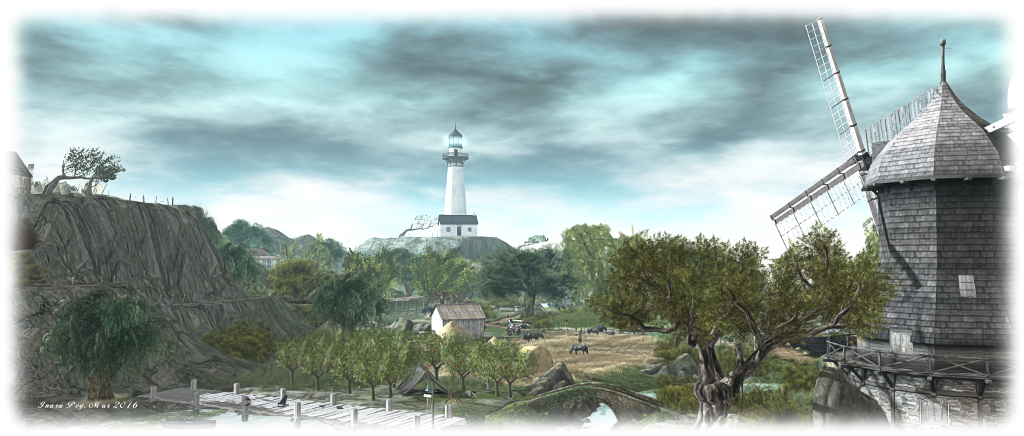
The landing point delivers visitors close to the centre of the region, on its eastern, lowland side. The fork in the dirt track where you arrive is an open invitation to start exploring, forward toward the rugged uplands of the west side of the region, eastwards and south towards a wooden windmill, or north towards the lighthouse sitting on a shoulder of the hills.

The Mill; Inara Pey, March 2016, on FlickrThe Mill

Caitlyn and I opted to follow the track north, towards the rocky hills, a set of stone steps leading us upwards. As we climbed, and amidst the singing of the birds and distant caw of gulls, came music of a different kind carried on the breeze. This comes from a little radio sitting within a little shack, slightly tired in appearance, wood bleached and weathered, tin roof rusting.

Tired it may look, but the shack is clearly home to someone. Flowers are tended in buckets outside, a hammock sways in the breeze and washing hangs on the lines to dry. A garden hose and sprinkler curled around an old tree stump raised on one side of the shack suggests whoever lives here enjoys a slightly bohemian touch to their life, and happily so, given the books and general bric-a-brac scattered around.

The Mill; Inara Pey, March 2016, on FlickrThe Mill

Behind the shack, a path leads on upwards to the tops of the rugged hills, the way marked by a rope path. Here sits old ruins, split by a deep box gorge. To one side sits the remnants of a small castle or fortified house, now occupied by trees, bent as with age by long exposure to the wind, their stooped forms suggesting they are ancient guardians of this place. Across the gorge, and reached by the stone span of a bridge, sits a ruined chapel and nearby tower, another path from them leading back down to the lowlands for those who wish to explore in that direction.

To the north of the homely little shack, the path will take visitors up over the rocky hills or down stone steps and past a walled garden and greenhouse and, via more steps, to the lone figure of the whitewashed lighthouse. With the warm and comfortable lounge and bedroom inside, this would seem to be the rest of the home started at the shack, the cosy little garden forming a homely link between the two.

The Mill; Inara Pey, March 2016, on FlickrThe Mill

A beach beckons from below the lighthouse, and can be most quickly be reached via a zip slide which passes over a small inlet. Stone and board paths then led you onward, over water or across sand, towards the old wooden mill, sails slowly turning as it faces the revolving eye of the lighthouse across the land.

Fabulously and naturally landscaped while avoiding a reliance on mesh to achieve its look, The Mill is an incredibly eye-catching environment. There is far more to see then I’ve described here, including lots of special little touches (such as the Triumph TR3 sitting nonchalantly at the entrance to the gorge, the tea and toast in the shack, the little union flags all pointing to a certain Englishness here…). And when you have finished exploring and photographing, there are plenty of opportunities to sit and relax and snuggle; something Caitlyn and I did after all our wanderings, passing the evening chatting together and simply enjoying the sights and sounds of the island.

The Mill; Inara Pey, March 2016, on FlickrThe Mill

SLurl Details