The Drax Files 44: “It’s Istanbul and VR education”*

Professor Tuncer Can and student share time in the physical world and in Second Life

*With apologies to Jimmy Kennedy.

The Drax Files #44 arrived on Monday, April 10th. It is a somewhat timely piece in content, returning as it does to the subject of Second Life and its role as an educational tool (first examined far back in segment #19) which has arrived shortly after the 10th Virtual Worlds Best Practice in Education Conference has closed its doors in Second Life.

This segment is slightly longer than recent instalments of World Makers, running to one second under 6 minutes. The focus is very much on the work of Professors Tuncer Can and Irfan Simsek from Istanbul University, but the episode encompasses far more than examining looking at how the professors and the university use Second Life to enable and empower student learning.

Istanbul University’s virtual presence in Second Life

“I’m really trying to summarise what are the defining factors that make Second Life work for education,” Drax told me as we discussed the segment.

“I’ve striven to have some detail [through the examination of Istanbul University’s presence in SL] but moreover I’ve striven to give a feeling of the freedom Second Life brings to education. Not just for the teachers, but for students as well. The emphasis is on the fact that Second Life can create an atmosphere of freedom that unleashes energy in the students, encouraging them to participate in the learning process.”

A core part of this freedom is the fact that Second Life presents students full agency over how they represent themselves in-world and the security that they have control over how much they reveal about themselves – and how much (if anything) can be traced back to them. This aspect of identity / anonymity is something oft touched upon in many areas of Second Life, but it is perhaps not so well recognised when it comes to education, where one would perhaps expect things to be more regimented.

A skyborne language park at Istanbul University, Second Life

“They want to reflect their own real character that lies behind their social masks,” Tuncer Can notes in the video. “I had one student whose voice I had never heard in my life; and instantly, when we had this virtual education class, he started using all of his experiences! He said that the anonymity that Second Life allows, nobody looks at me, and I started sharing.”

Tuncer sees this as a vital part of encouraging learning and giving student a greater freedom, as Second Life encourages students to remove the affective filter, causing them to be more receptive to learning, their peers and their class leader.

“That’s why I dwell on these different avatars,” Drax continues. “I have the feeling this is not really a priority right now in many of the VR applications. The ability to openly define yourself, which has a kind of creative chaos which can be leveraged by a skilled educator to open out the learning process. That’s what I’m really trying to show.”

Istanbul University’s virtual presence in Second Life

Second Life can help remove the affective filter in other ways as well. For example: many – if not all – students today are at least semi computer literate. They have games, the Internet, social media, and so on. Thus, they have a natural curiosity when introduced to Second Life, a desire to find out what it is, what they can do within it. This naturally pushes their affective filtering to one side, generating a desire to learn.

“You see this in the shot of students playing with the prims. I have so much footage where you see prims floating all over the classroom” Drax says (starting at around the 1:25 mark). “We gave the students scripts and let them play with the prims, and we filmed everything in real-time in Second Life and in the classroom at the same time. It was not a structured lesson; we weren’t teaching them scripting or coding. They weren’t doing that per se, but they were learning as they played.”

Istanbul University is the perfect focal point for a broader examination of immersive environments in education for a number of factors. It has around 200,000 students, many of whom come from far afield, marking it a melting point of cultures and social influences, any of which might influence the depth of affective filtering any particular student might already naturally feel.

Professor Irfan Simsek offers a helping hand to a student

Through Tuncer Can and Irfan Simsek, the University has been involved in using Second Life as an educational tool for a decade. This give the professors an in-depth perspective on how immersive tools might be used, and – through their technical abilities – a keen understanding of what the future of VR might bring and what are, for the time being at least, the limitations of the new wave of VR systems.

Some of this is touched upon in the video. Again as an example, take Erasmus City, as visited in the segment. It’s a unique environment, allowing students who are about to study at the university to visit it in virtual form, and gain a broader understanding of what their time at the university – and after – will be like. It’s a fascinating take on student orientation which not only helps students better understand the university and manage their expectations, but also offers a unique opportunity for social interaction between students before they even arrive in Istanbul.

Technology-wise, the focus right now is on the new era of VR as personified by the broad range of VR systems from the high-end HTC Vive through to elements such as Cardboard and Daydream. But, as Tuncer touches upon in the video, this entire new ecosystem is actually a big unknown, and raises more questions than it answers. This is not just an issue of cost of high fidelity headsets – specifically mentioned towards the end of the piece – it is the whole ethos of approach.

Erasmus City – offering students a virtual orientation to life at the physical world Istanbul University

“VR is at a point of transition,” Drax elaborates in our conversation. “We don’t know where it is headed. It’s fascinating, but there is nothing out there that really works. That’s something a lot of educators are questioning; there really isn’t a platform like Second Life. High Fidelity is way too complicated, and Sansar is not open yet.

“So this is where we’re stuck right now. Of course there’s Google Expeditions, and things like that, but right now only Second Life is out there and is known to work. And the price point, raised by Tuncer, is a legitimate point.  People will of course say, ‘Well, you can always get Google Cardboard and let students us their own devices’. But students using their own devices is an issue for some schools. So, where VR is concerned, there’s a whole set of issues which no-one is really addressing.”

Second Life, however has addressed many of the questions. Its success as an educational tool lies within its track record of use across a range of teaching disciplines. It is not something that is going to go away as use of consumer-based VR grows in use. But it is something which will remain relevant for some time to come and – for the wise at least – inform them as to how VR should be considered in the educational realm.

Once again, Drax has delivered another outstanding segment for World Makers, one which in itself see a return to the seeds of the show, in that like the first in the series, it is led by Drax himself – although this time purely in the form of a narrative voice over. It’s the perfect way to round-out the circle for the series.
A World of Details in Second Life

Melusina Parkin – World of Details

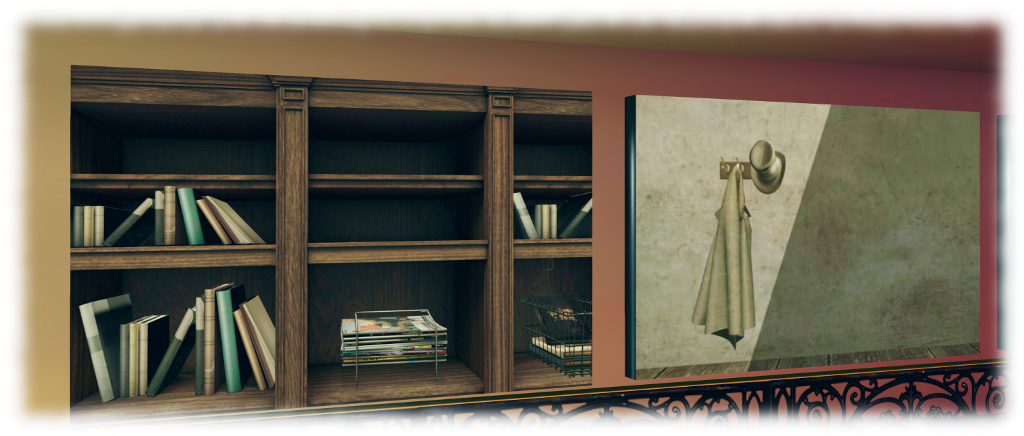
“Although I love landscapes and broad views, my photographer’s eye needs to go close the things,” Melusina Parkin says of he recently opened exhibition World of Details. “Maybe I got impressed forever by the words said by Mies Van De Rohe – one of my favourite Masters of 20th Century aesthetics – ‘God is in the detail’.”

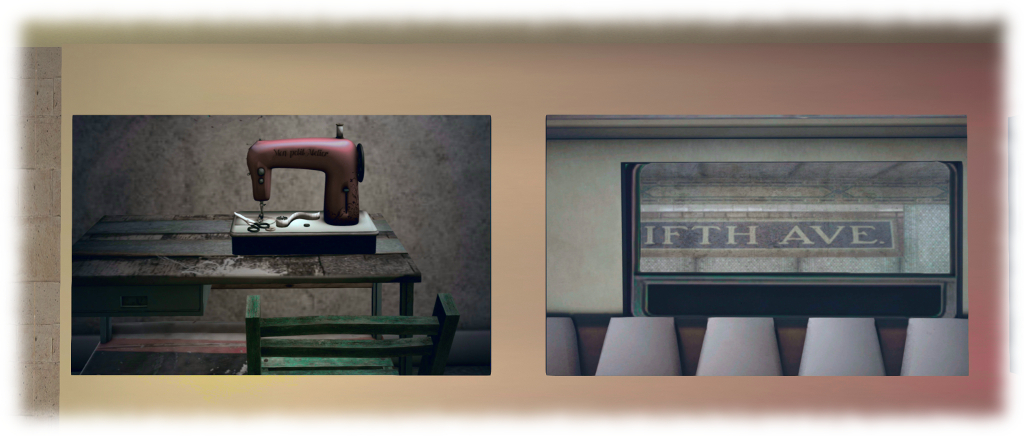
And so it is that we are led on a journey of fine detail through more than thirty images arranged around the split-level floor at Delmonico’s Artspace, where Melusina once again reveals that she truly does have an eye for detail and composition. In some respects, A World of Details shares a heritage with Closer Looks, and exhibition I reviewed in May 2014. As with that exhibition, the pieces here focus on the smaller details of a scene: instead of an entire workspace, we have a single typewriter or sewing machine; rather than the street, we have the street sign. Thus, common everyday things we might otherwise  never notice or which we take for granted are presented in a new light.

Melusina Parkin – World of Details

“Isolating a detail is an exercise of cleansing for our mind;” Melusina states. “It means to concentrate attention on a piece of reality,  until it loses its relationship with the environment and reveals its own meaning (or its own triviality). Then, we have to rebuild the context and to insert the detail into. These operations – made by our eye, that is: by our mind – can make true what Bertolt Brecht says in The Exception and the Rule: ‘We ask you expressly to discover that what happens all the time is not natural. For to say that something is natural […] is to regard it as unchangeable’.

She continues, “Moreover, attention to details can take us to the awareness that beauty and meanings aren’t compellingly in elaborated and sophisticated things, but they’re common and widespread.  I try to enhance all that by shooting everything I notice when I look close at anything. Sometimes I subtract or add light or colours, sometimes I isolate things deleting parts of their environment. Point of view, light and cut-off can enhance the subjects’ power of suggesting something.”

Melusina Parkin – World of Details

The majority of the pieces on display are new in terms of being exhibited; something which again helps with the feeling that World of Details and Closer Looks share a common bond. What is remark is – as noted above – the way in which the ordinary, the trivial, the things we regard as serving a physical function in life, become in and of themselves, art. The framing, colour palette, angle and focal point within each; the way each – as Melusina notes – offers a visual metonymy of a larger scene or of someone’s life.

Study is warranted, because each image reveals more than might at first be thought; as Melusina says, “All of them tell us something about their creators. All of them are both actors and silent spectators of the play we call ‘our life'”.

SLurl Details

Maison de L’amitie in Second Life

Maison de L’amitie – click any image for full size

Update, September 2019: Update: Maison de L’amitie has relocated.

I first visited Maison de L’amitie a year ago in April 2016. For reasons that escape me, I never actually blogged about it. So a suggestion from Shakespeare that Caitlyn and I should head on over came as a timely reminder.

As I recall (with the aid of photos taken at the time), a year ago Maison de L’amitie presented a rural scene with windmills, vines and lots of green. A year on and the region – designed by Corina Wonder with help from  Lan Erin – now presents a seafront environment which, although surrounded on all four sides by water, suggests that the land should actually continue to the south-east, where it otherwise falls sharply into the sea.

Maison de L’amitie

It is a place evocative of sea-side vacation destinations; much of the region is given over to water to form a natural bay which reflects a golden-hued sky. Sand bars to the south and west protect the bay on two sides. These form two broad, low beaches, the one to the south adjoining a sharp upthrust of land against which a little village sits. Running before this, and separating it from a sandy waterfront, is a wide road overlooking a line of rowing boats moored just off-shore, watched over by cormorants, gulls and a pelican.

The little hamlet – has a decidedly Mediterranean look to it: whitewashed walls fading from the effects of the sun and air doubtless heavy with sea-salt, sitting under red-tiled roofs. The houses and villa occupy a set of terraces stepping up the hill, a broad stone stairway dissecting them. On the lowest tier, at the roadside, sits a cosy-looking villa hotel. above and behind it are more houses – perhaps chalet-style accommodation for the guest of the hotel. The uppermost terrace is the home of a small chapel and the remnants of other buildings, their broken walls adding a certain charm to the island while suggesting a history lies here awaiting discovery.

Maison de L’amitie

Down on the waterfront, the road crosses the water via the triple arches of a sturdy stone bridge to arrive at a grand château. Sitting amidst tidy lawns with trim yew bushes on parade either side of the wide footpath lading up to it, the château appears to have been converted into a ballet school, and offers a commanding view out over the bay from this windows and from its well-tended lawns.

And out on the bay, boats lie at anchor, two single-masted sailing boats, a motor-cruiser, a fishing boats and – a commanding presence among all of them – a three-masted corvette. This sits with sails furled, far enough out to suggest it is standing guard over the bay and the little hamlet. Another protector can be found at the end of the western sand bar, looking out towards the corvette, warding boats away from the risk of running aground.

Maison de L’amitie

Maison de L’amitie is a place for meandering, unhurried exploration. The beaches offer  space to walk on golden sand, coupled with little snuggle points on  or under old rowing boats or on blankets just above the edge of the tide. A little book store between beach and village presents a place for browsing, while a short walk beyond it and around the headland, the broken finger of an old lighthouse lies forlornly at the foot of the hill against which the village has been built. Elsewhere lies a chance to see inside the workshop of a craftsman who makes surf boards, and everywhere are opportunities for photographs.

For those who wish to rez props for use with photos, a land group is available to join – either accept via the greeter at the landing point or step into the reception at the hotel, where you can touch the visitor counter up on the gallery overlooking the reception desk, and join the group. Should you enjoy your visit, please consider a donation towards the continued upkeep of the region for others to enjoy.

SLurl Details

Artful Expressions in Second Life: Pan and Sven

Artful Expressions: Pan

The April exhibition at Artful Expressions, the boutique gallery curated by Sorcha Tyles, opened on Saturday, April 1st, 2017. This month, it’s an all boys affair, featuring Panteleimon Aeon and Sven.

Up until now, exhibitions at the gallery have tended towards offering pairings of artists whose work tend to be complementary to one another. This has always added depth to a visit, encouraging one to compare and appreciate both styles on display and consider them as both individual portfolios and a join exhibition, flowing one to another.  With Pan and Sven, Sorcha has shifted things a notch:  Pan focus on avatar studies, while Sven leans more to landscape images; thus presenting two contrasting portfolios of images, each of which are fascinating in their own right.

Artful Expressions: Pan

Pan’s work is visually striking, combining a sense of posed set piece with natural flavour. The result is that while each may well have been composed, so to could each have been easily caught as a moment from the subject’s life; a frozen instant of an unfolding story, the subject unaware they have been so captured.

As regular readers know, I’m strongly attracted to images with contain a narrative, and Pan’s work easy contains entire novel in each image. They draw us into the story, opening the floodgates of the imagination so that we become enwrapped, filling out the back story to these people, their surrounding, and what brought them to this moment in time. These are images to be admired from an artistic standpoint as well; the use of light and shadow, the muted toning, the use of perspective, depth of field, rule of thirds, framing – all play a role in attracting us to these moments in time.

Artful Expressions: Sven

Across the central aisle of the gallery space, Sven also presents nine images, but these are focused on the places in Second Life he has visited and appreciated. “I am definitely no professional by any means. [This is] merely a hobby that I enjoy,” he states disarmingly of his work.

He may not by a professional – after all, how many of us are? – but that doesn’t negate his eye or his style. All of the pieces are again evocative in presenting the scenes they have captured. They also draw us to them, stirring thoughts and imagination, tempting us to wonder at what we might find were we to enter the worlds they offer us and encouraging us to check the pictures for the location names in a desire to visit them (and yes, the names are given).

Artful Expressions: Sven

And did I say these were two contrasting styles? Well, perhaps they are; but they are also drawn together into a cohesive whole by Pan. He has included a single, striking landscape in his set of images. It serves as a natural, subtle link between his display and Sven’s.

Both Pan and Sven will be on display at Artful Expressions until the end of the month. Don’t forget you can also enjoy an ever-changing display of Sorcha’s work on the ground floor of the gallery.

SLurl Details

Six days of Sky Gardens in Second Life

Sky Gardens, Filling the Cauldron – click any image for full size

Update: the Sky Gardens will remain at Holly Kai Park for the next couple of weeks. If you would like to visit them, touch the teleport “mirror” at the Holl Kai Park welcome gazebo and select “2” from the menu, then touch the beam. The winning gardens are numbered “1” for the overall winner and “2” for the joint runners-up.

ccI’ve written a lot over the last couple of weeks about Filling the Cauldron. This is primarily for two reasons. The first is that I’ve been one of the prime movers of the whole thing; the second, and more important reason, I believe in the cause – Elicio Ember is a very special person and a dear friend. Hence why I hope many of you will drop by the event between now an Sunday, April 9th, 2017 – but I’d like to give you another reason to do so. Well, NINE reasons, actually.

As a part of the run-up to the event, we put out a challenge for people to consider designing a garden featuring Elicio’s plants and creations. Nine people rose to the challenge, and their work is extraordinary, offering exotic, other-worldly realms nestled together which, because of their location on an overhead platform, we’ve called the Sky Gardens.

Sky Gardens, Filling the Cauldron

The nine designers who rose to the challenge are: Abinathra, Chic Aeon, Sweetgwendoline Bailey, Kzru Bruhl, Oscelot Haalan, Alliah Jewell, Opal Lei, Letty Luckstone and Eclair Martinek. All of them have produced the most amazing and beautiful designs  which we’ve set under a sky we hope shows them to their best and reflects Elicio’s use of purple in his work. This should set automatically on Firestorm, otherwise flick over to “[TOR] SCIFI – Purple wisps & egg yolk” if you are using a viewer which does not support parcel windlights (just reset to region default after a visit).

Each gardener had an area of 45 metres on the side, and a land impact allowance of 450 with which to let their creative juices flow. In addition, Alliah Jewell provided some surrounding landscaping and paths to lead visitors around the gardens, and placed some seating areas. One of Elicio’s gazebos finished off the setting, presenting people with another place to sit, offering a soothing environment in which to enjoy the gardens.

Sky Gardens, Filling the Cauldron

It would be easy to think that given the focus in on one creator’s items (although elements from other designers was permitted, as long as the focus was on Elicio’s work), all of these gardens would have a common look and feel. However, this is far from the case. All nine gardens are individual and uniquely beautiful, each one demonstrating a personal interpretation of the fantastic, mythological riches of Elicio’s creations, bringing them very much to life.

The gardens range from the simple elegance and tranquillity offered by gentle waters supporting exotic orchids and reflective bubbles drift on a gentle breeze, through the heart of Amazonian-like rain forests, where waters tumbles down rocks into shimmering pools, parakeets in bright plumage circle overhead; or where a path winds upwards through verdant undergrowth to reveal a temple-like structure hidden within the trees; to mystical places where sphere turn their rune-faced surfaces to visitors or the skeleton of a great beast rests.

Sky Gardens, Filling the Cauldron

Such is the depth of creativity shown with these gardens that I do urge you to pay a visit. Yes, you can also contribute to Filling the Cauldron if you so wish; but in this instance – and I know Elicio agrees – witnessing the creative vision embodied in these designs helps to bring each to life, and pays tribute to the gardeners for all of their work in bringing these garden scenes to us. And believe me, their beauty makes them more than worth the visit. I’d truly love to have them remain at Holly Kai park for people to visit and enjoy well into the future.

But they will soon be passing into the west. Filling the Cauldron draws to a close on Sunday, April 9th. But, should you visit, you can help to ensure one of the gardens will be reborn at another place and time later in the year, as one of these designs will – with your help – be selected for display at the upcoming 2017 Home and Garden Exhibition. You can read more on this at the Filling the Cauldron Gardens in the Sky page.

Sky Gardens, Filling the Cauldron

So, do please pay the Sky Gardens a visit; they will only bloom for a short time.

SLurl and Links

Kultivate 2017 Spring Art Show in Second Life

Kultivate Magazine 2017 Spring Art Show

The Kultivate Magazine 2017 Spring Art Show officially opened on Monday, April 3rd and runs through until Sunday, April 9th. This celebration of 3D and 2D art features more than 50 participating artists, with both juried and non-juried art competitions, with those participating in the juried event are competing to win a shared prize pot, gift cards, and more.

The event – which is talking place on a specially constructed festival area at Kultivate Magazine’s home region – will also feature live performers, tribute bands, DJ parties, two hunts and a photo contest, Spring Into Art.

Kultivate Magazine 2017 Spring Art Show

Hunt-wise, the Palette Hunt features artist’s palettes scattered across the show. Simply find them (in any order you come across them), and touch them to receive a prize.  The Art Quest Part 2 hunt is a HUD-based hunt, also running throughout the show, and is a mystery for you to solve. Follow the clues, and the following prizes could be yours:

  • A free mesh artist studio skybox
  • A free mesh slide show frame for your images
  • A free artist furniture mesh set
  • A free mesh frame
  • A free piece of art work.

You can pick up your HUD and the 2D Exhibition Art Gallery.

Kultivate Magazine 2017 Spring Art Show

A full list of participating artists and the event sponsors can be found on the Spring Art Show Press release, and artists are also listed by subject area:

A new component to this year’s show are the Art Talks. These classes feature a variety of subjects, including Second Life photography, copyright and creative commons information, how to market yourself as an artist and more. All of the talks are taking place at the Art Show theatre, at the following dates and times:

  • Tuesday, April 4th, 2017 at 07:00 SLT: Strawberry Singh, “Second Life Photography Tips”
  • Tuesday, April 4th, 2017 at 17:00 SLT:  Veruca Tamma “Copyright and Creative Commons”
  • Wednesday, April 5th, 2017 at 17:00 SLT: Kaijah Chrome “Beginner and Intermediate Photography class”.

So, as is always the way with Kultivate Magazine, there is a lot going on. To get a complete feel for the event, follow the links below, and be sure to visit the Kultivate 2017 Spring Art Show in-world.

Links and SLurls