The Poetry of the Planets in Second Life

Poetry of the Planets: Uranus – The Magician

Gustav Holst’s The Planets is perhaps one of the best-known suites of classical music; I doubt there are many reading these words who have not heard it at least in part. Notably, perhaps, thanks to Mars: Bringer of War and Jupiter: Bringer of Jollity (a movement from which is often used – possibly with Holst’s own posthumous disapproval – as the music for I Vow To Thee My Country).

Written between 1914 and 1916. Each movement of the suite is named after one of the seven major planets of the Solar System beyond Earth, and its corresponding astrological character as defined by Holst. The pieces are richly evocative and emotive – hence their popularity in modern western culture, and perfect for interpretation through many mediums – dance, theatre, film and musical re-arrangement.

Poetry of the Planets: the Teleport Temple

Holst’s Suite forms the focus for Caledonia Skytower’s Poetry of the Planets, which opened on Sunday, April 2nd, and runs through until the end of May. It offers a unique means ffor further interpreting Holst’s music – through the designs built by Caledonia, the music and our own words.

“Legend has it that the Ancient Gods of the Greeks have abandoned this realm, but evidence of their existence can be found above, in celestial spheres,” Cale explains. “These signs and symbols, both direct and abstract, are also reflected in Gustav Holst’s 1918 orchestral suite, The Planets, Op 32.”

Poetry of the Planets: Venus – Bringer of Peace

And thus, we are invited to take the teleport boards from Olympus Island, where a visit begins, and travel the spheres of Holst’s suite (Bringer of War and Bringer of Jollity – to use the original titles for each piece in the suite before the names of the planets were appended in 1918 – have yet to be added).

Within the spheres, scenes have been set which elegantly reflect the central theme of each piece, while a web link allows visitors to hear the associated piece from Holst’s suite via YouTube. Uranus, for example, offers a world of light and symbols, circles turn, runes glow, stars are born and fade mist hides and reveals – all emblematic of the arcane science of magic.

Meanwhile, Saturn offers a long winding patch that twists ever upward, passing windows in which a candle slowly burns. Steps along this winding path are in keeping with the doleful beat to The Bringer of Old Age, while the windows and the candle remind us of the passing of years, the slowness of progress up the hill a physical reminder of growing age until we reach the top – and?

Poetry of the Planets

As you explore these spheres and allow their mystique and the beauty of Holst’s music infuse you, you may well be moved to words and poetry – which is precisely the aim.

“Let your exploration of one or all of the planets inspire you to write a poem, Cale explains. “You need not be an experienced poet – all poems are welcome. You are even welcome to write a poem about Olympus Island itself.

“One poem a day will be featured here on the project blog,  In May, at the end of the project, there will be a reading event to share selections from the featured project poems.”

Poetry of the Planets: Neptune the Mystic

Dropboxes for poems can be found within each of the spheres, close to the landing point in each (where a blue sphere also offers a teleport back to the temple at ground level), and Cale points out that all rights to the poems submitted are retained by the poem’s author.

Poetry of the Planets is an inspired idea, bringing together fable, mysticism, music and words – and a wonderful means by which we can immerse ourselves in Holst’s suite. I look forward to a return visit to witness Bringer of War and Bringer of Jollity – and to trying my hand at writing a poem or two.

Poetry of the Planets will be open through until the end of May, as noted – and don’t forget to visit the resource centre while there.

SLurl Details

Orcadi Island’s simple splendour in Second Life

Orcadi Island – click any image for full size

Orcadi Island is a homestead design by Julya (Julya77) which is beautiful in its simplicity of approach, and likely mindful of places we may have visited or seen in the physical world. In my case, the strongest impression was that of England’s and Scotland’s heathland, thanks to the wide open vista presented. To others, doubtless it will evoke thoughts of America’s grain belt or the vast farms of the Australian outback.

The island rises from the sea table-like, the mostly flat top is entirely covered in tough wild grass turned sandy blond and suggestive of an autumn’s day – a feeling enhanced by the region’s windlight. A single hill rises to one side of this flat expanse, topped by the slim tower of a lighthouse. While this may break the illusion that the region is in the middle of a broad swath of heathland or wheat fields or the outback, it also reminds us that Orcadi Island isn’t really any attempt to mimic a particular place, but rather to evoke feelings and perhaps stir memories.

Orcadi Island

The landing point sits before the single cottage occupying the land – the storybook LAQ  Picturesque Cottage, which I still adore seeing, even if it’s not really suitable for placement at home. Its presence here further enhances the intertwining of feelings that this place is familiar with the knowledge it is really unique.

A track runs past the cottage, pointing towards the lighthouse on its hill in one direction, whilst winding its way towards a thatch roofed windmill in the other, passing horses grazing on the tall grass along the way. A branch of this path also offers the way to the beach on the north-east side of the island. A second windmill sits closer to the cottage, its circular sail turning slowly, a snuggle for couples sitting just above the late-blooming flowers surrounding it.

Orcadi Island

As well as the horses roaming the island, the yard of the cottage is occupied by chickens, while the nearby bales of hay, neatly rolled or squared, and the red bulk of a tractor suggest this is a working farmstead. But also scattered across the island are small ruins: a wall here, a shattered corner and floor there, the arches of what might have once been a chapel overlooking the sea. all of which suggest this place has long been a place of human habitation.

It’s often said that the skill invested in a design is often shown within its apparent simplicity – a word to which I keep circling back. Orcadi Island exemplifies this in spades: it seems so simple a design, deceptively hiding the care and thought invested in making it such a beautiful setting. Yes, you might be able to “see all there is to see” within a few minutes of arriving, but that’s not the point. This is a place to be savoured; a setting in which you can lose yourself in thought enjoy time spent with a loved one or friend without feeling the need to hurry on and see what’s around the next corner.

Orcadi Island

This is also a wonderfully photogenic place, richly evocative;  while walking through the tall grass, I found myself wanting to open my hands and feel the bushy tops of the golden stalks stroking my offered palms.

Should you enjoy your visit, do please make a donation at the tip jar by the landing point and help ensure Orcadi Island continues to be a place people can visit and enjoy.

SLurl Details

With thanks, yet again, to Shakespeare for pointing me towards Orcadi Island.

MisaKaory’s The Way I Feel in Second Life

Club LA and Gallery – The Way I Feel

Now open at Club LA and Gallery, curated by Fuyuko ‘冬子’ Amano (Wintergeist) is The Way I Feel a selection of images from the portfolio of MisaKaory. I’m actually getting to this review a little late, as the invitation got buried in my inventory, and so offer apologies to Misa and Fuyuko;  but I do recommend a visit before it draws to a close.

“Photography gives me a lot of emotions,” Misa says of her work. “Sometimes it is too exhausting, when you can not sleep at night because you keep thinking of some idea for a photo. It seems the idea came and you get it all together and press the shutter, but you are still dissatisfied. So you keep looking through the viewfinder to find the right angle, lighting, waiting for the moment… And then suddenly, here it is! Often it is a completely random person that you have caught in the frame, a bird or a gust of wind. The feeling that you get after taking the photo you like is just wonderful! The world that we see is infinite, but we remember only some moments that have given us a strong impression.”

Club LA and Gallery – The Way I Feel

Impression is certainly the word I would use with the images she has selected for exhibition here. There are all powerfully emotive and rich in story. A total of 19 pieces are displayed, ranging from black-and-white through monochrome shades to colour, with multi-panel images are  mixed with individual pieces (note that some at the back which might be considered NSFW). The result is an exhibit which demonstrates not only the range of Misa’s photography, but also her sense of art and balance in putting an exhibition together; even the positioning of the sofas and cloth-draped table has been carefully considered.

The emotional impact of these pieces hits you as soon as you enter the gallery, thanks to the mirrored pairing of babe asleep and bald woman lying with eyes closed (seen at the top of this article). So much is conveyed by the two: the indelible link between a mother and her baby; the innocence of new birth reflected in the bald pate and unlined face of the woman; the echo of that subtle, womb-like feeling we get when caught on the divide between wakefulness and sleep. And then there is the eye casually held under the woman’s hand; a subtle note that we are perhaps voyeurs encroaching on the private worlds of woman and babe.

Club LA and Gallery – The Way I Feel

Facing these two images is a line of four pieces running from black-and-white through monochrome shades back to black and white. They are all extraordinary in the depth of feeling they imbue as we are instantly drawn into the stories they tell. The desire to shout a warning  to the girl sitting against the tree in the first one is almost palpable, such is the sense of menace conjured by the shadowy male form coming towards her. The remaining three evoke equally powerful responses.

I could write a lot more, but this really is an exhibition deserving to be seen, not described. The Way I Feel presents images which are both intensely personal but because of their emotional content, are immediately empathic. We can immediately identify with the hope, passion, love, fear, loneliness, regret, joy and more captured within them; the impression they make is almost palpable, remaining with us after we leave the gallery space.

Club LA and Gallery – The Way I Feel

Another highly recommended exhibition.

SLurl Details

Sniper’s Second Life 1999 – 2017: The Story

Second Life 1999 / 2017 – The Story

“The initial project, ‘The Little Prince’, would take a long time,” Sniper Siemens explains in introducing Second Life 1999 / 2017 – The Story, which is now open through until the end of June 2017. “For my health and work reasons, I could not make it this year. I apologise for the inconvenience.”

Frankly, I don’t think an apology is warranted; if anything, Sniper’s look at the entire history of Second Life from 1999 through to the present should be a permanent, living installation in Second Life (although Sniper may well shoot me for saying so!).

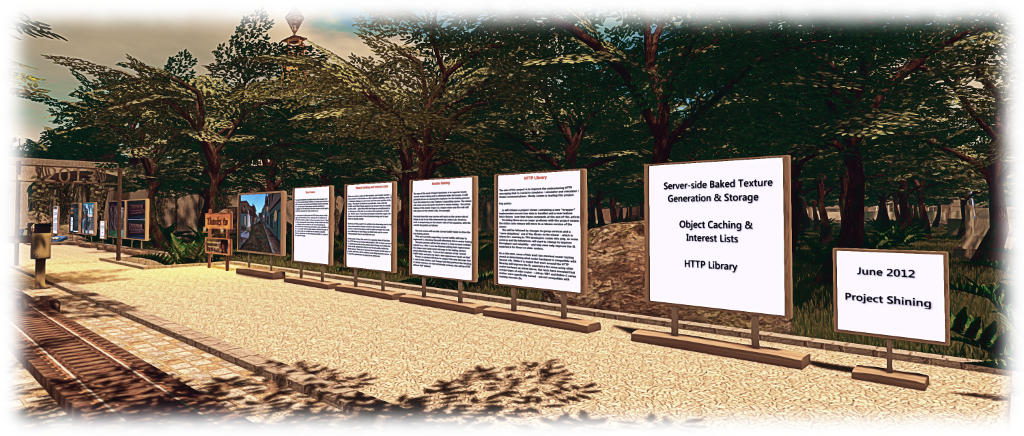
Second Life 1999 / 2017 – The Story – Project Shining: the start of the ongoing work to massively overhaul SL’s technical capabilities

Before I get into the Story of Second Life, let’s take a look at the story of the story of Second Life. The installation originally began in July 2014 as Second Life History, a relatively modest but informative installation, complete with humorous touches which continue to mark these exhibitions. In February 2015, Sniper returned with The Greatest Story Ever Told, expanding on the original idea, offering more information, a new presentation layout and lots of new little characters to show you each of the many notable events throughout Second Life’s history (and that of its precursor, LindenWorld).

For this latest installation, Sniper builds on the 2015 design, bringing it bang up-to-date with everything that’s happened since that installation was exhibited, with a look at things like  Bento, the starter avatar updates, improvement to Sl web properties such as the Community platform, etc., and a tongue-in-cheek “look” through the gates at Sansar.

Second Life 1999 / 2017 – The Story – remembering Lumiere Noir, one of the many residents who did so much to empower all of us in our time in-world

From the landing point / information point, visitors progress along a footpath passing through the years sequentially, from 1999, with the originals of Linden Research and The Rig, progressing through LindenWorld, Primitars, early experiments with AI creatures, to the birth of Second Life. From there, major notable events, positive and negative (depending on your perspective if you were around at the time). All are marvellously presented, with a great balance between information – presented via static information boards,  interactive elements, and in-world videos.

As well as walking around the installation, visitors can opt to take a train ride through the exhibits. A Canopied station forms part of the landing point. Simply touch the rezzer to generate a car, jump in and touch the car to start your ride. You can stop along the way at any time to take a closer look at exhibits by touching the car once more – just make sure you cam over to them, don’t get out of the car or you’ll have it de-rez on you! A further touch of the car will resume your journey, while barriers at certain points also encourage you to stop in case you risk missing something. With a change of train half-way around, this is a really charming way to see the exhibition (rail traffic allowing!) – kudos to Sniper for including it.

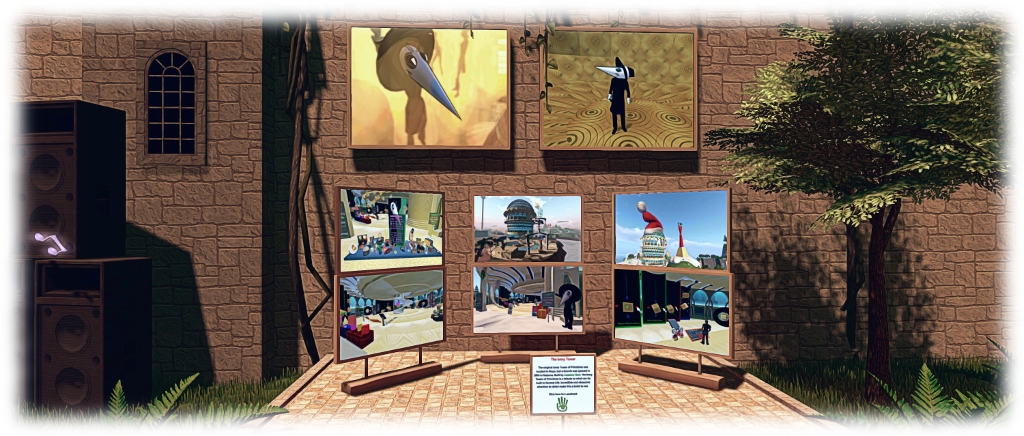
Second Life 1999 / 2017 – The Story – Bento in images and videos

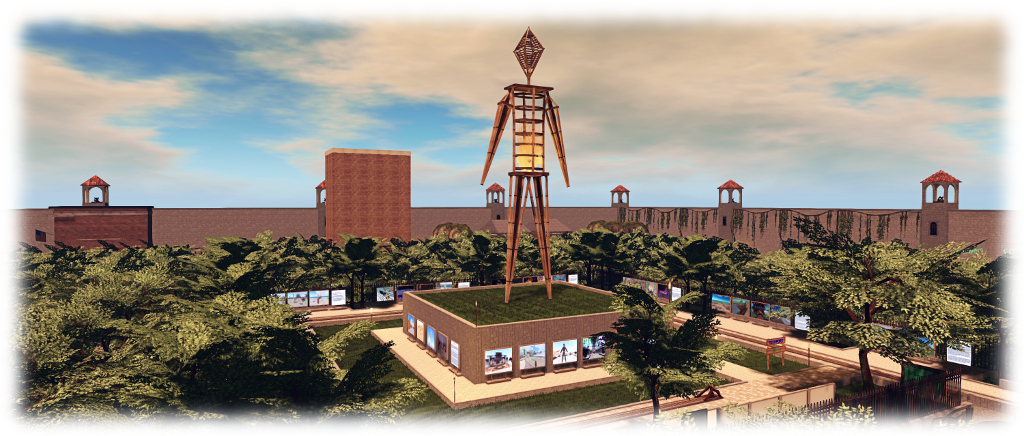
Journey’s end for Second Life 1999 /2017 – The Story is a shady park alongside of the cheeky “look” at Sansar. However, this isn’t the end of the installation. A teleport station will take you on to a look at the History of Burning Life, (or Burn 2 as we now know it).  This can also be toured by rail car – just follow the path to the right as you exit the main landing area and before you enter “1999”.

I am an unabashed fan of Second Life’s history (and I’m flattered to have played a very small and indirect role in this exhibit), so cannot recommend this installation highly enough anyone wishing to gain a rounded understanding on Second Life, Linden Lab and Burning Life / Burn 2. It really is a pleasure to visit, marvellously informative without ever drowning you in a flood of information, and rich in gentle touches and delightful flicks of humour. I also couldn’t help be notice the layout of the exhibit seems to include a fair amount of space for future expansion as well 🙂 .

Second Life 1999 / 2017 – The Story – the central Burn 2 exhibition

Second Life 199 / 2017 – The Story is an absolute delight, and as noted, will remain open through until the end of June 2017. Be sure not to miss it!

SLurl Details

Video by Sniper Siemens

PeTOu’s perfection in Second Life

PeTOu – click any image for full size

PeTOu is a place that is bound to draw me for a number of reasons. The first is the strong Oriental influence exhibited across this Full region. The second is the way the region uses Linden water throughout to naturally add ambience and harmony to the environment. And the third reason is that is another design by the immensely talented Uta (xoYUUTAox), who was responsible for bringing an ethereal beauty in one of the iterations of a favourite old haunt, Roche (which you can read about here).

With PeTOu, Uta has worked with her partner, Nagi Alekseev, to recreate some of the ethereal wonder present in her design for Roche, expanding it to encompass much more, rooting it in a much broader, but no less enchanting, environment. There are also a number of secrets to be unlocked and enjoyed for those willing to take the time.

PeTOu

A visit commences on the west side of the region at a landing point where – if you’re not careful – it is easy to miss a set of teleport boards. However, rather than taking any of them right away, I do recommend you start by letting your pedal extremities do the work and explore the region on foot. There are two obvious routes away from the landing point. The first is a calf-deep ribbon of water winding through a rich expanse of rapeseed and under the boughs of cherry blossoms; the second is a sort wade across the water to where the rapeseed climbs up over rocks and grass, and old stone steps offer the way to a footpath.

Whichever you take, you’re going to want to take your time – there is a lot to discover under the canopy of blossoms. The footpath for example, will take you up to a little traditional Japanese house sitting on a hill, a little garden to one side, complete with ponds presided over by a stately egret. A cobbled path offers a route around the garden, while on the other side of the house, a rocky path sweeps down to the water once more.

PeTOu

Before the path disappears under the water, however, visitors can turn away from it across a wooden bridge spanning a narrow channel, lanterns floating on the waters below. This leads the way to a network of bridges reaching out over an expanse of deep blue water, a pagoda sitting on the far side atop a rocky bluff. Two great golden dragons guard the waters, one of which has apparently crushed a pier under its weight.

Close by, on the nearer shore of the land, and reached by following another path from the little house on the hill or via a path leading up from the watery path through the rapeseed, is a much larger house. This overlooks the network of bridges, as well as offer much to see in and around it – do be sure to follow the stepping stones under the arc of Torii gates to the rather unusual sculptures at the far end.

PeTOu

PeTOu is truly a marvellous setting, rich in soft colours under an night-washed sky, perfect for photography and with lots of little gems to be found – keep an eye out for the white flowers which hide sitting poses within them, for example. Once you have finished your explorations, be sure to make your way back to the landing point and the waiting teleport boards.

While one of the boards – “Oriental” – will carry you to the ground level bridges and their dragons, the remaining five provide access to little vignettes in the sky. All are very different from one to another, and each has its own attraction / whimsy. The R2 Cafe, for example, has a little winter scene and a colourful teleport back to the ground (which you’ll have to look for!), while Paris Roofs presents a romantic rooftop tryst under a summer shower dropping into the street below.

PeTOu

Finished with an ambient sound scape, and matched with a piano music stream with minimal adverts, PeTOu is a marvellous environment for exploring and for simply getting away from everything, be it time spent on the ground, or up in one of the skybox locations. All told, highly  recommended – and if you do enjoy your visit as we did, do please consider making a donation via one of the tip jars so that others might also continue to enjoy the region.

SLurl Details

  • PeTOu (Everheart, rated: moderate)

A return to Storybrooke Gardens in Second Life

Storybrooke Gardens – click any image for full size

Lauren Bentham’s Storybrooke Gardens has long been a favourite of mine, particularly when it is dressed for winter (see here and here for more). With spring now upon us, Lauren has remade and expanded Storybrooke, so Caitlyn and I recently hopped over to have a look.

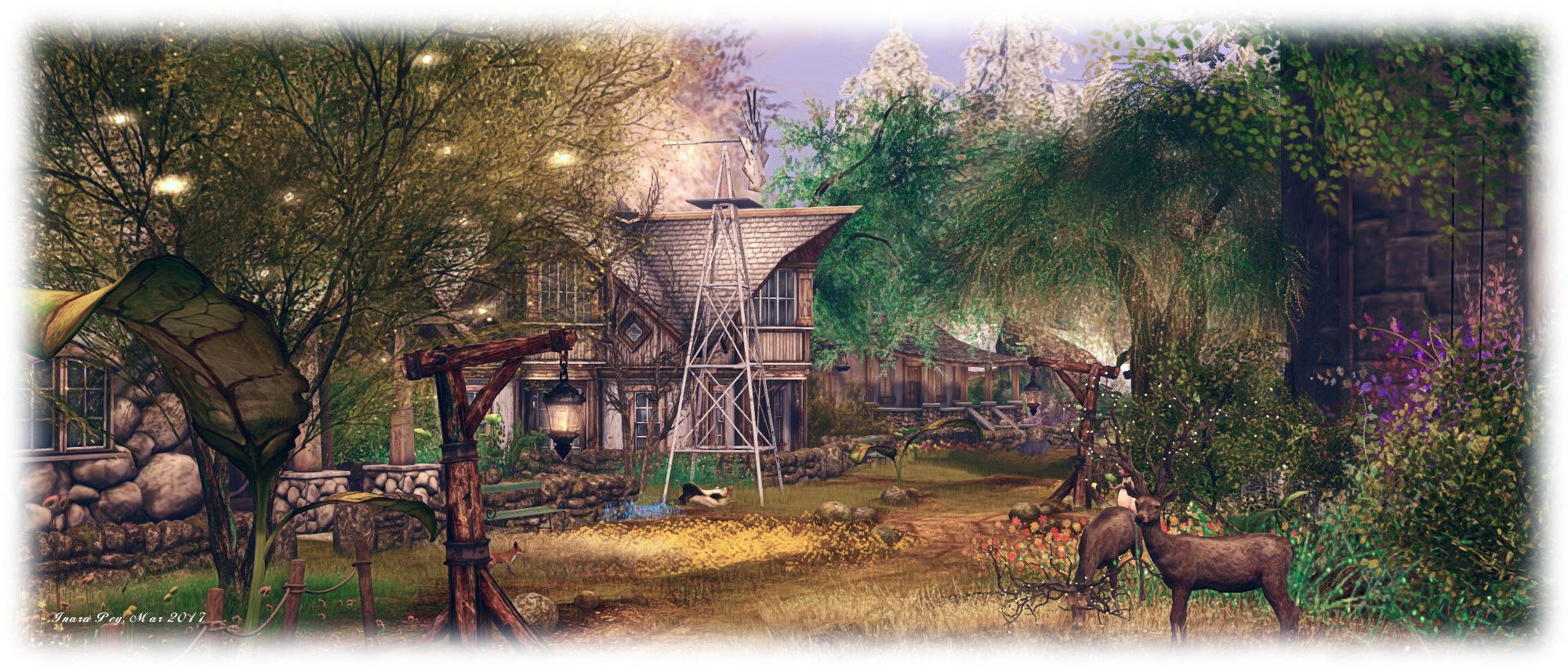
The new design means that there is now even more to see and enjoy, including part of the space retaining the snowy looks of the Gardens in winter – of which more anon. Winding past the landing point with its bright little tent, the familiar springtime trail still wind through the trees, lanterns hang from posts and branches, inviting visitors to follow. It meanders past little vignettes of charm and past cottages and houses available to rent, gathered here and there in little hamlet-like groups, sheep and deer grazing around them, foxes roaming nearby.

Storybrooke Gardens

This is a place of story-time fancy, so don’t be surprised when you bump into some familiar characters as you explore – both indoors and out (although again, do please be aware some of the houses may be privately rented when considering venturing inside anywhere). Humpty Dumpty, for example sits (a little headless) alongside the trail at one point, while gingerbread men peep and wave around the base of a tree at another and little fae folk hover and play. Those who are regulars to Fantasy Faire may also recognise little touches from popular FF creators adding to the magic of this realm.

Opportunities for photographs lie around every corner and along every path; for those looking for romance and a place to share a cuddle or two will find much to please them here, both under the trees and up in tall towers of varying descriptions. Camp sites, benches, blankets, even a bicycle suspended beneath dozens of colourful balloons, offer places to rest and enjoy. And, as noted above, those seeking a last touch of winter also won’t be disappointed.

Storybrooke Gardens – A Winter’s Tale

A short distance from the landing point is the entrance to A Winter’s Tale. This is a place where the snow lies heavy on the ground, frost wraps itself around bark and bough, and quaint little cottages, roofs laden under heavy white blankets, huddle close to the imposing bulk of a great castle. Above the two imposing guardians of the path leading up to the castle’s great doors, circles a magical boat held aloft by two translucent balloons, its deck offering a vantage point from which to observe the lands below.

Not far from the castle the single spire of a wizard’s tower points to the sky rises from the snowy landscape, a winding path curled around its rocky base leading to its front door. Children skate on the frozen pond at the foot of the tower, while reindeer keep an eye on all who climb the path to find out why lies inside.

Storybrooke Gardens

Towers are very much a part of this landscape – both winter and spring – as are windmills. They variously rise above tree-tops or swing their sails lazily in the breeze, adding yet more story-time feel to the land. Beneath all of them, the local folk sit and read or play, wave greetings to passing visitors, and go about their own little tasks, adding a further depth to all the scenes to be found through the Gardens.

Lauren has always had a gift for expression with her region builds, but sitting in the sky (not always the easiest place to create something with a truly natural look and feel), Storybrooke Gardens is perhaps one of her most magical environments. One we were delighted to once again visit and explore.

Storybrooke Gardens

SLurl Details