I first encountered the art of Morlita Quan in June 2016, when I visited her exhibition Organic Geometry (read here). I was at once fascinated and captivated by her work, so it was with delight that I recently had the opportunity to visit her gallery space in-world, Abstract Line Art Gallery, located over the region of Dax.
A physical world artist hailing from Spain and working under the name MorlitaM, Morlita’s artistic expression covers 2D and 3D art and music, and all three are very much reflected in her Second Life presence, where she exhibits her 2D work, creates 3D art and also plays music, often at the opening events for other artists and galleries she knows.
“The pictures exhibited at Abstract Line, are some of my physical world pieces,” Morlita says of her gallery space. “They mix classical painting with post graphic design work, focused on light and geometry. Everything is inspired by nature, and I try to show the beauty of nature’s shapes through a strong touch of geometry and always guided by feelings and an abstract touch.”
The result of this are images which form beautiful, geometric abstractions of line and shade, clearly driven by geometry and symmetry whilst all the time retaining an organic sweep and flow. Produced in black and white, or sometimes using soft colours, the pieces are at once alive and at times urgent in form, while also being calming and almost mesmerizing as we become caught in the patterns forming before us.
It is the organic aspect of the pieces which perhaps captivate the most. Looking at certain pieces, as abstracted as they are, it is difficult not to see ripples on water or the curl and twists of pattern we might observe on a butterfly’s wing – or even the head of a fly or bee; whilst elsewhere can be seen a beautiful nod to that move organic of geometric forms: the Mandelbrot.
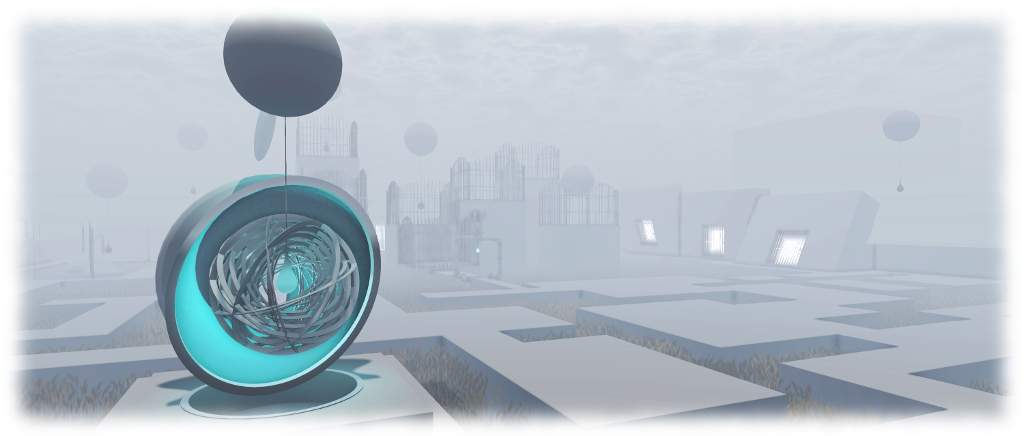
Also within the octagonal gallery space are several of Morlita’s 3D pieces, with the centre space dominated by a glorious 3D abstraction entitled The Garden. Translucent like smoked glass it forms three flower heads with petals that at once have hard, geometric edges but which are also completely organic in look, and through which white light flows sinuously.
Abstract Line Art Gallery makes for an engaging visit, particularly if you are interested in abstract and / or geometric art, and particularly for exploring more of Morlita’s artistry. When visiting, please also consider a donation towards the gallery’s upkeep.
“Magic and Mystery await around every corner,” Joonie Jatho says of her Homestead region, itself called Magical Mystery. “Come explore and see if you can find all the enchanted, secret places!”
It’s an enticing invitation, and one well worth taking the time to accept. Designed on Joonie’s behalf by the combined talents of Kaelyn Alecto (responsible for It All Starts With a Smile (which I last visited here), LuaneMeo (who designed Luane’s World – see here – with Kaelyn, and most recently opened Luane’s Magic World – see here), and Gorba McMahon, Magical Mystery presents visitors with a lot to see and discover.
This is a rugged landscape, icy and cold – but it has a warm heart waiting to be found by those who seek its secrets. Tall shoulders of rock and flat-topped plateaus surround the centre of the region, cut through by a deep gorge itself spanned by rocky arches. Snow caps the tops of these high, seemingly impassable cliffs, whilst encircling their feet is a low-lying realm of ice and snow.
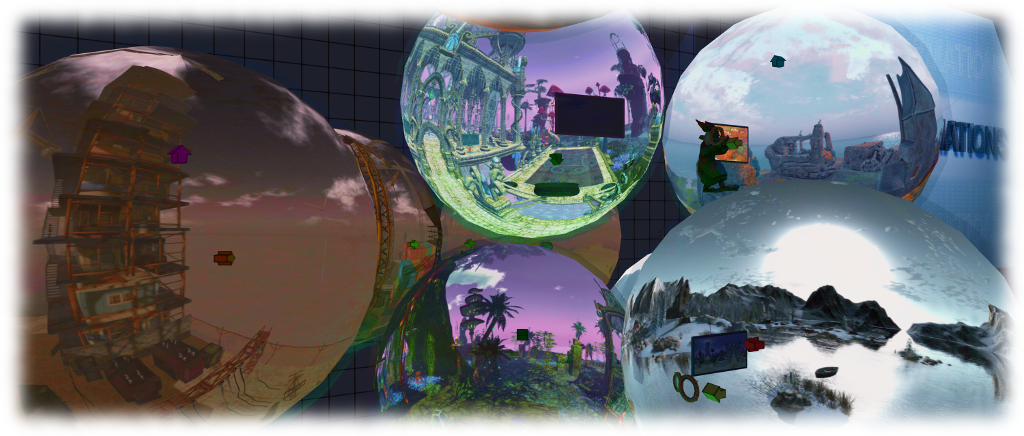
Visitors arrive on the south side of the region, where a path of snow-covered slabs forms a “T” junction. To the left and right, it points the way across the ice, while northward, it directs one’s feet into the deep cleft of the gorge towards a set of stone steps over which hang three great Fae bubbles, the hint of buildings lying beyond.
Which route you take in exploring is up to you; go east and you can enjoy the frolics of penguins waddling over ice and belly sliding down snowy slopes. Go west and a bridge suspended between coloured balloons leads to a small island. Boats bob on the water close by, offering cuddle spots, and a frozen pond sits in the middle of the island, watched over by snowy egrets and pink unicorns. A sign warns of the danger of thin ice – but find the right point and you can plunge through the ice and into another world.
The northward route, through the gorge, leads you under the gnarled form of an ancient tree, bent with age, lie a tired sentinel at the gate of the deep cleft. Across a stretch of glittering ice, the stone steps lead the way to a little village hidden and safe within the enfolding might of the rocky walls surrounding it.
Here the aged, bent trees clinging limpet-like to the near vertical walls of the gorge give way to firs trees, the largest of which is festooned with lights, the houses colourful and bright beneath it. A pond offers an opportunity for skating. Beyond the houses, more steps visible through a stone arch invite the visitor onwards and upwards, passing through a frosted wood to where a church sits on a finger of flat rock, reached via a sturdy wooden bridge.
But this is not all – far from it. Before the church the path again branches left and right through the trees, presenting visitors with more chances to explore – and those who take them will find more to explore, and that diving through broken ice isn’t the only way of finding the hidden magic of this region; more to be found underground and up on the rocky peaks. Throughout it all, the local wildlife also awaits discovery, and there are places to sit and places to cuddle, opportunities to slip inside and warm up after the cold. For those who feel a little more active, skating and sledding is also to be found.
Magical Mystery makes for a rewarding visit. Should you enjoy your time there, do please consider making a donation towards the region’s continued enjoyment by others.
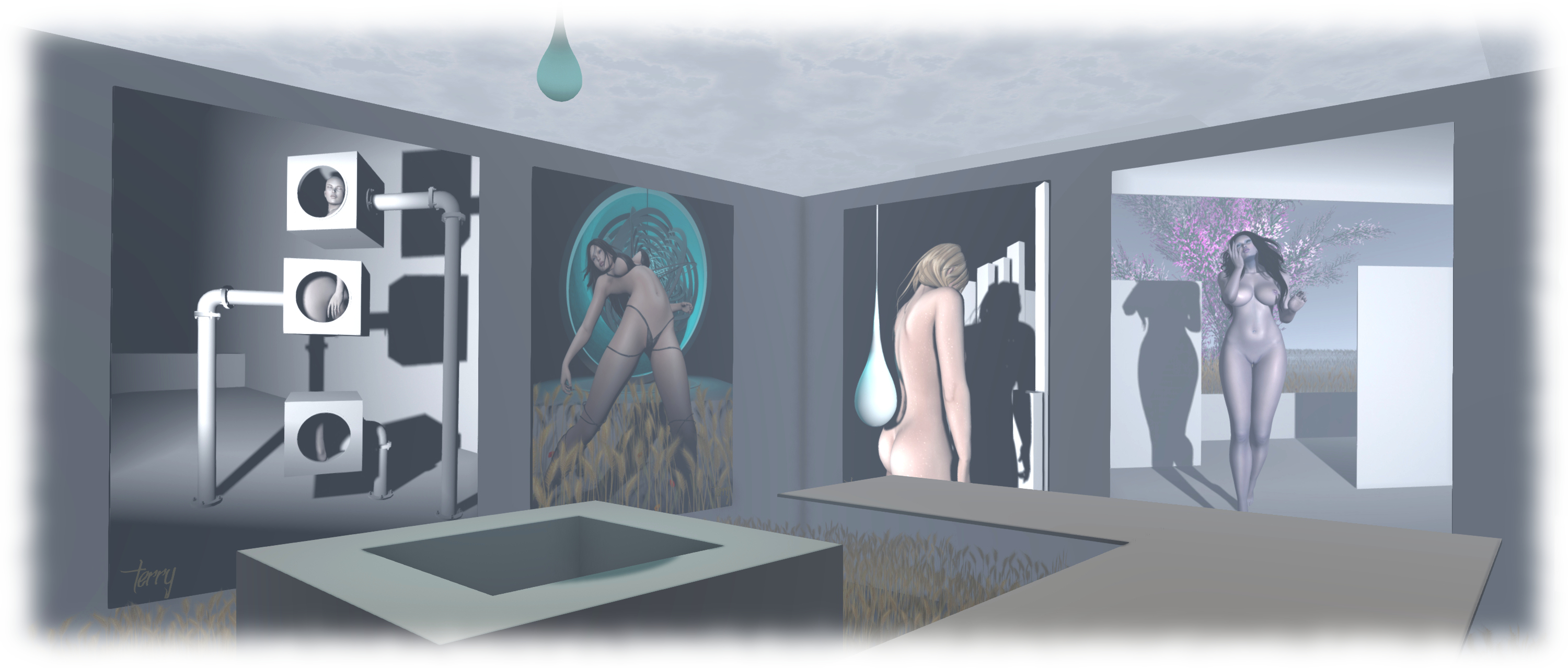
Running from 13:00 SLT on Wednesday, December 21st through until January 6th at Art on Roofs, is The Bridge by Terrygold, an exhibition of over 40 of her images and studies in what I think is the largest display of her work to date.
Anyone familiar with Terrygold’s work, cannot help but be struck by her expressive use of monochrome, her minimal and striking use of colour and the manner in which props form an integral part of her images and the narratives they project. Seeing so many pieces on display here, complete with thematic groupings, really brings the extraordinary power and beauty of her work home.
As with her previous exhibits, The Bridge is reached via teleport from the main Art on Roofs landing point. On arrival, some viewer set-up may be required prior to entering the exhibition areas. Specifically, the time of day should be set to ambient dark / midnight, and the graphics Advanced Lighting Model (ALM) should be turned on to appreciate the projected lights (there is no need to enabled shadows Sun/Moon + Projected Lights if this hits your performance too hard – the light projectors will still work, you’ll just use the use of shadows to further enhance the pieces).
Once your viewer is set, step out in the white area and onto the bridge. This leads the way between six tall alcoves in which are displayed the first of Terrygold’s pieces – including one of the props used in a study. This bridge is the first indication that as with previous exhibitions, the setting in which Terrygold displays her work is not just a backdrop to her work, it is very much part of the exhibition itself – as there the props she’s used, which is why they can be found within The Bridge.
On reaching the far end of the bridge, visitors are invited to pass between blood-red curtains (red being one of the colours Terrygold frequently uses to present strong contrasts in her work) to the second element of the exhibition. Here amidst echoes of her earlier installation, Windows (which you can read about here), are four pieces with a distinctly musical theme. Beyond this, reached by following a jigsaw on the floor, lay the main two exhibit areas.
The first of these offers another three-dimensional experience to visitors – a theme continued from the settings for earlier displays – with the art extending below “floor” level. A white path winds through this chamber, passing an ivory piano while offering a vantage point for camming around the art and the hall, before leading the visitor through a gap in the walls to the final, midnight black chamber. Here are themed sets of beautiful monochrome nude studies. With titles such as Gabbia, (“Cage”), Prigioniera (“Prisoner”), Freni (“Brakes”), and Muri Stella (“Wall Star”), they are stunningly evocative and powerful pieces which hold sway over one’s attention.
Terrygold modestly claims she is not an artist, just a photographer. I have, and continue to, disagree with her on this. Not only do her images demonstrate a clear eye for framing, composition and narrative, the environments in which she presents them more than demonstrate her considerable skill as an artist and designer.
The Bridge, as noted, will remain open through until January 6th, 2017. Should you visit, please do consider a donation towards Terrygold’s work and the upkeep of the Art on Roofs gallery spaces, of which she is also the curator.
In November, Caitlyn and I dropped in to Winter Trace, one of the three seasonal Trace regions in Second Life designed by Kylie Jaxxon and Elvira Kytori – see my article here. At the time of writing, I noted that we had yet to visit Fall Trace, so having spent some time bouncing around wintry regions, we decided to spend a lazy Monday taking a look.
As the name suggests, Fall Trace offers an autumnal look and feel, with Eliva taking the lead in the design, and Gnaaah Xeltentat providing additional support. The presentation is that of a low-lying marshland, perhaps at the estuary of a slow-flowing river. The land is flat and reedy, much of it under a shallow covering water, across which trees coloured in autumn’s golden hues stand sentinel.
This is a wildlife haven: deer stand in the ankle-deep water, appreciative of the tall grasses growing along the edges of the various water channels, watched by geese and black swans on the water. Cormorants and pelicans vie for perches on the posts supporting the wooden board walks which snake across the landscape, while crows wheel overhead.
The board walks offer visitors a dry means of getting around a lot – but not all – of the region. From the landing point, they run eastward before curling north and then back to the west, branching periodically to offer access to the stilt-mounted cabins and shacks or pointing the way to little decks with seating. Roughly half way around this arc of walkways sits a houseboat, smoke wafting from its stack, testament to the warmth inside.
South of this main route around the region, across a broad swathe of water, sits a little group of islands, another board walk running along them. These are home to a social deck with music, a tree house and, at their eastern end, a small shack. Two more shacks lie to the north-east, whilst dotted around the region are rowing boats and poses offering plenty of opportunities – along with the deck seats noted above – for sitting and watching the wildlife or enjoying time with a partner or loved one.
It seems that airboats were at one time available for getting between the main board walk and these outlying areas, but the rezzers were disabled on our visit; we assumed they’d proven too disruptive to the local wildlife. Getting across the water is therefore a case of getting feet wet and wading.
Set under a cloud scudded autumn sky, the sun low on the horizon, bathing it in a soft golden glow and scattering glimmering reflections over the water, Fall Trace offers a peaceful haven when so much is rush, rush, rush at this time of the year. It perfectly accompanied by an ambient sound scape, and offer considerable scope for the photographer.
I confess to having some performance issues during our visit – the region and my PC just did not want to play nicely, forcing me to turn off options such as shadows when moving around. However, this wasn’t a major inconvenience, and certainly didn’t in any way diminish my impressions of Fall Trace.
Fellow Second life traveller and blogger Wurfi drew me, by way of a Tweet, to a new exhibition of images by Vallys Baxter, which opened on Sunday, December 18th.
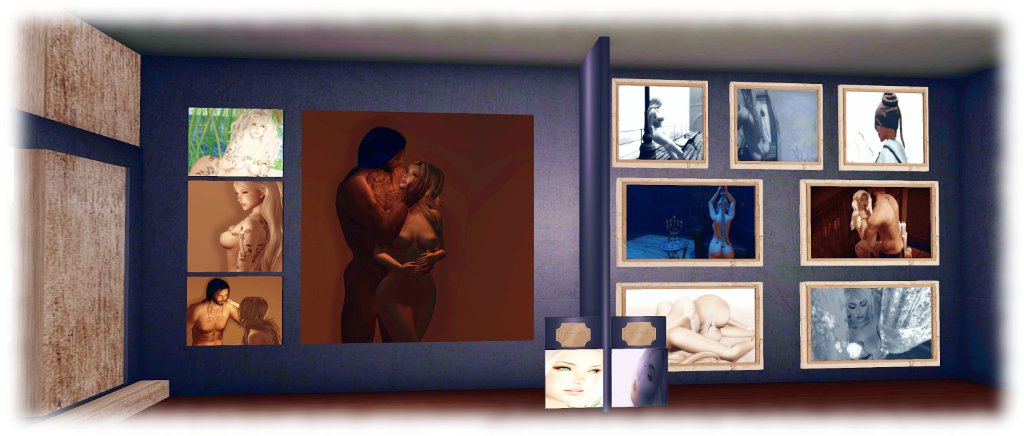
Taking place at the Club LA and Gallery, curated by Fuyuko ‘冬子’ Amano (Wintergeist), Body Talk offers a collection of 16 pieces offered in a large format. Presented as a series of monochrome images, they form an evocative study of the human form and moods – not all of them necessarily suitable for viewing at work – with equally evocative titles: Desire, Cocoon, Jeux de Mains (“Hand Games”), No Regrets, and more.
As one might expect from the title, each piece focuses on the avatar body – or a part thereof. So within the exhibition are studies of the face and head, the torso, the body as a whole, legs, arms – all of which are intended to convey a specific sentiment, mood or emotion. There is a sensuality about many of the pieces which may be obvious in some, and more subtle in others, and it appears the artist has positioned these so that their differing approaches to presenting their sensuality is carefully juxtaposed.
Take Codex and the image immediately to its left (both seen on the left side of the banner image for this review), apparently called Step by Step. In Codex, the sensuality of the piece is clear through the use of nudity the symbols on the torso and the posing of hands. In the piece to its left we are offered an image of a face partially hidden by the hood of a cloak; but what is visible – line of neck, sweep of cheek and hint of smile about the lips – offers a soft, subtle sensuality easily matching that of Codex.
The pairing of images seems to be apparent through the use of emotions – such as with No Regrets and Avec le Temps (“With Time”), or through the repeated use the a title, as with the two pieces entitled Barricade (seen directly above).
No Regrets and Avec le Temps are extraordinarily emotive, while the Barricade pair still have a sensual feel to them, but it is one perhaps mixed with other responses. The raised leg in one of them literally stands as just that, and thus is edged with a sense of confrontation. In this, it might also be paired with another piece called Step by Step, which presents a pair of booted feet, one apparently stomping downwards in a forceful stride.
Taken together, this set is an intriguing, enigmatic series, worth taking the time to visit.
“I’d been considering doing a 1920’s New York Project for a long time, wanted to make sure I had the time and resources for a project this big,” Jogi Schultz (yogijo) – “Mr. S” to the folk in his neighbourhood – told me as we emerged from the subway station into the world of New York in the mid-1920s, as modelled by his 1920s New York Project.
As we stood at the roadside, a few cars parked at the kerb, he continued, “New York City has been my favourite city since I was a kid. There is so much history here, even in the buildings themselves. And it’s so diverse in what it has to offer.”
I’d first come across the project via Annie Brightstar. Her article was enough to pique my curiosity and encourage me to hop over to take a look – and that encouraged me to contact Jogi to find out more.
1920s New York Project: the landing point, model on the Detention Hall, Ellis Island, complete with the Stairway of Separation (and the real thing, inset)
“I started back in September,” he told me as we stood chatting. “I’m doing everything by hand; none of the builds are intended for sale to others. It’s all for the project.” And by ‘everything’, he means just that: buildings, roads, sidewalks, street lamps, the elevated rail line, the ornate iron subway stair copulas – even the period cars parked at the kerb side – everything has come from Jogi’s research, and been carefully designed and constructed. “We’re at a quarter region now, and I’m just starting on the next quarter, in time the project will extend over a full.”
The work completed so far is impressive. Jogi has taken extraordinary care to recreate buildings from the period which actually existed (some of which still do today) along streets such as Pearl St and Water St in lower Manhattan. At street level, stores and boutiques line the sidewalks, with brick-faced and concrete apartment blocks rising 3, 4 or 5 stories above them, fronts often hung with the wrought iron railings and stairs of fire escapes, great ladders ready to drop to street level should they ever be needed.
Nor are these simply empty structures. “The aim here is authentic role-play,” Jogi told me. “We have around 50 rentals in total. Already all the available apartments have been rented, and the stores are filling up. When we formally open, a dress code will be in place, and visitors will be encouraged to dress the part on arriving. We’ll be requesting all open chat is kept in character, and everything else, questions and things, are kept to IM.”
As if to echo this, one of the local tenants came by, a bonnet protecting her head and hair from the cold, heavy coat falling to her knees. “afternoon Mistah S,” she greeted, with a nod and a smile to Jogi.
“Afternoon, Matilde,” Jogi replied, lifting a finger to touch the brim of his fedora in a polite salute.
Visitors to 1920’s New York Project arrive below a subway station in a large hall, on one side of which is a broad stairway leading up to the station’s platform. “It is actually modelled on the detention area at Ellis Island, New York”, Jogi told me. “And the stairs are the Stairs of Separation. When immigrants came to New York by ship, they’d arrive at Ellis island and checked. Some would be detained due to illness or other concerns, and get directed down the stairs to the detention area, where they might face deportation.”
It’s a sobering start to a visit to the project – but one not entirely out-of-context in a way. 1920s New York Project, as noted, is intended to be a period environment, and so the hall acts as a point at which arriving visitors can read the rules, understand things like the period dress code. Then, they can either pick up a suitable period outfit from the free vendors or, if they feel it is not for them, they can “deport” themselves by teleporting home or elsewhere.
Those taking the stairs up from the hall will pass by way of the station’s platform and ticket hall to street level. “Obviously, there isn’t a real subway platform connected to the Ellis Island hall,” Jogi said, “but it all seemed to fit together visually here. At street level, the station is actually a couple of blocks over from where we’re standing, but after seeing the original, I thought one would really complete the picture I was going for. In fact, I actually started the entire project with the subway.”
Jogi indicates a building across the street from the stations entrance. “That’s one of the oldest blocks in New York; still in existence today, actually. When picking an area, I really wanted something typical New York, but which offers things like a park, a waterfront, the elevated subway, and something like Fraunces Tavern and its history.”
The current build is centred on a one-block area of lower Manhattan, running from Broad Street up to Coenties Slip, and from Water Street across to Pearl Street, not far from either the East River or Battery Park. The second block, occupying a further quarter region area, is currently under construction, but even without this, the opportunities for role-play are clear. The apartments offer room for tenants to establish themselves (all who rent are aware the entire build will be re-locating in the future), while there are a number of businesses set-up specifically for the purposes of role-play.
Take the men’s barber’s shop on Water Street, for example, and remember that the 1920s were the era of Prohibition. Following the sign for the restrooms, you’ll come across a back room speakeasy, where the booze flows in secret (I’ve heard it’s run by Mr. S himself, but I cannot confirm or deny the rumour). While there, make sure you try the slot machines and games on the counter: they’re exquisitely made by Jogi, and all of them work.
“That’s one of the reasons I chose this era,” Jogi replied when I asked him about prohibition and the boom / bust cycle of the 1920s. “That, and the 1920 and 1930s have always been one of my favourite periods of history. So much changed in that time for better and for worse. New York offered so many Americans the chance at a new life.
“But the 1920’s weren’t just a decade of happy times. This city was tough, and to make it here took a lot of effort & major sacrifices. My goal is to help people learn about that, and experience it themselves.”
I wondered if the name of the environment was a reflection on a certain other recreation of the period in Second Life. Jogi laughed. “I’m a fan of the Berlin Project; always have been. It helped me realise what could be achieved in Second Life. Jo [Yardley] likes my sim and I enjoy hers. Originally, this was going to be just 1920’s New York, but that name was already taken; and since this is a project & work in progress, we added ‘Project’ to the end.”
Given all that has already been achieved,1920s New York Project is already a fascinating build and I look forward to witnessing it grow. The amount of effort already poured into it is amazing, and with all of the apartments already rented, the streets are starting to come live with local residents and characters. During our explorations, Caitlyn and I bumped into several and received a warm welcome each time. We both look forward to return trips to see how things grow.