Crumbs from nightmares in Second Life

Crumbs From My Nightmares

How do we express our nightmares? What words would we chose, what lyrics would we consider suitable? What songs or images might we regard as reflecting those dark, frightening thoughts and dreams which pass through our tangled thoughts as we sleep?

Questions like these occupied Slatan Dryke as he developed Crumbs From My Nightmares, a personal look at the dreams which can trouble his sleeping hours.
Crumbs From My Nightmares

“How could I express what a nightmare is with simple words? The breaking into the nights of unknown and disturbing elements, made visible by the Imaginary as a bearer of psychic content, free from the control of the principle of rationality?”

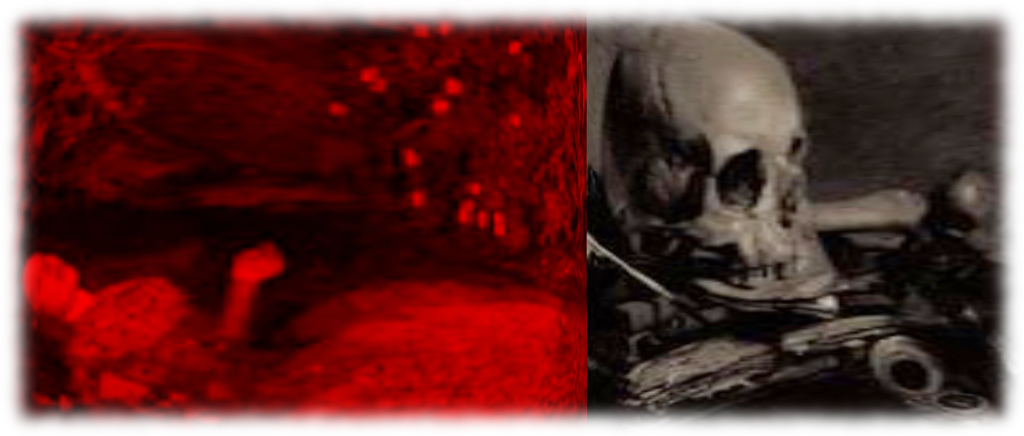
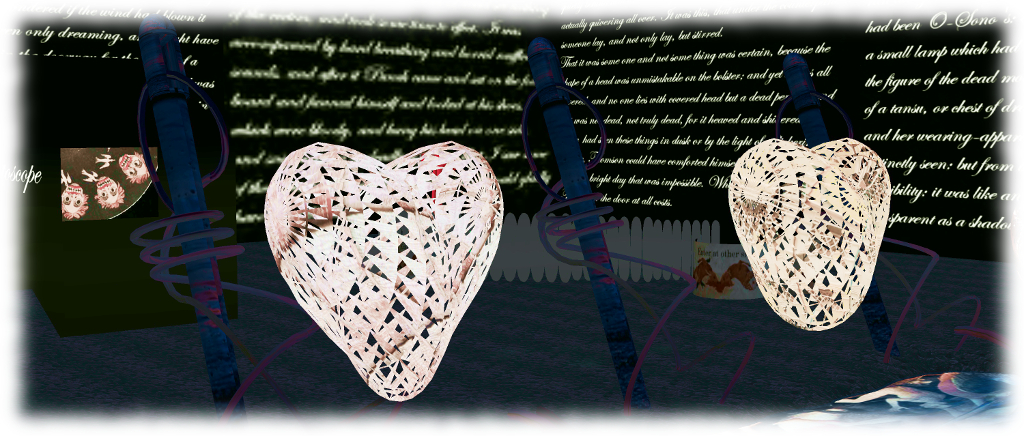
Using extracts from literature – M. R. James, Edgar Allan Poe, H. P. Lovecraft, Lafcadio Hearn and Ambrose Bierce, together with 2D images, 3D art and phenakistoscope, to present a vision from within the realm of nightmares: beasts feeding on flesh, hearts beating, words to chill the heart, bodies reposed apparently in death, ghoulish cartoon images, all held under a haunting audio scape.
Crumbs From My Nightmares

It’s a curious mixture; a rich tumbling of imagery in both form and words,  in places unsettling, in places familiar; sometimes edged in darkness, sometimes edged in the familiar or even the cartoonish. Just as we’d experience, perhaps, within a nightmare.

“The Imaginary is not real but true, messenger of a profound truth, therefore recognizable and unacceptable, Slatan continues, “The monsters represent the dark parts of the soul, in their various erotic, anxious or aggressive components. The Imaginary with its strange and disturbing images causes the turmoil that threatens the familiarity of the daily life.

Crumbs From My Nightmares

How much are our nightmares a part of us?How do they shape is, inform our natures? These questions also run through this piece, with Slatan further adding food for thought. “The perturbation as a feeling of fear and repulsion, arises from the risk of revealing the ‘ghost’ of desire and how much strong is the wish to control it. The irresistible necessity of controlling, natural in mankind, produces that protective mechanism that has enhanced the existence with monsters, vampires and ghosts, not only in dreams and nightmares.”

Crumbs From My Nightmares is an installation wherein the artist’s liner notes play an important role in helping focus thoughts and responses to all that we’re seeing in the installation. But while he may not that these may be his nightmares, many may find the symbolism here familiar, giving them pause to ponder within the framework of thought he offers.

SLurl Details

Revisiting Poetry of the Planets in Second Life

Poetry of the Planets: Uranus – The Magician

I returned to Caledonia Skytower’s Poetry of the Planets because when I first previewed it at the start of April 2017,  Jupiter and Mars had yet to open. This has now changed, with Cale recently completing both and opening them to the public, completing her “suite” of seven settings inspired by Gustav Holst’s famous suite, The Planets. Given this, and the fact that Bringer of War and Bringer of Jollity (the names of the planets were only added to the suite’s movements after their 1918 premiere) are perhaps the two most well-known pieces from the suite, a return to visit them seemed entirely appropriate.

Bringer of War, as one might expect takes us to the remnants of a campaign somewhere in the out reaches of Roman’s empire. From the landing point of the army’s camp, complete with banners and tents, visitors can follow the path down to the battlefield itself, where fires burn and the heaviness of death hangs in the air.

Poetry of the Planets: Mars, Bringer of War

It’s a setting entirely in keeping with Mars and its role as home to the Roman god of war, dark and foreboding. However, my own view of Mars is biased, being shaped by the images of Mars returned to us by the probes we’ve sent there: the winding depths of Vallis Marineris, the fractured chasms of Noctis labyrunthus, the towering peaks of the Tharsis volcanoes and the great cone of Olympus Mons. There is a grandeur to Mars as we know it today which I feel brings a new meaning to Holst’s piece; one less threatening, but more majestic than might have previously been the case. Which is not in any way to negate Cale’s vision, but rather demonstrates how our perceptions of the suite can be as much influenced by the planets as the music can influence our thinking about the planets.

Bringer of Jollity takes visitors to a marvellous crystalline maze, filled with columns reflecting and refracting light, through which a path runs, leading visitors between the columns to a set of golden steps. These in turn provide the means to climb up to a ballroom. One again, the theme of Holst’s piece is marvellously interpreted. It is not heard to image the passageways of the maze filled with the laughter of children as they chase one another up and down them, seeking whatever secrets the hallways might hide. Meanwhile, the ballroom offers a place of adult happiness among the dances – and dance itself might be said to reflect the beat and tone of the movement, with the almost eternal dance of Jupiter’s cloud system forming a backdrop.

Poetry of the Planets: Jupiter, Bringer of Jollity

Poetry of the Planets has a supporting website, and visitors to the installation are invited to submit poems, haikus and even short stories (up to a maximum of 2,000 words) inspired by one of more  of the settings, for publication on the website (authors retain the copyright on their work). Submissions can be made in-world via note card at any of the mail boxes within the installation, or directly to Cale herself.

Also, Poetry of the Panets will feature in the May 22nd instalment of Designing Worlds, and the show will be embedded in the Poetry website. The installation itself will remain open until the end of May for those wishing to visit or re-visit. As I noted in my preview, it is an inspired idea, bringing together fable, mysticism, music and words – and a wonderful means by which we can immerse ourselves in Holst’s suite.

Poetry of the Planets: Jupiter, Bringer of Jollity

SLurl Details

Kubrick and Wells in Second Life

The Kubrick Rooms

I was recently alerted to a couple of small exhibitions in Second Life with could be of interest to lovers of film and of science fiction: The Kubrick Rooms and the Wells Exhibit.

The Kubrick Rooms are the work of Rumpledink Robbiani. As the name suggests, this is something of a homage to legendary film-maker Stanley Kubrick. First opened in 2008 and available to visitors for a year thereafter, the rooms have been in limbo since then. However, Rumpledink’s friends encouraged him to bring them back in-world and he notes that this time, he hopes the money received in donations and from sales will help keep it around for longer.

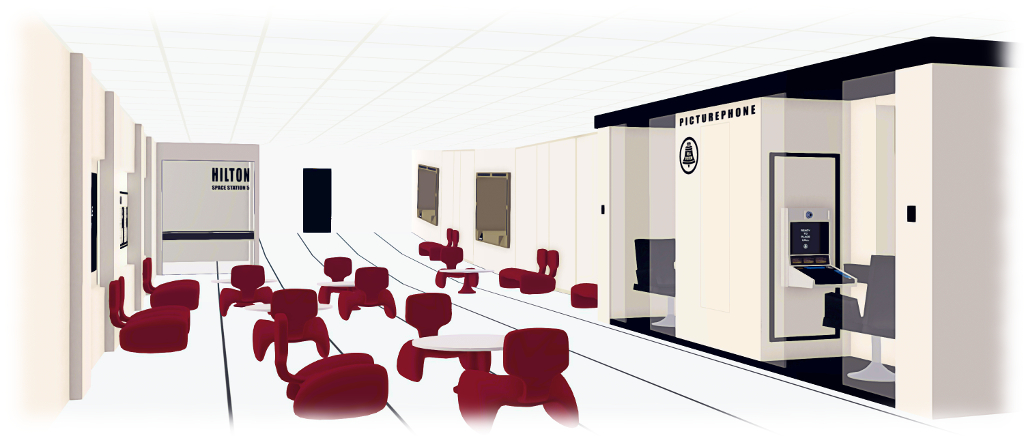
Rooms is neatly designed around three of Kubrick’s most notable films: The Shining, 2001 A Space Odyssey and A Clockwork Orange, with The Shining taking overall centre stage by providing the setting. Visitors arrive at a small anteroom where instructions are offered (set the viewer’s time to midday), together with a single door. Step through this, and a familiar – to anyone who has seen The Shining – hallway from the Overlook Hotel opens up, complete with child’s tricycle.

The Kubrick Rooms

As one would expect of a hotel, the hallway is lined in either side with room doors, some of which have their keys in the locks. They offer access to sets from The Shining – a lounge, the restrooms, the bathroom – as well as to the main rotating hallway of Space Station 5 from 2001 A Space Odyssey, where Doctor Heyward Floyd stops-over en route to the Moon and TMA-1, and another featuring A Clockwork Orange.

Within some of the rooms there are videos which delve into The Shining and 2001 – just ensure media is enabled on your viewer and click the screens as you come across them. A small cinema at one end of the hallway offers the 2014 documentary Kubrick Remembered, looking back on the great man’s life. At almost 90 minutes long, this is more than worth watching, presenting a fascinating retrospective on the man. Alongside of this is a small gift shop.

Wells Exhibit

The Wells Exhibit can be found on the floor above Netera’s Coffee Lounge in Snug Harbour, and is curated by the lounge’s owner, Netera Landar. Use the teleport door set into the wall of the lounge, the disk on the floor, or the outdoor staircase to reach it. Examining the life and works of Herbert George Wells, the English writer, this is a somewhat more modest affair than The Kubrick Rooms, designed to fit within the space provided by the upper floor of the coffee lounge.

Information boards provide biographical information on H.G. Wells while the walls are home to archive photographs of him and a note card giver listing his publications. However, the majority of the exhibit focuses on Wells’ science fiction works. There are posters celebrating The Island of Dr. Moreau (1896), The Invisible Man (1897) and The Sleeper Awakes (1910), together with small pictures dedicated to A Modern Utopia (1905) and The Shape of Things to Come (1933).  Two slightly larger displays touch upon what might be his most well-known novels: The Time Machine (1895) and The War of the Worlds (1897).

Wells Exhibit

Information on Wells’ writing is actually a little light and could perhaps benefit from two or three additional information boards. However, the Wells Exhibit still makes for an easy-going visit for those with an interest in his work. For those looking for a more unusual outing, it and The Kubrick Rooms might be just the ticket.  

SLurl Details

Summer’s colours and sensual moods in Second Life

DiXmiX Gallery: Lam Erin – Colours of the Summer

Now open at DixMix Gallery are two new exhibitions which, although not in any way intentionally paired, offer studies in the two most popular forms of Second Life photography: landscapes and avatar studies. Between them, they feature the work of Lam Erin and Tintin Tuxing.

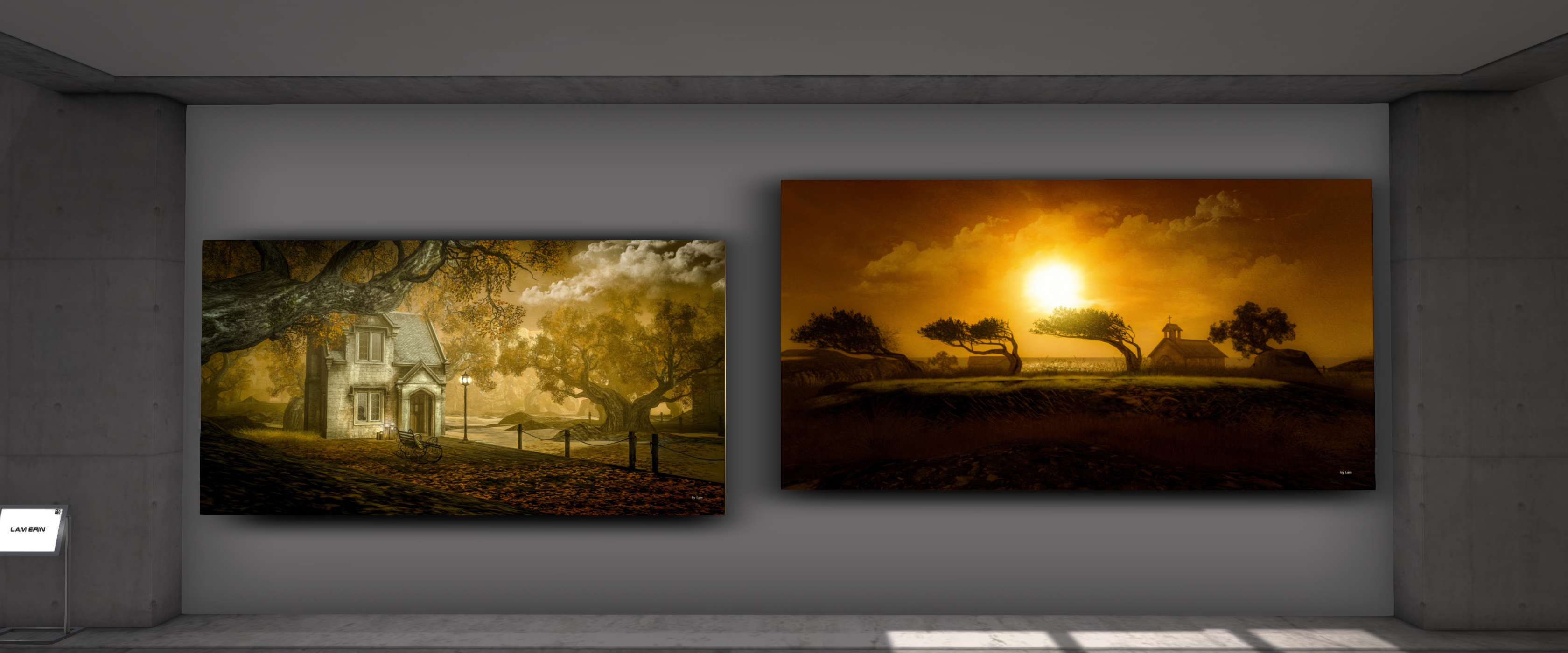
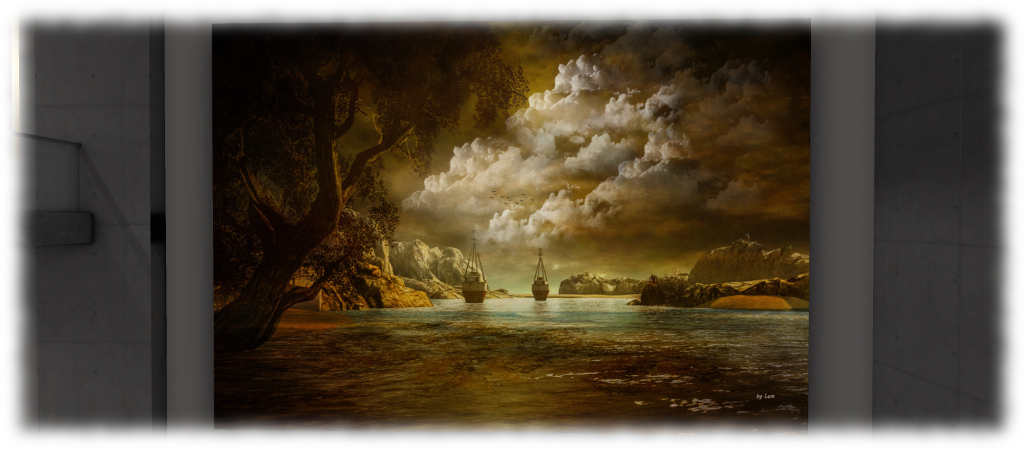
For Colours of the Summer, Lam Erin presents ten images of landscapes within Second Life, the majority of which have been tinted / enhanced with colours associated with summer – notably gold, yellow and green – but which should not be taken to be simple photographs of summer scenes. Rather, these are studied pieces, carefully processed to present a range of responses and perhaps suggest certain ideas for narratives behind them.

DiXmiX Gallery: Lam Erin – Colours of the Summer

In particular, each of the pieces is marked by a broiling, active cloudscape; a dramatic, even foreboding, cast to the skies which even in the more restful images among the ten (such as Autumn Trace and Italian Countryside) adds an edge to the picture. They serve to make us reconsider each image after we’ve first cast our eyes over them, drawing us into the narrative behind the scene presented. Sometimes this can be direct – such as the brooding sense of a rising storm in Neverfar, through to a more subtle reminder that the ship lying calmly at anchor in Bal Harbour can have a capricious mistress with the seas on which she sails.

All told, a marvellously evocative set.

DiXmiX Gallery: Tintin Tuxing – Sensual Moods

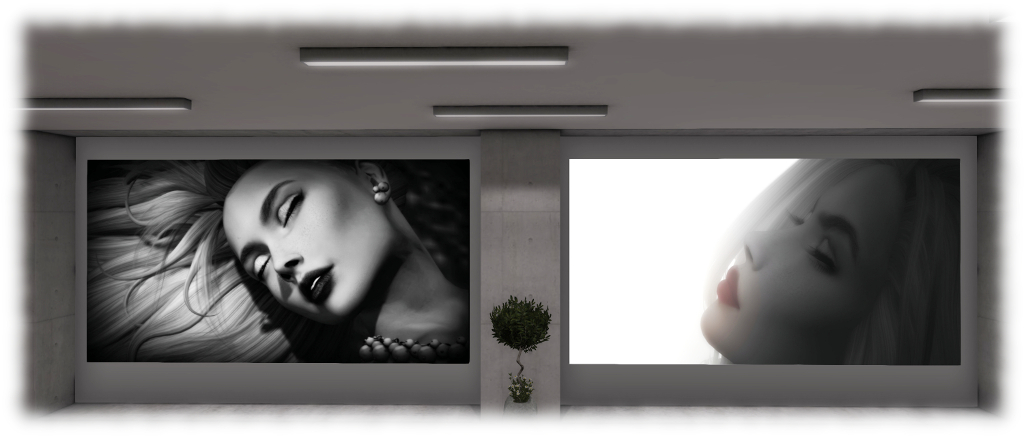
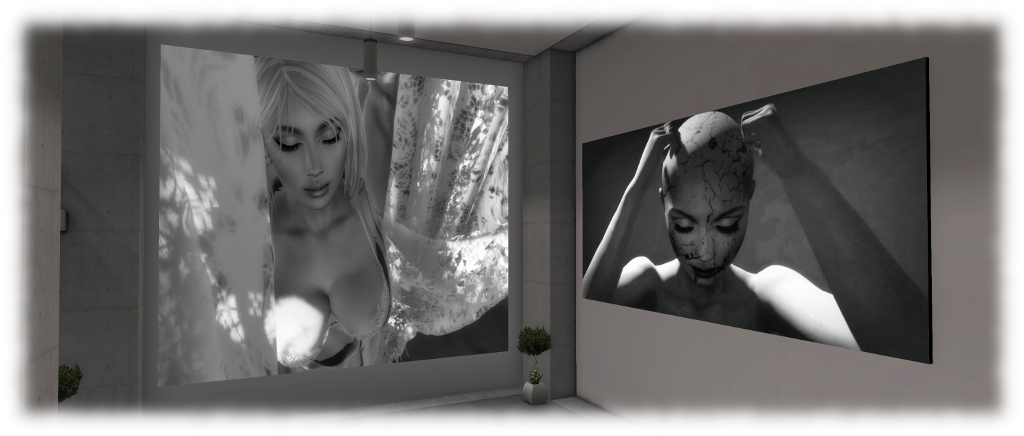
In the nine images she presents for Senusual Moods, Tintin Tuxing (Alexandrea Barbosa) takes visitors in another direction entirely: towards that of the sensuous and sensual.  Beautifully presented in monochrome (for the most part), these pictures draw us into a personal world of sensuality edged with a touch of the erotic in places.

The majority of the pieces focus on a single subject, and are both evocatively titled and posed. Six of the nine powerfully convey mood through the model’s expression alone, with one using a simple splash of colour to give draw us closer to it. These are marvellous studies which captivate the eye. Of the remaining three, I confess to finding one seemingly slightly out-of-place in that it features a couple and is posed such that a bicycle in the foreground draws and hold the attention more than the scene being played out. Perhaps intentional, it did for me break the mood evoked by the rest of the pieces. In difference to it, The Lonely Cello drew me the other way; the only one of the pieces fully  – if mutedly – in colour, it is a captivating study.

DiXmiX Gallery: Tintin Tuxing – Sensual Moods

Both Colours of The Summer and Sensual Moods are Small exhibitions in turns of the number of images displayed, but each is an engrossing display. My only grumble, which is towards the gallery, not the artists, is once again, no liner notes / biographical information is provided on the artists – or a means for them to offer their own information / thoughts on the works they are presenting.  Such notes may not be vital to an appreciation of the art on display, but can help present a clearer picture of the artists, and – as I’ve mentioned before – are hardly difficult to produce / have produced for presentation to interested visitors to the gallery.

SLurl Details

A return to The Mill in Second Life

The Mill, Pale Moonlight; Inara Pey, May 2017, on Flickr The Mill, Pale Moonlight – click any image for full size

Just as in the physical world, there are certain places in Second Life we’re drawn back to again and again. This might be because the place has special significance, or because it is held by friends or offers a opportunities or photography or simple enjoyment, or because it is like the seasons – constantly changing and renewing.

For me, The Mill encompasses all of the things, and so is a natural choice for semi-regular revisits. Designed by friends Max (Maxie Daviau) and Shakespeare (SkinnyNilla), it is an ever-evolving place, always marvellously landscaped and presented, beautifully photogenic and delightfully restful.

The Mill, Pale Moonlight; Inara Pey, May 2017, on Flickr The Mill, Pale Moonlight

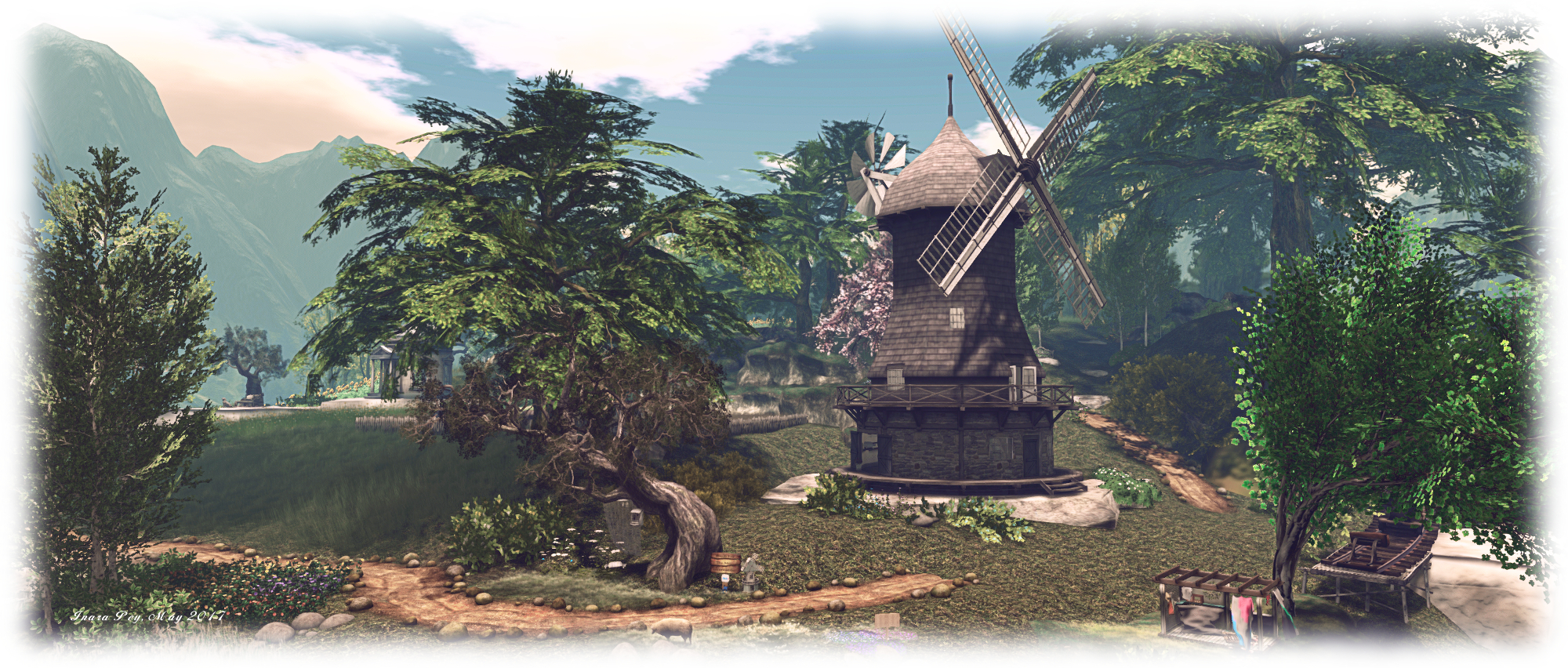
Celebrating spring and summer, this version of The Mill takes us to what might be the Apennine Mountains – perhaps, going on the style of buildings here, the Tuscan–Emilian Apennines. Surrounded by tall, rugged peaks, the rocky dome of a hill (or if you prefer, an island) rises from the waters of (again, depending on your point of view) either a lake within the mountains, or the confluences of rivers running through them.

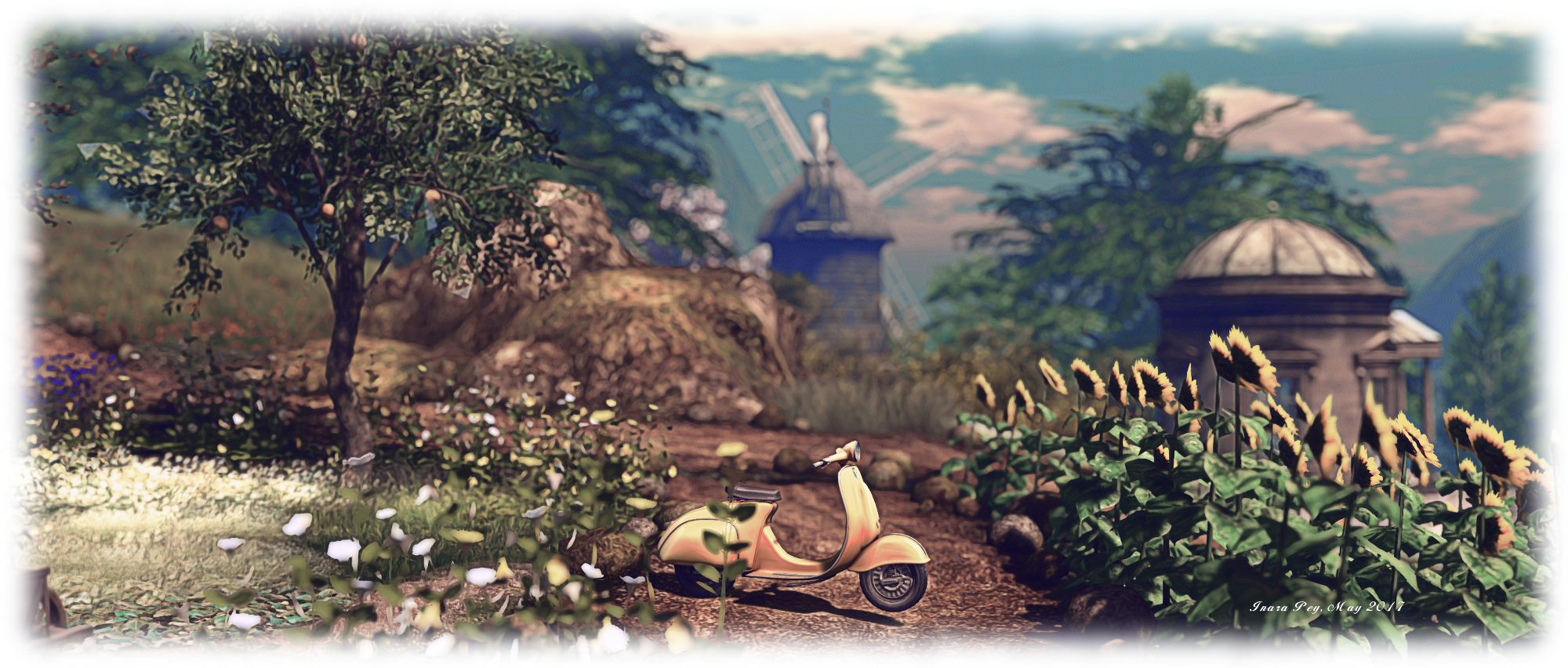
The majority of this island hill is given over to a farm where grapes and sunflowers are being cultivated. The farmhouse sits at the top of the hill, surrounded by woodland trees, wild grass and the nearest field of sunflowers. It is reached by a meandering track that slowly winds its way up the hill, passing further rows of regimented sunflowers and flat-topped outcrops of rock, content in taking its time to reach the farm, its wandering course encouraging visitors to do the same.

The Mill, Pale Moonlight; Inara Pey, May 2017, on Flickr The Mill, Pale Moonlight

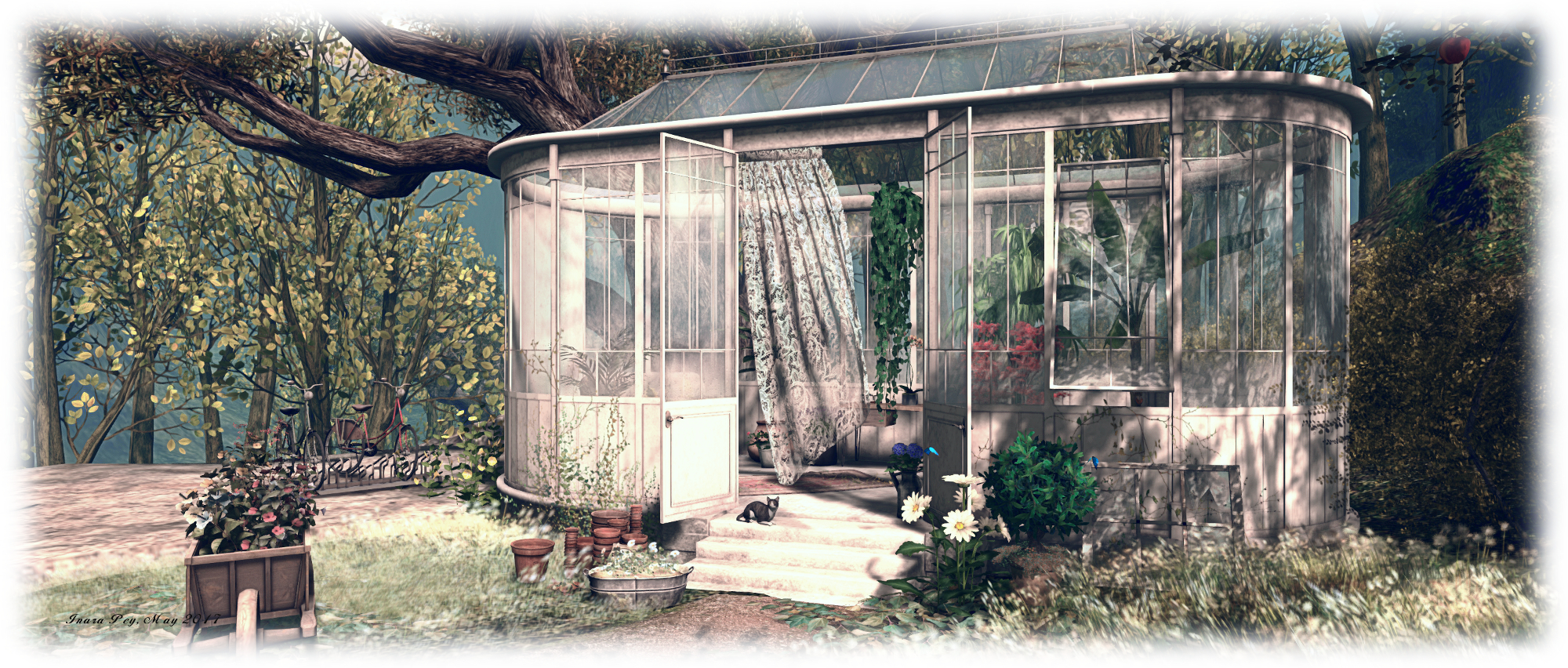
Few of the rocky tables pushing their way clear of the hill’s slope and grass are bare, Instead, each offers a point of interest – a folly, an artist’s studio, a swing beneath an aged, bent tree exerting a tenacious grip on the rock under it. Thus, each becomes a destination in its own right, filled with detail, enticing people to tarry, rather than hurrying onwards.

The track, which runs alongside the landing point, offers a fork which leads around the east shoulder of the hill to a steep slope falling away to the waters below. Here tall beech trees watch over a parade of vines already heavy with ripening grapes while a small summer-house sits close by, atop another outcrop and offering views both inland and out over the water.  On the north side of the land, the grassy slopes roll gently down towards the water’s edge, pointing to a café sitting atop a square promontory. Bracketing this and forming the shoreline, is a sandy beach to one side, and a grassy, gravelled bank on the other, connected to the track above by a terraced board walk.

The Mill, Pale Moonlight; Inara Pey, May 2017, on Flickr The Mill, Pale Moonlight

One of the things that repeatedly attracts me to The Mill is the way the landscapes designed by Shakespeare and Max are always beautifully natural. In this design, the blending of grassy slopes, woodland copses, the mix of gentle slopes and rocky outcrops and the way in which the natural contours of the hill are used for buildings and tracks, etc., is a perfect reflection of how such a place would appear in the physical world. Fenced grazing for horses is provided in a natural step in the hill, sheep wander the slopes as they wish; everything is as nature (and human needs) would intend.

There is also an attention to detail here that is exquisite, be it the inclusion of livestock and wildlife, or little touches such as the shaded beehives, the sprinkler feeding the sunflowers and all the little signs of habitation that bring the farm to life, and the little knick-knacks to be found inside the studio, folly and so on. All of this further brings The Mill wonderfully to life.

The Mill, Pale Moonlight; Inara Pey, May 2017, on Flickr The Mill, Pale Moonlight

With plenty of opportunities to simply sit and admire the landscape and enjoy the accompanying sound scape, or to wander through the long grass and between the trunks of beech, oak, pine and birch, The Mill continues to offer something for every lover of nature and much to please the eye and lens of any photographer.

SLurl Details

  • The Mill (Pale Moonlight, rated Moderate)

Dathúil: Me_You – Moon Edenbaum

Moon Edenbaum, Me_You – Dathúil Gallery

Open now at Dathúil Gallery, curated and operated by Max Butoh and Lυcy (LucyDiam0nd), is Me_You, the first in a two-part exhibition by Moon Edenbaum and Hillany Scofield.

The focus of the two exhibitions is the relationship between a man and woman, whose story arc runs from initial meeting through getting to know one another and intimacy, to separation. In this part of the exhibition, Moon Edenbaum presents his / the man’s perspective on the relationship through 13 large format pieces.

Moon Edenbaum, Me_You – Dathúil Gallery

These broadly encapsulate the core elements of the story, some with obvious clarity, others are more subtle in their approach, suggesting, rather than informing. Take the two images against the ground floor wall to the left of the gallery entrance, for example. These clearly portray an early meeting between the couple towards the start of their affair. However, the image placed in front of them offers a beautifully subtle view of their eventual separation, the cropping that cuts through her face and the complete obscuring of his speaking to them being a couple unknown to one another.

To me, what is interesting in this entire tableau is the use of language within the narrative and how the is reflected in the images. Nowhere is it stated the couple actually fall in love, rather “they become lovers”. The distinction here is important, suggesting as it does their relationship is born of little more than a physical attraction. Hence, perhaps, why the more intimate moments between them are shown purely in sexual terms.

Moon Edenbaum, Me_You – Dathúil Gallery

On the one hand, this lifts the images to an almost tragic level: the unfolding story of a relationship doomed from the outset, the players within it unable to avoid their eventual fate of separation. But on the other, it brings forth questions of perception within the relationship.  This is, after all, the relationship seen through the male eyes; so could they indicate an unwillingness on his part to engage beyond the physical? But what of the image of her with another woman? Might this indicate that it is she  – regardless of who suggested / initiated the encounter –  who is less engaged as he, and this scene has served to open his eyes to this fact?

Depending on how one views things, this particular image lifts the lid on a plethora of questions which range well beyond the simple narrative given as the exposition of the exhibit. It feeds directly into how we might interpret some of the other images in the set. For example: those of her in a white jumper, apparently trying to once again attract his attention. Are they because she earnestly wants to recover whatever intimacy they once had in the hope of taking it deeper? Or is it an attempt to overcome the growing gulf between them for what he sees as her “betrayal”?

Moon Edenbaum, Me_You – Dathúil Gallery

It will be interesting to see how the lines of thinking play out when Hillany presents her take on the relationship. This will be in June, with Moon’s interpretation of the story remaining on show through until the end of May.

SLurl Details