Relaxing in Cape Florida in Second Life

Cape Florida Lighthouse and Park; Inara Pey, June 2018, on FlickrCape Florida Lighthouse and Park – click any image for full size

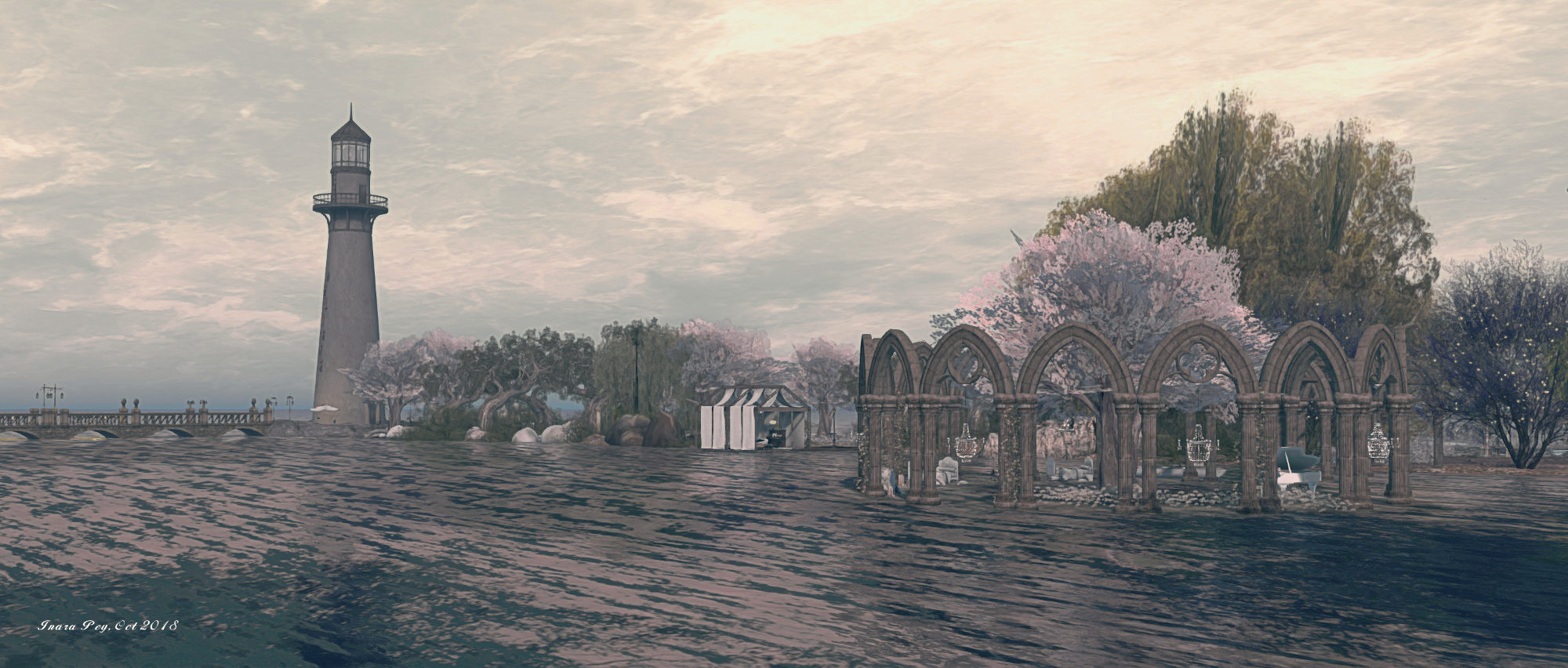
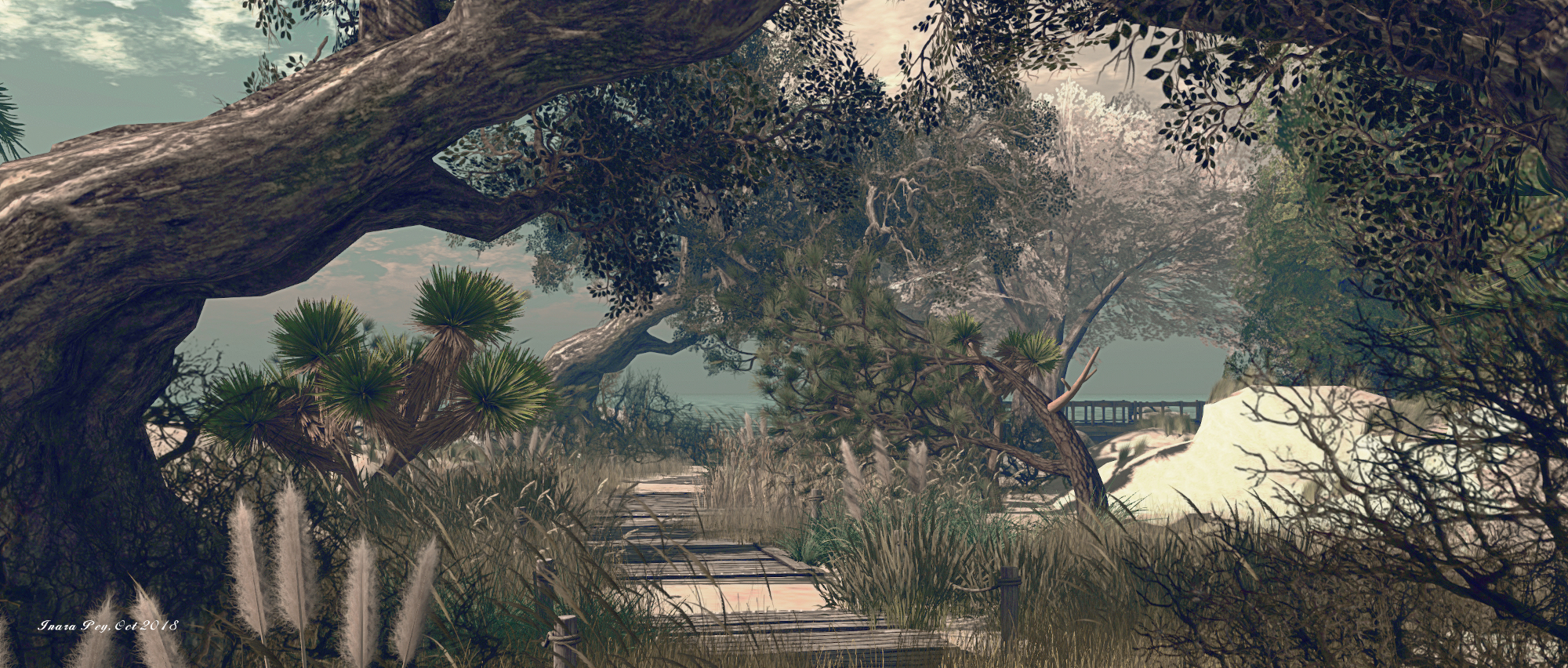
Cape Florida Lighthouse and Park is a homestead region designed by Shen Molinaro, specifically designed for people to visit, enjoy and to relax in. It offers plenty of walks, both along its sandy beaches and inland along paved paths, wooden board walks and over raised earthen trails that wind over grass and under bough. Also on the beaches and under the boughs of trees and palms, can be found places to sit or hang out along with opportunities to enjoy board games, take a bicycle ride or have a swim (look for the HUD givers as well as the rings out on the surf).

The region is somewhat modelled after the Cape Florida Light and the Bill Baggs Cape Florida State Park, at the southern end of Key Biscayne in Florida. The lighthouse has a long history, and is the oldest standing structure in Greater Miami. Today it is operated by the US Environmental Protection Agency.

Cape Florida Lighthouse and Park; Inara Pey, June 2018, on FlickrCape Florida Lighthouse and Park

I’ve no idea how well the region reflects the park, as I’ve never had the good fortune to visit the latter; but the lighthouse presents a fitting homage to its physical world namesake, and the beaches echo those from which popular photos of the lighthouse have been taken. However, accurate physical resemblance to Bill Baggs State Park isn’t important: the region stands on its own as a  place of natural SL beauty.

The beaches run along the west and north sides of the region, the northern beach becoming quite expansive before it reaches the white finger of the lighthouse topped by the black “nail” of its light. Grass grows on the undulating beaches, vying with trapped seaweed to break-up the whiteness of the sands. Rocky outcrops also break up the sands, several of which have snagged flotsam deposited by the sea during high tide; there are also numerous places to sit and watch the ebb and flow of the tide – be it on sun loungers, deck chairs or blankets.

Cape Florida Lighthouse and Park; Inara Pey, June 2018, on FlickrCape Florida Lighthouse and Park

Behind the beaches, the land rises gently – not to any great height, but enough for the sand to give way to a more solid covering of grass spread beneath the boughs of tress and palms. It is here, among the trees that the majority of the board walks and paths can be found, offering multiple routes to different destinations. The latter includes the octagonal bulk of a great greenhouse overlooking the southern coastline, the glass long gone from its heavy wooden frame, a small cabin, a partially walled terrace, a paved terrace under a triangular awning, and more besides.

To the east of the park is a tiled roof gazebo offering shade, food and refreshments, one of several decks that hug the coastline sitting below it. On one of the latter, set above the south-western tip of a beach on a rocky overlook, offers a couple of spiKKo tables for those looking to play a game. Just above one of the beaches, tucked away near the old church gate marking the way to (or from!) the paved terrace and its awning, in a chess table. A little stall can be found here as well, offering a range of fresh fruit.

Cape Florida Lighthouse and Park; Inara Pey, June 2018, on FlickrCape Florida Lighthouse and Park

The paths and board walks, with their twisting and winding and frequent intersections, help to give a feeling that the park is larger than the region on which it sits. This is further helped by the use of trees, bushes and shrubs to hide views of the coastline.

Those wishing to rez props for photography can do so by joining the region’s group. It might also be worth playing with windlight settings – I confess to flicking my viewer over to a couple sky options provided by Stevie Davos as a part of his cloud and sky series (see here for more), as I found the default windlight left me feeling a little chilly whilst exploring the region. When wandering as well, make sure you have local sounds enabled; Shen has provided a rich sound scape to fit the region and breathe further life into it.

Cape Florida Lighthouse and Park; Inara Pey, June 2018, on FlickrCape Florida Lighthouse and Park

A beautifully conceived and executed region which invites people to tarry whilst visiting.

SLurl Details

Gallery Mirror Amsterdam in Second Life

Gallery Mirror Amsterdam – Miles Cantelou

Now officially open is Gallery Mirror Amsterdam, a new arts venture in Second Life curated by Arete of Cyrene (AretevanCyrene). Occupying a homestead region, the facility comprises a primary gallery building of a modern design, with a second warehouse-like gallery facing it across a canal (and which current forms the landing point for the region). These sit with a region design resembling Amsterdam.

“The design is based on the place where my grandad grew up near the docks,” Arete explained during on of my visits. An artist living in Amsterdam herself, Arete hopes the region will become an SL arts community nexus. As well as the warehouse and main gallery build, the region includes a number of Dutch canal houses which will be made available for artists to hold exhibitions in addition to the main spaces.

Gallery Mirror Amsterdam

“The idea here is to let artists connect with each other and to promote art to visitors,” she continued. “”We have very talented people in SL.”

The opening exhibition at the main gallery features six of these talents:  Gitu Aura, Vallys Baxter, Miles Cantelou, Brysen Miller, Ada Resident and Cate Ansaldo (CateVogel).

The selection of these six reflects much of Arete’s thinking with the region and the exhibitions she plans to hold at Gallery Mirror. Rather than simply offering a space in which artists can display their art, Arete has sought to create and environment in which she can bring together artists whose visions and ideas reflect ones another in some way, within a space that in turn reflects the work of the artists.

“Miles was the first artist I invited. His acceptance led me to invite the others Arete explained. “Thematically, they work together.” As well as these six, she has been putting together a calendar, and now has commitments from artists through into 2019.

As an artist in both the physical world and SL, Arete sees her work as a curator as very much working in partnership with the artists she invites to Gallery Mirror. She provides advice and feedback on themes, the placement of images in the various display spaces within the gallery, and so on.

Gallery Mirror Amsterdam – Cate Ansaldo (CATEvogel)

The care put into Gallery Mirror is also shown in the fact that the region itself took four months to develop, including preparations for the opening exhibition.  Arete described her approach to the design thus, “I’ve designed the whole region with the thought of creative display. Art must flow; it needs air and open space so that the observer can experience the full impact of the works on display.” In this, the Amsterdam style setting offers the opportunity to display 3D art out on the waters of the canal and docks – something Arete has already taken into consideration.

The main gallery building is well-appointed in this regard. Three storeys in height, is offers large rooms with plenty of open space and good lighting in which visiting artists can display their work. It can support up to six artists at a time: two on the ground floor, which includes a lobby area with a lounge / bar area behind it. For the first exhibition, these  feature the art of Cate Vogel and Gitu Aura. On the mezzanine above is a large open area, superbly displaying Miles’ art. A second room (still awaiting the artist at the times of my visits) sits at the front of this level.

Gallery Mirror Amsterdam – Brysen Miller

The upper floor features the final two exhibition spaces – these occupied by Brysen Miller and Vallys Baxter – together with a social space. The latter was intended to be used for music events such as openings, but Arete informed me she’s now rented a parcel on another region which she plans to use for social engagements, so that the music doesn’t interrupt people’s appreciation of the art on display in the gallery.

Arete further brings the gallery to life through the use of sculptures – notably by CioTToLiNa Xue and Mistero Hifeng -, together with smaller pieces of 2D art she has selected.

Gallery Mirror Amsterdam – Vallys Baxter

Exhibitions are planned for periods of two months at a time. “I’m now working with artists on a ‘couples’ exhibition for August / September,” Arete told me.

When visiting the region, don’t confine yourself to the gallery spaces – as noted above, the surrounding dutch canal houses are available to artists, and while she is far too modest to point to it herself, I would recommend visiting the house alongside the warehouse gallery, as Arete has a small exhibition of her work on display. Also, there are 3D art to be found out on the waters already.

Gallery Mirror Amsterdam – Gitu Aura

Gallery Mirror represents a genuine commitment to support art in Second Life, and the opening event brings together six artists of unique talent in an absorbing exhibition. It is definitely not an exhibition to be missed, and this is very definitely a venue worth keeping an eye on. When visiting, please do set aside time to fully appreciate it and also, do consider making a donation towards the region’s continued existence.

SLurl Details

A Woods Club in Second Life

Woods Club; Inara Pey, June 2018, on FlickrWoods Club – click any image for full size

Woods Club is a picturesque quarter region designed by Secoia Harley Vita (Secoia Vita) and Viktor Galli, and which Shakespeare pointed us towards in late May. Ostensibly the home of a small club going by the name of the parcel, it offers a lot more to see and appreciate.

Established in 2008, the club offers music every weekend between 08:00 and 14:00 SLT, with a mix of deep tech, tech house, deep house, funky, tribal, indie dance, progressive, techno and more. It’s located on a plateau courtyard sitting with its back towards the centre of the region, with two rocky arms reaching out to the western and southern coastlines – the parcel occupying the south-western corner of the region.

Woods Club; Inara Pey, June 2018, on FlickrWoods Club

Dancing can be enjoyed both indoors and outdoors – there’s an outdoors stage to one side of the plateau, and there is also plenty of seating to be found as well. Take care when out on the cobbled terrace area, or you might trip over Clarice or Chuck Norris (a cockerel who presumably brooks no nonsense…). Steps under an ivy-wrapped arbour provide a way down off the plateau to where a colourful, if a little overgrown garden sits. This looks out over a ribbon-like pond to the sea to the west, and eastwards over a small stream running out from the pond.

Pointing the way between stream and pond is a tree-lined track, reached via a rocky incline, and which ends in the hump back of a stone bridge spanning the water. This offers the way to where a barn sits alongside a little vineyard guarded by tall cypress trees standing between it and the sea. The barn has been converted into a little wine bar, and faces a garden kitchen across tall grass growing around an old well.

Woods Club; Inara Pey, June 2018, on FlickrWoods Club

The track meanwhile, branches from the little bridge, one arm turned past the wine bar and kitchen to lead to a little fresh produce market beyond which visitors might find a little shaded picnic spot, a second facing it across the narrowing stream.  A rocky arch spans the neck of the stream, a shale beach of a little inlet, it’s mouth almost completely blocked by the rectangular forms of low boulders.

The other arm of the track runs northwards, pointing the way to another garden-like area sitting among the rocks and rugged grass, the talk finger of a windmill market its presence. Puppies and goslings share a common interest in steel tubs of water here, while old milk churns have been converted into planters. Beyond these, a swing bench under an awning of corrugated metals awaits visitors, a second, smaller pond sitting just above it. With a little care, the intrepid can make their way around the side of this pond, then over the grass and rocks, then past a painter’s little outlook to arrive back at the garden below the club.Woods Club; Inara Pey, June 2018, on FlickrWoods Club

Throughout all of this, there is a wealth of detail to find and enjoy – be it the little field of sunflowers sitting up on a headland, a wheelbarrow converted into a snug little outdoor bed next to them, or the deck chairs on the gravel beach, the rowing boat on the narrow pond, or simply appreciating just how naturally the garden areas have been brought to life. For the active, dancing can also be had down at the wine bar – but do keep an eye out for John Travolta strutting his stuff in the grass!

Woods Club is a genuine pleasure to visit, even if the weekend music selections aren’t to your taste. There are plenty of opportunities for photography, or simply to chill out and relax. Should you enjoy your visit, do please consider making a donation towards the parcel and club’s continued presence,  via the bongo drums alongside the outdoor stage.

Woods Club; Inara Pey, June 2018, on FlickrWoods Club

SLurl Details

Community Gateways in Second Life: Ajuda SL Brasil

Ajuda SL Brasil

As a community gateway, Ajuda SL Brasil (“Help SL Brazil”) has a long history. Original founded in 2009, it celebrated its ninth anniversary in May 2018, and primarily – but not exclusively – serves Portuguese speaking users. Located on a single region, the gateway has been through several different variations over the years, including a major make-over in 2011, and then acceptance into the new Community Gateway Programme beta in 2016, prior to becoming a full member of the Programme following its official relaunch.

“We are entirely self-funded as a non-profit group,” Roth Grut, the gateway’s founder,informed me. “Which, given the value of the real against the dollar, hasn’t been easy” (at the time of writing 1 BRL = 0.268 USD). He continued, “Since joining the new Community Gateway Programme, we’ve had a lot of practical support from Linden Lab in transforming our work into an official gateway programme partner.”

Ajuda SL Brasil

I can personally attest to the warmth of the greeting on arriving at Ajuda SL Brasil, with the team there both friendly and inviting, encouraging me to explore and find out more. They were also quick to guide genuine newbies to the learning centre and to help them refine  / customise their look.

The region itself is informally laid out in a design that works well in encouraging exploration. From the landing point on the south side, it’s a short, clearly marked route to the learning centrally located on the region. This presents a series of familiar self-learn lessons about the viewer and getting around in Second Life and essentials such as inventory use, etc. This area also features an auditorium, providing weekly lessons. In addition, there is an information broad displaying the Caledon Oxbridge two-week class schedule for SL-related lessons and events presented in English. Alongside this is a board offering information on other gateways and resident help groups.

Ajuda SL Brasil

Around the learning centre on the remaining three sides of the region sit, the aforementioned freebie centre, a sandbox where people can learn about building in prims and practice their skills, an events area for music and dancing, changing rooms, table-top games and various interactive elements – such as a “hydro-bike” for pedalling around on the water, a rezzing platform where people can learn to fly a helicopter. There are also some humorous little touches – such as a dollar bill innocently stuck on a manhole cover, inviting people to click on it – the result both demonstrates object / object interactions and how objects can be used to animate avatars.

“There is also a photo studio up in the sky,” Kon Magic, a gateway volunteer told me. Set out like a New York street scene, it offer people the opportunity to experiment with the viewer’s snapshot floater, using the provided poses or their own animations from inventory.

“We get an average of about 500 visitors a day,” Emma Floresby, another volunteer informed me. “Sometimes it might be 350 a day, others about 1,000.” I wondered how many of these were new arrivals as opposed to returning users.  “A lot of people come for the freebie store,” Emma told me candidly. “They account for some of the higher numbers.”

Emma continued, “While we are Brazilian and Portuguese based, we also cater for all languages, and get many non-Portuguese speakers. We try to provide a good place to welcome people and help them at basics, and also provide help and support to established users as well.”

Ajuda SL Brasil

Support is offered in a number of ways – in-world at the region itself (obviously!) and via the in-world group, Amigos Ajudam Group. There’s also the gateway’s supporting website,. This is a rich source of information for incoming new users: hints and tips, information on features and capabilities – such as Bento and mesh bodies / heads -, notes on viewers translations of SL documents such as the SL Terms and Conditions, can all be found, and those interested in joining the team can discover more about being a volunteer.

In particular, the website includes a link to a Portuguese-specific sign-up process, which will deliver incoming new users directly to the Ajuda region. While this is a capability offered to all the of the Community Gateway Programme partners, the language-specific nature of Ajuda SL Brazil’s approach helps maintain a contextual feel for incoming new users, starting in Portuguese and them delivering them (post viewer installation) to a Portuguese-speaking region.

Ajuda SL Brasil – new user sign-up

Now into its tenth year of operation, staffed by  dedicated, enthusiastic team and providing a service not just to one of SL’s larger ESL communities, but SL users in general, Ajuda SL Brasil continues to provide a valuable service to new and established users alike.

Related Links

Are you running a new Community Gateway? Want it featured in this series? Contact me in-world, or use the Contact Me form on this blog and drop me a line.

Further Dreams in Space in Second Life

Dreams in Space 2

In 2013, Sculptor Barry Richez presented Dreams In Space, an immersive arts / story environment focusing on a group of survivors who escape the poisoning of life on Earth and establish themselves as a small colony in the M51 galaxy.

Now he presents the sequel to that installation, Dreams in Space 2, currently open through until the end of June 2018. It builds on the original, utilising elements from that story – the pyramid on Earth; the (now flourishing) colony at M51. It’s a multi-level setting, commencing on the ground and moving up into the sky. It’s also, to start with, a little bit of a mystery in that visitors must find their way from the landing pint to a hidden teleporter.

Dreams in Space 2

On arrival, visitors are advised to set their time of day to midnight (if their viewer doesn’t accept the local windlight) and enable local sounds and particles. The arrival point is within the pyramid, on three of the internal walls of which scroll texts (in French), one of which focuses on the Buddhist Sutta Nipata and another from Confucius. The exit from the pyramid sits opposite the landing point, with a couple of airlocks and stairs leading to the surface.

Here one passes into the alien environment the Earth has become – a place of night and glowing plants and trees through which a path winds, passing through further airlock type doors. These offer access and egress to / from a biodome – possibly the attempt by the colonists to re-introduce flora and fauna to Earth which, as the story notes from 2013 (provided in the introductory note-card) indicate.

Dreams in Space 2

The path eventually comes to an end – but the journey is just beginning. From the end of the path, follow the red arrow and flashing lines, and with patience visitors will reach a conical structure in which sits the teleporter to the rest of the installation. This offers access to five areas:

  • City Arts – an orbital environment, in which elements of Barry’s art can be found travelling through tunnels and airlocks.
  • Gallery Alphalune Creations – a space station where more 2D and 3D art is on display. Note that to access it, you’ll need to join the local group (follow the instructions from inviter by the station’s entrance, then touch the door keypad, followed by touching the door).
  • Theatre – a retrospective of Barry’s 2015 Othello, the Moor of Venice, also know as Desdemona, Killed By A Pool Cue.
  • Flying Arts – a space offering further destinations via a second teleport, including the opportunity to fly, Inspire Space like. Note this second teleporter will also take visitors back “downstairs” through the different levels.
  • Colony – the human colony in M51, waiting to be explored.
Dreams in Space 2

With around 27 teleport destinations, 2D and 3D art elements and  experiences, Dreams In Space 2 makes for a mixed art / experiential style environment which makes for an interesting and intriguing visit.

SLurl Details

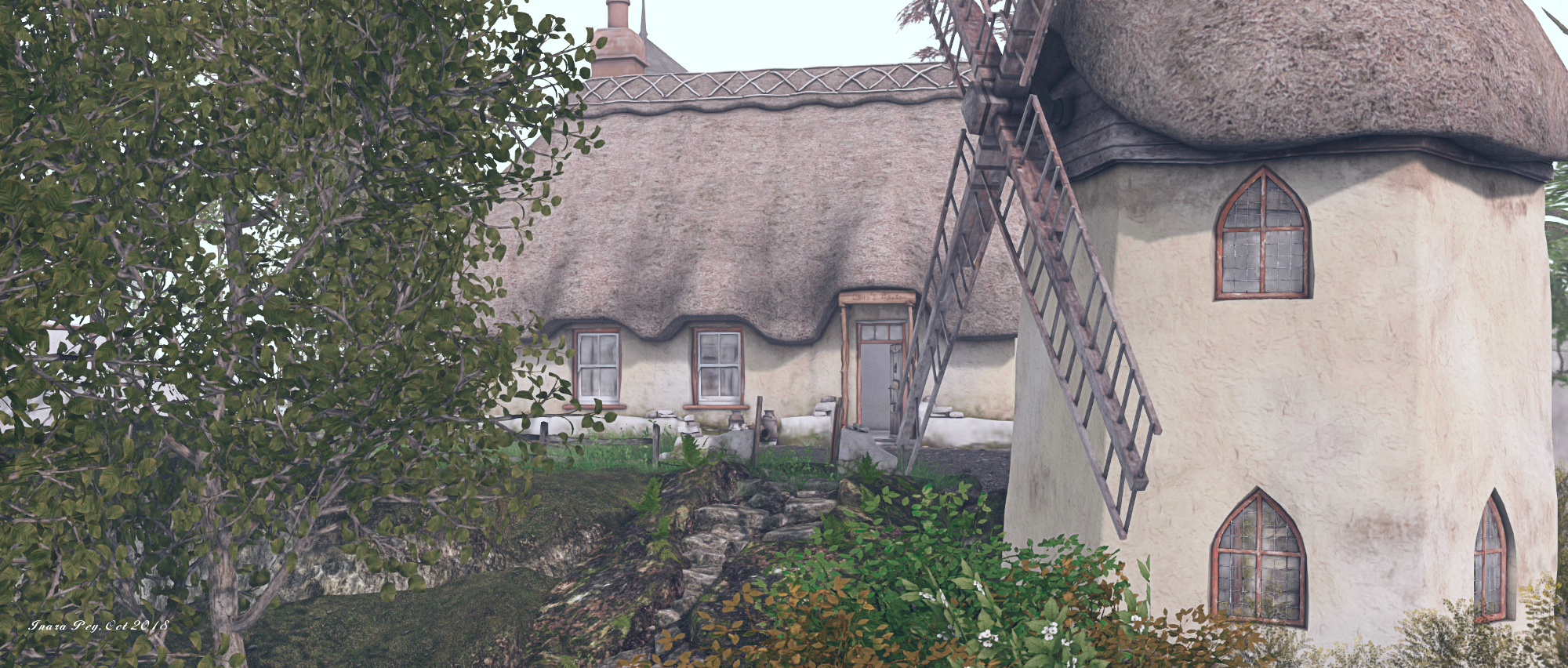
A touch of Scotland in Second Life

MindPillars, a Scottish themed Sim; Inara Pey, May 2018, on FlickrMindPillars, a Scottish themed Sim – click any image for full size

When first encountering its name, MindPillars, a Scottish Themed Sim would appear to give itself away from this title: a region with a Scottish lean in its design. However, this still leaves a number of questions open  – where in Scotland? Highlands? Lowlands? islands? When in Scotland? Modern times? Times past? These, and questions like them, demand people pay the region a visit to find out; and the truth is MindPillars has touch of Brigadoon about it, as well as a twist of Scottish legend and myth.

The landing point, while set, is not enforced. However after Caitlyn and I spent an hour exploring, I do recommend you use it, as per the SLurl above, as it will deliver you to Geata Fhoingail (Fingal’s Gate) towards the western side of the region. An arch cut through living rock, the landing point features a map of the region ( and sharing the same west-east orientation), highlighting the 30 points of interest located across the region. In this, Fingal’s Gate is appropriately named: geata fhoingail might also be translated as “foyer gate”.

MindPillars, a Scottish themed Sim; Inara Pey, May 2018, on FlickrMindPillars, a Scottish themed Sim

It worth noting that the 30 points of interest draw on a broad range of locations from physical world, myth, history and legend – and not all of them are necessarily Scottish in nature. Penn an Wlas, for example, translates as “Land’s End” – a location in England’s Cornwall.  Touching the map will present you with a series of options, including a note card, Storyteller’s HUD,  and a copy of the map of the region. Available in English and German, the HUD will attach to the top left of your screen, where it will initially remain passive.

Where you go from here is up to you – there are trails and paths winding throughout the region – although you might want to keep an eye on your location via the region co-ordinates displayed at the top of the viewer: the region joins “seamlessly” with the outlying surround – complete with paths appearing to wind off into the distance – so you can end up walking into a region boundary if you’re not careful! The effect, however, is to make the region look and feel a lot bigger – as well as give it a feeling of being in the middle of Scotland.

MindPillars, a Scottish themed Sim; Inara Pey, May 2018, on FlickrMindPillars, a Scottish themed Sim

As you explore, you’ll come across signs (and sometimes rocks) highlighting each of the 30 points of interest around the region. If you’re wearing the HUD, proximity to these signs will trigger a text chat invitation to tell you a story about the location. However, with or without the HUD, you can touch them to display a menu offering you the map, the HUD and a note card with the location’s story. Some of the signs also include a lamp labelled Public Transport Available. Touching these will either rez a donkey and cart you can ride in, or offer a choice of routes before rezzing the transport.

Setting out along the paths will reveal the setting is broadly medieval in tone – as seen in the clothing of the “locals”. As well as the village, there are a number of other buildings to explore, such as Gorm Coinneach Maineir to the south-east, or Crow’s Court in the mist, or the ruins of a castle. There are also hidden places to be found – such as in the graveyard – for those willing to follow the suggestion given in About Land to click on things. I’m just not sure that accepting a tankard of whiskey is a good idea; not if you’re planning to keep walking or want to avoid the charge of being drunk in charge of a donkey cart … or flying dragon… 🙂 .

MindPillars, a Scottish themed Sim; Inara Pey, May 2018, on FlickrMindPillars, a Scottish themed Sim

Designed by Gaelle Ravenheart (Gaelle Joubert) and Carsten Ravenheart, MindPillars is ideal for those seeking something a little different by way of region design, and a hat tip to Shakespeare for dropping me a landmark.

SLurl Details