Cica’s Sunny Day in Second Life

Cica Ghost: Sunny Day

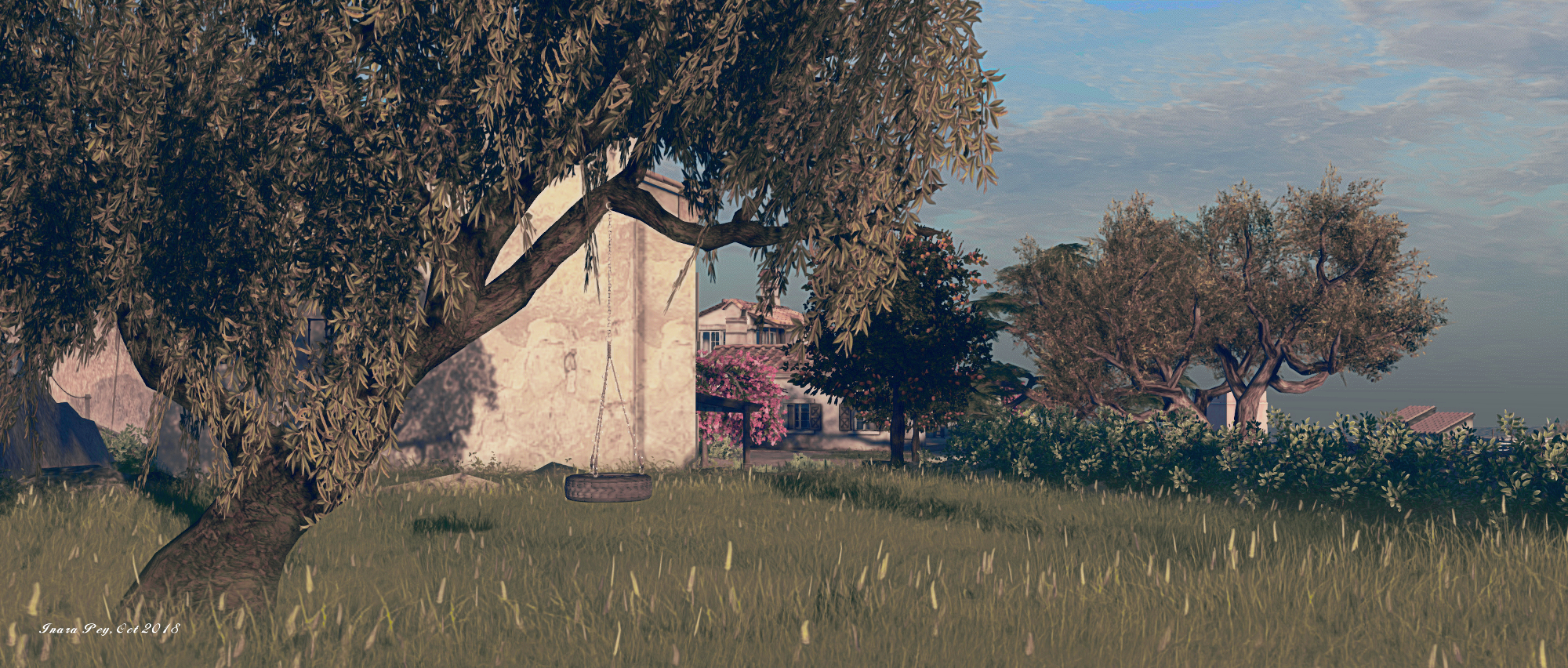
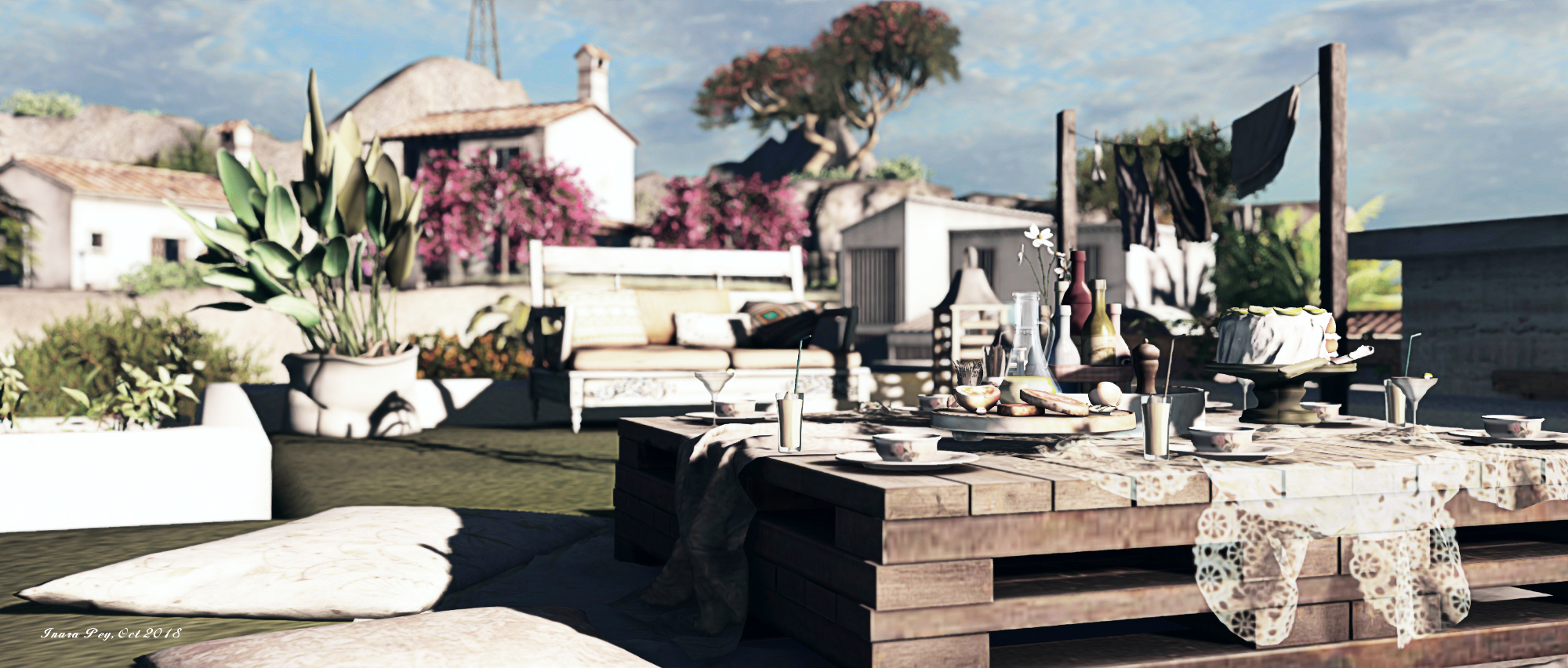
“It is the artist’s business to create sunshine when the sun fails.” So wrote Romain Rolland in La Foire sur la place (1908), the fifth book in his 10-volume novel Jean-Christophe (written between 1904 and 1912). It is the story of the life of a great German musician forced by circumstance to live in exile and it’s also the quote Cica Ghost has selected to place with her installation Sunny Day, which opened on June 9th, 2018.

“I liked the quote,” Cica says of Rolland’s words – and indeed they suit the installation admirably. This is a place that is bound to bring the sunshine of a smile to visitor’s lips and have them warmed by its whimsy and delight. But the quote also – by chance it would seem – might also reflect the broader of the theme of Jean-Christophe.

Cica Ghost: Sunny Day

From the landing point, visitors are invited along a series of offshore blocks and over a wooden walkway – beware of the great fish that seem ready to gobble the unwary should they stand on the walkway too long. On the landward side, a gateway bordered either side by flowers bids visitors to enter a little town of a most unusual kind.

This is a place where finger-like houses rise alongside lollypop trees, and the locals add their own splashes of colour as they stand outside homes or carry out duties such as tending goats, picking flowers or simply having fun. A pancake car, its shape reminiscent of a Volkswagen Beetle rolls around the single road surrounding the town while fish atop unicycle like poles rolls back and forth on large tyres. It is, in a word, a fanciful place.

Cica Ghost: Sunny Day

The whimsy continues up in the sky, where two suns pulsate with happy smiles on their faces, while towards the back of the town a giraffe awaits those who would ride upon its back, and a sea monster keeps an eye on all who come and go from the waters to the south-east.

While Cica might not always be present in person, what might be her double – albeit without her usual black dress – can be found outside the Cat Shop to the north-east. With a basset hound on a leash beside her, she invites people into the open-sided store, where Cica’s delightful cats (introduced with 50 Cats – see here for more) can be found and purchased.

Cica Ghost: Sunny Day

As noted, this is a setting that reflects the literal meaning of the Rolland quote: it is nigh-on impossible to pass through Sunny Day without feeling warmed by its light and sense of fun. As with all of Cica’s builds, be sure to mouse around, as there are several ways in which you can become a part of the setting. But how might it also reflect themes from Jean-Christophe, however accidentally?

Well, simply this: look closely at the characters scattered around the setting. There is a character with pointed ears, another is a neko. others are quite “ordinary” looking, while a white angel is easy to spot. All of them might be thought of as reflecting we, the denizens of Second Life.  And Second Life is a country  – of sorts – in which circumstance encourages us to spend time, just as circumstance (albeit it of a different flavour) forced Rolland’s protagonist, Jean-Christophe Krafft, to live his life in countries other than his own.

Cica Ghost: Sunny Day

A tenuous reflection? Perhaps – and I leave it to you to determine whether you find it valid (I’m of course overlooking Rolland’s re-examination of Beethoven’s life through Jean-Christophe) – but if you do nothing else, do make sure you visit Sunny Day and enjoy the its warmth and light.

SLurl Details

Heights of Haven boutique gallery

Heights of Haven Gallery

Heights of Haven is a newly opened boutique gallery operated by Maggie Blessing (Margaret Moleno) and Seiko Blessing (softandred) and (currently), featuring a small display of art by  Seiko and family member Micki Blessing (michellecallum) – although this might be “for the most part”, as some images are unsigned, so I’m not entirely sure on their provenance.

The images are a mix of landscapes and avatar studies on a variety of subjects, but with a degree of similarity between them; a similarity which extends to the stories they tell. This is not a criticism; taken together, the images have a familial feel to them that reflects the environment in which they are displayed.

Heights of Haven Gallery

As an exhibition space of personal art, none of the pieces on display are directly offered for sale. In an interesting touch, visitors are asked to vote on their favourite pieces. This is done by donating a minimum of L$10 via the candle burning under each picture. As the signs at the gallery explain, the five images receiving the most votes will remain on display for the following month.

This is an interesting way of raising funds to help keep the gallery active – and to help cover some of the costs involved in Seiko and Maggie’s other venture: the performing arts theatre next door to the gallery. They intend to use this to produce various shows, the début piece being Shall We Dance (opening date TBA). However, those wishing to buy any of the images displayed in the gallery can do so for a fee of L$200 per picture and by contacting either Maggie or Seiko.

Heights of Haven Gallery

Small it might be, but Heights of Haven is a nicely done “familial” style of gallery, and it’ll be interesting to see how the performing art theatre proceeds – and I’ll be pointing dance connoisseur Crap Mariner towards it :).

SLurl Details

A scene to remember in Second Life

Oboeru; Inara Pey, June 2018, on FlickrOboeru – click any image for full size

Update: Oboeru has closed. SLurl in this article have therefore been removed.

A fog horn plaintively calls in the early morning light, the Sun slowly burning through the dawn haze as it rises over the eastern horizon. Cicada song mixes with that of birds greeting the dawn and the stridulation of crickets, while in the background the dull rumble of waves breaking on a shoreline resonates through the air.

These are the sounds that greet visitors to Oboeru (“Remember” or “learn” in Japanese), a Homestead region designed by  Manis Lane and Axiom (Axiomatic Clarity). This is a place that is hauntingly romantic in its near-desolated nature; a low-slung archipelago, the main island of which has been clawed by long fingers of water, its outliers of varying sizes separated from it by channels which can be surprisingly deep.

Oboeru; Inara Pey, June 2018, on FlickrOboeru

This is a place which seems to brood under the early morning half-light; the deep mewling of the foghorn seeming to cloak the islands in an air of sadness. And yet this feeling of loneliness combines with the rugged setting with its patches of scrub grass, scatterings of copses of tall Scots pine and gatherings of shrubs and bushes, to present a place of mystery tinged with that hint of romance.

A single table of rock rises from the centre of the region, giving shape to the north-south “spine” of the main island. The single-storey building crowning this plateau calls to visitors as they arrive at the landing point, sitting on a knuckle of land to the north. Reaching the building takes a little effort – the plateau is pretty much sheer-sided, but a way up onto it can be found on the southern side

Oboeru; Inara Pey, June 2018, on FlickrOboeru

The building has the look and feel of a clubhouse; outside the front of the place is room to enjoy music and perhaps dance, while the rooms inside offer plenty of space to set on large sofas. Each room has its own bric-a-brac to set a cosily untidy setting for people to relax within; music also a theme indoors as well as outside.

There are a couple of other structures to be found in the region. To the west, and sited to offer a clear view of sunsets over the ocean, stands a tall tower of slowly rusting metal, creepers hanging from its frame as if a giant wave has at some point draped seaweed over it. Metal stairs climb two sides of the tower, offering a way up to its rusted platform, where an old sofa awaits, facing the sea under a canopy of circling gulls.

Oboeru; Inara Pey, June 2018, on FlickrOboeru

The second structure lies to the north-east, on one of the larger outlining islands. This is the ruins of a church or chapel,  windows now without glass, bushes reclaiming the space inside its walls as much as the space around it. Yet it is far from forlorn, and the stairs climbing to the flat roof offer another route up to a place where one can sit and remember or reflect…

There are numerous places to sit scattered over the landscape – from rooftop to tower to chairs amidst flowers. Board walks strike out over water, but sometimes with no direct connection to the land; but be warned, some of the channels the sit within are quite deep, as I’ve noted, so wading out to a board walk might hold a surprise.

Oboeru; Inara Pey, June 2018, on FlickrOboeru

Oboeru is an atypical region in its styling and approach. There is – as I’ve noted – something hauntingly beautiful about the entire region – the design, the windlight, the aural sound scape. Not a region to be missed.

SLurl Details

  • Oboeru (Landscape Dialog, rated: Moderate)

With thanks to Miro Colas for the pointer to Oboeru

Milly Sharple’s new fractal insanity

Fractal Insanity – The Art of Milly Sharple

Update, June 15th, 2018: I received the following from Milly – “I know I said I was staying put for a while but I ran out of space!” So, this being the case, she has relocated her gallery to Serena Montecito, where her art now resides in two buildings, rather than the single build described below. All SLurls in this article have been updated to reflect the new location. My thanks to Milly for letting me know.

I last wrote about Milly Sharple’s extraordinary art in October 2017. At that time, she had – as a result of a huge amount of support  / demand from friends – established a new gallery, after previously announcing she was retiring from Second Life art. A lot has happened since then; for one thing, her gallery of that time has since closed. Gone it may be, but the opportunity to experience Milly’s art as she would like it to be witnessed, has not.

“The old gallery never felt quite right to me,” Milly told me recently, “and I have re-opened a new version of Fractal Insanity – The Art of Milly Sharple at a new venue.”

Fractal Insanity – The Art of Milly Sharple

The new gallery, located in a sky sphere, showcases the rich diversity of Milly’s art. There is – obviously – her marvellously captivating fractal art, both static and animated.  The new gallery, with it predominant use of black and grey, brings these pieces sharply to life, the subdued wall panels and dark block walls bring out the rich depth of colour and contrast of these pieces.

Fractal Insanity – The Art of Milly Sharple – Woman With Cat – quite possibly my favourite of Milly’s pieces on display

Alongside of the fractal art, are pieces of Milly’s work in mixed media. These are also brought into vivid focus by the finish applied to the gallery building.

As much as I am a deep admirer of Milly’s Fractal art – I have to admit her mixed media work is as equally stunning – and quite possibly more enchanting. The use of colour, coupled with the almost etching-like finish to many of the pieces brings brings them to life in a remarkable way. Whether floral representations, animal studies or pieces with a more fantasy edge, or presenting an image such as a portrait through the use of fractals, these pieces are utterly captivating.

The gallery building offer two floors of display place – the ground floor and a mezzanine above. However, this is not all there is on offer, as Milly explains.

“I have closed the roof in to make more space and also added a sky sphere … There are teleporters in the gallery that go to the two extra levels.”

These teleport disks can be found on both of the lower levels of the building. At the time of my visit, the first of the upper levels – reached by teleporting to Rooftop 1 or Rooftop 2 – focused on Milly’s fractal work; the sphere above it, a selection of Milly’s animated etchings, which again should not be missed during a visit.

Finished with 3D art items, some by Milly herself and others modified by her, Fractal Insanity – The Art on Milly Sharple is a very welcome expansion of a public display of Milly’s art, and one which should be seen to be fully appreciated. One which, once seen, is liable to draw the discerning admirer of art back to it time and again. For those who enjoy their time visiting, kitty would appreciate a donation via his jar alongside the coffee machine.

Fractal Insanity – The Art of Milly Sharple

Congratulation to Milly on her new gallery – and my thanks to her for extending an invitation to visit.

SLurl Details

Looking into Devin’s Eye in Second Life

Devin's Eye; Inara Pey, June 2018, on FlickrDevin’s Eye – click any image for full size

Miro Colas recently tweeted me with a suggestion that Caitlyn and I pay a visit to Devin’s Eye, a Homestead region which recently opened in Second Life. As the name was familiar to me, we hopped over to take a look, confirming in the process that Devin’s Eye is the work of Roy Mildor and Ally Mildor (Ally Daysleeper), and represents something of a continuation of their work as we first came across it in Devin, back in January 2017, offering as a does the opportunity to visit two sim-wide locations  – one on the ground, and the other in the air. (As a point of note, Devin still exists, but appears now to be under private ownership.)

The ground level location offer a rugged island setting with offshore mountain ranges to the east and north. The landing point is located towards the centre of the island, close to a cove that cuts into the island from a narrow neck of a channel spanned by a log bridge, with a smaller and entirely land-locked body of water close by.

Devin's Eye; Inara Pey, June 2018, on FlickrDevin’s Eye

The south-eastern quarter of the region is given over to a rocky highland area, rising in steps to coastal cliffs that shelter in their landward lee, and somewhat incongruously, a motorcycle repair shop. The land before this slopes gently away towards the inland waters, largely denuded of trees but given over to growths of tough grass and shrubs, with the remnants of another barn and the bulk of a farm tractor sitting upon it.

These uplands continue northwards along the east side of the region, becoming gradually more verdant, becoming the home of grazing horses and coloured by shrubs and plants whilst offering several places visitors can sit and snuggle both on the ground and up in a wooden tower.

Devin's Eye; Inara Pey, June 2018, on FlickrDevin’s Eye

To the west and north, the rocky lowland flow around the landlocked pool and watery coves to reach sandy beaches as fir and temperate deciduous trees slowly yield to palm trees out on the sandy headlands. Bridges of various types offer ways across the different bodies of water, connecting sand with sand or to the gently rising uplands to the south.

There is much to be found here. The open nature of the landscape, largely devoid of set routes through it, encourages visitors to explore. So it is that in wandering, visitors might come across a little clearing here where the opportunity to dance is offered, or find a bubble car rezzer there, allowing them to float over the landscape from above (the usual PAGE UP/DOWN, arrow & WASD + E/C keys to rise, descend and move), whilst elsewhere might be found a little camp site or beach-side chairs might be found, or a rowing boat to cuddle on… These are just some of the many attractions  the region has to offer.

Devin's Eye; Inara Pey, June 2018, on FlickrDevin’s Eye

For the more active, there’s the opportunities to walk out along the pier to the north or go for a swim using the rings in the surf along the beaches or to ride the zip line ride running down from the southern uplands.

When taken as a whole, Devin’s Eye at the ground level can initially can come over as a curious potpourii of themes and scenes  which might in other circumstances clash one to another – the random wreckage of a plane crash, the motorcycle repair barn on its rocky shelf, the random placement of railings, the more coherent placement of fishing boat hulk and beach, together with the offshore scenes of boats at anchor, and so on. Yet the simple fact is – it all works, the different ideas and settings flowing together naturally to offer visitors something unique to enjoy.

Devin's Eye; Inara Pey, June 2018, on FlickrDevin’s Eye

The upper level of the region – referred to as Devin 2 – can be reached via a number of teleport boards scattered across the ground level setting (one most notably placed alongside the landing point), which also offer quick hops to various points at ground level.

Devin 2 is remarkably similar to its former namesake at Devin, presenting an area which might be taken as a part of the Sahel Zone of Africa, with rolling dunes, some of which are covered in a thin but tough mat of grass, scattered trees and a lone watering hole where the local wildlife – elephants, zebra, rhinos, gazelle and giraffe – come to drink and seek shade while camels troop by. Only the cheetah appear to be looking for more than a drink and a rest as they pad towards the little dazzle of zebra. For those so inclined a dune buggy rezzer is available here – but as the landscape joins almost seamlessly with a region surround, keep an eye on your direction and distance from the region’s four sides if you want to avoid collisions!

Devin's Eye; Inara Pey, June 2018, on FlickrDevin’s Eye

As with Devin, Devin’s Eye offers visitors a rich environment to explore and discover and with plenty to do. Should you enjoy your visit, please consider a donation towards the region’s continued availability as a public place.

SLurl Details

Four unique talents at the Rose Gallery

The Rose Gallery: Sisi Biedermann

The Rose Gallery, located at Kaya Angel’s stunning Angel Manor, and curated by  Shakti Sugafield (Shakti Adored) is hosting a further ensemble art exhibition across its two floors of exhibition spaces, featuring 2D and 3D work by several SL and physical world artists.

On the ground level, in Galleries 1 and 2, Sisi Biedermann presents a series of 17 images of her physical world art, the majority of which might be drawn together under the collected title of Illusions (although several of the pieces do have a title of their own). Rich in colour, all 17 are individually stunning pieces of art.

The Rose Gallery: Sisi Biedermann

Fantastical, emotive, evocative, and each with its own story to tell, these are pieces with a glorious depth and beauty. Some are presented in a “flat” traditional style of paint on paper / canvas; others are presented in an embossed, richly textured finish that is marvellously  tactile in appearance – in this, I found myself particularly drawn to Illusions 10, a simply exquisite study of two kingfishers. Some of the images present their subject matter in a fairly straightforward study, others are more abstract in tone, which one or two have an almost Bosch-like feel about them, albeit it without his darker thoughts and representations.  Any and all of them would add grace to one’s home (and are available for sale).

The Rose Gallery: Juro

Also on the ground floor, Galleries 3 and 4 offer ten pieces by digital and virtual artist Juro (JurisJo). These are quite the most stunning studies of Second Life wildlife and animals I’ve yet seen. All feature Juro’s preferred use of yellow and red within them, together with a rich processing of sky, all of which draws the eye into each image, encouraging the visitor to focus on the primary study within it whilst also adding context and depth the overall scene.

The ten pieces presented across the two halls range from the highly evocative through to the gently humorous, the mix carefully balanced so that the eye is both awed and captivated, and the lips given cause to relax and smile. Who cannot, for example find their breath catching at the sight of White Tiger or Goodnight Sun (to name but two of the more dramatic pieces), whilst also feeling the need to offer a chuckle on seeing Baja Sands or Owls (again to name but two of the lighter pieces)? Would that we had room to display all of these pieces at home.

The Rose Gallery: Juro

Take the gallery staircase up and to the right, and you’ll arrive in Gallery 7, featuring an artist whose work is entirely new to me. Matt Thomson has 20 years experience as a physical world digital artist and photographer. His work might at first glance appear to be abstract in nature.  It’s an approach Matt calls Techno Fusion, combining traditional  mediums for art – oil, watercolour, acrylics, ink – brought together as “music”, blending and mixing like the rhythm and beat of dance track. “Let your eyes have a treat,” he says of his work. “Colour is the music as it blends it dances weaves a tapestry that allows your eyes to follow the flow … enjoy the dance!”

The Rose Gallery: Matt Thomson

The rearmost gallery space on the upper floor is given over to a display of sculptures by Reycharles Resident. Mounted on plinths and along the walls, this exhibit features some 14 3D pieces of varying sizes, although their respective LODs might require you cam into some of them in order for them to render correctly.  The pieces are richly diverse: from delicate pieces that appear almost woven together, through to sold pieces which appear to have been carved from a single block.

The Rose Gallery: Reycharles Resident

For those looking for an additional  treat, Shakti offers a small selection from her personal collection of Molly Bloom’s always fascinating and eye-catching  – and perception defying – art. This includes one of my personal favourites of Molly’s work The Queen is NOT Amused, a simply marvellous triptych.

A set of four – or five, including the modest display of Molly’s art – very different displays of art, all of which are more than worth the time taken to store through the Rose Gallery’s halls.

SLurl Details