The portraits of Rofina Bronet in Second Life

Diotima Art Gallery: Rofina Bronet

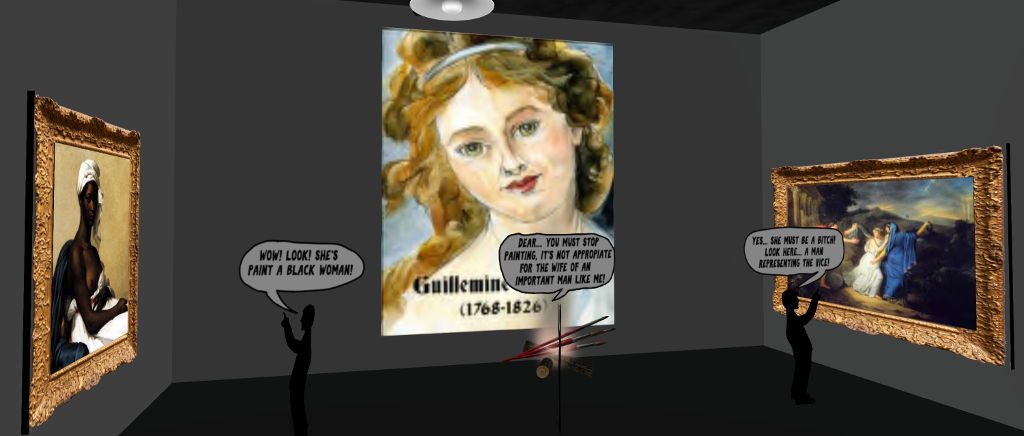
Currently open at the Diotima Art Gallery curated by Redi (Red Bikcin), is an exhibition of avatar portraiture by Rofina Bronet.

I confess that prior to receiving an invitation to view this exhibition, I was unfamiliar with Rofina’s art, and that having visited this exhibition, I find her approach to presenting avatars intriguing.

On display are eighteen portraits in a mix of colour and monochrome images that are striking in their presentation. The approach taking with each of them is to focus closely on the subject’s head, an approach that in many of the images offers a unique perspective on the individual in the picture.

Diotima Art Gallery: Rofina Bronet

At times this can be a little disconcerting in the way it gives prominence to facial features and the shape of the subject’s head. The result can be a little jarring when viewing the images, but the result is also visually striking, drawing  – challenging, even – the observer to closely study each image.

Many of the images – notably those in monochrome – offer the subject as the sole focus of the image, and have been taken in such a way that the subject is not looking at the camera. Rather, they are either looking to one side of the camera, or ignoring it completely, as if something out-of-frame has captured their attention.

Diotima Art Gallery: Rofina Bronet

This gives an added depth to the studies that is captivating. By having them appear as if they are focusing on something other than the camera, the portraits take on a unique and personal life of their own. Rather than appearing posed and framed, they come across as pictures taken in the moment; a chance event. Combined with the above-mentioned perspective carried within each image, this approach draws the observer into both studying the subject more deeply and create a narrative around that “moment in time” in which  the image seems to have been captured.

Alongside of these images are a number – notably in colour – are several in which the subject is looking at – or towards – the camera. These images are presented against a broader backdrop, one which combines with the subject to again create a narrative within the image; one that also brings the subject naturally to life.

Diotima Art Gallery: Rofina Bronet

This is a fascinating exhibition, and for me, an engaging introduction to the art of Rofina Bronet, one I enjoyed receiving.

SLurl Details

A SilentRane in Second Life

SilentRane; Inara Pey, October 2018, on FlickrSilentRane – click any image for full size

Update: SilentRane has closed, and the region is now privately held. SLurls have therefore been removed from this article.

A bell chimes forlornly against the susurration of tide over shingles and the steady beat-like passage of the wind. More distantly, an owl can be heard hooting softly, as if worried by the darkening skies, while the squeal of rodents perhaps put the teeth on edge. On the high wooden deck, its planks aged, weathered and broken, oil can bonfires add their own basso voices to the air, while a conspiracy of ravens circles ominously overhead, perhaps eyeing the wreckage around the deck and its steps suspiciously.

Such is the greeting for visitors to SilentRane, the atmospheric Homestead region designed by region holder Quinn Holsworthy (Zoey Drammond) and Bailey Button Rowman (Bailey Delwood) and presented as an “apocalyptic” setting. It’s not clear what may have happened but there is absolutely no denying the “creepy” and “Halloween” epithets appended to the region’s description are deserved, and the general state of the place does suggest some kind of event has overcome it.

SilentRane; Inara Pey, October 2018, on FlickrSilentRane

From the landing point, a raised wooden deck extends a finger out over the water and forms the bar of a shallow “T”, thanks to a short length of deck reaching for the land. Waves break against rocks and the tide clashes with itself as it rolls both towards and away from the coast.

Stepping down onto the railed board walk reveals the landing point and its derelict junk – which includes the wreck of an aeroplane lying in the water – is in fact located on a small off-shore knuckles of rock, a place suggestive of having once been a venue for entertainment.

SilentRane; Inara Pey, October 2018, on FlickrSilentRane

Once on land, the path offers a choice of routes: along a ravaged, broken path where a fire burns between a tall cement wall and a tired fence, or under a rocky arch and up into the wilds beyond, where the hooting of the owl is even louder and the sound of chimes can be caught in the wind.

The lower path leads by way of a tall copse of pine trees to and fishing wharf, suggesting this may once have been a thriving place of commerce. A large warehouse sits on the shore while fishing boats are moored at the wooden piers. However, given the ruined state of the building, and the carcasses of shark and swordfish rotting as they are suspended from lines or lie strewn on decks, it’s not unreasonable to assume this is a place perhaps now all but deserted.

SilentRane; Inara Pey, October 2018, on FlickrSilentRane

A little further around the coast, beyond more trees and a forlorn children’s playground sits a trailer park with suggestions of occupancy. A light burns, vehicles sit parked close to trailers and a flag flies from a pole. Closer inspection, however, reveals it as a place also long-deserted, the vehicles battered and bruised and nature starting to claim occupancy of the trailers and ground.

Above this, reached via the passage under the rocky arch and a walk up a winding path, sits an old fun fair and circus. These further suggest this place may have been a vacation spot, filled with the sounds of music and happiness, patrons perhaps staying in the trailers below. But those days are long gone; the big top is faded, its canvas mottled with mould;  the lights and paths of the fun fair are broken, the rides now rusting, decaying shells. What was once a place of laughter and joy now little more than a carcass itself; one edged with a little menace, given the patrons who do remain – and who tend to suggest whatever did occur here may not have been an entirely natural event…

SilentRane; Inara Pey, October 2018, on FlickrSilentRane

Set beneath an ideal windlight with the off-sim shadows of mountains suggesting this could be a place sitting on a lake in the wilds, SilentRane is hauntingly ethereal and wonderfully photogenic. A Flickr group is available to those who wish to share images of their time visiting, and should you enjoy yours, please consider a donation at the landing point so that others may also continue to enjoy SilentRane.

The art of Barry Richez in Second Life

Alphalune Creations Gallerie

Alphalune Creations Gallerie opened its doors to the public on September 29th as the new home for the art of Barry Richez.

A long-time resident of Second Life, Barry is well-known for both his 2D and 3D art and his forward, future-thinking outlook. The new gallery space combines all of these in an environment that reflects Barry’s futuristic outlook and offers a unique setting for both his 3D and 3D artwork.

Alphalune Creations Gallerie

Located in the sky, the gallery is a place of two halves. Contained within a skybox with a cityscape backdrop that suggests it exists within a modern setting, it offers a central arrival point bordered by the gallery buildings proper: primarily 2D art to one side, and primarily 3D sculptures on the other, each unit comprising multiple levels.

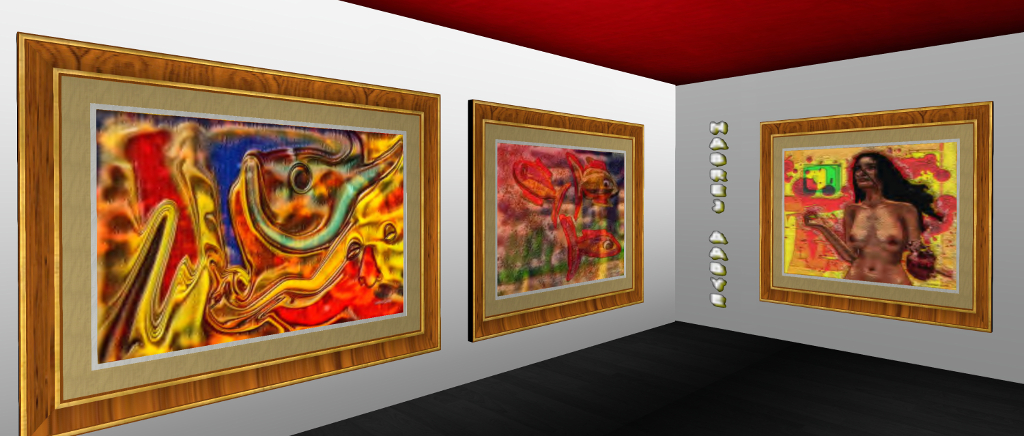
The 2D gallery presents Barry’s digital paintings, beautiful fractal pieces so intricate in form and design, they might so easily be mistaken for photographs of physical 3D objects presented against velvet backdrops. Others appear more abstract in nature, swirls and dishes, curls and splashes; images that through their very abstract form are suggestive of dense nebulae – albeit, perhaps, without the familiar depth of colour as the pieces here tend to focus on fairly fixed palettes, although this in no way detracts from their beauty.

Alphalune Creations Gallerie

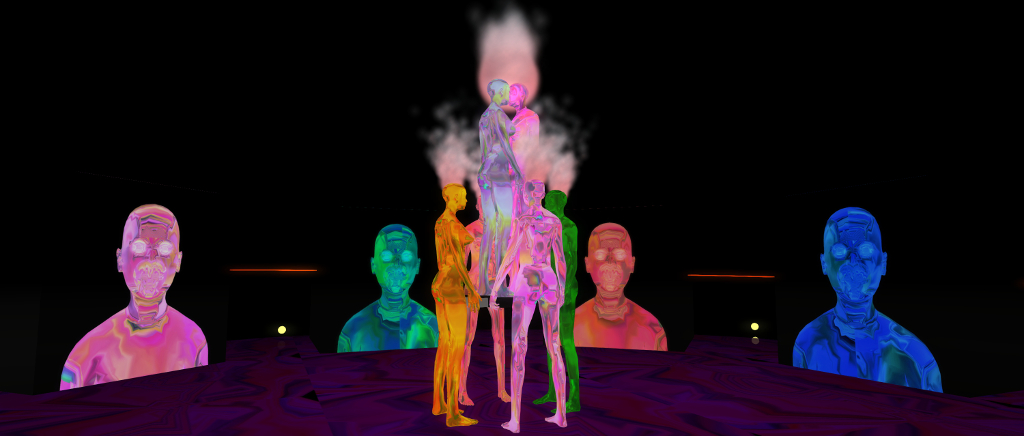
The 3D section offers a rich mix of Barry’s sculptures, most with its own story to tell. Movement between the levels is achieved by teleport disks (the 2D gallery space offering stairs as well), and the art structured in such a way that some levels are almost a mini-gallery of itself – particularly where the 3D work shares space with more of Barry’s fractal images. At the same time, one of the levels forms an installation in is own right, a rich blending of colour and animated pieces surrounding a sculpture Barry first presented at the University of Western Australia in Second Life.

In this latter regard, the gallery also offers a mini-retrospective of Barry work: those familiar with his past presentations will doubtless recognise some of the sculptures and designs presented here.

Alphalune Creations Gallerie

Considered, balanced and visually captivating, Alphalune Creations Gallerie offers the perfect insight into the art of Barry Richez, and should be a destination for all lovers of art in Second Life.

SLurl Details

Deadpool Reborn in Second Life

Deadpool Reborn; Inara Pey, September 2018, on FlickrDeadpool Reborn – click any image for full size

Earlier in September 2018, Megan Prumier posted images of Deadpool Reborn, with a note that the design she and Xjetx Chrome first opened back in 2013 (and about which you can read about here) would soon be opening. I’d al but forgotten seeing the notice, but fortunately, Shakespeare dropped me the new landmark.

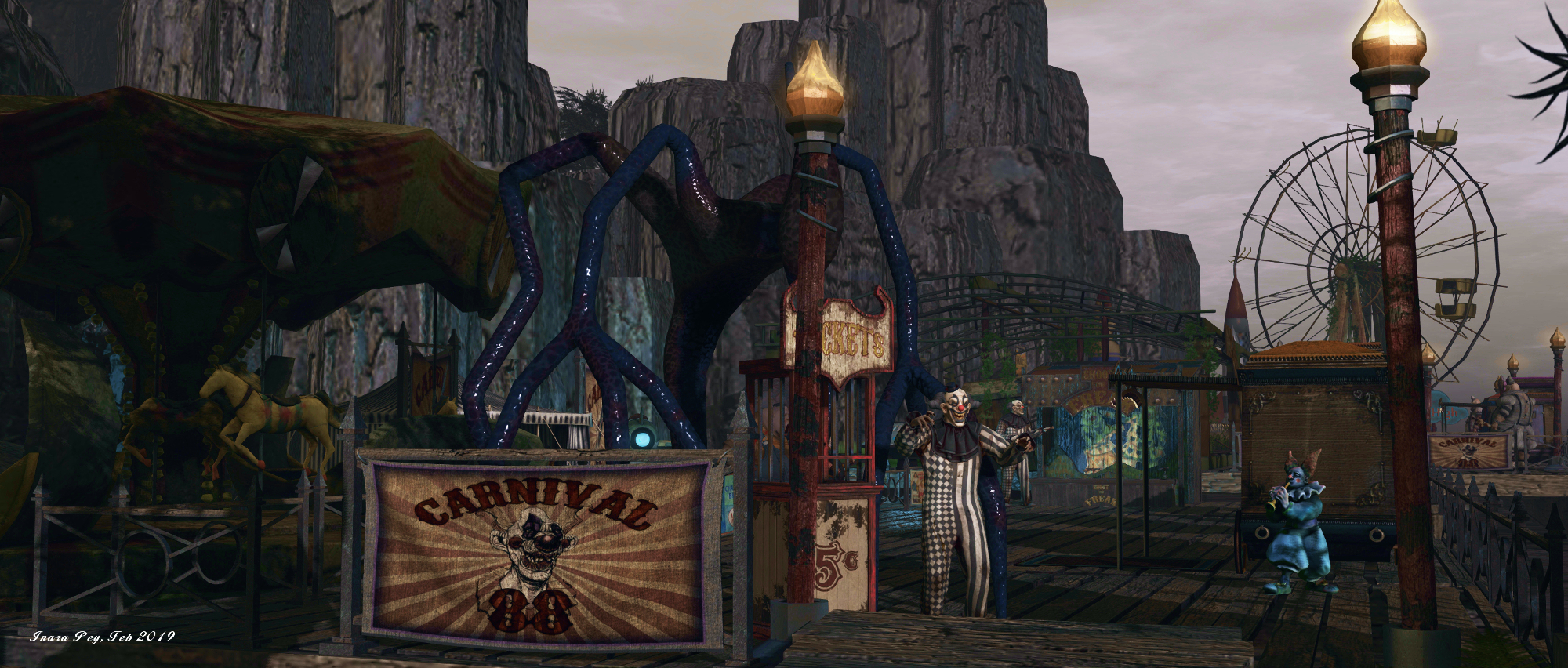
Like the original, Deadpool Reborn is in part focused on a run-down carnival that is not quite all it seems. For those who remember the original, there are several elements here that should ring the bells of memory: the great red Ferris wheel, the broken roller coaster and so on. However, as something I don’t recall from the original, the carcass of a city sits beyond the boundary of the carnival, adding its own ominous air to the setting.

Deadpool Reborn; Inara Pey, September 2018, on FlickrDeadpool Reborn

This is not a place for enjoying all the fun of the fair or holidaying in the city; again like its namesake, Deadpool Reborn is – for those so inclined – about hunting clowns and zombies as they wander the streets. To assist in this, weapons can be obtained from a large case just outside of the carnival grounds, alongside the landing point.

Within the fairgrounds, the decaying rides offer both atmosphere and backdrop for photography, while the clowns and scurrying mechanical spiders with their broken doll heads present an obviously malevolent edge to things – although they are by no means alone.

Deadpool Reborn; Inara Pey, September 2018, on FlickrDeadpool Reborn

A stage area sits to one side of the carnival’s cracked asphalt, a board revealing it is a place of entertainment and given the season that’s approaching it will no doubt some Halloween themed parties to come. Nor are the sideshows entire static as well; for those willing to explore, there is a little non-zombie killing fun to be had, in a slightly macabre manner.

In terms of the city, one can only guess at what may have befallen it; natural disaster, plague or some terrible experiment gone wrong. Whatever it was shows signs have having struck fast, and was certainly enough to bring down one elevated road with traffic still upon it; but it did not happen recently. The streets are now well overgrown; the building shattered and slowly falling apart – and yet, oddly, there is still power available to light street lamps and lurid neon signs.

Deadpool Reborn; Inara Pey, September 2018, on FlickrDeadpool Reborn

As noted above, this is the place where the clowns and zombies roam for those who fancy going hunting – although I confess that, after Hell’s Crossing, the zombies here are pretty tame, both easy to locate and easy to dispatch, either with the supplied weapons or your own. This tends to limit the appeal the region might have as a shoot-em-up.

The carnival isn’t the only echo of past builds; within the city are elements reflecting another of Megan’s designs: A Little Bit of Soul. While this is now gone from Second Life, you can read about it here, and recapture aspects of it in the split-level design of Deadpool Reborn’s city, notably the overgrown motel building, and the nearby backstreet market area.

Deadpool Reborn; Inara Pey, September 2018, on FlickrDeadpool Reborn

Which is not to say this area of the region is merely derivative: there is enough here to make it unique in its own right, and offer plenty of opportunity for photography. There’s also some nice touches in menace through the positioning of static NPCs (look up for some of them).

So, if you’re looking for somewhere a little more unusual to explore, why not celebrate Deadpool Reborn? When doing so – keep an eye out for the cavern system!

Deadpool Reborn; Inara Pey, September 2018, on FlickrDeadpool Reborn

SLurl Details

Four kilometres of art in Second Life

DC Spensley Retrospective

Despite receiving an e-mail invitation, I regret I was unable to attend the official opening of David “DC” Spensley’s towering – in a literal sense – art retrospective on September 22nd, 2018. However, as soon as time allowed, I did take the opportunity to jump over and immerse myself within it.

Known in-world as Dancoyote Antonelli, DC is one of the pioneers of visual arts in virtual worlds, working independently and in collaboration with other early pioneers to create 3D art that were considered ground-breaking at the time. In the United States, his work has been referenced in mainstream press, including The New York Times, Reuters, Step by Step Design, and Fibreculture Journal.

In 2006, DC also founded the world’s first virtual, aerial dance company – the ZEROG SkyDancers. On seeing the troupe perform, former Linden Lab alumni John “Pathfinder” Lester compared their work as genre-expanding as the Cirque Du Soleil. More recently, in 2014, DC and the ZEROG Skydancers again pushed the boundaries of performance art and dance, with Avant Garden. This mixed reality performance featured dancer Kathleen Moore performing on stage at the Little Boxes Theatre in San Francisco, a rear protection screen allowing her to interact with the troupe as they performed within Second Life.

Kathleen Moore performs on stage at the Little Boxes Theatre in San Francisco, August 2014, interacting with members of the ZEROG Skydancers performing in Second Life.

For this retrospective, DC presents many elements of his work (and notable elements by other artists) in which is likely to be the tallest structure yet built within Second Life: rising 4,000 metres from its water level base, the Tower of Light. The art is presented on a total of 40 levels extending from the tower, with a number being interactive either by touch (control panels and media boards) or physical avatar collision. Information plinths are placed on each level to deliver contextual notes and insights on each of the elements being presented, making this an informative, as well as visual installation.

Movement between the levels is achieved via a teleport HUD available from the landing point, or by sitting on a tour cushion,. The latter also allows for direct transfer to a desired level within the two (by means of a smooth vertical ascent rather than a TP), or can take riders on a “grand tour”, visiting each of the levels in turn. All three option are valid means of travel, delivering the visitor to each level alongside its associated information plinth, although I enjoyed the “grand tour” the most.

DC Spensley Retrospective

In a considered touch, the “tour cushions” will not simply poof should a visitor stand at any given level. Instead, they remain rezzed for long enough to get up, inspect the art, try any supplied controls or watching any associated video (if trying them / watching while seated proves inconvenient) before sitting once more in order to resume a journey to other levels.

Exploring the Tower of light is also both an exploration of DC’s thinking and his approach to art and of something of the history of visual arts in SL as a whole – although it should be noted this is not a chronological journey through DC’s art. Rather it is a thematic voyage, enfolding within it his concept of “hyperformalism”, exploring the nature of “native” art produced within a virtual world.

Rather, the historical aspect is born out of the majority of these pieces either being created before the advent of true mesh capabilities in Second Life, or which eschew the use of mesh in keeping with the aim of hyperformalism. Thus, these are primitive art, a term I use in reflection of their construction, not as a suggestion of any lack of sophistication they might otherwise contain; rather the reverse in fact: the nature of primitives actually requires these pieces to be sophisticated in design and scripting (and examples of all the scripts can be found in the relevant information note cards provided by DC).

DC Spensley Retrospective

It is also the information cards that offer insight into DC’s thinking and ideas around hyperformalism, with some also acting as a glimpse of part of the platform’s history. Of those who, like me, have been active in SL for the last decade, some of the names mentioned are liable to set memories tumbling: Qarl Fizz, Dekka Raymaker (who only returned to SL in August 2017 after a 6-year hiatus), and Nomasha Syaka to name but three (Nomasha’s sculpted horse was a decorative mainstay in many of my early SL homes, and is still to be found within the Library section of inventory).

When visiting, I would suggest allowing sufficient time to visit all 40 levels within the Tower, rather than breaking a tour up over two or more visits, as this offers the fullest potential to appreciate both the art and the concepts involved in DC’s work.  And as a purely subjective opinion, I would suggest using the viewer’s default midnight setting when travelling through the installation. This removes the distraction of the surrounding clouds, and more particularly adds a tangible depth to the colours within the Tower and the art it presents, giving a greater sense of presence whilst touring.

DC Spensley Retrospective

SLurl Details

Frog Hollow: a garden of delight in Second Life

Frog Hollow; Inara Pey, September 2018, on FlickrFrog Hollow – click any image for full size

Note: Frog Hollow has closed and Stella has created Winter’s Hollow – read here for more. Because it has closed, I’ve removed the SLurl reference from this review.

Frog Hollow, occupying the north-east corner of the Full region Blue Nile, is a 8176 sq m parcel that has been exquisitely landscaped by Stella Mahogany and offered to the public as a place of exploration and rest. It is also another shining example of why a full-sized region (Full or homestead) isn’t required to create something special and personal in-world.

Bounded on three sides by tall cliffs, Frog Hollow has a nice – but not overpowering – feeling of an enclosed garden, a personal space to be enjoyed without due worry about others looking in. To the west, it faces open water, where a wooden deck sits as the landing point for visitors. Lily pads below the decking offer a place for frogs to hop as lanterns drift on a slow breeze overhead.

Frog Hollow; Inara Pey, September 2018, on FlickrFrog Hollow

A single trail leads inland from here, winding between banks of wild flowers and the trunks of silver birch whose leaves are turning golden in reflection of of the changing of the seasons in the northern hemisphere. Fallow deer are to be seen among the tree trunks, and further inland, wander along the looping path or curiously exploring the spaces available for visitors to enjoy.

The largest of these spaces can be reached a short way among the path, where a little bridge branches away to arch over a dry steam bed and arrive at a set of gabled gates. Beyond these is a large brick-and-glass pavilion (another superb design from Cory Edo, for whose work I have a particular fondness).  This is presented as a romantic, magical place. An old grand piano sits at its centre, sheets of music floating and tumbling magically above it as if Harry Potter has recently been by in a playful mood. Cats play under the piano’s lee, and close by a painting, easel and paints await the return of their artist.

Frog Hollow; Inara Pey, September 2018, on FlickrFrog Hollow

To one side of this pavilion sits a small terrace, itself bordered by vines turning to gold, home to a setting for afternoon tea. A further befountained terrace lies to the pavilion’s rear, a paved path winding into the trees beyond. Also reached by a grassy path passing under a Rowan arch and alongside another snug little seating area with cosy bric-a-brac, the paved path leads to yet another patio, marked by a smaller, curtained pavilion presenting a place of rest and comfort.

Whilst all relatively close to one another, these little spots have been designed with considerable care; an eye for the considered use of space and for studied design ensuring that they do not feel clustered one atop the next, whilst also allowing each of them to have its own unique nature.

Frog Hollow; Inara Pey, September 2018, on FlickrFrog Hollow

Nor is this all; facing the front of the pavilion is a further paved area, complete with open fireplace and neatly set out for a formal meal as delicate little lanterns float overhead.

Should you opt not to cross the little bridge into the brick pavilion’s domain but instead follow the path onwards, it will carry you under bough and around twist and turn to a second bridge, and a further enchanted area. Here a chandelier hands from a stout tree branch, and a giant game of chess is set before comfortable armchairs, watched over by more fallow deer even as the trail winds onwards through an old metal gate – and arrives at the brick pavilion.

Frog Hollow; Inara Pey, September 2018, on FlickrFrog Hollow

In this the further genius of Stella’s design is revealed: no matter which route you take when following the path, it will take you through the garden to reveal all the major points of interest before looping you back the to landing point. Along the way you’ll pass many places where you can sit and talk and / or cuddle, engage in a game of chess, listen to, or play, a piano, observe the local fauna – and simply appreciate the beauty of Frog Hollow and Stella’s creative skill and eye for detail. And keep in mind that there are a lot of little touches to be found throughout I’ve not mentioned here (just observe the little pumpkin at the landing point for a couple of minutes, and you’ll see what I mean).

Magical and marvellous, Frog Hollow is a true delight – but it will apparently only be around as long as the leaves are falling. So don’t miss the opportunity to visit and share in the enchantment.

Frog Hollow; Inara Pey, September 2018, on FlickrFrog Hollow