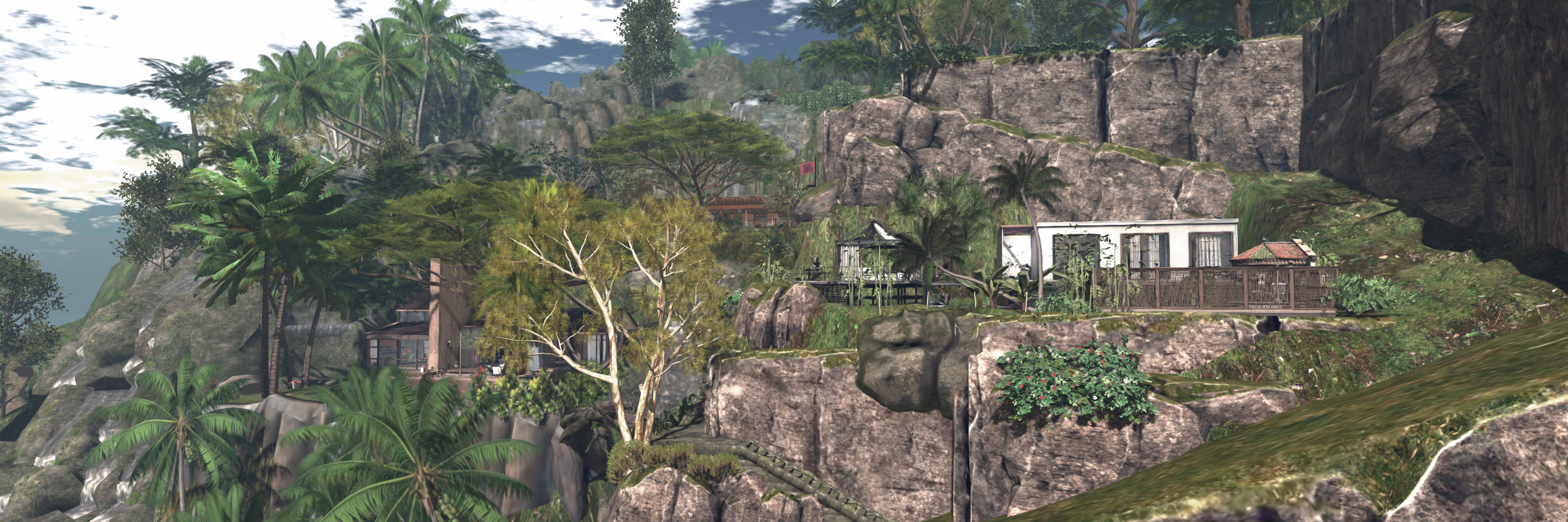
A further day at Sol Farm in Second Life

Sol Farm; Inara Pey, February 2019, on FlickrSol Farm – click any image for full size

In looking back through my notes on regions visited in these pages, I came across Sol Farm, a place we first visited just over two years ago (see A Day at Sol Farm in Second Life) but had failed to return to in the intervening time. So I suggested to Caitlyn we hop over and take a look at what may have changed over the past 25 months.

During our first visit to this Full region, designed by Show Masala that utilises the additional 10K Land Capacity option available to private regions, I noted it to be:

A largely rural setting, centred around Sol Farm, complete with thatched farmhouse, fields of crops and livestock, outbuildings, and many of the mechanical accoutrements of a working farm. However, there is much more here than may at first be apparent.

Sol Farm; Inara Pey, February 2019, on FlickrSol Farm

This is still very much the case. In fact, on first arrival, I wondered if anything had changed since our original visit or if the region had settled into one of those wonderful places that, rather than offering new looks to entice visits and exploration, instead preserve its original look and feel, making it an attractive and familiar place to re-visit,  where memories can be re-awoken be familiar sights.

For example, the thatched farmhouse with its fields are still there, sun-ripened crops looking ready for harvesting. Also still in evidence is the Mediterranean villa to the south of the farm, complete with its suggestion that it is perhaps a holiday home; while off to the west from the landing point the familiar Ferris wheel of an old fun fair breaks the horizon, as does the rocky knob topped by a lighthouse and pavilion.

Sol Farm; Inara Pey, February 2019, on FlickrSol Farm

But first looks can be a little deceiving: Sol Farm has changed over the intervening time. Thus, for those both new to the region or those who have perhaps visited it in the past but have not returned of late, it makes for an engaging and in places a quirky visit, with much to occupy the eye and camera.

The quirkiness can immediately be evidenced when using the SLurl given in this article. When looking west from the landing point in provides, it is hard to miss the blue whale serenely and slowly circling through the air over the farm, a small wild garden apparently growing on its back (and on in which you can ride for an aerial view of the region). But it is not the only twist to this setting.

Sol Farm; Inara Pey, February 2019, on FlickrSol Farm

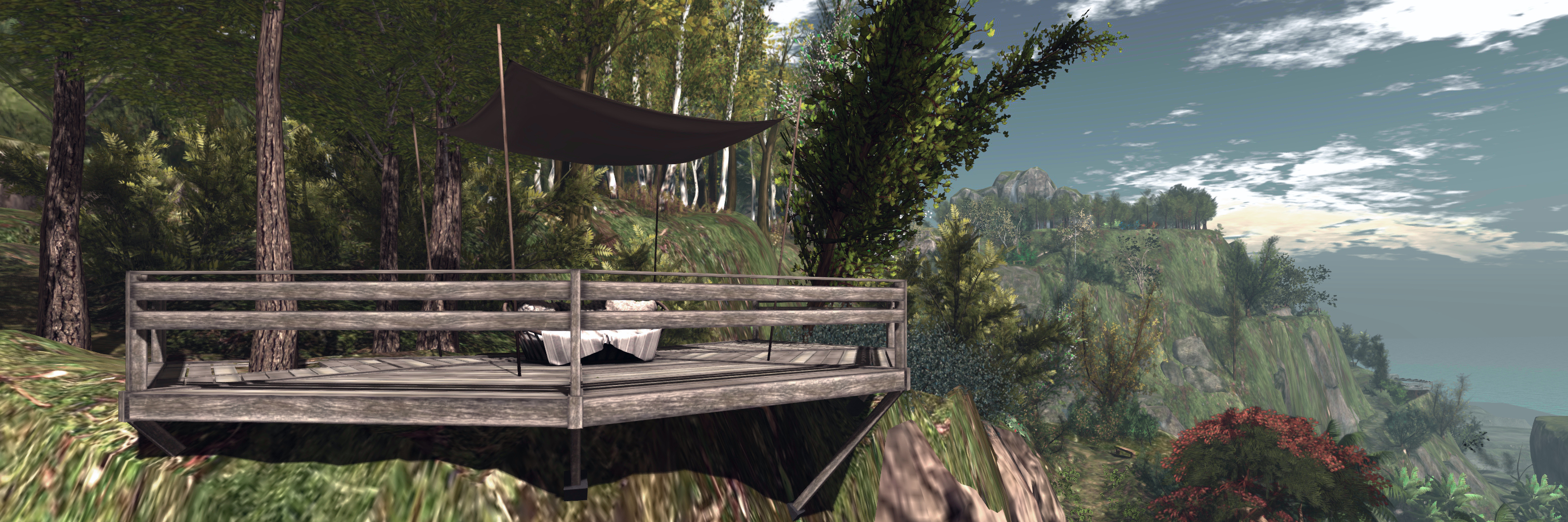
It is also to the west that I spotted another change from our last visit. What had once been a large house occupying its own island connected to the rest of the region via a wooden board walk, is now a headland where another crop is ripening and which ends in a rocky promontory, where sits the most eclectic little group of houses, both on the ground and up in the trees, a little wind turbine supplying them with power.

During our January 2017 visit, I noted in passing the presence of a little Japanese village occupying the west side of the region, but somewhat separated from it by a rocky curtain wall. This is still present and open to visitors (just follow the track around the island to the east and under the Torii gate sheltering beneath a rocky arch, or take the north side beach eastwards until you come to it). However, it now offers another odd little quirk, being the home to a host of cats. And not just any cats; these all stand upright as they go about their business, a large part of which appears to involve some kind of festival.

Sol Farm; Inara Pey, February 2019, on FlickrSol Farm

There are many elements that bring this setting together as a landscape painting made real. The first, perhaps are the rutted tracks that run through the region. These link the various points of interest – the farm, the villa, the broken old fun fair, the Mediterranean farm alongside it and the north-western headland – into a cohesive whole, giving the feeling you’re really travelling through a place. Another is the use of farm animals, sheep, horses, cattle, that neatly help stitch the central farm and the western lands together. Then there is the rich sound scape that perfectly enfolds everything.

Stay within the region long enough, and you’ll discover another somewhat unique element to it: the weather. Every so often a small tornado will pass through, bringing with it a squall of rain, the wind tossing bits and pieces of rubbish into the air which fall back to Earth in the storm’s wake before vanishing along with the storm itself.

Sol Farm; Inara Pey, February 2019, on FlickrSol Farm

Beautifully conceived from farm to beaches to houses and village, richly detailed and presented, Sol Farm remains a photogenic joy to visit.

SLurl Details

  • Sol Farm (Story of Infinite, rated: Moderate)

An art ensemble at * THE EDGE * Digital Renaissance Project

THE EDGE Art Gallery: Mirabelle Beidermann

Currently open at THE EDGE Art Gallery, curated by Ladmilla, is an ensemble exhibition of Second Life and digital art entitled All the Colours of Monochrome, featuring the work of Kapaan, Loegan (Loegan Magic), Patrick (PatrickofIreland), Rachel Magic, Trish (trishasrose) Vinicio Armin and Cybele Moon (Hannahoobinoo), together with a special exhibition entitled Tribute to Surrealism by Mirabelle Biedermann (mirabelle sweetwater).

The gallery itself is an intriguing setting, the exhibition spaces split between a medieval style church and a large castle. A medieval house offers a further annex for displaying art, but for this exhibition, it was empty.

THE EDGE Art Gallery: Venicio Armin

Mirabelle’s Tribute to Surrealism is located in two rooms within the church. A Second Life photographer since 2011, Mirabelle notes that her interest in surrealism is something of a recent turn for her. she started by interpreting some of the more notable works by René Magritte – a point most clearly demonstrated with Son of No One, reflecting as it does Magritte’s Son of Man – before she moved to developing her own style and images, which is also reflected in the pieces offered here.

Also to be found in the church are exhibits featuring the work of Patrick Ireland, who displays four marvellous monochrome pieces in a suitably monochrome setting; Cybele Moon, who has more of her narrative-rich images on one of the church’s two  upper galleries, the other being taken by the art of Venicio Armin. I confess to not having witnessed (at least, not that I can remember) his work, but I was immediately drawn to it; there is an evocative strength to his work that is entirely captivating.

THE EDGE Art Gallery: Ladmilla

Rounding out the exhibit in the church is a selection of Ladmilla’s art, more of which can be found in the main rooms within the castle setting. Like Venicio, Ladmilla focuses on landscape pieces, and her work is beautifully lit and rich in colour and tone. Above the main halls of the castle – and indeed below them – on both the parapet walks of the curtain walls and within the narrow passages within the walls, visitors can find the work of Loegan, Rachel, Kapaan and Trish.

Each presents a unique and eye-catching style, but again, I found myself drawn to the more monochrome work of Kapaan. His seven images are presented in two groups, each with its own story to tell, and both drawn together by the setting in which they are offered.

THE EDGE Art Gallery: Kapaan

As an ensemble exhibition, All the Colours of Monochrome offers a rich mix of style and images, and the title cleverly reflects the presentation of both monochrome and colour images. This makes for an engaging visit.

SLurl Details

Entering Kerupa’s Hydrosphere at Nitroglobus

Nitroglobus Roof Gallery: Kerupa Flow

Open through the rest of February and into March at Nitroglobus Roof Gallery, curated by Dido Haas, is Hydrosphere by Kerupa Flow.

The name is a reflection of Kerupa’s fascination with water, which has been – as she notes – a major theme in her art for a long time.

Creatures can not live without water, everyone knows. However, we forget what water is. Water is infinite, it’s a huge force beyond humanity, which enables us to stay alive …. but it also can destroy us.

– Kerupa Flow, introducing Hydrosphere

Nitroglobus Roof Gallery: Kerupa Flow

This description might suggest the art on offer comprises images with a water theme – and so they do; but not in the manner one might expect. These are images that reflect our complex relationship with water, richly personifying it. In one sculpture, it is celebrated as the place from which complex life evolved, the mother of all that life on Earth has become. In another it appears as a whirlpool drawing a body in to it, a reminder that it can be a destroyer of life; the most powerful demonstration of nature’s power, as Kerupa again notes.

The earthquake and tsunami disasters that occurred in 2011 in Japan were exactly the power of the earth itself. The way the tsunami moved over a long distance with the overwhelming power until it stopped inland, is a terror that can not be forgotten.

– Kerupa Flow, introducing Hydrosphere

Nitroglobus Roof Gallery: Kerupa Flow

The images present many facets of our relationship to water, a relationship which is so complex, it is easy to arrive at more than one interpretation for some of them. Take the second sculpture mentioned above, Minawa. On the one hand there is that sense of water’s power to kill, but it also perhaps personifies that origin of life also mentioned above – and even that of birth; that is, rather than being pulled into the whirlpool, the figure within the piece is coming forth.

The theme of birth might also be evident which might be seen in Twilight dreams. On the one hand, this piece might serve as a reminder of the soothing influence the sound of the ebb and flow of water can have on us, encouraging rest and dreams. On the other there is a suggestion of the womb, and the security it represents.

Nitroglobus Roof Gallery: Kerupa Flow

Elsewhere in the collection, the nature of water is more directly personified, through Merman – Voice of the Sea, for example, or the marvellously animate Water of the Erebus.  In this latter piece is another marvellous intertwining of ideas: water is given a face – but not just any face. It belongs to the primordial deity personifying darkness, a child of Chaos – a further referencing to natures raw power through water and the seas around us.

All told, Hydrosphere is another fascinating exhibit at Nitroglobus, rich in context and narrative (I’ve not even mentioned Water Dragon and how it would appear to have a tie with Kerupa herself – but I’ll leave you to read her byline for the exhibition and draw your conclusions on this 🙂 . All I will say is that, as always, this is not an exhibit to be missed.

SLurl Details

Back On The Other Side in Second Life

On The Other Side; Inara Pey, February 2019, on FlickrOn The Other Side – click any image for full size

We first visited On The Other Side in October 2018 (read here for more), and on the suggestion of Shakespeare and Max. At that time, we enjoyed our visit to this Homestead region designed by Michelle (xxMichelle20xx) and Indriel (Indrielx), so when Shakespeare nudged me with the news the region has been updated, we hopped back to have another look. What we found was very different to the settings presented in October 2018, but a place still with its own eye-catching design.

The Landing Point sits in what appears to be a shallow cavern – although one obviously with an opening to the outside world, given the volume of butterflies that have made the cave their home. I confess to being flattered in seeing one of my photos from our October 2018 visit used on the blogger link board before stepping across the water to the “outer” part of the cavern, where a Flickr link can be found together with teleport board up to the {JAS} main store.

On The Other Side; Inara Pey, February 2019, on FlickrOn The Other Side

A large slab of cut stone blocks further progress until touched, when it will slide side to reveal the region beyond. Stopping outside reveals the cavern is in fact beneath the ruins of a stone structure, its form suggestive of an ancient place of worship, the door itself faced by an ornate, teal-painted rune.

At first glance, the land beyond the door looks to be a simple rural scene: lavender grows on either side of a path that is itself is bordered by water. More water breaks the land – most of it low-lying  – into a series of islands. Birds can be seen, together with a tall wooden tower close by, a windmill further away.

On The Other Side; Inara Pey, February 2019, on FlickrOn The Other Side

But look again. A dragon hovers close by the roof of the wooden tower, while on either side of the ruin behind you are two odd-looking structures: green pillars topped by disc-shaped objects. These have attracted the attention of … visitors. A flying saucer floats close by one of the pillars, a possible rescue mission for the one lying crashed in the long grass to the side of the ruins. The pilot of the latter prowls through the grass, possibly annoyed at losing his vehicle.

These touches mark the magic of the region: an eclectic mix of vignettes, one or two of which  offer echoes of previous builds. To the north side of the region, sitting on one of the islands is a little outdoor cafe, for example. This offers a link back to the region design we visited in October 2018. Should you drop in for a snack, do take care not to disturb the couple of mice who are enjoying their brunch at their own little table.

On The Other Side; Inara Pey, February 2019, on FlickrOn The Other Side

The north-east corner of the region is the only part that is off-limits. It is home to a private residence and access control is set. Diagonally across the region of this is a farm, home to the aforementioned windmill. This sits on another island and raises a slightly different warning; when crossing the water between islands, it’s probably best to keep to the paths, bridges and stepping-stones. While the water is shallow in places, in others it can be uncomfortably deep, so you might find yourself taking an unexpected bath!

All of this is just scratching the surface of things. The wealth of detail found within On The Other Side makes exploration a real joy; the mix of ideas means that you’re never sure what might lie beyond the next hedgerow or over the brow of low hill. Standing stones here, a little lovers hideaway there, an unexpected and sheltered beach (complete with an opportunity to surf), over there – and more.

On The Other Side; Inara Pey, February 2019, on FlickrOn The Other Side

There are also more of the contrasts to be found throughout. Wander in the right direction, as another example, and you might come across a touch of the Far East mixed with a hint of Africa. A further hint of the Far East sits up on the hills behind the temple ruins, while another reminder of Africa can be found in the waters. For the adventurous who may want to explore the upper levels of the ruins, there is a crawl rope offering a route to them from the nearby wooden watch tower. And talking of adventurers, keep an eye out for the aerial critter braving the air over the crocodile waters!

With numerous places for people to sit and couples to share their company with one another, On The Other Side retains its appeal as a place in which to spend time. Throughout entire region there are numerous opportunities for photography, and pictures can be shared on the Flickr group. Rezzing in the region is permitted, with an auto return time of 60 minutes – but if you do rez, please remember to pick your things up rather than letting auto return take care of it. And, as always, make sure local sounds are enabled so you can appreciate the region’s immersive sound scape.

On The Other Side; Inara Pey, February 2019, on FlickrOn The Other Side

SLurl Details

Visiting Lost Unicorn Gallery in Second Life

The Lost Unicorn Gallery

The Lost Unicorn Gallery, curated by Natalie (Natalie Montagne)  forms a part of a trio of regions I visited in September 2018 (see Within a Lost Unicorn Forest in Second Life and Opening a Storybook in Second Life). As I noted in those articles, all three regions are utterly magnificent in design, with The Lost Unicorn Gallery offering one of the most stunning settings in which art can be exhibited – as any view from outside the gallery will more than demonstrate.

I was drawn back to the gallery for three reasons: the first is that Natalie routinely hosts engaging ensemble exhibitions of art; the second is that the featured artist for February 2019 is Cybele Moon (Hana Hoobinoo); and the third is purely personal: as a part of the current ensemble exhibition, Natalie has selected some of my own images.

The Lost Unicorn Gallery: Cybele Moon

Cybele Moon’s work really needs no introduction to regular readers of this blog. Her art is beautifully ethereal and rich in narrative. This is fully exemplified with Forests Were Made For the Hunter of Dreams. Located on the main floor of the gallery, this is an extensive exhibition of Cybele’s photography and art, each piece offered and ready to tell a story of its own. However, for those who prefer, Cybele offers a touch panel which will supply a short story snippet to accompany each piece.

Also to be found on the ground floor of the gallery are avatar studies by Razor Cure (sch511), and Aquatic Arugula (Sugarfairy88), who offer very contrasting styles. Razor is additionally the first prize winner of a recent photography competition held within the regions, his entry with the other prize winners also being displayed on the ground floor of the gallery.

The Lost Unicorn Gallery: Sugarfairy88

On the upper floors of the gallery is a veritable host of artists: Lia Swahn, Gassamer Star, Luke Henuskai, Meriluu, Pan Aeon, Poly Elan, Awesome Fallen, SelenLily Galicia, Efinyn Jinx, Iruki Levee, Babydoll Tracy Colt, Antarctica Slade, Pretty Rexen, Aleriah, Roxi Firanelli, Duchess Flux, and myself.

The majority of the images from these artists are focused on avatar studies, the only major exception being my pieces, which Natalie gathered from my visits to Lost Unicorn Forest and Storybook. My sincere thanks go to her for including me in such august company; I’m both flattered and honoured.

The Lost Unicorn Gallery: Inara Pey

For those who enjoy photography competitions, the Lost Unicorn Gallery is currently hold another with the theme of Lord of the Rings.

Participants are invited to submit up to two images (raw or post-processed) representing any part of the Lord of the Rings novels (The Fellowship of the Ring, The Two Towers and The Return of the King). Submissions should be made to the Lord of the Rings Flickr Group and labelled “Contest Entry”, no later than March 3rd, 2019. A L$9,000 prize pool is on offer, with L$5,000 to the first place entry. Full details on entry can be found via the contest information givers at the gallery.

SLurl Details

Originalia: a tropical paradise in Second Life

Originalia; Inara Pey, February 2019, on FlickrOriginalia – click any image for full size

Update: Originalia appears to have closed. SLurls have therefore been removed from this article.

Imagine you had a small personal fortune. Enough to, say, buy your own tropical island atoll. What might you look for in such an island prior to purchase? What might you do with it? What style of house would you opt to have built there? What facilities would you want to include to make it that special place where you can escape the pressures of life and simply be, enjoying sun and surf and the haven of tropical splendour with your family and / or friends?

Doubtless, many of us have fantasised having a life where we could “do a Branson” and have such an island – and I wouldn’t at all be surprised if in our individual mind’s eyes, it didn’t in some ways resemble Originalia.

Originalia; Inara Pey, February 2019, on FlickrOriginalia

Designed by Minnie Blanco (Minnie Atlass) of Soul2Soul fame for region holder Amase Levasseur, Originalia is an utterly stunning Full region this fully embodies the idea of a tropical paradise home. And if you’ve never dreamed of having such a place to call your own, or in letting your mind wander the fantasy of owning a private island getaway you’ve not pictured anything quite like it, I’ve little doubt that after a visit, you’ll be unable to picture anything else.

Set within an archipelago of off-sim islands – some quite mountainous – Originalia offers what could easily be the atoll top of a drowned volcano: an oval of sand and rock rising above the surrounding sea, the wall broken to the east, allowing the waters to enter the crater’s bowl to form a lagoon. Beyond  the curve of the island lies an outer semi-circle of low-lying rock, home to scrub grass and palm trees. It suggest that perhaps at one time the cone forming Originalia sat within a larger caldera, perhaps the last gasp of the volcano that formed it, pushing itself above the waves before falling silent, and then allowing the millennia and the sea take over the work of giving the land its current form.

Originalia; Inara Pey, February 2019, on FlickrOriginalia

Whatever its origin, what remains is perfectly idyllic; a horseshoe-like island running from sandy lowlands to the north around to a high ridge-line to the south, the ring of rock open to the sea to the east and also linked to the waters of the old caldera to the west, where the crater wall has in part collapsed to leave a magnificent arch of basalt arching over the waters below, thus forming a broad bridge linking the high plateau with the lower reaches of the island and the beaches there.

It is on this high shoulder of rock, from which waterfalls tumble from numerous points, that Minnie has sited the ideal residence: The Patron Banyan House by Eliza Wierwright, itself a stunning build that has always impressed me. Offering a southward view out over the lagoon, the house grandly sits on the high plateau, the pool between its arms feeding one of the falls that tumble over the rocks and into the blue waters of the lagoon below. Across the rocky arch from it sits a rotunda like cottage by Cory Edo, perfectly complementing the house and offering a spa style setting in which to relax.

Originalia; Inara Pey, February 2019, on FlickrOriginalia

The overall suggestion of house and cottage perhaps leans toward Thai in intent; but as is often the way with me, the setting carried soft echoes of places I’ve visited in Sri Lanka, such as Saman Villas. While the latter is far, far more developed than Originalia, I Couldn’t help but think of their rocky perch and the open-air nature of the public buildings within the development as we explored the house, memories of meals in the open-sided restaurant drifting into my thoughts.

Finding your way around the island is easy: just take the wooden board walk and bridge from the little sand bar of the landing point, then follow the rocky paths laid across sand and scrub. These wind over island and up hill under palm trees and between shrubs and rocky shoulders. Here and there the paths branch, offering routes to the outlying beaches where little hideaways can be found and boats bob on the surf at their moorings.

Originalia; Inara Pey, February 2019, on FlickrOriginalia

I’m not sure if Originalia is permanently open to the public, or whether public access is for a limited time. However, I do know that it is a setting that not to be missed – but do allow time for a visit; there is much here to captivate the eye and the imagination. And do make sure to have local sounds enabled; as something of a sanctuary for birds of all kinds, Originalia has a rich accompanying sound scape.

Our thanks, once again, to Shakespeare and Max for pointing us to this island gem. As Minnie points out in the comments, those taking photos are welcome to submit their pictures to the region’s Flickr group.

Originalia; Inara Pey, February 2019, on FlickrOriginalia