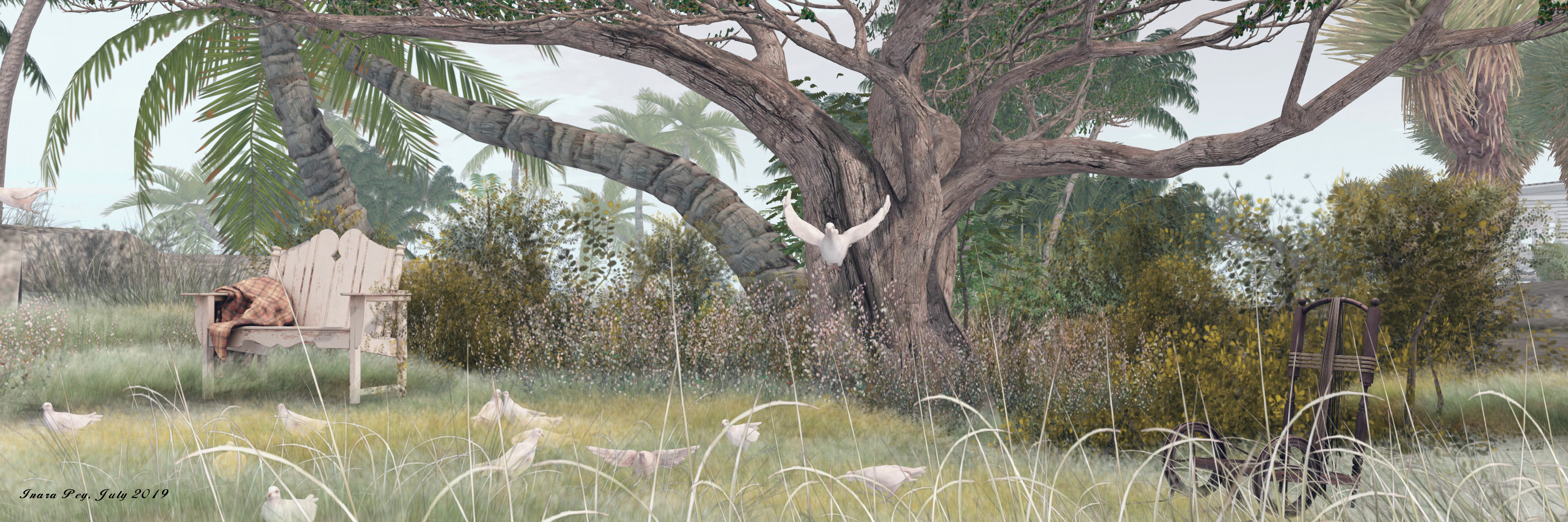
Warm sandy shores and tropical environs welcome you in this land filled with wildlife, relaxing beaches, and grassy areas. I hope you enjoy your stay and please remember to pick up after yourselves when you go.
Region designs by Arol Lightfoot are always guaranteed to generate a lot of interest, and so it is with her latest Homestead design, Carolina.
As Arol’s description of the region indicates, this is a very rural, open island setting. Three houses sit within its sandy banks and beaches, two on the coast and the third a little more inland. They sit amidst circling birds while Flamingos strut over the more grassy aspects of the island and horses stroll under the haze-heavy sky.
The surrounding waters cut into the island to form bays and channels, giving the low-lying land a richly natural look, grass and sandy mingling easily, waterfowl sitting among the piers and rocks that help define the landscape. A curious mix of trees – oaks, palms and Lebanon cedar – rise above smaller trees with bent trunks as if bowed under the weight of their boughs and leaves, but together they help further define the island’s look.
This is a genteel landscape where cats mix easily with dogs, donkeys and goats, all of whom add their own personalities to the region – some quite cheekily so. The only oddity within the setting is the battered and ageing humps of an old roller coaster. It’s not the kind of ride you’d want to take, given the state of the rail-less tracks, despite the cars being present – but it does made an interesting focal-point for photography.
Photography is very much a raison d’etre for Carolina, again as the About Land description notes. Rezzing in the region is open, but as auto-return is turned off, those who take advantage of it are asked to remember to pick their items when they are finished.
Peaceful, with multiple places to sit and relax and with its wildlife rounded-out by the presence of otters, sea lions – and pandas, Carolina makes for a quiet visit for those so minded, a cosy island with opportunities to explore, to sit and to contemplate – just mind the sharks if you go for a swim!
I recently gained an introduction to the photography of artist, photographer, and Second Life resident, Davenwolf Dagger as a result of his participation in the July exhibition at Kultivate’s The Edge gallery (see: Kultivate: The Edge Gallery – July 2019), where his presented an eye-catching collection of black-and-white photos entitled The Blacksmith Series, that particularly caught my eye, both for the richness of their narrative and for the fact they indirectly reminded me to recall the time I was lucky enough to spend in Tasmania.
Coincident to my review of that exhibition, Davenwolf also sent me an invitation to visit his in-world gallery, Pixtoria Galleries – an invitation I was happy to accept.
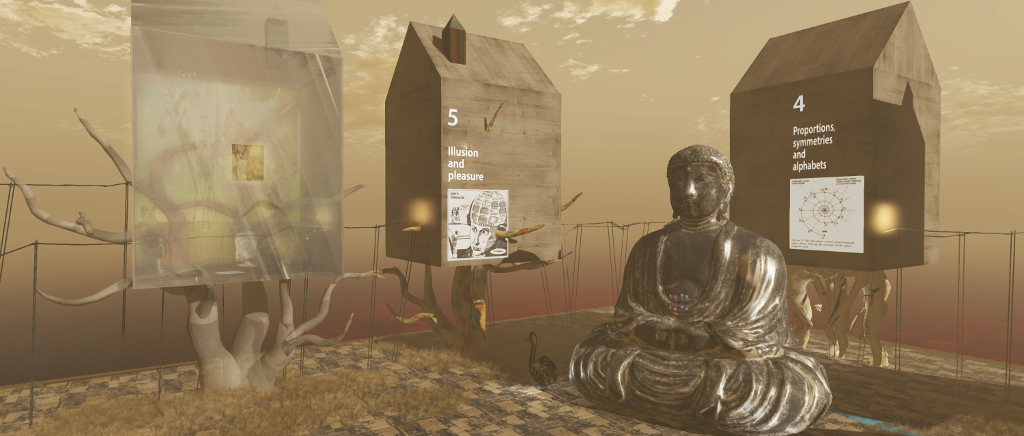
Split between two levels, one on the ground and the other in a skybox, Pixtoria is a veritable tour de force of Davenwolf’s art – and quite engagingly so. The ground floor provides an introduction to his digital images, running from the abstract through to fractal-like pieces to those suggestive of exotic, alien landscapes to a – for me – fascinating piece entitled DNA, with is marvellous suggestion of constructs and building-blocks and hint of architectural constructs.
The ground level gallery space is small, offering a social area on its upper floor rather than more images, but it is enough the whet the appetite and encourage the visitor to click the teleport disk to reach the sky gallery.
I’m a bit of a creator and perfectionist so I’m always making something. Whether it be in SL or the real world I like to keep myself entertained by creating artworks, photography, drums, videos, sculptures etc., you name it and I’ve done it over the years. Some projects I’ve had with better success than others but I eventually get there in the end.
The sky gallery is a much larger affair, split into two levels of two halls apiece, the upper levels connected to the lower by elevators. The lower level is home to more of Davenwolf’s digital art, one hall devoted to pieces that continue the themes evident in some of the ground level pcitures, with experiments in line, colour, form and tone. Some of these offer a clear fractal influence (Trident, the triptych like Connections and Spiral), while others present more “organic” forms.
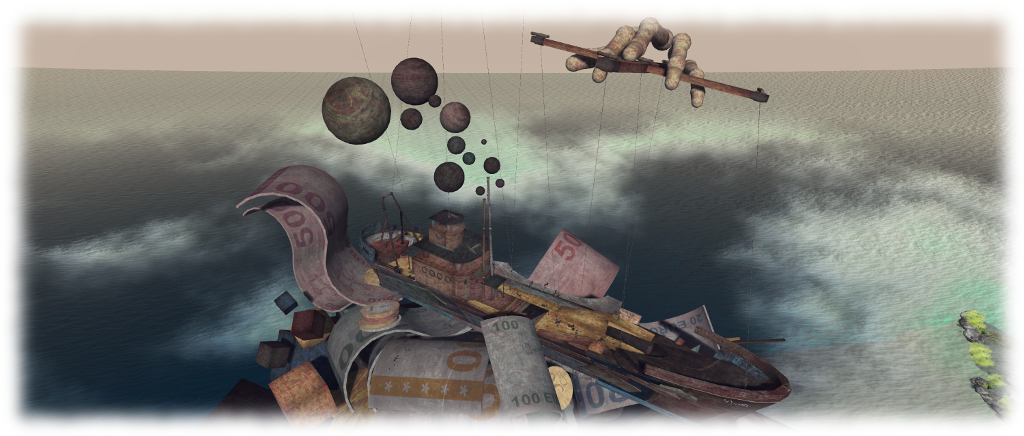
Across the floor, in the other lower level hall are some utterly wonderful images expressing the beauty of geometry as a model for art. Spheres, rings, cones and more sit on chequerboard patterns and under expressive skies, their colours and reflective surfaces offers wonderful depth, so much so you feel like the reflections should move in response to your own camera / avatar movements. Tucked into one corner of this hall are two pieces – Urban Decay and Stranded – that each contain an especially powerful narrative.
The upper levels of the gallery featured, at the time of my visit, two exhibitions of Davenwolf’s photography. The first focuses on The Blacksmith Series, his marvellous black-and-white series noted above, captured in an old working environment in Launceston, Tasmania, and, across the intervening atrium, Ward 21 Morisset Asylum.
The latter is an utterly evocative series, taken (I assume) in a disused wing of the psychiatric hospital that opened in 1908 either within, or very close to, the town of Morisset, New South Wales, Australia. Reaching its peak in the 1960, when it houses up to 1600 patients, today it still tends to dominate the town’s reputation, despite now having a patient population roughly one-tenth the number from the 1960s.
Davenwolf’s pictures capture halls and rooms now broken and decaying, but which are now the home of graffiti. Utilising light and shadow, camera angle and choice of lens, and the occasional image of a man, Davenwolf uses the condition of the ward and the presence of the graffiti to give – and pardon the term, no pun intended whatsoever – graphic interpretation of a mind in turmoil.
When viewed as complete sets, The Blacksmith Series and the Ward 21 Series are striking in their storytelling. However, the individual pieces within each also stand as collectable images in their own right. Similarly, the digital images offered through the gallery will natural grace any art collection, making any visit to Pixtoria Galleries doubly worthwhile.
Cornhub is a rather curious region, one which apparently changes perhaps more regularly than other public regions (designer Mya Milena notes of the region, “we change themes like socks”!). At the time of writing this piece, it offers a look into one aspect of modern-day mythology: that of flying saucers and alien visitations.
We were dawn to the region after seeing Ricco Saenz’s pictures of Cornhub on Twitter (and you can read about his explorations here). But if I’m honest, they didn’t entirely prepare us for what we found: this iteration of Cornhub is quirky, unexpected, different and, well, strange, with the flying saucers just a part of the story. However, it is the one I’ll start with, as it is perhaps the most obvious.
Sitting in the midst of this desert landscape is a crater out of which rises the crashed hull of a flying saucer, bodies of “greys” lying on the cracked ground where they were either thrown during impact or staggered to on escaping before collapsing. A second flying saucer is circling above, wobbling in its flight in the way such vehicles tend to do in those old 50s sci-fi B-movies.
A sign by the roadside that passes the crash site points the way to the “UFO Crash Site Roswell, New Mexico”. So, whether this crash is intended to represent that so-called incident is debatable. Certainly, other signs in the area suggest this is might actually be the legendary (in alien conspiracy theory circles) “Area 51” (officially, the Homey Airport or Groom Lake in the middle of the Nevada Test and Training Range) – which is roughly 900 miles from Roswell.
For those perhaps unfamiliar with the Roswell incident of mid-1947, it was triggered when a special high-altitude balloon being used by the (then) US Army Air Force in a top-secret endeavour came down some 75 miles from the town of Roswell. That secret endeavour was Project Mogul, an attempt to detect the sound waves generated by Soviet atomic bomb tests using special equipment suspended from high-altitude balloons.
Due to the sensitive nature of Project Mogul, various official statements were made about the nature of the crash were contradictory or simply didn’t match the facts (one USAAF report referred to the crash being a “weather balloon”, although the Project Mogul balloons were very different beasts). The event occurred just two weeks after aviator Kenneth Arnold made his famous report of seeing nine “saucer-like” flying objects near Mount Rainier, Washington State, so when a report was issued that a “disc” (albeit one apparently small enough to be held in the hands) had been recovered at the crash site, the press briefly went wild with speculation – something which, 30 years after the fact, resulted in Roswell becoming infamous as an alleged “UFO crash site”.
Whether you chose to see the Cornhub flying saucer crash as being a play on the so-called Roswell UFO incident is up to you. For my part, I found myself leaning more towards the road sign with its arrow being more a passing reference to Roswell, and the setting within the region far more of a play on the whole mystique of “Area 51” and its place in both “UFO / Alien visitation” mythology and some science fiction films.
There are certainly enough clues for the latter being the case: the Area 51 signs, the military vehicles parked close by, and the spacesuited figures of humans also scattered about the crash site. The latter in particular take on more of a sci-fi meme: the suits carry the NASA logo and look to be modelled on modern US EVA spacesuits. However, they also appear to have been ineffective in projecting those wearing them from something undoubtedly nasty in the immediate vicinity of the crash.
North of the crash site is what might be the edge of a town, one which might be taken as Roswell if one goes in that direction, or perhaps some little hamlet on the edge of the Nevada Test and Training Range. It offers a curious mix of buildings: there’s a very 50’s style diner and drive-in diner sitting alongside an 80s video game arcade, while SL table-top games can be found in the parking lot. Meanwhile, just across the road, there’s a concrete tower block that might at first appear to be a military-style structure (and thus suggestive again of “Area 51”), but which is in fact an apartment building, a trailer park (travelling UFOlogists?) located in the car park at its base.
Elsewhere, back towards the middle of the region, sitting between the flying saucer crash site and the region’s landing point, the top of the Statue of Liberty’s head rises from the dried sands, almost in a nod to the Planet of the Apes franchise and adding a further twist to the setting. Meanwhile, and off to the south where it stands alone, is the warehouse-like bulk of a television recording studio, apparently the home of “Cornhub’s Blind Date”.
Eclectic, unusual, overlooked by a Hollywood-echoing hillside sign spelling out the region’s name, and with a pot-pourri of ideas, Cornhub in this current iteration makes for an undoubtedly a strange – but also curiously photogenic. But remember, it might not be around too long, so should you want to visit, it might be best to do so sooner rather than later!
The Linden Endowment for the Arts (LEA) is to officially close on August 31st, 2019. The announcement came via a notice came via a note card circulated via the Linden Endowment for the Arts Info group, and follows on from a contraction of the scale of the LEA’s operations in Second Life and an announcement made in November 2018 stating the organisation would be going through a restructuring.
The Committee of the Linden Endowment for the Arts regrets to inform residents of Second Life that the LEA regions will be closing at the end of August 2019…
The Linden Endowment for the Arts (LEA) was established to help create a centre of arts activity in Second Life. It was founded in 2010 and launched its first events in 2011. For the last eight years, it has been a collaborative venture between Linden Lab and the arts community. Guided initially by a board of renowned Second Life artists and more latterly also bringing in people with a strong interest in promoting the Arts in Second Life, the LEA has been committed to providing access to engaging experiences in the arts for the Second Life community. Over the last eight years, through its exhibitions, programs, and events, the LEA has fostered awareness of artists’ contributions to our virtual world and encouraged others to get involved and be inspired.
– from the announcement of the LEA’s forthcoming closure
Linden Endowment for the Arts: Exodus: A Trip for Life, 2017
Sponsored by Linden Lab, and with 29 regions at its disposal, the LEA was initiated under Mark Kingdon’s tenure as CEO at Linden Lab to function as something of a “arts council” in Second Life, run directly by a committee of residents. The core ideals behind the LEA – as expressed on the official website were to:
Provide a starting point for artists in Second Life, and for those interested in art to make connections and display their work.
Encourage and cultivate art and artists within Second Life.
Foster community, creativity, and innovation among artists and all residents interested in art.
Provide a way for artists to promote their art.
Collaborate with existing art regions, galleries, exhibits, and performance spaces to help nurture their valuable participation in SL arts.
The regions were split into two primary programmes: the “core” regions (nine in all) which could be used by artists from across Second Life for relatively short-term projects, and 20 Artist in Residence (AIR) regions that could be “booked” for six months at a time. Following the announcement of the restructuring in November 2018, the 20 AIR regions were wound down as the last batch of installations for 2018 came to an end. With the formal closure at the end of August 2019, the remaining nine core regions will be shut down.
The LEA was a brave attempt to try to help promote arts within Second Life, although its very nature was bound to be somewhat controversial. Indeed, following its formation, there was a certain degree of hostility directed towards it, a lot of which was unfair.
As was pointed out to me after I wrote the article on the 2018 restructuring announcement, running any organisation like the LEA is going to be a thankless task; there is no remuneration for time given, there is always going to be hostility over actions taken and the grants awarded, and so on; it really can be a thankless task. Nevertheless, there were times when the committee really didn’t help itself, such as failing to adequately act in accordance with its own by-laws after a committee member openly griefed a privately-held arts region in 2015 (other than hiding those by-laws when challenged under them following said incident).
However, there can be no doubting then when all is said and done, the LEA did a tremendous amount of good for the artists who participated in its programmes, offering many the means to express themselves and reach audiences in a manner that might never otherwise been able to achieve.
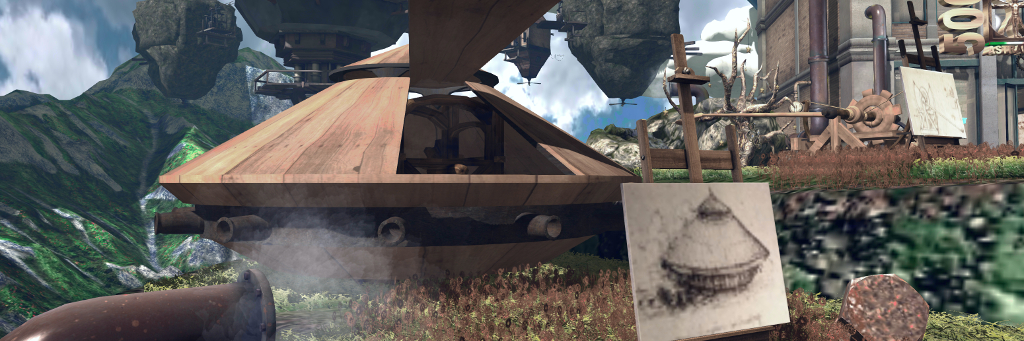
Linden Endowment for the Arts: Astral Dream Project – Leonardo 500, 2019. One of the last LEA core region exhibitions
For example, there have been collaborative projects too numerous to mention; there have been individual installations offered for use by a wider community (take Chic Aeon’s MOSP installations for example); there have been works embracing political and social issues (such as the 2LEI installations); investigations into matter of health (which through their construction and presentation may well have offered catharsis to the artists behind them). There have been installation that have allowed the many faces of art of be examined, explored and enjoyed music, song, dance, storytelling, the visual interpretation of classic works. And there have been those that have simply offered the opportunity for us to express joy and laughter – and so much more.
As such, and while the LEA many have had its warts and at times had to face undue criticism, it has through its nine years of existence been a force for good for those arts who have been able to make use of its facilities and it has certainly helped enriched art within Second Life and allow many to appreciate work and installations they might otherwise never get to see. So, it’s not unfair to say its passing will be missed.
The Vordun Gallery and Museum, curated and operated by Jake Vordun, has relocated to its own full region, and as a result has undergone something of an expansion.
Connected to its former home on the region Jake has his Fancy Decor business, the new Vordun Gallery and Museum now boasts two floors, offering highly flexible display space with – at present – nine gallery halls (although some look like they could either be expanded or split, depending on the needs of individual displays).
As I discussed exactly two years ago just after The Vordun originally opened (see: The Vordun: a new art experience in Second Life), one of the attractions with this gallery is the care with which Jake and his team have striven to make a visit to The Vordun something of a an experience that mirrors a visit to a physical world gallery or museum – and this is certainly continues with the gallery’s new location.
I wanted to expand the non gallery areas. The lobby in the old build was a small cube. I think the newer big lobby with café, bathrooms, elevator, coat check etc, gives it a more real-life feel. Plus adding the second floor adds a ton of new space for more exhibits!
– Jake Vordun on expanding the Vordun Gallery and Museum
The realism element was particularly reflected in the initial exhibit at the Gallery, European Masters, 300 Years of Painting, offering as it did a scripted audio tour of the pieces on display. In the intervening years, European Masters has become something of a permanent fixture at the gallery, and I’m pleased to say this is still the case following the move as it continues to occupy the main ground floor hall.
The ground floor also sees three other exhibitions that were open at the time of the move also continue. Two of these, Pictures of the Floating World and Proverbs of the Low Countries, I wrote about in June 2017 (see: Floating worlds and Dutch proverbs in Second Life). Both of these are again exhibitions designed to not only reveal the art to visitors, but actively engage the visitor with the art. Sincerely Yours / Postcrossing, meanwhile, brings to life the fascinating world of postcrossing.com, which invites people to sign-up and send a postcard to a total stranger in another part of the world, thus joining a chain of sharing that has seen some 40 million postcards exchanged at the rate of 187 being sent per hour!
The rear hall on the ground floor is home to one of the new exhibitions at the gallery: Claude: Monet Impressions, a celebration of one of the founders – and possibly the greatest exponent – of French impressionism Claude Monet. With something of a focus on some of Monet’s more famous paintings – notably those of his gardens at Giverny – this is at the same time a varied exhibition, featuring some of his portrait work and touching on the man and his life as well. All of which makes for an excellent introduction to Monet for those unfamiliar with his work.
The upper floor of the gallery holds the promise of the return of A Night to Remember, commemorating the loss of the RMS Titanic. This interactive installation had its début in Second Life at the Vordun as a part of the gallery’s original opening. It then travelled to the LEA where it was expanded somewhat (see: A Night to Remember in Second Life). Thus, the forthcoming its re-opening at The Vordun will be something of a coming home.
Also on the upper floor The Vordun offers visitors the chance to immerse themselves into the life and work of the great Dutch master, Rembrandt Harmenszoon van Rijn – but form an unusual angle. Best remembered as painter, Rembrandt was also a master draughtsman and printmaker, being a pioneer in the world of etching. It is this aspect of his art – for which he was perhaps most famous during his lifetime – that is celebrated here. Be sure to touch the images to gain deeper insight into each of them.
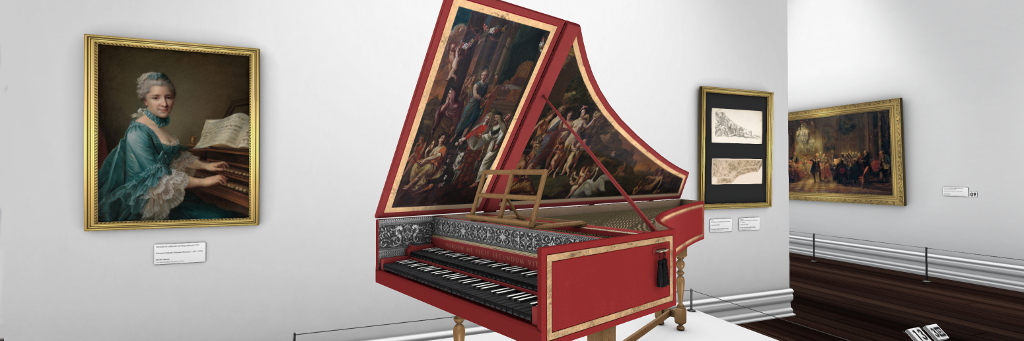
Alongside Rembrandt is another interactive, experience-driven exhibition, Musica Antiqua, a most engaging journey into music from the middle-ages to the Baroque period (the era of Bach, Vivaldi, Albinoni, Handel, Percell, Pachelbel and more). It features models of various instruments paints and – most immersely – the music of the instruments themselves through audio and video.
As with some of the other exhibitions at The Vordun, this is a HUD-driven exhibition (the HUD should auto-attach on entering the exhibition space, providing you have accepted the gallery’s experience. If you haven’t, you’ll again be asked to do so). Audio can be heard by pressing the number on the HUD corresponding to the instrument / painting you are viewing. Three additional button (indicated by the number with the video icons alongside them) will open a playback panel in your viewer, but note that a) you may have to click the panel to engage video playback; and b) playback is dependent upon HTML / Flash support in your viewer – an nearby chat link will help for those experiencing issues, and depending on their view of the security of Flash.
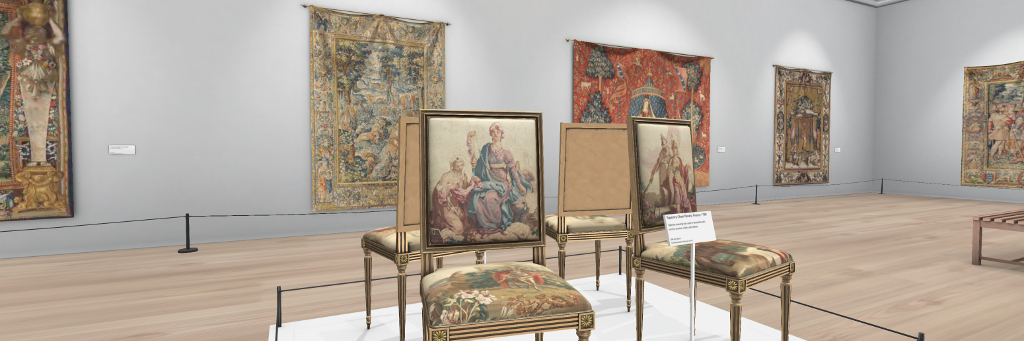
Across the hall from Musica Antiqua and Rembrandt is another unusual exhibition of physical world art – one perhaps at times overlooked outside of stately homes in Europe: that of tapestry. Threads of Gold celebrates this art through both wall hangings (perhaps how we most often think of tapestry) and upholstery embroidery – the latter again through the use of models.
The Vordun has cut a path of its own in terms of Second Life galleries, focusing as it does on physical world art. I personally find this one of the great attractions with the gallery; by doing so, it can bring the world’s art and artists to an audience who might otherwise never have the chance to experience the personal delight of what is to all intents and purposes a “first-hand” view of the art that the printed page can never really match.
That said, and allowing for the lean towards making The Vordun as close as possible to the feeling of visiting a “real” gallery, I did again find myself wishing in places that displays that do not provide auto-zooming used larger versions of the images they present (overall quality of the original image allowing, of course). This would potentially make them easier to appreciate by those less skilled in camera manipulation or who – more particularly – might suffer from poor vision.
Emphasising physical world art is something Jake would like to increase, as he informed me during a visit. “I’d love to have some Second Life artists showcase their physical world art.” There is nothing planned for this as yet, Jake has been focused on getting the gallery moved and the new exhibitions opened. However, we did discuss a few names, and SL artists who are not averse to displaying their art in-world might want to contact Jake directly to discuss their work and possible opportunities.
In the meantime, congratulations to Jake and his team for the gallery’s expansion and four new and very engaging exhibitions.
Recalling Apollo 11 in Sansar and Second Life – the Apollo Museum in Sansar
July 16th 2019 marks the 50th anniversary of the launch of Apollo 11 on its historic voyage to the Moon which saw Neil Alden Armstrong and Edwin Eugene “Buzz” Aldrin Jr. set foot on the lunar surface on July 20th, while Michael Collins orbited some 11 km (69 mi) overhead.
I’m re-tracing the flight of Apollo 11 in my Space Sunday articles – part 1, published to coincide with the launch of Apollo 11 is available now, and part 2, covering the Moon landing and the return to Earth will follow on the weekend of the landing. But you can also celebrate the audacious achievement of Apollo 11 in-world in both Second Life and Sansar (and, I’m sure, in other virtual worlds as well – but I am focusing on SL and Sansar here, as it is in these worlds that I spend my time nowadays).
Second Life
Note: there are likely to be more Apollo 11 celebrations than recorded here. These are simply two I’ve enjoyed visiting.
International Spaceflight Museum
Where better to immerse yourself in all things space than the International Spaceflight Museum? Covering two regions, and with the likes of NASA’s (slightly ageing) Jet Propulsion Laboratory region adjoining or close by, the ISM allows you to take a walk through the history of international space-faring achievements, see the massive launch vehicles, re-visit missions both crewed and automated, travel the solar system, and take a glimpse of things to come.
ISM features several elements related to the Project Apollo and its precursor Project Gemini programme; for example, in the shadow of the Rocket Ring sit models of an Apollo Lunar Module (also known as the Lunar Excursion Module or LEM) and the combined Command and Service Modules (the former the capsule in which most of the Apollo crews flew to the Moon and in which all returned to Earth, the latter the power and propulsion system for the Command Module). These include cutaway schematics and other information.
However, located on the ISM’s Spaceport Bravo region, and in the lee of the mighty Saturn V lunch vehicle that carried every crewed Apollo lunar mission on its way to the Moon, is a display dedicated to Apollo 11 (as also seen at the SL16B celebrations in June 2019). It features a combined model of the Command and Service Module and a model of the Command Module itself that allows visitors a peek inside.
Close the this display is a model of the LRV – the Lunar Roving Vehicle, or “Moon buggy”. While this did not fly to the Moon until the Apollo J-class missions (15 through 17), it still stands as a reminder of the technical abilities of the Apollo programme.
While it didn’t fly to the Moon until Apollo 15, the Lunar Roving Vehicle played an important role in humanity’s first foray to the Moon
And if you want to get a feel for how truly massive the Saturn V rocket really was, then hop up onto the Mobile Launcher behind the Apollo 11 display.
Sitting atop a crawler / transporter the Mobile Launcher comprises the massive slate-grey launch platform base and the massive Launch Umbilical Tower (LUT) that included all of the service arms required to support the rocket (nine in all) with fuel, power, and direct access. The most famous of these arms lay close to the top of the tower as it stood in attendance beside a Saturn V. This arm held the White Room – the room where the astronauts, assisted by pad technicians, boarded their Apollo Command Module. Sadly, the White Room doesn’t form a part of the ISM’s Saturn V Launcher model – but you can climb the stairs all the way up to the swing arm on which it sat, and in doing so gain an appreciation for the size of the rocket next to it.
Headline Apollo Exhibit
Headline Apollo is a pop-up exhibition by Diamond Marchant taking place at the Beckridge Gallery curated by Emerald Marchant in Bellisseria. It takes as its theme a look at Apollo 11 from the perspective of a north Texas newspaper, the Fort Worth Star Telegram. In doing so, it offers a unique perspective on the mission – which was as we know, managed out of the Manned Spacecraft Centre (later renamed the Johnson Space Centre), located further south, near the Texas state capital, Houston.
Given the size of the Bellisseria Homes, they make for a cosy gallery space, but this actually makes Headline Apollo more of an intimate visit. A guide note card is available both at the entrance to the galley and in the foyer (and which includes copies of some of the images seen in the exhibition). The exhibition itself is broadly split in two: to the left of the entrance foyer the launch and the flight to the Moon, to the right, the surface mission and return to Earth.
What makes this exhibition engaging is that Apollo 11 and the Apollo lunar missions as a whole, tend to be remembered in a way that frame them on their own. There might be some ruminations on major events of the time – such as the Vietnam War -, but by-and-large they are presented in something of a bubble. Headline Apollo, however, with its reproductions of front pages and columns from the Fort Worth Star Telegram frames the story of the mission alongside that of daily life in Forth Worth and America as a whole.
For example, sitting alongside the reports of Apollo 11 are those of a more infamous event that took place in 1969, one that would become known as the Chappaquiddick incident, which involved the death of a young woman in a car driven by Edward Kennedy, the youngest brother of John F. Kennedy, who had started America on its journey to the Moon in 1961.
This story, and the more local ones appearing on the reproduced pages of the newspaper put the Apollo 11 mission is something of a different perspective. We’re reminded that for all its faults and weaknesses, humankind can raise itself up, seek to achieve something better, and the bravery of just three men in a tin can can unite us all in a hope for a better tomorrow.
Complete with archival NASA photos an cover pieces from the likes of Time and Life magazines, Headline Apollo offers a departure from the more usual Apollo retrospectives and will be open to visitors through until July 28th, 2019.
Sansar
Sansar may be anathema to some Second Life users, but if you have the hardware to enjoy it – and remember you can with a suitable PC and without the need for a VR headset – then frankly, there is no better way within a publicly accessible virtual world to celebrate Apollo 11 and the entire Apollo lunar endeavour than by visiting the Apollo Museum ant Tranquillity Base.
The Apollo Museum
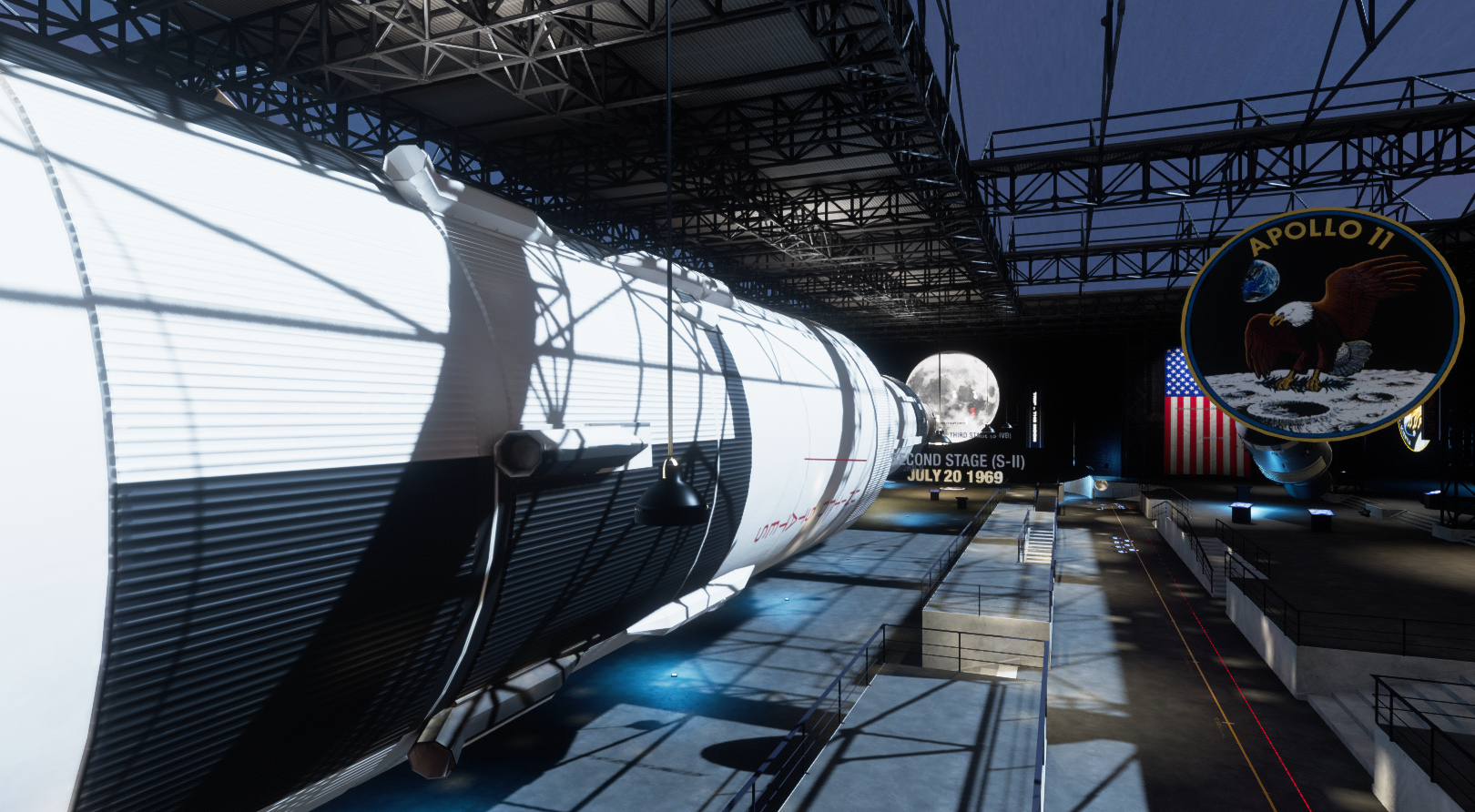
The Apollo Museum remains one of the highlights of Sansar (if first wrote about it back in 2017). Developed by Sansar Studios, Loot Interactive and NASA, it reproduces the main hall of the Apollo/Saturn V Centre at the Kennedy Space Centre, Florida, to offer visitors a fully interactive guide to the Apollo programme.
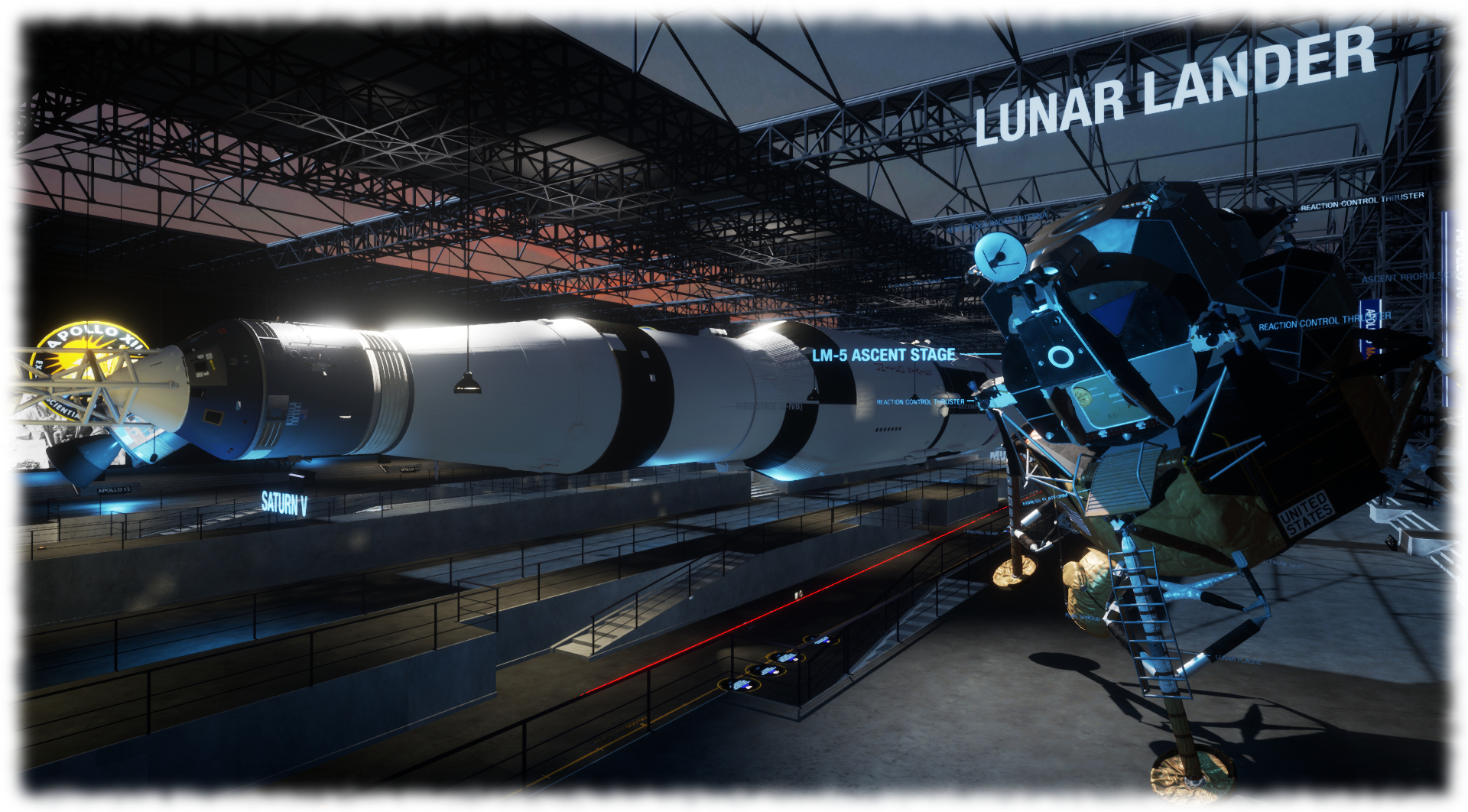
Here you can walk the length of a Apollo Saturn V launch vehicle, from the exhaust bells of its five mighty F-1 engines to the tip of the Launch Abort System tower. Along the way, and set out on time-line, you can re-trace the journey of Aldrin, Armstrong and Collins from the launch of Apollo 11 through to its splashdown 8 days later.
This is done by walking up the left side of the Saturn V, where exquisite models (the Earth and Moon not being to scale admittedly) and photos mark the significant stages of the the mission as they unfolded, culminating in Apollo 11’s arrival at the Moon and Armstrong and Aldrin’s descent to the Moon’s surface. The story then resumes on the other side of the Saturn V’s nose, with the two men ascending back to orbit to link-up with Collins in the Command and Service Module, before charting the trio’s return to Earth and splashdown.
The Apollo Museum: the little models re-creating the flight of Apollo 11, these showing the TDE phase of the mission, when Michael Collins manually flew the Command and Service Module to dock with and extract the Lunar Module from the S-IVB upper stage of the Saturn V
With interactive disks available that play audio relevant audio recordings from the mission, it’s a marvellous way to understand the mission, even if I do have a small quibble with the Lunar Module’s legs being shown unfolded during the flight to the Moon (this was actually only the case with Apollo 13, when the LM was being used as a lifeboat).
Beyond this, on the upper sections of the gallery, are sections devoted to all of the Apollo crewed flights, from the tragedy of Apollo 1 through the triumph of Apollo 11 to the near-disaster of Apollo 13, and thence to the the sounding bell of Apollo 17. These also include interactive panels that will play audio when an avatar stands on them, and are bracketed by a complete model of an Apollo Lunar Module (also referred to as the Lunar Excursion Module, or LEM) and a model of the Apollo 13 Command and Service Module showing the damaged and exposed part of the latter after it had been crippled by an explosion within a liquid oxygen tank.
From a large disk under the Saturn V’s Launch Abort System tower, visitors can jump to Tranquillity Base, the landing area for Apollo 11.
Tranquillity Base
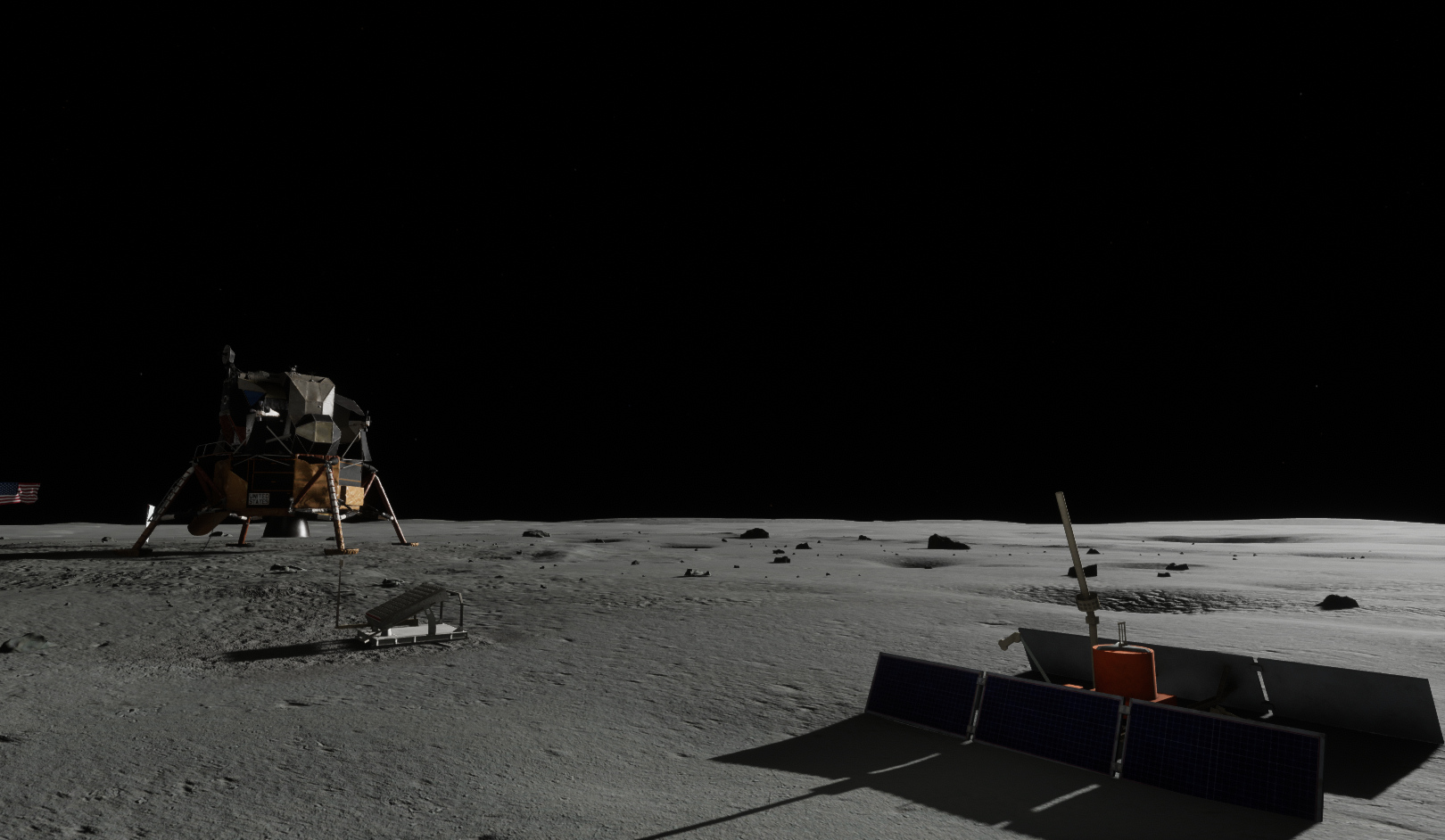
Also by Sansar Studios / Loot Interactive and NASA, Tranquillity Base reproduces the Apollo 11 Lunar Module as it sat on the Moon whilst Armstrong and Aldrin were on the lunar surface. This is a more static display when compared to the Apollo Museum, dominated by the Lunar Module and an overhead display which, when correctly aligned, provides insight into the surface equipment placed out on the lunar surface around the LM.
Visiting the individual elements will trigger playback of audio elements relevant to the science packages, whilst closer to the LM Armstrong’s famous statement on setting foot on the Moon’s surface can be heard.
Tranquillity Base: showing the Apollo 11 lunar Module Eagle in the background. In the middle of the picture is the Laser Ranging Retroreflector (LRRR), designed to gain accurate measurements of the Earth-Moon distance by reflecting lasers shot at it from Earth, and on the right, Passive Seismic Experiment Package designed to record “moonquakes”
And if you want to know how small the Earth looks from the surface of the Moon, be sure to tilt your camera up and around.
In Conclusion
As noted above, there are doubtless numerous other Apollo 11 celebrations – be they exhibits, parties or something else – across SL and other virtual worlds. But these are the ones I wanted to start here during this historic week. I hope you’ll take the time to drop-in and visits them.