As I’ve oft noticed in these pages, through her Nitroglobus Roof Gallery, Dido Haas presents some of the most evocative, engaging art to be found in Second Life. I’m constantly drawn back to the gallery each month as Dido has the ability to draw out the very best in the artists she invites to exhibit there, gracefully coxing their own inner voices to the fore.
However, Dido is herself a gifted photographer, although it is rare that she places her own art into the spotlight at her gallery. It is in part because of this that the latest exhibition at Nitroglobus is so attractive, because for April she offers a selection of her own work. I say “in part”, because Birds & Blue is very much a joint presentation from Dido (photography) and Harry Cover (ImpossibleisnotFrench – 3D elements).
We’ve turned Nitroglobus into a large pond, with the soothing sound of rippling water. Harry added awesome blue boats, barrels and super cool birds he made specially for this installation … For my part selected snapshots from my blog posts, which I made blue to fit into the mood of this installation, and I’ve added pieces of land (thx Miu) with seats and parasols, waving blue flower beds, rusty wind turbines, a beach hut, an animated rock and more… We hope you like to wander around, ‘cos it’s fun and should be enjoyed as such.
– Dido Haas describing Birds and Blue
Nitroglobus: Birds & Blue
The result is a setting that might be said to be much needed in the current times: big enough to have a wander around and enjoy the sounds and the setting; small enough to suit those who would rather just sit and admire the art and let the sounds wash over them and escape daily worries.
Tinted blue for the theme, Dido’s images further offer a means to relax and forget the worries of the world. Offering wide-open views, oft with coastlines and water, each piece sits as a window through which we can escape, perhaps to join Dido as she appears in many of the pictures, and share in her exploration.
When visiting, make sure you make your way up to the high beach house, where two of Dido’s black-and-white self-portraits offer s contract to the blue tones below.
Nitroglobus: Birds & Blue
A different kind of exhibition for Nitroglobus, but one that is nevertheless richly attractive.
The Oller Belair Art Gallery (follow the path across the covered bridge from the landing point), created and operated by Pencarrow Oller offers a venue for physical world artists to present their work within Second Life. In this, it presents an exhibition space that encompasses art by Pencarrow herself with artist in residence Layachi Ihnen, together with invited artist exhibitions and a monthly competition for physical world artists, the Unicorn Awards competition. For April, the invited artist is Uleria Caramel, whose exhibition Circular opened on April 3rd, 2020.
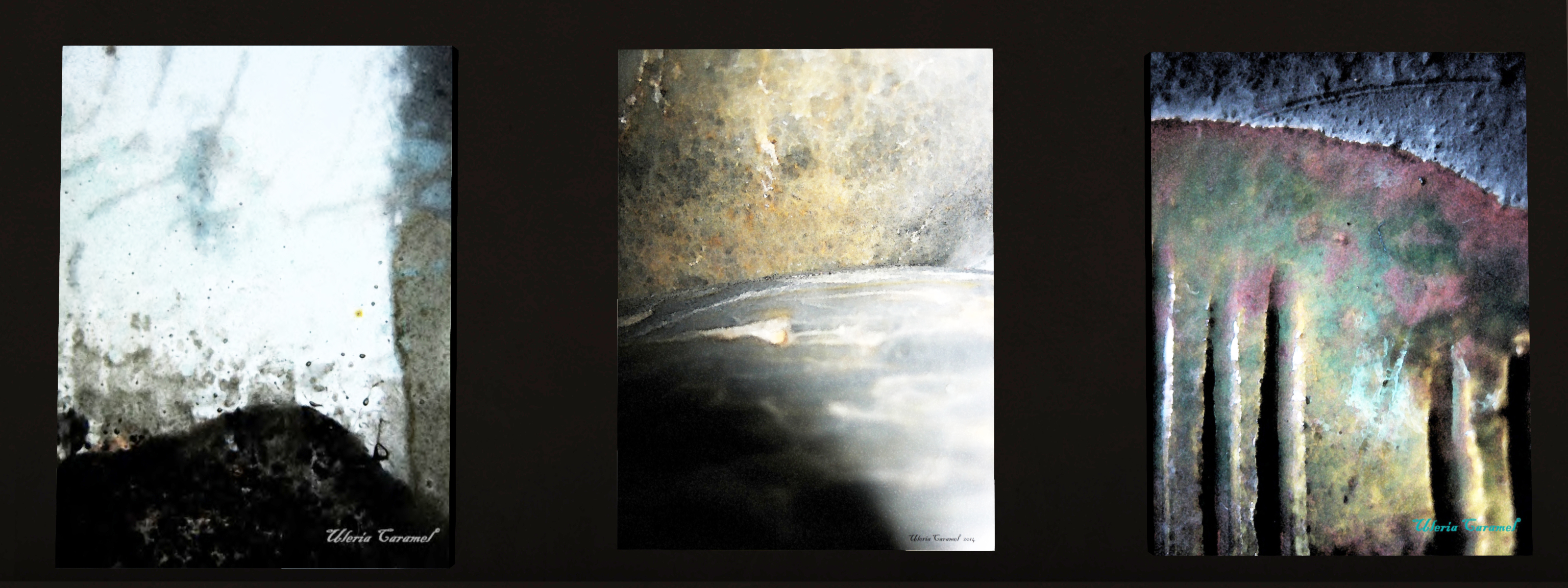
An abstract expressionist, Uleria works in a number of mediums: oils, glass painting, aquarelles, ceramics and photography. Her art combines colour and contrast, inspired by her own feelings and emotional reactions to the things and the worlds she observes; something that can give her art a particular depth of emotional resonance from observers.
This is particularly true for Circular, her exhibition within the Belair hall of the gallery. This series of works has, as their foundation, the on-going global crisis that is affecting us all, as Uleria noted to me when discussing the exhibition.
I was thinking, what would be this exhibitions theme, and the main thing in my mind has been this corona crisis on this Earth. So my vision started to grow from words like lifeless, rock, space, and round shapes like an Earth shape, the corona virus shape and round shapes in general. But I don’t want to the virus theme into the foreground; if someone sees it, that’s OK; if they see something else, that’s OK as well.
Oller Belair Art Gallery: Uleria Caramel
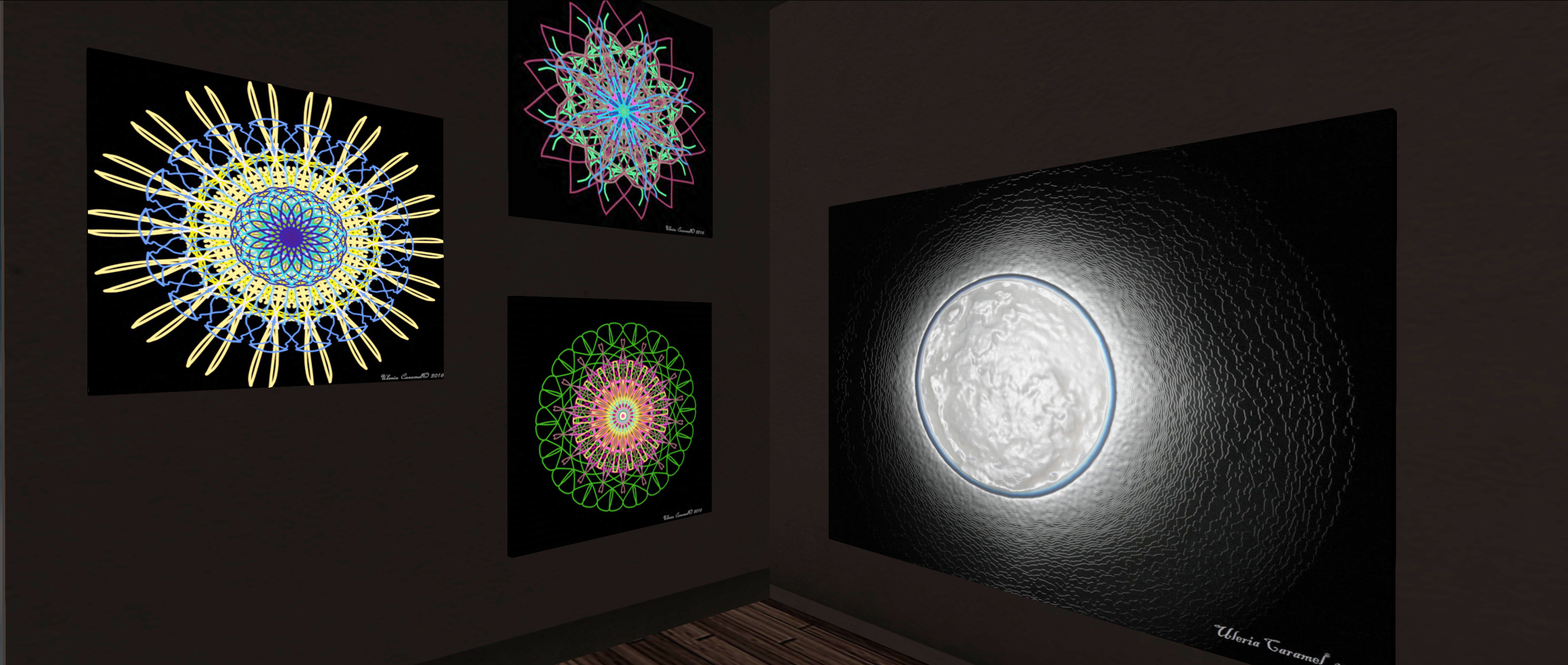
This idea of a theme for the exhibition that is not in and of itself a driving force behind the images presented within it is clearly reflected in the selection process Uleria used for Circular. While the ideas of circles, spheres and round shapes and form that might contain elements suggestive of things like a virus is prevalent in all of the images she offers here, none of the pieces have been created specifically because of the foundational theme for Circular; rather, they are all pre-existing pieces drawn from Uleria’s rich portfolio if past works.
This give Circular a layering of interpretation and emotional depth that is genuinely captivating; some of the pieces through colour, impression and shape offer very clear reflections of virus-oriented themes, from the idea of a viral invasion. Take Cell One, The Origins, and Drifting, for example, with the latter in particular perhaps bringing to mind oxygenated haemoglobin, so vital to aerobic respiration, offering an indelible link to the respiratory nature of the SARS-CoV-2 virus and the resulting Covid-19 disease.
Oller Belair Art Gallery: Uleria Caramel
Other pieces are more subtle in their connection to the thematic play of the exhibition, allowing us to view them entirely independently of that theme – although the threads of connection are there. Take the corner collection of mandala-like Kaleido images, together with Liquid Moon, for example.
These stand as pieces that engage the mind without any overt thoughts of illness or the like, yet within them are still thematic echoes: the Kaleido pieces offer both subtle suggestions of viral entities and of the interconnectedness we all share as a part of life that can enable their spread, while Liquid Moon can perhaps bring forth celestial thoughts on the cosmos around us and also suggestive of a single cell – the building block of life. Thus, these – and the other pieces presented here – mean that Circular can be viewed both as a social commentary for the times or purely as a retrospective of Uleria’s remarkable art.
Oller Belair Art Gallery: Pencarrow Oller
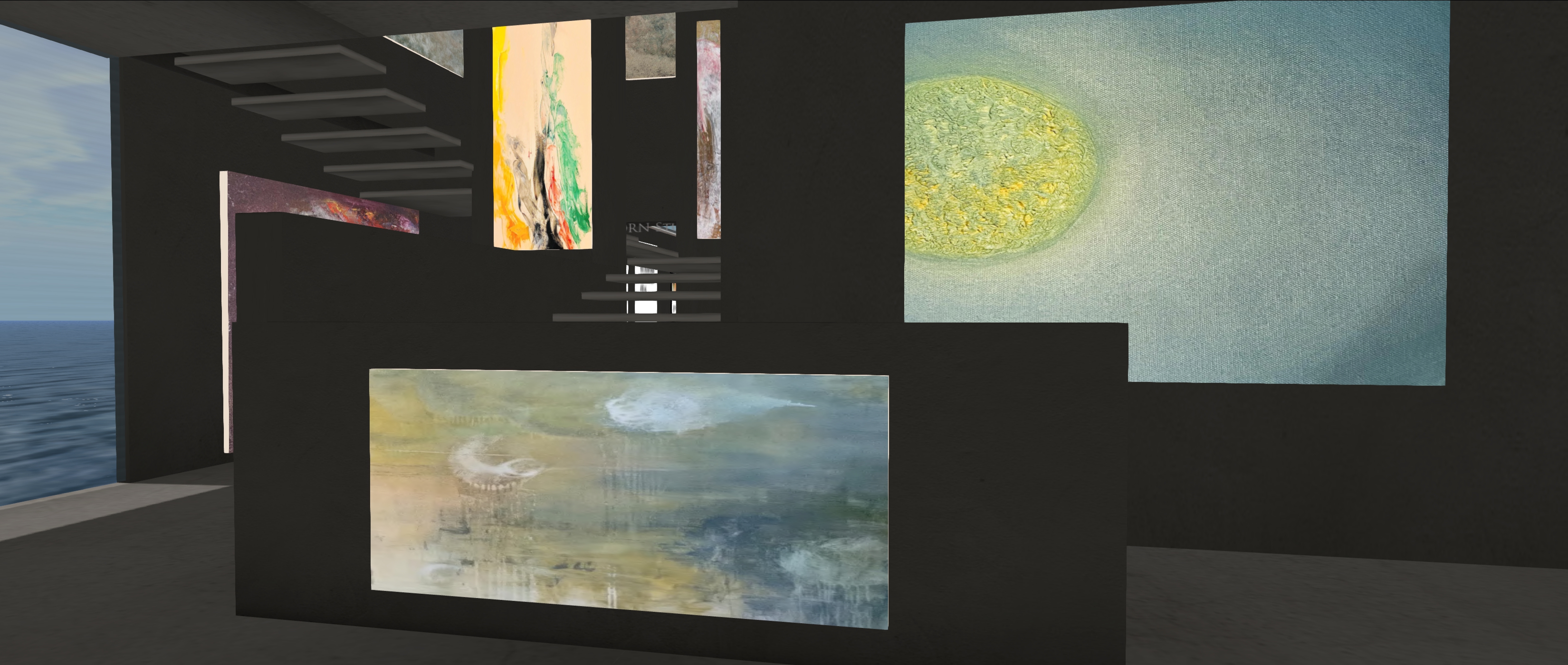
As noted, the gallery also features exhibitions by Pencarrow, who at the time of my visit was offering a display of abstract, flowing pieces inspired by haikus. Through their use of colour, these are expressive pieces, even without the words of the haiku which inspired them (these should be offered by touching an individual piece, although this was still to be set-up at the time of my visit), with the more slender pieces each suggestive of traditional Japanese scroll paintings, thus adding to the depth of the theme.
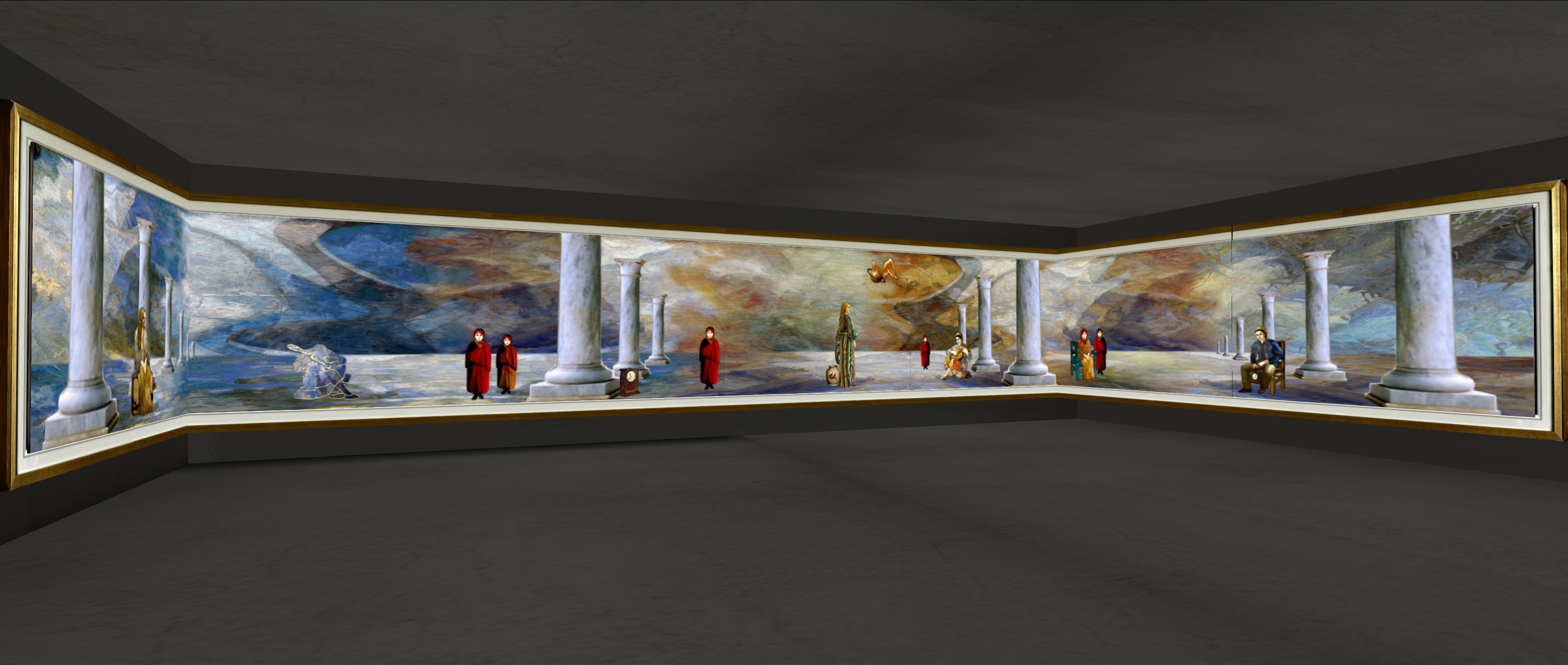
Deserving of a more expressive space in which to be shown, Pancarrow’s pieces occupy the Oller hall / stairway leading up to the upper floor of the gallery, where Layachi Ihnen’s always absorbing studies and portraiture can be found. These are presided over by the impressive multi-panel The Infinites, a study that wraps itself around three walls of the exhibition area to form an unfolding story.
Oller Belair Art Gallery: Layachi Ihnen
Provided for physical world artists displaying their work in Second Life, the Unicorn Awards is operated through the gallery, offering a prize pot of L$10K with art displayed in the Unicorn Studio hall. Each awards competition is themed, and details can be obtained by setting foot in the Unicorn Studio or by contacting the gallery’s manager, Airam79 Carami, in-world.
Sea Brook, April 2020 – click any image for full size
A full region using the full region land capacity bonus, Sea Brook is a remarkable setting that offers a stunning location that forms a rich, eye-catching, highly-photogenic haven of a destination that offers a tour de force of what can be achieved with vision and considered execution in region design in Second Life.
The work of Muira (Angelique Vanness) on behalf of Rahnn Parker (Rahnn) and Carrie Parker (Cari2017), the region is a tour de force demonstration of Muira’s remarkable eye for region design, something I first noted in 2019 after visiting Season’s Cove (now closed, but see The magic of Season’s Cove in Second Life). As with that design, this is one that again feels far bigger than its 256m on a side size. In this instance, the sense of size and space is made all that more remarkable by the fact that much of the centre of the region is given open to open water.
Sea Brook, April 2020
The water takes the form of an extensive lake fed by falls that drop from a massive up-thrust of rock that rises to the north-east of the region in great granite or basalt blocks, topped by high fir trees. A broad, paved footpath winds its way around the lake’s shoreline in a loop, connecting three small terraces that thrust their own out into the clear blue waters. One of these terraces forms the regions landing point, whilst all three present impressive views over the lake. At one end, this footpath connects to an imposing lodge that whilst grand in size, utterly fits with its surroundings. To the other end the path gives way to a rocky path – one of two in fact – that switch-backs up to the top of the high plateau.
Between the lake and the waters beyond the edge of the region, the land is entirely-low-lying with the exception to the huge plateau. Theses lowlands are rich is detail and – if I might use the term again – present an expansive setting. Rich in tall Scots pines, they are marked by gravel tracks that run around the outside of the paved path around the lake, the woodlands between pavement and gravel cut through with winding trails that allow visitors to wander and discover all that lies under the shade of the trees: ponds, little camp sites, a children’s playground, picnic spots – the list is extensive without – the setting ever feeling crowded.
Sea Brook, April 2020
The paths also provide links to other locations within the region. These include a west side beach, tucked between two headlands. One of these is home to the ruins of an ancient church that now offers a cosy retreat. A second, intact chapel forms a book-end to the ruins, sitting on a low hills on the other headland, resting atop a low hill that allows it to look north across the beach towards the ruins of its companion.
East and south, behind the great lodge – which appears to be open to the public and itself offers an impressive place to explore – the land opens a little as at sits between rocky highlands and a growth of mangroves that surround one of the smaller islands sitting just off the coast. This little island is home to an old gazebo that offers a place to dance. Across the narrow channel separating the gazebo from the lodge, sits a little fenced meadow, a place where visitors can rez a horse to ride around the region – something that is well worth doing.
Sea Brook, April 2020
Atop the plateau there is yet more to discover, the switched paths leading up to it connected one to the other by gravel trails that wind across the plateau, separating the woodlands to offer obvious paths for people (and horses) to follow and which take visitors past table-top games, and along an arched path to another dance area that offers an elven theme.
As with the lands below, the plateau is also cris-crossed by wooded paths that reveal more secrets among the trees, and which I’m not going to spoil by mentioning here. However, I will say that look carefully enough and you will find a zipline that runs down to the little finger-like island rising from the middle of the lake and where bumper boats can be rezzed by those looking for a little fun.
Sea Brook, April 2020
Nor is this all; below the plateau, and nestled in the roots of the cliffs, are wooden doors awaiting discovery. They lead to a network of tunnels and chambers that run through the rocks from on side to the other. With paved floors and faced stone walls, these tunnels and the halls and rooms that open off of them make for an intriguing point of exploration on their own; one looks like a former wine cellar, others present more intimate spaces.
A truly stunning design, Sea Brook is absolute perfectly set within the encircling region surround of high mountain peaks that – with the right windlight – give it tremendous depth, this is not a setting to be missed. It has a huge amount to discover (I’ve only scratched the surface here), and is finished with a matching sound scape.
The Second Life Railroad network is one of the major features of Second Life mainland – notably Heterocera – with lines also to be found on south and east Sansar and on Bellisseria, with number smaller (and private) lines also to be found across Second Life (such as the system in Second Norway).
Much as anyone can operate a car on the roads in Second Life, any Resident may use this public facility for any purpose consistent with the Second Life Community Standards/TOS (and at times the Lab has provided automated rail services). However, finding your way around the network can be a tad confusing, so enter 由里子 (Rydia Lacombe).
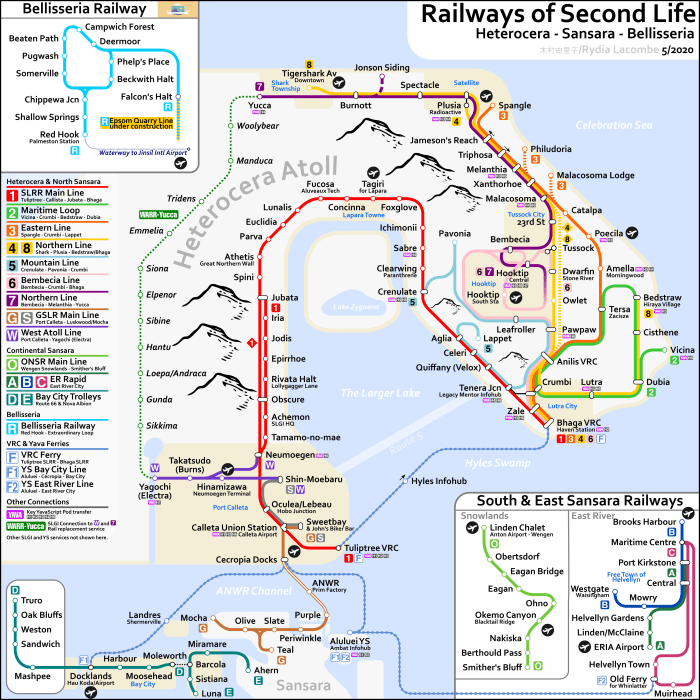
Not only is Rydia the creator of the sci-fi themed Aoshima, a homestead region Caitlyn and I enjoyed visiting in February (see: Beaming in to Aoshima in Second Life), she is a SLRR enthusiast, and something of a cartographer. She recently sent me her most recent map charting the major Linden-supplied train routes across and around Heterocera, Sansar and Bellisseria – and it is an impressive piece.
Rydia is a keen SL rail-roader, something she noted to me as we chatted about the map.
It’s what keeps me exploring! Mostly it stems from the time the WARR started building in front of the Burns freebie warehouse. I made my first SLRR railway maps in 2013 / 2014. I don’t have a formal means of distributing the maps, except through the various groups. The Virtual Railway Consortium [VRC] distributed my previous maps, but they don’t appear to be quite as active now.
– Rydia talking about her SLRR map work
WARR is the West Atoll Railroad, an electric railway line founded by Hilto Meridoc in 2010 and operating in southern Heterocera Mainland. The line opened in stages, first from Neumoegen to Electra, then east to Hera and west to Elpenor, before eventually closing in 2013, although I understand a part of it reopened in 2019.
Click the map above to go to the full-size version which you can examine on-line or right-click and download.
Despite its age and need of upgrade or overhaul, the SLRR has remained popular over the years and can offer a unique way of seeing Second Life mainland. Such are the number of lines and routes in Heterocera alone, that having a map makes a lot of sense, and the version Rydia has produced is an extensive, impressive, polished, professional, and informative piece of work.
As with a physical world railway map, the various lines are colour-coded, and the map includes all the major routes associated with the SLRR, form the SLRR Main Line through to the likes of the old WARR line, the the Okemo, Nakiska, and Southern Railway (ONSR), the Great Second Life Railway (GSLR), as well as the smaller and the more metropolitan routes such as the Northern Branch or the East River City Metro, the Bay City Trolleys and the current routes available in Bellisseria. Stops for the likes of airports are provided, together with crossover stations.
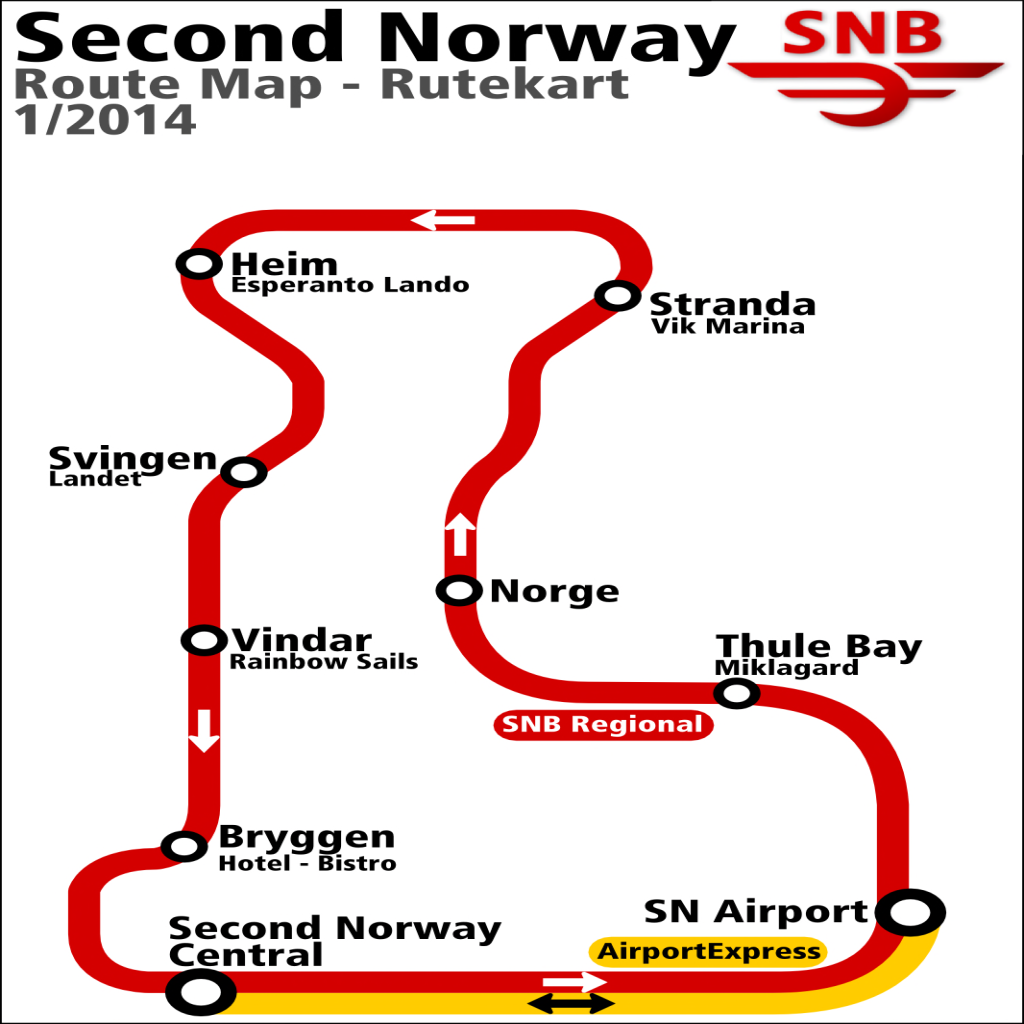
Rydia’s 2014 map of the Second Norway system
Unsurprisingly, Rydia’s work has been positively received in the past, with her approach to maps being adopted in a number of mainland regions.
As well as the 2013/2014 maps and this new iteration that would add grace to any SLRR station, Rydia has also produced maps for some private region transport network, such as the Second Norway system (also perhaps in need of a little TLC, depending on what eventually happens to that estate – see here and here for news).
There is a wealth of information available in the SL wiki about the SLRR – although I cannot vouch for how up to date it is – starting with the official page, and also covering the likes of the VRC, and from these, it’s possible to find out more about various lines and routes. Links from these pages also point to more technical discussions of the SLRR and Second Life vehicles. There are also various private estate lines (as with Second Norway), but these are currently outside the scope of the current map.
Despite some of the issues that can be encountered on the SLRR, if you’ve not tried it before, it’s certain worth exploring – even if only be reading about it initially. For my part, it’s something I’ve never actually blogged about per se in these pages, although I’ve ridden various trains and tracks.
Hmmm… so perhaps it might be time for an occasional series in these pages, something perhaps called From the Footplate or similar.
My thanks to Rydia for contacting me and for our chat.
Men in Focus, the gallery owned and sponsored by Men in Motion in support of the Movember Foundation (donations to which are accepted at the entrance to the gallery) and curated by JMB Balogh, will launch its latest ensemble exhibition on April 1st, 2020.
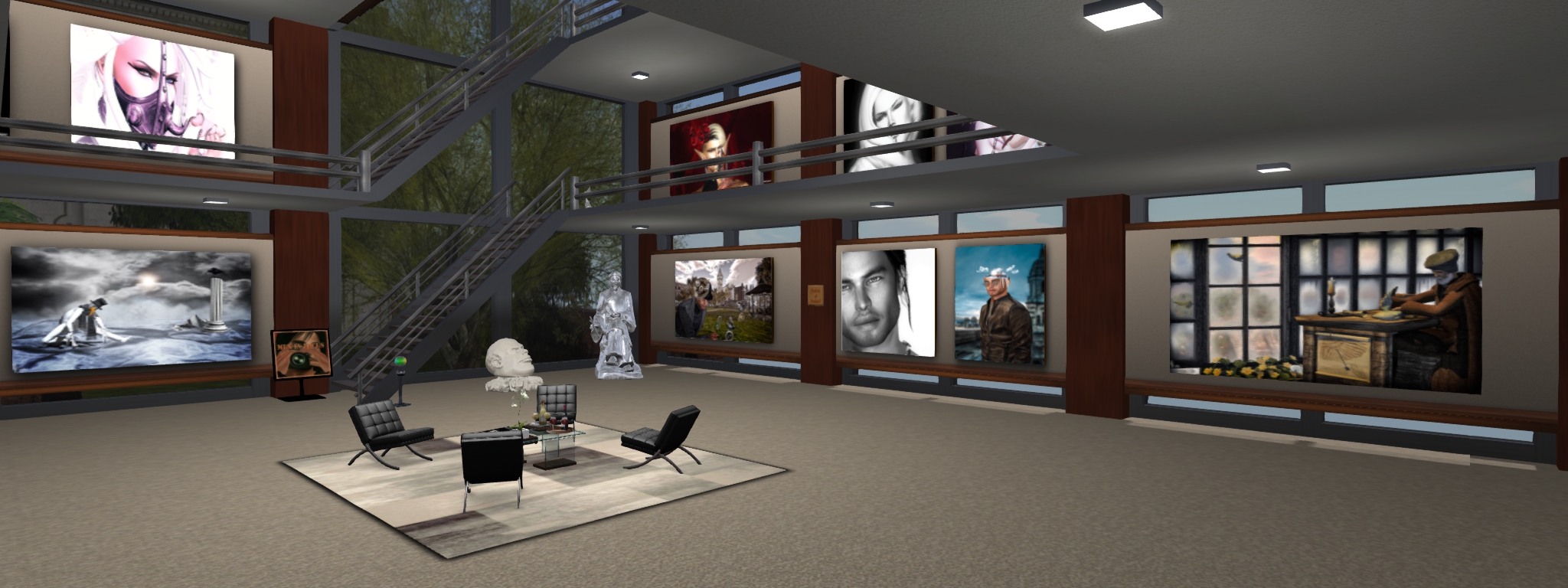
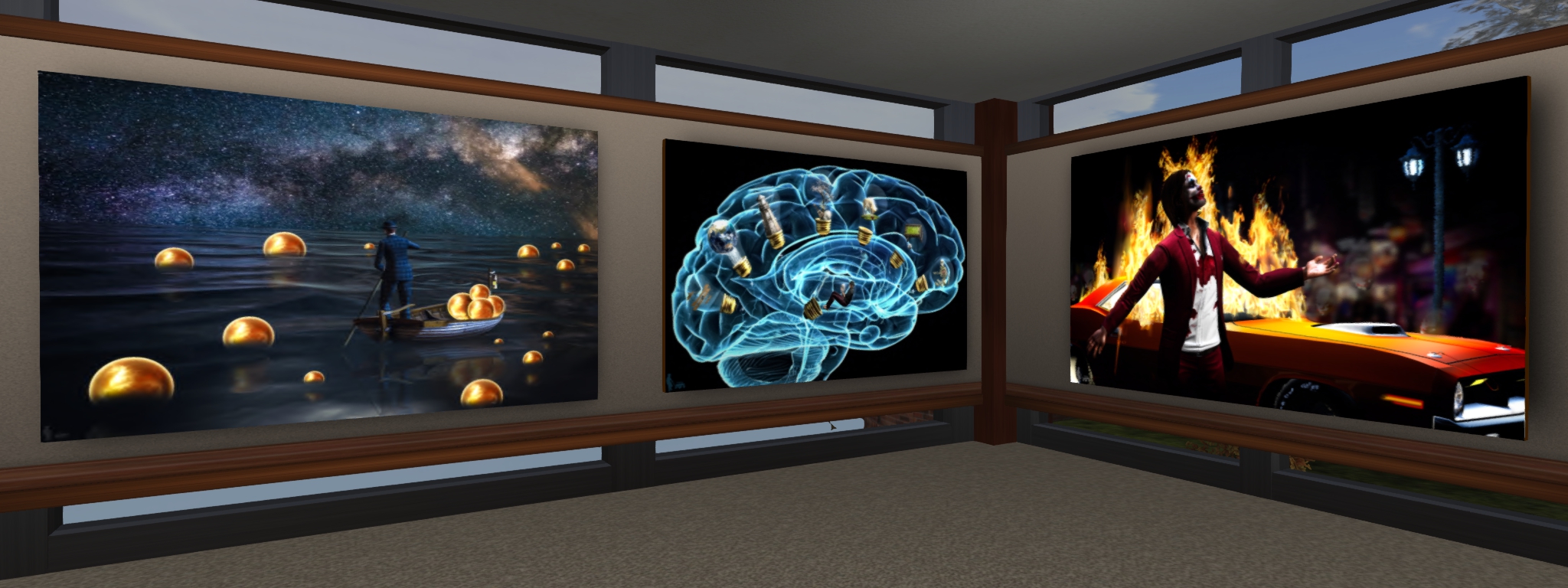
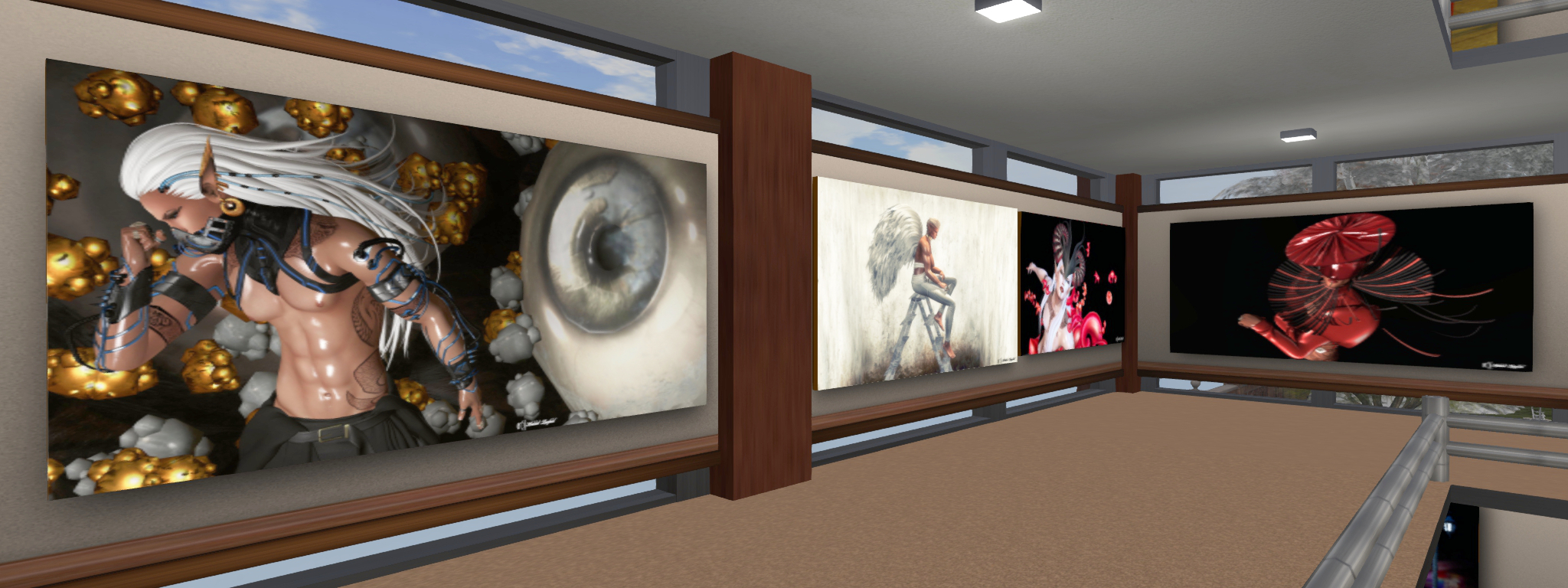
As I’ve previously noted in writing about Men in Focus, it is something of a unique location in that it focuses solely on male avatar studies and art my male artists in Second life, featuring art from invited artists and by members of the Men in Motion group. For this exhibition, the gallery features as 2D guest artists AlCyan, BanagherLinks, Patrick Ireland and Hobbit Zenfold; and 3D artists Reycharles, Harry Cover (ImpossibleIsNotFrench), Mistero Hifeng and Luc Lameth.
Men In Focus: Patrick Ireland
The range of art offered is once again impressive, each of the 2D artists utilising rich styles and approaches. On the ground floor, Patrick Ireland offers a fabulous series of images that run from self-portraits through social commentary and historical settings to provocative pokes at our imaginations, and reflections of popular culture, all wrapped within pieces that carry their own stories.
On the floor above, Hobbit Zenfold – an artist I’ve not previously encountered – offers a range of pieces that might be more closely focused as self-portraits, but which are equally rich in narrative, with several offering a fantasy or fashion element to them. A link in the form of face paint from both Hobbit and Patrick coincidentally flows between their individual exhibit spaces, the pieces containing it also offering an echo of cinematic wickedness.
Men in Focus, April 2020: Hobbit Zenfold
Above Hobbit, on the next two floors, AlCyan and BanagherLinks offer expressions of their Second Lives as avatars and photographers, each constraining his display to colour images that have depth and narrative before they in turn give way to pieces by members of Men in Motion on the upper floors of the gallery.
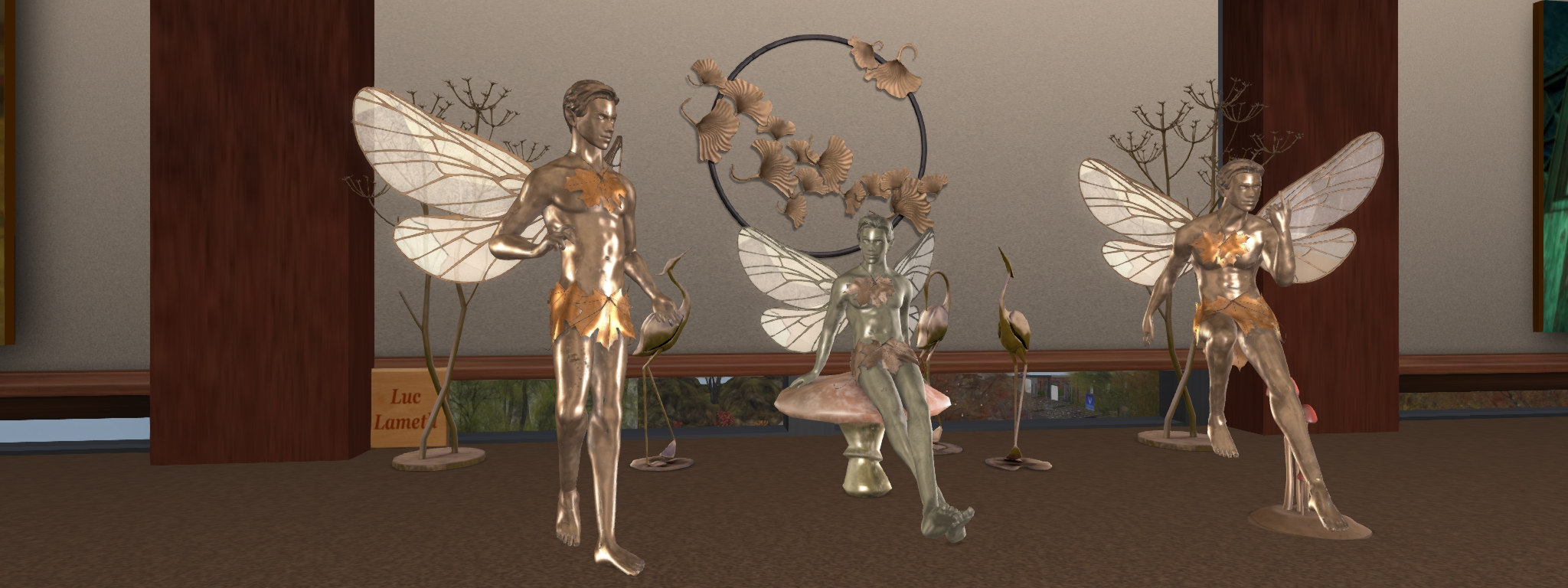
Spread between the floors are the 3D pieces by Harry, Mistero, Reycharles and Luc Lameth – the latter of whom I’ve also not previously encountered, and I found his Autumn Fairies selection a unique and charming turn in presenting fae folk (whom are so often presented in the female form), while his Shaolin Buddy (a play on Buddha) figurines are utterly charming – as is Harry Cover’s Nuts and Bolts Band.
Men in Focus, April 2020: Luc Lameth
April is Testicular Cancer Awareness Month, and Men in Focus is raising awareness of the disease, including how to self-test for possible signs of the disease through s series of information boards at the gallery’s landing space. Given that testicular cancer tends to be very prevalent among men of younger age ranges than we perhaps tend to associated with cancer (15-49 being the common age range), these boards are very much worth taking time to read if you are male.
Another excellent exhibition at Men in Focus, carrying with it a focused aim. The formal opening will be held between 18:00-20:00 SLT on April 1st, 2020, although the exhibition is already open for preview.
I’m reporting this a little late, given that both exhibitions only have a few more days to run, but currently on display in the featured artists sections of Sisi Biedermann’s Gallery are Melusina Parkin and Zia Sophia (Zia Branner), who will be at the gallery until the end of the month, so there really is only a couple of days left in which to see them!
Melusina Parkin really needs no introduction to readers of this blog; I’m an admitted admirer of her work, which I’ve featured in these pages on numerous occasions. Within her space at Sisi’s, she offers Journeys, another utterly engaging take on Second Life, the places it offers and their innate beauty.
Sisi Biedermann’s Gallery: Zia Branner
Melu’s eye for angle, depth, composition and detail always presents chances to see Second Life in a new way and / or light. Rather than focusing on the whole to tell a story, she discovers the part that perhaps utters only a single line: the curve and rise of a paved footpath as it winds between cresting undulations of flowers before it vanishes over a low rise; the silhouette of a lighthouse caught between the branches of a thicket as the Sun dips between the coastal hills beyond; a tree dipping branches into the sea as if testing the temperature of the water…
All these, and the rest of the images in Journeys form whisperings that are just enough for the imagination to create an entire world around them. At the same time, there is a rich impression of openness and space present within each piece that truly gives us room to breathe, to feel a sense freedom – something that in the current climate of having to stay at home and away from the rest of the world, can be refreshing and uplifting.
Sisi Biedermann’s Gallery: Melusina Parkin
Zia Branner is an artist in the physical world who uses paints with acrylics and use a variety of structure material – paste, gel, sand, glue, bandages and paper – together with oil crayons and acrylic ink, to accentuate elements with her pieces. Canvas is her preferred medium, although she also uses wood and paper, and while she has had formal art teaching, she is also autodidact, learning techniques and approaches whilst experimenting with art.
For her exhibition at Sisi’s, Zia offers an impressive portfolio of her art, from sweeping landscapes that encompass coastal scenes and rolling dunes to charcoal-like sketches of flowers and more abstracted pieces that use colour and line to capture the attention and hold the eye.
There is a vitality about each of these pieces, be it as a result of the sweep, turn, and mix of colour in some or the tactile sense of texturing visible in others, that truly brings them to life, perfectly echoing Zia’s view that “making art is rebellion against the finality of mankind”.
Sisi Biedermann’s Gallery: Zia Branner
As always, the floors of the gallery above the featured artists spaces are home to Sisi’s own remarkable and utterly captivating work. Having started painting in acrylics in the early 2000s, Sisi has developed her technique to encompass a range of styles and approaches, from painting to mix media and digital collages to Second Life photography, whilst encompassing a wide range of genres – fantasy, wildlife, portrait, landscape and so on. It is not hyperbole when I say her work is genuinely second-to-none for its sheer beauty and richness of expression.
Located just outside of the gallery is a broad glass-like spiral stairway leading up to the Artists United Gallery, were pieces by the likes of Rage Darkstone, TerraMerhyem, Nils Urqhart, Layachi Ihnen, Milly Sharple and more are offered in a richly eclectic and engaging exhibition that adds further depth to a visit to the gallery.