Stopping by a Paradise on Sea in Second Life

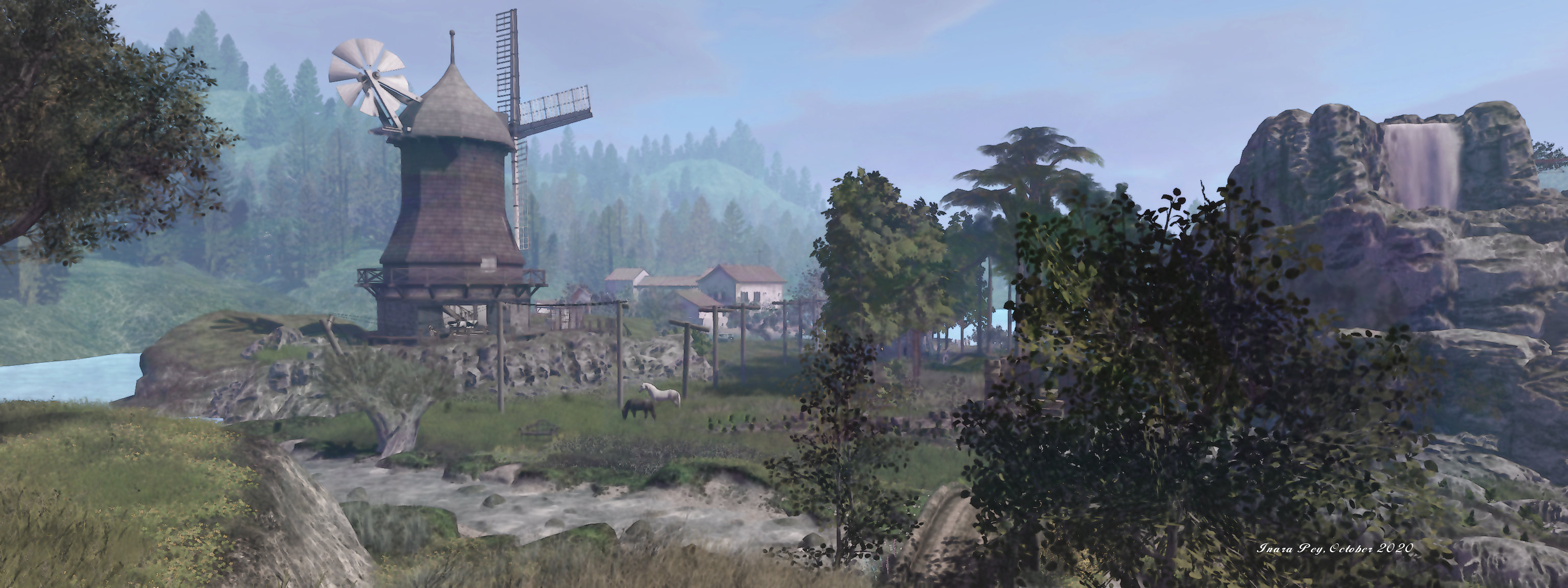
Paradise on Sea, October 2020 – click any image for full size

Paradise on Sea came to our attention via Shawn Shakespeare (who has perhaps the most unique talent for finding regions that are open to photographing / writing about). A Full region held by Bellita (Belle Onedin), it offers a home for her SL business, Heart Poses located on a sky platform high above the region, and a ground level that is open for visitors to explore and appreciate.

Set in summertime, the region offers a warming visit for those of us sitting in the northern hemisphere, where the weather seems to have decided to skip autumn entirely, and settled on scowling, rainy, winter-like days. Given this lean towards summer, Paradise on Sea is a bright, lush setting, full of greenery and with flowers – wild or potted – in full bloom to offer bright splashes of colour against the rich greens.

Paradise on Sea, October 2020

Although offering the “on Sea” in its title, the region has the appearance of being located within a landlocked lake, verdant hills cut by a single  serpentine river surrounding its three islands. The largest of these, forming the bulk of the region, is home to the landing point – which is not enforced (in fact the coordinates found in About Land’s Options tab are actually off, and will drop you into the waters of the region’s east side) – is located in an old stone ruin that offers a teleport disk up to the Heart Poses store.

The landing point sits at the feet of a tall, blunt-topped peak of rock that rises from a broad base that mixes grassy slopes with pools of clear water fed from numerous falls that tumble from multiple points in its sheer faces. It’s a distinctive rocky mass, vying with the huge form of a wooden windmill sitting on its own rocky upland to the south, and a nearby cedar of Lebanon for recognition as the tallest object on the island.

Paradise on Sea, October 2020

From the landing point, a cobbled path points both north and south – the former direction leading to the open fields that wash tall grass around the base of the windmill’s rocky foundation, while the latter direction winds its way to the north side of the region and the shallow cove of a beach.

Here wooden platforms rise in individual tiers from the narrow lip of grass between the beach the the walls of the high peak, ladders linking them to provide the means to scale the heights, passing water that drops to feed the beach-side pools that don’t reach the lake but instead offer places for birds and ducks to take a drink. Climb the ladders and platforms, and they’ll take you to a point just below the summit where a hot spring resides – or for the daring, a hang glider can be launched for an aerial view of the region and its surrounds.

Paradise on Sea, October 2020

The windmill is not the sole building within the region: four houses await discovery by explorers, with three of distinctly Tuscan design, suggesting the region might be somewhere inland in central / northern Italy. Two of these are to be found on the smaller islands that lie to the north-west and on the east side of the main land mass. Both are furnished and offer much to see both indoors and in the grounds around them The third and largest a villa occupies a south-west headland that is just a jumble of rocks away from becoming separated from the rest of the landscape as it dominates the flat sandstone slab of rock on which it sits. Again furnished, and with an inviting courtyard within its walls, it calls to visitors to come and explore it.

A surfaced, single-tracked road curls outward from this villa’s humped bridge. Passing around the shoulder of the windmill’s table of rock, the road ends close by a gabled cottage with an air of rural France about, it neatly juxtaposed by the very British presence of an old red telephone booth facing it over a parked car. Sitting within its own gardens and grounds, this cottage lies just above the waters of the lake and shares its location with a charming little painter’s studio and a small houseboat linked to the land by a wooden pier and deck to offer something of a floating summer house.

Paradise on Sea, October 2020

This is a region packed throughout with detail and many, many opportunities to sit and relax as well as for taking photographs. As noted, all of the houses are furnished – as is the windmill, while the outdoor sitting spots can be found in their grounds or gardens, along the beach, up on the tall peak and elsewhere. Cars (roadworthy and not) add a further sense of human life to the setting, whilst the birds overhead and the horses in fields and close to houses add their mix of life and presence to the setting.

With so much going on within a region that uses the private region land capacity bonus, there is a lot for the eye – and the viewer – to take in, and it would be remiss of me not to note the fact that the volume of mesh and textures can take its toll on older systems, and disabling shadows for those that use them might be advisable when moving around. Nevertheless, Paradise on Sea is a rewarding and engaging visit, and photos taken within the region can be submitted to its associated Flickr stream.

Paradise on Sea, October 2020

SLurl Details

JudiLynn’s Mindscapes in Second Life

Mindscapes: JudiLynn India at Janus Gallery II

I made my second visit of the week to Chuck Clip’s Sinful Retreat region in order to see Mindscapes, an exhibition by JudiLynn India, and which can be found within the region’s Janus Art Gallery II.

JudiLynn is a remarkable abstract artist who has been active in Second Life since 2009. Having studied graphics design at the Tyler School of art, at the opening of the new century she decided to focus her creativity on acrylic and digital painting, particularly exploring the opportunities for textured painting in the former and the ability to play with light and colour with the latter. When combined, these two approaches give her art a genuinely tactile dimension which in turn breathes a fascinating sense of life into them.

The title of this exhibition appears to be drawn from the fact that much of JudiLynn’s work originates within her mind’s eye, rather than being inspired by external sources. These are bold, vivid pieces, clearly drawn from her love of colour, their finish retaining the layered, tactile look that is so intrinsic to her art.

Mindscapes: JudiLynn India at Janus Gallery II
It is my goal to make charitable creation my life’s work. My intent is to share my craft and use it to raise much needed support for organizations that improve the quality of life for people at home and abroad.

– JudiLynn India, describing her art and her approach to life

Fourteen pieces are offered – twelve as conventional canvases, two as totems standing within shallow alcoves in the gallery’s curved wall. While all the pieces naturally draw and hold the eye, their mix of bright tones and more organic colours quite captivating, I confess that I found Mindscape 2 Totem particularly attractive; the colours within it richly organic, its form – a rectangular block – primal, its entire form exceptionally Earthly – by which I mean it has an element of having been drawn from the very crust of the planet, and raised up to offer a story of the ages that progresses down through its colours.

but each of these pieces that make up Mindscapes has something to say to those looking upon it; there are subtle narrative running through each, be it due the the shapes that are suggested within each or the manner in which colours ebb and flow with one another or intertwine gracefully, or the suggestion of things half-seen produced by the mix of line, colour and textural layering.

Mindscapes: JudiLynn India at Janus Gallery II

Captivating, entrancing, emotive and offering a combined journey into the art and imagination of their creator, the pieces presented through Mindscapes are not to be missed.

SLurl Details

Dya’s Southern Twilight in Second Life

Dya’s Southern Twilight, October 2020

We received an invitation from Dya OHare to visit the latest iteration of her region builds, “We’re not so far from the Caribbean,” she said, referencing her last design I covered in these pages (see Dya’s Scent of the Caribbean in Second Life). “I’ve tried to show a bit of the Southern Life and I hope you like it.”

So off we hopped to see Dya’s Southern Twilight, a place that presents a rich mix of southern American life in the form of aspects of New Orleans together with sights that might be found in Mississippi and Louisiana. This sounds a lot to cover in a single region, but Dya does a good job of mixing multiple aspects of these states and the Crescent City, with touches that suggest the era of the 1930s-1940s – although it could just as easily be a modern setting.

Dya’s Southern Twilight, October 2020

The region is diagonally split by a river running from the north-east to the south-west, representative of the Mississippi itself. The landing point sides on the north bank of the river, on a road that serves a built-up area suggesting the older parts of New Orleans. Here can be found multiple places of business, side streets with cobbled surfaces and tram tracks, a place where street urchins play (or perhaps whisper plans to hop a tram whilst avoiding the fare), and an open air café awaits patrons.

Also to be found on this side of the river is a touch of the city’s French Quarter. This takes the form of a street overlooked by wrought iron guarded balconies draped with flags, with more fluttering from short poles leaning out from the railing tops. Lights strung across the street help illuminate it, together with the signs for the local bar and the hotel, whilst the end of the street is awash in colours that splashes over aged whitewashed walls from two tall street lamps.

Dya’s Southern Twilight, October 2020

This built-up area is bracketed by sights often associated with New Orleans in film and television: a paddle steamer moored on the river, and a cemetery complete with family mausoleums. For the romantics, one of the Crescent City’s white horse-drawn carriages sits at the roadside as well.

The south side of the river has a small harbour area that connects it to the north side with the assistance of a girder bridge of the kind seen along to Mississippi, but also opens out to contain a suggestion of the bayou, complete with trees rising from misty waters, with cabins potted in the open spaces.

Dya’s Southern Twilight, October 2020

Separated from the bayou by shrubs and dense foliage sits one of the grand old plantation houses associated with the southern states. Set back from the riverside road, it rises from the end of a long footpath, the front door open to invite visitors into the partially furnished interior. Horses graze in the field alongside the the house, whilst a tall hedge guards a small, neat garden to the rear, which also has access to a local beach.

Rich in detail with plenty to discover, appreciate and photograph, Dya’s Southern Twilight continues Dya’s tradition in creating engaging locations for people to visit.

Dya’s Southern Twilight, October 2020

Our thanks also to Shawn Shakespeare for the LM.

SLurl Details


Milly Sharple’s Meanderings in Second Life

Meanderings: Milly Sharple at The Janus Gallery

Milly Sharple is a remarkable artist, creator and patron of the arts in Second Life. An artist and photographer in the physical world, she has always enjoyed art and artistic expression, particularly that of fractal art, a technique she started using in 2005.  It’s a medium in which she has gained deserved recognition: she has sold pieces around the globe, had them used as book and CD cover art and as promotional material, and has had her work used on the face of the bank cards issued by an Indonesian bank. Her work has even brought her to the attention of Salvador Dali’s protégé, Louis Markoya, who asked her to collaborate with him.

Milly was perhaps one of the first artists to bring fractal art to Second Life after she joined in 2008. Gaining familiarity with the platform, it became a place where she understandably wanted to exhibit her work, and following her initial exhibitions, she started receiving multiple invitations to display her work. She thus became immersed in the Second Life arts community, establishing her own gallery and also the Timamoon Arts Community, a place where artists could find a gallery home and like minds, and over the course of four years, she grew Timamoon into one of the most successful arts communities in Second Life.

Meanderings: Milly Sharple at The Janus Gallery

For her incredible and expressive fractal art, Milly uses the Apophysis software package, which allows her to create soft, flowing, liquid effects that sets her work apart from other, more rigidly geometric fractal art with which we might be familiar as it is displayed in Second Life. This approach gives her work a stunningly organic look and feel, rich in life and often encompassing the intricate beauty of the Mandelbrot set.

However, Milly is not constrained to only producing fractal art; as a mixed media artist her expressive range is broad and deep – and I have long been an admirer of this aspect of her work as much as I am her fractal art. Indeed, I’m honoured to be able to have a copy of what I regard as one of the most engaging pieces of art in my modest personal collection -her  Woman with Cat – hanging on the wall at our SL home. As  with her fractal work, Milly’s mixed media art couples a rich use of colour with an etching-like finish to bring individual pieces to life in the most incredible manner.

Meanderings: Milly Sharple at The Janus Gallery

I mention all of this because Milly has a new exhibition of work currently being hosted at Chuck Clip’s Janus Gallery, which opened on September 27th.

Meanderings brings together all of the above elements of Milly’s art and adds to it with a selection of her black-and-white portrait studies in a captivating microcosm of her talent. On display are seven large-format fractal pieces (with the patterns of two repeated on benches in the gallery’s two halls, and a third mirrored and inverted in the foyer that so blends with the décor, it might easily be overlooked), eight monochrome portraits and eight mixed-media pieces that are – without being in any way superlative – utterly stunning.

These latter pieces bring together all aspects of Milly’s art: her fractal work, her skills as a portrait artist and her  expressiveness as a mixed media creator; there is a richness of life about them that is utterly absorbing, Similarly, the depth of life in the black-and-white portraits cannot fail to hold the eye; these are pieces that, whether inspired by real people or their images, or have been drawn entirely from Milly’s imagination, not only capture the likeness of the subject, but offer a very real sense of their life essence. Further, these monochrome pieces share a strong sense of narrative flow that can also be found within each of the mixed media pieces, thus presenting a thematic thread to connect them, whilst their arrangement around two of the much larger (and richly organic) fractal pieces offers a natural visual connection to them.

Meanderings: The Mystic and The Flirt (with its hint of Kate Bush) two of the entrancing mixed media pieces presented by Milly at The Janus Gallery
Taken together the three styles of art present within Meanderings offer a rewarding introduction to Milly’s art for those unfamiliar with it whilst also offering a unique thematic and narrative flow through the differing mediums, making this both an engaging and outstanding exhibition.

SLurl Details

Talia’s Still Waters in Second Life

Still Waters, September 2020 – click any image for full size

I’ve long appreciated the region design work of Talia (Natalia Corvale),  having written about her designs for Broken several times. So it was with a sense of anticipation that I hopped over to Still Waters, a further homestead region she recently opened to the public at large. And as someone who appreciates open spaces and rural settings that can have some subtle quirks, I  found myself instantly at home and appreciative.

Still Waters is a prime example of sensible region design, one in which consideration of layout, theme, and thoughtful selection of items give rise to a setting that is self-consistent and rich in detail but doesn’t unnecessarily tax the computer running the viewer. Multiple use of landscape elements helps reduce the use of unique high-res textures, whilst considered placement ensures the viewer is not burdened at any point by a mass assault of mesh demanding to be rendered.

Still Waters, September 2020

The region sits as an island sitting within an almost entirely land-locked lake occupying a bowl formed by three-covered hills. I say lake rather than coastal inlet, as the ducks and swans swimming the waters would indicate they are freshwater, rather than of the salted variety. This water sweeps into the island to form a broad bay, the land reduced to a curved ribbon of green and autumnal hues, backed to the west by a ridge of uplands that broaden to the north to become a broad terrace of rock overlooking the bay, whilst dropping down to the south to become a low-ling headland.

The landing point sits at the mid-point in the curve of the bay’s shore, a wide deck built out over the water, a wooden lodge standing behind it waiting to greet visitors. The deck offers numerous places to sit, including in the rowing boat tied-up alongside, together with a small summer house sitting to one side between deck and lodge. The lodge is cosily furnished – as are all the buildings presented in the region – and visitors can wander through it to the back door, or around it from the deck, according to their preference.

Still Waters, September 2020

South from the lodge, a wooden bridge passes over a narrow channel of water. This flows under an arched canopy formed by two lines of four plane trees apiece, standing on either bank of the channel. They serve to shade the channel and hide a small, comfortably furnished gazebo sitting over the water, warmed by its own fireplace.

The bridge leads to way to a meadow of long grass, the home of a wagon, horses and a tractor. Check the horses carefully, and you’ll find one is a Water Horse that’s available for a visitor to ride (if you have a wearable Water Horse or Teagle, you can also wear and ride that for exploration). Beyond the meadow, the grass shortens and two quirky tree houses await discovery and exploration, a winding path linking them.

Still Waters, September 2020

West and north of the landing point, the land remains open and grassy before climbing up to the northern headland and its table of rock. Gabled gates mark the patch up to the top of these uplands, watched over by another open-sided pavilion offering seating before a stone fireplace, and a little garden chair sitting on the lip of the promontory above the path.

At the top of the path sits another wooden house, this one raised about the grass on stout legs, reached by steep steps.  The interior of the house offers another warm welcome with places to sit and bric-a-brac to admire. Young pygmy goats frolic in the field next to the house, their presence an interesting contrast to the general autumnal feel to the region, suggesting as it does a time earlier in the year and the lambing season; something that adds an interesting twist to the setting.

Still Waters, September 2020

Still Waters is a genuinely peaceful, gentle setting, rich in outdoor spaces (something sorely needed as many of us are once again feeling the pinch of 2020’s lock downs), and with multiple places to sit and appreciate the view and share it with others.

Completely photogenic and rounded-out by a perfect sound scape, this is not a destination to miss.

Still Waters, September 2020

SLurl Details

Milena’s Plead Guilty: a treatise in art in Second Life

Plead Guilty: Plead Guilty

Milena Carbone (Mylena1992) opened her latest art installation on September 23rd, 2020. Entitled Plead Guilty, its an installation of for distinct, but locationally and thematically connected exhibition in which the setting – the Adult-rated Noir’Wen City. As with all of Milena’s work, Plead Guilty is intended to get the grey matter sitting between the ears chugging on a four cylinders; it’s also an installation in which the location plays something of an integral role, given the way it struck a chord with Milena as she explored it ahead of her exhibition.

When visiting Noir’Wen City, I was struck by the density: density of urban planning, density of shops and the almost suffocating presence of the pleasure of the flesh…
Noir’Wen City illustrates for me the dead end of our civilisation of pleasure, the headlong rush into hedonism, the need for more and more dopamine for less and less desire …
Within the exhibition Plead Guilty, I wished to denounce this massive massive drift towards addiction, this infernal cycle of the hedonic system of our brain…

– Milena Carbone

Given this description, it might be said that Plead Guilty stands as something of a treatise through art, and as such, its four parts are best visited in the order suggested by Milena through her introductory note cards and the wearable book she has produced on the installation, which can be obtained at the landing points for each of the four installation exhibitions.

Plead Guilty: Nude Is Art

The first of the four parts, Nude Is Art, is located within the Noir’Wen Castle above the Adult club, Les Boudoir des Libertines (the front entrance of which forms the landing point – take the stairs to the right as you look at the club). As the exhibition’s name suggests, it is an extensive collection of nude studies located in the castle’s enclosed courtyard and surrounding rooms on the same level. Ten of the images within the courtyard’s cloisters represent the relationship between a couple, and the natural role nudity plays within it. Thus, it could be said to be a commentary on “nudity as innocence” – an act entirely free from the vice-driven lust, but which,  in the privacy of their home, is a simple expression of love and comfort a couple can feel for one another.

The remaining images within the various rooms are more general in nature, drawn from Milena’s admitted enjoyment of imaging the nude avatar form, and which continues the theme of the more innocent presentation of nudity as a statement of art. However, they are faced by images from real life that show homophobia, violence towards the LBGTQ community, people of colour and women; images that remind us that while society may see itself as “enlightened” and free to accept the needs of desire without love and guilt-free gratification, in actual fact it is still often driven by the intolerance bigotry and petty hatreds that long marred  humanity’s development, and which remain all too present in the world today.

Plead Guilty: Sermon of Madhi

The Sermon of Madhi, located in the city’s church, offers further commentary on the intolerance our society can express. building on a situation Milena first explored in Locked. It tells the story of a homosexual relationship in the style of renaissance religious paintings, with the central triptych expressing the tragic core of the story.

Nine Levels of Love, located within the City’s art centre, takes as its core, Diotima’s Ladder of Love (also referred to as Plato’s Ladder of Love), together with five virtues – knowledge,  empathy, concord, spirituality and justice. These are arranged so that visitors can sit on a ring of five seats, each with an image representing one of the virtues on its upright back, facing the nine paintings inspired by Diotima’s Ladder. The aim is to encourage discussion (amongst multiple visitors) or consideration (if on your own) on the place of virtue in modern life, and the nature of love itself in today’s physical, self-centric world. A mosaic again depicting the crueller, baser aspects of modern life hangs on the wall at the entrance to the exhibit, challenging us to further consider the virtues and idealisms of love espoused within the gallery in the context of the world at large.

Plead Guilty: Nine Levels of Love

The final part of the exhibition, Plead Guilty, is a collection of images found hanging over the main streets of the city. These feature those responsible for Noir’Wen together with friends and volunteers, each study framed against a Police arrest backdrop, and collectively presented by a poem inspired in part by Dante’s Divine Comedy, which can be viewed on-line by touching any of the little cube vendors that sit with a extract of the poem, below each of the portraits as they are strung across the city’s main streets.

This is a complex exhibition to untangle, containing what might at first appear condemnatory statements  given the artist’s opening statement. Take the Plead Guilty portraits hanging over the city streets for example.

The use of the Police mugshot backdrop might initially be seen as accusatory – those pictured being seen as guilty of aiding and promoting through the development and operation of Noir’Wen, the selfish hedonism the installation is attempting to denounce. But look again: the poses within  the images belie this; they offer a genuine take on the individuals feature as they are seen through Milena’s eyes – they are genuine portraits. It is perhaps with a third or at least longer look that the the underlying message might be revealed – the mugshot backdrop hinting that in fact we are all guilty of leading lives driven by a pursuit of happiness that has perhaps turned increasingly selfish over time, and which allows us to use it as veil to ignore the increases in intolerance and bigotry that once again become increasingly apparent in society.

Plead Guilty: Sermon of Madhi

Given all of this, Plead Guilty perhaps isn’t the easiest or most comfortable of installation to face. Each exhibition element requires time to absorb and interpret – so it is as well that (I believe I’m correct in saying) the installation forms a central part on Noir’Wen City’s Autumn Festival that runs through until December 20th, as this offers time to visit and revisit the installation and absorb it. However, for those who appreciate art that carries a theme or social statement, I would encourage taking the time to visit; and for art lovers in general, I would also note that these are all pieces worth viewing even if you prefer to separate them from statements or thematic interpretation, as they are exquisitely  produced and presented.

SLurl Details