Wision is a Full region designed by Mexi Lane, and intended as a place where:
Virtual projects are created for the real world… The sim hosts conferences and art exhibitions, but is available to photographers of the metaverse or to those who wish to stop in its suggestive quiet corners.
– From the region’s About Land description.
Wision, May 2020
A wildness region, largely given over to trees and open trails, ruggedly raised to the south-east, it is otherwise predominantly flat. It is home to three structures: an ancient turret of hewn stone sitting on the shoulder of the south-east hills, a far more recent warehouse-like building sitting within the trees to the west, and a futuristic geodesic dome on the west coast.
Wision, May 2020
The latter would appear to be the location for conferences / presentations, given the way it is laid out with concentric arcs of comfortable chairs facing a single pair set ready for group leaders. Admittedly, the dome has seen better days, the mesh of its walls torn and broken in places, but this adds a sense of depth to it. A terrace and stage outside offer space for events related to the dome.
Within its circle of trees, the warehouse also looks aged and careworn. Inside it offers what might a good sized exhibition space together with a separate café bar and mezzanine seating / reading area. With classic film posters on the walls, cases stacked with books and deep-set armchairs, its interior has a sense of cosiness about it.
Wision, May 2020
Beyond this, the landscape is open to wandering, and is ideal for photography. The north side of the region may look a little barren: the trees and rock abruptly end, giving way to an expanse of flat grass that may seem at odds with the rest of the setting. However, there is a reason for this, which I’ll be covering in a blog post in the near future.
Scenic, serene and simple in composition, Wision makes for a relaxing visit, Rezzing rights, for those requiring them, can be obtained by joining the local group. however, if you do use props, please remember to pick them up again when done. Information on using the region can be obtained directly from Mexi.
Wednesday, May 20th marked the opening of a new ensemble exhibition at La Maison d’Aneli Gallery, curated by Aneli Abeyante, together with a new look / set-up for the gallery’s spaces.
For those familiar with the gallery’s former “indoor” futuristic look with the display spaces all physically linked, the current appearance is very different. On the ground sits a warehouse-like building tucked into a corner of Virtual Holland. With an outdoor seating area / event space, the warehouse offers two routes to the exhibition spaces.
La Maison d’Aneli: Desy Magic
The gallery spaces are now located in the sky overhead and connected via teleport both with the ground and one to the next. These new spaces actually gives artists more physical space with their exhibitions / installations, including the freedom to add the the décor / environment in which they are displaying their art.
The teleports, as noted, take two forms: individual Anywhere Doors that, from the ground, take visitors directly to a specific exhibit / installation. These also connect one exhibit to another, if a little randomly in terms of you don’t know where you’re going next when you open a Door on any given exhibition space.
La Maison d’Aneli: Nox Kirax
For those who prefer to select where they are going, the gallery spaces and the ground level are also connected via teleport disks that will offer a menu of destinations within the gallery, allowing visitors to pick where they go next.
The artists displaying at the gallery comprise:
Ilyra Chardin, with The New Normal: The Date, 3D installation offering a commentary on the current state of physical / social isolation resulting from the SARS-COV-2 pandemic.
Slatan Dryke, with a redux of his installation, Crumbs from my Nightmares.
Thoth Jantzen, presenting Vortex one of his immersive, mesmerising media shows.
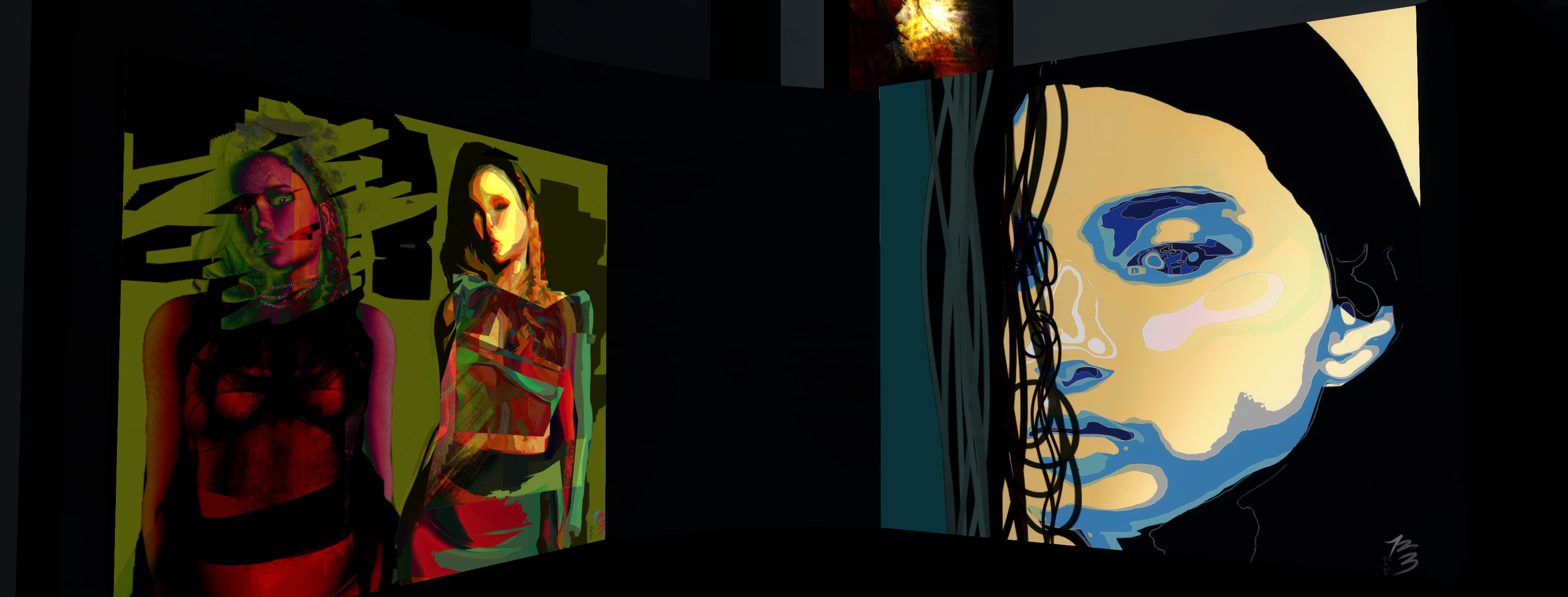
Nox Kirax, with a set of his portraits in which visitors are invited to consider the expressions on the faces of the subjects and reflect on what they might be saying.
Desy Magic, offering a captivating selection of avatar studies, paintings, and 3D sculpture.
Sophie Marie Sinclair, presenting a number of her physical world nude and abstract paintings.
Sweet Susanowa, with an intriguing selection of photographs and abstracted paintings / drawings.
La Maison d’Aneli: Ilyra Chardin
Together, they make for an engaging mix of art and expression. I admit to having a certain attraction to Thoth’s work and Desy’s images that tends to make me lean towards them, and that is true here -although admittedly, a still image of Thoth’s work really doesn’t convey it, it really does have to be experienced.
Ilyra’s piece is certainly of the times, and the staging of a couple sharing a romantic meal whilst keeping strictly to their own apartments, and they sharing it whilst separated by the gap between their balconies is certainly of the time, whilst Slatan’s redux offers the chance to re-visit an installation that challenged introspection the first time around.
La Maison d’Aneli: Sophie Marie Sinclair
Nox Kirax, Sophie Marie Sinclair and Sweet Susanowa was three “new” artists for me, inasmuch as I’m not aware of seeing their work in the past, and all three offer something entirely engaging, in very different ways to one another. I particularly found the portraits by Nox to hold my attention in full, while the sheer diversity of imagery with Sweet’s exhibit offer a richness of imagery and a different style of narrative within them, while Sophie’s nudes have a wonderfully fluid feel to them that is suggestive of life and vitality.
A further engaging ensemble of exhibitions well worth seeing.
We received an invitation to visit The Empire of Dreaming Books by the region’s co-creator, Num Bing. Together with Clifton Howlett, she has created an environment to honour the Zamonia series of books by German comic creator and author, Walter Moers.
Captain Bluebear tells the story of his first 13.5 lives spent on the mysterious continent of Zamonia, where intelligence is an infectious disease, water flows uphill, and dangers lie in wait for him around every corner.
– A description of the Zamonia books and their protagonist, Bluebear
The Empire of Dreaming Books, May 2020
In particular, the setting recreates a part of the city of Buchhaim., located in western Zamonia on the Dull plateau on the dry, flat, steppe country not far from the border with the South Desert. The city sits on the convergence of many trails across the plains, and is famous for two things.
The first is Buchhaim’s countless book stores and second-hand bookshops, printers, publishers and all things involving literature. It’s a place where the evening hours are traditionally called “wood time”, when poets of all kinds present their works in dining rooms and everyone can listen at will. The second is the extensive network of catacombs lying beneath the city.
The Empire of Dreaming Books, May 2020 – click any image for full size
It is said that it is in the centre of the city is where the influence of the Buchimists (alchemists who mainly experiment with books, words and literature) of Buchhaim is the greatest. It is also the the part of the city Clifton and Numb have recreated for their build. Specifically, they present the Schwarzmanngaße, the oldest alley in city, which spirals its way inwards to shop number 333, the home of Phistomefel Smeik and his bookimistic laboratory.
Number 333 is also where you can find the landing point for the build. From here you can step inside Herr Smeik’s store and thus find your way to the catacombs (via teleporting), or follow the Schwarzmanngaße on its outward spiral to the city’s edge, where paths offers routes of exploration around the outlying lands.
The Empire of Dreaming Books, May 2020
Wandering these outlands will reveal multiple places to appreciate the city from a distance. These retain bookish themes – some in quite a novel ways: even the bird stands offer a book or two to read! Thus, it’s worth taking time to explore on the ground before using the teleport to reach the catacombs.
I say this because the latter really are extensive – after two visits, there is still a lot I’ve yet to reach – so going to the catacombs could distract from ground-level explorations. While it is possible to “cheat” by flycamming around the tunnels and chambers, doing so is hardly keeping in the spirit of exploration, and also risks missing the finer details awaiting discovery. The tunnels wind their way up and down, connecting chambers one to the next – although some are also dead ends in terms of finding a way through all of the tunnels, thus adding to the sense of exploration and discovery.
The Empire of Dreaming Books, May 2020
Books feature strongly throughout the catacombs, which can make things feel a little “samey” in wandering through them – but the chambers offer their own individual themes that more than compensate for this. From cosy lounges to vast, tiered libraries, there is a wealth of detail to be found throughout these chambers – so much so, more than one visit may be required to appreciate them all.
Many of the chambers offer a further surprise in keeping with the catacombs of Buchhaim: they are home to buchlings (booklings). Often depicted as bloodthirsty cyclops species in Zamonian legends that eat everything that gets in their way, buchlings are actually the most intelligent and educated form of existence of the catacombs of Buchhaim. They worship, collect, maintain and read books, and believe they are the ones who have the most literature, because they only have to read it while others have to write, proofread, publish and sell it.
The Empire of Dreaming Books, May 2020
Within Numb’s and Clifton’s catacombs, the Buchlings are to be found in tunnels and chambers, sometimes standing innocently and sometimes getting up to a little mischief (or trouble). Their presence further reinforces the region’s homage to the Zamonia books, as does the name for the setting: The Empire of Dreaming Books was the title of one of the volumes of work by Hildegunst von Mythenmetz, the most famous Zamonian writer of his time.
A truly magical setting, The Empire of Dreaming Books is well worth the time taken to visit and explore.
The Empire of Dreaming Books, May 2020
With thanks to Cube Republic and MorganaCarter for their suggestions to visit the region as well.
I love to paint nature in the abstract form as I feel it. I try to capture that energy, the movement, of the natural world. My innate and incessant feeling and filtering energy is what drives me to paint the crazy way I do.
– Shakti Adored
I make no apology for covering another art exhibition connected with Kultivate Magazine and galleries just a couple of days after my coverage of the Kultivate Sensuality exhibition. While I may well be a contributing writer for Kultivate, this is not favouritism on my part; simply put, the Kultivate galleries cover an enticingly broad range of art and artists that is is entirely natural to be drawn back to shows there. This is certainly true of the May / June exhibition at Kultivate’s The Loft Gallery that opens at 13:00 SLT on Tuesday, May 26th 2020, featuring the extraordinary abstract work of Shakti Adored.
Kultivate The Loft Gallery: Shakti Adored
A 10+ year resident of Second Life, Shakti is perhaps best known to many as the curator of a range of art projects and galleries in Second Life over the years, including some exquisite exhibitions at Angel Manor. However, she is an accomplished artist in the physical world, with a lean towards abstraction, as the quote at the top of this piece notes.
However, far from being “crazy”, Shakti’s use of the abstract form is actually enticing, as can be seen within the twelve pieces she has selected for The Art of Shakti Adored. Rich in colour and tone, these may at first appear to be pure abstractions, but each carries within it a strong sense of theme and narrative that offers further depth to what are already captivating pieces.
This sense of narrative may be more obvious in some than with others: the titular character of Funny Bunny, for example, is unmistakable as his / she raises an inquisitive nose to take a sniff at a plant leaf – or is it a feather? – immediately drawing us into the picture, as it is hard not to find the bunny’s presence in the painting adorable, further adding to its appeal. Alongside of it, Fea Lights might at first appear to be more chaotic, but the two smoke-like presences quickly give it form, opening a story of sprites at play (or dancing) in an autumnal woods.
Kultivate The Loft Gallery: Shakti Adored
Meanwhile, Moving Forward offers a rich mixture: an abstracted watercolour / ink wash backdrop that almost suggests a collage, but within which the eye can discern certain things (in my case, the bent trunk of a palm tree, the suggestion of a conch shell and a pine cone, and a sense of flowing water to name but three), overlaid with more prominent elements (a rabbit once again), plus a hand holding what might be an infinity symbol). All of this combines to offer a sense of motion through both layering and motifs).
Creativity can often be a form of catharsis for the creator / artist. This is certainly true with Shakti’s work, as she notes herself. Her art, with the aid of a garden bath tub has allow her relief from the pain of fibromyalgia. At the same time, her discovery of Second Life offered her a way to escape the pain of a harmful marriage to a world that allowed her life-long love of art to bloom, first through her work in curating art galleries and projects.
Having recently returned to painting herself, Shakti now finds art as means to continue the healing process that continues on after the ending of her former marriage, that ability to overcome the discomfort of her medical condition, and a means to express the teaching of her other interests, such as Reiki, in a visual way, with Second Life offering her the means to present her work.
Kultivate The Loft Gallery: Shakti Adored
Thus, The Art of Shakti Adored is not only a expression of Shakti’s art, but very much an expression of her journey through life – physical and virtual – in which she is inviting us to share.This makes it a truly engaging exhibition that should not be missed.
THE EDGE Art Gallery, operated by Ladmilla and Eli Medier has a new home in Second Life. Now occupying a 2-storey villa-style house, the gallery serves as a centre for the couple to display their own art alongside of a new project they have initiated called Art on the Road.
The large interior walls of the house provide space for Ladmilla’s and Eli’s SL-centric images, with the rooms spacious enough so that the furniture within them doesn’t interfere with views of the art. These offer a mix of unique pieces by Ladmilla and Eli, and a set of joint pieces feature an image by Ladmilla and words by Eli.
THE EDGE Art Gallery, May 2020
This latter style of art by the couple has always had a fascination for me. The melding of Eli’s words with Ladmilla’s art offers a rich combination of imagery and narrative that cannot fail to capture the imagination. Eli also provides his own images and words, while Ladmilla presents a series of her own images taken from her journeys around Second Life, adding to the overall richness of the art on display within the gallery. Outside, the garden fence offers space for art by some of Ladmilla’s and Eli’s favourite artists.
Also to be found in the gallery is information on Lamilla and Eli’s Art on the Road series, mentioned above.
THE EDGE Art Gallery, May 2020
This is a project to bring art to the roads of Mainland, with small gallery spaces, offering people the chance to drop by and appreciate Eli’s and Ladmilla’s art.
We thought it would be nice that instead of calling people to the usual galleries, we’d use some spots like small pubs along the roadsides what may attract people’s attention. We don’t know how well it will work, although we hope to keep the spaces for some time, so we’re just a trying things. Besides, we love mainland!
– Ladmilla
At the time of writing, three such locations have been set up by the couple, landmarks below. As well as offering more opportunities to enjoy Lamilla’s and Eli’s art, each location includes a tandem bicycle rezzer so that visitors can enjoy along the roads of Mainland.
A Favela, May 2020 – click any image for full size
A favela is a unique, low and middle-income, unregulated settlement or neighbourhood in Brazil that has experienced historical governmental neglect. With a history dating back to the 1800s, most modern favelas appeared in the 1970s due to rural exodus, when many people left rural areas of Brazil and moved to cities, but could not find regulated places to live, and the 2010 Brazilian census reported that around 6% of the country’s population lived in favela or similar housing.
Around Rio de Janeiro, the favela cling to the sides of the hills, looking from a distance like colourful buildings – a colourful façade can oft disguise the crowded nature of a favela, with their tightly packed houses with little inthe way of open space, and where people strive to find a little corner of a rooftop in place of having any form of yard or garden.
A Favela, May 2020
The largest hillside favela in Rio de Janeiro (as well as in Brazil as a whole, and the second largest shanty town in Latin America) is Rocinha; and this mini city-in-a-city might well be the inspiration for the latest design by Lotus Mastroianni and Frecoi called, appropriately enough, A Favela.
Unlike their past builds, such as RioSisco Studio Pictures, ChatuChak or Kun-Tei-Ner, all of which covered a complete region, A Favela occupies a 4096 sq metre parcel, and sits as a sky build. This makes a a very compact build, but the space is effectively used to recreate the look and feel of a portion of a favela: the houses are stacked vertically, some buildings looking like there might be multiple apartments, others looking like that are single homes with one room atop the last; some have traditional water tanks, others have the famous blue roof-top tanks provided by power and water company Cedea.
A Favela, May 2020
As with their physical world counterparts, these buildings are made of a variety of materials, their roofs concrete or sheets of corrugated sheets of metal. Between them, a single road winds up the side of a rocky hill, the houses forming deep canyons, the “cliffs” of which and dotted with verandahs and windows. Towards the top of the setting, the road levels before apparently vanishing into a tunnel, above which a backdrop rises, offering a sense of the favela continuing up the mountainside while Christ the Redeemer stands with arms outstretched on a more distant peak.
Like a real favela several of the buildings have steps leading up to rooftop areas that offer places to sit, whilst walls are given life through the application of graffiti paintings or thanks to clothes and towels hung to dry from rails placed outside of windows. Further life is added to the setting through the inclusion of dogs and cats in passages on and rooftop “yards”, while pigs and chickens wander the road’s twists below, ignoring the old cars and trucks parked at the roadside (one of them so out of condition, it needs the help of large stones to hold it in place). Birds circling overhead and a sound scape give a further depth to the setting, rounding it out nicely.
A Favela, May 2020
A small, detailed setting ripe for photography and offering a small glimpse of life in parts of Rio and Brazil.