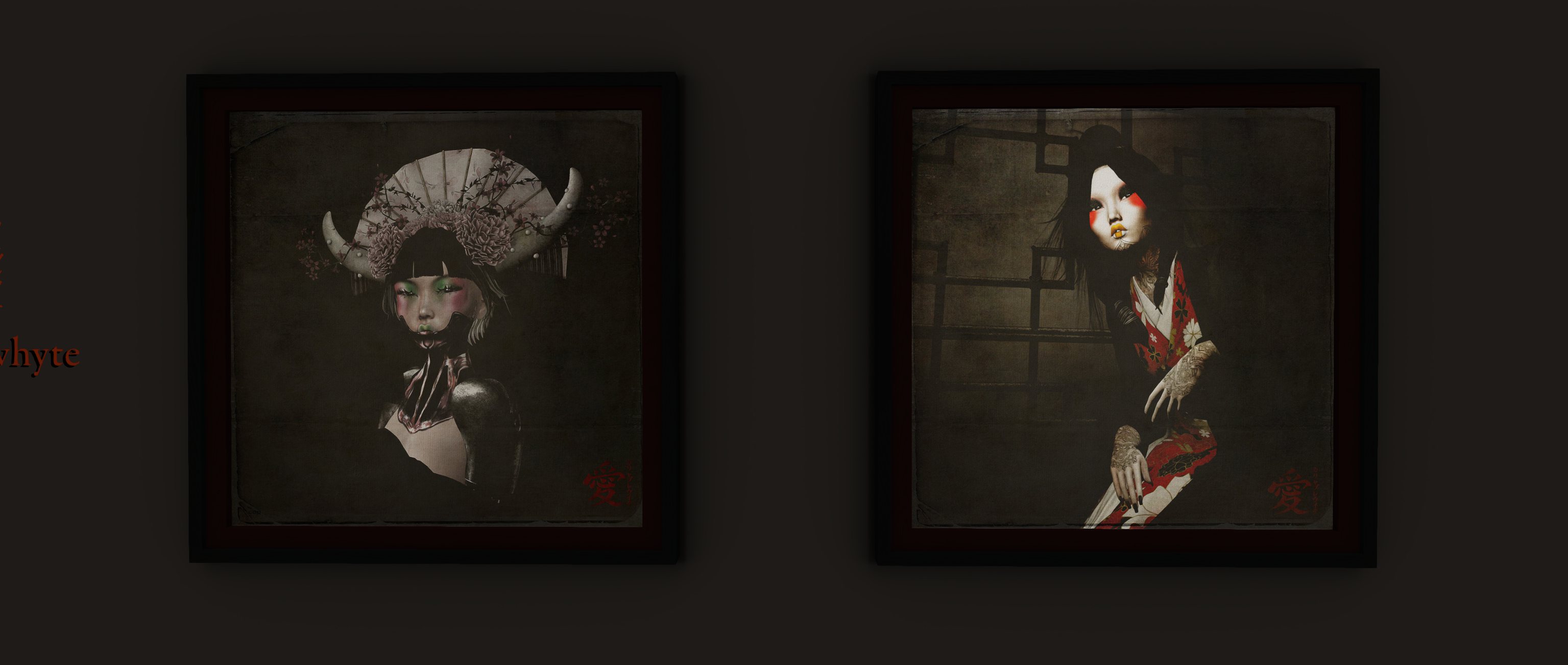
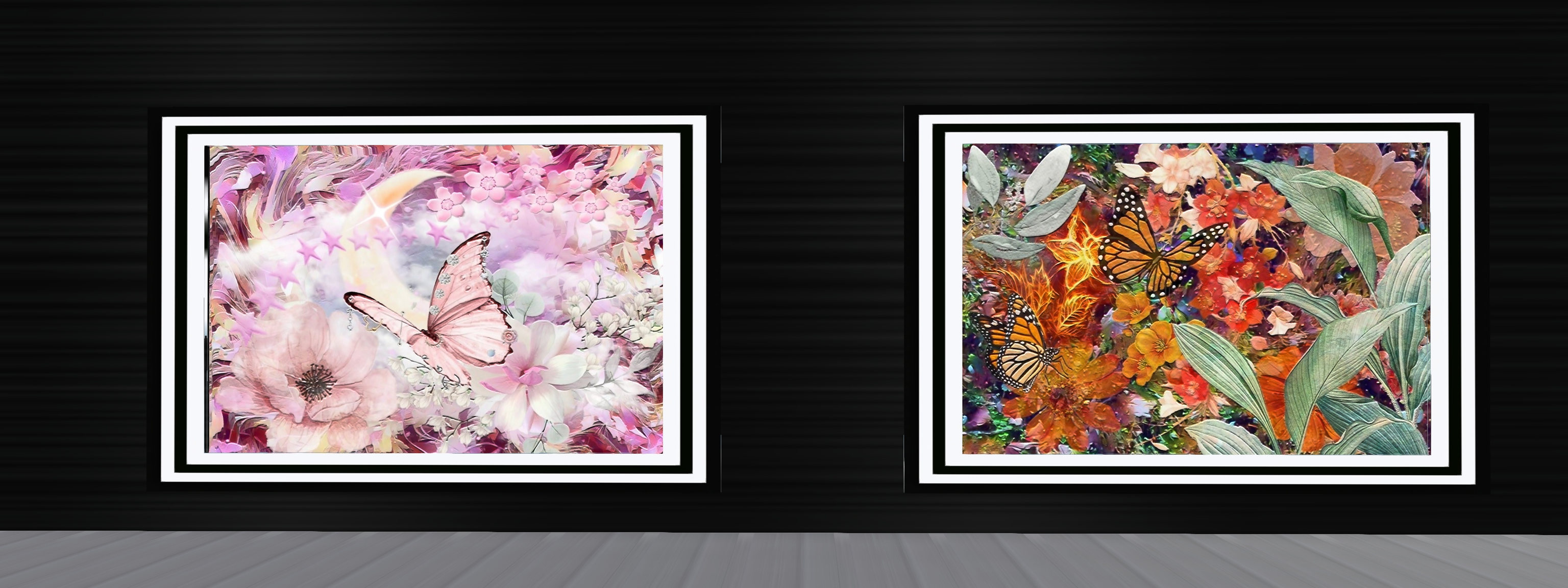
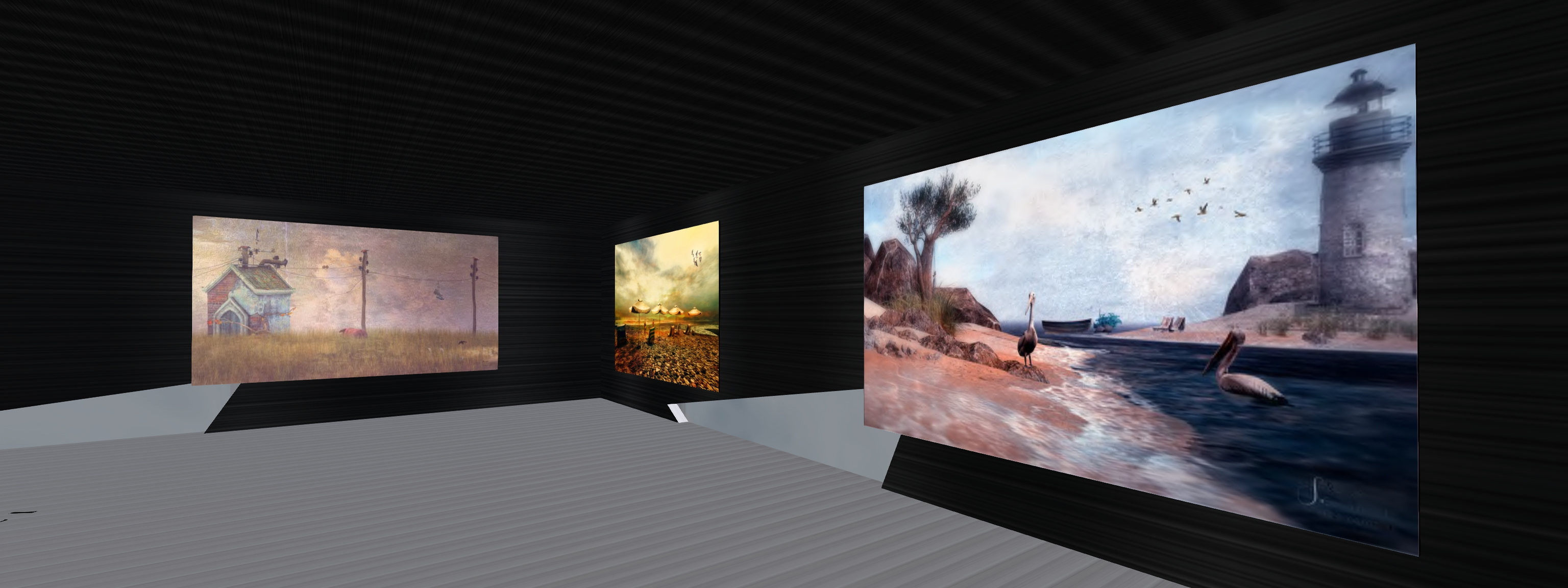
Now open through most of February at the Kultivate Signature Gallery is an exhibition of Second Life landscape photography by Anouk Lefavre.
There is something intensely fascinating about Anouk’s images. Gently post-processed, they have the look and feel of having been painted. The colours are perhaps a little heavier than watercolours, but are lighter than oils, so presenting her work as sitting between the two in a balance that is in itself captivating.
Kultivate Signature Gallery: Anouk LeFavre
More than this, however, the the colours Anouk looks for in her images, together with her framing, means that her pieces are more than images of the places she has records, they are statements of the natural beauty of those places that draws you in. To quote SL photographer Brysen Miller when discussing Anouk’s work:
Truly thought provoking artwork, deep in rich colour tones [and] amazing capture that really make you feel as though you are there. Absolutely brilliant.
All of this is demonstrated in full in the twenty images offered at the Signature Gallery. Nineteen of them are landscape images, with the 20th touching on Anouk’s other focus for photography: avatar studies. All are pieces guaranteed to hold the attention and, with the help of their titles, offer individual narratives that provoke the imagination.
Kultivate Signature Gallery: Anouk LeFavre
However, I admit that of all the images presented, I found myself particularly drawn to the two central images, located on the second and upper floors of the gallery.Neatly split into three panels, they offer a form of latter-day triptych, the breaks between the panels offering an almost chapter-like view of each when viewed left-to-right, whilst equally presenting the complete picture / story when viewed as a whole, the divides between their panels barely interrupting the views they offer.
Which is not to say I in any way dismiss the other pieces; far from it – as noted above, all of them have a marvellous visual appeal. It’s just that the triptych pieces would make for an ideal centrepiece in a home with a suitable fireplace and wall above it, while I am particularly drawn to the tighter focus and presentation of Behind Screen Memories.
Kultivate Signature Gallery: Anouk LeFavre
But whether drawn to Anouk’s work because of her use of colour, or for the way she balances land and water in creating a scene or for the way she breathes natural life into an image, this is a selection of pieces that will both please the eye and gladden the mind with thoughts of warmer happier days to come.
This is the first of two pieces on Tonarino, a Full region we originally visited just over a year ago in December 2019 (see: Tonarino: an oriental curio in Second Life). At that time, the region was a ground-level build, the work of 秋元のん (n0rik0), offering a Japanese urban design theme that was photogenic and fun to explore.
However, not long after our initial visit, n0rik0 extended the region design with the inclusion of a sky platform – Nekomachi Street – which we actually managed to miss at the time it was available. So, when I noted by way of Annie Brightstar’s Scoop-it pages that Nekomachi Street was back, I knew it was time for a return visit to Tonarino, starting with the sky platform lest it only be available for a limited time, and then progressing to the ground to see what has changed there.
Nekomachi Street, Tonarino
The clue to the theme of the sky platform, if the preceding shots above haven’t actually given it away, is in the name – neko, as in cat, so “Nekomachi” could be taken literally as “cat town” or “cat city”, with the setting itself being precisely that: a street scene featuring cats. However, these are not your average domesticated cats, as clever as they may be. These are cats that are completely anthropomorphic and who have overcome the limitations of not having an opposable thumb, in order to create a very human-like life for themselves in what is a delightful continuation of the overall Japanese theme for the region.
For those who visited the location in its past iteration, I understand that outside of the restaurant specialising in crab delicacies, not much has changed between this iteration of Nekomachi Street and the last. Which doesn’t mean it shouldn’t be re-visited; quite the reverse, I’d say: the entire setting is utterly adorable, whether or not you have seen it before.
Nekomachi Street, Tonarino
These feline characters – from sets by 丸角の人 (shiro0822), and sold under their Maru Kado brand (just search for “cats” to list the three sets) – are going about their daily lives just as we humans might. In this, n0rik0 has sown considerable creativity in how the various cats are presented and what they are doing.
Take the crab restaurant, which I’ve arbitrarily selected as a landing point for the article (the setting does have a more “formal” point of arrival / departure, but I’ll come to that later). Here, a kimono-wearing cat is clearly being tempted by the window display as she walks by – and is about to be further tempted by the platter (of samples?) a member of staff is holding by the entrance, whilst inside customers are happily eyeing their meals of fresh crab and supping beer.
Nekomachi Street, Tonarino
Further down the road from the restaurant, another cat is on his pizza delivery round, skilfully managing his bicycle while holding aloft a veritable tower of boxed pizzas, meals the group of cats and kittens putting on their own show outside the local cinema might actually enjoy, although they seem quite wrapped up in their dancing. Around a corner, meanwhile, another cat has stopped his little van above the local river to appreciate the view. A few metres away, another cat peruses the outdoor racks of the local bookshop while inside, the shop owner stands engrossed in one of his tomes.
Throughout the setting, around every corner and within many of the little shops and stores, similar scenes unfold, from the mechanic taking a break from work to enjoy and garden lunch and a read of a newspaper, to the baker and the happy-go-lucky delivery cats with their cart. Unsurprisingly, food does play a considerable role in daily life here – but name me a cat that doesn’t consider every minute of the day to be approximately half-past dinner time and therefore ideal for a snack?
Nekpmachi Street, Tonarino
However, the most endearing little scene awaits discovery along the eastern street.
Here, outside the local theatre and before a growing crowd, two highly skilled jugglers put on a show intended to entice people into the theatre – and their use of parasols and little boxes is a delight to watch. Animesh in nature, these are part of a gacha set by shiro0822, items of which can be obtained from the Maru Kado in-world store.
Juggling Cats
Just across the road from the theatre is a little alley linking the street with another, and which is notable for the little work cat climbing out of the manhole there. However, more than just working, he offers the way down to the ground level, and forms the “official” landing point for Nekomachi Street – touching his head will deliver you to the ground-level town, but I’ll be covering that in the follow-up to this article in due course.
In December 2020 I visited Path to Oneself Reflection, an immersive and semi-interactive art installation by the SL Random Art Crew led by RoxkSie (Roxie Logan) that sought to offer a look back at 2020 with its pandemic and divisions, and offer nudges for our thinking and outlook, and consider the ways in which the past years has both separated and united. It was an impressive and complex installation as I noted in A path of reflection in Second Life; in that piece, I also noted that the story of 2020 and its impact was far from over.
Thus is it that, officially opening on Monday, February 1st – although it has been available for the public to visit for that last couple of weeks – is what might be called the sequel to The Path, entitled Inner Self Awareness.
That it follows on from the Path is perhaps most clearly demonstrated by the fact Inner Self Awareness has a setting that is very much in keeping with its predecessor, although the actual focus of the installation is very different: whereas The Path encouraged us to look back over the past 12 months and consider how they have affected us both on an individual and societal level, Inner Self Awareness asks us to consider, what, as we emerge into a new year, we may have learnt from the past twelve months and how we might, as individuals, seek to move into the future and the changes (if any – change is not a subject everyone is comfortable with, as the installation duly notes in places) we might make in order to better embrace that future. To quote RoxkSie directly:
We have lost so much that is fundamental to what we call our normal lives. We are going to learn what our new normal is very shortly. This will mean a lot of different things to everyone individually. The year that has passed us has shown more than ever that at times out thoughts are not united; however, there is a lot of good that can be obtained from this. Different mindsets build a diverse society.
Inner Self Awareness
As with The Path, this is an installation that encourages us to walk through a rugged landscape; one in which walls of rock, mountains and hills break the lowlands into a series of areas encircling a central body of water and high peak topped by a massive hand reaching upwards in what might be an attempt to reach beyond what we are and become the promise of what be might be.
In following the path and bridges through the landscape, we’re asked to consider a number of topics and how they might impact us, and we them: the nature of diversity, the ideals of choice and change, the challenge of acceptance and willingness to change, how we might better face the future as individuals and in the benefit of humanity as a whole. Within these topics are couched responsibilities that affect us all, from dealing with the pandemic through to touching upon matters such as climate change.
All of makes Inner Self Awareness as very personal experience, one that is extremely difficult to transfer into words, simply because it does require each of us to invest a fair degree of introspection in it – and the very fact that we all have different perspectives means that the installation is going to resonate differently, depending upon just how much time and thought we are prepared to give to the subjects RockSie prompts us to consider – and the changes we are willing to make in order to help bring about a more desirable future.
Inner Self Awareness
For me, these thoughts all coalesced around ideas of a greater need for tolerance and understanding on the part of all of us as individuals; we have become far, far too intolerant of any ideas or thoughts that are not in absolute lockstep with our own. Simply put, far too many of us have become entrenched in our various beliefs and leanings, that we’re unwilling to accept the views of others.
Whatever the cause – and it is hard not to blame social media platforms such as Twitter, it has been increasingly easy for any of us to retreat into (or create) hollow echo-chambers of so-called “like minds” which, whilst seemingly harmless, only serve to negatively amplify a sense of self-righteousness of outlook, to the point where anyone who expresses a point of view that is not 100% in accord with our own is somehow “against us” and thus to be ostracised and / or vilified for daring to offer an alternate viewpoint.
These are attitudes that require intentional act on our part to change, as this installation attempts to point out through the encouragement of introspection. However, the fact that it does require introspections and an acknowledgement of a need to change, it is easy to brush the need aside because “one person cannot make a difference”, or because there are those who simply will not change. However, neither of these are valid arguments, because the fact is that, while it might feel that “its only me”, numbers do matter and can have an impact, as RoxkSie notes – couching her observation in a frame of reference that appears to encompasses the subject of climate change:
Nature never changes in its diversity and beauty. From aesthetically ugly to perfect, it is always beautiful and constantly evolving. The things we choose to do, do influence how it evolves and changes.
One person cannot do a lot, but if 100 or 1,000,000 people change just one habit, it can make a difference.
Some don’t want change, but it is happening whether we like it or not. Because nature does not care what we think.
Inner Self Awareness
Challenging and potentially discomfiting for some, Inner Self Awareness is an interesting successor to The Path, presenting as it does considerable food for thought – far more in fact, than I’ve thought in here, as there is a veritable treatise to be found within it, and I’ve forcibly restrained my commentary here so ad not to blanket the experience other may have with my own subjective thinking. When visiting, do be sure to have local sounds enabled (not the audio stream).
Back in October 2020, I was invited to visit the Wythburn Art Walk, a exhibition at Wythburn Village specifically in aid of Making Strides Against Breast Cancer (MSABC). At the time (see: Wythburn Art Walk in Second Life) some two-dozen artists were participating in the region-wide event, which also offered the opportunity for visitors to explore Wythburn and the surrounding region.
The Art Walk / Artists for Life event in support of RFL in SL will be back in 2021 (I understand it is currently scheduled for around April 2021). However, and in the meantime Artistic director at Wythburn, Star Finesmith (MorningStar Finesmith), invited me back to the Village, which is now a burgeoning arts community and centre for arts in Second Life, with two core centres of interest: the village itself and the Raven Craig Art Centre.
Raven Craig Art Centre, WythburnBoth the village and the Art Centre are located on the shoreline of Wythburn Lake, a ribbon of water that cuts across the land from the rugged uplands to the south-west, denoted by their waterfalls and the tall, blocky form of a Scottish-style castle, to run north and east to where the Art Centre and the village face one another across the water before being linked by a cobbled warehouse area and rutted track that extends from it, marking the lake’s easternmost extent.
The Art Centre, fronted by a garden space offering a strong Japanese / Zen setting complete with a small tea house and Torii gates, is the home of rotating exhibitions of art curated by Star and Sethos and which are intended to feature both established and up-and-coming Second Life Artists. In addition, the Centre is also intended to “freely educate in the history, practice, and methods of the arts in Second Life.”
Raven Craig Art Centre
An impressive building in size, with numerous large, airy halls on two levels, Raven Craig offers a rich opportunity for ensemble exhibitions, some of which could conceivably overlap with one another, encouraging repeat visits. It had yet to be fully occupied at the time I dropped in, with the displays that are available focused on avatar studies by Caly Applewhyte (Calypso Applewhyte), Wren Noir (Wrennoir Cerise), Max (Max Seagate) and star herself, with a mixed selection of avatar studies and landscapes presented in the upper floor rooms by a number of artists including, but not limited to Jaz (Jessamine2108), Akim (Akim Alonzo), Freyja (Freyja Merryman), Janine Portal, Pavel Stransky, and 3D pieces by Harry Cover (impossibleisnotfrench).
Also to be found on the upper level, but not officially open at the time of my visit, is a forthcoming exhibition of Second life landscape art by AriaRose Canningham (AriaRose Kiyori).
Wythburn Village and Arts Community
A short walk along the track from the Centre are the docks and village of Wythburn. Home to the Wythburn Arts Community, the village offers studio spaces of varying sizes to artists interested in renting them. Many have already been taken, thus providing visitors with a further opportunity to see (and purchase, if they wish) a range of art by artists and photographers from across Second Life, although there were a number of the smaller studios still available at the time of my visit, costing a very reasonable L$100 per week for 100 LI.
Beyond the village, through the arch at its southern extent, the lakeside landscape is also open to exploration. Here, over a bridge that spans further falls that feed the lake, lies a hidden henge sitting within surrounding oak and birch trees and curtain walls of rock. Just westward of this, along the path that might take you eventually around the lake and up to the high castle, is what appears to be a small market area sitting within its own ruins and carrying with it something of a medieval feel.
Wythburn Village and surroundings
What the function of this market-like setting might be, I have no idea; but it also sits close to a further set of ruins which, despite their classical columns, are of a distinctly more modern time frame. Sitting directly on the shore of the lake, they offer good views back towards the village and the Art Centre, as well as up to the castle, whilst also revealing the shore of the lake, rugged as it is, might also be circumnavigated.
Nor is that all. Also to be found within the setting are places with a decided lean towards fantasy, be it via the fae-guarded rotunda sitting within its own glade at the end of a grassy path, or the Game of Thrones-ish Hall of Faces that lies within a network of tunnels that also hide caverns with the most otherworldly of gardens. I’m not going to say where any of these might lie, suffice it to say, keen eyes and willing feet will find the way to them with reasonable ease – and that finding them is part of the fun of exploring this setting.
Wythburn Village and Arts Community
From art exhibition centre to arts community to a richly diverse landscape ripe for exploration and photography, and with opportunities for exploration on foot or horseback (rezzers available or wear your own), Wythburn and Raven Craig offer a lot to see and appreciate. And should the idea of tromping around on your pedal extremities feel off-putting, keep an eye out for the horse and carriage combinations both in the village square and outside the Art Centre; they’ll take you to one of a number of destinations by way of a gentle ride through and around the village.
When a region’s title includes “Handmaiden” (albeit without the apostrophe and ess), one might be forgiven if the mind jumps immediately to speculation on whether it might have something to do with Margaret Atwood‘s dystopian novel or the television that arose from it.
However, The Handmaiden Estate, designed by StephiDreamEverMore Doune (stephidreamevermore.doune) and Bella Cavanaugh (Bellacatorina McKeenan) on behalf of region holder Takao Kishijoten (Takao Kiyori), looks a lot further east the the totalitarian state of Gilead, drawing as it does primarily on Japan and other Asian elements for its inspiration.
The Handmaiden Estate
The region’s description notes that it is a place for “both lust and relaxation”, with the region rating further hinting that it can be a place where adult activities might be found – as does some of the décor with the main houses. However, to classify The Handmaiden Estate as being solely about adult pursuits would be unfair and inaccurate.
The landing point sits within the gardens of the main houses, both of which are imposing wood and slate structures of neo-classical Japanese design. One has a more direct reference to adult – or more precisely, BDSM – pursuits, whilst the other has furniture – including modern hot tubs – that perhaps leans more towards the occidental than oriental, making for an interesting mix.
The Handmaiden Estate
The gardens between the houses sits as a continuation of the landscape the beyond the houses and their walls, featuring grass and free-growing flowers and blossoms, which is again a step away from the more stereotypical representation of an oriental environment, where gardens can so often be more formally laid out.
Beyond the main houses the landscape is a further interesting mix. To one side, a canal-like channel splits the landscape, a bath house occupying the far bank. This looks like it could be the home of an onsen, but within, the bath room is more mundane. A large pools sits behind the bathhouse, its unheated water fed by four carved koi, towels and oils neatly laid out along one side for the use of patrons. Shaded by blossoms and lit by paper lamps, I found this pool to be perhaps the most enticing location within the setting in which to spend time.
The Handmaiden Estate
Outside of the bath house’s walls to the west, sits a natural pool fed by water tumbling from a rocky hill. It is the home to pedestal Shoji lanterns and water lilies, a stone bench under a Torii gate presenting it as a place to sit and perhaps meditate. A short walk away, stone steps rise to a higher peak, one topped by a further house. Guarded by a Buddha at the foot of the steps and stone lions at the top, I’m not entirely sure if this house is intended to be for public use or not, although there were no overt signs that it is reserved as a private setting or residence.
East of the bathhouse lies a small grassy bay, home to a pagoda style pavilion where tea might be taken and offering a view across the bay to where a small island is occupied by an Indonesian statue protected by the dome of a smaller pavilion whilst watched over by a sampan styled boat.
The Handmaiden Estate
With hints of formal gardens that never quite mature along a north-south path running beside the walls of the large houses, a statue of an emperor that perhaps leans more towards Sino origins than Japanese, and the aforementioned occidental furnishings, the Handmaiden Estate offers and interesting fusion of ideas and elements that, whilst perhaps eclectic, actually come together very well to present an interesting setting.
There are definitely some particular gems to be found when exploring. The aforementioned outdoor pool, for example, and / or the circular pond to the south-west, home to heron and guarding a further pavilion that looks in part to be a sitting area and in part a small shrine. However, I confess I did find the region to be a little let down by the default environment settings, which tender to render it a little flat. As such, I’d recommend dialling the environment over to one of your preferred environments for better ambient lighting. I found doing so really mad aspects of the region really pop, as I hope the images here demonstrate, making it ideal for photography and appreciation.
The Handmaiden Estate
With thanks to Morganacarter for the note card and LM.
What if I’m a princess on another planet? And no one on this planet knows it?
The above quote, from The Carrie Diaries by American author Candace Bushnell, is a musing on the part of the book’s protagonist, the young Carrie Bradshaw (the book is a prequel to Carrie’s later adventure in Sex and the City) as she endures high school in Cranberry, Connecticut and dreams of life in New York City and all she might become / escape once she has moved there to become an aspiring author, and left behind her provincial origins.
It is also a quote that Cica Ghost uses in her latest installation, which opened on Tuesday, January 26th, 2021 – and in using it, she offers perhaps the most perfect encapsulation of what Second Life can be to those of us invested in their digital world.
Cica Ghost: Planet
As such, Planet is a location that can be enjoyed on two levels. It can be taken simply as a whimsical and fun setting, filled with Cica’s usual interactive touches that always make a visit to one of her installations a pleasure; or it can be combined with the quote that accompanies it to offer the opportunity for deeper reflections on life and Second Life.
Caught under a mauve sky where the clouds have been strung into ripples that wash gently along under the light of a distant white star, this is a strange world filled with creatures of strange origins. Some are capable of walking, others of flying and some of slithering, whilst others appear to be rooted to the spot, almost as if they have been extruded out of the ground.
Not that any are particularly threatening – rather the reverse in fact, many of them standing in little groups or close enough together as if to be conversing. They are certainly at ease within their otherworldly landscape and not in the least fazed by the little flying saucers a that hover and flit around certain points over the landscape like little mechanical bugs.
Cica Ghost: Planet
Nor are the locals particularly bothered by the fact an very Earthly-looking rocket ship has landed among them, or that a human has quote literally established a homestead in their midst, one complete with cat potted plants and very Earthly looking grass and tree.
It is here that setting and quote intertwine to add that deeper layer of potential and reflection to Planet. Within her dome, the girl has arrived from another planet, a place where she might well be a princess, but here is just another sharing the land with her strange neighbours, none of them truly aware of the status or otherwise she might hold back in wherever she came from.
Cica Ghost: Planet
Thus, her presence might be said to mirror our own in Second Life. Here we can be anything we desire, unencumbered by who we are in the physical world – be it living the life of a princess or a pauper, so to speak; we can be accepted simply for how we are perceived through our looks and actions and activities within this virtual realm, free from all that might otherwise encumber us.
And, just as importantly, the reverse is true: here we can be that princess or that dragon or an elf warrior on a quest, or a starship captain seeking brave new worlds, or even a tinkerer and inventor of Things, or can simply escape cares and pressures and sit in the digital shade of a tree or sail the digital tides of a broad sea, and no-one around us in the physical world need be any the wiser as to who we become, where we travel, who we meet or the adventures on which we might embark and discoveries we make.
Cica Ghost: Planet
Whether you are looking to simply visit and have a little fun drifting around in little flying saucers or dancing among the aliens or drafting weightlessly within a space ship, or whether you are tickled into stepping through he door that Cica opens to deeper, broader thoughts about life, expression, the power of the imagination and the freedoms presented by SL, Planet makes for an ideal visit, and should remain open through to around mid-to-late February.