Who doesn’t know Hikaru? Dido Haas asks in reference to Hikaru Enimo in her introduction to the October art exhibition at her Nitroglobus Roof Gallery in Second Life. Well, to my embarrassment, I have to hold a hand up and say “me”; for despite Hikaru being a photographer, blogger, event organiser and Editor-in-Chief of L’Homme Magazine SL, I have not had a prior opportunity to view his work. Thus My Reflection, as his exhibition at Nitroglobus is titled, has been an opportunity for me to become better acquainted with, if not the man, then at least his work.
This is something of a person exhibition of pieces for Hikaru, as again the liner notes make clear. Each piece is intentionally designed to offer insight into the moods and emotions the artist was feeling during its composition of each shot, rather than just trying to evoke a mood or response in the viewer of his work. The result is a baker’s dozen of fabulously monochrome pieces that are presented in the large format that marks exhibitions at Nitroglobus, all focused on Hikaru’s avatar (joined in places by his dog), that are deeply expressive, and in which pose, tone, lighting and setting have been carefully crafted to as much give insight into the artist’s mindset as much as any facial expression.
Indeed, given that many of the images offered – in difference to Hikaru’s own comments on his use of his avatar’s gaze – eyes and face are not visible, the depth of feeling that is conveyed in some of these pieces just through pose completely captivates. Just take My Reflection 07, My Reflection 09 and My Reflection 10, for example, all of which contain a sense of listlessness borne of solitude and / or boredom. Similarly, Reflection 12 is a completely stunning narrative of mood in which, while it partially reveals a downcast face, the statement come no closer is perfectly portrayed through the placement of the stripped bars across the doorway before Hikaru’s avatar; so much so, I would suggest, that even whilst rendered in monochrome, bars mentally convey the idea they are in fact stripped yellow-and-black in that familiar warning do not cross.
Nitroglobus Roof Gallery: My Reflection
Where his avatar’s face is visible, the conveyance of mood / feelings is more directly pronounced, but not less marvellously framed. My Reflection 11 and My Reflection 04 (which I would not is definitely NSFW when viewing!) for example, utilise the placement of a hand over or before the face to charge each piece with its emotional content, the use of splayed or crooked fingers speaking volumes as to the thoughts that lie behind the avatar’s eyes even as those eyes remain hidden by lowered lids. Similarly, and alongside of it, the curl of cigarette smoke rising beside the steady gaze of Hikaru’s avatar in Reflection 01 draws us into his eyes and the sense of mood within them. And then there is My Reflection 14, where pose, directed gaze and the presence of a window (or door) frame between us and the avatar offers an entire story.
And it is in the idea of contained narrative that Reflections further unfolds before us. For while these are images intended to reflect Hikaru’s own moods, thoughts, feelings – and yes, his vitality – at the time of their creation, such is their depth and composition, we cannot help be see each as part of a larger canvas. Each image invites us in to it, awakening our imaginations to weave stories that can fill the rest of that unseen canvas. Stories in which our own role might also be defined: are we merely a observer of a moment in Hikaru’s life, or are we an invisible participant – lover, partner, friend, passer-by – looking upon someone we care for, like or just happen to see – or who has caught us unexpectedly within his gaze?
Nitroglobus Roof Gallery: My Reflection
Evocative, rich, personal, emotive and a tour de force of an artist’s talent for expression and story-telling, My Reflection is both a superb introduction to Hikaru’s work for those who like myself have not been fortunate enough to encounter it previously, and as a richly layered series of images that superbly straddle the line of “personal” and “public” in their conveyance of mood and narrative respectively.
Oxygen, September 2021 – click and image for full size
Earlier in September 2021, I took a tour of Oxygen: The Rock, Justice Vought’s homage to the island of Alcatraz and its famous former federal prison (see: A trip to The Rock in Second Life). Whilst I didn’t come across Nicolas Cage and Sean Connery trying to stop Ed Harris in his evil plans, much less Clint Eastwood planning his escape or Burt Lancaster (slightly apocryphally in historic terms) keeping his birds – it was an engaging visit, and one I encourage those who haven’t done so to also partake.
At the time, I noted that the start of a tour of Justice’s Alcatraz starts on wharf abutting his main region (co-held and designed with Six Vought (SixDigital)) of Oxygen, and that it was high time I took another look around it to see how things are. particularly as it is now some two years since my first visit. And I’m delighted to say – albeit without any surprise, given Justice’s eye for region design and detail – it remains as engaging as ever, offering a setting that carries forward the design first seen during my October 2019 visit, but with a number of small changes and touches that make a re-visit worthwhile.
Oxygen, September 2021
While it is not enforced, the landing point is given as the railway station that sits to the east of the region. and which contains one of those little anachronistic juxtapositions I like finding within region designs, this one in the form of a very British red telephone box facing off against a very US Postal Service mail box sitting across the narrow street that splits the station buildings.
From here, steps lead the way down a flat-topped ridge running along the region’s south side, the home to a little parade of shops fronted by a cobbled street marked by a fountain. A similar parade, complete with the Justice League Comics shop was present in the October 2019 version of Oxygen, but overall offered a slightly different mix of businesses.
Oxygen, September 2021
Two further elements retained within this iteration of the setting are the harbour and The Mystic. Facing north, the harbour sits directly behind (and separate from the wharf that marks the start of a visit to The Rock. On the landward side of the harbour, the ground rises upwards to the plateau that is home to The Mystic, the regions hilltop lodge. Wooden stairs climb the rocky face of the hill from the Harbour Master’s building with its arched sign, to reach the lodge by way of passing pelican and seagulls at the steps rise upwards.
Offering a place to relax or enjoy music events at the outdoor deck stage, The Mystic still offers a commanding view over the west side of the region as it falls away to the beach, which appears to be perhaps a little narrower than I recall from 2019. Getting down to it remains a choice of zipline or wooden steps, the latter leading both down the lower slopes of the hill and also presenting a route to Six Vought’s photo gallery as it sits tucked into the region’s gorge.
Oxygen, September 2021
The major shift in emphasis within the region’s design is that where it once included a number of rental properties, these have now been reduced to just a single property, tucked away into one corner of the region. This gives explorers more room for wandering along the lowland areas inland, and along the western beachfront.
The lack of additional rentals gives the impression the beach and its surrounds are a little more open than previously, although the drive in theatre remains. Similarly, the hills rising towards The Mystic seem a little more wooded and perhaps have some additional points of interest to find, such as the old bathtub watched over by a pair of peacocks or the sculptures sitting in the shade of trees.
Oxygen, September 2021
With the subtle changes made to its design, Oxygen remains an engaging visit; the kind of place you can visit and catch your breath, take a few photos and enjoy the ambient sounds and just be.
Drune Gotham, September 2021 – click any image for full size
It’s only a month since I wrote about Hera’s Shadezar and Venesha (see: Sharing in Hera’s dreams and visions in Second Life), so returning to a build by Hera (Zee9) so soon after that might seem a little too eager, but both settings were recently closed for a time which gave rise to thoughts that as Hera had indicated they would both only be available for a limiter period, they may have permanently closed. However, nothing could be further from the truth; the period of closure was to allow Hera to take down the skyborne Venesha and replace it with a new build, Drune Gotham. This being the case I accepted an invitation Hera extended to I might hop over to have a look around and offer what is really a “part 2” for the article mentioned above.
Accessed via the Neverworld X (as Hera calls the world in which her creations reside) landing point, which has also undergone its own redesign, Drune Gotham – as is likely to have already been spotted by fans of Hera’s work – returns to her fabled and always engaging city of Drune to offer a further twist on that design, based upon a recent iteration of that city. Back at the start of the year, Hera offered a design that – for me – stood as one of the first regions to attempt to delve into the world of dieselpunk and its sub-genre of decopunk; genres I outlined in Drune’s diesel-deco delight in Second Life:
For other unfamiliar with the genre, dieselpunk (and it’s sub-genre of decopunk) is based on the aesthetics popular in the interwar period of the 1920s/30s and extending through to the end of World War II, with some exponents also including the early 1950s. It is broadly defined as the era in which the diesel engine replaced the steam engine as the focus of technology. Within it, decopunk centres the aesthetic of art deco and streamline moderne art styles particularly prevalent to design and architecture in the same overall period.
Drune Gotham, September 2021
Within that setting, Hera included a model of a Batmobile from the Michael Keaton era of Batman films. As she notes. it was added on a whim, but seemed to fit the overall aesthetic of that build – something Hera notes she found surprising. I’ll have to state that at the time, I was not: there has tended to be a strong decopunk aesthetic to be found within most of the Batman films such that a Batmobile should feel and look at home in a dieselpunk / decopunk setting.
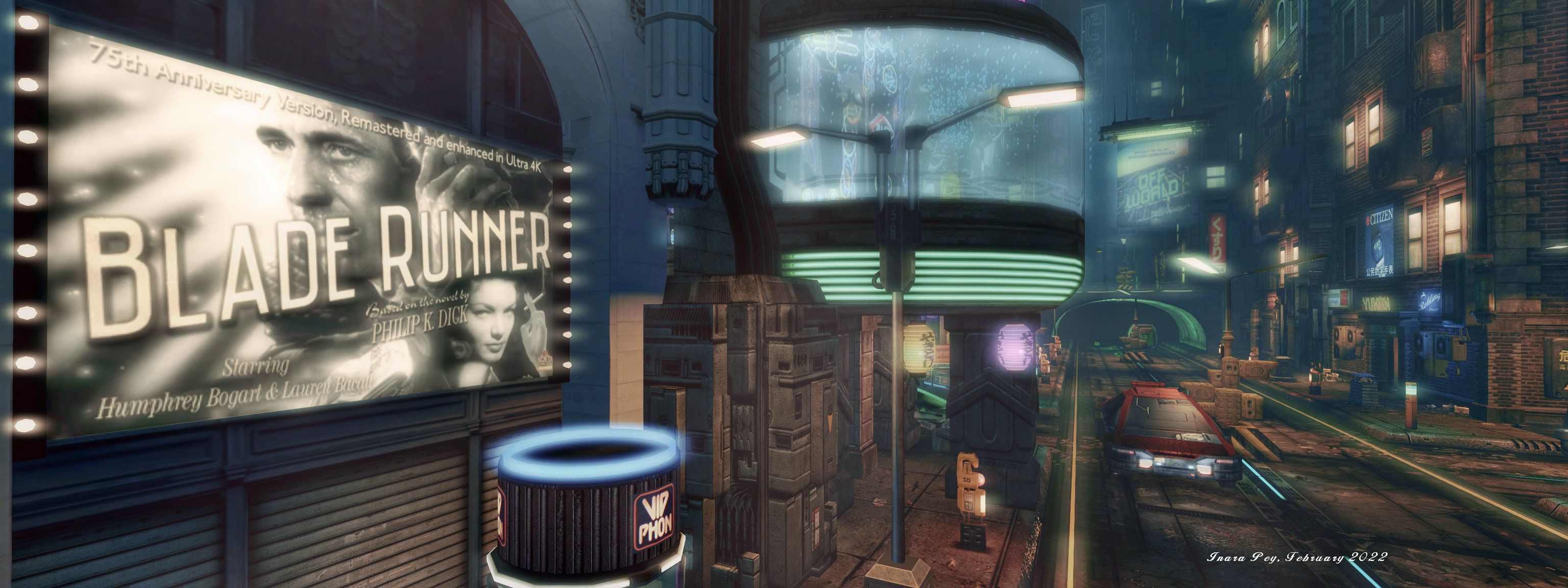
Drune Diesel was, sadly, relatively short-lived; it also encompassed multiple influences – Blade Runner, hints of dieselpunk films such as Sky Captain and the World of Tomorrow, references to Karel Čapek’s 1921 film Rossumovi Univerzální Roboti (Rossum’s Universal Robots) and even the Sirius Cybernetics Corporation from The Hitch-Hiker’s Guide to the Galaxy. With Drune Gotham, which Hera also notes was perhaps inevitable once she had set down the Batmobile within Drune Diesel, is more focused on the Gotham City / Dark Knight vibe, including touches from both the films and the Gotham TV series – although the regions should not be taken to be purely as reflective of the Batman / Dark Knight mythos as presented on screen.
Drune Gotham, September 2021
One of the first things I noticed with this build is that it includes several elements from Drune Diesel: awaiting (re)discovery are both the Shanghai Dragon restaurant and the marvellously deco Black Pussy nightclub, both of which deserve a further breath of life given how brief a time Drune Diesel sadly had to breathe. There’s also a noticeable difference between this and earlier versions of Drune in that this does not have any “outer” / “coastal” elements, instead it is enclosed, with a backdrop of densely packed tall buildings to give the impression of being in the heart of a massive metropolis like Gotham.
But it is in the Dark Knight references in which this setting really shines. From the elevated tracks along which trams, rather than speeding trains, clank bump, to the gates of Arkham Asylum, there are multiple motifs from the films and the TV series (and touches from the comics) awaiting discovery. These trams rumble past the tall finger of the Wayne Enterprises HQ, for example, a place you can enter through the street-level lobby and then ride the elevator to the CEO’s office, a place that has the sense of being the workspace of Wayne Senior rather than Bruce – although the scribblings on the desk tend to suggest the sometimes distracted mind of Michael Keaton’s Bruce Wayne. There is also a secret to be found within this office, of which more in a moment.
Drune Gotham, September 2021
The aforementioned Black Pussy can be found across the street from Wayne Enterprises, as can the lobby of Drune Diesel’s Hotel, reached via the stairs that sit between the Wayne building and the diner next door (there’s an alternate route via a far escape that overlooks Gotham Park on the other side of the Wayne Enterprises building, but I’ll leave you to discover that). The hotel appears to have been expanded since its Drune Diesel days, now offering a deco spa as well as rooms above its lobby.
Across another road from the hotel entrance and diner is the headquarters of the GCPD. On stepping through the front doors of this, it is hard not to expect Ben McKenzie’s Jim Gordon and Donal Logue’s Harvey Bullock from the Gotham TV series turn towards the doors in response to your arrival. Elsewhere in the city, the Arkham Asylum carries within it the Gothic menace that marked its appearance in the films, whilst the Apex Chemical Plant also awaits discovery. Whilst this appeared in the comics (the Case of the Chemical Syndicate), Apex was actually combined with Ace Chemicals (from Man Behind the Red Hood!) to form Axis Chemicals in the first Keaton Batman outing, the place where Jack Napier was transformed into The Joker.
Drune Gotham, September 2021
In continuing a walk around Drune Gotham’s streets, visitors might also come across the Gotham City College (from the TV series), with interior spaces to explore, the Gotham City bank (complete with vault) and a new burlesque club (which I have no idea as to whether it is tied to the Batman mythos) and which again offers interior spaces. These, with the likes of the plant, Wayne Enterprises, the hotel, etc., serve to give Drune Gotham a greater depth than perhaps has been present in other Drune iterations. Also, as a Brit I couldn’t help but smile at the English lean towards things: adverts for Cadbury’s chocolate, Fry’s Chocolate Cream (which had me wanting to rush up to the local shop and buy a bar or two, it’s been so long wince I’ve enjoyed it!) and more, all of why give this Gotham an slightly anglophile feel to it which simply didn’t feel out-of-place.
Nor is this all: look hard enough and you’ll find Bane’s office and, perhaps more interestingly, the Batcave, that sits with the Batmobile parked at the ready on its turntable (despite also being parked outside the Wayne Enterprises offices!) and various consoles providing assorted information as well as the expected bats circling around it. However, the closet for the batsuit is empty, suggesting Bruce is out and about as his alter ego! While this can be found by camming, the “proper” way into it might be a little harder to discover; all I’ll say is that it is to be found back within the Wayne office, and that bookcases may not always simply be for books (or posing).
Drune Gotham, September 2021
Offered under an environment setting which really should be used when visiting (as I have for the pictures here), and finished with a truly fitting sound scape, Drune Gotham really does make for a an engaging visit, one that carries within it a wonderful noir-esque feel that also carries over from Drune Diesel, and which is even more suited to the core theme of this build. In this respect, Hera additional offers a noir-style story in the setting’s introductory note card for those who grab it.
In closing, I would add that a major part of the magic of Hera’s builds – along with her imagination – is that Hera creates many of the elements and textures found in her builds herself, rather than using available kits, etc., available through the Marketplace. This adds up to an incredible amount of work on her part, all for our benefit; so if you could offer the bat bears to be found within the setting some Linden Dollar love to further Hera’s efforts, they would very much be appreciated.
Open until the end of the September 2021 at Sinful Retreat’s Janus Gallery is Visions of an Aspie, a collection of original physical world paintings by Xia Chieng. While I’m getting to it late, this is a fascinating exhibition that should not be missed.
Asperger Syndrome (AS or sometimes referred to just as Asperger’s (without the “syndrome” when used with the apostrophe)) is an autism spectrum disorder (ASD) characterised by significant difficulties in social interaction and nonverbal communication, along with restricted and repetitive patterns of behaviour and interests.
Having been diagnosed with the condition, Xia has found a way to overcome her difficulties in communicating with others through her art, using oils and watercolours to express the feelings and emotions she experiences and to give a sense of the her personal situations, outlook and experiences.
The Janus Gallery, September 2021: Xia Chieng
I see artistic creation as a tool for self-transformation and healing, a way to dialogue with my own internal demons and those of our culture, a means to create my own myths with which one moves through the world. I am on personal journey; personal exploration into the essence of the live; the nature of the relationship between my senses, ideas and perceptions and the external world; my conception of space and substance. Only things that are personal can be truly real for me.
My art is narrative but not literary, it tells stories but does not create their meaning. It may not mean anything, more than we can individually feel. My work is a thing, an object, presented to you for your pleasure and for my relief. It just is what it is. It is not explained alone.
– Xia Chieng
At Janus Gallery I, Xia presents a collection of self-portrait images each one of which presents a narrative – but not one in the literary sense; these are stories designed to give insight into a thought, a feeling, a senses of mind. In part, this might be contained within the title of each individual piece, but which is also mostly through the composition itself. Given this, these are exceptionally poignant pieces, paintings that might also be seen as a part of Xia’s own quest.
My condition makes me face life as a continuous challenge. Rejection, misunderstanding, intolerance have been present throughout my life and have led me to become elusive and lonely.
– Xia Chieng
Janus Gallery, September 2021: Xia Chieng
This quest is perhaps most clearly indicated in those images in the collection that feature a keyhole (or in some cases a question mark) painted onto the forehead of the subject(s) in each painting. A keyhole that might be taken as both Xia’s quest to unlock that part of her that causes her to feel apart, separate and lonely, and also perhaps as a pleas for use to better understand the blurred, isolated, challenging world in which she finds herself living.
As insights into a person’s life, these are pieces that can be stark, dark and a little disturbing (Memento Nori, I was a Suicide Girl, Misery, Nightmare, Good Memories), other have a difficult edge to them (The Princess of Broken Hearts, The birthday Party Without Guests); but these should not be taken to mean these are exercises in personal pathos – life is abundant throughout all of them, with some encompassing religious motifs that speak to broader questions that can affect us, thus offering something of a bridge between our own inner thoughts on life and those that flow through Xia’s mind.
Janus Gallery, September 2021: Xia Chieng
I cannot imagine what it means to be diagnosed with Asperger’s and would not try; but what is undeniable about Visions of an Aspie is the over-arching statement of the power of art in its ability to give voice, to share, to overcome – to help understand oneself and one another. This makes it – as mentioned at the top of this article – an exhibition that should not be missed, although it will be ending on September 29th.
La Maison d’Aneli – Desy MagicThe latest exhibition at Aneli Abeyante’s La Maison d’Aneli opened on September 15th, 2021, once again focusing on a group of artists with very different styles who present both 2D and 3D works, in a set of exhibitions that compliment one another, and which I’ll tackle in their teleport (via the ground level teleport disk as short walk from the landing point) order.
Hailing from Italy, Daco Monday is a self-taught artist who entered Second Life in 2009. His art is inspired by, and makes use of, space, as is amply demonstrated within Severed Roots, a fascinating 3D environment that mixes elements from a previous work (De Chiricocanto) with newer pieces to create a fascinating diorama that offers multiple possible interpretations. The central characters in this diorama take two forms: there is the stylised 3D artist from De Chiricocanto, who stands alongside a 3D musician (“the drummer”), then there is the image of a couple posing for a portrait and which occurs multiple times, in whole or in the shards of a shattered mirror. A large handgun and an old-style photographic plate camera hang on the air to one side, while particle figures dance and eyeballs roll.
La Maison d’Aneli – Daco Monday
Quite what we are to make of this is, as I’ve noted, a matter for personal interpretation – although I would suggest a clue might be found within the installation’s title and possibly the idea of time being shattered (but admittedly, as I’m mid-way through binge-watching Lost, I could be under the influence of that show’s frequent left turns into weirdness!).
Within her space, Madee (Kupu2) presents Precious Moments, a highly engaging series of self-studies with her avatar in both motion (dance) and at rest. Some of these should be considered not suitable for work as they contain nudity, but all are all completely engaging in capturing mood, emotion, movement and form. Presented in monochrome with a soft focus finish, the pieces reveal a talent that whilst new to the world of Second Life photography, is already producing quite mesmerising images and stories.
Utilising a soft form of black and white chiaroscuro, Madee’s art perfectly frames the beauty of the female form against a consistent dark background, leaving us with no distractions to carry our attention away from the central figure in each.
La Maison d’Aneli – Madee (Kupu2)
Desy Magic is an artist I first gained familiarity with whilst visiting Ayuda Virtual, the community gateway specifically developed in support of Spanish-speaking people. She is modest enough to believe she is not an artist, but an experimentalist who particularly likes to work with colour and form. However, the pieces offered in this exhibition prove that while she is very much an experimentalist, she very much is a skilled artist with an eye not only colour and form, but composition, cropping and finish to present highly engaging pieces rich in narrative and which encompass a number of artistic styles including abstract, expressionism and digital collage. It is a selection that includes what is perhaps my favourite of Desy’s pieces I’ve seen to date: Astronauta – if only NASA and ESA would paint the Orion capsule and its service module so imaginatively.
Around these 2D pieces are a number of equally engaging 3D pieces by Desy, some comprising a mix of fluid and abstract female forms.
La Maison d’Aneli – JudiLynn India
Abstract is the nature of JudiLynn India’s work, which really needs no introduction in these pages, as I’ve long appreciated her work. Her original painting are glorious in the order she offers out of the apparent chaos of colour, As always with JudyLynn’s art, the pieces displayed in this exhibition are all remarkable pieces she has created and then uploaded to Second Life; pieces that should be allowed to speak to us individually.
Nino Vichan has always been an artist who seeks to challenge our perceptions and thinking through his work – although I confess I’d lost track of him over the last few years (I was actually under the – possibly incorrect – thinking he had stepped away from Second Life). How well he achieves the former is a matter of individual choice, but there is no mistaking the evocative / provocative intent to his work. With Better Angels at La Maison d’Aneli, he highlights the dichotomy between our lean towards goodness and kindness, as represented by the images of angles offered on their easels, with our proclivity towards cruelty towards each other in so many ways – warfare, genocide, human trafficking, slavery, etc. Between the images are the words, there are at least two questions: the first is can we listen to the appeal of our better angels, our better selves?
La Maison d’Aneli – Nino Vichan
Five very different artists, each with an individual talent for presenting their work and engaging our eyes and minds, who here combine to present an evocative tour of art well worth taking the time to visit and appreciate.
It was back to Nelipot for me this week, after Shawn Shakespeare (SkinnyNilla) informed me he and Lien (Lien Lowe) had redressed their region for autumn.
This time forming a cluster of islands of varying sizes, the region continues to offer a delightfully rural setting, the islands linked by bridges to make moving between them easier.
Nelipot, September 2021
Once again Lien and Shawn have created a uniquely attractive setting, offering much to see. However, it also contains elements that help link it to past iterations of Nelipot and builds Shawn has created, giving it that thread of continuity that I do like finding within regions as they develop and change.
In this case, Nelipot once again features a windmill, one that carried me back to 2016, and The Mill, the first setting by Shawn I ever visited, and which offered me an opportunity to test one of the 360° panoramic camera HUDs that have been available on the SL Marketplace. Also to be found is the little “home-made” racing car that has been a frequent touch for Shawn’s region settings; and while a tram now sits on the lengths of railways lines, it nevertheless presented echoes of a past iteration of Nelipot itself that had a train sitting on the rails.
Nelipot, September 2021
The landing point sits to the west of the region, on one of the smaller of the islands, a place that is little more than a table of rock poking its head above waters laden with fallen leaves. A single bridge reaches the nearest neighbouring island to the south, starting an anti-clockwise route around the outer islands, and a way to reach the centre isle.
Along the way, this route around the outer islands will take visitors through a little farm-like setting with fenced meadow, cabin and a little thatched barn, then onwards to where the windmill.
Nelipot, September 2021
The latter sits on a spur of land that forms part of the largest island, open water to one side and a fast-flowing stream that falls from the island’s hills to reach the open sea, the headland beyond the windmill offering a place for sheep to graze. A choice of routes for exploration open from the windmill and its little wine cellar like setting with its gazebo and outdoor café.
One of these paths leads up and over the hills, the second along a board walk raised on stilts reaching around the rocky foot of one of the hills to winds its way onwards to where it re-joins the landward path as it continues over the island. A high deck awaits those who follow the board walk, again built out over the water, a smaller deck for mooring boast below it, home to the terminus of a zipline that reaches across the channel of water diving the large island from the the central isle.
Nelipot, September 2021
Forming a low hump, this middle island is home to a large forest cabin – well, a cabin that is large in comparison to the cabin and barn to the south. Cosily furnished, it straddles the brow of the hill to offer a welcoming retreat, the zipline sitting alongside it. To the west, the island is low-lying, a tongue of land that points to the smallest island in the group, and presents a rough bridge by which to reach it. This little isle, little more than circle of rock and grass that may have at one time been subject to flooding given the tumbledown hut that sits on its own rough wooden platform that has seen better days.
Nelipot, September 2021
Throughout all of this is a wealth of detail awaiting discovery, from the wildlife to the the vehicles and passing by way of the campsite at the landing point (with its art-appreciating cat!), to the swings and decks and more. All of this – quite obviously – makes this latest iteration of Nelipot highly photogenic, as well as offering a quiet, gentle retreat for people to take a little rest within.
But rather than wibble on about this, I’ll leave you with images and encourage you to pay a visit for yourself.