Opening on November 12th at a gallery space provided by the United Artists of Second Life is a fascinating and highly engaging exhibition that offers a small insight into the work of two artists from the physical world whose work is simply remarkable.
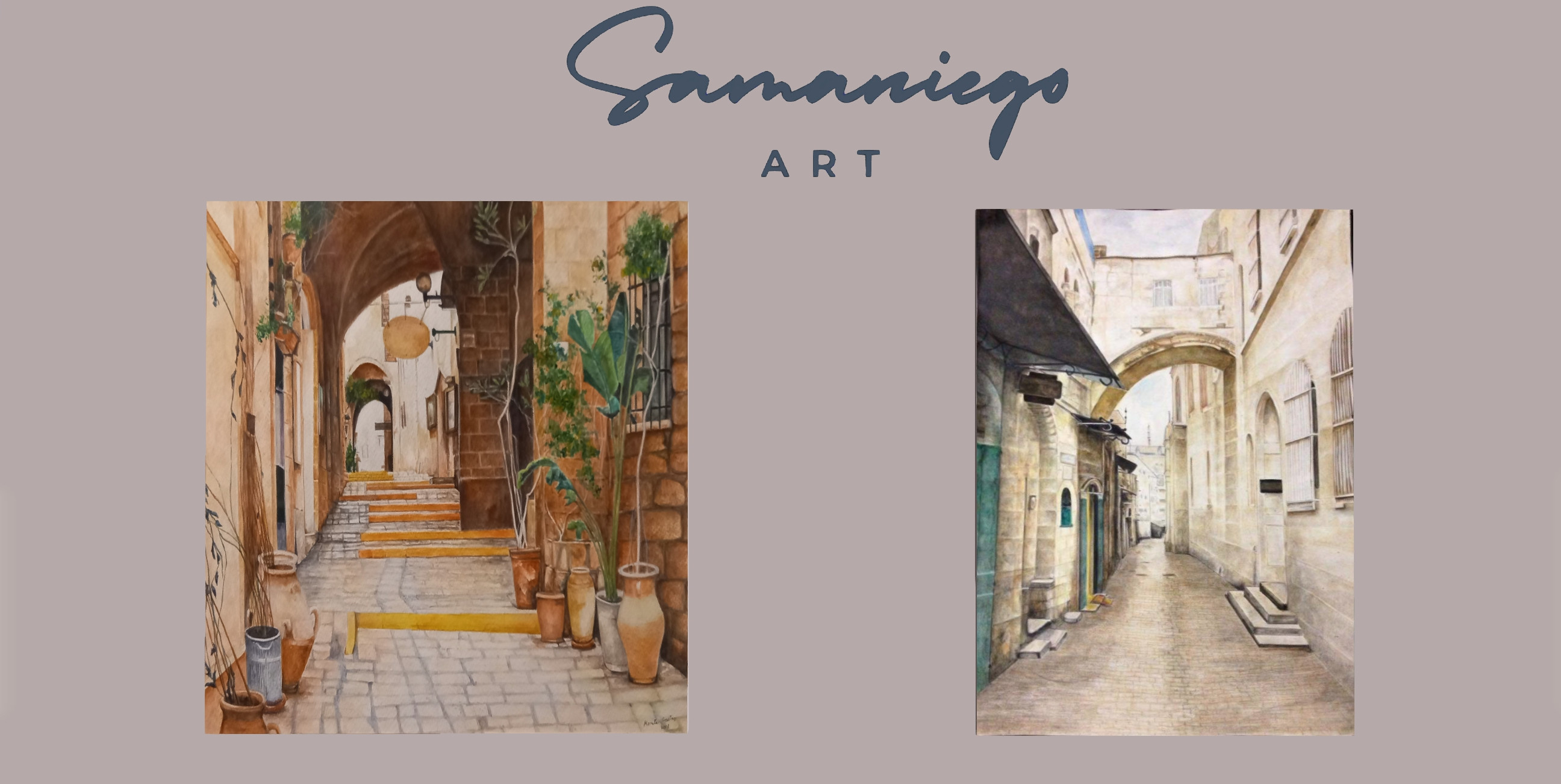
Presented by Bijoux (BijouxBarr – herself an artist), Samaniego Art is a collection of paintings by her mother and grandmother, which is being presented in Second Life with the artists’ full permission. The art on offer is primarily presented as digital prints of watercolours that art startling in their realism and accuracy whilst simultaneously presenting the journeys of the artists to the Middle East and within their home country, and starling life studies.
Most of the images are offered in pairs in around the gallery that have clearly be set out as such, allowing us to visit Manila and witness the beauty of its architecture (San Agustin Church and the El Hogar Building) or appreciate a more distant view of the city’s skyline before travelling onwards to enjoy the pools of the Estrella Falls on the island of Palawan and / or further afield to explore the streets of old Jaffa (Yafa) in Tel Aviv, Israel.
UASL: Samaniego Art
Also to be found are the vibrant richness of life studies that bring the power of dance, the serenity of a lake and the beauty of a bird to life, while rounding out the exhibition is a selection of oil paintings, one paired with the bird the other three hanging together as a eye-catching trio among a hall of eye-catching pieces that carry with them a depth of realism that is genuinely exquisite.
Drawing on a variety of influences such as the great Romantic painter Joseph Mallord William Turner through to modern artists such as Andrew Tischler, these are pieces that will genuinely grace any Second Life home. In this regard, while the pieces at UASL are not offered for sale, prints can be obtained via the Samaniego Art Gallery at Campbell Coast.
UASL: Samaniego Art
The UASL exhibition formally opens at 11:00 SLT on Friday, November 12th, with music by Bsukmet.
Bamboo Barnes opened her latest exhibition, entitled Drawer, at the Hannington Arts Foundation, owned and operated by Hannington Xeltentat. It also marks my own overdue resumption if covering art exhibitions at HAF.
A self-taught digital artist from Japan, Bamboo has used Second Life as a means of both refining her talent and displaying her work, growing from producing avatar studies to creating intricate pieces that both engage and challenge the eye and mind. Her work, generally vibrant in colour, and also evocative, provocative, and emotive, is among the most striking and unique in Second Life – and has also made the transition into the physical world.
Drawer features 20 images that appear to be self-portraits that – as is Bamboo’s style – lean towards the abstract, whilst using various techniques – collage, overlay, and so on – such that individual pieces can also touch upon the likes of impressionism and surrealism. Each image is perfectly capable of holding the attention in and of itself, but when taken together, how might they relate to the exhibition’s title and the poem Bamboo presents within its introductory notes:
Drawer that don’t close properly. Drawer that you no longer use. A faded picture stuck in the back, ton messed wrinkled one. You’ve forgotten what was like but the smell comes back. For the days you have loved close your eyes, close the drawer.
– Bamboo Barnes
Hannington Art Foundation: Bamboo Barnes – Drawer
To me, these lines suggest two potential interpretations. The first is on the theme of introspection; something Bamboo has dwelt upon through exhibitions such as Receding Reality and Mindstorm. However, here it is perhaps more layered, referencing that spark of joy when finding something created long ago than had been put away and forgotten, and which in turn brings forth memories and feelings that had themselves been locked away unheeded in the filing cabinet of the mind. Are, then, these images each a visual aide-mémoire, bringing forth those long hidden thoughts and emotions that led to its creation?
O might this been a broader commentary that we cannot remain caught up with dwelling on (or in) the past? That life moves on perpetually, carrying us along with it – and for the artist this means accepting what has been created can not no longer be changed, no matter how more advanced we have become or how out outlooks have changed; and for the artists, this means accepting what has been, and it is towards canvases new that one should now turn? And in this, is there not a salient reminder to us all, that while looking back can yield understanding or discovery, so too should the drawers of memory be pushed closed, keeping safe that which has been, while the eyes look towards what is yet to be?
Hannington Art Foundation: Bamboo Barnes – Drawer
As always, Bamboo offers us much to appreciate through her art, and much to ponder both in terms of how each piece came to be and what it represents, and the challenge she present through the five lines of blank verse.
Saturday, November 6th saw Chuck Clip’s Janus Gallery I at his Sinful Retreat arts hub unveil a new exhibition of physical world art by none other than Filthy Fluno, one of the pioneers of presenting art through Second Life.
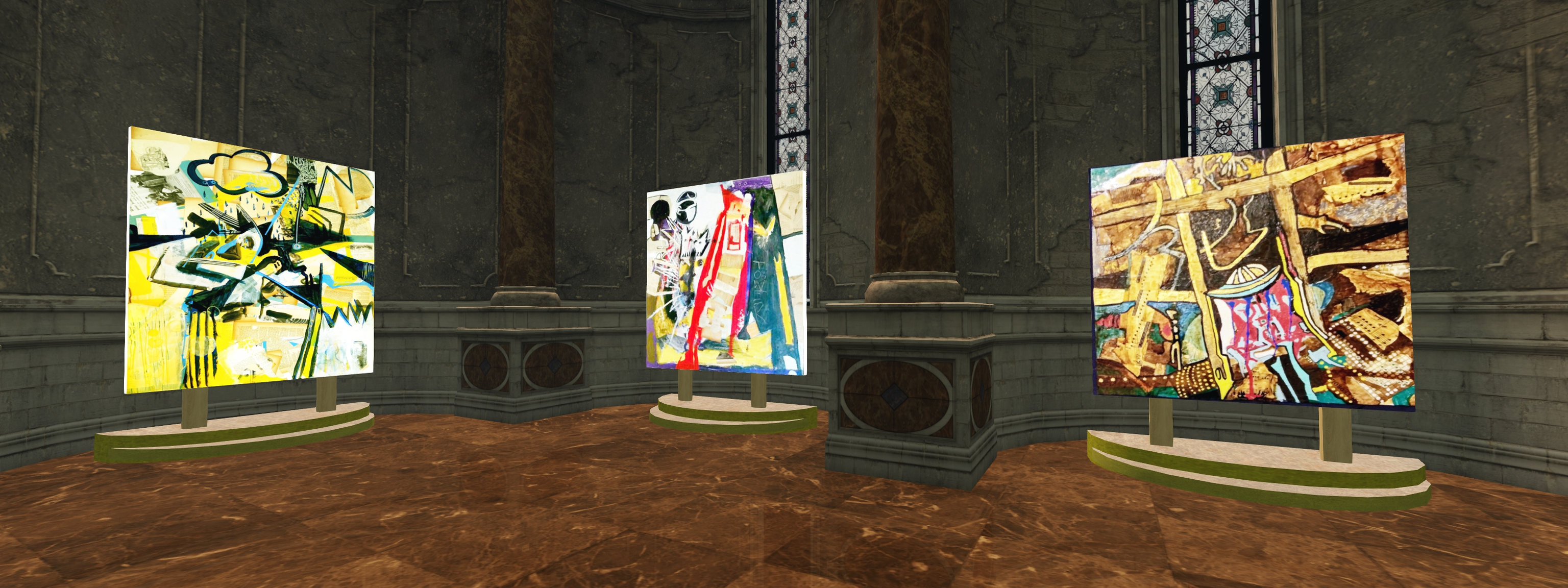
Known the the physical world as Jeffrey Lipsky, and residing in Massachusetts, Filthy is a master of art that is so vibrant, it appears to be breathing for itself. His pieces often a marvellous concoction of abstraction, graffiti, and mosaic-like composition that can be rich in presentation, whilst carrying its own narrative, and his style can frequently touch upon the likes of Wassily Kandinsky and Henri Matisse, with a flavouring of Picasso, while also remaining true and unique to itself.
As a virtual world pioneer, he joined Second Life in 2006, recognising the platform as a means to connect with an international audience. Not long after joining he founded (and managed) the Artropolis virtual art community alongside of Maxim Deharo, a group which quickly gained prominence and a hub for arts in SL, and his involvement within the platform was reported in pieces on his work by the likes of the New York Times Magazine and The Improper Bostonian lifestyle magazine, whilst his work and adventures as Filthy Fluno have been exhibited at numerous galleries in the United States and in France and Portugal.
Janus Gallery I: Filthy Fluno
In Filthy Fluno Returns we can witness much of the rich of his work, ranging from the abstracted mentioned above, through to the surreal, with one or two coming close to being impressionistic in their style. Most demonstrate his dynamic approach to art, both in terms of his use of colour and in their overall composition. These are works that are not going to be to everyone’s palette, but for those who like modern art with a twist of metaphor and / or narrative, they are pieces that will not so much gently hold the attention but grab it warmly by the throat and give it a vigorous shaking as the capture the eye and mind.
All of the pieces in the gallery are offered for sale – and not just as virtual pieces. Any purchase entitles the purchaser to obtain a limited edition 9 x 12 inch print on paper with hand embellishments. Simply contact Filthy via e-mail with details of your purchase and suitable mailing address, and he’ll contact you (note that shipping charges included for mailing anywhere in the US or Canada, elsewhere additional shipping charges may apply).
Alongside of the 2D art are a pair of 3D pieces; Nightflyer and BAM, both of which harken back to the days when all people had to create with were humble primitive shapes, with BAM offering a sculpture of Filthy himself.
Janus Gallery I: Filthy Fluno
A genuine blast from the past featuring an artist whose work is as relevant and eye-catching today as it was back in 2006, Filthy Fluno Returns is a terrific exhibition of art and – for those of us who have been active in SL for long enough – a real blast from the past that is evocative on so many levels.
IMAGOLand: Sophie de Saint Phalle – The Art of Water and Colour
Recently opened at Mareea Farrasco’s IMAGOLand Gallery (level 1B), is an exhibition of art by Austrian artist Sophie de Saint Phalle (Perpetua1010). Entitled The Art of Water and Colours, it offers a selection of Sophie’s work which may also serve as an introduction to her broader portfolio of work than can be found at her own gallery spaces, of which more in a moment.
The Art of Water and Colour, as the name suggests, showcases a selection of Sophie’s watercolour pieces that might be split broadly into two categories: landscapes and life studies, although all of them are simply captivating that speak to a talent steeped in, and with an innate understanding of, art and artistic expression.
IMAGOLand: Sophie de Saint Phalle – The Art of Water and Colour
Such is the beauty and skill found within these pieces, none of them really need any form of exposition here; each speaks plainly and clearly as to it’s subject and nature – and to Sophie’s skill as artist and teacher. Each is presented in a style that befits its subject, from the more abstract seen within Bodensee and the pair of “Namibia” scenes, through to the ink-and wash studies of the human form to the sheer beauty and power of Tanz (Dance), these are very much are pieces that speak for themselves.
As noted, these pieces can form an excellent introduction to Sophie’s work, and for those who haven’t witnessed it previously, I would strongly recommend a visit to The Art of Water and Colours be combined with time at Sophie’s own gallery, the SUBCUTAN Art Gallery and Multimedia centre.
SUBCUTAN Art Gallery: Sophie de Saint Phalle – Red Expressions
Here, across four galleries spaces one can more fully appreciate Sophie’s sheer versatility. From further studies of the human form through digital art that is as captivating to – at the time of my visit – the most glorious selection of political caricatures that are both fun and; this a richly diverse tour de force of art.
Set within a series of futuristic buildings by Colpo Wexler, which I know from experience – and as SUBCUTAN proves – are ideal as gallery spaces, SUBCUTAN also encompasses a small club and an information centre, which is rounded out by a fascinating media display that steps the visitor through her creative process in producing Lazy Afternoon, copies of which can be purchased on the upper floor of the main gallery.
SUBCUTAN Art Gallery: Sophie de Saint Phalle – Political Caricatures
For those with a love of art from the physical world, Sophie’s work is not to be missed; whether you explore it through her exhibition at IMAGOLand or via her gallery – or both, for as long as The Art of Water and Colour is open – I cannot commend it strongly enough.
Lost Unicorn Gallery: Serina – Fantasies and Illusions
Currently open at the Lost Unicorn Gallery, curated by Natalie Starlight, is a superb exhibition of fantasy avatar studies by : SERINA :: ( SerinaK ) entitled Fantasies and Illusions.
Hailing from Japan, Serina is the owner of the Alter Ego mesh clothing brand, and I’m not sure how long she has been involved in SL photography – she joined Flicker in 2018; but I believe this is the first time I’ve see her work in a solo exhibition. And I use the term “superb” above quite deliberately: the pieces exhibited at Lost Unicorn are genuinely captivating.
As avatar / fantasy studies, the pieces presented in the exhibition are rich in colour, detail, motif and visual story, where everything has clearly been carefully considered in compositing and frame that makes them instantly attractive. Most are rendered in colour, although some monochrome pieces are hidden within the collection, their muted tones deliberately chosen to bring forth their story for the eye to see without the need to view any title.
Lost Unicorn Gallery: Serina – Fantasies and Illusions
Whilst focused on fantasy figures and framing, several of the images touch upon the surreal – perhaps most notably with Blind Justice, but elsewhere as well, in subtle touches. This reflects Serina’s broader interest in art that encompasses fantasy, surrealism and fine art. But there is more to be found within these pieces.
Although each an every piece can be appreciated as it is seen, its initial narrative ready to be captured by the eye, this is but an illusion; each carries a deeper story. In some, this might appear to be a personal statement, in others more a comment on society at large. I’m not going to point to individual images here as is often my wont, because these deeper narratives are best discovered by seeking the name of each piece through a right-click → Edit after each has been viewed free from preconceptions brought forth by knowing an particular picture’s title in advance.
Occupying the main lower hall at the gallery, Fantasies and Illusions makes for a grand exhibition – one that flows into the rest of the gallery space as a whole, where the fantasy theme continues with images by a number of artists. Thus the gallery offers a broader, worthwhile visit that I also recommend.
Lost Unicorn Gallery: Serina – Fantasies and Illusions
As noted above, this is the first time I’ve seen an exhibition focused on Serina’s work, and on viewing, I hope it is not the last that I have the opportunity to do so.
Nitroglobus Roof Gallery: Milena Carbone – No Exit
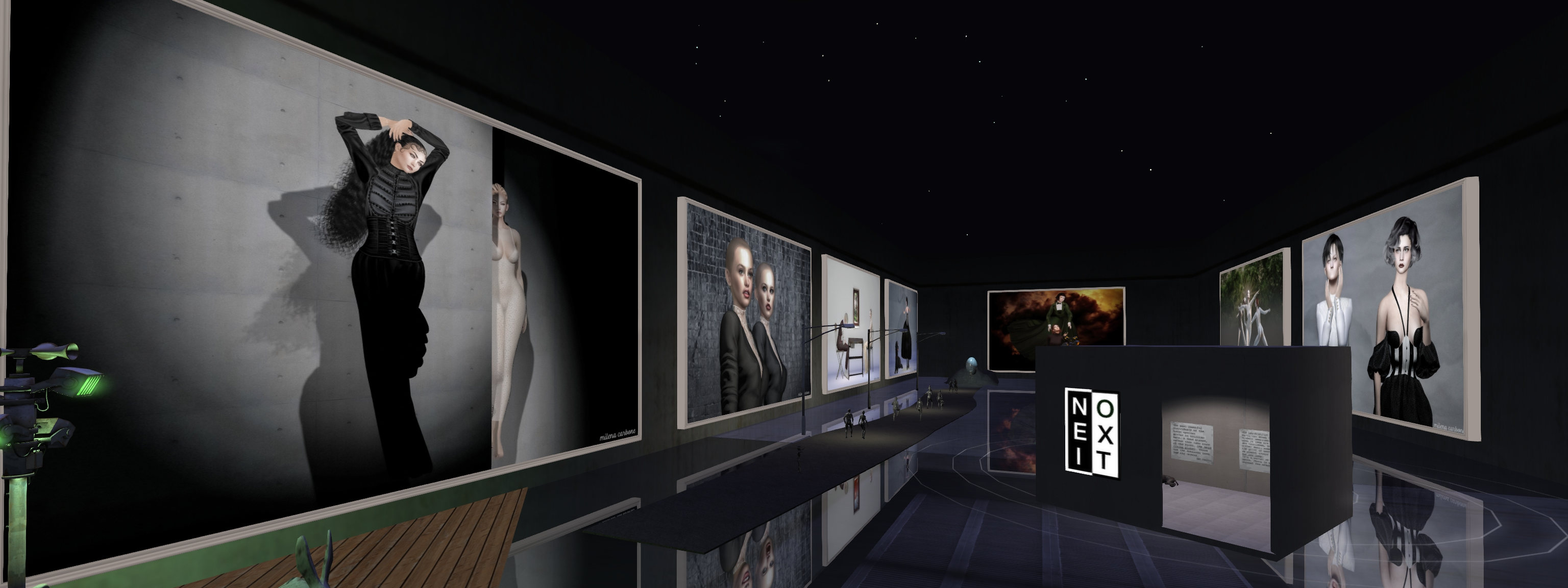
No Exit is the title of the latest 2D art exhibition hosted by Dido Haas at her Nitroglobus Roof Gallery. It features the images and words of Milena Carbone, and is very much something of an “accidental” exhibition which still nevertheless offers food for thought – something Milena is prone to do with her art.
I’ll let Dido explain why No Exit might be considered an “accidental” exhibit:
[Milena] initially intended to work on a totally different project. However, this was cancelled due to her RL work as well as to her lack of motivation. So the images shown at the walls of the gallery this month were not created for an exhibition. Instead they were taken from the stream of images which Milena regularly produces for herself.
I made the selection and pointed out to Milena that there were always two characters in each image, .which made Milena think of the French philosopher Jean-Paul Sartre’s play “No exit” (“Huis clos” in French). And voila the title for this exhibition was born.
– Dido Haas, explaining the origins of No Exit
The connection between Satre and images is important to understand, because – as if so often the case with Milena’s work, there is a philosophical theme running through No Exit that invites consideration and, by nature of the framing of the play’s own central theme.
The title of the play actual comes from the French legal term “in camera”, denoting a private discussion behind closed doors; within it, three deceased people find themselves trapped in a room with no exit, doomed to face eternity with only one another’s company. Thus they are faced with Satre’s truth that “hell is other people” (L’enfer, c’est les autres), itself a reflection of his fascination with existentialism (perhaps most notably through L’Être et le néant), and of the internal struggle that arises when forced to view oneself from both the point of view (that is solely from how they see you in a particular moment) and the perspective (i.e. how they perceive you and your actions within the broader context of their own cultural and societal influences and personal biases / experiences) of another consciousness.
Nitroglobus Roof Gallery: Milena Carbone – No Exit
However, before delving into these deeper themes, I would emphasise that these are images that can be seen and appreciated entirely in their own right and free from any more layer thinking. In fact, I would say they should be seen in this manner before being contextualised within the broader scope of theme and Satre’s world of ontological thinking; there is a beautiful minimalism to every piece that renders it fully as moment of narrative, encouraging us to freely construct a story around it, or to simply appreciate its form, tone, framing and expression.
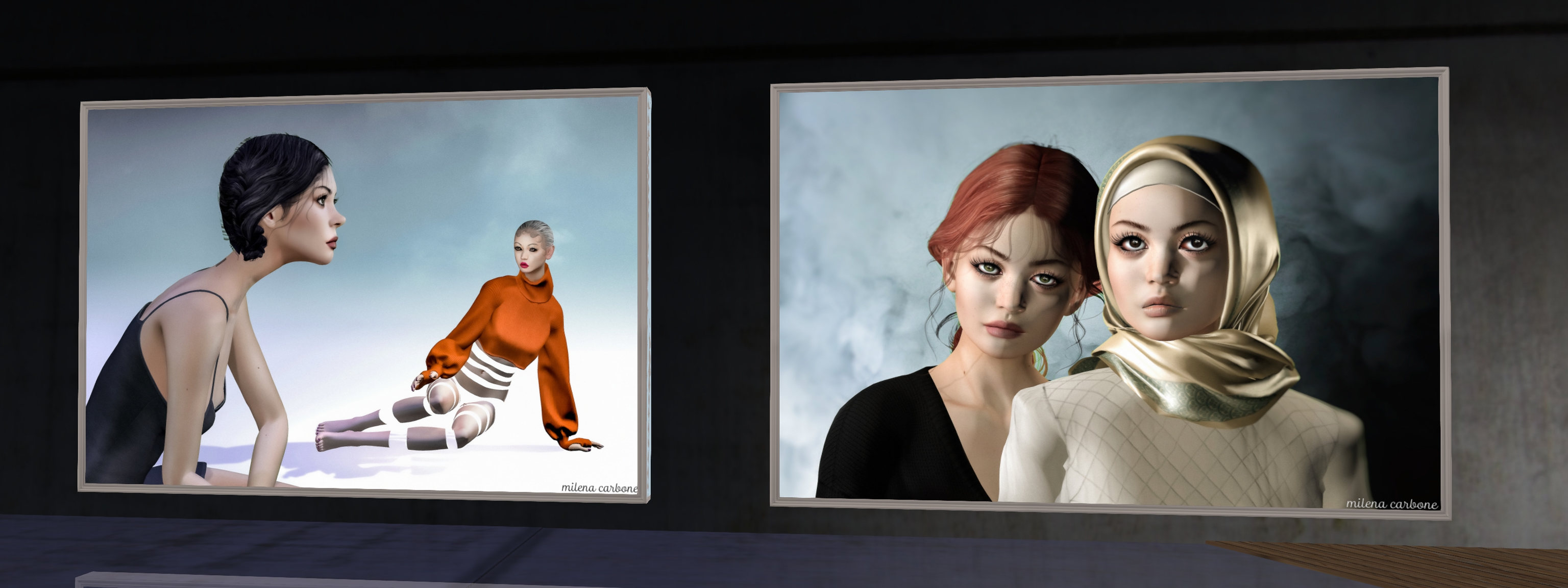
When Milena’s theme and Satre’s ideas are taken into consideration, these are images that taken on an entirely new depth. Take, for example, XXI Century. On the surface, a simple image of two women with different cultural heritages posing for a photograph – be they friends or relatives, it makes no difference. But, add the title of the piece into the equation, together with the fact one of the women is wearing an al-amira, and a more complex narrative emerges, that invokes thoughts of the manner in which during the first 21 years of the 21st century has continued to see the impact of “otherism” – the ostracising of those whose dress, system of belief and place of origin mark them as “different” and thus not to be trusted or allowed. It’s a negative attitude that has gripped many to the point of being without any exit; yet, were they to step outside of the strictures of peer / societal pressure, then the reality that we are all of one, single unique race would become that much harder to ignore.
Elsewhere, the questioning of self, and other others see is more direct (e.g. within Difference, Asymmetry, and The Invitation (the latter’s use of Black and white being particularly effective in bringing for the idea of differencing outlooks / perspectives that challenge our own). Whilst 7 Billion Bullets most clearly questions our entire attitude towards the preciousness of an individual life.
Nitroglobus Roof Gallery: Milena Carbone – No Exit
This image also leans itself to the central cube that sits between the two arms of the exhibition hall. Apparently open from the outside, in stepping in, it becomes a closed room with no exit – a physical representation of the room from Huis clos. Here we are forced to confront the fact that we are all essentially locked in rooms of self – everything we see or experience generates our world-view, making us all, in essence selfish; the imprint of those around us, through their thoughts and actions, rightly or wrongly, shaping our own views and outlooks, thus trapping us in our own hell of thought and convictions.
The words here carry both a startling reality of creating our own hell and – conversely – of allowing ourselves to become trapped in thinking that encourages us to retain that hell. The former is most succinctly stated through the commentary that global ammunition production means that each year, sufficient bullets are produced to wipe out all of humanity. Whether or not one is rooted in “the right to bear arms”, this is a grotesque factoid.; how much better might it be if the money poured into arms and ammunition were to be devoted to green sources of energy, improved food production, medicine and education?
Conversely, the fact that we are trapped within this one world is not an argument against attempting to expand elsewhere. For one thing, we are a naturally expansive race – and right now, we have nowhere else to go – a point of increasing concern given Earth’s finite resources. More to the point, space has more than anything else, given us the means to truly understand the fragility of this world and to actually start to take constructive (if limited) action to curtail damaging activities. For 60+ years, we have simply failed to more properly respond to what as been revealed, trapped as we have become in a materialistic, selfish need to have with no apparent exit – and pointing the finger of blame to a billionaire or two isn’t going to change (much less reverse) that; we – you, me, Milena, et al, are equally as guilty.
Milena is, I understand, absent from Second Life due to those physical world commitments mentioned above, and is liable to remain so for a while. As such, whether or not you are drawn to the philosophical / ontological expressions found with No Exit, or if you would simply like to again experience the attractiveness of her art for its own sake, this is an exhibition well worth witnessing.
Nitroglobus Roof Gallery: Milena Carbone – No Exit