Jayjay Zifanwe of the University of Western Australia brings word of a new film and machinima challenge
Project Homeless 2014 is a Challenge run by Screen My Shorts Incorporated and the University of Western Australia in partnership with, and sponsored by the Parramatta City Council.
Film-makers of all ages cultures and ability are invited to submit original creative digital content (conventional film and / or machinima) and win a share of the $10,000 Aus (L$2.28 Million) cash and prizes (with at least $700 Aus reserved for Machinima), and have their works exposed on the international stage. Films may be individual or team efforts.
Entrants are asked to indicate two themes from the 22 listed by the competition, on which they would like to base their film. The organisers will then allocate one the selected options. Entrants then have full freedom to explore and interpret the allocated theme and create a completed film within 30 days. All entrants are asked to be as creative as possible in interpreting their nominated theme.
All registrations should be received no later than Friday April 11th, 2014, which is the date on which entrants will be informed of their allocated film theme.
Completed films must be submitted by Sunday May 11th, 2014.
How to Register
The preferred method is to register via the competition website– note that entry fees for machinima style film are being sponsored by the University of Western Australia.
Send an email (or a NC in-world) with the following details to jay.jay@uwa.edu.au:
Second Life name
Team name (if applicable)
Email address
City & country
2 preferred themes as the subject of the entry, in order of preference.
Essential Rules
Only G or PG rated films will be accepted.
Entry length to be between 3 to 10 minutes.
Registration is essential.
All entries are to be made specifically for the Project Homeless Competition.
Register before the 11th of April & must nominate two of the listed themes.
$10,000 Aus in prizes available with at least $700 Aus reserved for machinima.
As I recently noted, the Linden Endowment for the Arts have announced the successful applicants for the 6th round of Artists in Residence (AIR) grants.
Tyrehl Byk: returning to the LEA
All of the successful applicants, who will be receiving the use of one full region supplied by the LEA each for a six month period, are to be congratulated. However, and without wishing to sound like I’m playing favourites, there are a couple in particular that I’m looking forward to.
The first of these is Tyrehl Byk. The master of the particle, Tryehl’s work is nothing short of astounding, as anyone who has had the pleasure of seeing shows like Catharsis and Particle Phantasmagoria can more than confirm.
I’ve no idea what Tyrehl has planned for his installation at the LEA, or whether it will be particle-focused; but I am convinced it will not disappoint, and I’m already eagerly waiting to hear more – which admittedly may not come until he’s ready to unveil his installation.
The other item I’m fairly bouncing about getting to see is from a team new to the LEA, although they have already established themselves as a creative tour de force in performance arts within Second Life, having established the Basilique Performing Arts Company.
I’m of course talking about Canary Beck and Harvey Crabsticks who, as their stunning Romeo+ Juliet approaches the end of its fourth season, will be trasferring it to the LEA as a part of an interactive, educational multi-media exhibit which will allow visitors to not only witness performances of their interpretation of Shakespeare’s immortal play about tragic love and loss, but to immerse themselves in the world of Romeo and Juliet.
“We envision building a full, open-air sim laid out on ground level making the scenes in Romeo + Juliet come to life. We hope that becoming associated with LEA will help us expand our reach to a broader audience,” Canary states, announcing the plans in her blog. She goes on:
At the centre of the sim will be the Basilique Playhouse where the play will be performed on a weekly basis, beginning in March.
The aim of this project is to build on our past work in presenting the play, augmenting the experience for visitors beyond spectator status, but rather as involved, participating, and interactive “actors” in the work, in three dimensions.
Extending on the themes of the play, and surrounding the playhouse, will be four highly immersive and distinct quarters giving the visitor the impression they have stepped back in time.
Relive the Basilique Performing Arts Company’s Romeo+Juliet and immerse yourself in scenes from the play
The four immersive environments will comprise a public piazza and streets that one would have found in Verona at the time of the play’s setting; the Capulet family’s mansion where Romeo and Juliet first encounter one another at a ball, which will contain Juliet’s bedroom and the orchard beneath it where Romeo famously woos her; the town of Mantua, to which Romeo is banished after killing Tybalt; and finally, the chapel in which will reside Friar Laurence’s cell and the Capulet family tomb where Romeo and Juliet find their eternal rest.
Visitors will be able to witness performances of the production, re-create famous scenes from the play themselves, and engage in an interactive, HUD-based hunt / game based on challenges and clues surrounding the play, and the life of William Shakespeare.
The installation is to be developed in phases over a two-month period, opening its doors to the public on March 1st for perfomances and the additional quarters opening progressively as they are completed.
Having see the dedication and talents of Canary and Harvey – and the Basilique Performing Arts Company – I have little doubt that everything that is being promised will be delivered. This really is an exhibition – an event – you will not want to miss. Hopefully, and with Canary’s permission, I’ll be able to bring more news on this project as things progress.
On Monday January 27th, the Linden Endowment for the Arts announced the successful applicants for the 6th round of the LEA’s Artist-in-Residence (AIR) programme.
Musiclandia by Livio Korobase, a successful AIR 5 bid
The LEA received over 40 applications, and those selected were viewed as presenting “truly outstanding proposals that represent a diverse range of virtual art.”
The successful applicants will each be allocated a full region within the LEA for a 6-month period. They have up to four months to prepare their projects, which range from full-sim immersions, to innovative builds geared specifically for multimedia works such as sound and machinima. Each installation must be open for a minimum of two months of the 6-month allocation, and it is expected that some will be open in advance of the four-month build deadline. All exhibits must be open to the public by the end of May 2014 at the latest.
All openings will, as usual, be announced in the LEA blog.
Angel Manor – a fitting venue for displays of fine art in SL
Updated, August 2026: Angel Manor and the Rose Theatre closed in July 2026.
I last blogged about Angel Manor a year ago. Since then, Kaya Angel’s magnificent house and grounds have both undergone some transformation – so much so that I really should find the time for a camera-laden revisit. One part of the manor which only got passing mention last time around is the gallery there, and it is time to set that to rights.
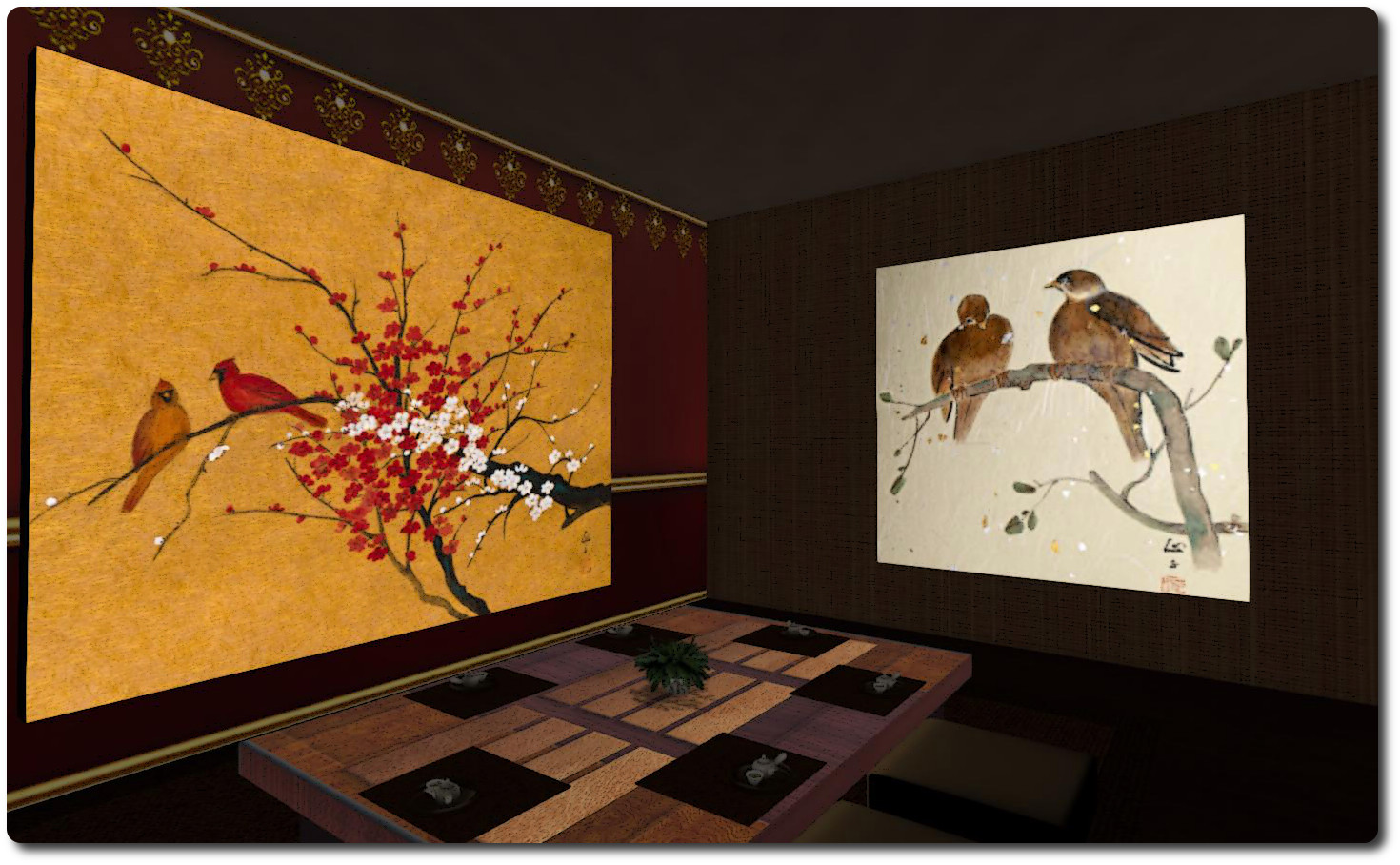
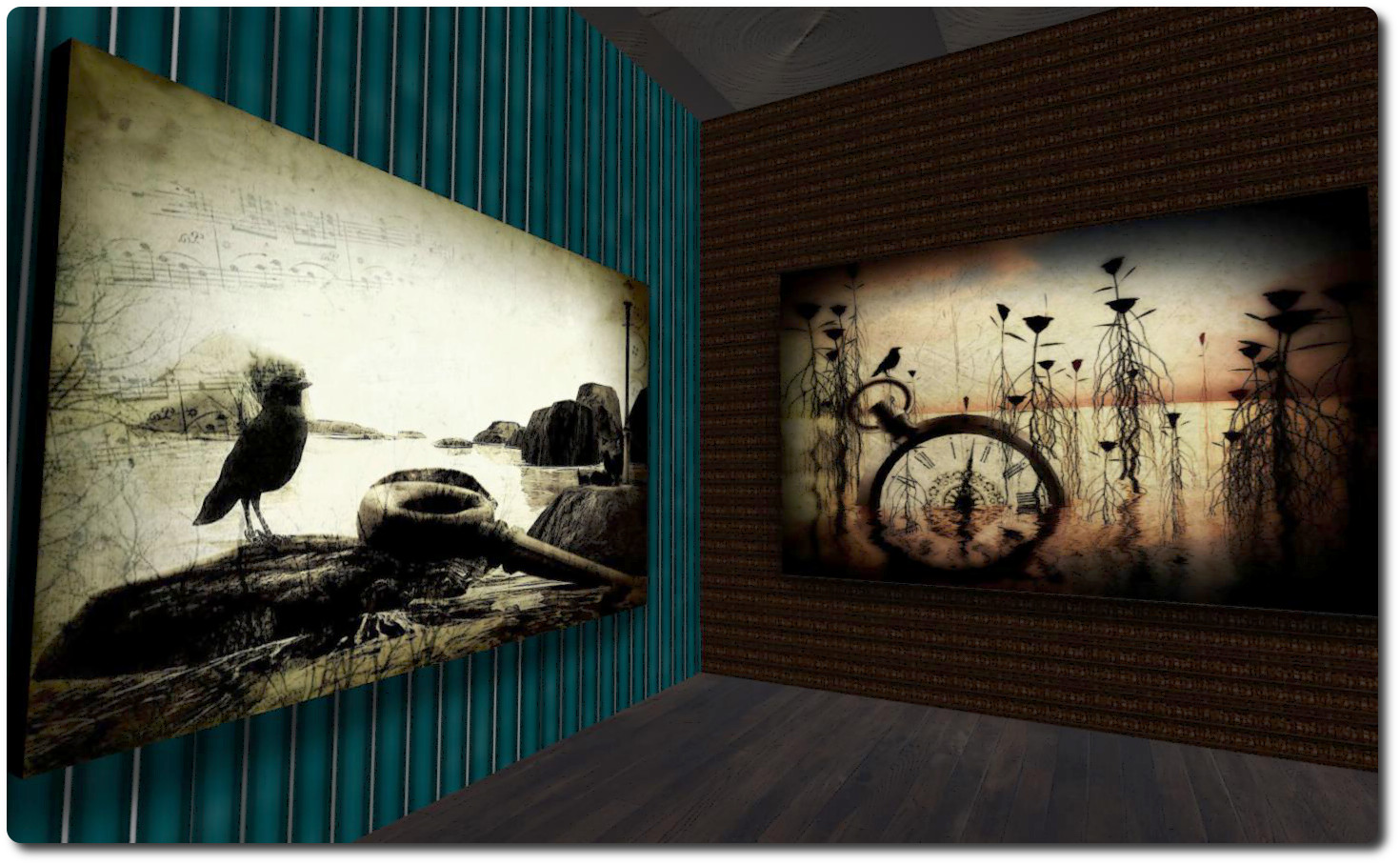
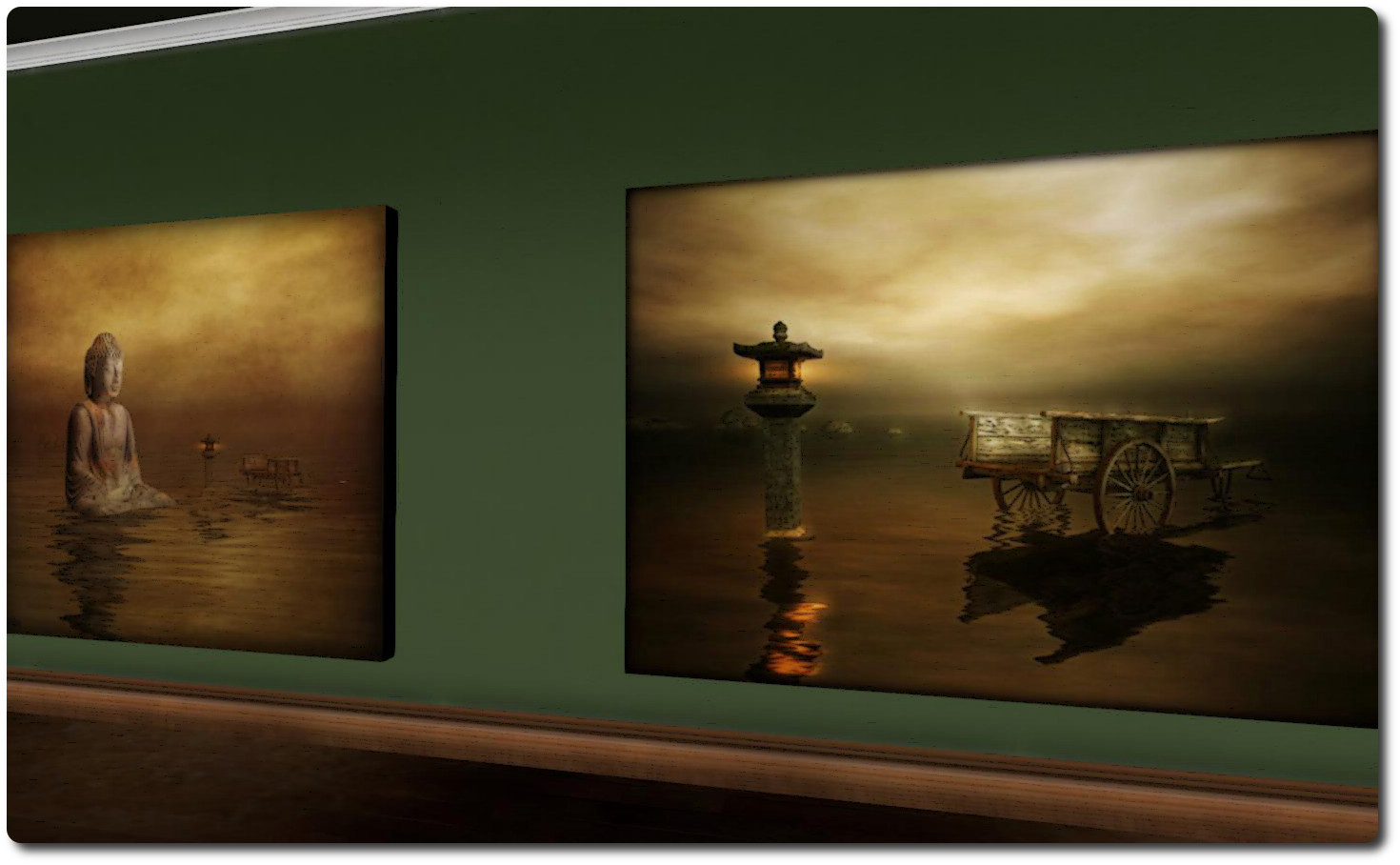
Curated by Kylie Sabra, the Angel Manor gallery is one of SL’s foremost venues for fine art and special art events. The gallery covered several exhibition halls on the upper floors of the main house, which are put to good use hosting displays of a number of SL artists at any given time. It was here that I recently visited Ride the Universe, a magnificent exhibition of Gem Priez’s fractal art, which genuinely a must-see.
The gallery spaces are laid out to allow easy viewing, and each has an info board which displays an image of the artist on display, and can be used to obtain a bio on the artist and also, if written, by-lines on the exhibit itself. As well as Gem’s installation at the gallery, other artists featured during my tour include Masako, TwinkleStarlight and Angel Kingmaker, as well as Kylie Sabra herself.
The beauty of Angel Manor is that not only does it offer exhibits covering a number of different SL artists at any one time, it presents them in a quite magnificent venue itself, one which allows you to combine your time viewing the exhibits with exploring a quite magnificent house and its gardens and grounds, making it the perfect destination for a “day out” in Second Life. And don’t forget the Angel Manor ballroom, the Angel Manor Rose Theatre and the Angel Manor Opera House for live events.
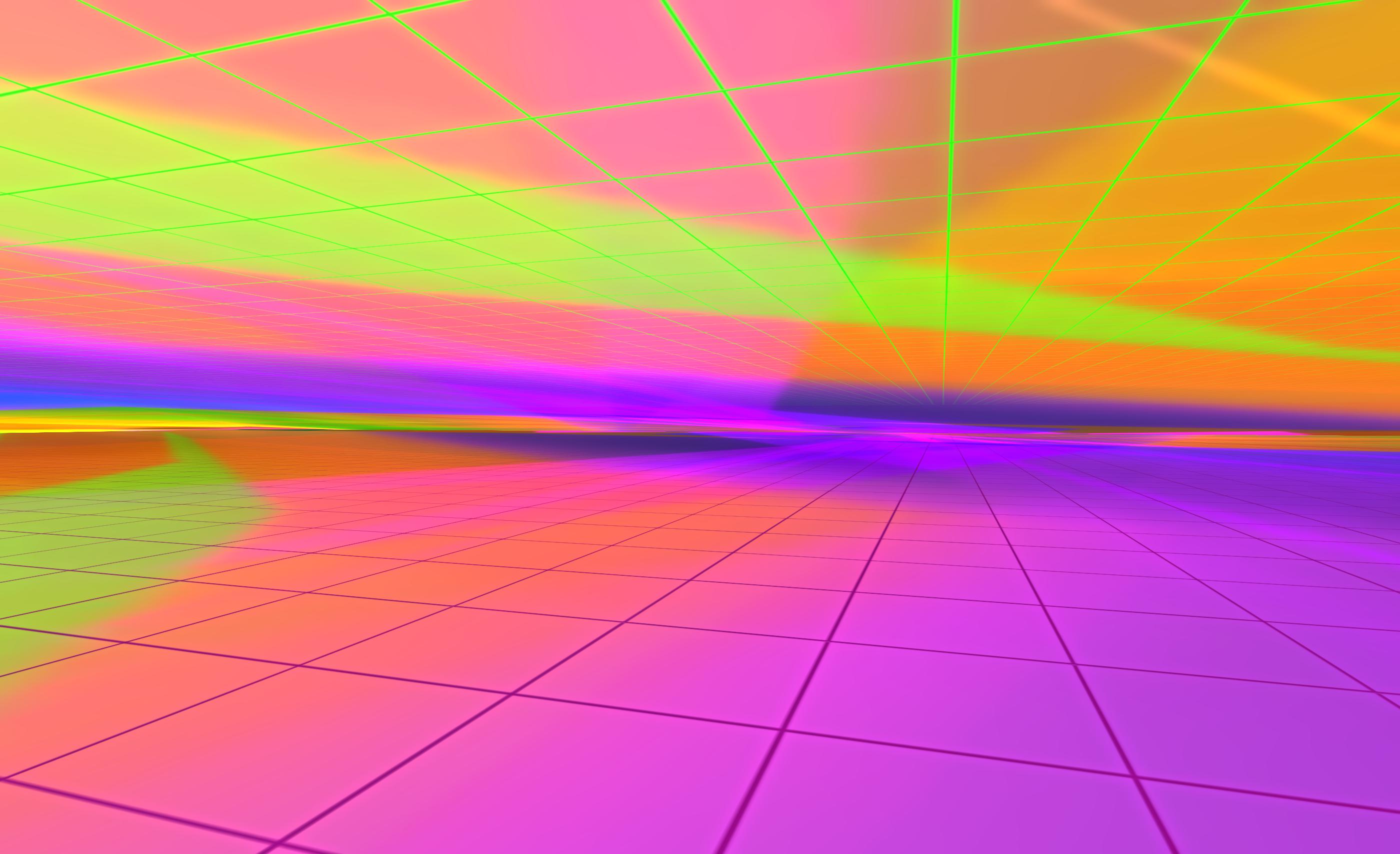
A new installation by Betty Tureaud opens on Friday January 24th in Southern Cross, and it’s an excellent example of depth perception.
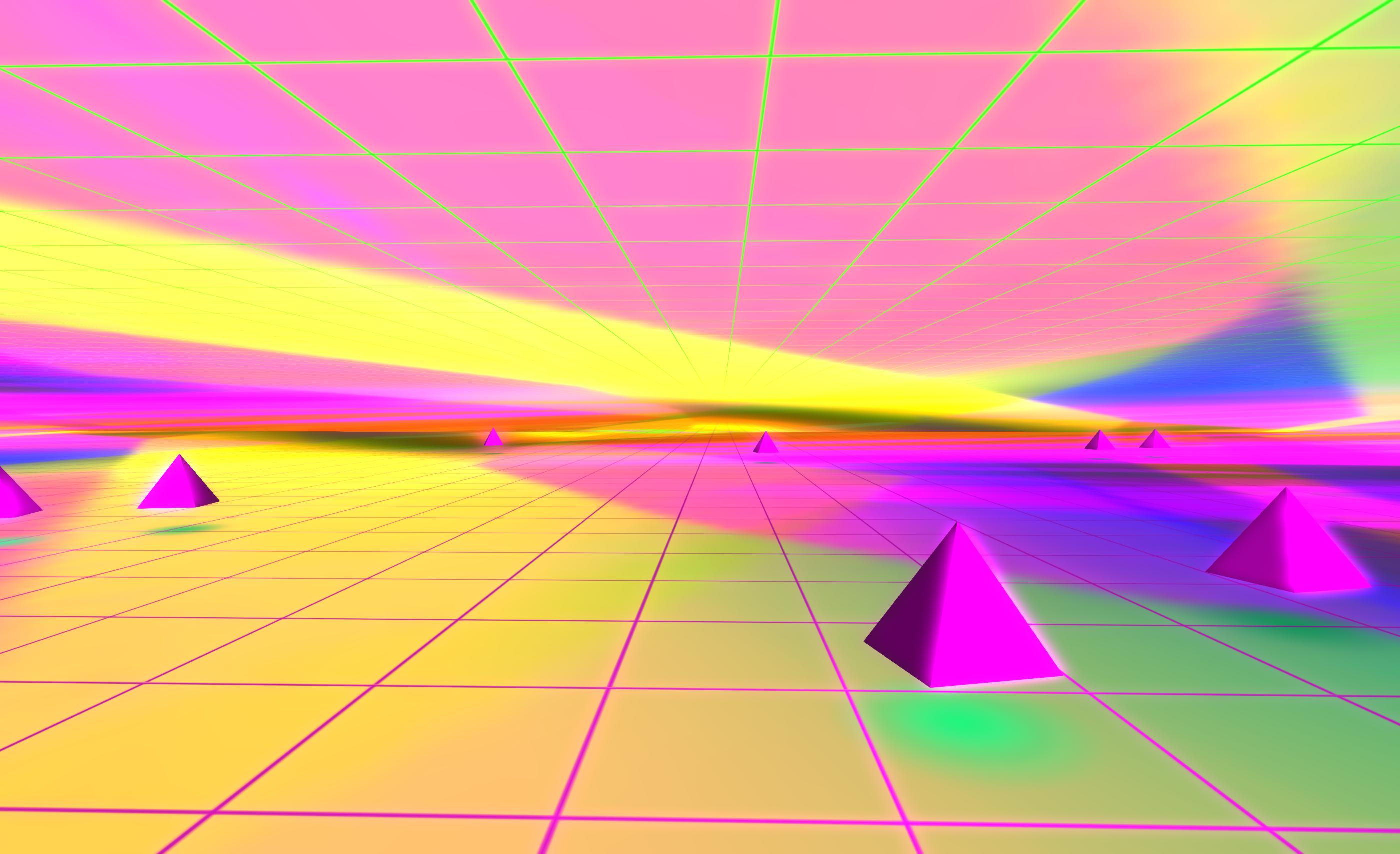
Infinity Space comprises a huge, multi-hued horizontal space overlaid with two grids, one above the visitor’s head and one below their feet, all of which recedes infinitely into the distance no matter where you stand – or how far you walk.
While it sounds a simple idea, the execution is highly effective; some of the prims used in the installation are phantom extenders, so you can reach the edge of the region and still appear to keep on walking (albeit it with a slight bouncing off the region boundary), while the parallel lines of the grid stretch away in front of you forever converging without ever touching, enticing you to try to keep on following them. This optical effect can be enhanced by operating in Mouselook – which is really the best way to appreciate the build.
There is also a little band of floating pyramids circling around the build, offering visitors a ride which lifts the experience even more. Just click on one of the small poseballs scattered around the arrival point and you’ll be delivered, seated, to one of the moving pyramids. Once there, slip into Mouselook. The effect now borders on the hypnotic as the colours above and below the grid flow and change and the grid slowly appears to rotate, the axes interchanging. Riding in this way immediately put me in mind of part of astronaut Dave Bowman’s trip through the stargate in Kubrick’s seminal 2001: a Space Odyssey, such is the effect – at least in part.
The installation opens at 14:00 on Friday January 24th with a performance by Ultraviolet Alter.
“O Romeo, Romeo! wherefore art thou Romeo? Deny thy father and refuse thy name;” – Romeo+Juliet, the Basilique Performing Arts Company
I’ve recently blogged a few times about the Basilique Performing Arts Company’s productions, both the upcoming Paradise Lost and the current Romeo + Juliet. The latter is now into its final run for the current season, having just four more presentations to go during January and February. Lauded and acclaimed since opening in April 2013, this really is a show not to be missed, and I do encourage anyone who has not seen it to take advantage of the remaining four show dates and attend a performance; you will not be disappointed.
Those familiar with the filmography of Baz Luhrmann may spot from the production’s title that it carries something of a hat-tip towards his 1996 cinematic piece starring Leonardo DiCaprio and Clare Danes. However, this isn’t merely a transcribing of Luhrmann’s cult classic; this production more than stands on its own as a slick and creative retelling of the tale of tragic love and star cross’d lovers.
With a costume style carrying a distinctly mid-1940s USA look, complete with sharp suits, fedoras, brogues and automatic handguns but with a distinctly renaissance-inspired feel to the sets, the production has been beautiful conceived and directed by Canary Beck (who is also the narrator) and produced by Harvey Crabsticks. Dance and music lay at the heart of the production, the latter from the likes of Nat King Cole, Ewan McGregor and Nicole Kidman, Michael Buble, Jack Black, Carl Douglas, Moby, Duran Duran, The Indigo Girls, and Queen.
This eclectic soundtrack brilliantly enhances each scene, bringing to each a sense of mood which is very cleverly conceived and, in places, not a little mischievous. At the start of the performance, for example, Mercutio, standing-in for Benvolio, has his view that love is a simple matter of sexual appetite engagingly underlined in the opening number, Straighten-up and Fly Right as he seeks to lift the spirits of a downcast Romeo. Later, his showdown with Tybalt is played-out to Carl Davis’ Kung-Fu Fighting, which, despite the tragic outcomes of that confrontation and the one which immediately follows it, again underlines Mercutio’s irreverent outlook on life.
One also cannot mention the music within the play without mention of the choreography. This is simply exquisite, the dances clearly conceived and executed to suit the numbers to which they are danced, further lifting Romeo+Juliet into the realm of the extraordinary. Through the combination of dance and the accompanying soundtrack, the audience experiences the range of emotions reflected in the tale, such as both the passion Juliet and Romeo feel for one another, and the pain of unrequited love Paris feels towards Juliet. In the case of Paris in particular, the use of music and dance further serves to make him more of a sympathetic character than perhaps the original play allows.
The nods towards Luhrmann’s film are not limited to the name of this production, either, but are cleverly carried through several scenes. Note Juliet’s costume for the Capulet feast, for example, and the use of television sets between each set, which are reminiscent of Luhrmann’s use of news broadcasts to convey the broader strife between the two families. Other motifs from the film are also used with great effect in the production, most notably, perhaps, during Act V.
All told, the Basilique Performing Arts Company’s Romeo+Juliet is a remarkable piece which substantially raises the bar for performance art and drama in Second Life. Aso noted at the top of this article, if you’ve not already seen it, I cannot recommend it highly enough nor urge you strongly enough to make sure you do. Full kudos to all involved.
“O my love! my wife! Death, that hath suck’d the honey of thy breath, Hath had no power yet upon thy beauty” – Romeo+Juliet the Basilique Performing Arts Company
The last four presentations for the current run of the production will be:
Saturday, January 25th, 13:00
Saturday, February 1st, 13:00
Saturday, February 8th, 13:00
Friday, February 14th, 13:00
All performances take place at The Basilique Playhouse. Please refer to my earlier article on the production for notes on how to enjoy it to the fullest.
A Sneak Preview
Following the performance of Romeo+Juliet on Sunday January 19th, Canary and Harvey generously invited me backstage to the rehearsals area for the Company’s upcoming new production Paradise Lost: The story of Adam and Eve’s original sin, which opens in Spring 2014, and which currently has an open casting call for a number of roles.
While backstage, I was privileged to see a performance of three scenes from the new production. Sadly – although fully understandably – I was asked not to take any pictures while the cast were performing, so I cannot visually share just how impressive Paradise Lost will be. However, I can say, with hand firmly on heart, that the production further builds on the incredible work that has gone into Romeo+Juliet, and promises to be something extraordinarily special in Second Life when the curtain rises this spring.
It is evident that considerable effort has been put into refining and improving the techniques used within Romeo+Juliet, and an enormous amount of care and attention has again been put into developing choreography which carefully and precisely matches Mozart’s Requiem. This will definitely not be a production to miss, and I’m already keenly anticipating its opening.

 Entrants are asked to indicate two themes from the 22 listed by the competition, on which they would like to base their film. The organisers will then allocate one the selected options. Entrants then have full freedom to explore and interpret the allocated theme and create a completed film within 30 days. All entrants are asked to be as creative as possible in interpreting their nominated theme.