Currently open at Kultivate’s The Loft Gallery, curated by Johannes Huntsman, is an exhibition of art by JudiLynn India.
An abstract painter in the physical world, having studied graphics design at the Tyler School of Art, Temple University, Philadelphia, JudiLynn has been a part of Second Life since 2010 as both an artist and an engaged member of the broader Second Life community of users.
Kultivate The Loft: JudiLynn India
I’ve been drawing since I could hold a crayon. After the turn of the century, I decided to focus my creativity on acrylic and digital painting and have totally enjoyed the journey. My work embodies my spirit and personality. My goal is to allow you to experience the image with your own mind’s eye. My work is entirely intuitive. I get lost in the layering of texture and colour. Occasionally, I will include figurative work if my spirit is so presented with the composition.
– Judilynn, discussing her work
For her exhibition at The Loft, Juilynn presents some 22 pieces in a larger format, with a further 10 in a slightly smaller format on a single wall (grouped into two theme of 5 pieces each).
Together, they represent a cross section of her digital acrylic and wet paint work, and all of them offer insight into her creativity as an abstract artist and her ability to offer a captivating mix of form, depth and colour. Each piece naturally calls on the eye and mind to appreciate them and call forth the forms they might suggest. These might be anything from an autumn sunset through a woodland glade to distant nebulae – or perhaps people dancing and coastal waves or distant mountains.
Kultivate The Loft: JudiLynn India
A further aspect of Judilynn’s work is the depth of emotion present within so many of her pieces: primal colours that suggest the baser responses like rage; softer colours and forms prompting calmer, more introspective responses. These are also intensely tactile pieces, calling on the observer to want to reach out and touch them, to be a part of them; this adds a further sense of connection to each piece – one that potentially flows through any purchases that might be made, making them very personal possessions.
All of the pieces in this exhibition are uploads of Judilynn’s physical world art, more of which – for those who would like a piece on their wall at home – can be purchased her on-line gallery and shop.
Bryn Oh’s Hand first appeared in Second Life is 2016, located on her arts region of Immersiva. At the time, it proved a highly popular installation, likely thanks to its nuanced tale that straddled the light and the dark places of life and offered a commentary on the possible future relationship between physical and virtual life. More recently, Bryn rebuilt Hand entirely in mesh for Sansar, taking advantage of that platform’s particular capabilities, before porting the mesh build back to Second Life and her home region of Immersiva, giving it a new lease of life there, using SL’s particular presentation strengths.
As with much of Bryn’s work and such is her standing as an artist, Hand has been supported by a grant from the Ontario Arts Council – a part of which has required Bryn produce a machinima of the installation; and she is offering members of her Patreon group and readers of this blog an advanced viewing of the film, which you can find at the end of this article.
Hand is the story of a time when society transitioned to living and working in the virtual space. In this society people housed their bodies in inexpensive pods hooked up to food cannisters. They discarded their houses and furniture as they were no longer needed. They evolved past their physical bodies and lived digitally as the person they wanted to be. Overseeing all of this is a singularity AI named Milkdrop, first seen in the Singularity of Kumiko, though only now revealed to be an AI.
– Bryn Oh on Hand
Bryn Oh: Hand – Second Life, 2020
In this, Hand, whilst an accessible piece in and of itself, offers a deeply layered story that reaches beyond its own pages. At its core, it is the story of children who have been left out of the VR “nirvana” entered into by adults, and who must fend for themselves. largely surviving by “borrowing” the condensed food used to feed the VR “dreamers” in their pods. For these children, any understanding of life and the world around them comes purely through the ideas of fairy tales and ancient copies of Dick and Jane books. They believe that the dreamers, like Sleeping Beauty, will one day awake and rejoin them – but until that time, they must strive to maintain life and family through the simple, idealised writing found in Dick and Jane.
We follow this story through the character of Flutter, a young girl who yearns for the touch and companionship of a mother. She sates some of this need through the plastic hand of a shop window mannequin, holding on to it as though it were the hand of a mother figure with whom she converses. Through Flutter and her conversations, we are connected to the rest of this world – a place that is perhaps unpleasant to both the rational and the emotive mind, both which may recoil from the themes offered. But that’s intentional; Hand is not supposed to be black-and-white. Rather, and like all of Bryn’s work, it is intended to provide a narrative and to challenge perception and raise questions.
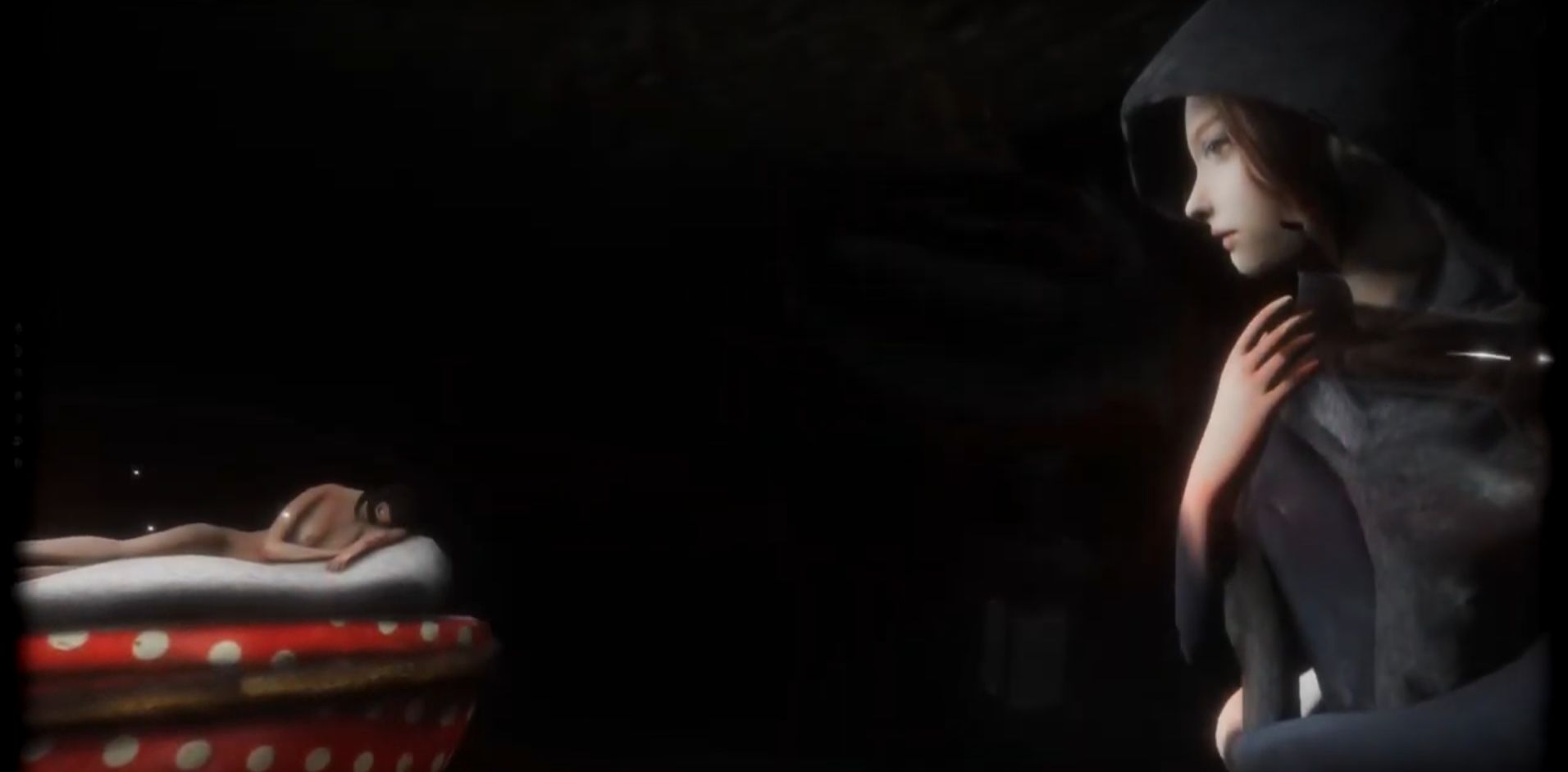
Bryn Oh – Hand, Second Life: Flutter and a sleeper. Credit: Bryn Oh
The layering evident in the tale is highly nuanced, some of it contained within the central story, other elements reaching beyond it. For example, within the story we have the subtle parallel of between “dreaming” adults and awake children. The former have escaped reality into a virtual existence, whilst the latter find a more acceptable order to their reality by framing it in terms of the fictional happy family ideal of Dick and Jane.
But beyond, this, Hand reaches into the rest of Bryn’s immersive universe. As she noted herself, the AI Milkdrop is actually first witnessed in The Singularity of Kumiko (2016). It is also, perhaps, the intelligence that assisted human scientists create the robots from 26 Tines (2017), while those same scientists constructed the Rabbicorn we see in The Daughter of Gears (first seen in 2011 and again 2019), whilst the laboratory they use harkens back to 2011’s Standby.
Thus is it possible to bring these stories together on a time line, one in which Hand takes place some 120 years after The Daughter of Gears was built by her grieving mother, but only 20 years after the Rabbicorn discovered her in her Standby, whilst little more than a decade has passed since the events of The Singularity of Kumiko.
With my work I build for different types of people. There are those who have followed my work and know how to search for the deeper layers; they are the “experts”. For them, the story and time line are important. But I also try to build for people who know nothing about the history of the world I have created. So I build in layers: the top layer is for people who know nothing of my work and they enjoy the story on its own; the next layer is the story and then concepts within the story and the final layers are where the story fits into the time line.
– Bryn Oh
This broader layering is also reflected in some of those we meet in Hand, such as Milkdrop. Then there is also the character of Juniper, hidden under her blankets, and whom Flutter stops to visit on her way home. She is the central character in Bryn’s 2013 poem and machinima of the same name, and who also forms a part of Imogen and the Pigeons. Thus, through Hand, we discover more about Juniper’s huddled existence and why, in so strange and lonely world, she finds such security and comfort under her hole-riddled blankets.
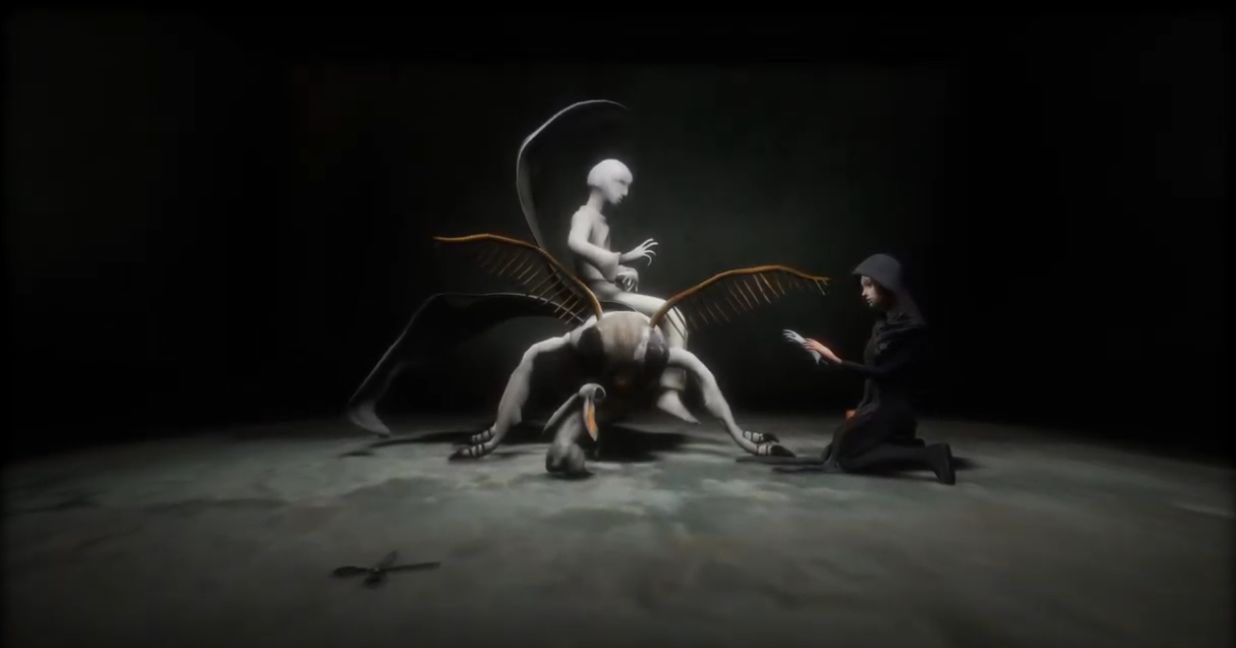
Bryn Oh – Hand, Second Life: Milkdrop the AI and Flutter. Credit: Bryn Oh
Whilst stories in their own right, all sharing a common universe, there is something more within each of Bryn’s installations and pieces which reflects her thoughts and feelings in an almost journal-like fashion.
My work is almost a type of diary. I take things from my life or observations on society and incorporate them into the ongoing narrative. The idea is to create a parallel society we can recognise, but use very personal or emotional aspects of my own life to connect to the viewer. So as an artist if I take something from my own life, something I understand deeply and personally, I can convey that emotion to the viewer better than an idea that I have not lived. The first hand experiences let me detect the nuances that may be lost if I were to attempt to create something that I had not experienced.
– Bryn Oh
Bryn Oh in Second Life, by Jamisson Burnstein
As immersive pieces, Bryn’s works are also somewhat experiential, in that they often involve a lot of activity on the part of visitors. This is again intentional, as Bryn noted to me: having to work for something results in a deeper attachment to an installation, a sense of achievement on gains success, together with a personal connection to the story through that achievement. It may not be something that appeals to everyone, but it is something that undoubtedly adds significantly to the ability of her work to keep people visiting and in making repeated visits.
When looking at Bryn’s work as a whole, it is not unfair to say that she has, over 13 years, become one of the world’s foremost virtual artists, and through her work in Second Life, Sansar and other virtual mediums and environments – including the use of machinima as seenat the end of this article -, she is very much a pioneer in shaping a new artistic movement.
We had the Cubists, Impressionists, Surrealists, Modernists and I see our movement as the Immersivists. I have believed in this idea a long time but now with virtual reality headsets such as Vive or Oculus, the immersion is less fragile. You don’t look at a computer screen and beyond its borders see a bill that needs to be paid or your cell phone rings… instead you are in the world I have created and firmly there. Unlike painting where you stand from a distance and look at a static scene or cinema where you are told a story as a passive observer, virtual reality artwork can offer the ability to be an active participant in the art.
– Bryn Oh
As a pioneer, Bryn herself faces many challenges, up to and including being able to finance her virtual work. In this, she is keen to note the on-going support of the Ontario Arts Council, which has been vital to Hand’s renewal in Sansar and Second Life, as well as supporting her in some of her other installations and work.
Hand took me almost a year to build; to undertake a project like this with potentially few prospects is, as you can imagine, unwise. So the financial support of the Ontario Arts Council helps enormously. But what is more important to me is the psychological support they provide through their belief in me as an artist. I work alone; few among my family and friends understand what I do, nor are they particularly curious … Recognition by, and support from, the OAC, is something that reinvigorates my confidence and says to keep going and striving in this art medium that I truly believe in. So I would like to thank again the OAC and the great work they do.
– Bryn Oh
A further reflection of the depth and importance of Bryn’s work also lies in the fact that professor Carolyn Steele of the Communication and Culture department at York University, Toronto, is putting together a new course on Bryn’s work that will be presented at the university in the near future.
For those of us unable to attend that course, we still have Hand to appreciate in Second Life and Sansar – and, doubtless, more stories to come out of Bryn’s universe. So for now I’ll leave you with the aforementioned video, as produced for OTC, and also offer my thanks to Bryn for all of her work in Second Life and Sansar, which means a lot to so many, and for giving me the time to answer questions and discuss her work in order to produce this article.
The 5th Annual Kultivate Spring Art Show opens it doors on Friday April 24th, 2020, and will run through until Saturday May 2nd.
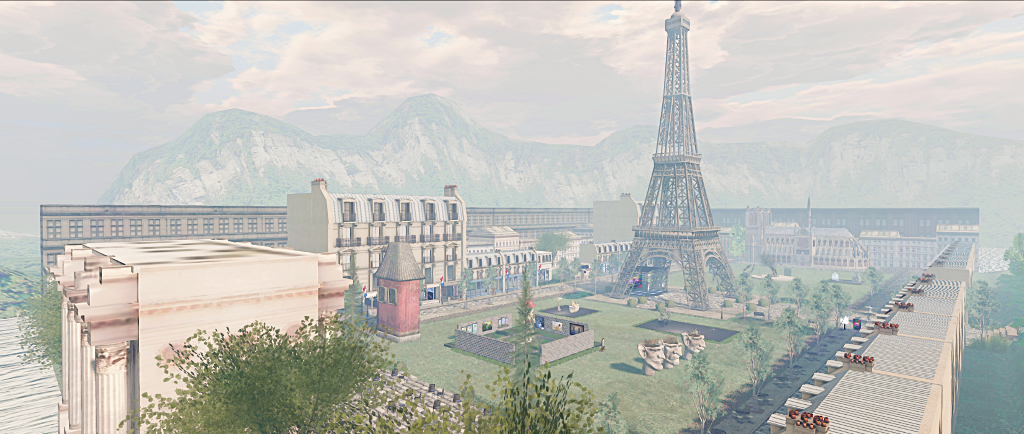
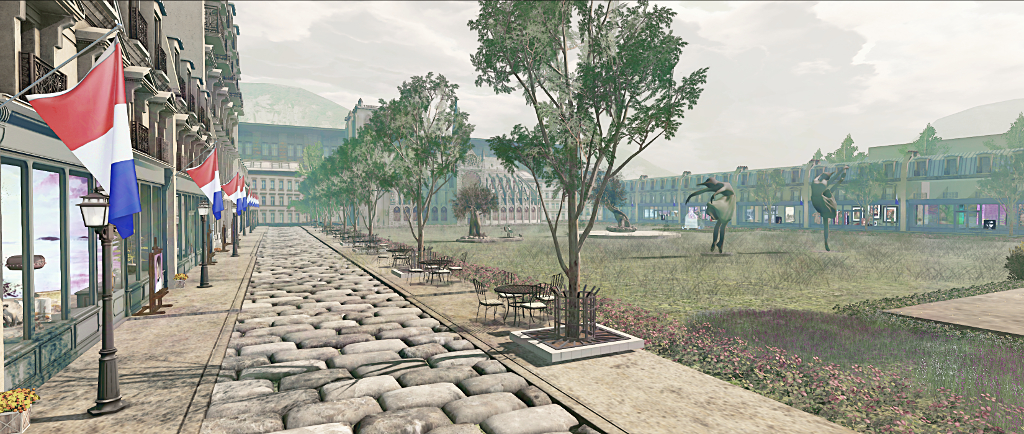
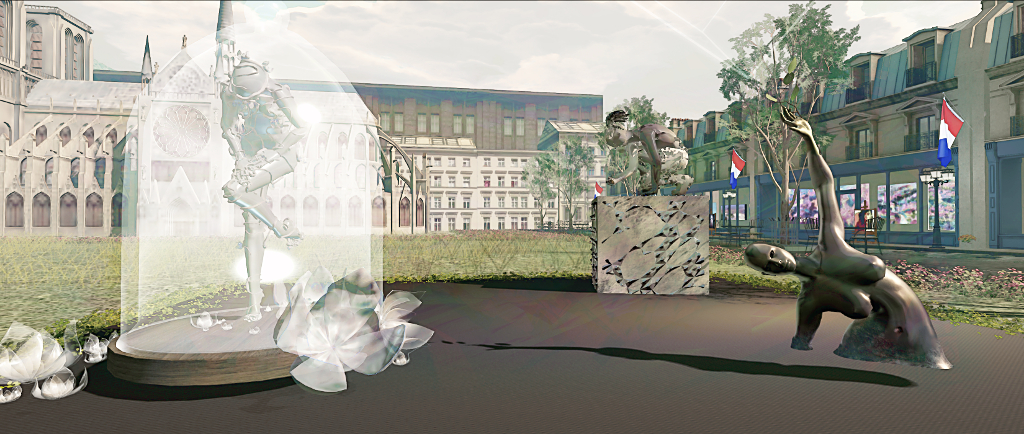
Carrying a Parisian theme, complete with the Arc de Triomphe, the Eiffel Tower and Notre Dame, and with art studios sitting with French style town houses fronted by cobblestone walks, the Spring Show also marks the re-launch of Kultivate Magazine, the April 2020 edition of which is currently available.
The event featured 2D and 3D artists, entertainment with live performers, give away events with special prizes, juried and non-juried art contests, hunts, storytelling and cabaret.
Kultivate Spring Art Show 2020
The artist participating in the event comprise: AlexAvion, Angyel Resident, Anouk Lefavre, Danielofangel, Eucalyptus Carroll, Freedom Voix, Ilyra Chardin, Jamee Sandalwood, Johannes Huntsman, Judilynn India, Juliette Rainfall, Kacey Macbeth, Kapaan, KodyMeyers Resident, Leaf Mia Lone, Michael Lysios, mth63, Myra Wildmist, Paineful, Rory Torrance, Sabine Mortenwold, SandyBlackCloud, Sheba Blitz, Skye Joubert, softandred, softandred, Solana Python, Syphera Inaka, TaraAers, Tempest Rosca, Vanessa Jane, Veruca Tammas, ViktorSavior, Whata Conundrum, and Zigmal.
In addition, there are special exhibition by Debauche Dance, Dirty Pretty, & The Art Loft.
Hunt information can be found on the information boards within the event grounds, close to the landing point.
The Photo Challenge
Open to all visitors to the Kultivate Spring Art Show, the Photo Challenge offers a prize pool of L$5,000 shared between the four selected winners, with the winning images published on the Kultivate website.
To enter, all you have to do is take a picture of yourself whilst visiting the show (moderate or pg/g in rating), and then upload it to the contest Flickr group. Make sure you include the SLurl of where you took the image in the Flickr description, and that your image is uploaded to the Flickr group before 23:59 SLT on Thursday, April 30th, 2020.
Full guidelines and rules can be found on the challenge page on the Kultivate website.
Kultivate Spring Art Show 2020
Event Schedule
Times, where given, are SLT. Note that there may be further give away prizes at events.
Friday, April 24, 2020
Exhibition opens.
Photo Contest and Art Quest begin.
Judging of Juried Categories Begins.
Entertainment:
16:00-17:00: live performer Wolfie Starfire.
17:00-18:00: live performer SaraMarie Philly.
Saturday, April 25, 2020
16:00-17:00: White Party with live performer Aislen Sings
Photo background HUD and & Fotoscope Fotostudio give aways.
17:00-18:00: White Party with live performer Melenda Baptiste
The Camden Photo Studio Build by Maven Homes give away.
Sunday, April 26, 2020
13:00-14:00: Sam Quenda.
14:00-15:00: live storytelling with Seanchai Library.
Monday, April 27, 2020
16:00-17:00: Spring Art Ball with live performer Holly Giles.
Trompe Loeil L$1,000 gift card give away.
Kultivate Spring Art Show 2020
Tuesday, April 28, 2020
17:00-18:00: Audience Participation Cabaret with Whymsee.
L$1,000 give away.
Wednesday, April 29, 2020
16:00-17:00: live performer Savannah Rain.
TEMPLAR Poses give away.
Thursday, April 30, 2020
16:00-17:00: Kultivate Magazine relaunch party with live performer Mavenn
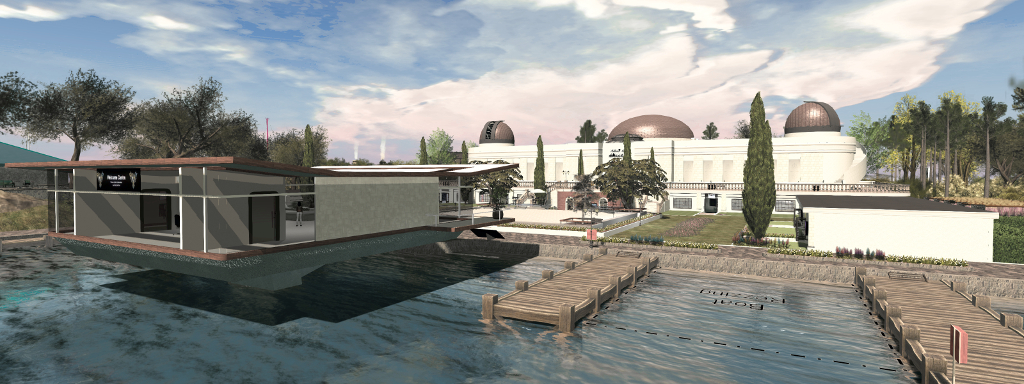
In March I wrote about the Phoenix Artists Collaboration (PAC) obtaining a new home (in part) at Holly Kai Park. Since then, things have been moving along (including a few changes at the Park!), but as a whole PAC is now moving to a point where it can start hosts exhibitions and events.
Since my last update, PAC has increased its facilities with the addition of a sky platform at Cherished Melody, provided and looked after by the talented Audie Whimsy. This provides space for a further 22 artists in addition to the 28 currently exhibiting at Holly Kai Park, with plenty of room for expansion, should the demand be there.
Cherished Melody
Both locations offer the same facilities to artists – gallery spaces with up to 50 LI per artist for personal use. Units – as and when available – can be obtained by joining the PAC group in-world (although we are currently full at both locations; new units will be come on-stream in the near future, we just need time to breathe!), and there is no rental fee associated with unit use.
Units can be decorated however artists wish (although we request no temp rezzing and particle effects are kept to a minimum). Artists can also arrange and promote their own mini-exhibitions and advertise them through the PAC group and website.
Holly Kai Park
Planning is about to commence on the first of the PAC group exhibitions, which will also likely serve as the formal opening events for PAC activities at both Holly Kai Park and Cherished Melody. We’re also mulling options for group social events, and details of these will be announced through both the PAC in-world group and the new website.
Members who use Discord can also track activities, join / create discussions about art, SL and whatever else that suits them through our Discord server. All that’s asked is that conversations are kept polite, topics keep a focus on art (physical world or SL) and Second Life, and that the server isn’t used for spamming others. You can join the server (and create a Discord account, if required) via the link here, or via any of our Discord Server stands located at both Cherished Melody and Holly Kai Park.
Cherished Melody
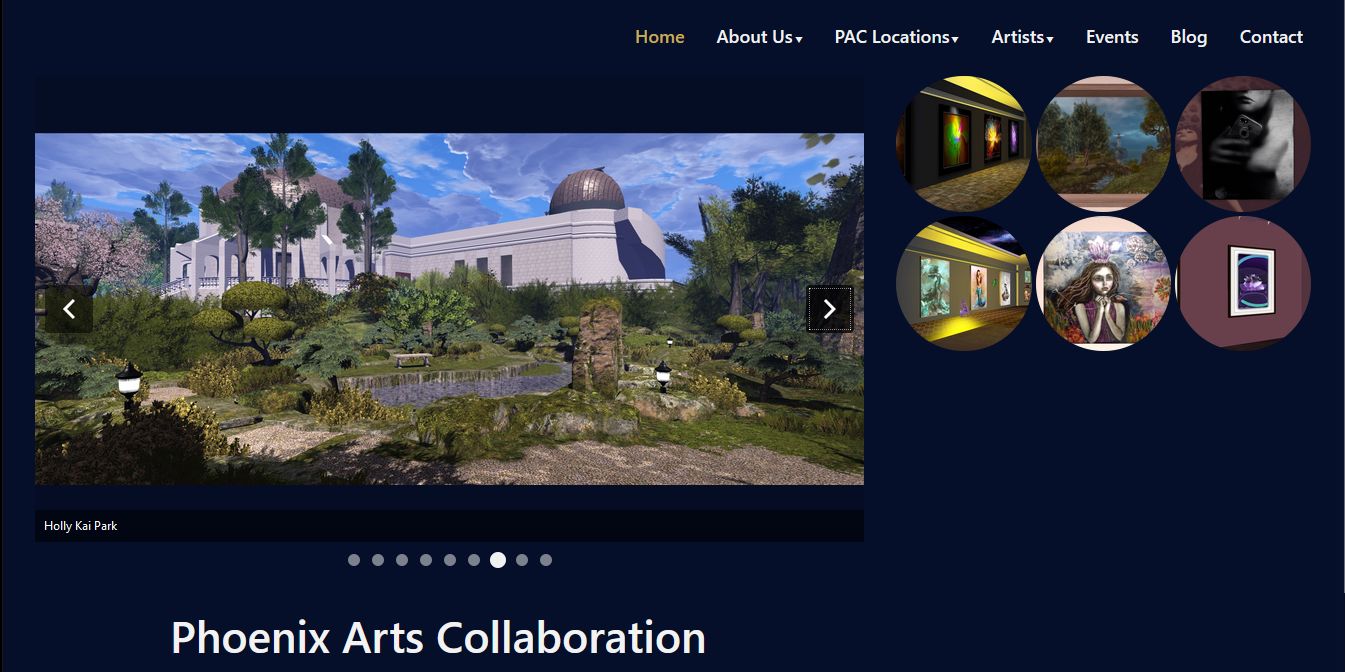
Rather than information on PAC being confined to the Holly Kai Park website, a separate web presence for the group is being put together. While this is still very much under construction, but it can be found at https://phoenixartsl.wordpress.com/, where information on PAC, the PAC locations and current artists using PAC facilities can be found. In time, the website will also promote PAC events, host a blog on activities, exhibitions, artists and more, and more as we think of it!
There’s still some work to be done (notably with the website as indicated), with some nips and tucks going on at the two locations – so please forgive and sawdust, construction signs or bits that seem to be missing in the need few days. However, for those who do fancy a visit, feel free to drop into either or both locations.
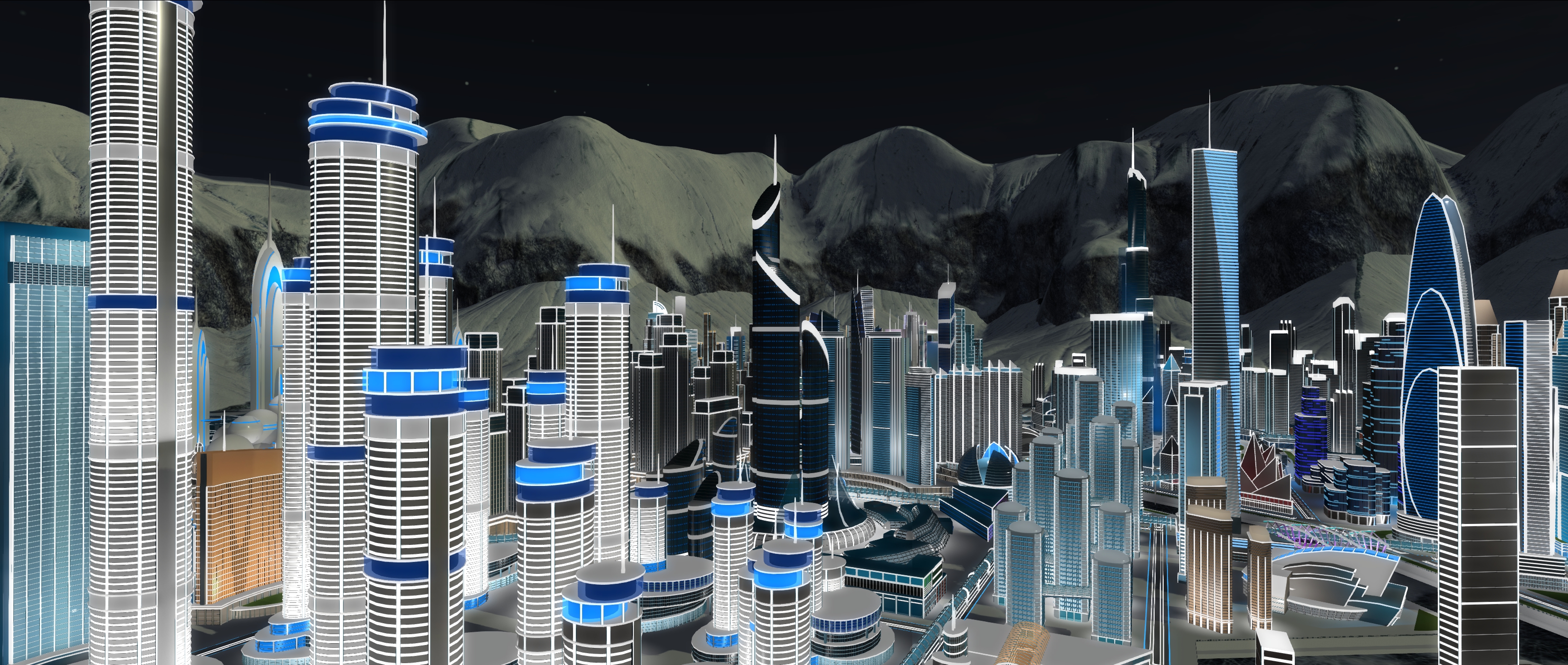
On April 19th, 2020, Gem Preiz, the master of the fractal image, opened a new installation in Second Life – one that is a little different to his past installations / exhibitions in that fractals are almost non-existent within it. Instead, with Skyscrapers, he presents an immersive installation that is drawn from one of his many passions: architecture.
In short, the installation presents a region-wide city – but with a difference. Everything in it is represented at 1/10th scale (based on a region’s size). Thus, rather than offering a location just 256m on a side, Gem presents a city that is 2.56 kilometres on a side, representative of a city covering 100 regions. It has been built to reflect the beauty of modern skyscrapers which have a unique impact on Gem, as he explains in the introductory note card:
skyscrapers [are] modern cathedrals which are, like those of the past, the synthesis of all the techniques of their time, dedicated to the collective aspirations of their builders. Incredible technological challenges, they are increasingly integrating the search for an aesthetic that reinforces their impact. They have to be beautiful, since they will be more and more numerous in order to limit the surface of land arable or reserved for ecosystems that will be needed for human housing.
Gem Preiz: Skyscrapers
It is also – as he also explains – an exercise in immersion. By using a set scale for this build, and by providing the means to move through it at an equivalent scale, Gem has created an environment that is richly encapsulating, the scale allowing you to travel through the streets and parks of a city some 2.56km on a side.
This is achieved through the use of an option to make your avatar “invisible” via an alpha layer (remove all mesh and other attachments) and then using one of the flying vehicles available at the landing point within the city itself (in turn reached via a teleport board from the main landing point). Three of these vehicles are “self drive”, so you can pilot them yourself, or you can take the red car on a guided tour of the city, its sectors and buildings.
Gem Preiz: Skyscrapers
While it is possible to walk and fly around the city as an avatar, I strongly recommend using the alpha layer (your avatar sans all mesh and attachments) and the vehicles. The latter are scripted to move at a speed consistent with the scale of the city, and by hiding your avatar, you gain the distinct impression of the city’s size. If you opt to go into the installation as you are, without using the alpha option, then I still suggest using the vehicles – but switch to Mouselook when doing so to gain a real sense of scale. Note also that a teleport HUD is available from the city landing point, and with will allow you to hop between specific points of interest.
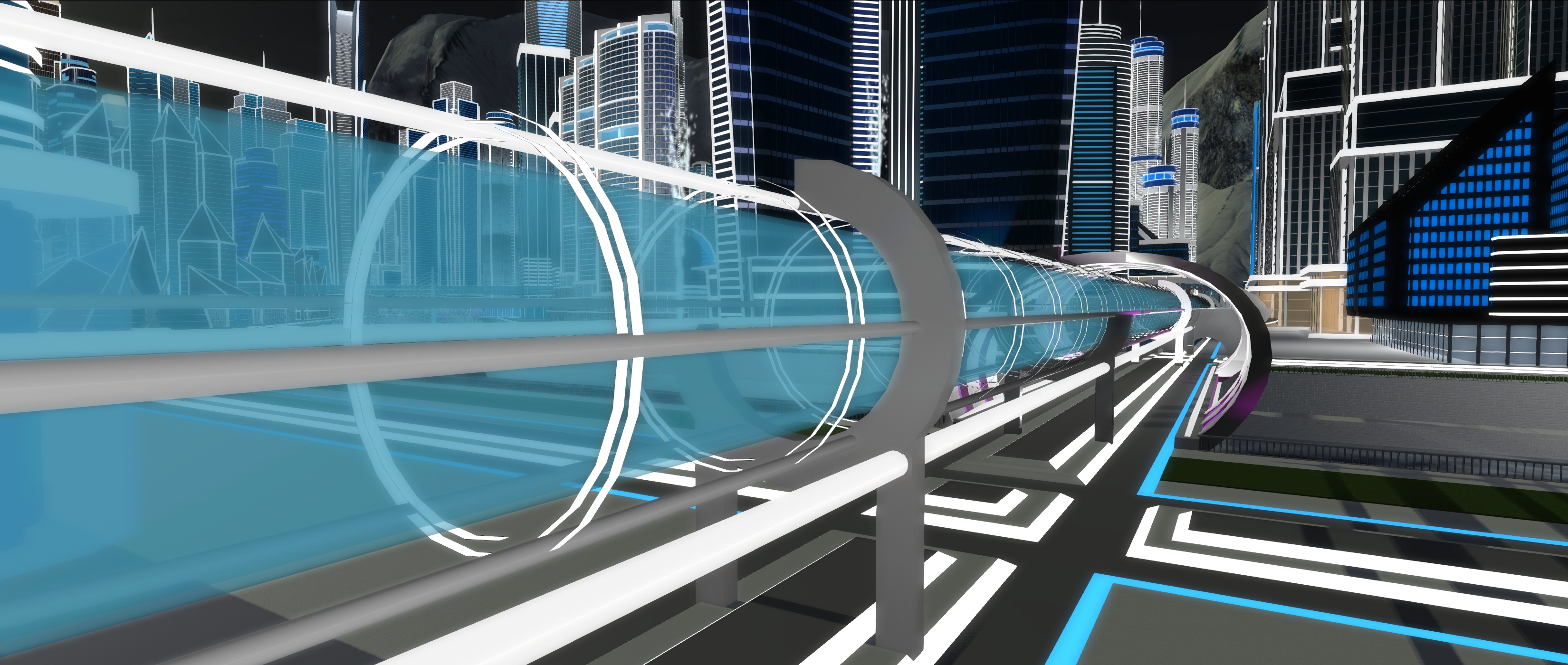
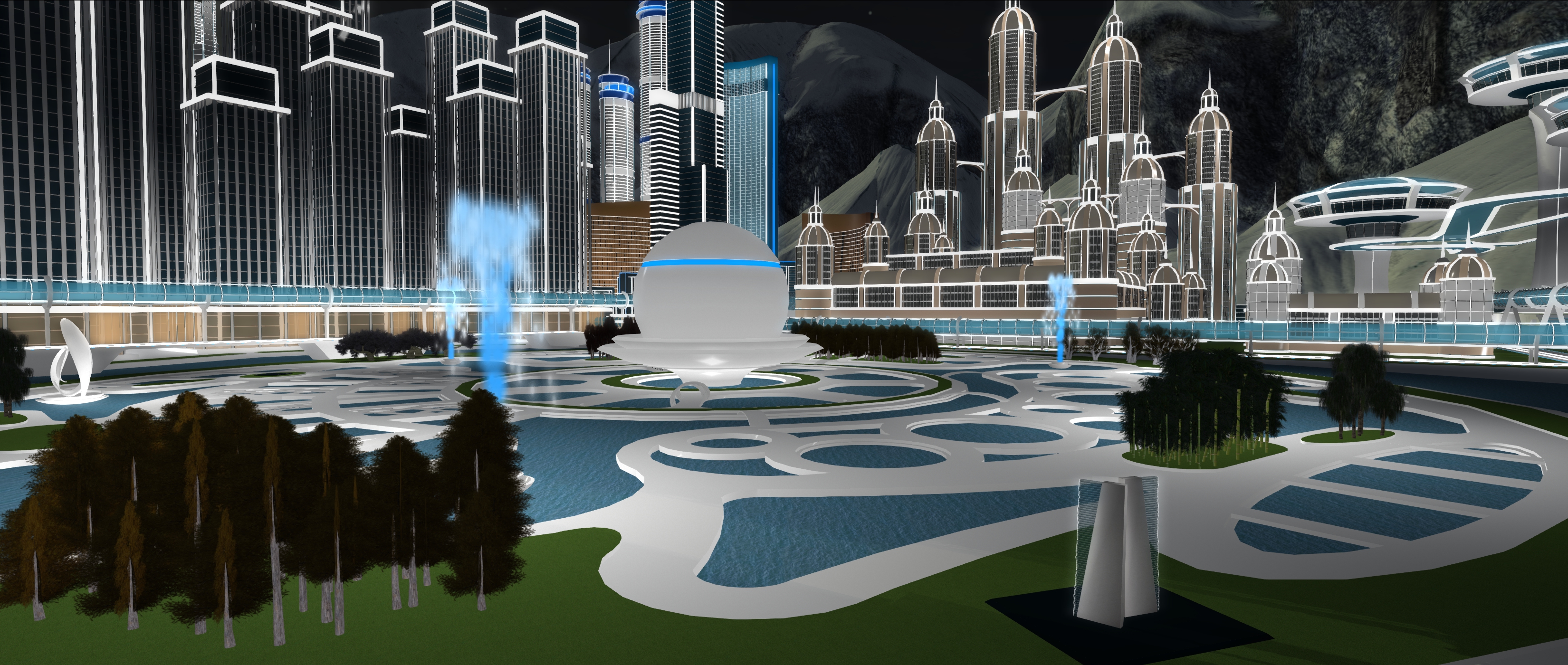
Like a real city, Gem’s is split into various districts, each with its own buildings / architectural styles. Some sections are purely conceptual / entirely futuristic in style, others are more recognisable in style (such as the residential districts, the shopping district with its malls, etc.). Most of the buildings are ultra-modern in look, although some offer stylised designs that embrace the past. Surface and elevated roads cut their way between districts, as do the tubes of what might be taken as a mass transit system, which also separates the main park in the city from the surrounding districts, giving it room to breathe.
Gem Preiz: Skyscrapers
However, it is the buildings that are the most fascinating. Some are simple box and cylinder designs, others more sculpted / futuristic in style. However, many owe their inspiration to skyscrapers from the physical world, and it is seeking these out among the towers and districts that can get someone thoroughly engrossed. Gem provides a list of the latter, but during my visit I spotted what appeared to be a number – by happenstance or design – that also appeared to be drawn from physical world counterparts not listed in the note card. These included the Hong Kong and Shanghai Bank building in Hong Kong, the shape of which appears echoed through a number of blue buildings in the city, London’s Shard, and two graceful golden curves of buildings that put me in mind of the U.N. Building in New York, while a series of paired towers each linked by high-level walkways put me in mind of the Petronas Towers.
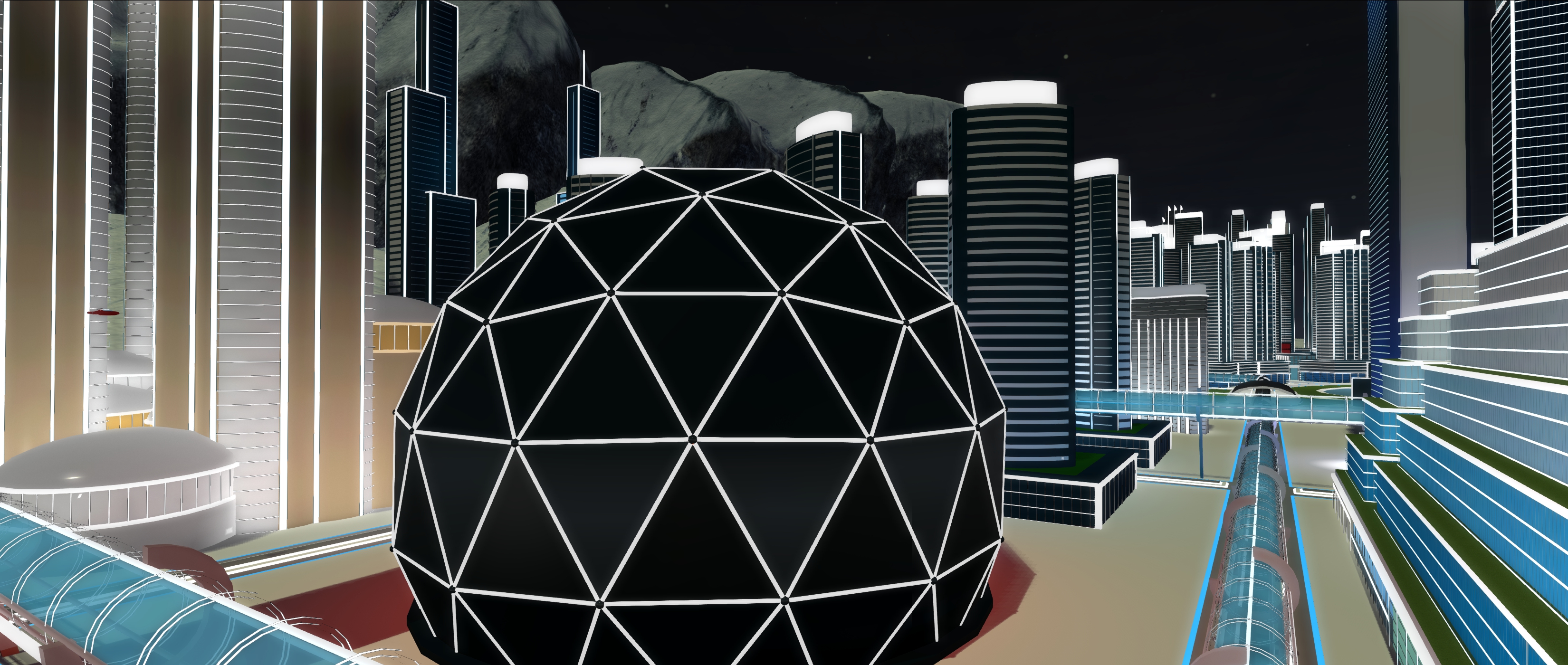
I mentioned above that Gem’s Fractal images are “almost” non-existent in this build. The qualifier comes because deep within the city is a large geodome, within which is a series of his fractal images, scaled down from their usual size, each one offering a view of futuristic architecture entirely in keeping with the installation’s theme.
Gem Preiz: Skyscrapers
An extraordinary and engaging installation, Skyscrapers is well worth visiting while it remains open.
Johannes Huntsman may not be a familiar name to patrons of art in Second Life when reading it here – but if I mention that he’s actually the founder of Kultivate Magazine and the Windlight Gallery, then recognition will immediately drawn, the new moniker he carries being the result of SL’s Name Changes capability.
As a Second Life resident, Johannes’ support of the arts over the years has been indefatigable, from the magazine and gallery through to supporting multiple charity events to co-founding has own fund-raising organisation, Team Diabetes of Second Life, he is a veritable powerhouse. He is also an exceptional gifted photographer and artist – a fact that can be attested to with a visit at the Kiku Gallery curated by Suzanne Logan during April / early May, for that gallery is currently hosting a stunning portfolio of pieces by Johannes that are – without any exaggeration – quite breath-taking.
Kiku Art Gallery: Johannes Huntsman
Encapsulated in what is itself a charming boutique gallery space are 15 large-format image images, with a supporting collection of 8 smaller pieces, Naturescapes is an honest tour de force for Johannes’ ever-evolving breadth of styles with his art, offering as it does pieces that appear to enfold both second Life and the physical world. As the name suggests, this is a series of images focused on nature’s beauty, with three pieces offering painted coastal views that may have started life as photographs.
The collection is mostly presented in colour, but with five monochrome pieces, two of which have a marvellous quality of having been etched. Other pieces have the clarity of pencil drawings or the gentle tones of watercolours or the richness of oil paintings. Each individual item has a natural beauty, but I confess to being particularly drawn to the studies of a puffin and a dog – with a bias towards the former, if only because like many people, I have a peculiar fascination for those little alcids.
Kiku Art Gallery: Johannes Huntsman
Whether painted directly or the result of post-processing, these are all pieces that carry a depth of life that instantly draws the observer into each one. Meanwhile, the eight smaller pieces are in fact three collections of pre-sized, pre-framed pieces that would grace any Second Life home; one contains three miniatures of the coastal sail scapes, the second the trio of flower paintings and the third an exquisite pair of monochrome photographs of birds.
A genuinely engaging exhibition, well worth visiting.