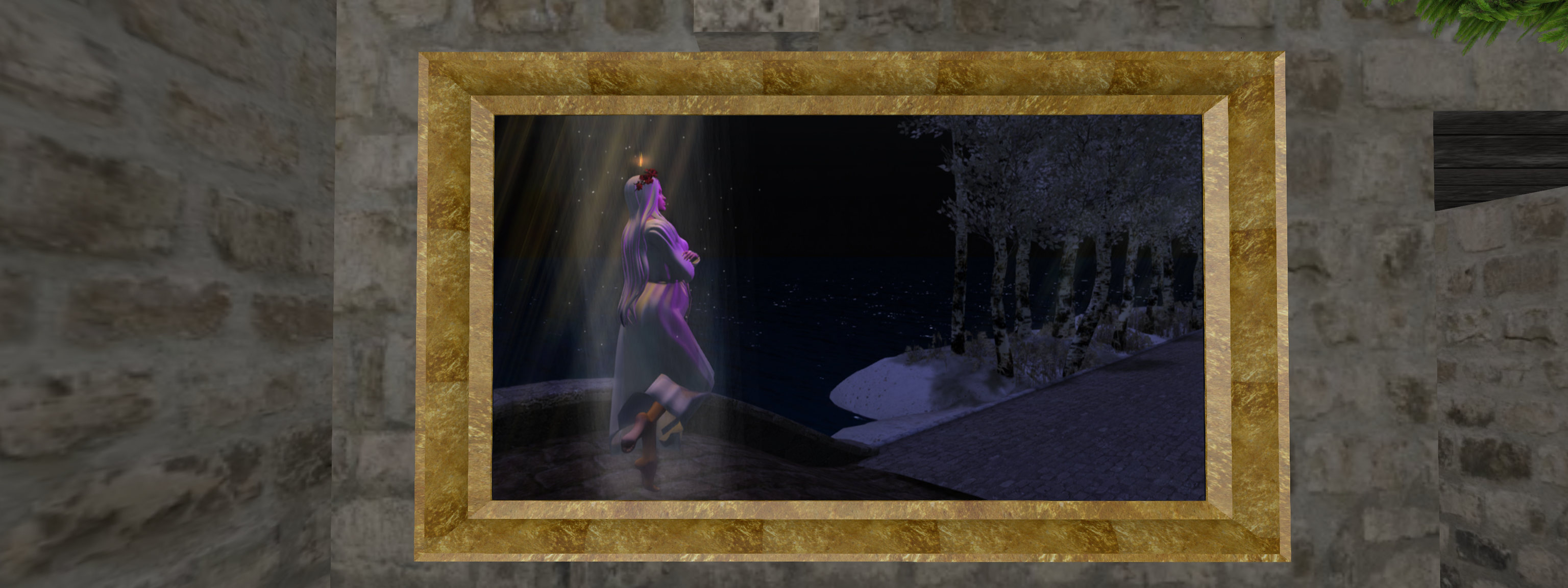
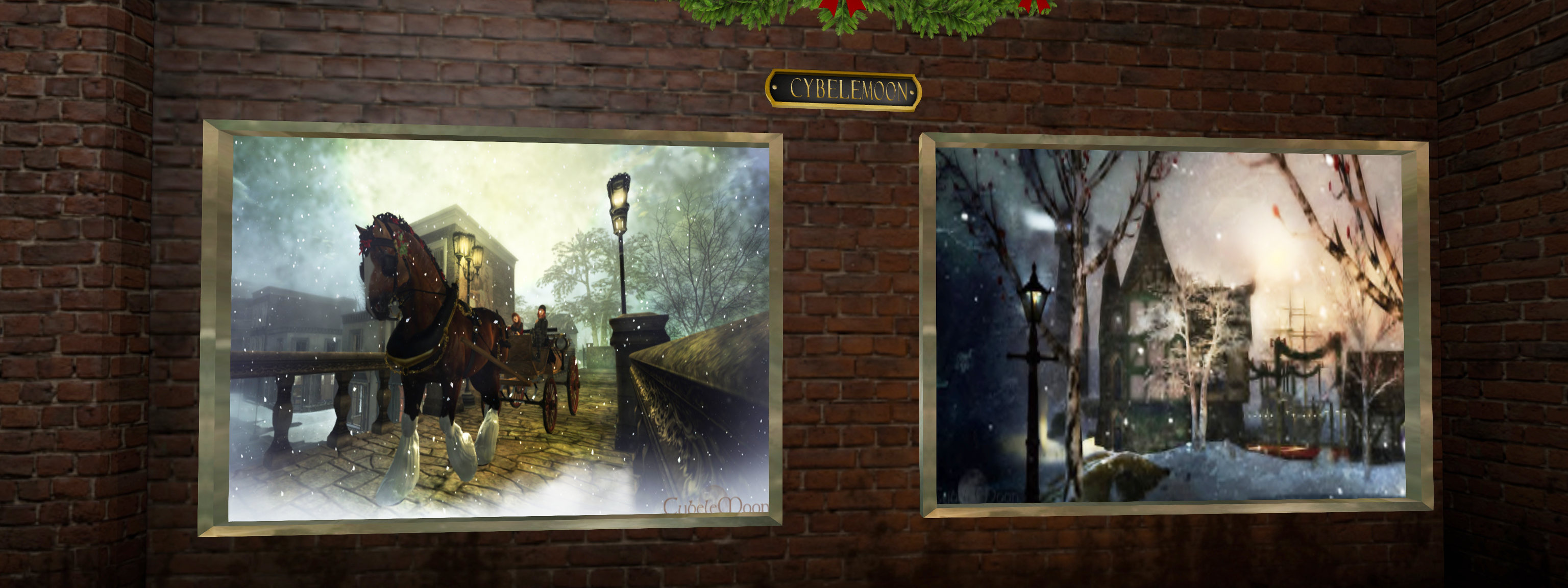
The October 2020 exhibition at the Third Eye Gallery, curated by Jaz (Jessamine2108), brings with it a selection of art by Poppy (Popikone) and a second by Thus Yootz, both of who present pieces that are captivating to the eye and rich in narrative.
Poppy is a physical world photographer who discovered Second Life somewhat by chance: whilst entering various physical world photo challenges presented through Flickr she came across the work of Second Life photographer and became entranced by what she saw to the point of signing-up and getting involved. Since joining, she has become deeply involved in in-world photography to the point that she notes she has a backlog of around 2,000 images she has yet to process and upload.
Third Eye Gallery: Poppy (Popikone)
Despite this, Poppy has never publicly exhibited her work in SL until Jaz approached her about this exhibition. Within it, she presents 26 images that are somewhat thematically defined as you view them, with some focused on water and boats, others on landscapes, and others on avatar and art. These are presented in a number of styles, some of which are mindful of painting styles (Girl in Blue) for example, with its Neo Impressionism overtones), others of which might be said to lean more towards Expressionism or Abstract). Many have a rich vein of narrative within them, some quite captivatingly so, while her use of colour brings her landscape images very much to life.
Third Eye Gallery: Poppy (Popikone)
Narrative is also very much present within Thus Yootz’s work. With an MA in art, Thus has no fear in experimenting in style and genre, and here she presents a total of nine pieces, each individual and unique, encompassing a range of themes as well as artistic styles. Within some, there is a sense of abstract expressed through the use of colour (I Wish the fog would Lift and Sunny Summer Filled with Colour). Others offer rich studies, and I found myself particularly drawn to Sola Festa and – most particularly – Fantasy Garden Statues, which has a stunning depth and richness of story to it that is remarkable.
This is only the third time I’ve witnessed Thus’ work on display, and as the first two times her work was part of a larger ensemble exhibition, it is the first time I’ve been able to study it in the depth it deserves – and I hope to see more in the future as it is genuinely evocative.
Third Eye Gallery: Thus Yootz
Similarly, I hope that following this exhibition, Poppy will accept further opportunities to display her work – and gallery owners will seek her out as well, as she is richly deserving of the opportunity.
The October exhibition at Raging Graphix Gallery, curated by Raging Bellls, brings us a joint exhibition by Jamee and Matt Thompson, perhaps between known to many in Second life as Jamee Sandalwood and MTH63, who recently officially partnered in SL.
Both are well known for their photography depicting the sights and art of Second Life, their individual styles an engaging mix of the contrasting and the complimentary, depending on subject and – I assume – mood. Indeed, so complimentary are their styles that but for the tell-tales evident in some of the piece in this exhibition, and the occasional presence of a name in a canvas corner, all of the photographs offered here might be mistaken as being captured by the same photographer.
Jamee’s work encompasses several genres, including landscapes, avatar studies, fashion photography and abstract pieces, although her landscapes predominant here. These generally tend towards softer tones and lighting, carefully processed to give a genuine feel for the time of day that frames them. However, more recently she has moved towards what she refers to as”shadow photography”, using both the play of light and shadows to create elements within her images, while at times also leaning towards darker tones in over composition.
Matt has also built a reputation as a landscape photographer, again as evidence in the pieces included in this exhibition. However, were Jamee sways towards softer tones and post-processed finishes, Matt often tends towards sharper, cleaner lines and finishes that – even when portraying reflections on the water – give his work a more crystalline finish, one so sharp in places that it feels as if a brush of the fingers over some of the lines of his images might well cut the finger.
Raging Graphix Gallery: Matt Thompson (MTH63)
This sharpness gives his pieces a sense of life and realism comparable to Jamee’s work, one that like hers reaches beyond the digital realm in which they were taken to offer something very tangible, whilst that same sharpness mentioned above offers that subtle contrast to Jamee’s work, gently pointing to the fact these these are pieces produced by two individual artists, even as they are unified by subject matter and tonal quality that can unify them into a single exhibit.
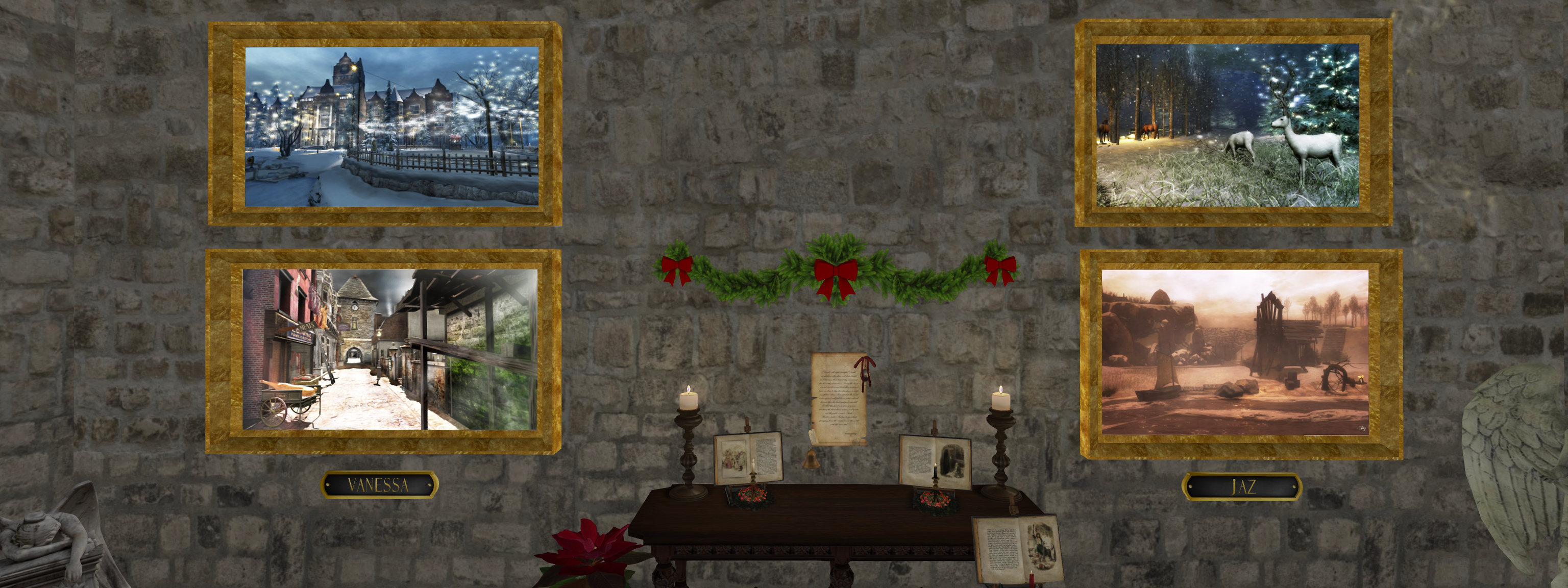
This complimentary flow is perhaps seen in the four pictures along the longest wall of the exhibition space, in which two of Matt’s landscapes bracket two of Jamee’s pieces that lie within her more “shadow photography” approach. The contrast of hard and soft lines, be it through finish or the use of the shadows inherent within the location where an image was taken and the tonal qualities of all four pieces, even with the differing approaches to post-processing offer all four as a continuous whole, the eye running easily across them as if they had sprung from the one artist’s eye and hand.
Raging Graphix Gallery, Matt and Jamee
Engaging, bold, and with a personal touch through the inclusion of The Rings, a piece marking their recent union in Second Life, this is another excellent exhibition at Raging Graphix, and it will run through until the latter later of October.
The start of October brings with it the opening – on Monday October 5th at 12:30 SLT – another provocative exhibition at Nitroglobus Roof Gallery, curated by Dido Haas.
Nitroglobus remains one of my most-visited (and most written about!) galleries because month in and mouth out, Dido encourages some of the most engaging artists to display their work there, and to do so within the frame of a theme she – or more usually the artist – has set. The result is that each most, Nitroglobus plays host to art that can provoke, evoke, emote, and engage on a level that I personally cannot help but find magnetic.
For October, the gallery is playing host to an installation put together by two artists working together under the banner of Dreamers & Co. They are Nette Reinoir (Jeanette Reinoir) – who is exhibiting her work within a gallery for the first time – and Livio Korobase, and they are supported in part by drawings from the portfolio of physical world Dutch artist, Redmer Hoekstra.
Entitled Animals on Earth, the installation is designed to encourage us to use this time of enforced pause in our lives courtesy of the SRS-COV-2 pandemic to consider what is happening to the world’s ecosystem – its flora and fauna – directly as a result of mankind’s impact on the planet.
Modern societies have been treating Mother Earth as if it was their property; extracting resources, polluting constantly, changing the landscape, killing the animals and destroying its natural balance.
Since the Industrial Revolution, humanity has killed 83% of all wild mammals and half of all the plants on Earth. Two hundred species of living beings are extincted every single day. We collectively need to change so many things in areas such as the use of plastic, meat consumption, contaminating energies, day-to-day overconsumption and more.
– Statement by the artists
Nitroglobus Roof Gallery: Animals on Earth
Now to be sure, statistics and figures need context, and those relating to “daily” extinction rates can be called into question, as they tend to be inconsistent. For example, in 2015 the Millennium Ecosystem Assessment concluded that perhaps some 24 species of plant, insect and animal became extinct either regionally or globally every day – but the U.N. Convention on Biological Diversity put the figure at “up to 150”, a far larger number, even allowing for the “up to”. Other models present further differing rates, and all appear to be distanced from the fact that historically, we have “only” seen around 800 global extinctions of animals (land, air and marine), during the last 400 years.
However, this does not negate Animals on Earth‘s thematic message. The current epoch – the Holocene – is regarded as encompassing the sixth mass extinction level event (ELE) this planet has seen, the Anthropocene extinction; and event that is still very much on-going, and potentially accelerating. It has its roots in natural climate change as the Pleistocene period, with its rolling waves of ice ages, gave way to the warmer, wetter Holocene period, leading to the extinction of many of the large mammalian species that had acclimatised to the cold, dry ice ages, and an a matching marine megafungal extinction event that brought an end to many marine reptiles and fish due to changing sea temperatures.
But this period of extinctions was influenced by another factor: the rise of humans as organised hunter-gatherers, which gave rise to the first wave of over-hunting, accelerating the demise of many species. It was the start of a trend of human intervention and meddling in Earth’s ecosystem that has continued throughout the Holocene period such that within a few thousands of years, humankind has had one of the most dramatic impacts the Earth’s biomass has witnessed.
Nitroglobus Roof Gallery: Animals on Earth
From over-hunting, to disrupting natural environment as a result of increasing agricultural needs (notably livestock rearing) through to large-scale urban and other development and its associated infrastructure and waste, humans have significantly altered the world’s biomass in multiple ways, own of the biggest being the distribution of mammalian life on Earth, which in 2018 was shown to be 36% humans, 60% livestock (notably cattle and pigs) and just 4% wild animals (source: The biomass distribution on Earth, Proceedings of the National Academy of Sciences). Nor does it end there; as the pre-eminent apex predator, human kind is regarded as a megahunter due to our predisposition to hunt and kill creatures pure for “sport” – an act that significantly increases the risk of regional (and even global) extinction of multiple species.
Thus, through our actions, we are directly responsible for continuing the Anthropocene extinction, and thanks to our broader impact on the climate, we are pretty much its primary driver. Our actions are bringing multiple species of fauna and flora and biota dangerous close to the edge of global extinction, we have irrefutably been responsible for many regional extinctions (rendering portions of the world and its oceans no longer habitable by species that once occupied them, even if those species survive to some degree elsewhere) over the last several decades.
It is all of this that Animals on Earth tries to encompass, and it tries to do so not by brow-beating with facts and figures or by doing so by being unduly heavy in its imagery, but by presenting us with images and models and interactive elements that in places fun (do make sure you kiss the frog) and which also serve to get the grey matter working, even if subconsciously.
Nitroglobus Roof Gallery: Animals on Earth
Flow with the thoughts and you’ll discover nature illustrates the Creator’s powers, whoever he/she is. Most of us, however, fail to appreciate nature because we’re entangled in our fast-paced lives, and life’s problems cloud our minds from grasping its beauty and lessons. Climate change, overpopulation, pollution, unfettered urbanization, and wars cause disasters to the natural environment. Little wonder we see less of nature and more of guns, nukes, and bloodshed in our cities.
Statement by the artists
Rich in colour thanks to Nette’s images, and very interactive thanks to Livio’s models and scenery (be sure to mouse-over things carefully – even Redmer Hoekstra’s drawing are more than they seem – Animals on Earth encourages the visitor to consider Earth’s biodiversity as represented by the creatures with who we share the world, and presses us to imagine what life would be like in general terms were we to lose them.
With much to see and do – and to mull over / research – Animals on Earth officially opens to music by DJ Gorilla on Monday, October 5th, appropriately enough, and will remain open through the rest of October.
I made my second visit of the week to Chuck Clip’s Sinful Retreat region in order to see Mindscapes, an exhibition by JudiLynn India, and which can be found within the region’s Janus Art Gallery II.
JudiLynn is a remarkable abstract artist who has been active in Second Life since 2009. Having studied graphics design at the Tyler School of art, at the opening of the new century she decided to focus her creativity on acrylic and digital painting, particularly exploring the opportunities for textured painting in the former and the ability to play with light and colour with the latter. When combined, these two approaches give her art a genuinely tactile dimension which in turn breathes a fascinating sense of life into them.
The title of this exhibition appears to be drawn from the fact that much of JudiLynn’s work originates within her mind’s eye, rather than being inspired by external sources. These are bold, vivid pieces, clearly drawn from her love of colour, their finish retaining the layered, tactile look that is so intrinsic to her art.
It is my goal to make charitable creation my life’s work. My intent is to share my craft and use it to raise much needed support for organizations that improve the quality of life for people at home and abroad.
– JudiLynn India, describing her art and her approach to life
Fourteen pieces are offered – twelve as conventional canvases, two as totems standing within shallow alcoves in the gallery’s curved wall. While all the pieces naturally draw and hold the eye, their mix of bright tones and more organic colours quite captivating, I confess that I found Mindscape 2 Totem particularly attractive; the colours within it richly organic, its form – a rectangular block – primal, its entire form exceptionally Earthly – by which I mean it has an element of having been drawn from the very crust of the planet, and raised up to offer a story of the ages that progresses down through its colours.
but each of these pieces that make up Mindscapes has something to say to those looking upon it; there are subtle narrative running through each, be it due the the shapes that are suggested within each or the manner in which colours ebb and flow with one another or intertwine gracefully, or the suggestion of things half-seen produced by the mix of line, colour and textural layering.
Captivating, entrancing, emotive and offering a combined journey into the art and imagination of their creator, the pieces presented through Mindscapes are not to be missed.
Milly Sharple is a remarkable artist, creator and patron of the arts in Second Life. An artist and photographer in the physical world, she has always enjoyed art and artistic expression, particularly that of fractal art, a technique she started using in 2005. It’s a medium in which she has gained deserved recognition: she has sold pieces around the globe, had them used as book and CD cover art and as promotional material, and has had her work used on the face of the bank cards issued by an Indonesian bank. Her work has even brought her to the attention of Salvador Dali’s protégé, Louis Markoya, who asked her to collaborate with him.
Milly was perhaps one of the first artists to bring fractal art to Second Life after she joined in 2008. Gaining familiarity with the platform, it became a place where she understandably wanted to exhibit her work, and following her initial exhibitions, she started receiving multiple invitations to display her work. She thus became immersed in the Second Life arts community, establishing her own gallery and also the Timamoon Arts Community, a place where artists could find a gallery home and like minds, and over the course of four years, she grew Timamoon into one of the most successful arts communities in Second Life.
For her incredible and expressive fractal art, Milly uses the Apophysis software package, which allows her to create soft, flowing, liquid effects that sets her work apart from other, more rigidly geometric fractal art with which we might be familiar as it is displayed in Second Life. This approach gives her work a stunningly organic look and feel, rich in life and often encompassing the intricate beauty of the Mandelbrot set.
However, Milly is not constrained to only producing fractal art; as a mixed media artist her expressive range is broad and deep – and I have long been an admirer of this aspect of her work as much as I am her fractal art. Indeed, I’m honoured to be able to have a copy of what I regard as one of the most engaging pieces of art in my modest personal collection -her Woman with Cat – hanging on the wall at our SL home. As with her fractal work, Milly’s mixed media art couples a rich use of colour with an etching-like finish to bring individual pieces to life in the most incredible manner.
I mention all of this because Milly has a new exhibition of work currently being hosted at Chuck Clip’s Janus Gallery, which opened on September 27th.
Meanderings brings together all of the above elements of Milly’s art and adds to it with a selection of her black-and-white portrait studies in a captivating microcosm of her talent. On display are seven large-format fractal pieces (with the patterns of two repeated on benches in the gallery’s two halls, and a third mirrored and inverted in the foyer that so blends with the décor, it might easily be overlooked), eight monochrome portraits and eight mixed-media pieces that are – without being in any way superlative – utterly stunning.
These latter pieces bring together all aspects of Milly’s art: her fractal work, her skills as a portrait artist and her expressiveness as a mixed media creator; there is a richness of life about them that is utterly absorbing, Similarly, the depth of life in the black-and-white portraits cannot fail to hold the eye; these are pieces that, whether inspired by real people or their images, or have been drawn entirely from Milly’s imagination, not only capture the likeness of the subject, but offer a very real sense of their life essence. Further, these monochrome pieces share a strong sense of narrative flow that can also be found within each of the mixed media pieces, thus presenting a thematic thread to connect them, whilst their arrangement around two of the much larger (and richly organic) fractal pieces offers a natural visual connection to them.
Meanderings: The Mystic and The Flirt (with its hint of Kate Bush) two of the entrancing mixed media pieces presented by Milly at The Janus GalleryTaken together the three styles of art present within Meanderings offer a rewarding introduction to Milly’s art for those unfamiliar with it whilst also offering a unique thematic and narrative flow through the differing mediums, making this both an engaging and outstanding exhibition.
Milena Carbone (Mylena1992) opened her latest art installation on September 23rd, 2020. Entitled Plead Guilty, its an installation of for distinct, but locationally and thematically connected exhibition in which the setting – the Adult-rated Noir’Wen City. As with all of Milena’s work, Plead Guilty is intended to get the grey matter sitting between the ears chugging on a four cylinders; it’s also an installation in which the location plays something of an integral role, given the way it struck a chord with Milena as she explored it ahead of her exhibition.
When visiting Noir’Wen City, I was struck by the density: density of urban planning, density of shops and the almost suffocating presence of the pleasure of the flesh…
Noir’Wen City illustrates for me the dead end of our civilisation of pleasure, the headlong rush into hedonism, the need for more and more dopamine for less and less desire …
Within the exhibition Plead Guilty, I wished to denounce this massive massive drift towards addiction, this infernal cycle of the hedonic system of our brain…
– Milena Carbone
Given this description, it might be said that Plead Guilty stands as something of a treatise through art, and as such, its four parts are best visited in the order suggested by Milena through her introductory note cards and the wearable book she has produced on the installation, which can be obtained at the landing points for each of the four installation exhibitions.
Plead Guilty: Nude Is Art
The first of the four parts, Nude Is Art, is located within the Noir’Wen Castle above the Adult club, Les Boudoir des Libertines (the front entrance of which forms the landing point – take the stairs to the right as you look at the club). As the exhibition’s name suggests, it is an extensive collection of nude studies located in the castle’s enclosed courtyard and surrounding rooms on the same level. Ten of the images within the courtyard’s cloisters represent the relationship between a couple, and the natural role nudity plays within it. Thus, it could be said to be a commentary on “nudity as innocence” – an act entirely free from the vice-driven lust, but which, in the privacy of their home, is a simple expression of love and comfort a couple can feel for one another.
The remaining images within the various rooms are more general in nature, drawn from Milena’s admitted enjoyment of imaging the nude avatar form, and which continues the theme of the more innocent presentation of nudity as a statement of art. However, they are faced by images from real life that show homophobia, violence towards the LBGTQ community, people of colour and women; images that remind us that while society may see itself as “enlightened” and free to accept the needs of desire without love and guilt-free gratification, in actual fact it is still often driven by the intolerance bigotry and petty hatreds that long marred humanity’s development, and which remain all too present in the world today.
Plead Guilty: Sermon of Madhi
The Sermon of Madhi, located in the city’s church, offers further commentary on the intolerance our society can express. building on a situation Milena first explored in Locked. It tells the story of a homosexual relationship in the style of renaissance religious paintings, with the central triptych expressing the tragic core of the story.
Nine Levels of Love, located within the City’s art centre, takes as its core, Diotima’s Ladder of Love (also referred to as Plato’s Ladder of Love), together with five virtues – knowledge, empathy, concord, spirituality and justice. These are arranged so that visitors can sit on a ring of five seats, each with an image representing one of the virtues on its upright back, facing the nine paintings inspired by Diotima’s Ladder. The aim is to encourage discussion (amongst multiple visitors) or consideration (if on your own) on the place of virtue in modern life, and the nature of love itself in today’s physical, self-centric world. A mosaic again depicting the crueller, baser aspects of modern life hangs on the wall at the entrance to the exhibit, challenging us to further consider the virtues and idealisms of love espoused within the gallery in the context of the world at large.
The final part of the exhibition, Plead Guilty, is a collection of images found hanging over the main streets of the city. These feature those responsible for Noir’Wen together with friends and volunteers, each study framed against a Police arrest backdrop, and collectively presented by a poem inspired in part by Dante’s Divine Comedy, which can be viewed on-line by touching any of the little cube vendors that sit with a extract of the poem, below each of the portraits as they are strung across the city’s main streets.
This is a complex exhibition to untangle, containing what might at first appear condemnatory statements given the artist’s opening statement. Take the Plead Guilty portraits hanging over the city streets for example.
The use of the Police mugshot backdrop might initially be seen as accusatory – those pictured being seen as guilty of aiding and promoting through the development and operation of Noir’Wen, the selfish hedonism the installation is attempting to denounce. But look again: the poses within the images belie this; they offer a genuine take on the individuals feature as they are seen through Milena’s eyes – they are genuine portraits. It is perhaps with a third or at least longer look that the the underlying message might be revealed – the mugshot backdrop hinting that in fact we are all guilty of leading lives driven by a pursuit of happiness that has perhaps turned increasingly selfish over time, and which allows us to use it as veil to ignore the increases in intolerance and bigotry that once again become increasingly apparent in society.
Plead Guilty: Sermon of Madhi
Given all of this, Plead Guilty perhaps isn’t the easiest or most comfortable of installation to face. Each exhibition element requires time to absorb and interpret – so it is as well that (I believe I’m correct in saying) the installation forms a central part on Noir’Wen City’s Autumn Festival that runs through until December 20th, as this offers time to visit and revisit the installation and absorb it. However, for those who appreciate art that carries a theme or social statement, I would encourage taking the time to visit; and for art lovers in general, I would also note that these are all pieces worth viewing even if you prefer to separate them from statements or thematic interpretation, as they are exquisitely produced and presented.