A quirky Peace of Mind in Second Life

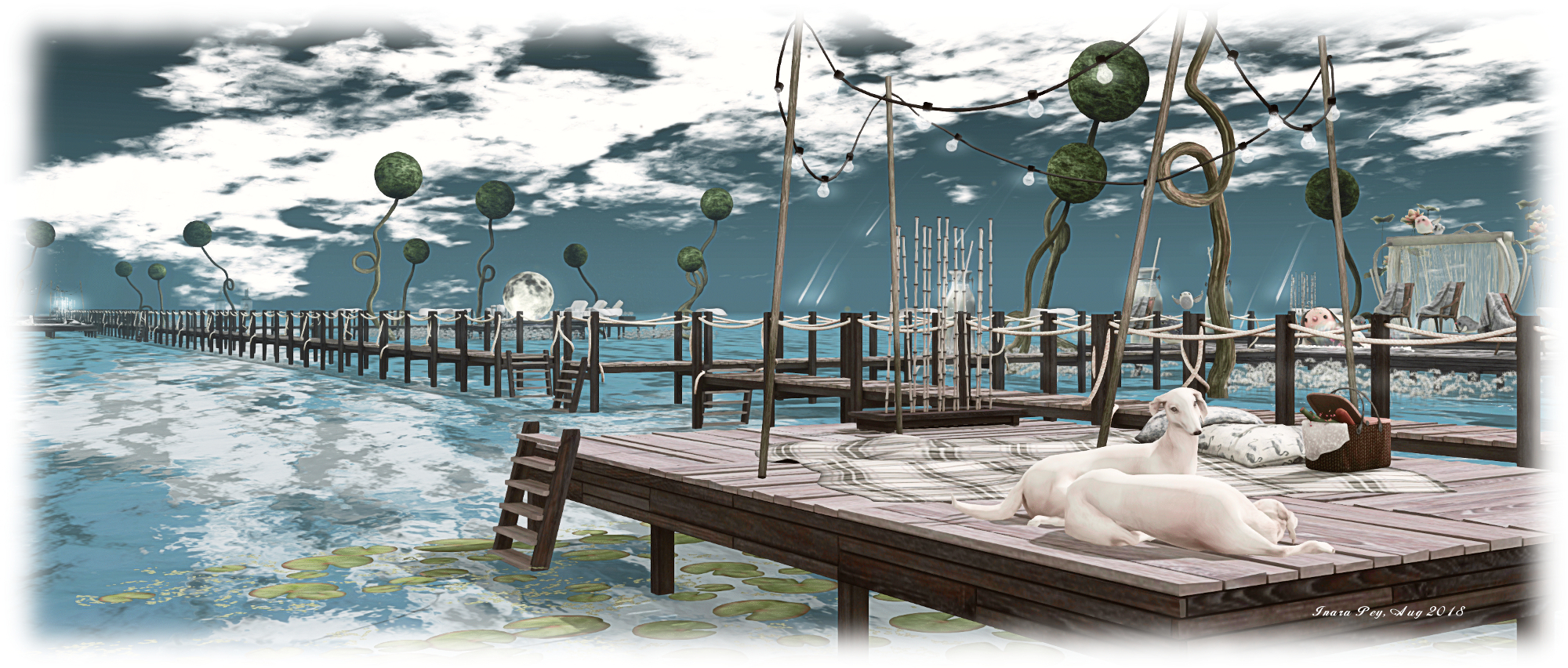
Peace of Mind; Inara Pey, August 2018, on FlickrPeace of Mind – click any image for full size

Peace of Mind is a Mainland parcel a little over a quarter region in size, held and landscaped by Talacious (Talacious Tigerpaw).  It’s a quirky design that offers as much vertically as it does horizontally for the willing explorer, so a stout pair of walking boots might be recommended!

The About Land description offers a warm invitation to arrival to explore, relax and have a little fun, with Talacious noting she has a passion for landscaping, design and art, and hopes that people find a little peace and tranquillity when visiting.
Peace of Mind; Inara Pey, August 2018, on FlickrPeace of Mind

Visitors arrive on the beach, a narrow sliver of sand sitting between high craggy shoulders of rock that reach back inland. Water tumbles – a little erratically in places – from one of these high mesas, eventually finding its way down to the beach where it rolls over the sand and into the sea.

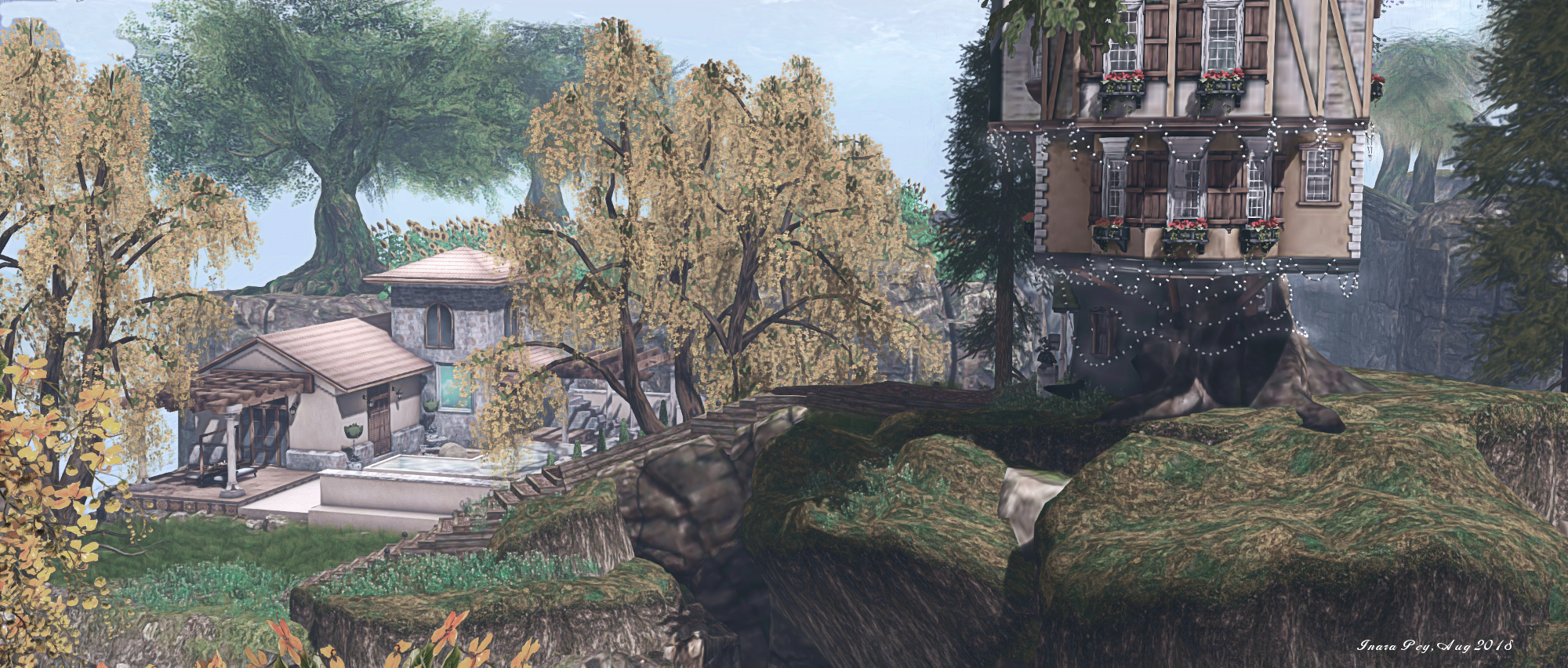
Three opportunities for initial exploration are offered from the beach: a short climb up stone steps to a caravan, oddly perched on a shelf of rock and now so much a part of the landscape, nature is taking up residence on the outside as much as someone ins living on the inside. More stone steps run up alongside the caravan and to the conservatory sitting above and behind it, while a wooden bridge spans the water in its rush to the sea, offering the way to one of several routes up into the high cliffs and rocks surrounding the setting.
Peace of Mind; Inara Pey, August 2018, on FlickrPeace of Mind

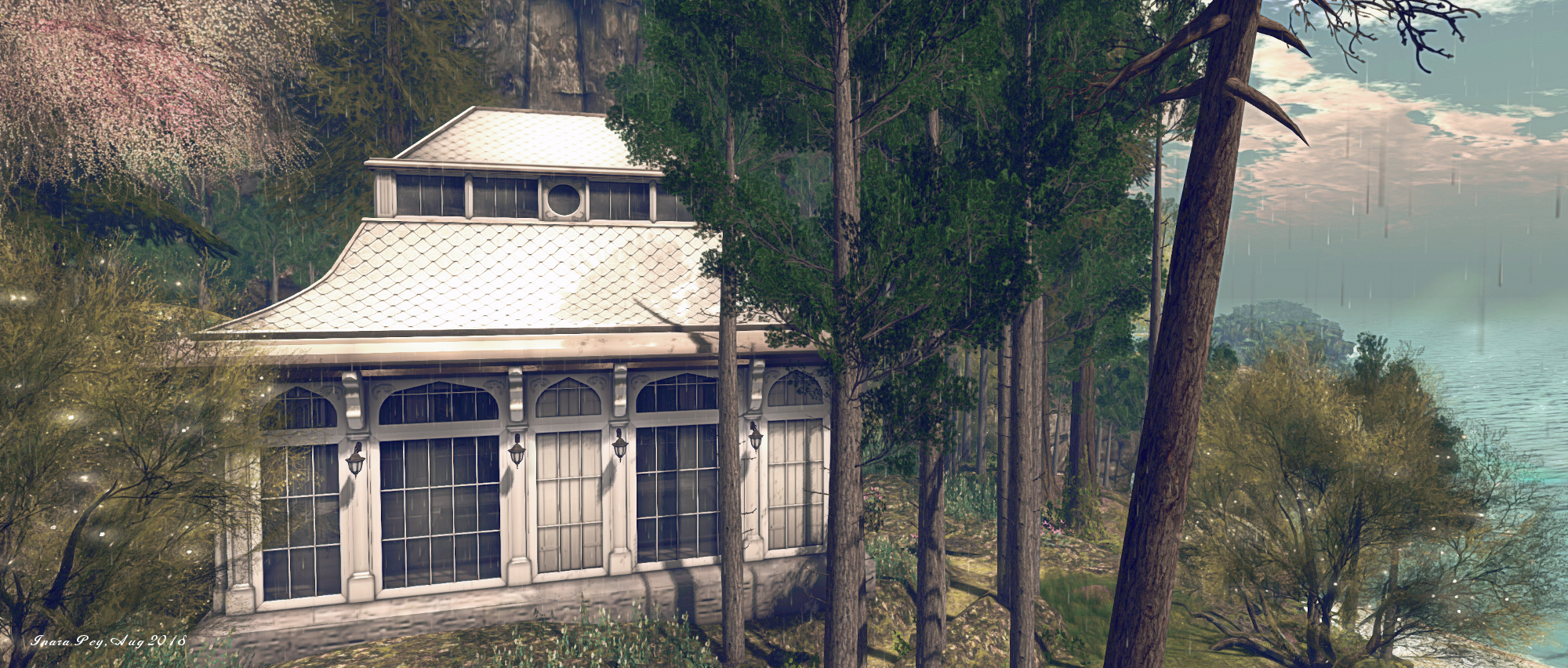
Those climbing to the conservatory will find it is home to a warm-looking bathing pool, while the path branches left and right – offering a further choice in routes of exploration. While you take is entirely up to you; suffice it to say both – and the path winding upwards from the log bridge down by the beach – offer routes of discovery.

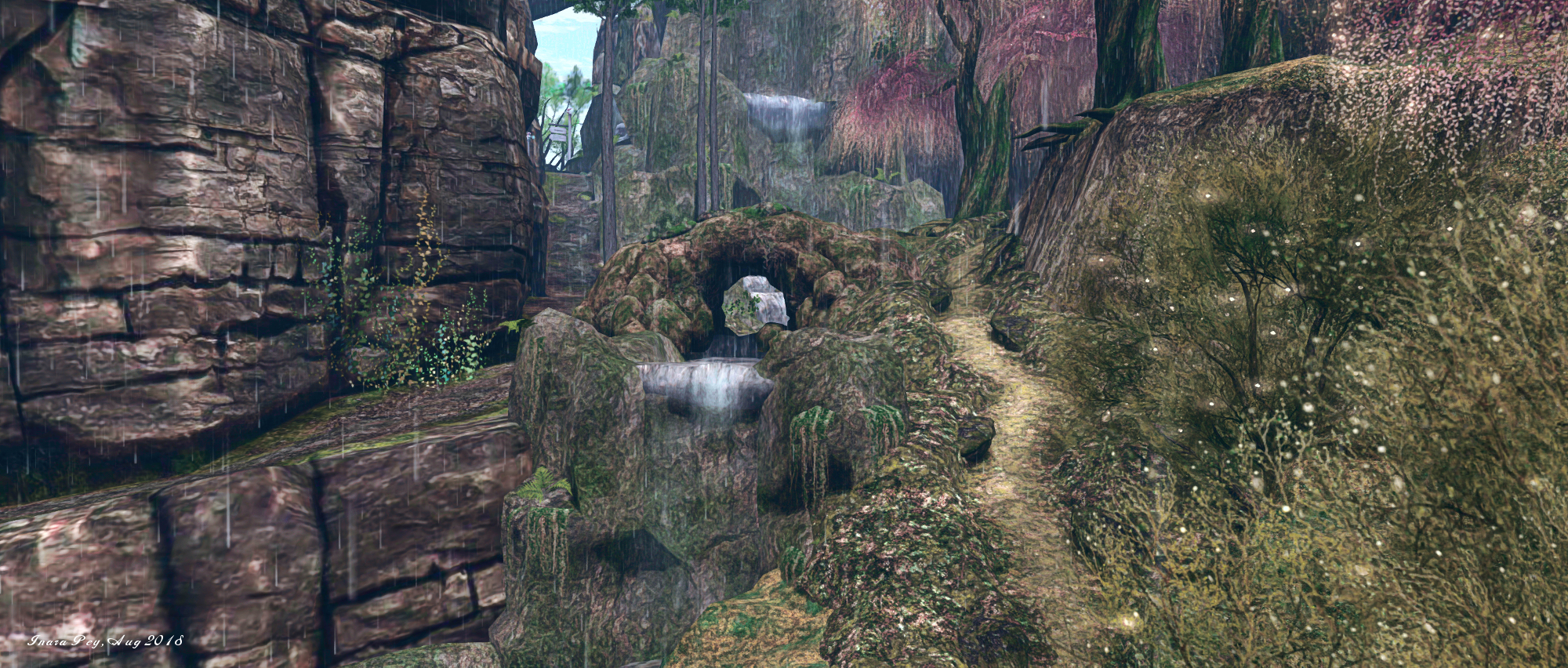
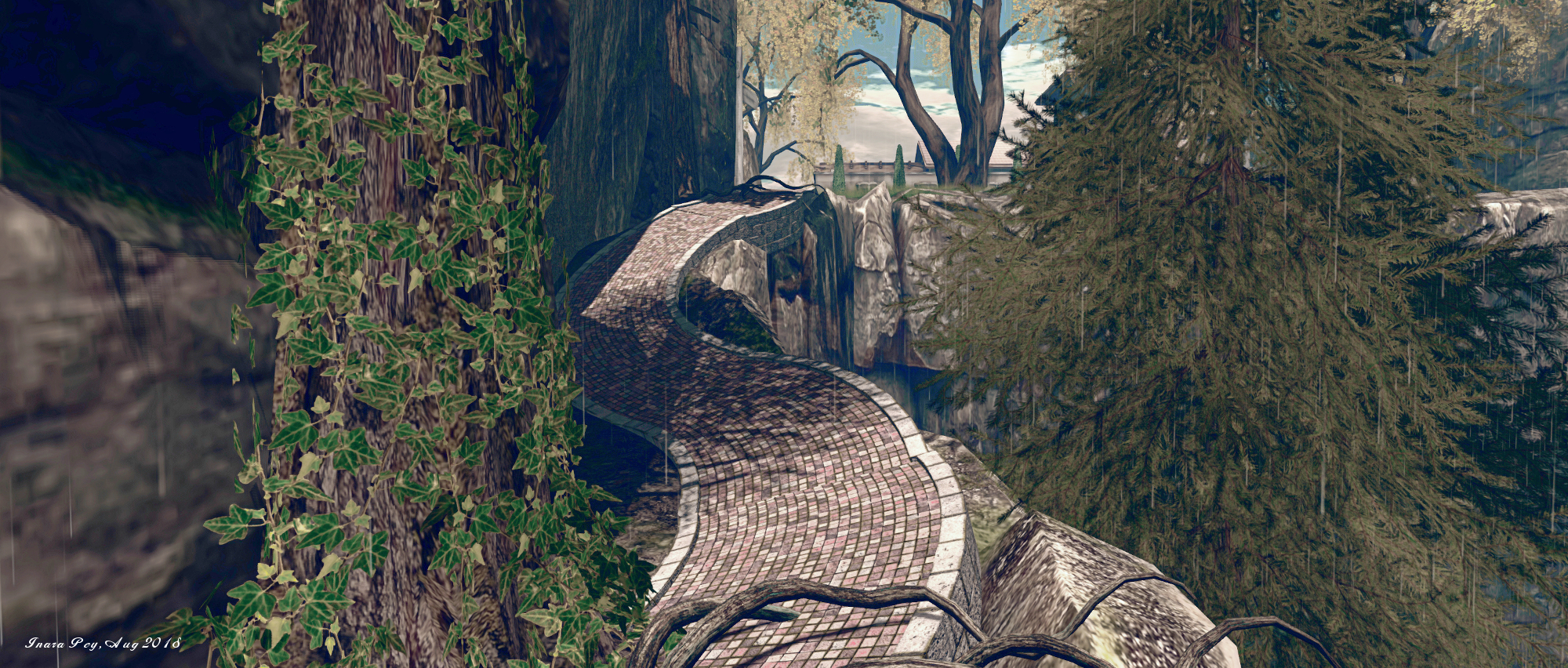
Trails wind between the trunks of tall pines and other trees and slide between tall cliffs and hunched rocky outcrops, leading the traveller past local wildlife, over pond and root and through the occasional shower of rain, before inevitably winding upwards. As they do so, the paths climbing the cliffs may change from bare rock to tiled step (or back again) or from grassy trails to dirt tracks, all of which twist and climb – sometimes very steeply – up to the high plateaus above.
Peace of Mind; Inara Pey, August 2018, on FlickrPeace of Mind

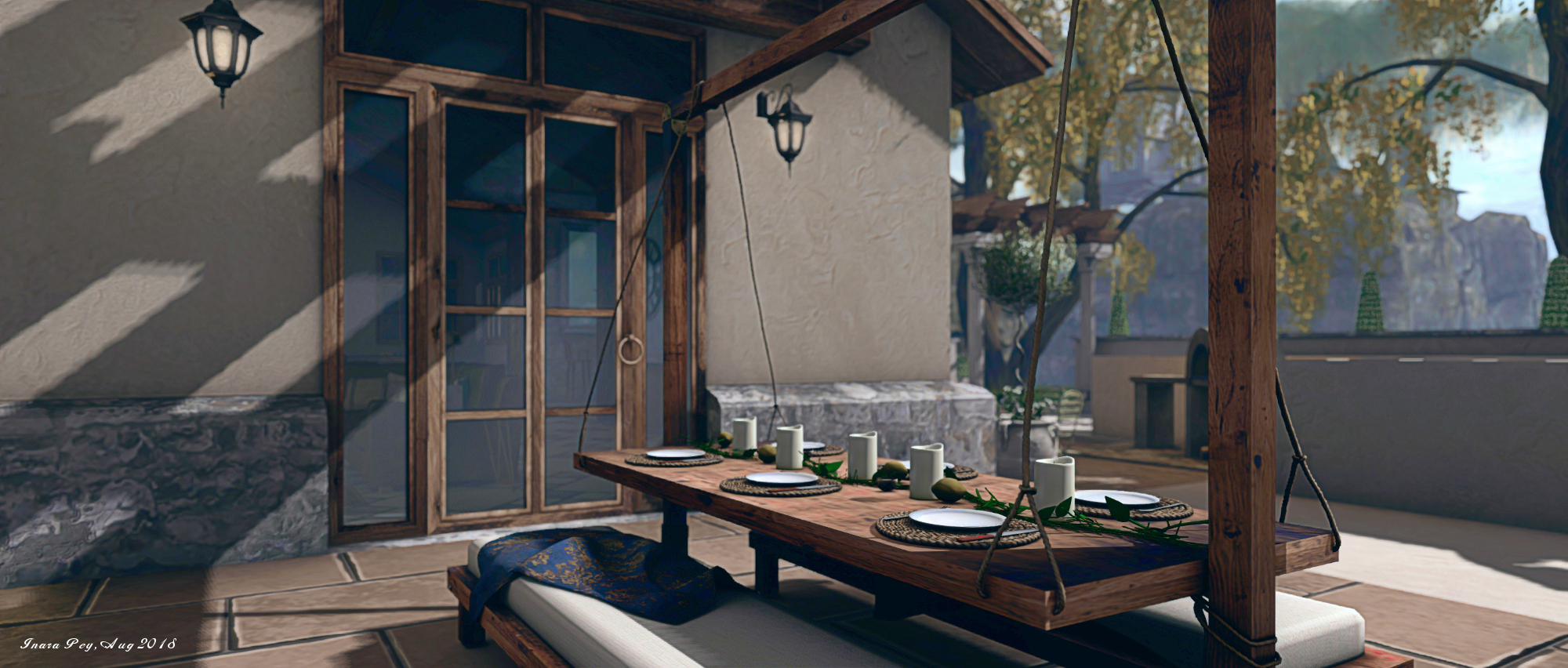
These high tables are home to more curios awaiting discovery – a pair of trees houses here, with the remains of an old van that must have had a bugger of a time climbing up the steep trail; a house cut into a hill there, surrounded by sunflowers that reach down into a little box canyon where yet another cottages sits, roof covered in grass and more sunflowers growing above it bay windows. Just below the house-in-a-hill sits a Tuscan villa, a paved set of steps reaching up from it to a narrow promontory on which sits a further tree house, even as hollow logs offer a bridge to a large house standing on the headland, and the destination of the rocky path winding upwards from the beach. This last appears to be the house of Talacious; however, like the other buildings sitting both high and low, it appears to be open to the public.

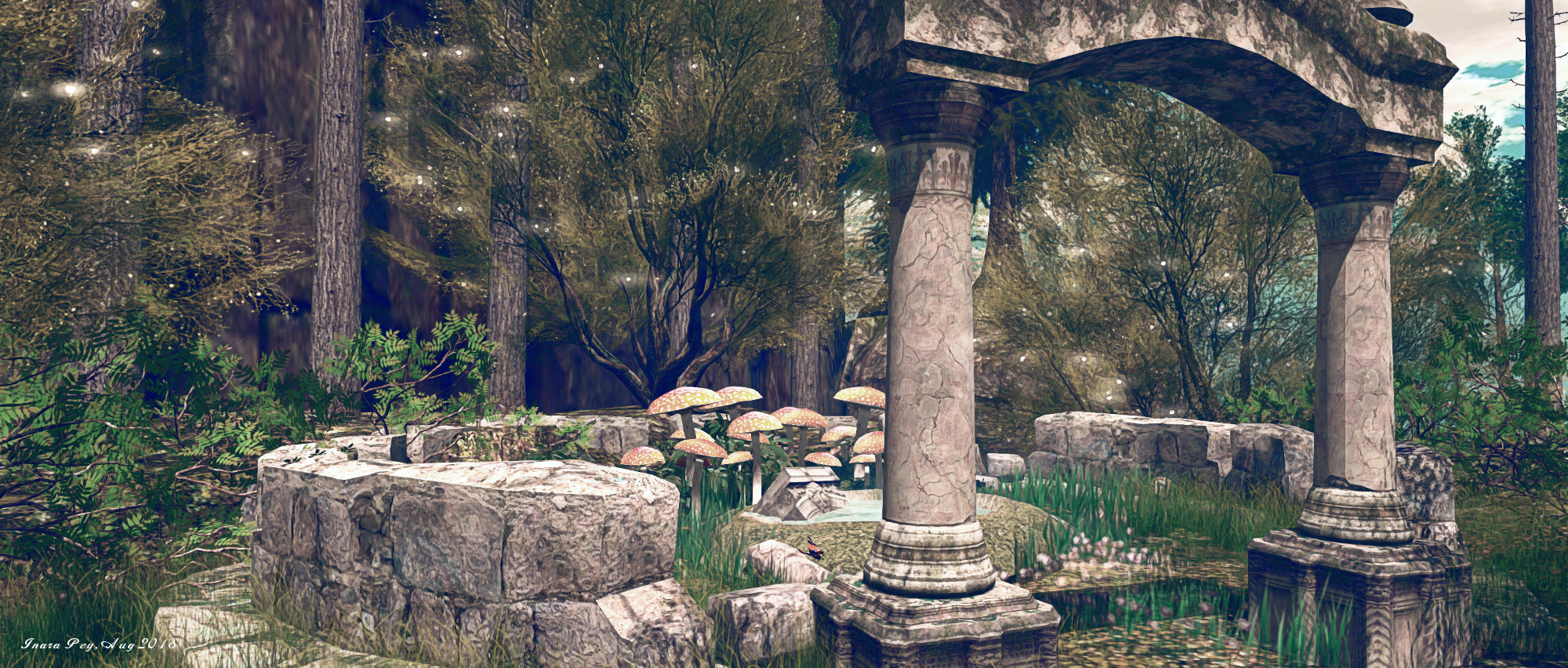
With the many different paths and bridges connecting them, finding one’s way around and between the houses is something of an adventure, and reveals some of the more quirky elements of the parcel – such a  set of stone steps supported on nothing more than a wish, leading the way to vine-arched bridge spanning the gap between one plateau and another. Meanwhile, the path winding down from from the garden of the twinned tree housesoffers a way past a cavern, also awaiting exploration.
Peace of Mind; Inara Pey, August 2018, on FlickrPeace of Mind

However, said cavern is not the “secret caves” referred to in the About Land description. This requires a little discovery. Clues are provided, and I don’t want to spoil the fun. Suffice it to say: look for the “arrowed” paths  in the grounds of one of the houses, or the sign board watched over by rabbits (then touch the rock behind it). And when you do find your way into the caves, be sure to follow the paths all the way down and to give the wall below a certain sign concerning life a tap …

Peace of Mind is, as I’ve mentioned, a quirky place. It is rich in detail, albeit with a few rough edges that could do with a little attention (waters falling into grass and vanishing, or floating above the beach as it flows to the sea, for example, while the odd tree floats rootless above the ground). But these are not sufficiently problematic as to spoil the overall effect, and it’s clear that Talacious has poured a lot of her own personality into the parcel’s look and feel, together with her sense of fun.
Peace of Mind; Inara Pey, August 2018, on FlickrPeace of Mind

So if you are looking for something just that little bit different to explore, Peace of Mind might be for you.

SLurl Details

RFL of SL: brainstorming ideas for 2019 and beyond

via slrelayinfo.com

Following on from their blog post concerning the restructuring of volunteer services (see here for more), the RFL of SL team has announced an “open house brainstorm session” on Wednesday, September 5th, 2018.

To be as inclusive as possible on a global basis, the event will comprise 3 core sessions (all times SLT): 07:00-09:00; 12:00-14:00 and 18:00-20:00.

We want to make sure that everyone has the opportunity to share their ideas for growth and for how we can make the 2019 Relay season the best it can be.

This will be a ‘revolving door’ concept that allows you the chance to come and go as your schedule permits within [the] three different time-frames.

– from the RFL of SL blog post on the open house sessions

In particular the RFL team are looking for feedback in four core areas of RFL activities within Second Life:

  • Ideas on businesses, groups, and communities not currently engaged in supporting RFL of SL, and how they might be encouraged to do so.
  • For 2019, the Activities Regions will be replaced with a “5 Days of Relay” concept to allow new communities and new partners to host events/activities in the week prior to the main 24-hour event, and the RFL of SL team would like to hear feedback on opportunities to engage with new communities / partners and grow involvement with RFL of SL.
  • Additional ways in which cancer survivors and their caregivers might be more involved in the 24 hour relay weekend activities beyond the opening lap and gift bag.
  • Potentially moving the RFL season to be more effective with fund-raising.
    • The blog post notes this would likely comprise kicking off in January, along with the ACS national registration challenge, then holding the relay weekend in May, which would place it within the time period of ACS “signature” events held worldwide.
    • In particular, the team would like to hear about practical considerations that need to be kept in mind for such a move to be successful.

In addition, the team would to hear ideas on tactical ways that RFL of SL can help present the American Cancer Society as a service-first organisation that is available to cancer patients, survivors, and caregivers in Second Life.

We have met with so many people in the last few weeks and have identified several thoughts that were consistent from one person to the next; but we recognize that there just isn’t enough time to meet individually with everyone. So we’re using this open house concept for the final brainstorming session to give everyone the chance to participate in the creative and strategic direction of Relay For Life of Second Life. I’m excited about this because we get to hear from as many people as possible, and I’m especially looking forward to learning what creative ideas our volunteers and supporters have.

– Stingray Raymaker, Director of the American Cancer Society in Second Life,
on the open house meeting

As noted above, the three sessions will be run on a “drop in” basis, with those wishing to participate free to join or leave any session at any time at their convenience, or to attend more than one session if they wish. The sessions will all be held at the American Cancer Society HQ in-world.

A sense of Confinement in Second Life

DaphneArts: Confinement

Confinement is a complex installation located at DaphneArts, featuring a concept and art by Mi (Kissmi), with the physical space and overall presentation of the elements making up the installation by DaphneArts curators Angelika Corral and Sheldon Bergman (SheldonBR).

Mi says of the piece:

Confinement is our lot – from the beginning, in the womb, and even before, as soon as the idea of our conception germinates in the minds of our parents, enclosing us.

In other words, how we might grow as individuals is subject to a series of constraints which encompass us from the moment of conception through until death. Mi sees these constraints as falling into four main categories: geographical, mental, physical and social, and the visitor is invited to consider each of these both visually and aurally.

DaphneArts: Confinement

To fully achieve this, it is necessary to ensure your are correctly set-up to experience Confinement. This means ensuring you have Advanced Lighting Model enabled within your viewer (Preferences > Graphics > check the Advanced Lighting Model check box), you accept the local Windlight setting on arrival (automatic if you are using Firestorm; if you are using any other viewer, the preferred Windlight is Phototools – No Light by William Weaver. Should you not have this available with your viewer, try opting for Midnight or a similarly dark setting). Most importantly, you must accept the local HUD when offered and allow this to attach – without it, you will miss the greater part of the installation. Once attached, the HUD will display introductory text, which can be clicked away once read and the instructions followed. You are then ready to proceed.

This involves walking along a walkway constructed of massive cubes, while walls of these great cubes dominate the view left and right, separated from the walkway by deep chasms.  As one progresses, each of the four categories of confinement are revealed in turn, starting with Geographical. Images by Mi are illuminated, and the HUD presents visitors with the opportunity to hear a reading in French by Mi intended to encompass the symbolism of the confinement – and to read the words, presented in both French and English (note that due to the limitations of SL, the words may lag behind the reading; this is unavoidable).

DaphneArts: Confinement

For Geographical, the reading is taken from the lyrics to né quelque part (“born somewhere”), first recorded by Maxime Le Forestier in 1987; for Mental Confinement, we are presented with Un grand sommeil noir (A big black sheep), by the 19th Century poet Paul-Marie Verlaine; for Physical Confinement and Social Confinement, Mi presents two poems by Jacques Prévert: First Day and Familiale, respectively.

Each of these reading is accompanied by a series of images by Mi, also designed to be representative of the confinement they represent. Like the readings (including né quelque part, when the lyrics are separated from the music), these are stark pieces; abstract in nature, are designed not so much to illustrate, but to encourage, along with the spoken words, our deeper contemplation on the nature of each type of confinement we live within: those born – no pun intended – by the place and time of our birth; the confinement we face in terms of mental development – both our own capability and the opportunities society gives to us;  and the constraints we have to face within both life itself and in society’s expectations of the roles we will ultimately play.

DaphneArts: Confinement

Beyond the fourth confinement, the way leads down to a lower level, stairs lit by the naked flames of candles cupped in stone hands as the darkness closes around. In descending these steps, it is easy to feel as if one is descending into a sepulchre; or that the descent marks the passing from life to death. In echo of this, the hands towards the bottom of the stairs become more grasping in nature, as if trying to reach out from the walls and grasp the life from those passing.

Finally, the path leads by candlelight to a last figure:  a woman caught between death (the hand at her throat) and life (the candle emerging from her midriff). And thus the circle is closed; our ultimate confinement lies within the unknown: we emerge from it in birth, and descend back into it in death.

One since June 2018, Confinement is a layered installation deserving of time and consideration when visiting.

SLurl Detail

2018 SL UG updates #35/1: server, viewer, bugs

Black Kite; Inara Pey, August 2018, on FlickrBlack Kite – blog post

Server Deployments

Update: the RC channels received a new server maintenance package on Wednesday, August 28th. Maintenance package  18#18.08.24.519036, comprises an update for the new land auction system.

As always, please refer to the server deployment thread for the latest updates.

  • There was no SLS (Main) channel deployment on Tuesday, August 28th. Regions on the channel, however, were restarted.
  • At the time of writing, it is unclear as to the status of any deployment to the three RC channels, which are listed as “TBD” in the deployment thread. As nothing was mentioned at the Server User Group meeting, I’m assuming there will be no deployment.

It there is no RC deployment, it will leave all of the main grid channels om server release 18#18.08.10.518612.

SL Viewer

At the time of writing this update, there had been no viewer SL viewer updates at the start of the week, leaving the pipelines as follows:

  • Current Release version 5.1.8.518593, dated August 14, promoted August 20. Formerly the SL Voice RC viewer – NEW.
  • Release channel cohorts:
    • Animesh RC viewer, version 6.0.0.518949, August 24.
    • Love Me Render RC viewer, version 5.1.8.518751, released on August 20.
    • BugSplat RC viewer, version 5.1.8.518305, August 7. This viewer is functionally identical to the current release viewer, but uses BugSplat for crash reporting, rather than the Lab’s own Breakpad based crash reporting tools.
  • Project viewers:
  • Linux Spur viewer, version 5.0.9.329906, dated November 17, 2017 and promoted to release status 29 November – offered pending a Linux version of the Alex Ivy viewer code.
  • Obsolete platform viewer, version 3.7.28.300847, May 8, 2015 – provided for users on Windows XP and OS X versions below 10.7.

It is anticipated the Love Me Render and Bugsplat RC viewers will be updated this week to bring them to parity with the release viewer code base. It is also anticipated that the next Maintenance RC viewer could be appearing during the week.

EEP / BOM / AIS

As I’ve noted in my most recent CCUG and TPV Developer meeting summaries, it had been anticipated that a new AIS (Advanced Inventory Service) update would start to be deployed in week #35.This would include the necessary support for the new asset types to be used by both the Environment Enhancement Project (EEP) and the Bakes on Mesh (BOM) project. However, at the Server User Group meeting, Rider Linden had indicated that a last-minute bug had cropped-up with the AIS update, was has delayed its deployment. However, it does not appear that this is related to the server RC channels having a “TBD” status against them.

Bug Hunting

Sim Surrounds Issue

BUG-225295 “Sim Surrounds often fail to rez” indicates that some people are having problems seeing region / sim surrounds render in their viewer. The problem was first reported by Firestorm 5.1.7 users, but also reproduces on the SL 5.1.7 viewer code-base, and it is thought the issue might relate to changes made in the previous Love Me Render viewer.

“Bug of the Week”: Animations Issue

The superbly named Hexadeci Mole has raised a curious bug report in the form of BUG-225288, “llStopAnimation is stopping all animations on detach instead of only the one specified”. This occurs when a scripted object starts an animation when worn, and stops the animation when detached (as intended) also causes all other animations to stop, and stops animations played from inventory. The bug appears to be a duplicate of SVC-7596, and as Whirly Fizzle observes, only seems to reproduce when the attached objects instance key is lower than the wearing avatar’s own avatar key!

Simon Linden has had a look at this issue and commented:

Fwiw I did an initial investigation into that bug — and was surprised. It’s actually pretty simple code, removing the current animation and sending an update. It may be a more fundamental design problem … SL isn’t set up to cleanly stack and merge animations and then remove parts of it.

Retrieving Grid Statistics Page via llHTTPRequest

BUG-216320 has been causing problems for a while. Essentially, trying to retrieve grid statistics via a script results in a 499 error, although queries via web browsers will still succeed. Oz Linden summed-up the status of work on this thus:

It turns out that it was two independent problems. We’ve fixed one, but the other is still pending.


Second Life bug tracker upgrade: August 29th, 2018

On Wednesday, August 29th, the Second Life bug tracking and feature request system will be undergoing an upgrade, starting at 20:30 SLT (so the early hours of the morning for those in Europe).

The scheduled window for the upgrade is some six hours in length, although as the official blog post states, it is hoped that the overall downtime will be far less than this.

The primary aim of the upgrade is to bring the Second Life bug tracking system up to a more recent release of the Jira software used the manage the bug tracker by Atlassian Corporation plc.

From a user’s perspective, most of the changes are of a cosmetic nature, again as the official blog post notes; the most obvious being the new log-in page that will be displayed for users following the upgrade, and whenever they are required to log-in to the system to use it.

One of the more visible changes with the Jira update will be the format of the log-in page (left), compared with the more familiar log-in page for most Second Life web properties (right)

An important aspect of this change is that every time you log-in to the new system, it updates the email address  that Jira uses for you from the one given with your Second Life account, instead of only updating it the very first time you use Jira, as is the case with the “old” system.

As well as this, there are various layout improvements and updates to the information displayed in things like a user’s dashboard, and some revised positioning of options and buttons.

Key among the latter is likely to be the positioning of the option to create a new bug report / feature request, etc. On the current Jira, this is located in the top right corner of a user’s dashboard. After the upgrade, it should be a lot more front-and-centre on a dashboard, appearing as a blue button.

Following the upgrade, I understand the option to file new bug reports, etc., will be moved from the top right of the Bug Tracker dashboard (shown top for the current version used by the Lab) to a more prominent, button-like position with the new Bug Tracker version, as I believe it will appear after the upgrade (shown bottom)

I understand from the Lab there the upgrade also means some changes to how they handle bug reports, etc., internally, but these should not see any significant changes to actually filing bug reports and feature requests. However, there may be some additional cosmetic changes to some of the forms used with the system, and if so, these will take place once the new system has had time to settle.

I have been working on a guide to filing bug reports and feature requests (with the assistance of a number of people from Linden Lab) for those unfamiliar with using Jira, and hope to be able to publish this, as it reflects the new system, in the near future.

A late summer exhibition at the Rose Gallery

The Rose Gallery: Biancajane Juliesse

The Rose Gallery, curated by  Shakti Sugafield (Shakti Adored) is hosting a”late summer” exhibition with a focus on physical work art, of which the greater theme within it might be said to be of an abstract nature.

On the ground floor, in Halls 1 and 2, the marvellous art of Sisi Biedermann continues to be exhibited. Her work – always marvellous to see – was a focus of what might be called the “early summer” ensemble of art on display at the Rose, again in Halls One and Two, and was a subject of my review of the Rose exhibitions at that time. Her display has been refreshed, with a further offering of her stunning art, some of which can also be found in her What a Wonderful World exhibition at the Lin C Art Gallery (read here for more).

The Rose Gallery: Sabine Mortenwold

Occupying Halls 3 and 4 is a visually impactful exhibition of abstract art by Sabine Mortenwold. Working in mixed media on canvas, Sabine’s work is powerful in tone and style, with the pieces offered at the Rose perhaps split into two halves. Within Hall 3 is a series of images that might be referred to as more deeply abstract, the 11 pieces  offering  reflections on emotional states. Vivid, strongly abstracted and layered, there are pieces that may at first be hard to grasp, but there is also a subtleness in the way each really is reflective of its title.

Hall 4, meanwhile offers what might be referred to as a “softer” series of Sabine’s art, with 13 pieces, the majority of which are clearly collage paintings of flowers. With softer tones and lines that clearly denote leaves and petals, these are perhaps the easier images to grasp with eye and mind, but each of them retains a wonderful abstract form within it.

The Rose Gallery: Sabine Mortenwold

Hall 6, on the floor above, is home to a series nine pieces of digital art by Leigh Quartz. Small the series might be, but each image is powerfully evocative, colour and tone carefully balanced to match its title, with just a hint of abstraction within some of them to offer a  connection with the exhibitions on the ground floor.

The Rose Gallery: Leigh Quartz

The use of the available space within the hall, with wide gaps between most of the pieces, allows the eye to focus on each painting in turn, encouraging the visitor to fully appreciate it without the distraction of neighbouring pieces slipping into the eye’s periphery. Thus it is possible to almost feel the primal force evoked with More Than a Conqueror, sense the passage of time in Seize the Moment, or find oneself caught within the gaze of Jolie Moly, seen on the right.

The abstract theme continues into Hall 7, where art by Etamae is presented.

Several of the ten images offered here are of an abstract nature in tone and idea; but with a much softer, more organic approach that perhaps found in the abstract pieces found within Sabine Mortenwold’s and Leigh Quartz’s pieces. Shapes here are more rounded, offer flow and a sense of quiet, almost relaxed (hypnotic?) motion within them.

Also offered within the set are paintings of flowers. Again abstract in nature, these offer a connection back to the flower-themed pictures within Sabine’s exhibition, and so again present a sense of thematic threads follow through the exhibitions, weaving them together on a subconscious level.

The Rose Gallery: Etamae

The Gallery’s main exhibition hall is given over to a presentation of art by Mary Sparrow, via her alter-ego(?) Bianca (biancajane Juliesse). Known for her portraiture of both humans and their pets, Mary’s art also encompasses still life, animals (notably horses) and photography.

Portraits and pets are very much the subject of the exhibit at the Rose Gallery, although wildlife and farm animals and poultry are also represented. The portraits  – all of them women and their dogs, are neatly presented to one side of the hall, becoming an exhibit in their own right, all presented in Art Deco or gilt-edges frames that perfectly compliment and complete the images they contain, which are themselves perfectly executed paintings.

However, it is likely to be the animal paintings on the remaining walls of the hall that are liable to captivate, simply because of the depth of character caught within them; not only with the portraits of cats and dogs, where it is perhaps most clearly evident, but also with the paintings of pig and piglet, cow, rooster and flamingos.

The Rose Gallery: Biancajane Juliesse

I believe this selection of exhibitions continues through into September – but please check with the gallery.

SLurl Details