
Amidst some unconfirmed reports relating to upcoming robotic missions, in October 2026 China provided updates on plans for its crewed lunar missions due to start around 2029/2030.
Staring with the speculation: in August 2026 – and with the mission actually on the launch pad – China abruptly postponed the Chang’e 7 mission – one of the two final robotic missions in the Chang’e lunar series which started in 2007, and which between them are intended to be direct precursors of the first crewed landing attempt. Initially, it had been assumed the launch had been delayed due to the proximity of a tropical storm to the launch site. However, the Chinese Manned Space Agency later released the following statement:
Chang’e-7 lunar probe does not meet launch conditions, and its launch therefore cannot take place during the planned window this year. The assessment was conducted following the principle of prudence, reliability and absolute mission success.
This had been taken to mean that – given the pretty much 100% track record of success for the Chang’e programme, China was unwilling to launch a vehicle which might put a dent in that record and set the entire China Lunar Exploration Programme (CLEP) back somewhat, but that the mission would still go ahead some time in 2027. Since that statement was made, CMSA has hinted that the mission is now “indefinitely delayed” and neither CMSA nor the China National Space Agency, which has been responsible for mission will offer any indication as to when it might launch.
More recently, and while still-to-be-100% confirmed, it is being suggested that final mission, in the robotic series, Chang’e 8, is now at least “delayed”. This speculation first arose as a result of a slide circulating on social media, which appears to be from a recent Chinese symposium on the country’s lunar programme.
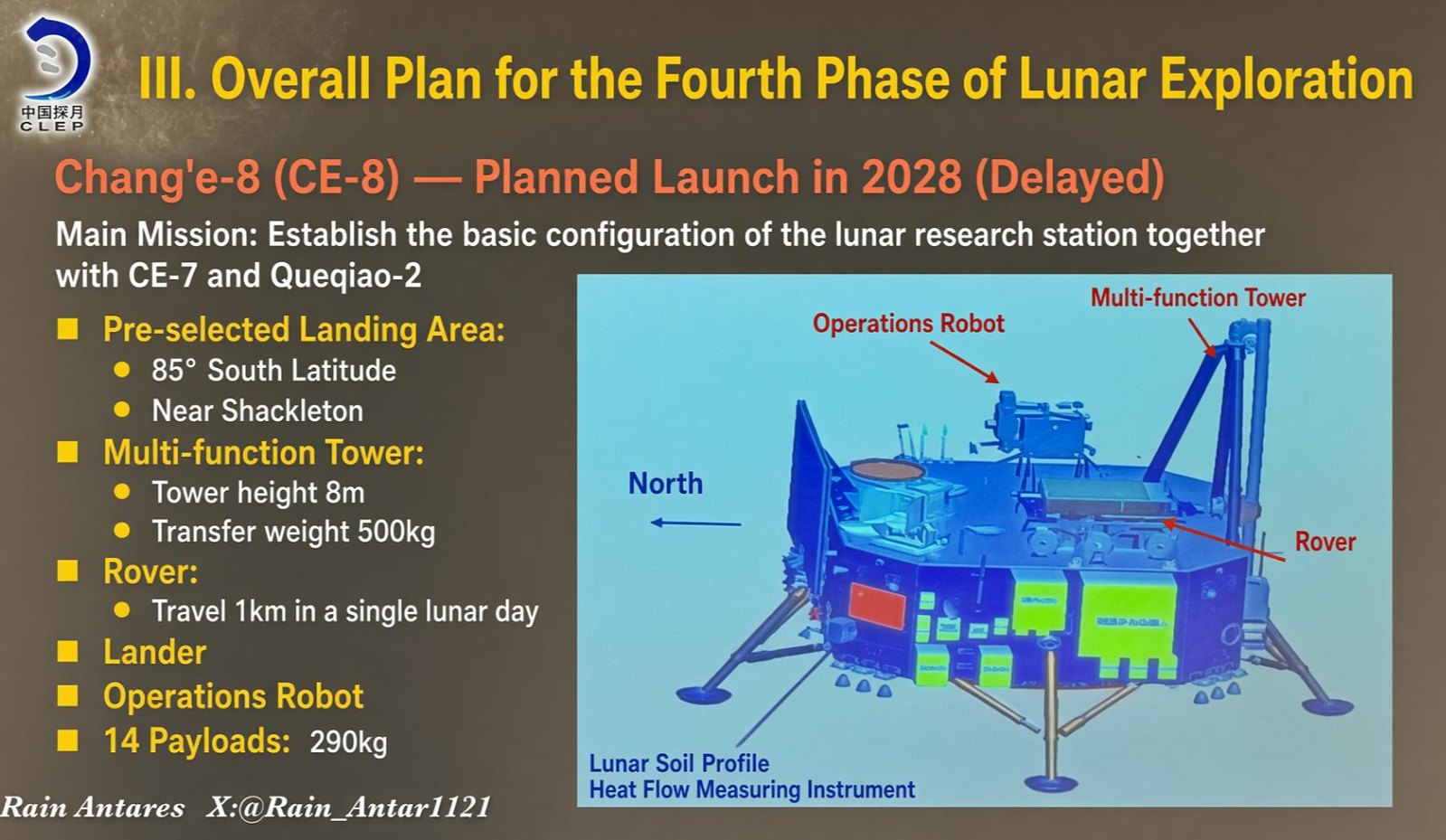
It’s not clear if the translated slide is true to its original, but it has led to additional claims that CMSA now intends for elements of the Chang’e 8 mission – such as the in-situ resource utilisation experiments to be carried out by future crewed missions. The claims here are that by cancelling Chang’e 8, CMSA is looking to avoid potential bottlenecks for the upcoming crewed missions – which have until now been dependent upon both Chang’e 7 and Chang’e 8 successfully completing – which may arise from continued delays to either of both of the robotic missions.
Whether such speculation is accurate or not remains to be seen. However, at the CLIP symposium where the delay to Chang’e 8 may have been indicated, CMSA did provide a update to plans for China’s first crewed landing on the Moon – and the agency does seem to be accelerating the timeline slightly, indicating things are to proceed as follows:
- 2027: maiden flight of Long March 10A (CZ-10A) rocket, carrying a cargo-carrying Mengzhou vehicle to the Tiangong space station, allowing the spacecraft’s core systems and on-orbit capabilities to be assessed / validated in a single, uncrewed mission. Mengzhou is the new multi-purpose, reusable space capsule intended to ferry crews to / from the Tiangong space station and carry crews to / from lunar orbit.
- 2028: launch of a Long March 10 (CZ-10) heavy lift launch vehicle (HLLV – up to 70 tonnes to LEO and 27 tonnes to lunar orbit) with an uncrewed Lanyue lunar lander to the Moon. The latter will perform a lunar descent / ascent test, assessing and validating the vehicle’s propulsion and guidance systems.
- Early 2029: dual CZ-10 launches carrying an uncrewed Mengzhou and a Lanyue lander for a full-scale lunar-orbit rehearsal, demonstrating automated rendezvous, docking, and integrated operations.
- “Before 2030”: a further dual CZ-10 mission to send a crewed Mengzhou vehicle and a Lanyue lander to lunar orbit, with members of the crew performing the first Chinese crewed landing on the Moon.

The interesting factor here is the “before 2030” – suggesting that China is eyeing-up mid-to-late 2029 for their first lunar landing with a crew. Some have suggested this is to try to “beat” the US-led Artemis programme to the first lunar landing of the 20th Century. However, October 1, 2029 marks the 80th anniversary of the founding of the People’s Republic of China.
Thus, an alternative suggestion for the use of “before 2030” might be that those responsible for the crewed mission are eyeing the possibility of doing so in time to mark the October 1, 2029 celebrations – but they don’t want to risk being held to account should they fail to do so. After all, it is relatively easy to slip “the end of” between “before” and “2030” without it appearing to be a formal declaration that a specific landing date (e.g. “in 2029”) is going to be missed – something which might be abruptly career-ending (at the least?) for those in charge were it to be the case.
Blue Origin: New Glenn – Slippage and Enhancements
In May 2026, Blue Origin lost No, It’s Necessary, A New Glenn Booster and upper stage to a massive explosion during a launch pad static fire engine test ahead of what would have been the rocket’s. The event – which I covered – saw the complete destruction of the vehicle together with the near-complete destruction of the launch pad facilities, as well as extensive damage to nearby infrastructure.

Following that event, Dave Limp, Blue Origin’s CEO came out with an aggressive statement that the pad and facilities would be completely rebuilt and New Glenn would again be flying by the end of 2026. A statement many (including myself) as being far too ambitious; it was 18 months before SpaceX were able to resume launches from one of their pads following a similar explosion of a much smaller Falcon 9 rocket (with payload) in 2016. However, Blue Origin did look like they were going to prove the doubters wrong: the issue causing the explosion was found, the pad clearance work was completed pretty quickly, and reconstruction proceeded rapidly, right alongside the construction of a completely new launch facility as well.
Unfortunately, one or two issues – notably miserable weather during part of summer – served to delay things. As a result, on November 5, 2026 the company announced New Glenn will not resume flights until January 2027. This launch will also see the first-time use of a “hybrid horizontal-vertical integration” process (aka “crane”).
Initially launches for New Glenn saw the use of a massive 1,800 transporter-erector which carried the rocket from the integration facility horizontally on its back before raising it to the vertical position on the pad, the vehicle then effectively becoming the rocket’s launch tower. As this vehicle was a one-of-a-kind and totally destroyed in the May 2026, Blue Origin will continue to integrate their boosters horizontally and deliver them to the launch pad this way. However, on arrival a crane will hoist them to a vertical position where they will be supported by a dedicated launch tower (a conversion of one of the pad’s existing lightning towers, which largely survived the explosion), which can also be used for payload integration.
Despite the fact the next launch of New Glenn has slipped, this is still a remarkable turn-around for the company, the fortunes of which reside largely on New Glenn’s success. The return to flight for the rocket will see the first deployment of a fully operational Blue Ring vehicle. This is a highly-flexible hybrid solar electric and chemical propelled platform intended to perform a wide variety of roles: helping to deliver payloads to their assigned orbits; relocating and refuelling satellites, operating as a satellite itself, if required, and even forming the propulsion and power system for interplanetary satellite missions.

To compensate for the news of the New Glenn launch delay, Blue Origin announced two major enhancements to the New Glenn family: GS3 and Northstar.
GS3 (Glenn Stage 3) is a new third (uppermost) stage for both the current New Glenn 7×2 (meaning it has a first stage using four engines and a second using 2) and the upcoming 9×4 (with 9 first stage and 4 second stage engines), allowing both to increase their geostationary Earth orbit (GEO) and lunar mission payload capabilities. In the latter case, GS3 – which will use a single Blue Origin BE-7 motor, originally developed for the Blue Moon lunar landers – will increase New Glenn’s direct-to-the-Moon payload capacity from 7 tonnes to 10 tonnes for 7×2, and from 14 tonnes to 20 tonnes for 9×4.
It’s not clear what (if any) nomenclature will be used to differentiate a 3-stage 7×2 or 9×4 from the 3-stage variants; I just hope the latter aren’t just referenced as 7x2x1 and 9x4x1, because – boring!

Northstar, meanwhile, is a new high-performance liquid oxygen/liquefied natural gas (LOX/LNG) rocket motor. It is intended to be for commercial use as well as powering New Glenn’s first stage, further increasing the payload capacity of both variants of the rocket. Compared to the current BE-4 engine, Northstar is more compact and uses fewer overall parts whilst increasing thrust by some 30%, from 290 tonnes to 324 tonnes (or 54 tonnes of thrust greater than the current SpaceX Raptor 3).
No date has been given for NorthStar’s introduction into service, but its development has been meteoric: 11 months from development approval to full-scale development testing.
And finally on the Blue Origin front: with SpaceX having recently applied to the FAA for a license to make up to 100 Starship launches a year (ramping to a ludicrous 456!), Blue Origin has applied to increase New Glenn’s licensing to 50 launches a year.
Both the SpaceX 100-a-year and New Glenn’s 50-a-year could be seen as preparations for supporting the upcoming Artemis 4 and 5 missions (SpaceX will require up to 22 “refuelling” flights to get their Starship lunar lander to the Moon, and Blue Origin will need an unspecified number of similar flights in order to get their Blue Moon MK2 lander – partnered with a yet-to-fly “Transporter” vehicle – to lunar orbit), as well as meeting existing commitments (commercial and military payloads in the case of Blue Origin, Starlink launches in the case of SpaceX Starship, which is currently incapable of launching other payloads). Exactly how or why SpaceX is going to hit a cadence of 426 launches outside of their CEO’s fever-dream of hundreds of thousands of “Starmind” AI satellites orbiting Earth, is anyone’s guess.
NASA: Voyager 1 up; Swift down; iROSA done; Names to Titan!
NASA’s Voyager 1 did something quite unexpected in October, which has engineers on Earth scratching their heads.
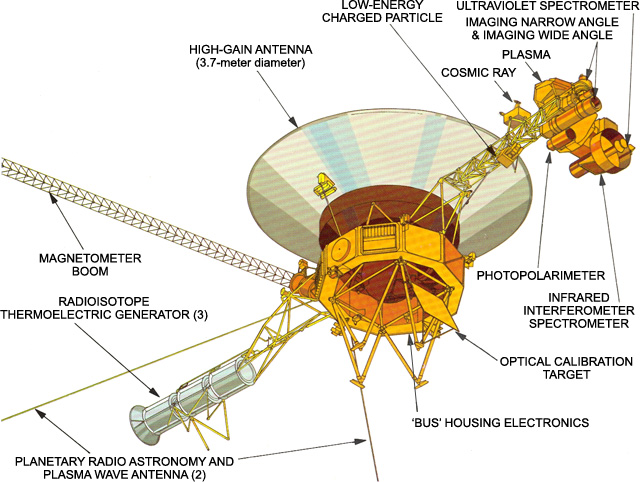
As I’ve previously noted in these pages, both of the Voyager mission spacecraft are well into interstellar space and, as they approach the 50th anniversary of their launches in 2027, slowing running out of electrical power as their nuclear generators run out of the ability to produce enough heat. Because of this, not only have various science instruments been turned off on both craft, they have also been limited to communicating with Earth once a day, by replying to a signal set from Earth the previous day (as it now takes a day for radio communications to reach the craft, and a day for a reply to be received).
On October 18 and 19, 2026, Voyager 1 stopped sending its response signal. However, before engineers on Earth could send a signal asking the probe to wake up, it resumed normal communications on October 20. A request was sent asking the probe to transmit its logs back to Earth for analysis, and these suggested Voyager 1 went into s “safe” mode during a switch-over between two sets of orientation thrusters after one set went off-line.
Such switches to “safe” modes are intentional and designed to prevent a spacecraft losing power or damaging instruments if something unexpected happens. What is not usual – and has engineers scratching their heads – is that normally, for a spacecraft to exit a safe mode, it requires instructions from Earth; however, Voyager 1 appears to have taken the step all by itself, without intervention from mission control. Which has left mission engineers with a bit of a mystery on their hands.
This is the first time we’ve seen the spacecraft do something like this, but we are also at a point in the mission where we have to expect the unexpected. We’re relieved to be back in contact with Voyager 1 and are eager to understand what happened.
– Kareem Badaruddin, Voyager mission manager, NASA’s Jet Propulsion Laboratory
Meanwhile, NASA’s Neil Gehrels Swift Observatory finally re-entered the atmosphere here on November 4, 2026 and burned-up.
As I’ve noted in recent Space Sunday pieces, the 1.4 tonne observatory was the focus of a rescue attempt in which a small, low-cost vehicle was launched with the intention of “grabbing” it and gently pushing it back up to a more stable orbit, removing the risk of it re-entering the atmosphere for several more years and allowing it to continue its mission.

Unfortunately, that rescue craft itself had problems, and while it was able to rendezvous with the observatory, it was unable to perform the required rescue. As a result, the observatory re-entered Earth’s atmosphere at 12:39 UTC on November 4 over northern Sumatra, appearing as a blazing meteorite as it burned up, with any surviving debris falling into the Pacific Ocean.
On November 5, NASA astronaut Anil Menon and Canadian Joshua Kutryk completed the installation of the last of the roll-out solar arrays (called iROSA, the “i” to distinguish them from similar roll-out arrays used with some spacecraft) designed to boost the available electrical power aboard the International Space Station.
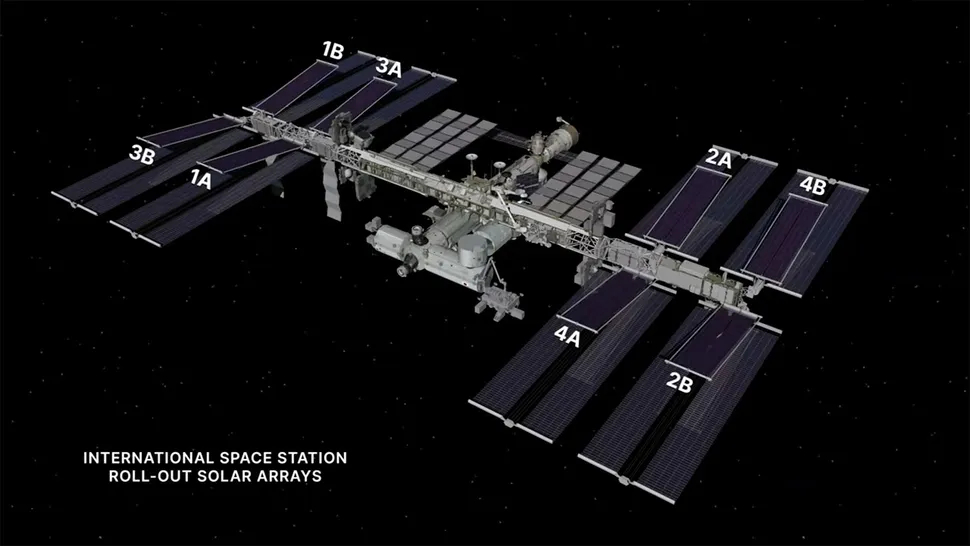
The process to install the new, smaller and more efficient arrays alongside the station’s existing massive arrays commenced in 2021, and now sees the station’s power capability increased by some 40% whilst being half the size of the original – and degraded – arrays and 20% lighter. Although coming in what might appear to be the twilight years of ISS operations – the station is due to be decommissioned and de-orbited in 2030 – the completion of the iROSA installation work means ISS has the power it needs to complete its operations.
Due to be launched in 2028, Dragonfly is the name given to NASA’s Titan probe quadcopter, a unique aerial vehicle intended to explore Saturn’s largest moon, Titan to characterise its prebiotic chemistry and extra-terrestrial habitability. Due to arrive on Titan in 2034, the nuclear-power aerial vehicle is intended to be the first make the first powered and fully controlled atmospheric flight on any natural satellite.
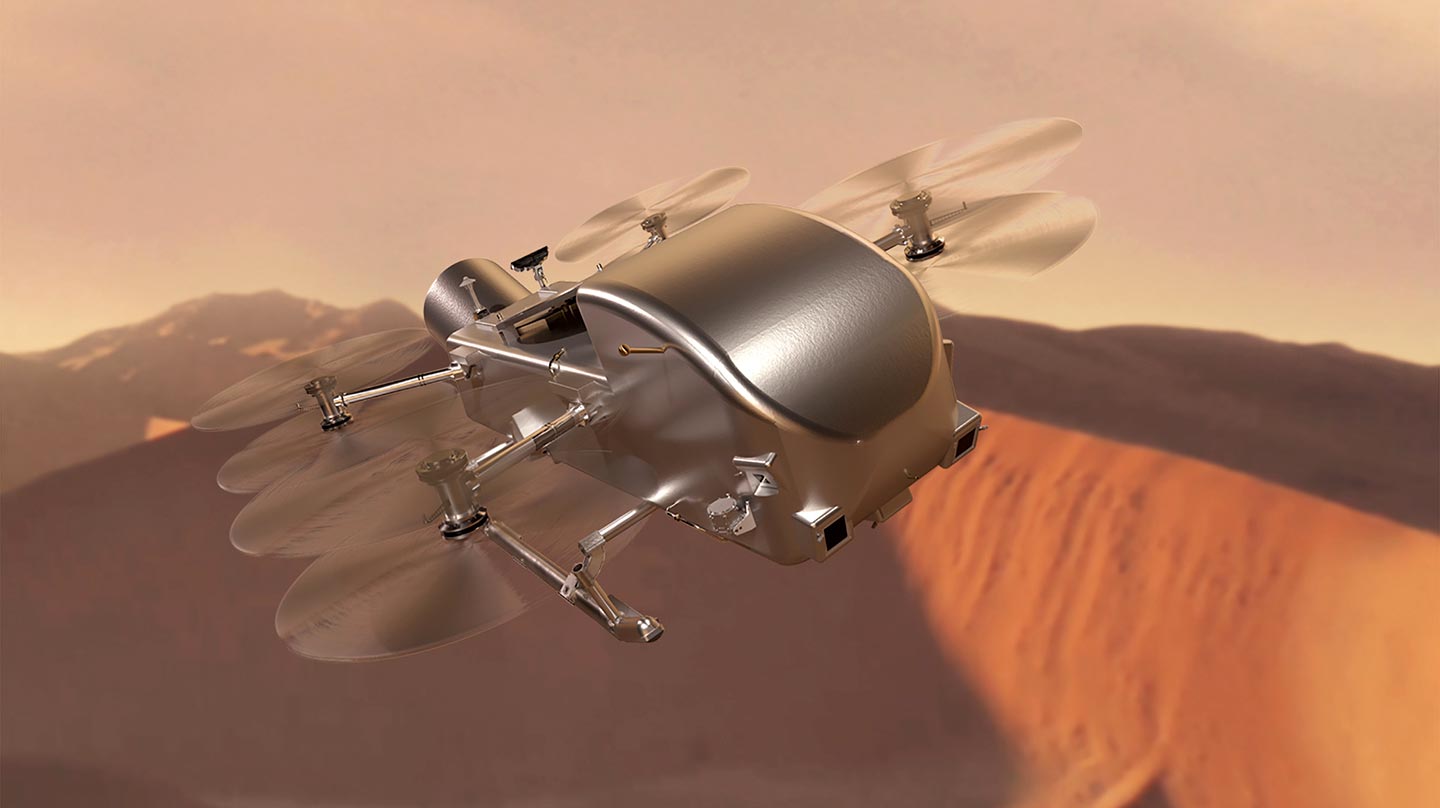
It is hoped the vehicle will make between 20 and 30 flights over Titan during a 3 terrestrial year mission, covering around 8 kilometres per flight. Whilst airborne, the vehicle will be capable of sampling Titan’s dense atmosphere and studying its meteorology. Whilst on the ground between flights, it will gather samples from the surface and below it, with all samples – atmosphere and ground/sub-surface – being analysed by the vehicle’s on-board laboratory.
With cameras to film its passage, Dragonfly will uncover many of Titan’s secrets – and NASA has opened (through until January 15, 2027) the opportunity for people to have their name flown on the mission. Simply supply your name and e-mail and receive a NASA “boarding pass” for the mission. All received names will be recorded in a chip which will be included in the vehicle.


