Kokua: Admin changes and the 6.2.4 release

The Kokua team released Kokua 6.2.4 on Friday, August 16th, 2019, and with it come some changes to general administration of the viewer’s website and management tools.

In terms of the latter, and for ease on management going forward, a number of changes are in the works including:

  • The use of the Atlassian Confluence platform to provide:
    • A blog capability.
    • Release notes support.
    • A master download pages.
    • RSS feeds.
  • The use of Atlassian Jira (as used by Linden Lab and the likes of Firestorm) for bug reporting and tracking.

The switch-over is still a work-in-progress, so the existing blog, wiki and bug tracker remain in operation for the time being, however, relevant links for the new environment are given as:

While the switch-over is in progress, users are advised against linking to individual sub-pages within these sections, as pages may change as things are bedded-in. For this purposes of this blog, the new Kokua home page is referenced in the sidebar links (right, under Maintained Viewers) and within my Current Viewers Release Page and the weekly release summaries drawn from that.

Kokua 6.2.4

Kokua 6.2.4 brings the viewer to parity with the most recently Linden Lab viewer release (version 6.2.4.529638, formerly the Love Me Render RC viewer dated August 5th, promoted August 12th). In addition, it updates the RLV version to Marine Kelley’s RLV 2.9.26.2.

As has been customary with Kokua releases of late, the viewer is provided in three versions for each of the supported operating systems (Windows, Mac OS X and Linux, all 64-bit):

  • Non-RLV – version 6.2.4.45881.
  • “Standard” RLV (can be enabled and disabled via a viewer restart) – version 6.2.4.45882.
  • “Full Time” RLV (RLV is active all the time) – also version 6.2.4.45882.

In addition to these updates, Kokua 6.2.4 includes a number of third-party additions, most notably from Firestorm, as noted in the sections below, and with due credit to the originators of the code updates.

Settings Backup

Sometimes when installing a new version of a viewer, there can be a recommendation to perform a “clean install” – removing all cached and settings files. This can make any viewer installation labour-intensive, as settings all need to be restored after the installation is complete.

The Settings Backup (Preferences > Backup) eases some of the pain by allowing users to back-up many of their global and account settings to a local hard drive. Once done, the back-up can then be restored to an updated version of Kokua (e.g. if a clean install has been required, or if some settings have become corrupted). Settings can also be backed-up at any time as changes are made.

The Kokua Settings Back-up option, courtesy of Firestorm

Settings can be backed-up to any location on a local drive, and users can select those settings they wish to back-up by unchecking / checking the available options. It is also possible to save settings on a per account basis. So if you have several accounts, each with different settings, you can back-up each of them separately – just make sure each back-up has a unique location.

Restoring previously backed-up files requires the viewer is restarted after the restore – and again, this is conveniently taken care of by the viewer allowing you to quickly log-out following a successful restore – although you’ll have to manually re-start the viewer once you’ve been logged out.

Sounds Output Device Selection

Preferences >Sound and Media includes a new drop-down allowing users to select their preferred output device for playing in-world sounds.

Sound output device selection, courtesy of Firestorm

When using it, note that:

  • Selecting Default will always select the first output device in the list.
  • If Default is selected but the previous device is no longer available, the viewer will automatically switch to the next available “default” device as defined by your operating system.
  • Manually selecting an output device from the drop-down  prevents the viewer from automatically switching to another device if the selected device is no longer available. Instead, the field will show “Unavailable Device” until such time as the nominated device is again available, or the drop-down is changed to Default or an alternate is manually selected.

Updated Debug Floater

Finally from Firestorm, Kokua 6.2.4 includes an improved debug settings floater with search and sanity checking of key values.

The improved Debug floater, courtesy of Firestorm

Other Updates of Note

Finally there are a number of fixes/improvements on the Kokua code base itself, notably fixing the pie menus so that the Hover Height command appears (i.e. was there but a mistake in the file concerned prevented it being shown). For details, please refer to the Kokua 6.2.4 release notes.

Feedback

Kokua 6.2.4 continues to maintain parity with the official viewer whilst also importing some additional updates from Firestorm that Kokua users will doubtless find useful and which are likely to help enhance Kokua as the go-to viewer for those who have used Firestorm , but who are looking for an alternative that offers reasonable familiarity.

Additional Links

Life and moods at Vibes Gallery in Second Life

Vibes Gallery: Paola Mills

Vibes Gallery, curated by Eviana Robbiani, is currently home to an untitled exhibition featuring Sunset Theas, Paola Mills, Lyack Glenwalker, Megan Prumier, and Aurora Donner. Given some of the images involve nudity, it should perhaps be considered an exhibition that is NSFW.

Immediately inside the entrance to the gallery is a quartet of images by Sunset Theas that follow a theme of their own, perhaps best described as condensing the seven stages of life into four evocative monochrome images, entitled, Embryonic, Birth, Life and Death. As the titles imply, each captures a moment in time and life.

Vibes Gallery: Sunset Theas

The use of monochrome, soft focus and life and shadow serve to make each of these pieces an intriguing study that fully captures the essence of their titles. Take Embryonic, for example. The use of depth of field and the off-centre capture are so suggestive of an ultrasound scan, with just enough form and substance for us to understand what we are seeing.

And so the images progress: Birth using light and shadow and a huddled form that offers the idea of a babe is dark swaddling; Life offers a image of the full vitality of a person in their prime, the use of a mask preventing us from being drawn into studying the model, but considering that broader idea of life. Then depth, with it simple setting, soft focus and back view of a naked body without adornment of clothing or within the setting is simply glorious – if such a term can be used – in its presentation of the body’s emptiness in death.

Vibes Gallery: Megan Prumier

At the far end of the gallery space are four images by Megan Prumier that again offer a theme; this one using reflections in the form of overlaid images of the female body. Each displays a considered use of technique that makes the nudity within the images secondary to their narrative. Take Warm Shivers, for example; the marvellous placement of the image, one copy superimposed over the other wonderfully suggests both someone feeling the cold in their nudity whilst at the same time presenting the idea of receiving warm comfort from someone close.

Between these two groups lie another set of four images by Paola Mills, and two pairs of images by  Lyack Glenwalker and Aurora Donner. I admit to being unfamiliar with the latter two, but again, on the strength of the two images presented here, Lyack has a talent for producing images rich in narrative. Certainly, his images reflect the stories inherent in the four pieces offered by Paola, while Aurora’s pair of studies round-out the exhibition nicely.

Vibes Gallery: Lyack Glenwalker

SLurl Details

2019 SL User Groups 33/2: Content Creation summary

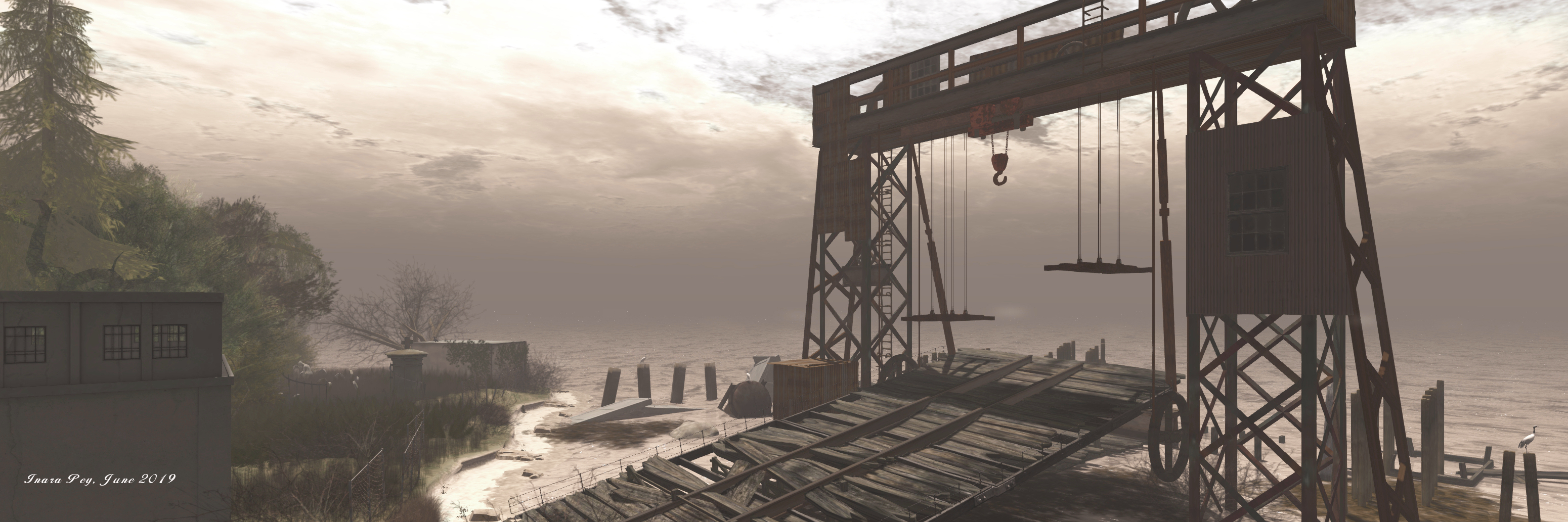
North Brother Island; Inara Pey, June 2019, on FlickrNorth Brother Island, June 2019 – blog post

The following notes are taken from the Content Creation User Group (CCUG) meeting, held on Thursday, August 15th 2019 at 13:00 SLT. These meetings are chaired by Vir Linden, and agenda notes, meeting SLurl, etc, are usually available on the Content Creation User Group wiki page.

Items Coming out of the SL Summit

  • LL might potentially be looking at a refresh of SL terrain texturing in the near future.
  • Pathfinding is recognised as a pain-point, but no resources are available within the Lab to tackle improvements / enhancements in the immediate future.

ARCTan

Project Summary

An attempt to re-evaluate object and avatar rendering costs to make them more reflective of the actual impact of rendering both. The overall aim is to try to correct some inherent negative incentives for creating optimised content (e.g. with regards to generating LOD models with mesh), and to update the calculations to reflect current resource constraints, rather than basing them on outdated constraints (e.g. graphics systems, network capabilities, etc).

Current Status
  • The project has been on hold for some time, but due to be rebooted during the current quarter.
  • Emphasis will initially be on data gathering, as previously.
  • No decision has yet been made on whether or not the first pass of work (once the data has been gathered) will include avatar accountability (including a further pass with Animesh), or initially only focus on in-world objects.
  • The overall aim is that of encouragement – getting users to think and want to be on-board with the changes, as they can see the benefit.
  • This work will not reduce the maximum texture size (1024×1024 – and remembering that for Bakes on Mesh avatar texture sizes have actually been increased from a 512x512cap to 1024×1024). However, ARCTan might penalise for “improper” use of textures (e.g. multiple uses of unique 1024×1024 textures across object faces, no matter how small the faces might be).
  • There are a lot of ideas around ARCTan (e.g. finding a means to not encourage lowest LODs of near-zero triangles, not penalising people if they include valid LODs, etc). However, threading the need to find the right balance on how things should be handled is acknowledged as being difficult, and as such, do not expect ARCTan to start changing anything soon.

Environment Enhancement Project

Project Summary

A set of environmental enhancements (e.g. the sky, sun, moon, clouds, and water settings) to be set region or parcel level, with support for up to 7 days per cycle and sky environments set by altitude. It uses a new set of inventory assets (Sky, Water, Day), and includes the ability to use custom Sun, Moon and cloud textures. The assets can be stored in inventory and traded through the Marketplace / exchanged with others, and can additionally be used in experiences.

Due to performance issues, the initial implementation of EEP will now likely not include certain atmospherics such as crepuscular rays (“God rays”).

Resources

Current Status

  • The viewer should be updated shortly to bring it to parity with the most recent viewer release (version 6.2.4.529638, formerly the Love Me Render RC).
  • There are still issues on the rendering side affecting people on various graphics systems that need to be resolved, together with some remaining performance issues.

Bakes On Mesh

Project Summary

Extending the current avatar baking service to allow wearable textures (skins, tattoos, clothing) to be applied directly to mesh bodies as well as system avatars. This involves viewer and server-side changes, including updating the Bake Service to support 1024×1024 textures, but does not include normal or specular map support, as these are not part of the existing Bake Service, nor are they recognised as system wearables. Adding materials support may be considered in the future.

Resources

Current Status

  • Still a number of bugs to be resolved, and Vir is now working on these as well as the Animesh follow-on (below). These include, but are not limited to:
    • Shadows are failing to render correctly.
    • Issues with some alpha settings.
  • Otherwise, most of the functionality is now believed to be in place.

Animesh Follow-On – Project Muscadine

  • DRTSIM-421 on Aditi (region Bakes on Mesh) now has the server-side code to support the new visual parameters LSL code.
  • Project viewer supporting the new LSL code should be out for use on Aditi in the next week.
    • This will provide the means to test the new LSL code functionality, but as with all project viewers, may not work 100% in all other areas.
    • May get enhanced with additional Animesh-related capabilities, although this is dependent on commitments with other projects, notably Bakes on Mesh and Project ARCTan.

General Discussion

Possible SL Wiki Deprecation?

  • For the last few years, the Lab has been moving information away from the SL wiki and into knowledge base articles.
  • During a recent Web User Group meeting, it was indicated that this trend will continue, and that the use of the SL wiki may be deprecated over time.
    • One of the reasons for this is the wiki software has some issues, and there are problems in opening the wiki for general management by users.
  • These changes will not result in the wiki immediately vanishing.
  • It’s not clear as to the best mechanism for getting outdated / incorrect knowledge base articles corrected – potentially the best way at the moment is to raise a bug report.

Documentation

The wiki situation prompted a broader discussion on documentation.

  • LL has been considering how to better provide documentation and demonstration videos for upcoming features and new capabilities.
  • It has also been suggested a Content Creation blog where notes on projects, best practices relating to them and for things like mesh design – LODs (including how to make efficient low LOD models rather than just tossing a low number of tri into the mix) – uploads, etc., and other content creation information could be posted.
  • It is acknowledged that there is a lot of expertise within the Lab and within the community for content creation, and none of it really resides within a single individual – therefore determining what should be documented, how it should be documented, etc., is not an easy matter.
    • A lot of the existing best practises for content and build has come from users / creators.
    • Given the status of the wiki, adding to this is currently difficult.
    • While creators have produced their own documentation, etc., it does come at a cost, and tends to focus n their own specifics. Leveraging this into a more general set of best practices and documentation library would take a lot of further time and effort.
    • As such, some sort of collaborative effort between creators and the Lab might be the way forward, although even organising this and ensuring a consensus of opinion may not be easy.
  • Another way to enhance documentation might be to submit new articles / updates to existing articles through a mechanism like the open source contribution agreement.

Mesh Uploader

Work is continuing on improving the mesh uploader – notably with the contributed updates from Beq Janus of the Firestorm team (see my Firestorm 6.0.1 review for details).

Further work could be done to improve feedback information given by the uploader, but this is currently seen as being more UI intensive, and outside the immediate scope of this updates.

Wandering Highland Hills in Second Life

Highland Hills, August 2019 – click any image to enlarge

Highland Hills is the name given to a quarter Full region designed by EloiseBlake, and it is a place that packs a lot into it. Open to the sea on two sides, the parcel is described as the “Highlands of Scotland. A forgotten era. Ruined, rural and rustic. Where nature has claimed its home.”

As a representation of the Scottish highlands, I’d perhaps suggest the parcel is intended to offer some the many aspects of the highlands – the rugged hills, the rough, weather coastline, hints of glen-like slopes (al be they narrow), rushing streams, and so on – rather than any single place within them. In doing so, it presents a rough-hewn landscape that is entirely its own, one that invites exploration.

Highland Hills, August 2019

The ruins referenced in the description come in multiple forms, from the great round bulk of a coastal tower, sitting atop a shoulder of rock and protected on two sides by open sea – or perhaps intended to command an offensive view over the waters – to the squat rectangle of a castle keep brooding against the western cliffs of the land.

Between and around these two are multiple signs of what might have once been an extensive fortification – the ruins of curtain walls, ached entrances that might once have been guarded by stout gates, the remnants of a chapel, and so on. Are these all symbolic of a once might castle that dominated the landscape at some point in the past? Or are they indicative of multiple attempts to fortify and hold the land during different times in its violent history? That’s one of many questions the visitor might be tempted to ask, although the lay of the land perhaps points to the various ruins being somewhat separate in nature.

Highland Hills, August 2019

More recently, the land has become home to a small farm, the house of which sits in the lee of the great round tower, with a cattle barn sitting across the parcel from it, overlooking the eastern coast. The latter is intended to be the home for shaggy highland cattle, but the cows appear to have had other ideas, an open gate affording them the opportunity to wander down to the rocks sitting above the coastal waters.

Also down among the rocks can be found the detritus of human life: abandoned crates, broken rowing boats and so on – some of which offer places to sit. More places to sit and relax can be found scattered across the parcel, most of them easily reached from the landing point by following the dirt tracks that roll away from it. One of the latter will take visitors past the great tower, then the little farmhouse, and onwards to where beehives have been carefully set among the heather. Just to one side of these a great tree has, at some point in the past collapsed, its aged trunk now a convenient bridge by which to reach the rectangular castle keep.

Highland Hills, August 2019

In truth, getting around parts of the region can require a bit of scrambling and / or searching. Take the main steps up to the castle keep, for example. They link keep with an entry arch and one of the tracks running through the land – but the entrance itself is blocked by the stones that have fallen from the top of the arch, the keystone presumably having given way at some point in the past. On the one hand, this leaves visitors struggling to get over the fallen stones in order to climb the steps beyond, but on the other it cleverly encourages people to look for an alternate route – and those who do can be rewarded by further discoveries of hidden spots on their way up to the keep.

Similarly, finding the way up to the round tower is – without cheating – a little bit of a game of exploration. While it is possible to get up to it from inland, the easier route perhaps lies elsewhere. All I’ll say by way of a clue is that to go up, you first need to go down.

Highland Hills, August 2019

Finished with a sound scape fully in keeping with the setting, Highland Hills makes for a diverting visit with plenty to see without taking up a huge amount of time, and opportunities for photography, and pictures can also be submitted to the parcel’s Flickr pool.

SLurl Details

A return to HippiMagic in Second Life

HippiMagic Gallery

HippiMagic Art Studio and Gallery has relocated, and now occupies a part of a Full region. While the latter is still being developed by Sophie72 Congrejo, the gallery’s curator and the region holder, the art exhibitions have re-opened, with August seeing something of a change-up with the art on display.

Within the garden area of the gallery are displays by Anibrm Jung, featuring a mix of her Second Life and Real Life photography mounted on the wall of the gallery building. This is one the most diverse selections of Ani’s art that I’ve seen in an exhibition like this, featuring as it does her always stunning physical world macro photography, and a range of styles an finishes to her SL art that are truly engaging.

HippiMagic Gallery: Anibrm Jung

Also in the garden as a corner display of physical world photography by Phenix Wonder. This is actually my first exposure to  Phee’s work, and again, her use of the macro lens in some of the pieces is superb; just take Sun Pattern and Thistle as two examples (seen below, left). Just nine pieces are offered here, but they are enough to captivate the eye – and to leave me hoping to see more of her work in the future.

The gallery building continues to exhibit the work of Wintergeist, another artist I admire, together with Sophie’s own images as well, both of which I wrote about back in June 2019 (see Art with a touch of HippiMagic in Second Life).

HippiMagic Gallery: Phee Wonder

Outside in the square is the Woodstock Art Contest. This features images by MikeMazrok, Kalyca McCallen, Jeri Rahja, Doris Johnsky, FreeDom Voix, Dido Haas, Edwige Monroe and Fluer Heartsdale.

As the name suggests, this is a contest with a focus on the 1960s and Woodstock, with the images reflecting the hippy counter-culture epitomised by Woodstock. The winners for the contest will be announced on Sunday, August 18th, with a party   featuring live singer StayAwayJoe from 12:00 noon, SLT.

HippiMagic Gallery: Woodstock Contest

SLurl Details

2019 SL User Groups week #33/1: Simulator User Group

Otter Lake; Inara Pey, June 2019, on FlickrOtter Lake, June 2019 – blog post

Server Deployments

  • There was no deployment to the SLS (Main) channel on Tuesday, August 13th.
  • On Wednesday, August 14th the RC channel should be updated as follows:
    • BlueSteel and LeTigre should be updated to server maintenance update 19#19.08.07.529856, containing internal updates which should see improvements to the percentage of scripts running per CPU cycle (particularly for Full regions) and reduce the portion of a cycle given over to idle scripts.
    • Magnum should be updated to server maintenance update 19#19.08.06.529800, containing internal fixes.

SL Viewer

The Love Me Render viewer, version 6.2.3.527758, formerly the Rainbow RC viewer dated June 5th, was  promoted to de facto release status at the start of the week.

The rest of the official viewer pipelines remain as follows at the time of writing:

  • Release channel cohorts (please see my notes on manually installing RC viewer versions if you wish to install any release candidate(s) yourself):
  • Project viewers:
    • 360 Snapshot project viewer, version 6.2.4.529111, July 16th.
    • Legacy Profiles viewer, version 6.2.3.527749, June 5. Covers the re-integration of Viewer Profiles.
  • Linux Spur viewer, version 5.0.9.329906, promoted to release status 29th November 2017 – offered pending a Linux version of the Alex Ivy viewer code.
  • Obsolete platform viewer, version 3.7.28.300847, May 8th, 2015 – provided for users on Windows XP and OS X versions below 10.7.

In Brief

Scripts

  • Script usage is still seen as possible cause of contention (e.g. because one parcel owner is consuming all script resources within a region). A means has been suggested for changing (see BUG-225391), but the Lab see the issue as complex and so wanted to get improvements such as those being initially deployed to the BueSteel and LeTigre RC channels issued first before potentially digging more deeply into the question of script usage and allocation.
  • How clear a picture does the Full private region Top Scripts give for script usage in a region? Obviously, it can help, but as Mazidox Linden noted: “I do something similar all the time. It doesn’t give you the fine grained details you’d imagine for our set-up however. For that I use other (mostly internal) tools/techniques.”
  • It’s been suggested that script information could be extended to parcel level. This is something the Lab has indicated it is musing doing – but no firm plans to implement any changes if the Lab go in that direction have been indicated. It is also a complicated issue, as Simon Linden summarised:

So how would you treat someone with 1/4 of a region and a club [and] 50 avatars come to see a popular performer, and the other 3/4 are empty at the time? Give [the club] all the script time? Or leave 75% for the  …  other land?

Region Memory Bloat

As a reminder: a region can suffer significant memory bloat during repeated terraforming. Simply put, this is the result of the navmesh (part of the region’s physics) being reformed during the terraforming. This can have numerous impacts: overall performance can be affected, as can rezzing objects. Nominally,  if a Full region’s memory allocation hits approx 900 Mb, or a homestead 230 Mb, it will shut down rezzing (if the underpinning simulator gets within ~90% of its memory limit (256MB for a Homestead & 1024MB for a full region) it will disallow rezzing).

So, if you are running a region that starts reporting issues with rezzing and have been terraforming, consider a restart (or requesting a restart from support).