Glitch Social in Second Life

Glitch Social, July 2020 – click any image for full size

Note: Glitch Social has closed; as such SLurls are removed from this post.

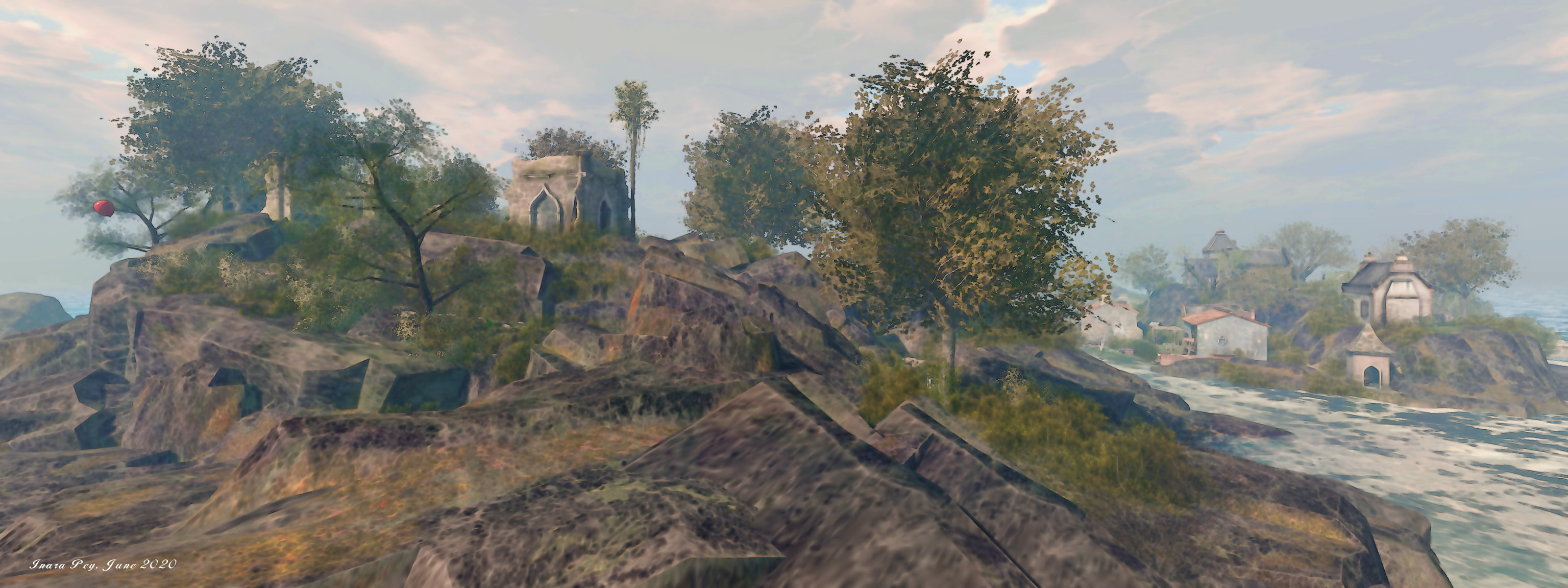
Glitch Social is a public space developed by KaidenTray, owner of the Glitch brand, and who is also a region designer / Second Life photographer. Located on a 1/4 region parcel within a Full region, it is offered as beach-front hang-out for people to enjoy, complete with a range of activities to partake and places to simply sit down and relax.

The landing point is located towards the southern edge of the parcel and sits above a fast-flowing stream and right on top of a little picnic area with a bonfire that may or may not be lit when you arrive. The stream is an odd little beast, lying as it does on a raised arc of land than falls away it either end such that the stream appears to be following both eat and north before dropped down into a depression fed on its far side by more waterfalls, and south and west to were it splashes down a lip of rock into a much wider, deeper pool of water that is also served by a series of large falls erupting from the surrounding rocky hills.

Glitch Social, July 2020

This large pool offers the first hint of recreational options in the parcel. Once you’ve passed the black bear and her cub as they stand on the far side of the stream, a structure somewhat like a diving board  extends an arm over the water, dangling various rope climbs abov the waves, with poses available on them with a right-click. Rubber rings also float on the water for those who fancy a dip.

Just behind the landing point and hidden from it by bushes, a set of stone steps wind up the hill from the grassy knoll between “diving board” and picnic area. Rising along the slope in a gentle arc, it offers a way up to a large house and yard. While this may at first seem to be a private dwelling, it actually appears to be open to the public: a sign on one of the other routes up to it from the beach – of which more anon – offers a welcome to visitors as they approach the front yard area of the house.

Glitch Social, July 2020

A sprawling setting, the house squats rather uncomfortably on mesh landforms (and in one place is in need of a measure of support as it does so!) surrounded by a mix of gravel, vegetable garden, wild grass and chickens. The house is comfortably furnished, again with opportunities for couples and groups to gather, sit and chat indoors or out, those opting for the latter possibly coming under the watchful eyes of a heron perched at the edge of the large stone pond sitting on the front gravel.

Despite its elevation, the house is set far enough back on is perch so that a screen of weeping willow and maple trees hide it from the beach below, and vice versa – although admittedly the high dormer roof of the house does raise itself sufficiently enough to be seen through the trees and bushes from below. Three tiers of stone steps connect the front yard of the house with the beach, these being the way up to the house marked by a welcoming sign mentioned earlier.

Glitch Social, July 2020

A third way from / to the house sits on its north side, where a rock path slopes down to a cinder path and boats docks. The path pushes through a narrow ravine of rock to link up to a meadow sitting back from the beach as it curves east and north around the land. The north western end of the docks are marked by a squat lighthouse that appears to be hiding behind a tall shoulder of tock, rather than giving warning of its presence.  Alongside of it, the cinder track turns sharply inland to climb up the hill before the cliffs, passing between them and the house.

The top of this climb is marked by a café / music venue built over a shelf of rock and looking down onto the large pool – so much so, in fact, that the daring can use the platform extending over the water from one side of the venue’s deck to do some spectacular high diving into the waters. For those less inclined to daring-do, the deck and café offer a further place for relaxation and passing the time.

Glitch Social, July 2020

With bumpers boats available in the waters by the beach, a camp site in the meadow and little details tucked away here and there, Glitch Social has much to recommend it, all wrapped in pleasing sound scape.
2020 Simulator User Group week #30 summary

Frogmore, June 2020 – blog post

The following notes were taken during the Simulator User Group meeting of Tuesday, July 14th, 2020.

Simulator Deployments

Please refer to the server deployment thread for news and updates:

  • On Tuesday, July 21st, the majority of the grid was updated with server maintenance update 544832, designed to resolve issues with some internal service updates, chat range improvements and capability improvements.
  • On Wednesday, July 22nd, the should be a single RC deployment comprising “a few internal changes (mostly logging)”. At the time of writing, the server deployment thread had yet to be updated with the release notes reference.

SL Viewer

The Tools Update viewer, version 6.4.5.544639, was promoted to de facto release status, Friday, July 17th. This viewer uses the new viewer build tool chain, but does not include any user-facing updates outside of bug fixes.

The remaining official viewer pipelines remain as follows:

  • Release channel cohorts (please see my notes on manually installing RC viewer versions if you wish to install any release candidate(s) yourself):
    • Arrack Maintenance RC viewer, version 6.4.5.544465, July 6th.
    • Love Me Render RC viewer, version 6.4.5.544028, June 30th.
  • Project viewers:
    • Custom Key Mappings project viewer, version 6.4.5.544079, June 30th.
    • Mesh uploader project viewer, version 6.4.4.543141, June 11th.
    • Copy / Paste viewer, version 6.3.5.533365, December 9th, 2019.
    • Project Muscadine (Animesh follow-on) project viewer, version 6.4.0.532999, November 22nd, 2019.
    • Legacy Profiles viewer, version 6.3.2.530836, September 17th, 2019. Covers the re-integration of Viewer Profiles.
    • 360 Snapshot project viewer, version 6.2.4.529111, July 16th, 2019.

Further Regions in the Cloud

Following from the announcement concerning Ahern and Morris on Aditi, the beta grid, being in the cloud (see my previous Simulator User Group update),  most / all of Blake Sea has been cloned to Aditi and is now running in the cloud, specifically for the purposes of  region crossing tests with vehicles.

Again, just to emphasise, this is Aditi, the beta grid, only (at least one person has reported on region crossings on Agni (the main grid) in relation to this announcement). For more information, refer to my blog post Blake Sea in the cloud on ADITI.

Blake Sea is now on Aditi and running in the cloud for those wishing to test vehicle region crossings

What is Simulator “Sleep Time” and how are Scripts Processed?

The viewer provides a set of stats related to both itself and the simulator your user is on (CTRL-SHIFT-1). Most of the stats proved in this window are relatively self-explanatory, although some can cause confusion or can be misrepresented. One area of confusion  – what is simulator “sleep time”  – was raised in the forums recently, and Rider Linden took the time to explain it and a couple of other things in the stats panel. As his reply may help others, I’m including it in full here:

The short answer is that sleep time is the mean amount of time in ms per simulator frame that the simulator has spent idling over the last minute.
The long answer is that the simulators attempt to keep a constant number of processing frames (one cycle through the main loop) per second. This number is displayed in the statistics window as Sim FPS. This value is not the same as the Viewer’s FPS. When the Sim FPS starts to fall below 45 you will begin to see lag events like delayed movement and rubber banding, among other symptoms.
A single frame should take about 21ms. (21ms * 45) = ~1 second (less about 50ms overhead). If a single simulator frame takes less than that 21ms we need to add a few extra ms in order to maintain the constant rate. This extra time is reported as “Sleep Time” and tracks closely to “Spare Time”.
Every frame on the simulator is divided into a number of phases. The big ones are network message processing, advancing the state of the physics simulation, processing agents in the region and updating their interest lists, and executing scripts.
The amount of time allowed per frame to execute scripts is capped. The simulator will attempt to execute all the scripts in the region in that allotted time slice, if it can not make it all the way through the list it will stop and pick up where it left off on the next frame (this gives you the “Scripts Run %” statistic.) Since the time for script execution is capped you can see situations where the % of scripts executed per frame begins to fall even though there is idle time reported on the simulator.

Rider Linden, July 23rd, 2020

Blake Sea in the cloud on ADITI

Blake Sea is now on Aditi and running in the cloud for those wishing to test vehicle region crossings

Following from the announcement concerning Ahern and Morris on Aditi (the beta grid), being in the cloud – see my Simulator User Group update of July 14th, 2020 – it has been announced that most / all of Blake Sea has also now been cloned to Aditi, and is also running on AWS cloud servers.

The came via a forum post by Mazidox Linden on Monday, July 21st, and the move has been made so that those who use boats and aircraft can carry out region crossing tests.

We’ve now expanded the number of regions we’re running in the cloud on Aditi to include the entirety of the Blake Sea mainland regions. For those of you who aren’t familiar with Blake Sea, you can use the following entry points to log in on Aditi and rez a vehicle to start exploring:
Blake Sea – Japan (secondlife://Aditi/secondlife/Blake%20Sea%20-%20Japan/207/248/22)
Blake Sea – Beagle (secondlife://Aditi/secondlife/Blake%20Sea%20-%20Beagle/207/208/13)
Blake Sea – Mainbrace (secondlife://Aditi/secondlife/Blake%20Sea%20-%20Mainbrace/211/241/16)
Blake Sea – Atlantic (secondlife://Aditi/secondlife/Blake%20Sea%20-%20Atlantic/245/219/16)
Objectives:
Test region crossing code (particularly using vehicles) between cloud simulators on the same host, and cloud simulators on different hosts.

– Mazidox Linden, July 21st

Again, just to emphasise, this is Aditi, the beta grid, only (at least one person has responded to the thread referencing Blake Sea region crossings on Agni, the main grid).

Those wishing to try boat / aircraft region crossings can do so by logging-in to Aditi and teleporting to the locations given above. you can also use Blake Sea – Half Hitch on Aditi for rezzing boats and seaplanes can be rezzed.

When testing, be aware that crossings between these regions can be unpredictable – so please do report your experiences via the forum thread, and with the following points in mind, as also indicated by Mazidox:

  • Some regions can cause you to “bounce off an invisible wall” at the region border, even though you are able to see into them.
    • Please report instances of this occurring in the forum thread, including the name of the region you were in, the region you were trying to enter, the date, and the time.
  • Some regions will not show up at the edge of your current region, even though they are adjacent.
    • Again, please report instances of this occurring in the forum thread, including the name of the region you were in, the region that failed to appear, the date, and the time.
  • HTTP-out for LSL scripts is disabled on cloud-based regions, as is sending e-mails via LSL scripts. Please do not report either, as both are currently working as intended.

to Access Aditi

If you have not logged-into Aditi before, you should file a support ticket requesting access.

Once your ticket has been responded to, you can log-in to Aditi via any Second Life viewer using to SL account name and password:

  • Launch the viewer.
  • If the grid selection option is not displayed, press CTRL-SHIFT-G.
  • Select Beta Test Grid (Aditi) from the drop-down (see below).
  • Enter you log-in credentials.
Use the Grid selection option in any viewer to access the beta grid
  • To return to the Main Grid select Second Life Main Grid (Agni) at your next login

Note: when you log-in, your inventory may not reflect your inventory on the main grid (so you may not have your desired vehicle available, for example), and you’re need to wait for your inventory to be duplicated from Agni (the main grid).

The inventory copying process is automatic, and occurs at approximately 06:00 SLT daily. Simply by logging-in to Aditi you will have flagged your inventory to be updated the next time the copy process is run, so you should not need to wait more than 24-hours for your Aditi inventory to properly reflect your Agni inventory.

Further information on Aditi can be found on the Preview Grid page of the SL wiki.

Premièring on July 24th, 2020: STÖMOL a Second Life Machinima

STÖMOL publicity image

Update: due to some last-minute changes, the public première of  STÖMOL is now slated for July 24th – details at the end of this article.

STÖMOL is an ambitious feature-length science fiction machinima filmed entirely in Second Life and due to première on You Tube on Thursday July 23rd, 2020.

Written, directed filmed and produced by Huckleberry Hax, who also takes the lead role of Epi Stömol, a private investigator. Also appearing in the film are Caitlin Tobias as Waarheid and who is also the film’s assistant director and publicist; Ylva as Verity Certain, Boudicca Amat as Istinito Tatsache, Anthony Wesburn as Adevaru) and Mich Michabo as The Quill.

Stylistically, the film is very much shot in the style of an animated graphic novel – think of the likes of Sin City and you’ll get the idea – that grew out of Hax’s writing and Second Life photography. In all it has taken some 18 months to produce, and involved filming in more than 15 regions around Second Life. These include Zee9’s evolving Drune builds, which I’ve featured in these pages on a number of occasions (see: Drune IV: an Aftermath in Second Life, and Drune: a further visit in Second Life, for example), and the (now sadly passed into history) Kun-Tei-Ner by Lotus Mastroianni and Fred Hamilton (see: Kun-Tei-Ner: a water world in Second Life) and Huntington Beach, designed by Jade Koltai, although it has also since passed into a the pages of history (see: A trip to Huntington Beach in Second Life).

Described as being about “history” in the form of climate change and “truth” – topics that should both resonate with an audience, given the current geopolitical situation in the modern world – STÖMOL  is framed around the search for a pair of missing coders, a boy and a girl called the Eye and the Quill respectively, who may hold the key to unlocking the truth about Earth’s current situation- or perhaps they represent something else.

Official history tells us the sky turned red after an asteroid hit the planet and a trillion particles of dust got blasted into the air. But some people say that’s a lie. They claim we did this to ourselves.
They can’t prove any of it. From 1990 onwards – seventy years of history – there’s official conglomerate media only. Systems today don’t recognise the file formats from back then. ‘Digital Hygeine,’ they tell us.

– From STÖMOL

Despite these focal points within its narrative, STÖMOL is a film that came together somewhat organically, rather than building from a set story. Discussing the development of the idea during a segment of Lab Gab, Hax noted the the filming of scenes would take place as locations in Second Life were identified, with the structure of the story not emerging until some 50% of the filming was completed, the actual script / dialogue then following from that.

This is, to say the least, an unusual approach to shooting a film, and appears to be borne out of Hax’s experience with the National Novel Writing Month, an event that takes place globally every year and in which writers are encouraged to write a 50,000 novel across the 30 days of novel – but not to edit or revise as they write, instead allowing the story to shape itself.

Which should not be taken to mean STÖMOL  is in any way haphazard. Quite the reverse; the film demonstrates a high production quality, with many considered creative choices. It is also a film that carries with it a certain twist at the end (although the clue is there from the beginning – will you spot it?), whilst offering a certain amount of hat-tipping to the likes of Blade Runner and Blade Runner 2049 without ever feeling at all derivative.

However, while I’ve been able to see the film in advance of its release, I’m not going to go into further details here, as I have no wish to spoil the public première, the details of which are:

I’ll also have a personal review available following this public première. In the meantime, here’s a sneak peek, and you can catch more on the STÖMOL website.

Renoir and PxL at Club LA and Gallery

Club LA and Gallery: Renoir Adder

Now open at Club LA and Gallery, curated by Fuyuko Amano (Wintergeist) are two boutique exhibitions offer small selections of art by Renoir and Adder PxL (Z3NooBhasR3turn3D), two very distinctive and very different artists who together present two very different displays of art.

Renoir Adder is an artist who straddles genres. Within his pieces can be found elements of post-impressionism, potentially influenced by the like of Van Gogh; suggestions of Picasso; and surrealist leanings.

Club LA and Gallery: Renoir Adder

Here he presents a dozen paintings, some ten of which carry a strong hint of Van Gogh. Rich in colour, they present a range of landscapes and studies that might have been lifted from a gallery in the physical world and dropped into Second Life. The last two, meanwhile, lean more towards the surreal, with one in particular offering a nod and wink to the Belgian surrealist painter René Magritte.

Prior to this exhibition, I had not come across the work of PxL. Occupying the gallery’s north side, he offers 15 Second Life photographs that offer an enticing mix, in terms of their focus and style.

Club LA and Gallery: PxL

Mixing landscape image and avatar studies, they range of the delicately post-processed to those that have been heavily treated to offer the impression of painting as what I might describe as charcoal-like drawings.

These latter images are especially evocative, with a pair of images both called c3dots particularly capturing the eye – which is not to dismiss any of the others, I also found myself drawn to the darkly atmospheric Final Breath, together with Like a stone equally attractive.

Club LA and Gallery: PxL

SLurl Details

2020 viewer release summaries week #29

Logos representative only and should not be seen as an endorsement / preference / recommendation

Updates for the week ending Sunday, July 19th

This summary is generally published every Monday, and is a list of SL viewer / client releases (official and TPV) made during the previous week. When reading it, please note:

  • It is based on my Current Viewer Releases Page, a list of all Second Life viewers and clients that are in popular use (and of which I am aware), and which are recognised as adhering to the TPV Policy. This page includes comprehensive links to download pages, blog notes, release notes, etc., as well as links to any / all reviews of specific viewers / clients made within this blog.
  • By its nature, this summary presented here will always be in arrears, please refer to the Current Viewer Release Page for more up-to-date information.
  • Note that for purposes of length, TPV test viewers, preview / beta viewers / nightly builds are generally not recorded in these summaries.

Official LL Viewers

  • Current Release viewer version 6.4.5.544639, formerly the Tools Update RC viewer, promoted to de facto release status, Friday, July 17th – NEW.
    • Uses new viewer build tool chain, but does not include any user-facing updates outside of bug fixes.
  • Release channel cohorts:
    • No updates.
  • Project viewers:
    • No updates.

LL Viewer Resources

Third-party Viewers

V6-style

V1-style

Mobile / Other Clients

  • No updates.

Additional TPV Resources

Related Links
