2020 SL project updates week #30: TPVD summary

Paris for Ara, June 2020 – blog post

The following notes are taken from the TPV Developer meeting held on Friday, July 24th, 2020. These meetings are generally held every other week, unless otherwise noted in any given summary. The embedded video is provided to Pantera – my thanks to her for recording and providing it. Time stamps are included with the notes will open the video at the point(s) where a specific topic is discussed.

SL Viewer News

[0:00-3:47]

The promotion of the Tools Update RC viewer to de facto release status didn’t go as intended, resulting in the promotion being rolled back to viewer version 6.4.4.543157, dated June 11th, promoted June 23rd, formerly the CEF RC viewer. In addition, a further version of the Tools Update viewer was issued in RC form.

The roll-back was due to the Tools Update viewer causing incoming new users to crash on arrival at the welcome islands. Presumably, the arrival of a second Tools Update RC viewer is to allow comparative testing between the two versions in an attempt to understand what is happening, the Tools Update 2 viewer having some form of internal differences to the Tool Update viewer.

There are reports that the Tools Update viewer also has a deadlock issue associated with it – see BUG-229110.

In the interim, the recommendation is for TPVs not to release version based on or incorporating the Tools Update viewer code.

Therefore, this leaves the current viewer pipelines as follows:

  • Current Release viewer version  6.4.3.543157, dated June 11th, promoted June 23rd, formerly the CEF RC viewer – ROLL BACK
  • Release channel cohorts:
    • Tools Update 2 RC viewer, version 6.4.6.545538, July 24.
    • Tools Update RC viewer, version 6.4.5.544639, July 17 – ROLL BACK TO RC STATUS.
    • Arrack Maintenance RC viewer, version 6.4.5.544465, July 6.
    • Love Me Render RC viewer, version 6.4.5.544028, June 30.
  • Project viewers:
    • Custom Key Mappings project viewer, version 6.4.5.544079, June 30.
    • Mesh uploader project viewer, version 6.4.4.543141, June 11.
    • Copy / Paste viewer, version 6.3.5.533365, December 9, 2019.
    • Project Muscadine (Animesh follow-on) project viewer, version 6.4.0.532999, November 22, 2019.
    • Legacy Profiles viewer, version 6.3.2.530836, September 17, 2019. Covers the re-integration of Viewer Profiles.
    • 360 Snapshot project viewer, version 6.2.4.529111, July 16, 2019.

General Viewer Notes

  • The “big push” is now on getting the Love Me Render (LMR) viewer promoted to release status. There are currently just “a few” open issues with the viewer, and the hope is these can be closed and the viewer cleared by QA for promotion “soon”. This is the viewer that includes several EEP-released fixes for things like HUD issues, specularity, etc.
  • The Legacy Profiles viewer has had some back-end web integration issues that have prevented it from progressing to RC status as had been hoped at the last meeting.
  • A further Maintenance RC viewer is close to being ready for issuing.

In Brief

  • [9:36-19:33] EEP issues:
    • People continue to report noticeable performance degradations with running EEP enabled viewers. The current work-round is for users to disable Linden Water rendering (CTRL-SHIFT-ALT-7), which appears to work even when Linden Water is totally occluded.
    • This is a recognised problem, and is being actively investigated. However, there may not be a single fix that resolves all performance issues, so this work may not delay the promotion of the LMR viewer, bu could end up being addressed as one or more “future fixes”.
    • There are also reports of increased sudden viewer freezes / stalls within EEP enabled viewers. Again, LL is aware of such reports and is investigating them.
    • In addition, there continue to be major questions as to the real value of EEP when compared to issues such as the overall impact on people having to remodel custom environments, ease-of-use within the tools, performance hits, etc.
    • Firestorm’s preview release of EEP has already resulted in considerable negative feedback even amongst a limited subset of users; there are concerns that when released, it could result an large-scale user backlash.
  • [20:54-24:18] Increasing the official viewer’s texture memory allowance: currently, the official viewer is pegged at using 512Mb of memory for texture handling, which can result in performance hits due to texture switching issues.  This is on a list of changes LL “would like to get to” – although Kitty Barnett has offered LL a code patch (already used by some TPVs, and baed on Runitai Linden’s own code) to help.
  • Reminders:
    • The fix for off-line inventory offers failing is now grid-wide. This is still awaiting an update in the official viewers, but TPVs capable of using the capability can now “go ahead and use it.”
    • Those wishing to test how regions running on AWS servers can do so on Aditi, the beta grid, as follows:
      • Regions Morris and Ahern (and possibly now Dore and Bonifacio, although this hasn’t been clarified).
      • The majority of the Blake Sea regions – see: Blake Sea in the cloud on ADITI.


Second Life’s STÖMOL: a review

From STÖMOL

Warning: if you have not seen STÖMOL, be aware this article does contain spoilers! So if you don’t want your experience spoiled, I suggest you click this link and catch it before you read any further!

Friday, July 24th, 2020 saw the official public première of STÖMOL, a feature-length science fiction machinima filmed entirely in Second Life. Written, directed, edited and produced by Huckleberry Hax, the film also stars Hax in the titular role of Epi Stömol, a private investigator / hunter, with Caitlin Tobias as Waarheid (and who also serves as the film’s assistant director and publicist), Ylva as Verity Certain, Boudicca Amat as Istinito Tatsache, Anthony Wesburn as Adevaru, and Mich Michabo as The Quill.

Set some 40 years into the future, the film combines elements of the graphic novel with those of noir-style films to unfold a tale framed by the search for two missing coders, and which folds into itself questions on the nature of truth and reality in a world impacted by climate change and the control of conglomerates.

On the surface, the story appears straightforward enough: attractive, mysterious woman hires PI / Hunter to locate her missing adopted son. Along the way, the PI encounters another hunter, Waarheid, who is looking for her missing niece – and both boy and girl appear to be two halves of the same puzzle: coders called The Eye and The Quill respectively, who could unlock both the reason for the climate catastrophe impacting the Earth – and also could hold the keys to both reality and our perception of the truth.

“It is an intimate thing to kill someone, especially when you get to see them taking you in with their eyes in that final second of life, knowing it was you who has just taken everything from them. There is nothing you can see that come even close to seeing that” – Epi Stömol. Screen caps from STÖMOL.

Agreeing to seek the girl if Waarheid attempts to locate the boy, Stömol sets about his task, a shadowy, helmeted figure tracking his movements. Whether he is aware of this or not isn’t clear, but Stömol does find the girl – and has an initial encounter with the helmeted figure in the process. Opting not to inform Waarheid of his find, ostensibly to prevent her from ending her search for the boy, Stömol has a further encounter with the mysterious helmeted one, confirming him to be Adevaru. Attempting to strike a deal, Adevaru reveals the true value of the two coders – giving Stömol  pause for thought.

Keeping to the bargain, Waarheid, informs Stömol she has located the boy, who is being held against his will. A rescue attempt is made, only to apparently fail, a kidnapper escaping with the boy. This set the film up for a sharp plot twist that is genuinely surprising and unexpected, in the process moving us to the final denouement, which in turn brings the story full circle to connect neatly with the opening sequence.

All very easy to follow. However, this simple sounding narrative actually lies within a much more complex story, one that might be summed up in asking the question just what is truth?

Waarheid. Screen cap from STÖMOL.

This is exactly what Stömol does as the film opens, mulling over both that and the nature of reality.

Stamp your feet on the ground; down three fingers of whiskey; put a cigarette in your mouth and light it. Is any one of these things real? Is any one of these things “the truth”? Or is truth just a story we create so that things seem to make sense? The line that joins the dots up into a picture that we can understand. We think each dot can only lead to one other; but what if every dot leads to a thousand others, and a million different pictures can be drawn?

– Epi Stömol

Presented in terms of the action that follows these ruminations – the dispatch of an unknown individual carrying an automatic weapon – it’s easy to simply view Stömol’s words as merely reflective of that action; indeed, with a nice slight of narrative, we’re encouraged to do so; but the fact is with this opening statement the film’s focal point is set – and, again, indirectly, a hint is given about Stömol himself.

This element of “truth” being at the core of the film is revealed in other subtle ways as well. Take the names of the principal players Stömol encounters: Verity Certain (itself a play on words), Istinito Tatache, Waarheid – all are words for “truth” and / or the state or quality of being true in their language of origin (English, Croatian and Dutch). Even Adevaru would appear to be a play on Adevărul, Romanian for truth. Similarly, The Eye and The Quill are not randomly chosen names for the two missing coders: the eye is the organ that sees the truth, whilst the quill is the tool by which the truth can be recorded.

It is this layering of elements in which STÖMOL is lifted above being a”simple” tale (although it can still be enjoyed as such), giving it more of a novel-like feel. Similarly, the broader production values evident in the film also help to present it as more of a motion picture than a machinima. Good use is made of framing – over-the-shoulder shots, cutaways, close-ups, all provide depth to STÖMOL.

There are subtleties in approach that give the film added richness. As noted, the twist towards the end of the story is presented in a manner that is so entirely unexpected, I doubt anyone could see it coming. There are also ambiguities scattered throughout that add a certain edge to Stömol. Take the outcome of the rescue attempt: did it really fail, or did Stömol allow the kidnapper to escape with the boy so he might remove Waarheid as a potential rival and thus leaving open his path to having sole control over the Quill and the Eye? And what of the comment about making a gift to the man killed in the opening sequence, is not a new light on this cast within the film’s ending and Stömol’s comments about controlling the truth through The Quill and The Eye?

An encounter with Adevaru. Screen cap from STÖMOL.

However, it would be remiss to say STÖMOL is not without its warts. Whilst relatively few, they do jar when they happen – such as the fight scene with Täuschung (another clever name – this time meaning “deception” or “to deceive”; a shame it didn’t go anywhere). It appears to have been included because it had been shot before the core of the story had been settled, and the fight couldn’t be readily re-filmed to better fit the narrative. Thus we’re left with a character that pops up and dies without saying a word and without serving any other purpose than to facilitate a fight.

The narration can also be unsettling. Delivered without cadence, it is peppered with unnatural pauses in delivery that can grate to the point of spoiling enjoyment. A case in point: early in the film Stömol walks the streets in a 4½-minute segment during which he delivers less than a minute of voice-over in total. This is painfully drawn out across the 4½-minutes with clumsy, mid-statement pauses up to 20 seconds in length. It’s a sequence that could have been edited to around 90-100 seconds without losing any of its dramatic edge whilst facilitating a far more fluid narrative delivery.

Elsewhere, the film offers ome nice hat-tips to its major sci-fi influences: Blade Runner and Blade Runner 2049. These range from the obvious – the use of Zee9’s Drune designs  (Bladerunner) plus the atmospheric effects (aka Blade Runner 2049) – through the the more subtle: watching the robotic major domo march into Verity Certain’s pool area ahead of Stömol, I couldn’t help but think of Sebastian’s robotic playmates greeting him on his homecoming. Stömol’s use of a noodle bar also sits as a nod towards Deckhard in Blade Runner.

Overall, STÖMOL is a creditable first outing into feature-length filming in Second Life. Yes it has some faults – name me a film that doesn’t, and technique can always be polished. Certainly, the warts don’t prevent the film from packing a satisfying punch at the end whilst achieving what it sets out to do: entertain.

Oh – and when watching, make sure you do so through the credits: there’s an MCU-style tag scene that offers a hint of what might come in the future.

Here’s the link for the film again.

Winter Moon’s scenic beauty in Second Life

Winter Moon, July 2020 – click any image for full size

Annie Brightstar recently and indirectly reminded me that it’s been nigh-on two years since our last visit to Dream Shadowcry’s Homestead region, Winter Moon and that as such, a return visit was much overdue.

Dream’s designs are always places that draw lovers, romanticists, grid travellers and photographers; rich in detail, perfectly  designed and steeped in evocative elements, they’ve never yet failed to capture the eye at the heart – and this latest iteration is no exception, returning as it does to one of Dream’s themes of balancing land and water in a way they is both natural and visually engaging.


Winter Moon, July 2020

For this build, Dream presents a circle of islands, each sitting between the surrounding sea and a broad lagoon caught within them. Such is the shape of the two larger islands that it’s hard not to see this as the rim of an ancient crater, the crown of a volcanic mound that once reared its head above the waves, only to fall silent at some point in the past, its walls then beaten down over the aeons by wind, rain and sea until in time they in part collapsed, allowing the sea to rush in and fill the extinct crater bowl, the last remnants of the one proud walls now restricted to the north and west of the setting, where high cliffs rise.

The landing point for the setting sits to the south-west, on a slender finger of an overgrown walkway that reaches out from the largest of the islands to tickle a low mound of rock that has been used as the foundation of a lighthouse (the lighthouse being something of a motif for several of Dream’s Winter Moon designs). A second walkway, this one with it paving still very much intact and resistant to the grasses that have overgrown its twin, points eastward to reach the second of the large islands at it arcs from south to north on the east side of the region.

Winter Moon, July 2020

Predominantly low-lying, the island raises a sinuous, wooded spine perhaps as much at 10 metres above the waters either side, prior to dipping down to a sand bar that shows every indication of being the next point where the sea will overcome the land and cut a new channel into the lagoon, running between the wooded spine and the narrow curtain of rock that risks above the sand at the island’s northern end.

Here, in a sign that the waters around the islands tend to be generally calm, a board walk steps out over the waters snaking over the shallows to pass around the sheer cliffs of the larger island’s northern extent to eventually meet with the beaches that hug the feet of  those same cliffs. Passing around the northern side of the table cliffs, the path then proceeds onwards, using a more rudimentary board walk to step over the water flowing outside from the cliffs as it drops over a number of the great falls that adorn the high rocks.

Winter Moon, July 2020

From here it is possible to follow either the beach around the north and west sides of the major island and back to the old walkway, or pass over the centre of the island, taking the path through a strange ravine and the woodlands beyond to reach the same point. As simple as either route sounds, both are worth exploring because there is a wealth of detail to be found along both.

For the adventurous, a second board walk extends out over the eastern waters of the lagoon from a point close to the one mentioned above. this stretches to where a pair of narrow screens of rock rise from the water like the prow of a ship. they guard a narrow path that connects the board walk to a small island crowned by the spread of an ancient oak-like tree.


Winter Moon, July 2020

One of the great attractions of Dream’s builds is the sense of age and purpose given them – and this is again true here, particularly with regards the many aged stairways, complete with broken or damage balustrades, that help connect different parts of the islands. Their presence suggest that this place was once one to a people at peace with both lands and sea, with the many scattered statues and carvings adding to this feeling as one explores, together with the gentle ringing of wind chimes.  Even the singing happiness of an old phonograph isn’t out of place, offering as it does and echo of more recent times past with some classic oldies being played.

With a well-rounded soundscape, lots of details I’ve barely touched upon (go fine the chandeliers and all the places to sit and relax- alone or with someone special) for yourself!), this iteration of Winter Moon is idyllically sublime.

Winter Moon, July 2020

SLurl Details

Gen Con: sneaking a peek in Second Life

Part of the VRazeTheBar Gen Con Experience Welcome Centre, reproducing the Indiana Convention Centre entrance, which is replicated in full within the event regions

It’s now just a week before GenCon 2020 opens its on-line and virtual doors to gamers. The largest tabletop-game convention in North America by both attendance (almost 70,000 in 2019) and number of events, Gen Con features everything from traditional pen-and-paper games to computer games by way of role-playing games, miniature war games, strategy games, board and card games, to live-action role-play – and more.

Traditionally held over four days in down town Indianapolis, Indiana, where it is focused on the Indiana Convention Centre, Gen Con has – like so many other large scale gatherings – been forced to change tack for 2020, courtesy of the SARS-CoV-2 virus, and as I noted in Coming to Second Life: Gen Con “the best four days in gaming”, for 2020 Gen Con will be taking place on-line across a number of platforms – and it will also be going virtual with a presence within Second Life.

Called VRazeTheBar Virtual Gen Con Experience, the Second Life event is being developed by solution provider VRazeTheBar, who are in working closely with Gen Con to ensure the convention is fully and strongly represented in-world.

Given it is both a week since my first report on the event and just a week from opening, event organisers Alesia Clardy (AleisaPM in-world) and Ron Clifton (RCArchitect in-world), respectively VRrazeTheBar’s Creative Director and Technology Lead, allowed me to hop back and see how things are coming along.

We’ve made some minor changes since we last chatted. The Welcome Centre will now be remaining in its own location on Mainland, rather than moving here, and will remain open for folk who are not registered for the event, or who misplace where they are supposed to be. We’ll have guides there to provide assistance to visitors throughout the four days of the event. Second Life users will also be able to visit it for information on registering for the event and then getting to the main event regions.

– Alesia Clardy (AleisaPM in-world), VRazeTheBar

Part of the VRazeTheBar Gen Con Experience: the Fantasy games area
Taking place over the four days of Thursday, July 30th through Sunday August 2nd, VRazeTheBar Virtual Gen Con Experience features a full schedule of activities for gamers and attendees spread across four regions collectively divided into themed areas defined by altitude, with levels on the ground, at 500m, 1,000m and 1,500m.

The latter is devoted to gaming areas, the level split between sci-fi, fantasy, steampunk, medieval, and renaissance areas built around a central arrival, greeting area.

We’ll be running the games here. some will be open to whoever wants to play, others will be lead by our Second Life event Games Masters (SLeGMs). When an SLeGM activity is in progress, access will be restricted to the registered players and the GM and Host. When not in use for a specific game, attendees will be free to wander through through and explore – we even have some horse rezzers for those wishing to try their hand at riding in SL!

– Alesia discussing the 1500m level at the VRazeTheBar Gen Con Experience

Part of the VRazeTheBar Gen Con Experience: a table-top game in the Medieval area

Meanwhile, at the 500m level, is a reproduction of down town Indianapolis, a place where those who regularly attend Gen Con in the physical world can feel at home, relax and generally socialise. The build includes a reproductions of the convention centre that is the focal-point for the physical world event, and the Union Station, where social activities take place.

To help people get in the mood for the main event, the VRazeTheBar will be hosting a pre-convention dance for registered attendees on Friday, July 24th, between 17:00 and 19:00 SLT. It will take place in the Union Station building in-world,  and fancy dress is encouraged with prizes for the best costume / best look. The event will also be live streamed as a part of GenCon Online’s pre-event activities.

Getting around so large an environment could be confusing for those unfamiliar with Second Life, so the VRazeTheBar team have utilised Second Life Experience keys to establish easy, HUD-based teleporting. Arrivals within the regions will receive an invite to join the experience and receive the HUD, which will be auto-removed when they leave / log-off, as per any other experience, and replaced automatically on their return.

Part of the VRazeTheBar Gen Con Experience: a part of the Sci-Fi area (the “Inara Pyramid”! – no, nothing to do with me, rather part of a link to the TV series Firefly

As I noted last time around, attendance at the event requires registration through the Gen Con website – and this includes Second Life users. Registration is mostly free, although there is a nominal US $2.00 fee for some special events, mandated as a part of Gen Con Online’s registration requirements. Whilst visiting VRazeTheBar Gen Con Experience, attendees will have the opportunity of picking up an in-world Gen Con tee shirt, a backpack and other goodies.

I’ll have a further update on things, including details of the opening event and the special guest who will be attending ahead of the opening next week. In the meantime, once again my thanks to Alesia and Ron for their time and attention.

However, if you’d like to learn more before then, tune-in to Lab Gab at 11:00am SLT on Friday, July 24rh, when Strawberry Linden will be chatting to Alesia and Ron – read more here. Or, if you prefer, hop over the the Welcome Centre!

Links and SLurl

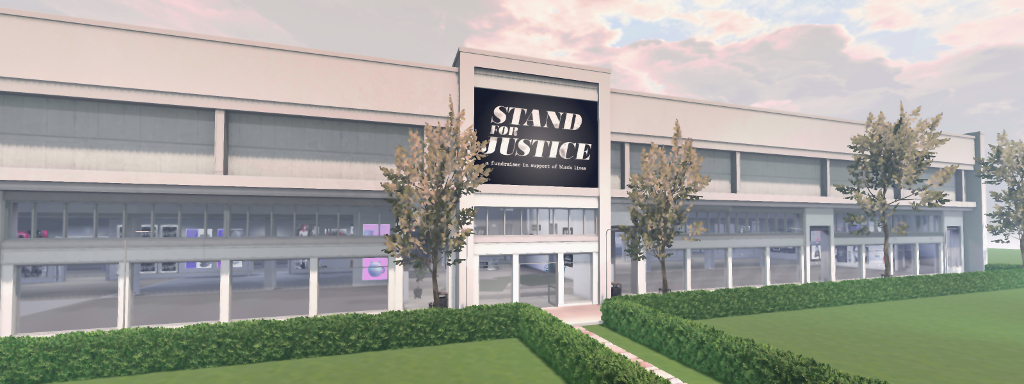
Stand for Justice: US $11K+ for BLM-related charities

Stand for Justice

At the start of June 2020, and thanks to a post by Linden Lab, I learned about Stand For Justice, an Second Life event organised to raise funds for the charities Black Lives Matter, Black Visions Collective, Campaign Zero, the National Police Accountability Project, and a Split Bail Fund benefiting 38+ bail funds across the United States (see: Stand for Justice in Second Life).

Over 100 SL brands and stores joined the event, with 100% of all sales to be donated equally among the supported charities and organisations. The event closed its doors at the end of June, and during the first part of July, the funds raised with cashed-out from Second Life and distributed to the supported charities. On July 16th, the organisers announced the final pay-out of funds raised had been made.

In all, a total of US $11,159.64 was raised by the event, after process credit fees. However, by the time the event closed and donations were ready to be made, the Black Visions Collective has ceased accepting funds. A poll of Stand For Justice group members was therefore taken for alternate charities to whom a donation could be made, resulting in the nomination of the National Institute for Criminal Justice Reform, a non-profit organisation providing technical assistance, consulting, research, and organisational development in the fields of juvenile and criminal justice, youth development, and violence prevention.

The five donations came to US $2,231.93 each. A full breakdown of payments and receipts can be found on the Stand for Justice website, and the actual transfers of funds from the Stand for Justice account to the charities was recorded via a You Tube live stream.

Additional Links

The beauty of steam machines in Second Life

Kondor Art Centre: Hermes Kondor, July 2020

The Tejo Power Station, located in the Belém district of Lisbon, Portugal, is regarded as one of the most beautiful examples of Portuguese industrial architecture from the first half of the 20th century.

Occupying the site of a thermoelectric plant first built in 1909 on the banks of the Rio Tejo, the building as it is seen today was first built in 1941, and provided power to the city through until the early 1970s, undergoing expansion over that time.

Kondor Art Centre: Hermes Kondor, July 2020

Encompassing architectural styles that run from art-nouveau to classicism, the power station was declared a major Portuguese heritage centre in 1986, and in 1990 became the home of the Electricity Museum, celebrating its role in bringing electrical power to Lisbon. It is in this capacity that Hermes Kondor visited it, along with his camera, returning with photographs of the building’s machinery, some 28 of which his has placed on display at the Kondor Art Centre.

And while this may sound like a boring subject – believe me it is not. The bunkers, pressure chambers, pipes, valves and metal walkways of the station’s machinery within the museum have been lovingly restored and maintained, and Hermes has captured all of this in incredible detail.

Kondor Art Centre: Hermes Kondor, July 2020

Through an exquisite use of depth-of field, macro focus, angle, framing and light, Hermes presents these machines and their individual part as living entities. From threaded nut to valves to pressure vessels to the complexity of the larger machines, the crisp detail found within each photograph is stunningly exceptional.

Displayed within a modern skybox setting that itself has a clean industrial feel to it and that perfectly complements the art on display, this is a genuinely engaging exhibition that fully captures the history and beauty of these remarkable machines.

Kondor Art Centre: Hermes Kondor, July 2020

SLurl Details