Diamond Marchant recently extended an invitation for me to drop into the latest exhibition at her Beckridge Gallery in Bellisseria to see a fun little exhibition of 3D creations that are a common element for the “Halloween season”: pumpkins and pumpkin lanterns.
Digital Magic is described by Diamond thus:
Fall brings pumpkins. In Second Life that means an endless variety of shapes, sizes, colours, embellishments, and carvings. Some are comforting, some horrifying… yet all are a product of digital magic. The exhibit includes the works of 37 pumpkin creators spanning the last 10 years. … Creators include 22769 Anachron, Andika, Apple Fall, ARIA, Ariskea, AVEC TOI, Candle and Cauldron, CELESTE, Cubura, Dark Secrets, Di’Cor, Dreamscapes Decor, DUST, Dysfunctionality , Fancy Decor, Finishing Touches, GOOSE, JIAN, Kres, LaFrayeur, Lilith’s Den, MudHoney, Organica, Ramen, random.Matter, Sass, Sau, Sepph, Soy, tarte, The Green Door, The Owl, Trompe Loeil, Vespertine, What Next, and Your Dreams.
Beckridge Gallery – Pumpkins: Digital Magic
The result is a house filled with pumpkins large and small, most carved for the season, some painted, some looking more like they may have been imbibing a tipple or two rather than being frightening, and one or two looking like they’ve been inspired by a Tim Burton movie. All are, however, quite endearing to see, and the house has been suitably decorated for the exhibition; such is the detail found within all of them, it is easy to see why this can be classified as an exhibition of 3D art.
While primarily aimed at Halloween, Digital Magic will remain open through until the end of November, potentially reflecting the popularity of pumpkins – albeit pumpkins that have been more happily decorated or have been used to create a certain pie :).
When visiting, you should set your viewer to midnight to enjoy Digital Magic under the intended lighting (the environment hasn’t been set within the parcel). Otherwise – enjoy!
So, I’ve probably mentioned I’m really not one for the whole “Halloween season” thing, but a couple of years ago I dropped into Miskatonic County, the themed Full region held by Tobiath Tendaze, and tried their Halloween / horror first-person adventure / shoot-’em-up. As it has been a couple of years since that visit, I decided to drop back and see what has changed with the new adventure, Tales of Miskatonic County: Dragon Rising.
In the shadows and back alleys of Miskatonic, evil has returned. Cultists have raised portals and called forth horrors from the abyssal plains to attack the city. Their goal is to restore the reign of the Great Old Ones. This Halloween, a titan will rise!
– Introduction to Tales of Miskatonic County: Dragon Rising
The HUD: The compass and bio monitor “sidebar” with Inventory option (1); The health status monitor (2); and the information display (3), which can display information according to the button at the bottom of the sidebar.
Visitors to the region are delivered to a landing point where the essentials can be picked up – a HUD and a revolver. Both of which are available via boards on the walls of the landing point.
When obtaining the HUD, may be asked to join the region’s Experience. This is a necessary part of the activity, so you should click on the Yes button. Don’t worry about the control permissions being granted over your avatar – these are necessary to the game and will be revoked when you leave the region (those who have previously accepted the Miskatonic experience need only touch the board to receive a fresh HUD).
Once the Experience has been accepted, the game HUD will automatically attach to your screen, and – unseen – a character sheet is created for you, if one does not already exist. This records and saves your progress, and allows you to leave the experience at any time (removing the HUD), and then re-join it at a later time, your progress being automatically uploaded to the new HUD. If you wish to delete all of your progress and start over, click the red cube at the landing point.
I’m not going to explain the HUD in all its glory here, as it includes an option to receive an explanatory note card, so I’ll leave you with a quick image-based overview (right). Do note that the three numbered elements of the HUD can be moved independently around your screen.
Once the HUD is attached, click the Pistol sign on the wall to obtain what looks to be a Colt Python .357 Magnum. While this may not be “the most powerful handgun in the world” (as a certain cinematic cop might say through gritted teeth), you will need it to blast the various nasties you’ll be encountering, preferably before they do you a serious mischief.
To find said nasties, take the teleport portal just outside the landing point down to the ground level and the edge of the town of Miskatonic. On arrival, you’ll need to switch to Mouselook to aim and fire your gun (left mouse-click). The nasties themselves may be wandering the various locations, others might be spawned via a “gateway” and others may burst forth in front of (or behind) you unexpectedly. When they attack you, they will cause damage to your health, shields and armour – so shooting sooner rather than later is advised. Such damage will recover over time, but should your health reach “zero”, you’ll be teleported to the town’s care centre where you can use a hospital bed to recover.
You can also help recover your health in several ways: by consuming the food and drinks that might be found within some of the buildings (which you can move around in 3rd person view as the nasties do not enter them), or by collecting any first aid kits you might find, or by using the energy vials some of the nasties might leave behind when “killed”. In all three cases, left-click the object in question to “add” it to a slot in the HUD’s inventory, then click the slot itself to “consume” the item it contains.
It is possible to simply run around blasting nasties, using the teleport portals (tunnels and covered bridges) to move between the town’s different locations to locate them. However, there is also at least one story awaiting discovery by touching various books, etc., and then reading the contents via the HUD.
However, there are also NPCs – non-player characters – awaiting discovery. Touching one will open a “dialogue” conducted via the HUD that will both provide information (possibly via more than one touch or by clicking the HUD info panel), and one or more quest options, including a list of possible quests which you can opt to complete. (you can select up to 5 quests at a time, opening opportunities for varied game play).
Interacting with an NPC via the HUD – clicking the NPC or the HUD’s information area may display further information from the NPC, which may be displayed over several “pages” of the information area of the HUD – click on it to move through (1). There may also be an options list where you can click on individual items for information, including any available quests (2). Click a quest adds it to your task list; completing it removes it from the task list
Quests vary in content from continuing the shoot-the-nasty format through to performing rescuing or finding items. Again a note card available through the Help options in the HUD will provide information on the various quests that many be available.
All of which adds up to the opportunity for first-person entertainment. As with 2019, I found that while the instructions on using the HUD, following quests, etc., to be very detailed, the broader brush-strokes of the main story seem to be poorly presented. What is the coming “titan”? What role does it play in the actual activities within the region? Perhaps this is only discovered by completing all quests, etc., which admittedly I have not done. I will say that I found the shoot-’em-up aspect oddly addictive – as I did in 2019 -, although this was tempered by the fact that the game HUD seemed exceptionally slow to respond / update, even when I was the only person in the region.
Nevertheless, if adventure games / hunts are your thing, Dragon Rising may well be worth the time poking at.
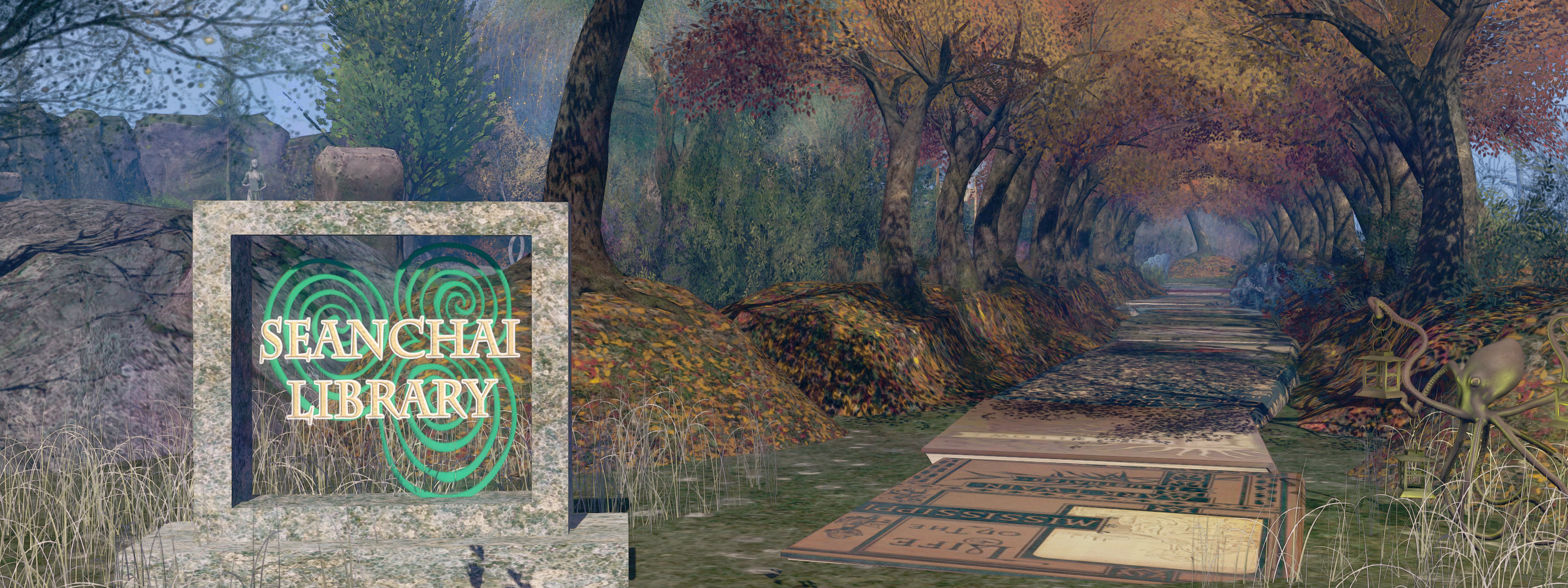
It’s time to highlight another week of storytelling in Voice by the staff and volunteers at the Seanchai Library. As always, all times SLT, and events are held at the Library’s home in Nowhereville, unless otherwise indicated. Note that the schedule below may be subject to change during the week, please refer to the Seanchai Library website for the latest information through the week.
Sunday, October 17th, 13:30: A Night in the Lonesome October
It is the start of the Haunted Month, and Seanchai Library (SL) are marking the arrival and passage of October with a reading of Roger Zelazy’s A Night in the Lonesome October, the last of Zelazy’s published works.
A Night In The Lonesome October
Every few decades, when the Moon is is full on the night of Halloween, the fabric of reality thins and the door between worlds becomes unlatched. At this time, those with certain Occult knowledge gather to engage in The Game.
Those who play take opposing sides; on one: those who seek to win The Game and throw open the door by the light of the full Moon to usher in the Great Old Ones from the other side so that they might remake Earth in their own images and enslave or slaughter the human race in the process. Opposing the Openers are those are those who would, by winning, re-latch the door and deny the Great Old Ones their prize – at least until The Game once more resumes.
Thus, through the month of October, the Players in the game – all archetypal characters from Victorian Era gothic fiction – form alliances, make deals, oppose one another, and even kill off opposing Players, until the night of October 31st, when the ritual of the door takes place, and the fate of the world is decided.
Each Player has his or her familiar, an animal companion with near-human intelligence, to help them complete the numerous preparations they must make and so be ready for the ritual on the final night. One of these is Snuff the dog, the familiar of Jack the Ripper, and who not only attends the play of The Game with his master, but also acts as the narrator of the month’s proceedings.
Alone in the desert, Daiya is faced with dilemma that will determine her fate. If she can successfully resolve it she will join the Net of her village, but if she fails, her life will be spent with the feared Merged Ones. Confused and torn between worlds near and far, Daiya harbours a secret of her people, and must find a way to move beyond her discoveries to a safe place where she can survive.
Join Gyro Muggins as he reads from Nebula-winning author Pamela Sargent’s Watchstar series.
On All Hallows Eve, young Pipkin is due to meet his eight friends outside a haunted house on the edge of town. But as he runs through the gathering gloom, Something sweep him away.
Arriving at the house in expectation of meeting Pipkin, his eight friends instead encounter the mystical Carapace Clavicle Moundshroud, who informs them that Pipkin has been taken on a journey that could determine if he lives or dies.
Aided by Moundshroud and using the tail of a kite, the eight friends pursue Pipkin through time and space, passing through the past civilisations – Egypt, Greece, Rome, the Celts – witnessing all that has given rise to the day they know as “Halloween”, and the role things like ghosts and the dead play in it.
Then, at length they come to the Halloween Tree itself, laden with jack-o’-lanterns, its branches representing the confluence of all these traditions, legends and tales, drawing them together into itself.
Tune-in via your Internet radio player, your browser or even you parcel’s audio stream as Seanchai Library presents and VCR hosts an adaptation of Robert Louis Stevenson’s famous tale about Gabriel John Utterson’s investigations into the strange occurrences between his old friend, Dr Henry Jekyll and the evil Edward Hyde.
Currently open at the 22 Art Space in Bellisseria, operated and curated by Ricco Saenz and Randy Firebrand, is a shared exhibition of images by two Second Life photographers – Dutch Ireman and Evie – that is built around the theme of Duet, or pairing. Although as Randy and Ricco explain in the exhibition’s introductory notes, the theme was actually suggested by the art offered by the artists, rather – as is more usually the case – the theme informing the art that is offered:
The concept … was born more or less by chance. At first [we] selected four pictures of each artist’s established production and suggested that Evie and Dutch complete the sets of images in a way that would make some sense to them. The results came with a positive surprise: even if each photographer … provided the gallery with photos that could be arranged in sets of two. In other words, the concept for the exhibition just emerged from that: there were duets – both of pictures and of ways to think of those photographs.
Thus, through the rooms at 22 Art Space, are hung eight images by Dutch and eight by Evie, each artist offering them as complementary pairs (4 pairs from Evie, four from Dutch). The images in each pair are able to stand as both an individual pieces in their own right and as one half of a broader story. Take, for example, Dutch’s Connecting and Connected, located on the upper floor of the gallery. Each offers a statement on human connectedness that can be appreciated in its own right; but they also stand together as a pair of images that give a wholeness to that theme of connectedness and connection.
The 22 Art Space: Duet
Given that each artist was given free reign over how they took the four images initially selected by Ricco and Randy and added to them to offer a selection for the exhibition, that both Evie and Dutch both independently arrived at the idea of pairing off their images (rather than simply adding and additional four, either randomly or based along a single collective theme) is genuinely intriguing. It also speaks to an interesting harmony between their individual approaches to the the exhibition that further this idea of duet: their individual voices as photographers coming together in unison in how they present their pieces as individual pairings.
And just as a duet can comprise contrasting harmonies and / or voices working together through the combined singing of different lyrics or one offering the melody, the other a descant around it, so too does Duet. Evie, for example, presents images that largely have darker backdrops and /or deeper colours, forming, one might say, a “descant” to the “melody” of Dutch’s work, with its bolder, vibrant mix of colours and backdrop, with both harmonising their their respective use of tone, angles and lighting.
The 22 Art Space: Duet
Completed by various items placed around the gallery that help underpin the idea of duets and pairings – a rug with the yin-yang pattern, a pair of shoes, tennis rackets and balls – Duets is a small, engaging exhibition that run through until December 11th.
Tucked into the mouth of the river Esk on Yorkshire’s rugged coast is the town of Whitby. It’s a place that many from outside of Great Britain might not have heard of, yet it is a place steeped in history and literature. It was, for example, the place from which Captain James Cook learned the ropes (literally and figuratively) as a merchant navy seaman. In fact, the ship on which he completed his first great voyage to the Pacific Ocean (1768-1771), HMS Endeavour, was originally a Whitby “Cat” collier (called the Earl of Pembroke). It is a town overlooked by the ruins of a once great Abbey that, in 664, hosted a synod called by King Oswiu of Northumbria, in order to set fast the rule that his kingdom would calculate Easter and observe the monastic tonsure according to the customs of Rome.
In terms of writing and literature, Whitby was the home to the first known Anglo Saxon monk, Cædmon, who resided at the Abbey during the abbacy of St Hilda (657–680). It was also visited by Charles Dickens and Wilkie Collins, whilst the likes of Elizabeth Gaskell, Lewis Carroll and G.P. Taylor all used it within works of fiction and short stories. And most famously of all, in terms of literature, it was in part the inspiration of, and setting for, Bram Stroker’s masterpiece of Gothic fiction (although arguably, it is far more than that): Dracula.
Whitby: Birth of Dracula, October 2021
All of which acts as a long way of introducing the latest public build by Hera (zee9): Whitby: Birth of Dracula, opened as a part of the Halloween season in Second Life, and which is reached via her “Neverland X” landing point, sharing the space with the teleport to Drune Gotham, which I wrote about in September 2021. Now, given I am a huge fan of Hera’s work (and oft wish my photographs could do it real justice), when I say this is yet another superb build, some might opt to see my words as fangirl fussing. However, as one explores Whitby: Birth of Dracula, slowing peeling open its layers of composition, then it becomes obvious that it really has been cleverly brought into being.
The first thing to note about the setting is that it is not intended as a representation of Whitby past or present. Nor is it entirely the Whitby glimpsed through the pages of Stoker’s novel. Rather, it is a rich melding of elements, from the actual locations that feature in the story and are present in Whitby to this day, to representations of the things that are said to have influenced his ideas for the story and elements of Victorian life with which he would have been familiar, through to interpretations as to how Stoker might have imagined scenes from his story as he walked through Whitby’s streets, attempting to thresh out the tale he’d been working on since well before taking a family holiday to the town.
Whitby: Birth of Dracula, October 2021
Thus it is that visitors arriving in the setting (DO make sure you have your viewer set to Use Shared Environment via World → Environment) find themselves on the east bank of the river Esk, a stylised version of Whitby’s waterfront hugging the feet of the coastal hills behind. Caught in a brooding night, these streets offer clever little points of interest for those who walk them. There is the bookshop, for example, displaying a large volume on Vlad the Impaler, a touch that evokes both the idea (now regarded by scholars as mistaken), that the character of Dracula was inspired by the infamous Wallachian prince, and the reality that Stoker first came across the name “Dracula” whilst perusing Whitby’s library. Across the street sits a tavern – pubs being very common in Whitby, it being a sailor’s town – that both suggests a place with Stoker himself might have partaken the odd tipple and a place where, within the novel, rumours of night terrors might be softly spoken by frightened townsfolk.
Further along the streets visitor will come across the place of business of Madame Blavatsky, offering both funeral services and occult / spiritual services. It offers a clever linking of many of the underpinning themes within Stoker’s novel on matters of religion, life, death, and afterlife with the life and work of Madame Helen Blavatsky. Whist Stoker may not have met her, her thinking did much to elevate matters of the occult, spiritualism and life and death amongst Victorians, which may also have influenced his writing.
Whitby: Birth of Dracula, October 2021
Then there are the famous Whitby steps. While the ones within this setting may not count 199, they do wind up to the headland where sits Hera’s interpretation of both St. Mary’s Church and the ruins of the Abbey that formed such a backdrop to Stoker’s tale. The church, carefully aligned east-to-west, as one would expect, is furnished within and sits with gravestones without. The real St. Mary’s offered further inspiration for Stoker; whilst walking through the graveyard, he came upon a headstone bearing the name “Swales”, which in turn became the name of Dracula’s first victim, after he came ashore at Whitby thanks to the ship he was travelling board ran aground close to the town’s East Cliffs.
The wrecking of Dracula’s ship within the novel actually draws upon a piece of local legend from Stoker’s time: the beaching of the Russian vessel Dmitri. Within Whitby: birth of Dracula, Hera directly references Dracula’s arrival, a sailing vessel lying aground just off the headland, bloody bodies of her crew on her decks, victims of his insatiable appetite, and her precious (to Dracula, at least) cargo still in her hold.
Whitby: Birth of Dracula, October 2021
Up on the headland is a further building, representing the manor house said to have been erected in the 1500s in part using stone from the ruins of the Abbey (which fell to the Danes in a series of raids along the coast between 867-870). Here, the building is offered as a combination of potential settings from the book. The hearse and gargoyles to the front suggest it is the place of shelter for Dracula, as do some of the pictures on the walls inside. However, the interior with its large, uncurtained conservatory, mirrored washrooms and comfortable bedrooms, perhaps also suggest it to be the house in which Mrs. Westenra, her daughter Lucy and Lucy’s friend Mina stay whilst holidaying in Whitby; whilst the placement of certain items on tables and within carry cases suggest it might also represent the living quarters for Dr. John Seward at his asylum, the place from which he, Harker and others used to execute their hunting of the vampire under the guidance of Professor Abraham Van Helsing.
To the rear of this house is a garden that extends out to a crypt. This offers further echoes of Dracula, although the glass coffin within the tomb itself is perhaps suggestive of the resting place for fair Lucy, after her being turned, but before her final fate befell her after death. Or, perhaps, it is presented as a place for Mina, once her fate is sealed (unless Dracula is first killed).
Whitby: Birth of Dracula, October 2021
And therein lies the magic of Whitby: birth of Dracula. Just is the novel has no singular protagonist, but is instead presented as an epistolary novel, speaking with multiple voices, so does Hera’s setting speak in many voices, each whispering a different interpretation of the places we come across whilst visiting, with some telling the story in their own words and those telling a broader tale of Stoker’s relationship with the town. Different they may be, but together they nevertheless offer the harmony of a setting that perfectly encapsulates the atmospheric essence of Stoker’s novel whilst living our imaginations free to call forth all of the characters within its pages – and even Stoker himself as he vacated in the quiet town of Whitby in the 1980s.
The following notes are taken from the TPV Developer meeting held on Friday, October 15th, 2021.
These meetings are generally held every other week. They are recorded by Pantera Północy, and her video of the meeting is embedded at the end of this report – my thanks to her for allowing me to do so – and it is used with the chat log from the meeting and my own audio recording to produce this summary, which focuses on the core topics discussed.
SL Viewer
The Apple Notarisation viewer, version 6.4.23.564172, was promoted to de facto release status on Wednesday, October 13th. This means the other RC viewers will be updated to match it in due course.
A new Viewer Performance Improvements project viewer, version 6.4.23.564530, was issued on Tuesday, October 12th.
This viewer focuses on reducing image decoding time, less frame stalls, and initial font rendering time, and there is a dedicated forum thread for discussing it.
Currently, the viewer is only available for 64-bit Windows, but other versions will be made available in the future.
This viewer should not be confused with the Performance Floater project viewer.
The rest of the official viewer pipelines remain as follows:
Release channel cohorts:
Maintenance RC viewer updated to version 6.4.23.564063, on September 21.
Simplified Cache RC viewer, version 6.4.23.562623, dated September 17, issued September 20.
Project viewers:
360º Snapshot project viewer, version 6.4.23.563579, issued September 3.
Performance Floater project viewer, version 6.4.23.562625, issued September 2.
Mesh Optimizer project viewer, version 6.4.23.562614, issued September 1.
Legacy Profiles viewer, version 6.4.11.550519, dated October 26, 2020.
Copy / Paste viewer, version 6.3.5.533365, dated December 9, 2019.
General Viewer Notes
The Maintenance RC remains the next viewer in line for promotion to release status.
The Simplified Cache RC viewer is currently regarded as pretty much “on hold” due to all the other performance-related work going on with the viewer. It is not felt by the Lab that it will yield sufficient performance gains at this point in time `to be regarded as a part of the viewer performance project(s).
The Legacy Profile project viewer remains on hold pending server-side back-end work.
Viewer Performance Notes
Part of the viewer performance work is utilising the the Tracy debugger / system analyser. This started as an exercise to analyse the main rendering loop to reveal any high latency operations that could be moved to their own threads.
The outcome of this work will likely be pulled into a Maintenance viewer at some point, but it is not currently a part of the Viewer Performance Improvements RC viewer.
Given how useful Tracy has been, it is likely that it will be included in the viewer build process, but the switch to include the necessary code will be set to “off” by default, as Tracy requires dedicated external support to be of use.
Also at some point, a viewer will be issued using the code that has been revised as a result of the analysis carried out using Tracy, and this will form another performance improvements viewer at some point in the future.
Another area of work for improving performance is that of Linden Water.
As previously noted in these summaries, Catznip has been investigating the cost of rendering Linden Water in situations where it cannot be see (e.g. when standing in the middle of a multi-region estate so it is completely “invisible” under the terrain). They have found significant FPS improvements can be gained by completely ignoring Linden Water rendering via occlusion checks in these cases.
The Lab is interested in improving general performance around Linden Water, and so a branch of the code Catznip has been using will be contributed to the Lab so they can take a look at it.
Discussions have started about possibly moving the Windows build tools to be based around VS 2019, as this support Clang tools, as it is thought Clang to offer further performance improvements. However, these discussions are still at an early stage.
TLS Changes
As per the announcement by April Linden on October 8th, Linden Lab will be turning off support for Transport Layer Security (TLS) 1.0 and TLS 1.1 security protocols on all log-in services on November 1st, 2021. This action is in line with the Internet Engineering Task Force (IETF) have officially deprecated both protocols in March 2021.
This means that any viewer or client (including any scripted agents to log-in to Second life) that utilises either TLS 1.0 or TLS 1.1 will be unable to do so from November 1st onwards. Only clients and viewer using supported TLS protocols (e.g. 1.2 or above), will be able to access Second Life. In particular, this step will impact Lib.metavers.open-based viewers and clients.
A request has been made for Aditi log-ins to have TLS 1.0 and 1.1 disabled so that viewers can be tested for other potential impact of the change ahead of it being made for the main grid. Those running older operating systems – such as Windows 7 without Service Pack 1 installed, may experience issues when TLS 1.0 / 1.1 support is turned off.
In Brief
iOS keeps being raised at the TPV Developer meetings, so in short:
A dedicated iOS client app is in development.
The initial versions are focused on communications (so no 3D rendering, inventory support etc), and have been subject to limited internal testing.
The client has gone through Apple’s review process, but has not been offered to a wider “beta test” audience, as there has been a further round of updates, and currently work is paused.
An Android variant of the client is in development, but is also paused and remains some way behind iOS.
See my updates tagged SL Mobile, which are added to as an when there is further reportable news out of the Lab.
The last part of the meeting is devoted to a general discussion on animation overrides and their limitations (both scripted and client / viewer-side). While the Lab has no plans to update the current approach to AOs in the immediate future, the discussion is worth listening to / reading via the meeting video below.



 On All Hallows Eve, young Pipkin is due to meet his eight friends outside a haunted house on the edge of town. But as he runs through the gathering gloom, Something sweep him away.


 Inara Pey: Living in a Modemworld