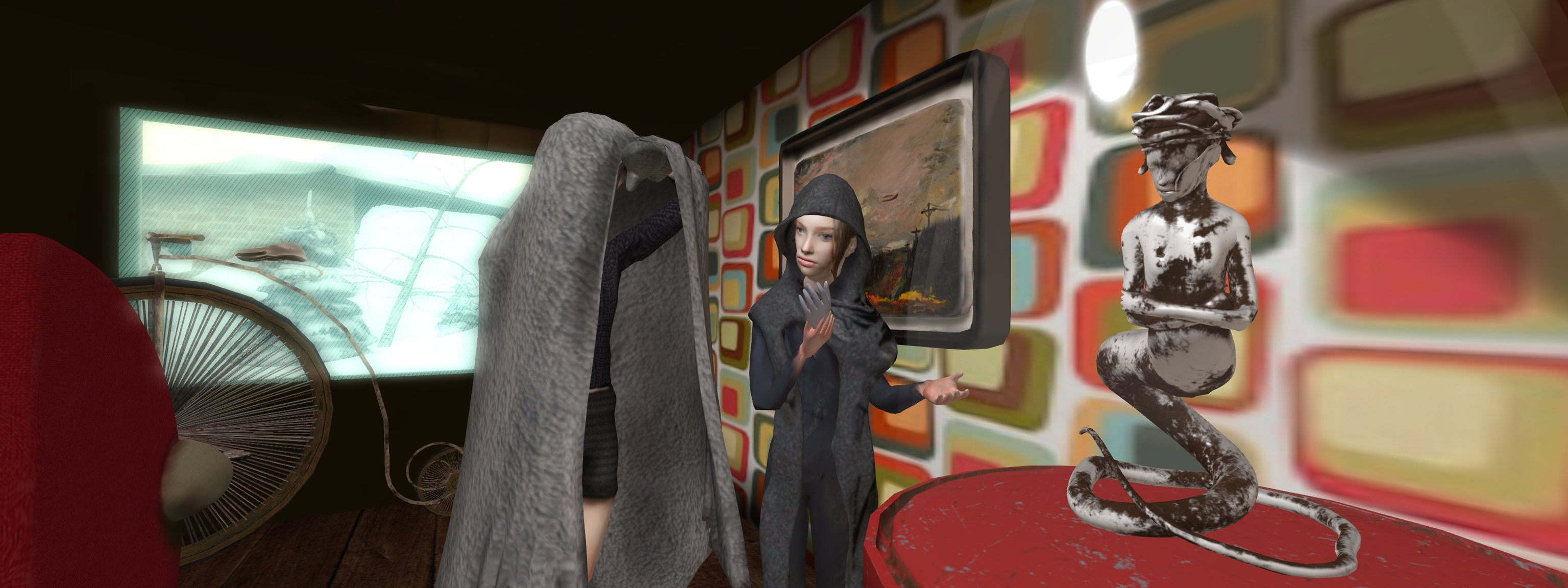
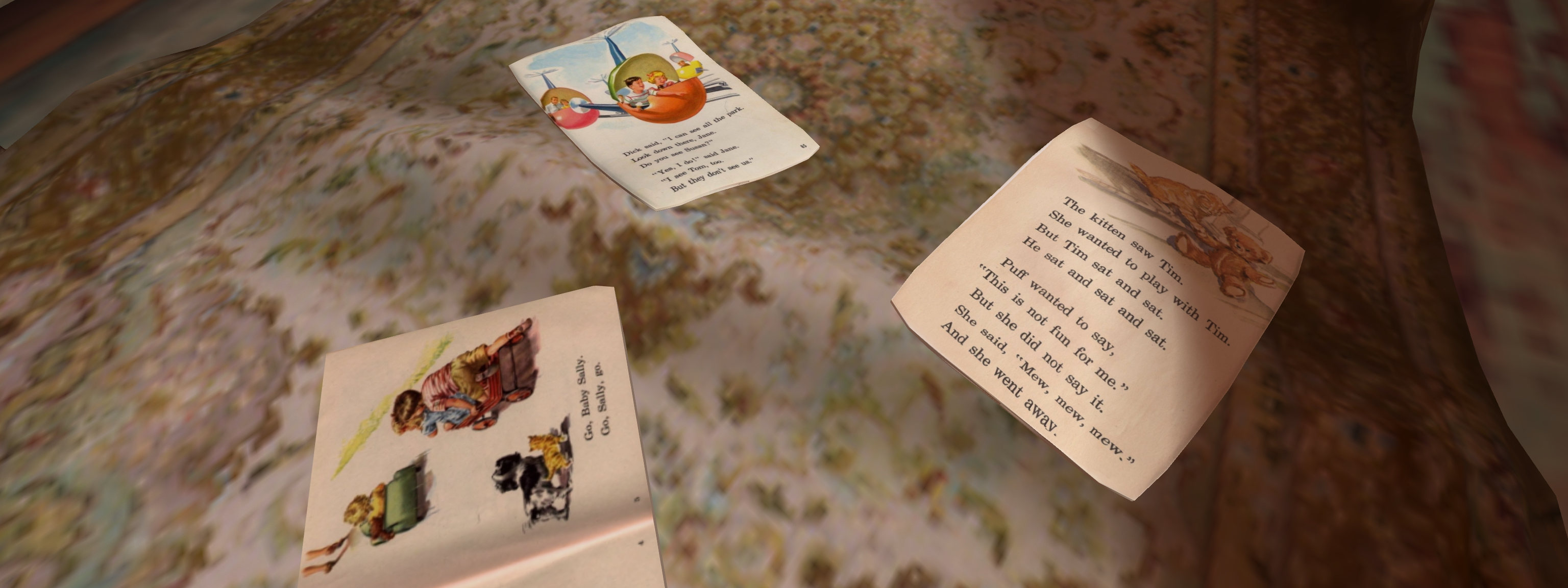
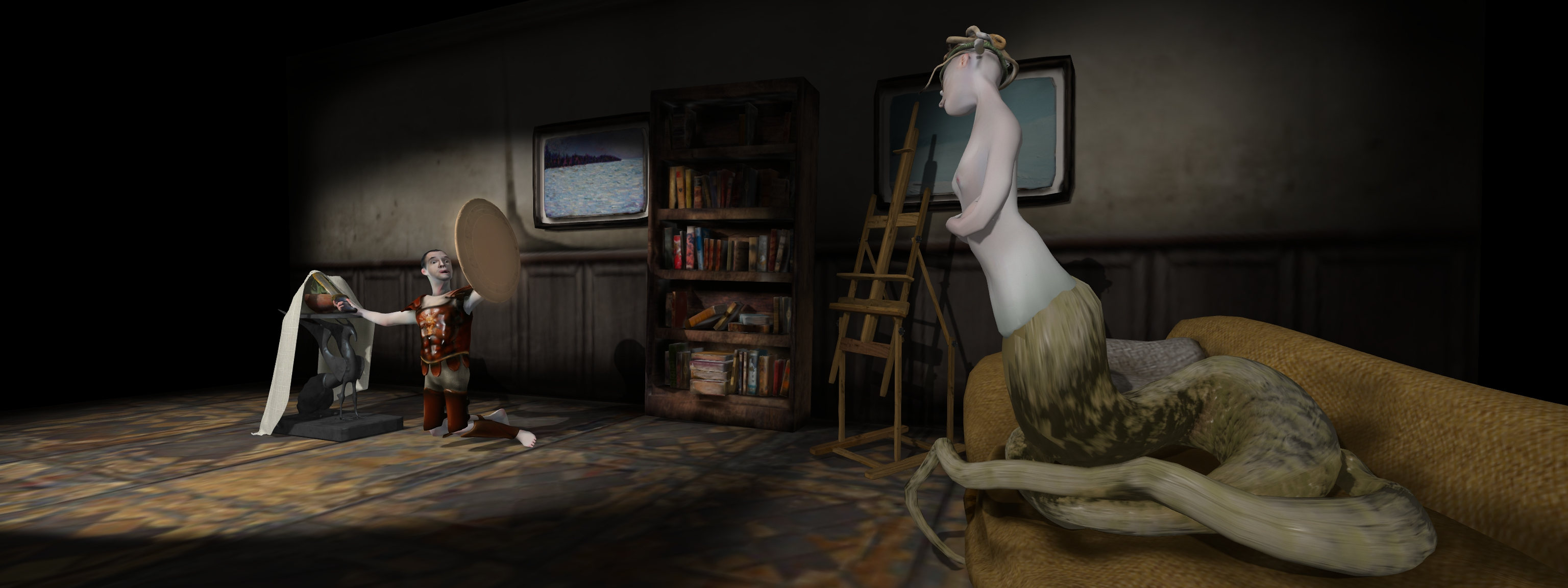
Men in Focus Movember 2021 exhibition in Second Life

Men in Focus Movember 2021: OSO

The 2021 Movember art exhibition at the Men in Focus Gallery curated by JMB Balogh, open on November 1st, once again sponsored by the Men in Motion dance troupe. As with previous years, the exhibition is primarily in support of the Movember Foundation, the leading charity changing the face of men’s health, with the secondary aim of promoting and featuring photography by male Second Life artists.

For 2021, the gallery is displaying the talents of four invited 2D artists – Ethan Lane, Looker Lumet, OSO (akash25g Resident), and Akim Alonzo, whose images are displayed together with works by members of the Men in Motion Dance Troupe and 3D sculptures and pieces by Mistero Hifeng, Silas Merlin, Harry Cover (Impossibleisnotfrench) and Jⓞhan Lionheart (AndreJohan).

Men in Focus Movember 2021: Ethan Lane

The owner and designer of Tulum Reserve, a publicly-accessible region, Ethan Lane specialises in avatar studies, producing single frame stories with his images designed to give flight to the imagination of those viewing them. As an explorer and photographer, he is constantly seeking new themes to incorporate into his images and new or different styles by which he can bring them to life, whilst unabashedly admitting much of his own dreaming (and what he calls his geekiness) is bound within all of his pieces.

Looker Lumet is a Belgian photographer-hobbyist who discovered Second Life photography in 2007. That discovery led him into the world of digital editing and photo-manipulation, and he notes that more than a decade on, he is still honing his post-processing skills and continuing to learn about the tools at his disposal. Through the skills he has acquired, he attempts to present his images as realistically as possible, noting that many of the technical and other improvements that have been made to the platform naturally encourage photographer to move in this direction.

Men in Focus Movember 2021: Looker Lumet

“Art is always a way to express oneself when words fail and that’s the beauty of it,” OSO (akash25g Resident) says of his work and photography and art as a whole. Hailing from India, OSO has the misfortune of having witnessed many unpleasant things in life, a fact that has given him the desire to travel in a world that is free from hate and greed, and where love and care can be freely expressed – an attitude that sharply informs his photography, as can those things in life that have impacted him. His work is intense in narrative, beauty, metaphor and mood as can be particularly witnessed through his Flickr stream.

Hailing from Italy, Akim Alonzo is both a creative photographer and digital artist and the curator of the Itakos Project Gallery, which ran from 2017, when initially leveraged facilities provided by the former Linden Endowment for the Artist (LEA) grant system to display art by those artists in Second Life who might not be confident enough to apply for a grant in their own, through until 2021. Akim made the decision to close the gallery in order to focus his efforts on a new project, details of which are to be announced in the near future. as Akim has a new project in mind. In the meantime, the Itakos Project website remains as an archive of the exhibitions hosted by the project.

Men in Focus Movember 2021: Akim Alonzo

The upper floor of the gallery displays work by three members of the Men in Motion dance troupe – photographer and dance choreographer Antonio Atovio, Men In Motion founder Sebastain Bourne, who marks his work with as little post-processing as possible to give it a natural edge; and Quient, who came to SL as an explorer who used the platform to help educate his daughter, taking her on visits to in-world galleries and museums, before himself becoming enraptured with dance in SL and the opportunities for photography.

Located throughout the gallery’s floor are pieces by the 3D artists exhibiting at the gallery, none of whom need any introduction, their work being familiar across Second Life. All four never fail to engage their audience be it through pieces that combine the near-classical with the modern (Jⓞhan Lionheart (AndreJohan)), or those that engage the emotions (Mistero Hifeng) or offer the potential for narrative (Silas Merlin) or are simply and quite wonderfully quirky (Harry Cover),

Men in Focus Movember 2021: Troupe photographers

About the Movember Foundation

The Movember Foundation is a multinational charity raising awareness of, and money for, men’s health and welfare, with a focus on cancer, mental health and suicide prevention. Its titular and widely known campaign is Movember, which encourages men to grow moustaches during the month of November. The foundation partners annually with the Distinguished Gentleman’s Ride to also raise money for men’s health.

Founded in 2003, in Melbourne, Australia by Adam Garone, Travis Garone, Luke Slattery, and Justin Coghlan, the organisation attained registered charity status in 2006, and has raised approximately US $700m in charitable donations. These funds have been used to fund more than 800 programmes focusing on prostate cancer, testicular cancer, poor mental health, men’s health awareness and healthy lifestyles. It is active in 21 countries and has a global workforce of 130 people. In addition, Movember coincides with International Men’s Day (November 19th), which among its aims, shares the goal of promoting the health and well-being of men and boys.

SLurl and URLs

2021 SUG meeting week #44 summary

Tierra Mer Mar, LeLoo’s World, July 2021 – blog post

The following notes were taken from the Tuesday, November 2nd, 2021 Simulator User Group (SUG) meeting. The meeting was recorded by Pantera Północy, and the video is embedded at the end of this summary. Note this summary focuses on the key points of the meeting; where there is something to report, the video should be referred to should full details of the meeting wish to be reviewed.

Server Deployments

  • Tuesday, November 2nd saw simhost on the SLS Main channel updated to the simulator release deployed to the RC channel in week #43. This includes a revised implementation of PRIM_PROJECTION.
    • For the time being, it will be write only, meaning it can used in llSetPrimitiveParams but not in llGetPP. The associated wiki documentation has yet to be updated.
    • This update will also include BUG-231158 Allow llGetNotecardLine to return more than 255 bytes (to a maximum of 1023 characters).
  • Wednesday, November 3rd should see regions on the RC channel restart, but no deployment made, and version numbers should not change.

SL Viewer

This list reflects those viewers available via the first four links in the LL Viewer Resources section, below.

  • Release viewer: version version 6.4.23.564172, formerly the Apple Notarisation Fix RC viewer, issued September 24 and promoted October 15.
  • Release channel cohorts (please see my notes on manually installing RC viewer versions if you wish to install any release candidate(s) yourself):
    • 360 Snapshot RC viewer, version 6.5.0.564863, issued October 21.
    • Maintenance RC viewer updated to version 6.5.0.564805, on October 20.
    • Simplified Cache RC viewer, version 6.4.23.562623, dated September 17.
  • Project viewers:
    • Performance Improvements project viewer, version 6.4.23.564530, dated October 12.
    • Performance Floater project viewer, version 6.4.23.562625, issued September 2.
    • Mesh Optimizer project viewer, version 6.4.23.562614, issued September 1.
    • Legacy Profiles viewer, version 6.4.11.550519, dated October 26, 2020.
    • Copy / Paste viewer, version 6.3.5.533365, dated December 9, 2019.

Apple Notarisation Viewer Issue

With the release of the Apple Notarisation Viewer there were updates to many of the viewer’s third party libraries, and some of these updates have be found to cause issues related to playback of certain media types in-world (notably MP3s and MP4s). A fix is in progress, and once ready, LL intend to fast track it through QA ahead of other viewer updates and make an RC viewer with the fix available ASAP.

TLS Changes

As per the announcement by April Linden on October 8th, Linden Lab turned off support for Transport  Layer  Security (TLS) 1.0 and TLS 1.1  security protocols on all log-in services (in line with the Internet Engineering Task Force (IETF) having officially deprecated both protocols in March 2021). However, it resulted for older services running Windows 7 (lacking TLS 1.2 support unless running with Service Pack 1 – see BUG-231303 “Scripted agents can no longer log in”, and also this blog post from Cinder Roxley.

In Brief

  • The Map tile server is currently “note working”, so the Map may display issues in updating. Steps are being taken to identify tiles that are not updating and rectifying the problem – it is hoped the fix should be in place by November 3rd.
  • Tool update work / server OS update remains the primary focus within the simulator engineering team.
  • There was general discussion on possible work the team might try around temp attachments and alternatives to HUDs, but nothing that is close to being discussed in depth.

Visiting ancient Greece in Second Life

Delos, November 2021

In October, I visited ancient Alexandria, a two-region build by Kleopatra T. Philopator (Kleopatra Alpha) and Elio Donat, and which offers an historical / role-play environment set in the reign of Cleopatra VII Philopator (69 BC – 10 August 30 BC) – see Cleopatra’s Alexandria in Second Life. However, adjoining the two regions representing Alexandria is a third, offering settings from ancient Greece within the same period (centred on around 43-42 BCE). At the time I covered Alexandria, I had intended to include the settings from ancient Greece; however, in talking to their creator (and holder of the region where they sit), Ellen of Sparta (ellenharriet) it became apparent they should be covered separately – hence this article.

As their joint name suggest, Sparta and Delos offer setting representative of the famous Greek city-state and of the the island said to be one of the most important mythological, historical, and archaeological sites in Greece. In addition, the region also offers the opportunity to visit ancient Crete. All three locations stand separately on their own sky platforms, but are interlinked via a teleport system. In addition, both Sparta and Delos can be reached from the “Library” landing point above Alexandria.

Sparta is today probably best known for its connection with the mythology of Helen of Troy and the Trojan War, and its military might, most notably enshrined in the reign of Leonidas I and the Battle of Thermopylae (480 BCE) during the second Persian invasion of Greece, led by Xerxes I. However, the city-state’s entire history is rooted in legend and mythology, which states it was founded by Lacedaemon, son of the god Zeus (by way of the nymph Taygete), and later became the seat of descendants of Heracles.

Sparta, November 2021

Regarded as less sophisticated than the likes of Athens, Sparta rose to become the dominant land-based power in Ancient Greece, largely due to the system of education imposed by the laws of semi-mythical legislator Lycurgus (c.820 BCE). And whilst seen as “less sophisticated”, it wasn’t in any way backward. For example, Sparta was very much ahead of the rest of ancient Greece in terms of gender equality – women, (at least those classed as citizens of the city) enjoyed a status, power, and respect that was unknown in the rest of the classical world, being seen from birth as near-equals to male offspring and offered the same freedoms, up to and including education and competing in sports. As such, many women played significant roles in the city-state’s history, such as Queen Gorgo, heiress to the throne and the wife of Leonidas I.

As represented by Ellen, Sparta in Second Life sits at a time well past its heyday as an independent city-state (that having been lost in 192 BCE, when Alexander the Great forced it to join the League of Corinth), but when it was nevertheless enjoying a curious renaissance. Whilst subject to the rule of Rome, it was seen as a Free City, allowing at least some of the institutions of Lycurgus to be restored – a fact that lent it to becoming a “tourist attraction” for wealthy Roman citizens wishing to learn about it culture and ways. Hence why, within Ellen’s setting, we find a Romanesque colosseum rising up on one side of the city.

The core of Ellen’s build is laid out along Afetais Avenue, regarded as the major thoroughfare of Sparta. Here can be found a number of buildings that help represent something of Sparta’s long history and its roots in mythology. First among these, just beyond the training arena for those wishing to participate in combat RP and the tournaments that regularly take place at the  colosseum, is a temple dedicated to he mythical Helen of Sparta, daughter of Zeus and wife of King Menelaus of Sparta (and perhaps better known as Helen of Troy), as well as temples to the Muses and Heracles, the legendary hero of ancient Greece. He was said to have conquered Sparta two centuries after the Trojan war, causing the rules lines of the Agiad and Eurypontid kings claiming to be his descendants. Red plinths outside of these temples and the other buildings lining the avenue will provide brief note cards on the buildings and the roles of those they honour in the history of Sparta.

Sparta, November 2021

At its northern end, Afetais Avenue opens out into a broad square sitting before a representation of the main courtyard from the massive Mycenaean palace discovered at Aghios Vassilios Hill close to Sparta, a structure thought to have once covered some 35 acres. Here the palace courtyard looks towards the Sparta Acropolis, home to a reproduction of the Sanctuary of Athena Chalkioikos, and the city’s civic amphitheatre.

Delos, meanwhile, transports us to the historic island of the same name. Located near the centre of the Cyclades archipelago, it is home to some of the most extensive archaeological excavations in the Mediterranean. These show the island has been inhabited since around the 3rd millennium BCE, with Thucydides claiming the original inhabitants were driven from the island by King Minos of Crete (he of the Minotaur infamy). By the time of Homer, the island was reputedly the birthplace of the twin gods Apollo and Artemis (although Ortygia is also given as the birthplace of the latter), a legend that led to the island undergoing several “purifications” by  Athens in an attempt to render it fit for the proper worship of the gods.

By around 42 BCE, the importance of Delos had waned. Under Roman rule, the island has rises to the heights of being the premier trading centre of Greece after the Romans has soundly stomped on Corinth, but the Mithridatic Wars brought an end to this, such that by the 1st Century BCE, Delos as a centre of trade and culture. Even so, it did remain a centre of population through until the 1st Century CE (after which things get spotty), so Delos as seen here is perhaps representative of the island as it sat during Roman rule, and when its sanctuaries and temples  were sill very much maintained.

Delos, the Temple of Apollo, November 2021

Dominating the island is a temple celebrating Apollo, sitting on a hill overlooking the rest of the island, a tall statue of Hebe situated on one shoulder of the hill. Also to be found here is a sanctuary to Dionysus  – Delos was the centre of a cult that revered both him and Leto, mother of Athena and Apollo, and an Erechtheion dedicated to Athena. The later stands to one side and slightly below the temple of Apollo in a manner that is mindful of the way the Erechtheion in Athens sits to one side of the Parthenon. Also to be found within the setting is a further grand temple and the palace of Queen Ellen, together with a small wharf, open fields, a marketplace a landowner’s villas, and assorted points of interest, all of which offer a more relaxed environment for potential role-play when compared to the possibly more combat-centric Sparta.

Sitting within its own sky platform, Crete is the work of Ellen with the help of Delia Kleopatra (Naburita), and appears to take us to the Minoan era. It centres on a great palace, seemingly inspires by the Knossos, and within which can be found a tripartite shrine of the kind discovered during excavations at Knossos, and reproductions of frescoes of the kind that may have once decorated the walls of buildings at Knossos.

And role-play (and combat) environments, these settings (notably Delos and Sparta) are home to a wide range of events, which are detailed at the landing points. Dress code for visitors is not strictly enforced, but those wishing to blend into the settings can join the local group and obtain free outfits from the vendors at the Delos and Sparta landing points. When exploring Sparta and Crete in particular, do not that there are private residences to one side of each setting, some of which are available for rent by interested parties – contact Ellen of Sparta (ellenharriet) for information.

Delos, November 2021

Taken on their own, collective and or / with Alexandria, Sparta, Delos, Crete make for an engaging and historically rich visit.

SLurl Details

Note Starr is rated Adult.

Bryn Oh’s Brittle Epoch in Second Life

Bryn Oh: The Brittle Epoch

Opening on November 1st at her arts region Immersiva, is Bryn Oh’s latest work, entitled The Brittle Epoch, an installation that has been several months in development.

Whilst it can be viewed as an installation in its own right, The Brittle Epoch forms the second part of Bryn’s Hand trilogy, and so a degree of context with that story is extremely beneficial for visitors. In addition, the Hand trilogy are themselves contained within a universe and timeline that frames and encompasses all of Bryn’s core works, a point those who are not so familiar with her work may unaware. To this end, the landing point for The Brittle Epoch includes a number of reference resources, as do the notes for the installation; for convenience, I’ve gathered the core of these at the end of this article.

However, if you have not previously visited Hand, I would strongly urge you to do so before entering The Brittle Epoch -you can find it on Bryn’s adjoining region courtesy of a grant Bryn received from the Ontario Arts Council.

Hand is the story of a time when society transitioned to living and working in the virtual space. In this society people housed their bodies in inexpensive pods hooked up to food cannisters. They discarded their houses and furniture as they were no longer needed. They evolved past their physical bodies and lived digitally as the person they wanted to be. Overseeing all of this is a singularity AI named Milkdrop, first seen in the Singularity of Kumiko, though only now revealed to be an AI.

– Bryn Oh on Hand

Bryn Oh: The Brittle Epoch

To help understand the overall context / chronology of the narrative flow of Bryn’s installations, the landing point at The Brittle Epoch offers a timeline of core events, together with the various installations and pieces Bryn has created over the course of the last decade or so. For those of us who are admitted “Brynists” (so to speak), it is worthwhile pausing to consider this before moving on to the start point proper.

As an experiential installation, The Brittle Epoch is interactive, as with Hand and other elements of Bryn’s work. Once within the installation itself, be sure to mouse over and touch items, as many can either provide additional information or offer an object. It is also essential you have local sounds enabled, as sounds are used both immersively and narratively. Finally, in terms of general set-up, the installation is also best experienced under its default environmental settings (World → Environments → Use Shared Environment) and with Shadows enabled (Preferences → Graphics make sure Advanced Lighting Model is checked, and then select Sun + Moon or Sun + Moon / Projectors from the Shadows drop-down  – both will give the required lighting).

Bryn Oh: The Brittle Epoch

Again, as with many of Bryn’s pieces, a HUD forms a central element. If you are not a member of the Bryn Oh Experience, you’ll be asked to join in order to receive it. When attached to your screen (this happens as you pass through / touch the doorway to be teleported to the first scene in the story), the HUD will provide an unfolding narrative as you progress through the installation – instructions on its use will be displayed in local chat.

The focus of this installation is the character of Flutter, the girl first introduced to audience in Hand and one of the children left out of the VR “nirvana” entered into by adults, leaving them forced to fend for themselves. She, together with her friends, will lead you through the installation as they embark on a journey from the heart of the city featured in Hand to the suburbs – a place very, very, different in nature, being caught in the midst of a hard winter suggestive of a new ice age that is befalling the world. As such, we follow them into an airship for the trip out to the ‘burbs, and then through the deserted homes that lie there – and beyond.

Bryn Oh: The Brittle Epoch

Here you need to keep an eye on the butterfly icon / listen for the tones so you witness the unfolding story – and be sure to touch the green button when you get to the Medusa, to follow a story-within-the story (and click the black balls before the glowing doors to progress on through this story, which on its conclusion will return you to the snowbound suburbs, allowing you to continue your journey through the story.

I do not wish to give too much of the story away here to avoid spoiling it as it unfolds through its sixteen scenes, so that you might follow and experience it for yourself. What I will say is, that as The Brittle Epoch is bringing Bryn’s larger, decade-spanning story to its conclusion, so too does it reacquaint us with a number of Bryn’s characters from previous works, including Lady Carmagnolle, Rabbicorn and the Daughter of Gears, and others, There is also a lot that might be extracted in terms of familiar mythologies and tales, and enough discrete elements that can also engage our own imaginations, allowing us to add our own twists to the story – a habit I’ve tended to have with several of Bryn’s installations!

Bryn Oh: The Brittle Epoch

The concluding part of the story will be unveiled in due course. However, in the meantime, I would note that Bryn’s work – in particular The Singularity of Kumiko, Hand, and The Brittle Epoch, form part of a course being taught by Carolyn Steele of York University, Toronto, and I hope to cover more of this in the near future with both Dr. Steele and Bryn.

SLurl and Additional Links

As noted, Bryn’s installations all take place within the same over-arching universe, and thus share degrees of connectedness. As such, for those possibly unfamiliar with her work, or who wish to re-acquaint themselves with her themes and idea, I recommend the following resources:

Grimm Stories, steampunk tales and fantasy treats in Second Life

Seanchai Library

It’s time to highlight another week of storytelling in Voice by the staff and volunteers at the Seanchai Library. As always, all times SLT, and events are held at the Library’s home in Nowhereville, unless otherwise indicated. Note that the schedule below may be subject to change during the week, please refer to the Seanchai Library website for the latest information through the week.

Sunday, October 31st, 13:30: The Brothers Grimm

Jacob and Wilhelm Grimm

Jacob Ludwig Karl Grimm (1785–1863) and Wilhelm Carl Grimm (1786–1859), were German academics, philologists, cultural researchers, lexicographers and authors who together collected and published folklore during the 19th century. They were among the first and best-known collectors of German and European folk tales. Their classic collection, Children’s and Household Tales (Kinder- und Hausmärchen), was published in two volumes: the first in 1812 and the second in 1815, with multiple revisions between then and 1857 that saw the collection of tales grow from 156 stories to more than 200.

In addition to collecting and editing folk tales, the brothers compiled German legends, whilst working individually, they published a large body of linguistic and literary scholarship. In 1838 they began working on a massive historical German dictionary (Deutsches Wörterbuch) – but were only able to reach the word Frucht (fruit) within their own lifetimes.

Many of their folk tales have enjoyed enduring popularity, being available in more than 100 languages, and adapted by filmmakers the world over. Possibly less well-known is that during the 1930s and 1940s, the tales were used as propaganda by the Third Reich, tarnishing their appeal outside of Germany in the war years. Later in the 20th century, psychologists such as Bruno Bettelheim reaffirmed the value of the tales in spite of the cruelty and violence to be found in some of the original versions – which the Grimms themselves had sought to sanitise through their editing and writing.

The Tea Time Crew (Da5id Abbot, Gloriana Maertens, Corwyn Allen, Kayden Oconnell, Caledonia Skytower, and Elrik Merlin) presents five of these tales, mostly from the lesser known parts of the canon. All would be grim enough on your average day, but are all the more so on All Hallows.

The stories will also be available via Virtual Community Radio – so tune-in via your Internet radio player, your browser or even you parcel’s audio stream!

At the Haunted Hollow.

Monday, November 1st, 19:00: The Stone God Awakens

A 20th century scientist is rendered frozen at the molecular level, and then reanimated millennia later by a freak accident. He finds himself in a strange world populated by sentient, anthropomorphic animals, who take his awakening to be the fulfilment of prophecy.

He accepts the mantle of godhood and sets about discovering this brave new world, hoping to find clues to the past while finding his place as the last human. But his quest leads to to question the reality of his status – might other humans also have survived? To find the answers he must lead his tribe of feline worshippers to the heart of a rival god: a great tree spanning half a continent.

Join Gyro Muggins as he reads a novella by the fantasy and sci-fi author Philip José Farmer.

Tuesday, November 2nd

12:00 Noon: Russell Eponym

With music, and poetry in Ceiluradh Glen.

19:00: The Wild Wood

A young artist returns to her cabin in the deep woods of Canada to concentrate on her illustrations. But somehow, strange and beautiful creatures are slipping into her drawings and sketches. The world of Faerie is reaching out to her for help – and she may be its last chance for survival.

With Willow Moonfire.

Wednesday, November 3rd, 19:00 Steampunk Stories

Finn Zeddore opens the pages of Lightspeed magazine to read Carrie Vaughn’s Harry and Marlowe and the Talisman of the Cult of Egil.

Some would say the Cult of Egil was not far wrong, to take the artefact as a holy talisman. Harry couldn’t be bothered with the theology of the matter. She needed it for more mundane purposes. This was a piece of Aetherian technology that no one else in the world possessed. Britain had brought Aetherian wonders to the rest of humanity; by rights, it should have this as well, before anyone else. If she could convey it back home successfully.
Carefully, with gloved hands, she removed the object from its stone niche, where it had rested for centuries deep underground, inside the dormant volcano where the mysterious Icelandic cult that guarded it made its home. It hardly weighed anything. Surely the tingling she felt from it was her mind playing tricks. Merely the anticipation of finally having it in her possession. Nerves, that was all.

Thursday, November 4th

19:00: Alice In Wonderland

Don’t fall down any rabbit holes, or allow yourself to get waylaid by airborne grins, because this is one tea party date for which you cannot afford to be late as Shandon Loring dives into Lewis Carroll’s popular tale – albeit this time a version with a certain Tim Burton twist!

21:00: Seanchai Late Night

Contemporary sci-fi / fantasy with Finn Zeddmore.

Artistic Sensuality in Second Life

Art Korner: Izabela Navarathna – Sensuality

Update, June 27th, 2022: Art Korner has Closed.

Words have a habit of evolving over time. Take “sensuality” as an example. Within the English language, it has its roots in the 14th Century Old French sensualite (“the five senses”), which in turn lies rooted in the Late Latin Sensualitatem (nominative sensualitas) “capacity for sensation,” or  “endowed with feeling.” As used in the 14th Century, the term was oft used as a sign of “spirituality”, describing the ability to sense or perceive the meaning of Holy Scripture. Two hundred years later, however, “sensuality” was largely frowned upon by the religious, who saw it as a direct reference to our baser animal instincts and lusts of the flesh.

Today, we tend to use the word to express the the idea of enjoyment of the innocently pleasurable to give it an edge of “naughtiness” (“the sensually smooth dark chocolate”; ” the rich, sensual aroma from the blend of oils…”, etc.), as well as in reference to the lascivious and suggestive – particularly in reference to the female form. The latter use is perhaps most noticeable within the world of photography and advertising, where images – generally in monochrome – are used to encourage desire without actually being in sexually explicit it is the suggestion of want might happen or might just have happened, that is used to taunt our senses and emotions.

All of which forms a lengthy introduction to a collection of 32 images by Second Life photographer Izabela Navarathna entitled Sensuality, which is currently open through until November 15th, 2021 at Frank Atisso’s Art Korner Gallery.

Art Korner: Izabela Navarathna – Sensuality

This is a veritable tour de force of photographic depictions of sensuality that at first appears to be lifted from that monochrome world of suggestive advertising – but which is actually far more, offering as it does multiple takes on the idea of sensuality. And whilst the the use of monochrome might suggest an intent to emulate such advertising images, it is actually because since her entered the world of Second Life photography, Izabela has specialised in black-and white avatar studies, believing – and I would agree with her – that they convey a greater depth of emotional content.

Within them, we can find the full range of interpretations of sensuality from the clear pleasures of the flesh evoking by touch, closeness and – yes – the suggestion of sexual activity (which carries with it a discomforting frisson as we are cast also into the role of voyeur), through to pieces that might be considers personal takes on the “classical” suggestions of female sensuality, and the use of an image to engage our senses in response, through to a reminder that sensuality can be experienced in multiple ways, some simple others through our need to simply indulge ourselves, with many (if not all) of the pieces containing a subtle twist or layering of meaning.

The clearest examples of sensuality as experienced through physical pleasures are those featuring both man and woman together. But then there are images such as Wings, Hand in Hand and Back all of which present suggestions of sensual, sexual bondage – the placement of hands and arms behind back, the collar around the neck, together with an innocent twist through their titles. Elsewhere, Cherry, presents a classical image of the sensual / sexual: a ripe fruit caressed by pouting lips as they hold it almost teasingly; whilst the use of nude and semi-nude images present the that subtle projection of sexuality, the desire to be able to touch without tipping into raw nudity: it is the suggestion, rather than the exposure, giving them a sensual twist.

And then there are the likes of I Wait To See You Smiling, My Body Is My Temple, and Rose, all of which offer their own takes of the use of a partially-shadowed face, camera angle and / or single item – a hat, the cigarette, a rose, to evoke a system of sensual mystery and desire.

In this respect, I could wax on about individual images, but these are pieces that deserve to be witnessed first-hand and their richness experienced, they are a genuine and skilled demonstration of the art of photography, the ability to evoke an idea and / or sensation merged with a narrative skill that is utterly superb; Izabella has a unique ability to visually encourage the imagination in one direction, then pull the emotions in another, just be her consideration of the title she gives a piece.

Just take La Llorona (which, of all the pieces in the collection, for me is the most utterly captivating). Within it there are all the familiar suggestions of sensuality: the woman in the bath; pouted lips, lowered eyes, the symbolic cigarette held between languid fingers, the presence of the decanter indicating a rich liqueur / liquor awaiting consumption. All speak to sensuality (and a hint of sexuality).  But then take the title of the piece into consideration, and the emotional narrative is utterly transformed, and with it our perception of what each element in the image is actually saying.

Art Korner: Izabela Navarathna – Sensuality

Most of all, however, is the manner in which this collection offers a stunning demonstration of Izabella’s skills as a photographer, storyteller, and sensualist (in the most positive sense of the word) through her choice of pose, camera angle and lighting, followed by cropping and finish. to produce imaginative images that weave subtle narratives through perfectly framed images.

A truly engaging exhibition, offering much to appreciate and admire.

SLURL DETAILS