Experiencing The Way of Life in Second Life

The Way of Life, November 2021 – click and image for full size

As I’ve mentioned recently, the end of 2021 is approaching, bringing with it (for the northern hemisphere at last) the cold of winter. For Second Life it means we’re in the time of year that sees outburst of snowy realms across Second Life. Over the last few days I’ve been hopping around a number either as a direct result of my own poking around or on the recommendation of friends. One of the latter is The Way of Life, a Homestead region held and designed by Dum (dumeric Asp), and which came to my attention by way of Shawn Shakespeare.

If sledding and snowboarding happen to be you thing, then this is a good place to visit – although these are far from the only reasons, as we’ll get to shortly. I mention both here and now because the landing point sits on the top of a towering table of almost sheer-side rock, running east-to west across the southern side of the region, dropping from its squared top by means of a snow-covered slope as it does so.
The Way of Life, November 2021

Bounded on three sides by Tuscan-style buildings, the fourth side of this mesa is formed by the aforementioned slope, which has at its lip both sled and snowboard rezzers. These allow the adventuresome to descend the slope via the piste, either directly or using the slalom markers and ski jump, to reach the region’s lowlands. For those not so enamoured of such pursuits, a path does descend the slope close to one of the sheer sides of the snowy mesa, marked by fir trees that stand to attention on either side of it, guarding the way.

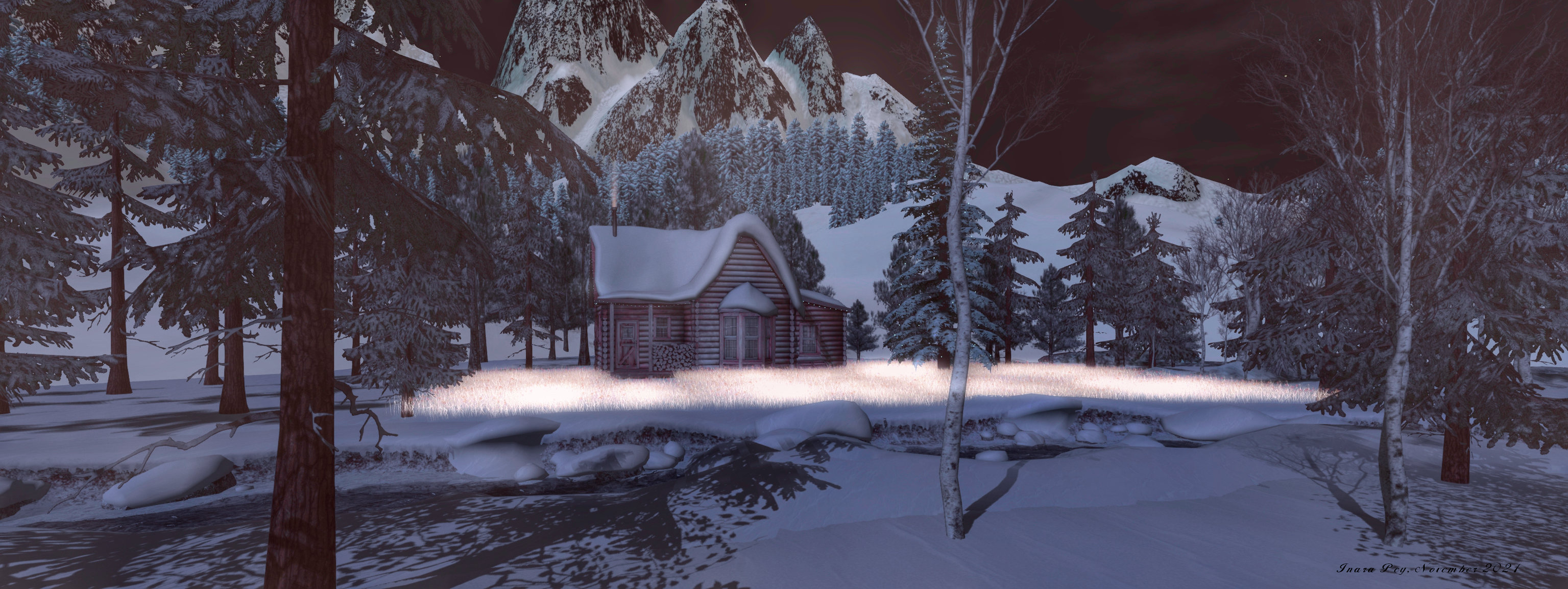
At the foot of the slope, the region spreads itself northwards from a snow-dusted Zen garden, the land almost entirely flat in nature, cut through in part by a meandering stream that flows southwards from the large lake that sits to the north, its frozen surface yet offering a glimpse of water moving below, flowing towards the throat of the stream. Around the lake lay a trio of cabins, all of them apparently open to the public to enjoy as they explore, whilst a second stream winds inland from a larger, mountain-bound (and off-region) body of water to feed the lake, explaining the movement of water under its covering of ice.
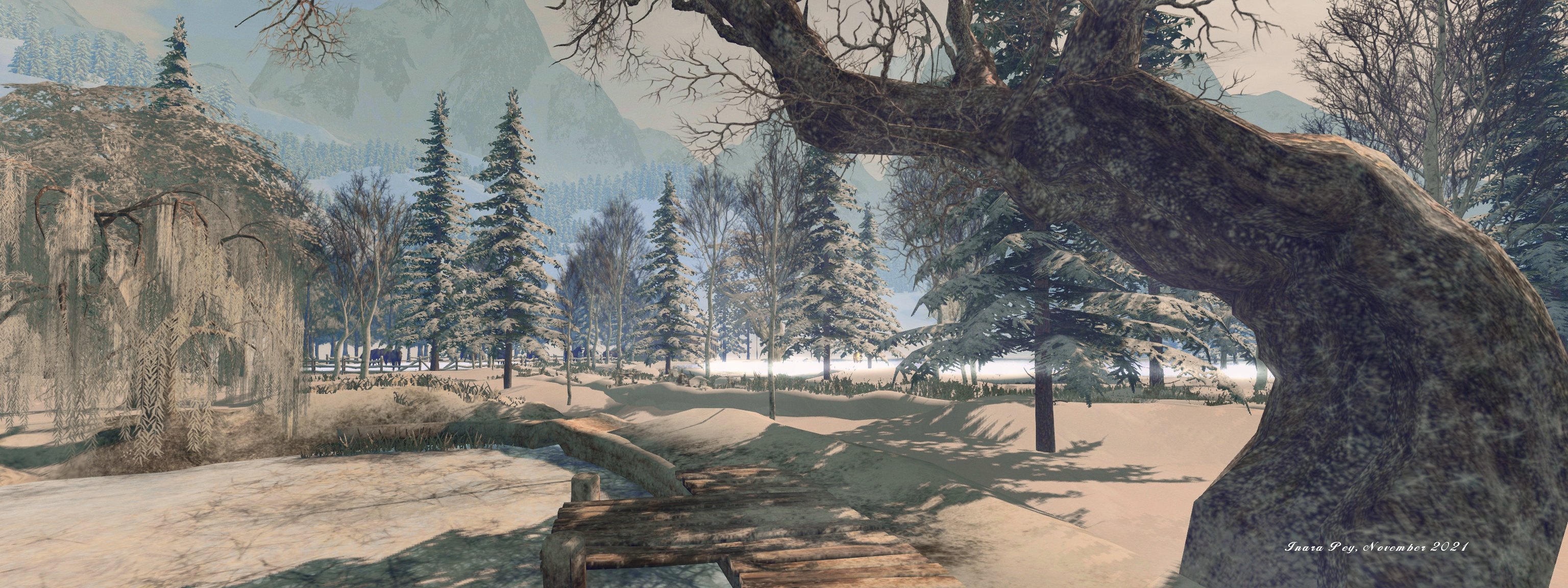
The Way of Life, November 2021

Whilst somewhat transparent, the ice is nevertheless dense enough to allow for ice skating, and skate givers are dotted around the rough shoreline for this purpose, offering more opportunities for exercise and fun.

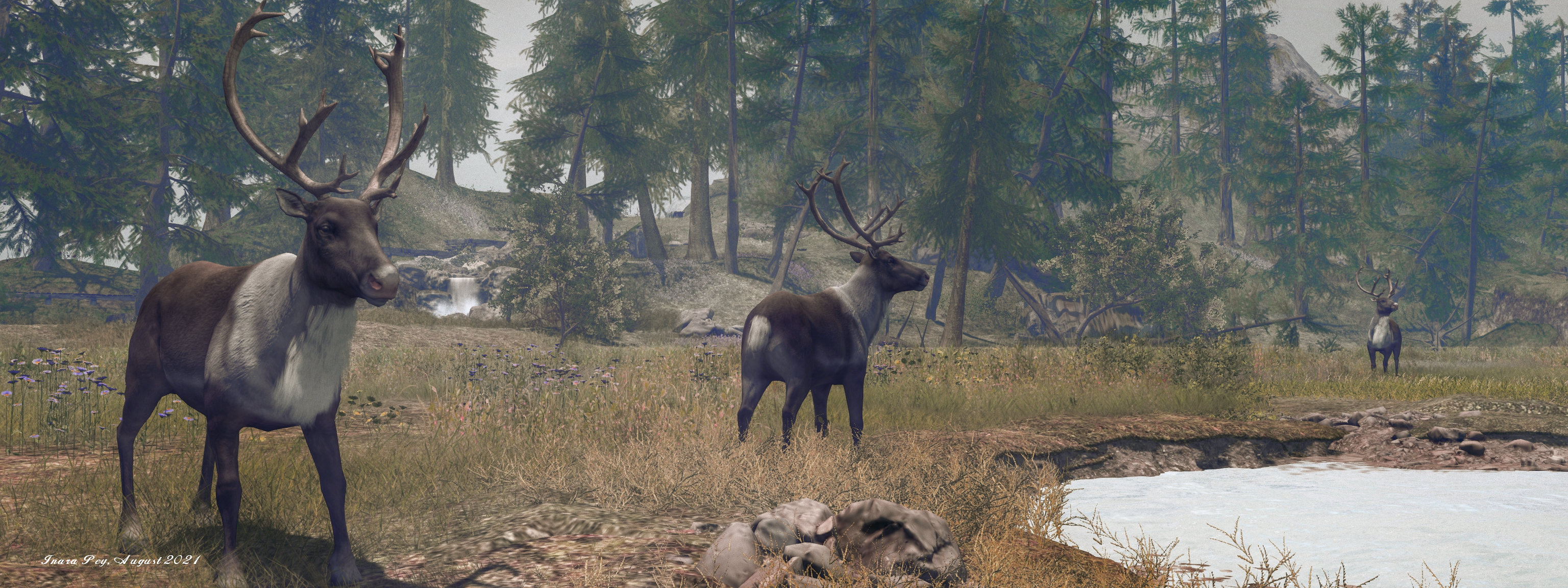
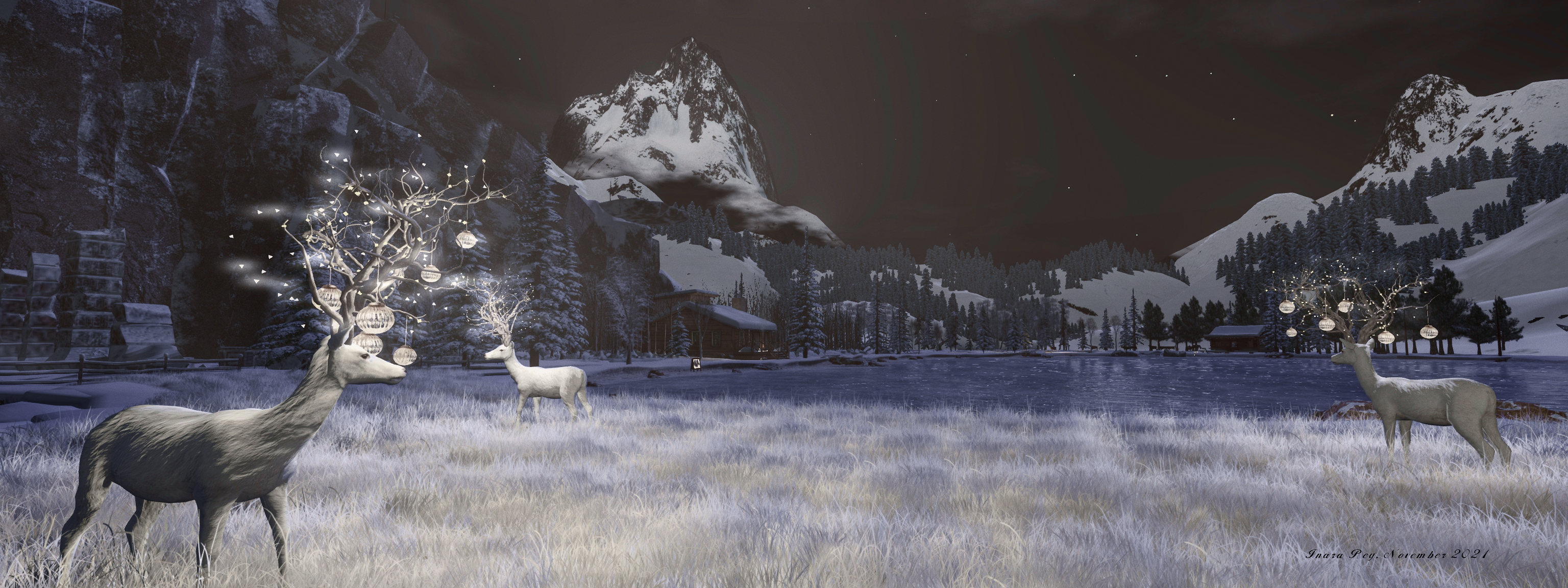
The lake, cabins and landscape are caught under a midnight sky (other EEP setting are available, consult your viewer for details 🙂 ), with bright pools of grass rising above the snow to vie with the lake for attention. One of these is fenced-off, the retreat for horses, straw bales stacked alongside the cabin nearest them in readiness to become a source of food. Elsewhere, the grass is home to lantern-bearing snow deer and white-furred wolves.

The Way of Life, November 2021

Under the lee of the region’s mesa lie the ruins of some ancient structure tucked tightly into the lee of the mesa, the wreck of a helicopter alongside. Quite how the latter got here is open to conjecture, but it offers one of many interesting backdrops for photography.

The three cabins within the setting are all lightly but comfortably furnished, Dum here being assisted by a number of friends in supplying décor elements and furnishings. Thus they make for welcome breaks from the cold outside – although there are a number of sit points to be found out under the stars and on porches for those who prefer. At the time of my visit (given it was only pre-US Thanksgiving November), Christmas / holiday decorations were at a minimum (some lights strung around a couple of the outdoor trees, and a tree and holly around the mantelpiece within one of the cabins), so the region sit as a nice wintertime setting rather than a holiday time setting, which frankly makes it all the more (to me) attractive place.
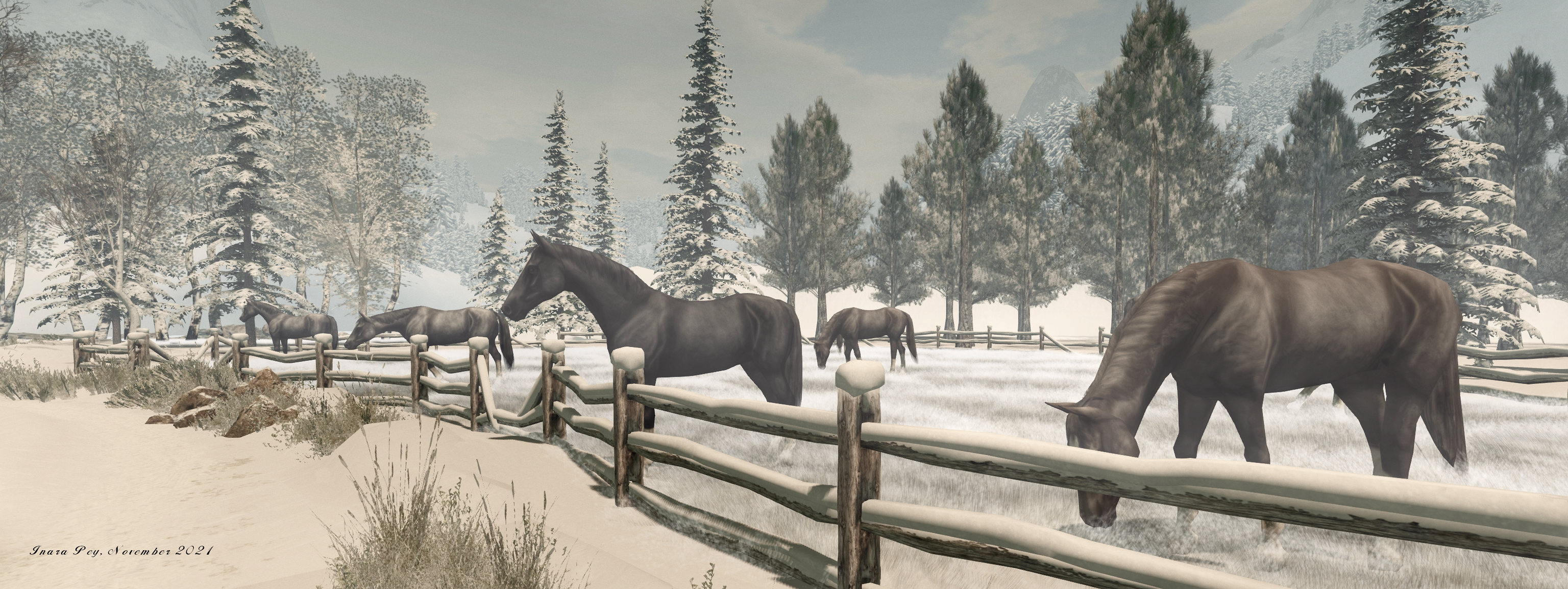
The Way of Life, November 2021

For those who wish to use the setting a s backdrop for avatar photography, rezzing is open to all, with auto-return set to 2 hours – but if you do put props out, please do remember to take them back to inventory rather than leaving to to auto-return to vacuum them up and drop them on you; that way the environment is left cluttered for other visitors.

Aside from the glowy grass (the wonder / irritant of Full Bright) that to me didn’t feel quite right, even allowing for the lanterns placed out (or carried by the snow deer presumably in an attempt to explain its glow, The Way of Life is an easy-to-explore, tranquil setting that offers a charming and cosy location that should not be overly stressful for most systems (the default environment gave me between a 30-45 FPS average with shadows enabled), while the snowboarding, sledding and skating give visitors the option to have a little fun whilst visiting.
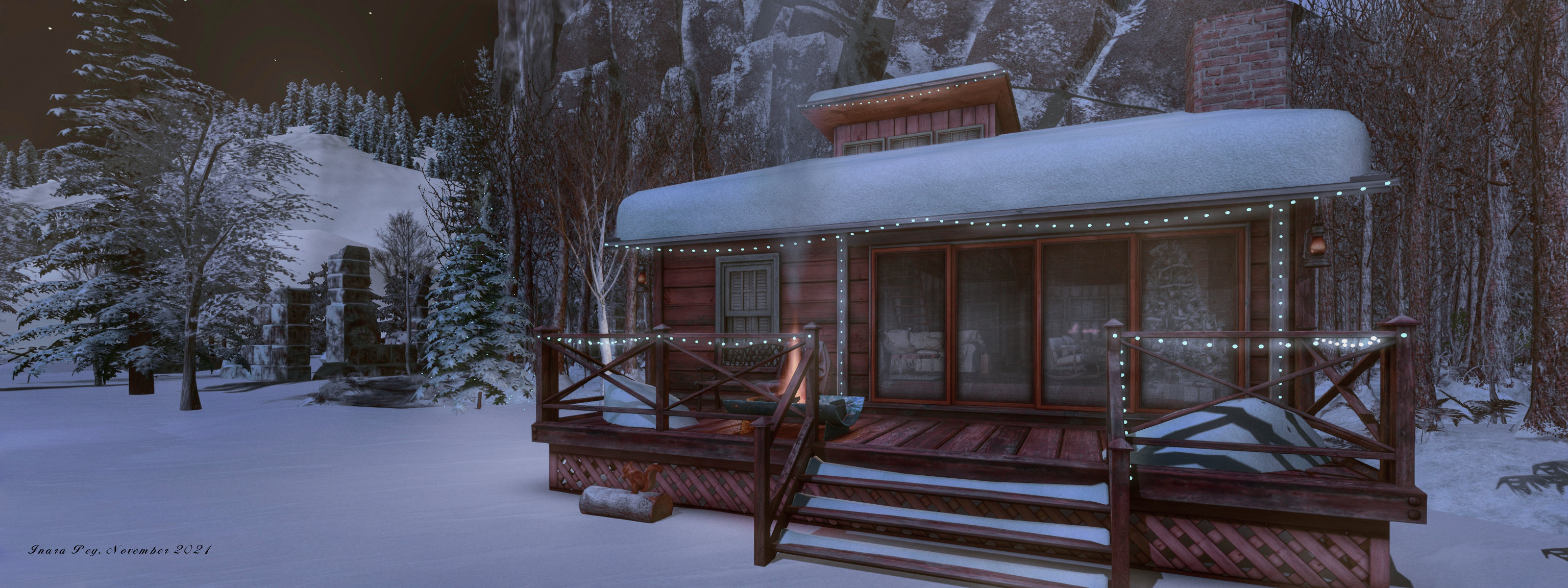
The Way of Life, November 2021

My thanks, as always, to Shawn for the pointer and LM.

SLurl Details

Suzen’s Illusion in Second Life

Kondor Art Garden: Suzen JueL – Illusion

Now open at the Kondor Art Garden, curated by Hermes Kondor, is Illusion, an exhibition of 2D art by photographer-artist Suzen JueL (JueL Resistance). It offers an engaging range of pieces that mix styles and ideas to present images that are visually engaging and carry with them strong narratives.

Within these pieces might we find photo-collages, measures of surrealism, expressionism and more; stories with an edge of abstraction and / or the broad strokes of impressionism, some of which sit as dream states in their form and colour. Primarily produced within Second Life and richly post-processed, these are pieces that also encompass elements and images drawn from the physical world.

An intriguing aspect of several of the pieces is that rather than using a traditional avatar, Suzen presents a mannequin-like personage that, while female in form, offers us – male or female – the opportunity for greater association with it, and thus themes and emotions contained within the pieces where it is used.

Kondor Art Garden: Suzen JueL – Illusion

With their focus on the mannequin presence, these particular images offer a sense of dual narrative. Backwards into Depths, for example offers the suggestion of taking a leap of faith. On the one hand, they colours stand in emphasis of the fact it is into the unknown we might jump whilst also presenting the sense of fear that such leaps often entail. Similarly, Monster at first seems to suggest the coming of a horror, a strange, looming creature that might well be in pursuit of us – but then on second look, it perhaps suggests we are the monster, looming forth to inflict something on the unwary.

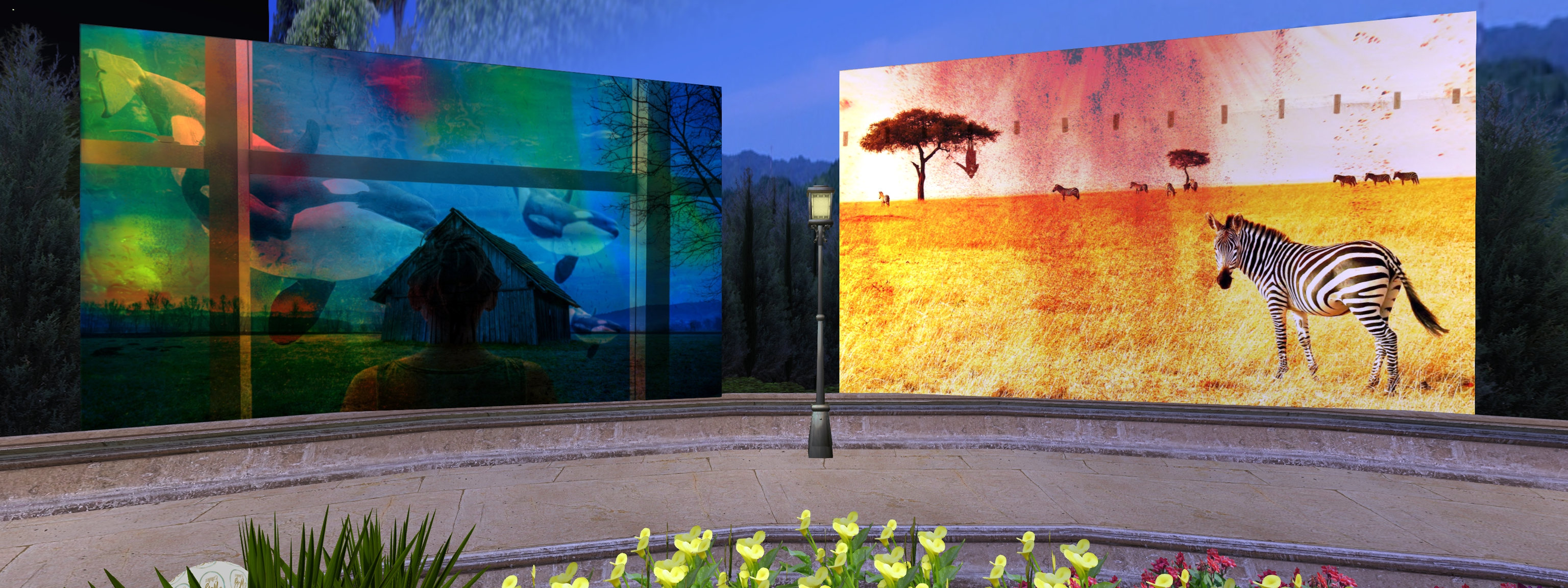
Elsewhere the narrative is more direct, as with Whale Dreaming, a marvellous photo-collage that folds into itself considered elements of surrealism, impressionism and realism. Beside it, Hanging with the Zebra similarly offers a mix of surrealism and over-exposed expressionism that holds the eye before the magnificent Elephant awaits to again offer use entwined stands of narrative.

In their mixing of styles, narrative, these are pieces that live up to the title of the exhibition. Each gives us an illusion to ponder, be it directly through the image (again, I’d point to the likes of Whale Dreaming) or in the manner in which meaning and narratives might be seen to be intertwined to hold our attention, making it an engaging and captivating exhibition.

Kondor Art Garden: Suzen JueL – Illusion

SLurl Details

2021 CCUG meeting week #46 summary: Graphics work

Bella’s Lullaby, September 2021 – blog post

The following notes were taken from my audio recording and chat log of the Content Creation User Group (CCUG) meeting held on Thursday, November 18th 2021 at 13:00 SLT. These meetings are chaired by Vir Linden, and agenda notes, meeting SLurl, etc, are are available on the Content Creation User Group wiki page.

AVAILABLE VIEWERS

This list reflects those viewers available via Linden Lab.

  • Release viewer: version version 6.5.0.565607, formerly the Maintenance RC and dated November 10, promoted November 15 – this viewer now contains a fix for the media issues caused by the Apple Notarisation viewer.
  • Release channel cohorts (please see my notes on manually installing RC viewer versions if you wish to install any release candidate(s) yourself):
    • The Tracy Integration RC viewer version 6.4.23.563771 (dated Friday, November 5) issued Tuesday, November 9.
    • 360 Snapshot RC viewer, version 6.5.0.564863, issued October 21.
    • Simplified Cache RC viewer, version 6.4.23.562623, dated September 17, issued September 20.
  • Project viewers:
    • Performance Improvements project viewer updated to version 6.4.24.565324 (dated November 5) November 9.
    • Performance Floater project viewer, version 6.4.23.562625, issued September 2.
    • Mesh Optimizer project viewer, version 6.4.23.562614, issued September 1.
    • Legacy Profiles viewer, version 6.4.11.550519, dated October 26, 2020.
    • Copy / Paste viewer, version 6.3.5.533365, dated December 9, 2019.

General Viewer Notes

  • It is possible the 360 Snapshot RC viewer and the Simplified Cache RC viewers may be merged prior to either being individually promoted to de facto release status.

Graphics Work

  • The core of the graphics team is shifting emphasis from making performance changes to the rendering pipe to focusing on stabilising the changes thus far made. As Vir has elsewhere noted, the problem with moving operations between threads / to their own threads is that there can be undesired consequences which then must be addressed.
    • This work has comprises a number of elements, both in moving processes that should logically have their own threads, and in moving processing that can cause the main thread to stall while it is handling them (e.g. processes that talk to the graphics API, the texture upload to OpenGL, etc.) to other background threads.
  • Runitai Linden continues to update how avatar rigged meshes are rendered.
    • In short, he hopes to use the same approach to handling static meshes to rigged mesh (including Animesh creations), allowing the latter to be handled in batches, reducing the overall number of draw calls and giving a potentially substantial performance boost.
    • The improvements should be particularly noticeable when rendering the “onion layer” avatar meshes that have multiple layers and are segmented into multiple cuts. Runitai reports his testing shows a 50% improvement in rendering 20 avatars – but improvements will be hardware dependent.
    • There are some issues: as it stands, the updated code does change the order of sorting / rendering alphas, which could be problematic for some creators. If so, LL will look at what can be done to prevent this (as an aside to this, vertex ordering within Blender, etc.), should not be impacted). There are also limits on how far this can be taken due to things like how faces with unique textures or with separate materials must be handled.
    • Currently, Runitai plans to spend the next few weeks testing and improving the changes with a view to having a view publicly available in the New Year.
  • Part of the discussion centred on texture use (and over-use), which covered a number of elements including:
    • A reminder of why the use of 1024×1024 textures on every surface, no matter how small is really bad idea, both because of the amount of VRAM each texture (+ any associated materials) uses (up to 4MB each); and because even if the face used only exposes a small portion of the texture, the viewer still has to process the entire texture before it can be rendered at full resolution, so it’s just leaving people with a greater amount of time the texture is blurred in their view.
    • The pros and cons in using a texture atlas. On the plus, this always multiple textures to be handled as a single draw operation, and is done where possible. However, unlike a conventional game, texture use in Sl is less predictable (e.g. an avatar can use the same texture “as is”, alpha masked, alpha blended and as a specular map, impacting the ability to use it within any texture atlas.
  • Whilst on the back burner at present, it is hoped that Vulkan, if / when adopted, could solve a lot of texture batching and draw call issues on the Windows platform, as it has a “fundamentally different” way of handling the latter. However, any shift in graphics API is held depending the current clean-up of the rendering code. On October 30th, Runitai described the options under consideration as:
    • Using Vulkan (Windows) and Metal (Apple).
    • Running Vulkan extraction layers on top of G3D on Windows (and MoltenGL for Apple?)
    • Implementing an off-the-shelf multi-API extraction layer.
    • Home-brew a dedicated extraction layer.
    • Stick with OpenGL for Windows and use MoltenGL for Apple (as noted above).
    • Initially supporting Vulkan + OpenGL for Windows and then retiring OpenGL and running Vulkan extraction layers on top of G3D (no word on Apple solutions in this scenario).
  • As a part of the current  work, LL has tested using OpenGL Core Profile rather than the currently-used OpenGL Compatibility Profile.
    • Core Profile offers a performance win for nVidia GPUs – but presents a performance hit for AMD and Apple systems, so a determination on its use has yet to be made.
    • Core Profile also does not work GLOD for mesh uploads, so if adopted, GLOD support may be entirely dropped from the viewer in favour of the Mesh Optimiser (as found in the current Mesh Optimiser project viewer).
  • Other updates the graphics team are considering include:
    • Making VSync enabled by default in the viewer, which should give a more consistent rate at high (100+) FPS.
    • Removing the ability to uncheck OpenGL Vertex Buffers and Hardware Skinning, as disabling either isn’t particularly good for performance.

Ashemi’s neon return in Second Life

Ashemi, November 2021 – click any image for full size

It’s been a little over three years since my last visit to Ashemi, the ever-evolving Oriental-themed region designed by the team of Ime Poplin, Jay Poplin (Jayshamime) and Shaman Nitely (see: Ashemi: an Oriental reprise in Second Life), although I believe for some of the intervening period, the region may have been absent from Second Life. So, when Shaman kindly dropped me a line to renew my acquaintance with the setting, I was happy to accept.

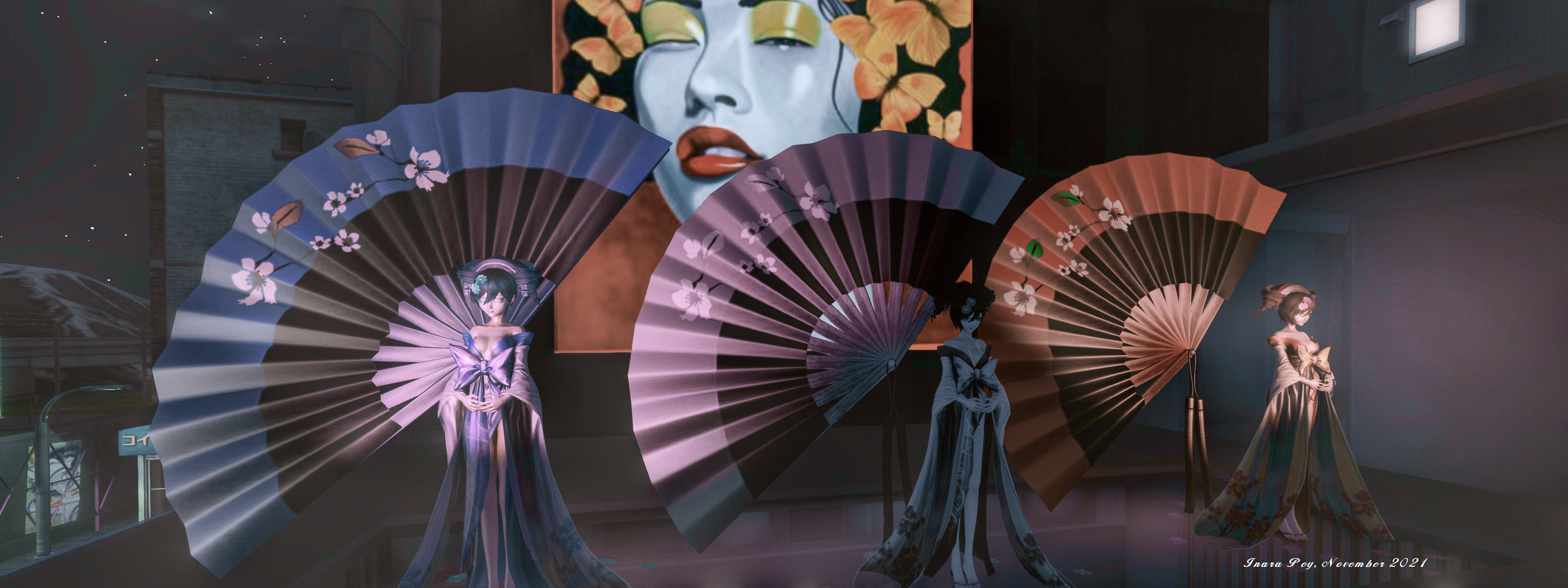
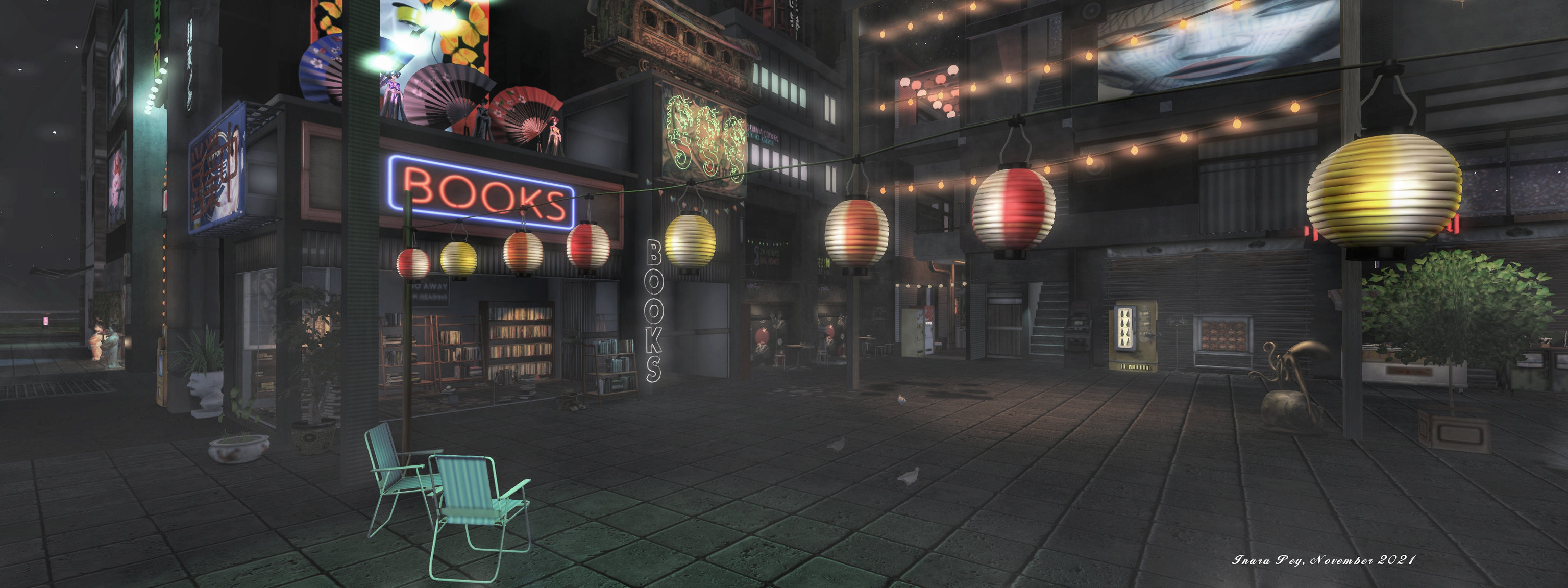
As with its past incarnations, Ashemi offers a busy urban setting primarily designed to be seen under night-time conditions – witness the huge Moon hanging in the sky! – although it also lends itself to daytime settings as well, as I hope some of the images herein demonstrate. I’ll also note a couple of things up front, as they both help with any visit.

Ashemi, November 2021

The first is that you really should have local sounds enabled. This is a cityscape that offers a rich sense of depth through the use of a rich sound scape. Not just cars, cicadas and so on, but the sounds of people as they hold conversations indoors and out; the echoes of shouts and laughter along train platforms, the clatter and chiming of crockery and glasses – all of which gives further depth to the setting.

The second point is that Ashemi really is a place that can clobber performance; under the default EEP and with shadows enabled, I was looking at around 4.5-6.7 FPS on average on my not-top-of-the-range-but-reasonably-OK system. Flipping to my preferred EEP settings, and so often seen in my images (as they tend to get attached to me for travelling), this clambered its way to 9-10.8 fps. So, if you are on a mode-to-lower-range system, you might want to toggle shadows on when needed and otherwise leave them off.

Ashemi, November 2021

This is a setting that carries with it echoes of earlier iterations of Ashemi, whilst at the same time offering something entirely new. The lightness of touch with the familiar – for those who remember past versions of the city – may help prompt the imagination to consider that we are within the same metropolis, but a different district or prefecture. Or we can accept what we see as an entirely new setting. like those past iterations, this is a busy place – not in terms of textures, mesh etc.), but in style. The ambient sounds suggest a place where people work, live and relax. The buildings offer a mix of outer high-rises and smaller, inner buildings that include places of business and entertainment as well as transit points and homes.

But whereas the Ashemis of the past tended to feature water within them, here is has been pushed outwards, as if roughly shoved away to make way for humans. Nevertheless, whilst waterside walks may have vanished, this setting carries with it places where a degree of peace and relaxation might be found – although one in particular may require a little effort to find, while others may have their solitude poked at by the noise of the unruly masses.

Ashemi, November 2021

There is also, perhaps a sense of age here that may not have been quite so prevalent in previous iterations. Older, more traditional houses have been converted to places of business, whilst the concrete blockhouses common to the latter part of the 20th century peer over fences and wall as if to see what is going on. Sad to say, as well, that such is the age of this district, it appears to have become something of a littering ground, as can be seen within  the local cemetery; clearly no longer used, it is home to  unwanted bodies of metal, plastic stone quite aside from the souls who might still be interred within. And as one wanders, so might the slow lament of a violin be heard – or perhaps it is a kokyu.

Some interesting references might also be found here for eyes that seek and feet that walk. For example, outside of one place of work there might be found a certain car awaiting the call of lightning; down another street you might prompted to ask who ya gonna call? Throughout all, NPCs further bring the setting to life as they work in garages, await a train or walk down pathways.

Ashemi, November 2021

Rich in detail with assorted opportunities for photography, Ashemi remains an engaging visit – if one a little hard on the system, as noted, although this should not stand in the way of any visit.

My thanks again to Shaman, Ime and Jay for the invitation to visit and explore once more!

Ashemi, November 2021

SLurl Details

  • Ashemi (Queen Dreem, rated Moderate)

The art and beauty of the microscopic in Second Life

Limoncello Art Gallery Annexe: Unseen Beauty

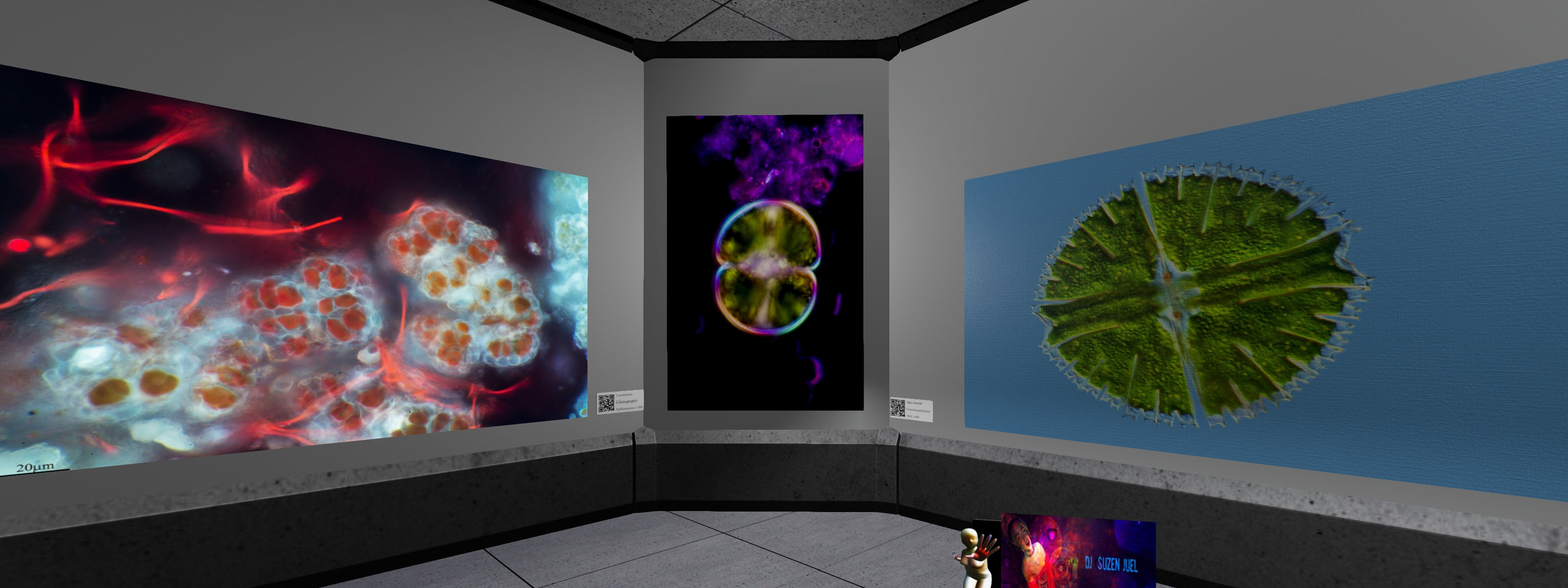
Currently available within the Annexe of the Limoncello gallery – for a while longer, at least, given it opened at the start of November – is an intriguing exhibition of images by Guille (Antoronta) entitled Unseen Beauty.

Guille appears to be a relatively recent arrival in Second Life – as inferred by his Profile. An educator by profession and hailing from Spain, he appears to be bound to the natural beauty of Nature, noting in his Profile that it is the ultimate expression of art whilst his Flickr stream takes us on a journey into the microscopic – as is the case with Unseen Beauty.

Through both the exhibition and his Flickr stream, Guille takes us on a rarely-seen journey, one to a world that exists not beyond our own, but within it. no, not a world – an entire universe where the strangest and in many respects the more wonderous forms of life exist.

Limoncello Art Gallery Annexe: Unseen Beauty
It is possible that this is the first time that a sample of these characteristics has been exhibited in SL, as in RL this type of exhibition is extraordinarily scarce, as well as the knowledge of these wonderful and fascinating living beings to whom it is dedicated. All the images have been taken under the microscope, on living organisms that, after being observed, have been returned to the place from which they were collected. Almost all of them are very little known, and some of the smallest, contain the keys to know how we are and how we have evolved.

– Guille, describing Unseen Beauty

Thus  we are presented with a series of living images of the most incredible creatures, from cyanobacteria (aka Cyanophyta or “blue-green algae”), a kind of  prokaryote and one of the first organisms known to have produced oxygen, thus helping to start life on Earth as we know it today. Then there are diatoms such as the family of Coscinodiscaceae, noted for their radial symmetry and circular shapes when viewed from the front.

Each image is accompanied by an information giver providing a description of the featured algae, bacteria or amoebic form, each beautifully – in places poetically – written by Guille. Witness:

In each drop, the world of Cosmarium becomes rainbow, letting the sun melt on its cover, while absorbing the juice of life between its rays, tiny pearls that live are arcoris, true water jewels. They gravitate in the water like planets that in each drop for them is infinite.
Perhaps because it has the skin of an elephant, Cosmarium pachydermum, it endures the icy winter nights with the starry sky and the scorching summer sun on the highest peaks, as long as a drop of water is its ocean between Sphagnum, and in it, which is its universe, can show its soul scalloped with green jewel, perhaps from the times when the ice was the mantle of these mountains.

– Guille, describing Cosmarium pachydermun

Limoncello Art Gallery Annexe: Unseen Beauty

Beautiful images of life unimagined – but without which we would not be here to admire it – captured in an instant and written into the memory through colour and words, Unseen Beauty is a bewitching exhibition, not to be missed, and an excellent gateway to the additional exhibitions on the remaining levels of the Annexe.

SLurl Details

2021 SUG meeting week #46 summary

Endless: Permafrost, August 2021 – blog post

The following notes were taken from the Tuesday, November 16th, 2021 Simulator User Group (SUG) meeting. The meeting was recorded by Pantera Północy, and the video is embedded at the end of this summary. Note this summary focuses on the key points of the meeting; where there is something to report, the video should be referred to should full details of the meeting wish to be reviewed.

Server Deployments

  • The are no planned deployments to the majority of the region simhosts.
  • On Wednesday, November 17th, the servers on the Bluesteel channel should be updated with a fresh version of the tools update simulator version.
  • It is unlikely the simulator version on Bluesteel will be rolled to additional simhosts / channels prior to US Thanksgiving, as there are some issued the Lab has noted, which are proving a little hard for the Lab to track down in testing on Aditi and the Lab’s internal test grid.
  • It is likely that the number of server deployments between now as the end of the year will be “minimal”.

SL Viewer

This list reflects those official viewers available via Linden Lab.

  • Release viewer: version version 6.5.0.565607, formerly the Maintenance RC and dated November 10, promoted November 15 – this viewer now contains a fix for the media issues caused by the Apple Notarisation viewer.
  • Release channel cohorts (please see my notes on manually installing RC viewer versions if you wish to install any release candidate(s) yourself):
    • The Tracy Integration RC viewer version 6.4.23.563771 (dated Friday, November 5) issued Tuesday, November 9.
    • 360 Snapshot RC viewer, version 6.5.0.564863, issued October 21.
    • Simplified Cache RC viewer, version 6.4.23.562623, dated September 17, issued September 20.
  • Project viewers:
    • Performance Improvements project viewer updated to version 6.4.24.565324 (dated November 5) November 9.
    • Performance Floater project viewer, version 6.4.23.562625, issued September 2.
    • Mesh Optimizer project viewer, version 6.4.23.562614, issued September 1.
    • Legacy Profiles viewer, version 6.4.11.550519, dated October 26, 2020.
    • Copy / Paste viewer, version 6.3.5.533365, dated December 9, 2019.

In Brief

  • It has been reported that general region performance is better with the new toolset simulator version. However, when something is rezzed with scripts there is a 2 second rez delay if there are child prims in the object – if it is a singular object, there’s hardly any delay. The object appears inworld but on_rez() and object_rez() don’t trigger for a solid 2 seconds. This does not happen for a single prim object. It’s not clear if this is some variant of BUG-228939; however, that tended to become more noticeable the longer a region was running, but this issue seems to occur immediately after a region is restarted. See here for more.
  • User Fourmilab has also been investigating the user of the broader “2-second delay”, and has posted findings here and here.
  • BUG-231303 “Scripted agents can no longer log in” is still under investigation, although it had been hoped the issue might have been resolved by now. The issue has caused some “alarm” (on behalf of those doing so) that so much is being run on what is effectively outdated “abandonware”.
  • Work is going on to make Map updates more reliable, and it is possible there may be further updates to the Map system in 2022.